Safety and Cost-Effectiveness of Bridge Therapies for Invasive Dental Procedures in Patients with Mechanical Heart Valves
Ki-Bum Won,1,2* Seung-Hyun Lee,2* Hyuk-Jae Chang,2,3 Chi-Young Shim,2 Gue-Ru Hong,2 Jong-Won Ha,2 and Namsik Chung2
1Department of Cardiology, St. Luke’s International Hospital, Tokyo, Japan; 2Department of Cardiology,
Yonsei Cardiovascular Center, Yonsei University College of Medicine, Seoul; 3Severance Biomedical Science Institute, Seoul, Korea.
Received: August 21, 2013 Revised: October 31, 2013 Accepted: November 13, 2013
Corresponding author: Dr. Hyuk-Jae Chang, Department of Cardiology,
Yonsei Cardiovascular Center, Yonsei University College of Medicine, 50-1 Yonsei-ro, Seodaemun-gu, Seoul 120-752, Korea.
Tel: 82-2-2228-8460, Fax: 82-2-393-2041 E-mail: [email protected]
*Ki-Bum Won and Seung-Hyun Lee contributed equally to this work.
∙ The authors have no financial conflicts of interest.
© Copyright:
Yonsei University College of Medicine 2014 This is an Open Access article distributed under the terms of the Creative Commons Attribution Non- Commercial License (http://creativecommons.org/
licenses/by-nc/3.0) which permits unrestricted non- commercial use, distribution, and reproduction in any medium, provided the original work is properly cited.
Purpose: Bridge anticoagulation therapy is mostly utilized in patients with mechani- cal heart valves (MHV) receiving warfarin therapy during invasive dental procedures because of the risk of excessive bleeding related to highly vascular supporting dental structures. Bridge therapy using low molecular weight heparin may be an attractive option for invasive dental procedures; however, its safety and cost-effectiveness com- pared with unfractionated heparin (UFH) is uncertain. Materials and Methods: This study investigated the safety and cost-effectiveness of enoxaparin in comparison to UFH for bridge therapy in 165 consecutive patients (57±11 years, 35% men) with MHV who underwent invasive dental procedures. Results: This study included 75 patients treated with UFH-based bridge therapy (45%) and 90 patients treated with enoxaparin-based bridge therapy (55%). The bleeding risk of dental procedures and the incidence of clinical adverse outcomes were not significantly different between the UFH group and the enoxaparin group. However, total medical costs were significantly lower in the enoxaparin group than in the UFH group (p<0.001). After multivariate adjustment, old age (≥65 years) was significantly associated with an increased risk of total bleeding independent of bridging methods (odds ratio, 2.51; 95% confidence in- terval, 1.15--5.48; p=0.022). Enoxaparin-based bridge therapy (β=-0.694, p<0.001) and major bleeding (β=0.296, p=0.045) were significantly associated with the medical costs within 30 days after dental procedures. Conclusion: Considering the benefit of enoxaparin in cost-effectiveness, enoxaparin may be more efficient than UFH for bridge therapy in patients with MHV who required invasive dental procedures.
Key Words: Anticoagulation, bridge therapy, dental procedure, low molecular weight heparin, mechanical heart valve
INTRODUCTION
Patients with mechanical heart valves (MHV) are at the highest risk for thrombo- embolism without anticoagulation; therefore, lifelong oral anticoagulation (OAC) treatment is mandatory for preventing thromboembolic events.1-3 However, tempo- rary discontinuation of long-acting OAC drugs (e.g., warfarin) may be inevitable to allow patients with MHV to undergo an invasive dental procedure or surgery.
farin. Initial bridge therapy started 24 to 36 h after the last dose of warfarin, irrespective of the bridging method. All patients treated with UFH-based bridging were hospitalized to maintain the activated partial thromboplastin time be- tween 1.5 to 2.5 times the control values during the intrave- nous administration of weight-adjusted UFH. Enoxaparin- based bridge therapy was performed on an outpatient basis.
A therapeutic dose of enoxaparin (1 mg/kg) was subcutane- ously administered twice daily. Warfarin was resumed 12 to 24 h after the dental procedure, and the bridge therapy was continued until the international normalized ratio was in the therapeutic range (more than 2.0 for most cases) for at least 2 consecutive days. Total medical costs were calculated for the period beginning 10 days before and lasting until 30 days after the dental procedures. The HAS-BLED score, which is a useful predictor of major bleeding, was calculat- ed for all patients before their dental procedures.10 The bleeding risk of dental procedures was categorized as mod- erate or high. Dental procedures with moderate bleeding risk included restorations with subgingival preparations (n=54), standard root canal therapy (n=36), simple extrac- tions (n=46), and regional injection of local anesthesia (n=80). Dental procedures with high bleeding risk included extensive surgery (n=2), apicoectomy (root removal) (n=1), alveolar surgery (bone remove) (n=5), and multiple extrac- tions (n=51). Multiple procedures involving different bleed- ing risks were performed simultaneously in patients receiv- ing bridge therapy; the more invasive dental procedure was considered the main procedure. Dental procedures with a low bleeding risk (e.g., supragingival scaling, local anes- thetic injection, and simple restorations) were excluded in the present study.
Post-procedural bleeding
Major bleeding was defined as overt bleeding with 2 g/dL or greater decrease in hemoglobin, a transfusion of 2 U or more packed red blood cells, bleeding that required surgical inter- vention, or life-threatening bleeding. Minor bleeding was de- fined as any bleeding that was self-limiting such as epistaxis, ecchymoses, hematoma, or an incision site bleeding that did not require withholding anticoagulation therapy.11
Statistical analysis
Clinical characteristics are presented, based on the bridge therapy method used. Values are expressed as the mean±
standard deviation for continuous variables and as numbers and percentages [i.e., n (%)] for categorical variables. Con- The recommendation for the management of OAC in mi-
nor dental procedures such as simple dental extraction has been proposed on the basis of clinical data; however, a con- sensus on which patients require invasive dental procedures is lacking.4-6 In clinical practice, conventional care with a short-acting anticoagulant as “bridge therapy” is commonly used to decrease the risk of thromboembolism during the cessation of OAC therapy.7-9 Intravenous unfractionated heparin (UFH) is the conventional medication used for bridging; however, it can be expensive and time-consuming, because periprocedural hospitalization for administering and laboratory monitoring is imperative. Despite the higher drug price of low molecular weight heparin (LMWH) compared with UFH, LMWH may be an attractive option for bridge therapy because it is relatively short-acting, requires no co- agulation monitoring, and can be self-administered by the patient without hospitalization. However, there are only lim- ited clinical data for the safety and medical costs of LMWH as bridge therapy for dental procedures that are associated with a moderate to high bleeding risk in patients with MHV.
The present study compared the safety and cost-effective- ness between enoxaparin and UFH for bridge therapy in MHV patients receiving long-term warfarin therapy who were to undergo invasive dental procedures and who posed a moderate to high bleeding risk.
MATERIALS AND METHODS
Subjects
We analyzed clinical data from 169 consecutive patients with MHV receiving long-term OAC therapy with warfa- rin. Between January 2008 and December 2011, the pa- tients visited the Severance Dental Hospital (Seoul, Korea) for elective invasive dental procedures. Only patients with stable anticoagulation status and general status were in- cluded. Patients (n=4) who had undergone mechanical valve surgery within the previous 3 months were excluded.
We finally enrolled 165 patients in this study. The study protocol was approved by the local ethics committee of our institution. Each patient provided informed consent for the procedure.
Dental procedures and bridge therapy
All patients stopped taking warfarin 4 days before their dental procedures, and they received bridge therapy with UFH or enoxaparin during the temporary cessation of war-
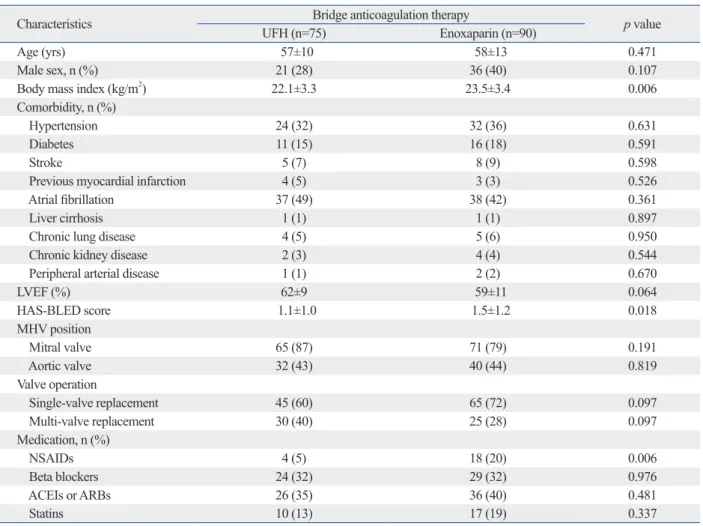
the 165 patients, 75 (45%) patients were treated with UFH- based bridge therapy, and 90 (55%) patients were treated with enoxaparin-based bridge therapy. The mean body mass index (BMI) and the HAS-BLED score were signifi- cantly higher in the enoxaparin group than in the UFH group (BMI: 23.5±3.4 vs. 22.1±3.3, p=0.006; HAS-BLED score: 1.5±1.2 vs. 1.1±1.0, p=0.018). The incidence of non- steroidal anti-inflammatory drugs was significantly higher in the enoxaparin group than in the UFH group (20% vs.
5%, p=0.006).
Dental procedures, medical costs, and adverse clinical outcomes
The bleeding risk of the dental procedures was not signifi- cantly different between the UFH group and the enoxaparin group. The incidence of clinical adverse outcomes includ- ing total bleeding, major bleeding, stroke, and death was not significantly different between the UFH group and the tinuous variables were compared using Student’s t-test, and
categorical variables were compared using Fisher’s exact test or χ2 test. Multivariate logistic regression analysis was used to evaluate the clinical risk factors for total bleeding within 30 days after dental procedures. Multivariate linear regression analysis was used to evaluate the clinical factors for medical costs. The dependent variable of medical cost was transformed with the natural logarithm function. SPSS software version 18 (SPSS Inc., Chicago, IL, USA) was used for all statistical analyses. All statistical tests were 2-tailed and p<0.05 was considered significant.
RESULTS
Baseline characteristics
Table 1 presents the baseline characteristics of the 165 pa- tients (57±11 years, 35% men) with MHV in this study. Of
Table 1. Baseline Characteristics
Characteristics Bridge anticoagulation therapy p value
UFH (n=75) Enoxaparin (n=90)
Age (yrs) 57±10 58±13 0.471
Male sex, n (%) 21 (28) 36 (40) 0.107
Body mass index (kg/m2) 22.1±3.3 23.5±3.4 0.006
Comorbidity, n (%)
Hypertension 24 (32) 32 (36) 0.631
Diabetes 11 (15) 16 (18) 0.591
Stroke 5 (7) 8 (9) 0.598
Previous myocardial infarction 4 (5) 3 (3) 0.526
Atrial fibrillation 37 (49) 38 (42) 0.361
Liver cirrhosis 1 (1) 1 (1) 0.897
Chronic lung disease 4 (5) 5 (6) 0.950
Chronic kidney disease 2 (3) 4 (4) 0.544
Peripheral arterial disease 1 (1) 2 (2) 0.670
LVEF (%) 62±9 59±11 0.064
HAS-BLED score 1.1±1.0 1.5±1.2 0.018
MHV position
Mitral valve 65 (87) 71 (79) 0.191
Aortic valve 32 (43) 40 (44) 0.819
Valve operation
Single-valve replacement 45 (60) 65 (72) 0.097
Multi-valve replacement 30 (40) 25 (28) 0.097
Medication, n (%)
NSAIDs 4 (5) 18 (20) 0.006
Beta blockers 24 (32) 29 (32) 0.976
ACEIs or ARBs 26 (35) 36 (40) 0.481
Statins 10 (13) 17 (19) 0.337
ACEIs, angiotensin-converting enzyme inhibitors; ARBs, angiotensin receptor blockers; LVEF, left ventricular ejection fraction; MHV, mechanical heart valve;
NSAIDs, non-steroidal anti-inflammatory drugs; UFH, unfractionated heparin.
Data are expressed as mean±standard deviation or as the number and percent, i.e., n (%).
DISCUSSION
The present study demonstrated that in patients with MHV who underwent invasive dental procedures, enoxaparin- based bridge therapy had a similar complication rate but was more cost-effective than UFH-based bridge therapy.
Old age (i.e. ≥65 years) was significantly associated with total bleeding within 30 days after the dental procedures, independent of the type of bridge therapy.
With respect to dental procedures or surgeries, optimal management varies considerably for patients at high risk of thromboembolism receiving long-term OAC.4-6 Periproce- dural anticoagulation therapy is especially important in pa- tients with MHV receiving long-term OAC, since they have the highest annualized risk of thromboembolic complica- tions in the absence of anticoagulation therapy.2 A previous meta-analysis study reported that maintaining a regular dose of warfarin may not confer an increased bleeding risk as opposed to interrupting or modifying the warfarin dose for patients who undergo minor dental procedures.12 The enoxaparin group. However, medical costs were signifi-
cantly higher in the UFH group than in the enoxaparin group
$2227±$3133 vs. $699±$1503, p<0.001) (Table 2).
Clinical factors associated with total bleeding
Multivariate logistic regression analysis for clinical factors associated with total bleeding within 30 days after dental procedures revealed that enoxaparin was not significantly associated with total bleeding after dental procedures [odds ratio (OR), 0.64; 95% confidence interval (CI), 0.29--1.44;
p=0.280]. Old age (≥65 years) was an independent clinical factor associated with an increased risk of total bleeding af- ter dental procedures (OR, 2.51; 95% CI, 1.15--5.48; p=
0.022) (Table 3).
Clinical factors associated with medical costs
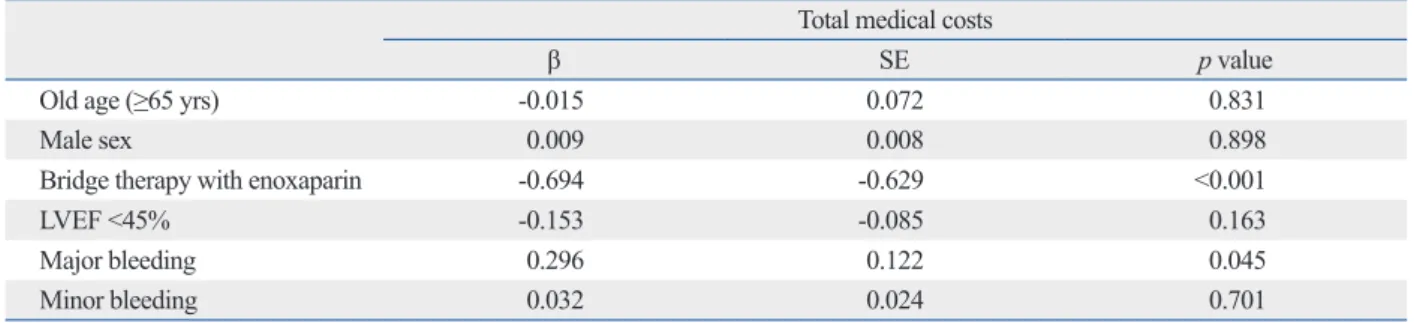
Multivariate linear regression analysis revealed that bridge therapy with enoxaparin (β=-0.694, p<0.001) and major bleeding (β=0.296, p=0.045) were clinical factors signifi- cantly associated with medical costs within 30 days after dental procedures (Table 4).
Table 2. Medical Costs and Adverse Clinical Outcomes within 30 Days after Dental Procedures
Characteristics Bridge therapy
p value
UFH (n=75) Enoxaparin (n=90)
Dental procedures, n (%)
Moderate risk of bleeding 48 (64) 66 (73) 0.196
High risk of bleeding 27 (36) 24 (27) 0.196
Total medical costs (dollar) 2227±3133 699±1503 <0.001
Adverse clinical outcomes, n (%)
Total bleeding 23 (31) 20 (22) 0.219
Major bleeding 5 (7) 4 (4) 0.531
Stroke 0 (0) 1 (1) 0.360
Death 0 (0) 1 (1) 0.360
UFH, unfractionated heparin.
Data are expressed as mean±standard deviation or as the number and percent, i.e., n (%).
Table 3. Independent Clinical Predictors of Total Bleeding within 30 Days after Dental Procedures: Multivariate Logistic Re- gression Analysis
Total bleeding events
OR (95% CI) p value
Old age (≥65 yrs) 2.51 (1.15--5.48) 0.022
Male sex 0.89 (0.40--1.97) 0.764
Body mass index (kg/m2) 1.01 (0.90--1.14) 0.829
Bridge therapy with enoxaparin 0.64 (0.29--1.44) 0.280
Procedures with high risk of bleeding 1.33 (0.58--3.05) 0.498
Multi-valve replacement 1.97 (0.91--4.28) 0.087
LVEF <45% 0.19 (0.02--1.51) 0.115
NSAIDs 1.00 (0.32--3.14) 0.996
LVEF, left ventricular ejection fraction; NSAIDs, non-steroidal anti-inflammatory drugs; OR, odds ratio; CI, confidence interval.
py with enoxaparin was not significantly associated with ad- verse clinical outcomes, compared to bridge therapy with UFH, in patients with MHV who underwent dental proce- dures with a moderate to high bleeding risk. Old age was sig- nificantly associated with total bleeding within 30 days after dental procedures, independent of the type of bridge therapy.
These results suggested that enoxaparin could replace con- ventional bridging with UFH without increasing complica- tions in patients with MHV who require invasive dental pro- cedures. Close observation of bleeding complications may be needed in elderly patients during bridge therapy.
Several previous studies have evaluated the medical costs of LMWH therapy during invasive procedures or surgeries in patients receiving OAC therapy who had a high risk of thromboembolism; the results were inconsistent. Pettinger and Owens18 reported that the use of LMWH may result in avoidable costs during dental extractions. However, in this study, LMWH therapy was not performed on an outpatient basis, and the duration of LMWH therapy was somewhat long, extending from 30 days before the procedures to 5 days thereafter. Meanwhile, Spyropoulos, et al.19 reported that the mean total health care costs during the perioperative period were significantly lower in patients bridging with LMWH than in patients bridging with UFH for an elective general surgical procedures. This cost saving was associated with avoiding or minimizing hospitalization and no increase in clinical adverse events when bridging with LMWH than when bridging with UFH. However, this report was differ- ent from our study in that they included patients who un- derwent a variety of surgical procedures and the compari- son between LMWH and UFH was not contemporary.
The present study found that enoxaparin-based bridge therapy in patients with MHV was significantly associated with reducing total medical costs without increasing adverse clinical events, compared to UFH-based bridge therapy dur- American College of Chest Physicians guidelines also rec-
ommended continuing warfarin around the time of dental procedures in patients receiving long-term OAC.13 Howev- er, the safety of maintaining warfarin during invasive dental procedures remains unclear, especially in patients with MHV.
Dentists furthermore have concerns about excessive bleed- ing from highly vascular supporting dental structures and a residual anticoagulation effect of warfarin after invasive procedures or surgeries. For these reasons, bridge anticoag- ulation therapy is commonly applied in patients with MHV after temporary cessation of warfarin in clinical practice. In the present study, we compared the safety and cost-effec- tiveness between bridge therapy with enoxaparin or UFH in MHV patients at moderate to high bleeding risk who re- quired dental procedures.
While both UFH and LMWH have been used for bridge therapy, UFH is costly and time-consuming, as it requires ex- tended periprocedural hospitalization and laboratory moni- toring. The risk of heparin-induced thrombocytopenia is also higher in patients treated with UFH than in patients treated with LMWH.14 Therefore, LMWH may be an attractive op- tion for bridge therapy, compared to UFH. Several previous studies reported an increased risk of hemorrhagic complica- tions associated with general surgical procedures in patients treated with LMWH.15,16 However, the clinical significance of hemorrhagic complications related to bridge therapy with LMWH remains unclear in the field of dentistry.
Bui, et al.17 recently reported that enoxaparin is safe for outpatient bridge therapy in patients with MHV. However, they did not provide clinical data related to the safety of enoxaparin in dentistry because dental procedures were not included in their study, and the study included no compari- son group that received UFH; therefore, they could not com- pare the efficacy and safety of LMWH and UFH as bridge therapies. The present study demonstrated that bridge thera-
Table 4. Clinical Factors Associated with Total Medical Costs within 30 Days after Dental Procedures: Multivariate Linear Re- gression Analysis
Total medical costs
β SE p value
Old age (≥65 yrs) -0.015 0.072 0.831
Male sex 0.009 0.008 0.898
Bridge therapy with enoxaparin -0.694 -0.629 <0.001
LVEF <45% -0.153 -0.085 0.163
Major bleeding 0.296 0.122 0.045
Minor bleeding 0.032 0.024 0.701
LVEF, left ventricular ejection fraction.
The cost of the dental procedure cost was excluded from the total medical costs.
Education, Science and Technology (2012027176).
REFERENCES
1. Cannegieter SC, Rosendaal FR, Briët E. Thromboembolic and bleeding complications in patients with mechanical heart valve prostheses. Circulation 1994;89:635-41.
2. Ansell J, Hirsh J, Poller L, Bussey H, Jacobson A, Hylek E. The pharmacology and management of the vitamin K antagonists: the Seventh ACCP Conference on Antithrombotic and Thrombolytic Therapy. Chest 2004;126(3 Suppl):204S-33S.
3. Palareti G, Hirsh J, Legnani C, Manotti C, D’Angelo A, Pengo V, et al. Oral anticoagulation treatment in the elderly: a nested, pro- spective, case-control study. Arch Intern Med 2000;160:470-8.
4. Wahl MJ, Howell J. Altering anticoagulation therapy: a survey of physicians. J Am Dent Assoc 1996;127:625-6, 629-30, 633-4 pas- sim.
5. Lim W, Wang M, Crowther M, Douketis J. The management of anticoagulated patients requiring dental extraction: a cross-sec- tional survey of oral and maxillofacial surgeons and hematolo- gists. J Thromb Haemost 2007;5:2157-9.
6. Ward BB, Smith MH. Dentoalveolar procedures for the anticoag- ulated patient: literature recommendations versus current practice.
J Oral Maxillofac Surg 2007;65:1454-60.
7. Katholi RE, Nolan SP, McGuire LB. The management of antico- agulation during noncardiac operations in patients with prosthetic heart valves. A prospective study. Am Heart J 1978;96:163-5.
8. Bonow RO, Carabello BA, Chatterjee K, de Leon AC Jr, Faxon DP, Freed MD, et al. 2008 focused update incorporated into the ACC/AHA 2006 guidelines for the management of patients with valvular heart disease: a report of the American College of Cardi- ology/American Heart Association Task Force on Practice Guide- lines (Writing Committee to revise the 1998 guidelines for the management of patients with valvular heart disease). Endorsed by the Society of Cardiovascular Anesthesiologists, Society for Car- diovascular Angiography and Interventions, and Society of Tho- racic Surgeons. J Am Coll Cardiol 2008;52:e1-142.
9. Vahanian A, Baumgartner H, Bax J, Butchart E, Dion R, Filippa- tos G, et al. Guidelines on the management of valvular heart dis- ease: The Task Force on the Management of Valvular Heart Dis- ease of the European Society of Cardiology. Eur Heart J 2007;28:
230-68.
10. Pisters R, Lane DA, Nieuwlaat R, de Vos CB, Crijns HJ, Lip GY.
A novel user-friendly score (HAS-BLED) to assess 1-year risk of major bleeding in patients with atrial fibrillation: the Euro Heart Survey. Chest 2010;138:1093-100.
11. Schulman S, Kearon C; Subcommittee on Control of Anticoagula- tion of the Scientific and Standardization Committee of the Inter- national Society on Thrombosis and Haemostasis. Definition of major bleeding in clinical investigations of antihemostatic medici- nal products in non-surgical patients. J Thromb Haemost 2005;3:
692-4.
12. Nematullah A, Alabousi A, Blanas N, Douketis JD, Sutherland SE. Dental surgery for patients on anticoagulant therapy with war- farin: a systematic review and meta-analysis. J Can Dent Assoc 2009;75:41.
13. Douketis JD, Berger PB, Dunn AS, Jaffer AK, Spyropoulos AC, Becker RC, et al. The perioperative management of antithrombot-
ing the invasive dental procedure period. Major bleeding was significantly associated with an increase in medical cost, independent of the bridging method. Thus, for patients with MHV who require invasive dental procedures, using enoxa- parin as a bridge therapy on an outpatient basis may be a cost-effective and safe method, compared to using UFC.
This study has several limitations. First, there is no official protocol for bridge therapy; we therefore complied with the American College of Chest Physicians guidelines.13 Second, several previous studies on bridge therapy had a follow-up period lasting up to 3 months after the procedures.20-22 However, it could be difficult to determine the cause of thromboembolic or bleeding events if the follow-up period was too long in patients who need mandatory life-long anti- coagulation therapy. We therefore evaluated the adverse clinical outcomes associated with bridge therapy during a 30-day tracking period after invasive dental procedures.
The rate of adverse clinical events may be somewhat differ- ent in comparison to previous studies. Third, we evaluated the cost-effectiveness of different bridge therapies includ- ing only total medical costs occurred during the periproce- dural period. However, most previous studies comparing the cost-effectiveness of bridge therapy between UFH and enoxaparin used total medical costs during the periprocedur- al period. Additionally, in contrast with UFH-based bridge therapy, enoxaparin-based bridge therapy was performed on an outpatient basis in this study. Lastly, we only compared safety and cost-effectiveness between UFH and enoxaparin in regards to bridge therapy. We did not evaluate these clin- ical outcomes with regard to the maintenance of warfarin without bridging therapy during invasive dental procedures.
Further prospective studies with larger sample sizes are re- quired to address these issues.
In conclusion, considering the benefit of enoxaparin in regards to cost-effectiveness, enoxaparin may be more effi- cient than UFH for bridge therapy in patients with MHV who require invasive dental procedures. Close observation may be necessary in elderly patients as old age was shown to be an independent predictor of bleeding complications after invasive dental procedures.
ACKNOWLEDGEMENTS
This research was supported by the Leading Foreign Re- search Institute Recruitment Program through the National Research Foundation of Korea, funded by the Ministry of
during dental extractions in a medicaid population. J Manag Care Pharm 2007;13:53-8.
19. Spyropoulos AC, Frost FJ, Hurley JS, Roberts M. Costs and clini- cal outcomes associated with low-molecular-weight heparin vs unfractionated heparin for perioperative bridging in patients re- ceiving long-term oral anticoagulant therapy. Chest 2004;125:
1642-50.
20. Ferreira I, Dos L, Tornos P, Nicolau I, Permanyer-Miralda G, Sol- er-Soler J. Experience with enoxaparin in patients with mechani- cal heart valves who must withhold acenocumarol. Heart 2003;89:
527-30.
21. Kovacs MJ, Kearon C, Rodger M, Anderson DR, Turpie AG, Bates SM, et al. Single-arm study of bridging therapy with low- molecular-weight heparin for patients at risk of arterial embolism who require temporary interruption of warfarin. Circulation 2004;
110:1658-63.
22. Douketis JD, Johnson JA, Turpie AG. Low-molecular-weight heparin as bridging anticoagulation during interruption of warfa- rin: assessment of a standardized periprocedural anticoagulation regimen. Arch Intern Med 2004;164:1319-26.
ic therapy: American College of Chest Physicians Evidence-Based Clinical Practice Guidelines (8th Edition). Chest 2008;133(6 Suppl):299S-339S.
14. Warkentin TE, Levine MN, Hirsh J, Horsewood P, Roberts RS, Gent M, et al. Heparin-induced thrombocytopenia in patients treated with low-molecular-weight heparin or unfractionated hepa- rin. N Engl J Med 1995;332:1330-5.
15. Bickler P, Brandes J, Lee M, Bozic K, Chesbro B, Claassen J.
Bleeding complications from femoral and sciatic nerve catheters in patients receiving low molecular weight heparin. Anesth Analg 2006;103:1036-7.
16. Hardy RG, Williams L, Dixon JM. Use of enoxaparin results in more haemorrhagic complications after breast surgery than un- fractionated heparin. Br J Surg 2008;95:834-6.
17. Bui HT, Krisnaswami A, Le CU, Chan J, Shenoy BN. Compari- son of safety of subcutaneous enoxaparin as outpatient anticoagu- lation bridging therapy in patients with a mechanical heart valve versus patients with nonvalvular atrial fibrillation. Am J Cardiol 2009;104:1429-33.
18. Pettinger TK, Owens CT. Use of low-molecular-weight heparin