Original Article
한방병원에 입원한 요통 환자의 요추 전만각
,요천각 변화의 심각도에 따른 예후 분석 연구
한수빈*⋅김은산†⋅김효준‡⋅조후인§⋅김미혜*⋅이남우*⋅한정훈*⋅박병학*⋅손재민*⋅
강도현*⋅민태운*⋅이현준*⋅안재서*⋅이한솔*
자생한방병원 한방재활의학과*, 자생의료재단 척추관절연구소†, 대전자생한방병원 한방재활의학과‡, 자생한방병원 침구과§
Association between Prognosis of Low Back Pain Patients with Severity of Abnormal Lumbar Lordosis
Su-Bin Han, K.M.D.*, Eun-San Kim, K.M.D.†, Hyo-Jun Kim, K.M.D.‡, Hoo-In Jo, K.M.D.§, Mi-hye Kim, K.M.D.*, Nam-Woo Lee, K.M.D.*, Jeong-Hun Han, K.M.D.*, Byung-Hak Park, K.M.D.*, Jae-Min Son, K.M.D.*, Do-Hyeon Kang, K.M.D.*, Tae-Woon Min, K.M.D.*, Hyun-Jun Lee, K.M.D.*, Jae-Seo Ahn, K.M.D.*, Han-Sol Lee, K.M.D.*
Department of Korean Medicine Rehabilitation, Jaseng Hospital of Korean Medicine*, Jaseng Spine and Joint Research Institute, Jaseng Medical Foundation†, Department of Korean Medicine Rehabilitation, Daejeon Jaseng Hospital of Korean Medicine‡, Department of Acupuncture and Moxibustion Medicine, Jaseng Hospital of Korean Medicine§
RECEIVED September 17, 2020 REVISED September 24, 2020 ACCEPTED October 7, 2020 CORRESPONDING TO
Su-Bin Han, Department of Korean Medicine Rehabilitation, Jaseng Hospital of Korean Medicine, Gangnamdaero 536, Gangnam-gu, Seoul 06110, Korea
TEL (02)-2222-2754, FAX (02)-2222-2737 E-mail [email protected] Copyright © 2020 The Society of Korean Medicine Rehabilitation
Objectives To analyze the prognosis of patients with low back pain according to the severity of abnormal lumbar lordotic angle and Ferguson's angle.
Methods Data from electronic medical record of a total of 199 patients hospitalized in Korean medicine hospital were analyzed. With the sagittal view of lumbar spine X-ray, lumbar lordotic angle was defined as the angle between the superior endplate of L1 with the inferior endplate of L5. Ferguson’s angle was defined as the angle between the superior surfaces of the sacral with a horizontal line. ‘Measure Cobb’s Angle Tool’
of ‘INFINITT PACS’ was used to measure both angles. Lumbar lordotic angle and Ferguson's angle were subdivided into five sections. The number of days from onset and the duration of hospitalization were analyzed in each section.
Results Severe hypolordotic lumbar lordotic angle group were found to have longer medical history and hospitalization duration than the control group. The ratio of long-term hospitalization (over 15 days) and chronic medical history (over 180 days) of patients with severe hypolordotic Ferguson’s angle were significantly higher than the control group. The ratio of patients with chronic medical history (over 180 days) was sig- nificantly higher in severe hyperlordotic Ferguson's angle group than the control group.
Conclusions Severe hypolordotic lumbar lordotic angle was related to patient’s prognosis.
Both severe hyperlordotic and severe hypolordotic Ferguson’s angle were found to be related to patient’s prognosis. However, a moderate loss of lumbar lordotic angle and Ferguson’s angle was not related to prognosis of low back pain patients. (J Korean Med Rehabil 2020;30(4):143-154)
Key words Low back pain, Lordosis, Kyphosis, Prognosis, Spinal curvatures
서론»»»
사람의 직립 보행에 따라 발생한다고 알려진 요추의 퇴행성 변화는 사춘기 이후부터 시작되며 성인의 60~80%
는 일생 중에 한 번 이상의 요통을 경험한다고 한다1). 급 성 요통의 경우 장애를 일으키는 경우가 드문 대개 저절 로 호전되는 예후가 좋은 증상이나2), 요통 환자의 10-20%
정도는 3개월 이상의 만성적인 경과를 거친다3,4). 이러 한 요통의 높은 발병률로 인하여 국제적으로 개인적, 사회적 비용이 많은 발생되고 있다5). 특히 질환 치료를 위해 한방 의료기관을 찾은 환자가 가장 많이 호소하는 질환으로 외래 환자의 43.9%와 입원 환자의 42.8%가 요통 치료를 목적으로 한방 의료기관을 찾았으며, 그 수가 매년 증가하는 것으로 조사되었고6), 요통의 원인 중 가장 많은 것은 잘못된 습관, 자세와 작업환경으로 인한 허리의 연부조직 손상이다7).
요추의 전만각은 중력에 대항하여 척추가 부하를 분 산시키는데 주요한 역할을 한다고 알려진 이후로8,9) 많 은 연구가 진행되었고, 요추의 전만각이 요통과 관련이 있는가는 한동안 논쟁이 있던 주제였다. Christie 등10), Ohlén 등11), Korovessis 등12)은 만성 요통 환자군에서 비요통군보다 요추전만이 증가한다고 하였고, Hansson 등13), Pope 등14)은 요통군과 비요통군 사이의 요추 전 만도는 유의한 차이가 없다고 하였으며, Itoi15), Jackson 과 McManus16), Adams 등17)은 요통 환자군에서 정상 대조군에 비하여 요추 전만도는 감소한다고 하였다.
최근의 메타분석 연구에서는 소실된 요추 전만각이 요통과 강한 관련성을 가지고 있음을 제시하였으나18,19), 요추 전만 소실 혹은 과전만의 심각도에 따른 요통 및 요통의 예후에 관한 연구는 부족한 실정이다. 따라서 본 연구에서는 요추 전만각과 요천각 소실의 심각도에 따른 요통 환자의 예후를 분석하였고, 유의미한 결과를 얻었기에 보고하는 바이다.
1. 연구윤리
본 연구는 자생한방병원의 의무기록을 이용한 후향 적 의무기록 분석 연구이고, 개인식별 정보를 제거하여 데이터화한 자료로 분석하여 최소위험 이내의 연구이 며, 자생한방병원 Institutional Review Board (IRB)의 연
구 승인을 받았다(IRB File No. 2020-09-009).
대상 및 방법»»»
1. 연구대상
2020년 3월에서 2020년 9월 사이 자생한방병원 한방 재활의학과에 입원한 환자 중 입원 당시 numeric rating scale (NRS)가 5 이상의 중등도 이상의 통증을 호소하 는 환자, 요통이 주 증상이거나 주 증상 중 하나인 환 자, 그리고 20세 이상 70세 미만의 성인 200명을 연구 대상으로 하였다. 데이터 처리 과정에서 한 증례에서 오류가 발견되어 최종 분석에는 199명이 포함되었다.
2. 측정 방법
요추 전만각의 주요 평가 척도로는 lumbar lordotic angle 및 Ferguson’s angle을 이용하였다. Ferguson’s an- gle의 측정은 Lee 등20)과 Koh 등21) 그리고 Jung 등22)의 선행 연구를 참고하여 기립위 요천부 외측 단순방사선 사진에서 천추 기저면과 수평면 간의 각을 측정하였다.
Lumbar lordotic angle의 측정은 Jeong 등23)의 연구를 참 고하여 제1요추 추체 상연과 제5요추 추체 하연에 평행 하게 직선을 긋고 두 직선이 이루는 각도를 측정하였다.
Lumbar lordotic angle과 Ferguson’s angle 모두 INFINITT PACS (인피니트헬스케어, 서울, 한국)의 measure Cobb’s angle tool을 이용하였다(Figs. 1, 2).
3. Ferguson’s angle, lumbar lordotic angle 구 간의 설정
요추 관절과 요천관절의 전만각을 다각도에서 분석 하기 위하여 L5-S1 분절의 전만 각도는 Ferguson’s an- gle로 독립하여 측정하고, 요추의 전만각은 L1-L5로 구 별하여 측정하고자 하였다. Lumbar lordotic angle은 Choi 등24)의 연구에서 평균 36.32°, 표준편차는 9.62°였 고, Fernand와 Fox는25) 평균 29.96°, 표준편차는 0.74°
로 보고하였고, 본 연구에서 평균 29.6°, 표준편차는 11.4°로 나타났기에 본 연구에서는 30.00-39.99°를 정상
Fig. 1. Lumbar lordotic angle. Lumbar lordotic angle was measured between the superior endplate of L1 and the inferior endplate of L5.
Fig. 2. Ferguson’s angle. Ferguson's angle was measured between the upper endplate of S1 and a horizontal line.
군, 40.00-44.99°를 중등도 과전만군, 45.00° 이상을 심 한 과전만군, 20.00-29.99°는 중등도 과소전만군 19.99 이하는 심한 과소전만군이라고 정의하였다. Ferguson’s angle은 Kang 등26)의 연구에서 건강한 한국 청장년의 기립위에서의 평균값의 범위는 평균 39.1°, 표준편차는 2.29°이라고 하였고, Jung 등22)의 연구에서는 평균값은 35.90°, 표준편차는 8.50°이었고, Kim 등27)의 연구에서 는 평균 38.21°, 표쥰편차는 8.66°였다. 본 연구에서는 전체 연구 대상자의 평균 기립위에서의 Ferguson’s an- gle의 평균은 35.0°, 표준편차는 8.5°였기에 이를 참조 하여 정상 Ferguson’s angle의 범주는 35.00-44.99°는 정
상군, 45.00-49.99°를 중등도 과전만군, 50.00° 이상을 심 한 과전만군, 25.00-34.99°를 중등도 과소전만군, 24.99°
이하를 심한 과소전만군이라고 정의하였다.
4. 통계 처리
환자의 기본정보는 연속형 변수는 평균±표준편차, 범주형 변수는 n수와 퍼센트로 표현되었다. 입원기간과 발병일로부터의 기간은 중간값을 표시하였다. Lumbar lordotic angle 및 Ferguson’s angle의 구간별 입원 기간 과 병력의 차이는 kruskal wallis test로 검정하였으며, 장기입원 및 만성질병 여부는 Fisher's exact test로 검정 하였다. 이후 lumbar lordotic angle과 Fergurson’s angle 이 장기입원 및 요통의 만성화에 끼치는 영향을 보기 위해 로지스틱 회귀분석을 수행하였다. 연령과 성별이 보정되었으며 결과는 오즈비(Odds ratio, OR)와 95% 신 뢰구간으로 표현하였다.
염좌군에 대거 포함된 교통사고 환자가 본 연구 결과 에 끼친 영향을 알아보기 위하여 로지스틱 회귀분석을 이용하여 하위그룹 분석을 시행하였다. 한국자동차보 험 진료의 특성상 대부분 14일 이하의 입원 기간을 가 지므로 다른 환자와 동일하게 자동차보험 환자에 대해 서도 15일 이상의 입원을 장기입원으로 간주하는 것은 적절하지 않았다. 그에 따라 장기입원의 정의를 다르게 하여 로지스틱 회귀 분석을 이용한 민감도 분석을 추가 로 시행하였다. 자동차보험 환자에 대해서는 14일 이상 의 입원을 시행한 경우를 장기입원으로 간주하였고, 건 강보험 환자에 대해선 a) 30일 이상, b) 15일 이상을 장 기입원으로 정의하여 분석하였다.
결과»»»
1. 연구 대상의 일반적 특성
자생한방병원의 전자 의무기록을 이용하여 환자의 성별, 연령, lumbar lordotic angle, Ferguson’s angle, 입 원 기간, 병역 기간 등을 조사하였고, 한의사가 요통 환 자를 염좌, 요추 추간판 탈출증, 협착증, 기타 등으로 진단하였다. 총 연구 대상자는 199명이었으며, 평균 나
Severe
hypolordosis Moderate
hypolordosis Normal Moderate
hyperlordosis Severe hyperlordosis Lumbar lordotic angle*
Age 45.7±13.1 40.8±13.1 43.2±15.0 38.7±12.8 36.2±13.0
Sex 38 (100) 64 (100) 62 (100) 14 (100) 21 (100)
Female 16 (42.1) 32 (50.0) 37 (59.7) 5 (35.7) 10 (47.6)
Male 22 (57.9) 32 (50.0) 25 (40.3) 9 (64.3) 11 (52.4)
Lumbar lordotic angle 14.2±4.4 24.5±2.8 34.5±2.9 42.0±1.3 50.3±4.9
Ferguson’s angle 27.0±6.4 32.3±6.1 37.8±6.5 43.4±8.3 44.2±6.0
Diagnosis
Sprain 18 (47.4) 44 (68.8) 50 (80.6) 10 (71.4) 17 (81.0)
Disc herniation 17 (44.7) 19 (29.7) 9 (14.5) 2 (14.3) 4 (19.0)
Others 3 (7.9) 1 (1.6) 3 (4.8) 2 (14.3) 0 (0.0)
Ferguson’s angle†
Age 40.2±14.7 42.9±13.3 40.1±14.0 44.4±12.2 47.0±16.3
Sex 23 (100) 80 (100) 74 (100) 10 (100) 12 (100)
Female 9 (39.1) 44 (55.0) 39 (52.7) 4 (40.0) 4 (33.3)
Male 14 (60.9) 36 (45.0) 35 (47.3) 6 (60.0) 8 (66.7)
Lumbar lordotic angle 15.8±7.4 25.0±7.6 35.8±9.5 36.1±11.5 43.1±5.3
Ferguson’s angle 20.7±2.4 31.0±2.4 39.3±3.0 46.2±1.3 53.5±4.7
Diagnosis
Sprain 13 (56.5) 51 (63.7) 60 (81.1) 8 (80.0) 7 (58.3)
Disc herniation 8 (34.8) 27 (33.8) 11 (14.9) 1 (10.0) 4 (33.3)
Others2 (8.7) 2 (2.5) 3 (4.1) 1 (10.0) 1 (8.3)
The continuous variable is presented with mean±standard deviation. The categorical variable is presented with number (%).
*Severe hypolordosis: <20.00°, moderate hypolordosis: 20.00°-29.99°, normal: 30.00°-39.99°, moderate hyperlordosis: 40.00°-44.99°, severe hyperlordosis: >44.99°.
†Severe hypolordosis: ≤25.00, moderate hypolordosis: 25.00°-34.99°, normal: 35.00°-44.99°, moderate hyperlordosis: 45.00°-49.99°, severe hyperlordosis: >49.99°.
Table II. General Characteristics of the Patients According to the Severity of Lumbar Lordotic Angle and Ferguson’s Angle
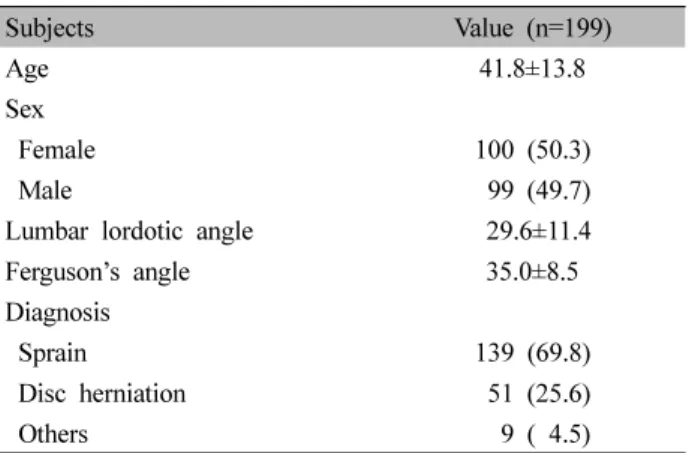
Subjects Value (n=199)
Age 41.8±13.8
Sex
Female 100 (50.3)
Male 99 (49.7)
Lumbar lordotic angle 29.6±11.4
Ferguson’s angle 35.0±8.5
Diagnosis
Sprain 139 (69.8)
Disc herniation 51 (25.6)
Others 9 ( 4.5) Values are presented as mean±standard deviation or number (%).
Table I. General Characteristics of the Patients 이는 41.8±13.8세, 여성은 100명, 남성은 99명이었다. 평
균 lumbar lordotic angle은 29.6±11.4°, 평균 Ferguson’s angle은 35.0±8.5°이었다. 총 연구 대상자 중 139명(69.8%) 은 한의사로부터 염좌로 진단받았고, 51명은 요추 추간판 탈출증(25.6%), 9명은 기타(4.5%, 협착증, 골절 등)로 진단 받았다(Table I). Lumbar lordotic angle의 경우 정상군의 연령(43.2±15.0세) 혹은 심한 과전만군의 연령(36.2±13.0 세)에 비하여 심한 과소전만군의 연령(45.7±13.1세)이 높 게 나타났으며, 요추 추간판 탈출증의 비율은 심한 과전 만군의 19%, 정상군의 14.5%에 비하여 심한 과소전만군 에서 44.7%로 높게 나타났다. Ferguson’s angle의 경우 정상군의 연령(40.1±14.0) 혹은 심한 과소전만군의 연령 (40.2±14.7)에 비해 심한 과전만군의 연령(47.0±16.3)이 높게 나타났으며, 정상군의 요추 추간판 탈출증의 비율
이 14.9%이었던 것에 비해 심한 과전만군은 33.3%, 심 한 과소전만군은 34.8%로 높게 나타났다(Table II).
Duration of hospitalization Onset
Mean±SD Median [Q1-Q3]
Long-term hospitalization
(≥15 days) Mean±SD Median
[Q1-Q3] Chronic cases (≥180 days) Lumbar lordotic angle
Severe hypolordosis (<20.00°) 18.8 (20.3) 11.0 [8.0, 16.8] 13 (34.2) 996.8 (1,918.4) 121.0 [12.3, 741.5] 17 (44.7) Moderate hypolordosis
(20.00°-29.99°) 12.2 (13.5) 10.0 [6.0, 13.0] 9 (14.1) 290.4 (750.6) 14.0 [10.0, 112.3] 16 (25.0) Normal (30.00°-39.99°) 9.6 (5.1) 9.0 [6.0, 12.0] 9 (14.5) 235.2 (598.2) 14.0 [8.0, 14.0] 10 (16.1) Moderate hyperlordosis
(40.00°-44.99°) 11.9 (7.4) 11.0 [7.0, 12.8] 3 (21.4) 338.6 (981.1) 14.0 [13.0, 158.8] 4 (28.6) Severe hyperlordosis (>44.99°) 11.0 (11.8) 8.0 [6.0, 11.0] 2 (9.5) 323.0 (777.3) 12.0 [9.0, 14.0] 4 (19.0)
p-value 0.162 0.080 0.023 0.034
Ferguson’s angle
Severe hypolordosis (<25.00°) 17.9 (22.6) 9.0 [7.0, 15.5] 7 (30.4) 985.5 (2,185.9) 14.0 [9.50, 645.5] 8 (34.8) Moderate hypolordosis
(25.00°-34.99°) 11.8 (9.9) 10.0 [6.75, 13.0] 13 (16.2) 320.7 (767.2) 14.0 [11.0, 259.5] 22 (27.5) Normal (35.00°-44.99°) 11.2 (11.8) 9.0 [6.0, 12.0] 10 (13.5) 258.0 (777.1) 14.0 [9.0, 14.0] 13 (17.6) Moderate hyperlordosis
(45.00°-49.99°) 11.1 (10.8) 8.0 [4.8, 11.8] 2 (20.0) 485.0 (1,181.6) 12.0 [8.5, 18.5] 2 (20.0) Severe hyperlordosis (>49.99°) 15.9 (15.6) 10.5 [7.0, 15.3] 4 (33.3) 859.0 (1,107.8) 213.0 [13.0, 1,699.8] 6 (50.0)
p-value 0.669 0.198 0.14 0.103
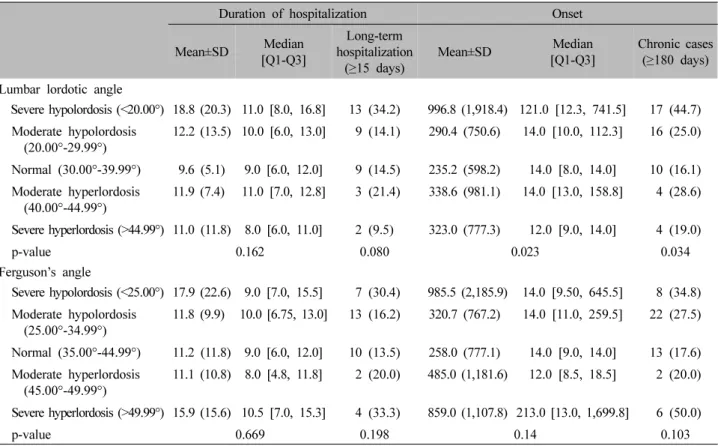
The distributions of duration of hospitalization and days from onset are presented by lumbar lordotic angle and Ferguson’s angle.
Each days is presented with mean±standard deviation (SD) and quartile [25th percentile (Q1)-75th quartile (Q3)]. The case is presented with number (%). The difference in distribution was tested by Kruskal Wallis test for continuous variables and Chi-square test for categorical variable.
Table III. Distributions of Duration of Hospitalization and Days from Onset According to the Severity of Lumbar Lordotic Angle and Ferguson’s Angle
2. Lumbar lordotic angle과 Ferguson’s angle 의 구간별 입원 기간, 병력 차이 비교
Lumbar lordotic angle의 경우 심한 과소전만군에서 평균 병력이 길게 나타났다. 심한 과소전만군에서 평균 병력이 996.8±1918.4일로 나타난 반면에 정상군에서는 235.2±598.2일, 심한 과전만군에서는 323.0±777.3일로 나타났다(p<0.023). 중간값 또한 산출하였는데 심한 과 소전만군의 중간값은 121일, 정상군에서는 14일, 심한 과전만군에서는 12일이었다. 또한 180일 이상 만성 환 자의 비율이 심한 과소전만군에서 44.7%, 정상군에서 16.1%, 심한 과전만군에서 19.0%로 나타나 심한 과소 전만인 경우 만성 환자의 비율이 높은 것으로 나타났 고, 이는 통계적으로 유의미하였다(p<0.034). 15일 이상 장기입원한 환자의 비율은 심한 과소전만군에서 34.2%, 정상군에서 14.5%, 심한 과전만군에서 9.5%로 나타났
다(Table III, Fig. 3).
Ferguson’s angle의 경우 평균 병력이 정상군에서 258.0±777.1일, 심한 과전만군에서 859.0±1,107.8일, 심 한 과소전만군에서 985.5±2,185.9일로 나타났다. 병력 의 중간값은 심한 과전만군에서 213일, 정상군에서 14 일, 심한 과소전만군에서 14일로 나타났다. 병력 180일 이상의 만성 환자의 비율은 정상군에서 17.6%이었고, 심한 과전만군에서는 50.0%, 심한 과소전만군에서는 34.8%로 나타났다. 15일 이상의 장기입원 환자의 비율 이 정상군에서 13.5%, 심한 과소전만군에서 30.4%, 심 한 과전만군에서 33.3%로 나타났다(Table III, Fig. 4).
3. Lumbar lordotic angle과 Ferguson’s angle 의 구간별 장기입원, 만성 환자 발생 비율 비교
로지스틱 회귀 분석을 이용하여 lumbar lordotic angle
Fig. 3. Duration of hospitalization, long-term hospitalization, days from onset, chronic cases according to the severity of lumbar lordotic angle. Severe hypolordosis: <20.00°, moderate hypolordosis: 20.00°-29.99°, normal: 30.00°-39.99°, moderate hyperlordosis: 40.00°-44.99°, severe hyperlordosis: >44.99°.
Fig. 4. Duration of hospitalization, long-term hospitalization, days from onset, chronic cases according to the severity of Ferguson’s angle. Severe hypolordosis: <25.00°, moderate hypolordosis: 25.00°-34.99°, normal: 35.00°-44.99°, moderate hyperlordosis:
45.00°-49.99°, severe hyperlordosis: >49.99°.
Long-term hospitalization (≥15 days) Chronic cases (≥180 days)
OR (95% CI) p-value OR (95% CI) p-value
Lumbar lordotic angle
Severe hypolordosis (<20.00°) 3.95 (1.35-12.27) 0.014 5.83 (2.12-17.15) 0.001 Moderate hypolordosis (20.00°-29.99°) 1.31 (0.44-3.94) 0.626 2.42 (0.94-6.54) 0.071 Normal (30.00°-39.99°)
Moderate hyperlordosis (40.00°-44.99°) 3.07 (0.54-14.83) 0.173 3.84 (0.83-16.55) 0.073 Severe hyperlordosis (>44.99°) 1.06 (0.14-5.39) 0.948 2.08 (0.47-8.19) 0.305 Ferguson's angle
Severe hypolordosis (<25.00°) 3.63 (1.03-12.80) 0.043 3.20 (1.00-10.16) 0.047 Moderate hypolordosis (25.00°-34.99°) 1.11 (0.43-2.93) 0.83 1.70 (0.76-3.92) 0.206 Normal (35.00°-44.99°)
Moderate hyperlordosis (45.00°-49.99°) 1.48 (0.18-8.22) 0.673 1.10 (0.14-5.73) 0.914 Severe hyperlordosis (>49.99°) 2.74 (0.52-13.31) 0.215 5.35 (1.24-23.71) 0.024 The logistic regression was performed. The odds ratio (OR) is presented with 95% confidence interval (CI), age and sex were adjusted.
Table IV. The Association of Lumbar Lordotic Angle and Ferguson’s Angle with Long-term Hospitalization and Chronic Cases 및 Ferguson’s angle에 따라 장기입원 (15일 이상)과 만
성 환자(180일 이상)의 발생 비율을 비교하였다. 장기입 원의 경우 lumbar lordotic angle의 정상군에 비하여 심 한 과소전만군에서 OR (95% confidence interval [CI])값 이 3.95 (1.35-12.27)배로 나타났고, 이는 통계적으로 유 의미하였다(p<0.014). 또한 병력이 180일 이상된 만성 환자의 OR은 정상군에 비하여 심한 과소전만군에서 5.83 (2.12-17.15)배로 나타났고, 이는 통계적으로 유의 미하게 나타났다(p<0.001). Ferguson’s angle의 경우 심 한 과소전만군에서 장기입원 환자의 OR은 정상군에 비 하여 3.63 (1.03-12.80)배로 통계적으로 유의미하게 나 타났다(p<0.043). 또한 Ferguson’s angle이 심한 과소전 만인 경우 병력이 180일 이상된 만성 환자가 정상군에 비 해 OR이 3.20 (1.00-10.16)배로 높게 나타났고(p<0.047), 심한 과전만인경우 또한 OR이 5.35 (1.24-23.71)배로 정상군보다 유의하게 높았다(p<0.024, Table IV).
4. Lumbar lordotic angle과 Ferguson’s angle 의 구간별 하위 그룹 분석
교통사고 환자들의 경우 제도적인 영향으로 14일 안 에 퇴원하는 것이 일반적이므로 본 연구의 주요 변수인 입원 기간에 영향을 끼쳤을 가능성이 있다. 따라서 본 연구의 염좌군에 대거 포함된 교통사고 환자가 입원 기
간에 끼친 영향에 대해 알아보고자 하위 그룹 분석을 시행하였다. 하위 그룹 분석에서 염좌군을 단독 분석한 결과, lumbar lordotic angle이 심하게 과소전만인 경우 에서 15일 이상 장기입원의 비율이 높았다(p<0.03). 이 는 교통사고 환자가 대거 포함된 염좌군만 단독으로 놓 고 보더라도 앞선 연구 결과와 비슷한 경향성을 보임을 의미한다(Table V). 염좌군을 제외한 비염좌군(대부분 요추 추간판 탈출증)에서는 앞선 연구 결과와 비슷한 경향성을 보여주지 못하였다.
5. Lumbar lordotic angle과 Ferguson’s angle 의 구간별 민감도 분석
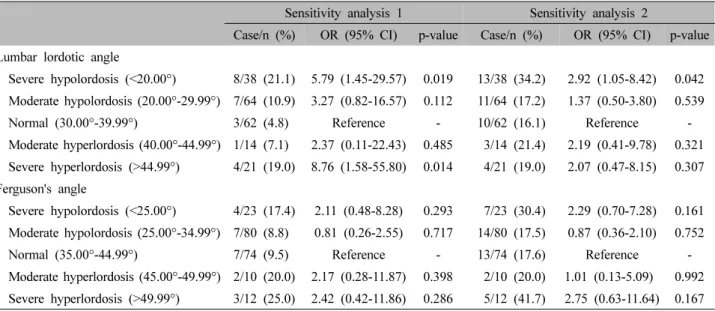
본 연구의 염좌군에 대거 포함된 교통사고 환자가 연 구 결과에 끼친 영향에 대해 알아보고자 민감도 분석을 시행하였다. 한국자동차보험 진료의 특성상 14일 이상 의 입원이 힘든 상황이므로 교통사고 환자 중 14일 이 상 입원한 환자를 장기입원 환자, 교통사고가 아닌 환 자 중 30일 이상 입원한 환자를 장기입원한 환자로 간 주한 결과, 그 비율이 lumbar lordotic angle이 심하게 과 소전만된 경우와(p<0.19), lumbar lordotic angle이 심하 게 과전만된 경우에서 높게 나타나(p<0.014) 앞선 연구 결과와 비슷한 경향성을 보여주었다(Sensitivity analysis 1, Table VI). 또한 교통사고 환자 중 14일 이상 입원한
Sprain group Non-sprain group
Case/n (%) OR (95% CI) p-value Case/n (%) OR (95% CI) p-value Lumbar lordotic angle
Severe hypolordosis (<20.00°) 2/18 (11.1) 17.72 (1.38-326.68) 0.03 11/20 (55.0) 0.87 (0.27-2.84) 0.823 Moderate hypolordsis, normal, moderate
hyperlordosis (20.00-44.99°) 2/104 (1.9) Reference - 19/36 (52.8) Reference - Severe hyperlordosis (>44.99°) 1/17 (5.9) 9.96 (0.36-215.08) 0.121 1/4 (25.0) 0.27 (0.01-2.56) 0.291 Ferguson's angle
Severe hypolordosis (<25.00°) 1/13 (7.7) 22.80 (0.69-934.10) 0.06 6/10 (60.0) 1.34 (0.32-6.11) 0.691 Moderate hypolordsis, normal, moderate
hyperlordosis (25.00-49.99°) 3/119 (2.5) Reference - 22/45 (48.9) Reference - Severe hyperlordosis (>49.99°) 1/7 (14.3) 4.38 (0.12-108.12) 0.359 3/5 (60.0) 1.45 (0.20-12.68) 0.71 Subgroup analysis 1: Long-term hospitalization (over 15 days) in sprain patients. Subgroup analysis 2: Long-term hospitalization (over 15 days) in non-sprain patients. n: total number of patients categorized by severity of lumber lordotic angle or Ferguson’s angle. Case: Patients hospitalized for over 15 days, The logistic regression was performed. The odds ratio (OR) is presented with 95% confidence interval (CI), age and sex were adjusted.
Table V. Subgroup Analysis of Sprain Patients and Other Patients
Sensitivity analysis 1 Sensitivity analysis 2
Case/n (%) OR (95% CI) p-value Case/n (%) OR (95% CI) p-value Lumbar lordotic angle
Severe hypolordosis (<20.00°) 8/38 (21.1) 5.79 (1.45-29.57) 0.019 13/38 (34.2) 2.92 (1.05-8.42) 0.042 Moderate hypolordosis (20.00°-29.99°) 7/64 (10.9) 3.27 (0.82-16.57) 0.112 11/64 (17.2) 1.37 (0.50-3.80) 0.539
Normal (30.00°-39.99°) 3/62 (4.8) Reference - 10/62 (16.1) Reference -
Moderate hyperlordosis (40.00°-44.99°) 1/14 (7.1) 2.37 (0.11-22.43) 0.485 3/14 (21.4) 2.19 (0.41-9.78) 0.321 Severe hyperlordosis (>44.99°) 4/21 (19.0) 8.76 (1.58-55.80) 0.014 4/21 (19.0) 2.07 (0.47-8.15) 0.307 Ferguson's angle
Severe hypolordosis (<25.00°) 4/23 (17.4) 2.11 (0.48-8.28) 0.293 7/23 (30.4) 2.29 (0.70-7.28) 0.161 Moderate hypolordosis (25.00°-34.99°) 7/80 (8.8) 0.81 (0.26-2.55) 0.717 14/80 (17.5) 0.87 (0.36-2.10) 0.752
Normal (35.00°-44.99°) 7/74 (9.5) Reference - 13/74 (17.6) Reference -
Moderate hyperlordosis (45.00°-49.99°) 2/10 (20.0) 2.17 (0.28-11.87) 0.398 2/10 (20.0) 1.01 (0.13-5.09) 0.992 Severe hyperlordosis (>49.99°) 3/12 (25.0) 2.42 (0.42-11.86) 0.286 5/12 (41.7) 2.75 (0.63-11.64) 0.167 n: total number of patients categorized by severity of lumber lordotic angle or Ferguson’s angle. Case for sensitivity analysis 1:
Traffic accident patients who hospitalized for over 14 days, other patients who hospitalized for over 30 days were regarded as long-term hospitalization. Case for sensitivity analysis 2: Traffic accident patients who hospitalized for over 14 days, other patients who hospitalized for over 15 days were regarded as long-term hospitalization. The logistic regression was performed. The odds ratio (OR) is presented with 95% confidence interval (CI), age and sex were adjusted.
Table VI. Long-term Hospitalization of Traffic Accident Patients and Other Patients
환자를 장기입원 환자, 교통사고가 아닌 환자 중 15일 이상 입원한 환자를 장기입원 환자로 간주한 결과, lumbar lordotic angle이 심하게 과소전만된 경우에서 그 비율이 높게 나타나 앞선 연구 결과와 비슷한 경향성을 유지하였다(p<0.042, Sensitivity analysis 2, Table VI).
고찰»»»
너무 작거나 너무 큰 요추 전만 각도가 요통의 위험 인자가 될 수 있음은 최근 여러 문헌 고찰을 통해 익히 알려져 있다18,19). 요추 전만각은 사람의 직립 보행에 대
한 진화적 적응이며28), 올바른 요추의 전만각은 중력에 대항하여 체간을 골반 위에 유지시킨다8,9). 요추 전만각 의 소실은 척추전방전위증처럼 직접적인 요통의 원인 이 되기도 하며29), 척추 유합술에서는 요통 환자의 전 만각 확보가 수술의 성공 여부를 결정짓는 요인이 되기 도 하기에 적절한 요추 전만각의 확보는 건강한 척추를 위한 주요한 요소라고 볼 수 있다30). 또한 비정상적 요 추 전만각은 척추 추간판에 스트레스를 주어 요추 추간 판 탈출증의 원인이 되는 것으로 알려져 있기도 하다31). 한의학에서도 작업이나 자세에 의하여 발생하는 요통 에 대한 언급이 있는데, 東醫寶鑑에서는 十種腰痛 중 挫 閃腰痛의 ‘擧重勞傷 或 挫閃墜落 以作痛’, 濕熱腰痛의 ‘濕 熱腰痛者 遇天陰 或 久坐而發者 是也’이라고 하여 요통 의 원인 중의 하나로 제시하였다32). 반면에 Hansson 등13) 과 Pope 등14)은 요추 전만각이 요통과 관련이 없다고 하 였다.
이러한 상반된 연구 결과는 요추 전만각의 측정 방법, 혹은 표본 수가 부족하거나, 요추 전만각 소실의 심각도 를 고려하지 않았기 때문에 발생할 수 있다. Hansson 등13) 은 요추 전만 각도를 L1-S1까지로 측정하였으며, Pope 등14)은 전만 각도의 심각성을 고려하지 않았다. 이에 본 연구에서는 lumbar lordotic angle로 측정한 요추 전 만각 및 Ferguson’s angle로 측정한 요천각의 소실의 심 각도에 다른 요통과의 상관성을 다각도에서 살펴보고 자 하였다. L5-S1 전만각을 측정할 경우, Ferguson’s an- gle값이 중복하여 포함될 가능성이 크기 때문에 요천각 을 배제한 요추 전만각을 관찰하기 위하여 L1-L5에 해 당하는 lumbar lordotic angle을 측정하였고, L5-S1분절 의 불안정성은 Ferguson’s angle을 통하여 분리하여 측 정하였다. 또한, 요추 전만각 소실의 심각도에 따른 입원 기간 및 유병 기간의 변화를 알아보기 위하여 lumbar lor- dotic angle 및 Ferguson’s angle을 각각 다섯 범주로 세 분화하였다.
그 결과, lumbar lordotic angle은 20° 미만으로 심하 게 과소전만된 경우 환자의 병력이 유의미하게 길게 나 타나며(Table III, Fig. 3), 15일 이상 장기입원 환자와 병 력이 180일 이상 되는 만성 환자가 정상군에 비해 유의 미하게 많다는 결과를 보였다(Table IV). 한편 Ferguson’s angle인 경우 심하게 과소전만된 군에서는 장기입원과 만성 환자의 비율이 유의미하게 높았고, 심한 과전만군
에서도 병력이 180일 이상인 만성 환자 비율이 유의미하 게 높았음을 알 수 있었다(Table IV, Fig. 4). 또한 lumbar lordotic angle에서는 20° 미만의 심각한 과소전만일 경우 유의미하게 예후가 좋지 않음이 나타났으며, Ferguson’s angle에서도 경도 혹은 중등도의 과소전만 혹은 과전만 보다는 25° 미만의 심각한 과소전만 혹은 50° 이상의 심한 과전만군에서 환자의 예후가 좋지 않음이 나타났 다. 이전의 연구들에서는 요추 전만각과 환자의 유병률 및 특정 질병의 발생 여부에 초점을 맞춘 경우가 많았 고, 요추 전만각 및 요천각과 환자의 예후 간의 상관관 계를 분석한 연구는 부족한 상황이다. 본 연구에서는 한방병원에 입원한 환자 중 요통을 주 증상 중 하나로 하며, NRS 5 이상의 중등도 이상의 요통을 호소하는 환자, 20세 이상 70세 미만의 성인 199명을 대상으로 요추 전만각 및 요천각 변화의 심각도와 환자의 병력 및 입원 기간 간의 상관관계를 분석하였다. 요추 전만 각의 정도는 5개의 구간으로 분류하였으며, 그 결과 심 각한 요추 과소전만 및 심각한 요천각 과소전만, 그리 고 심각한 요천각 과전만에서 유의미하게 환자의 경과 가 좋지 않게 나타나며, 경도 혹은 중등도의 전만 소실 에서는 유의미한 차이가 없다는 특이점을 발견하였다.
본 연구의 한계점은 다음과 같다. 연구 대상자 중 급 성 요통(요추 염좌)의 대부분이 교통사고 환자였다는 점, 그리고 만성 요통 환자의 대부분이 요추 추간판 탈 출증 환자였다는 점이 연구 결과에 영향을 끼쳤을 가능 성이 있다. 본 연구에서 주요하게 살펴본 병력의 측면 에서 교통사고 환자는 외상 혹은 염좌로 인한 급성 요 통을 잘 대변하며, 진료 현장에서 만성 요통의 상당수 가 요추 추간판 탈출증임을 고려한다면 본 연구의 연구 대상이 크게 잘못되지는 않았을 것이다. 하지만 입원 기간의 경우 염좌군에 대거 포함된 교통사고 환자들은 제도적인 영향으로 14일 이내에 퇴원하는 경우가 대부 분이므로 연구 결과에 영향을 끼쳤을 가능성이 있다.
그 영향에 대하여 알아보고자 하위 그룹 분석에서 염좌 군을 단독 분석한 결과, 앞선 연구 결과와 비슷한 경향 성을 보여주었다. 하지만 비염좌군을 단독 분석한 결과 에서는 앞선 연구 결과와 비슷한 경향성을 보여주지는 못하였는데 이는 하위 그룹 분석 시 60명으로 줄어든 표본의 영향일 수 있다(Table V). 또한 교통사고 환자에 대한 민감도 분석을 실시한 결과에서도 앞선 연구 결과
와 비슷한 경향성을 보여주었다(Table VI). 대한의사협 회에서 발행한 진단서 등 작성 교부 지침에 따르면 통 상 요추 및 척추의 염좌에 관하여 중등도 이상의 손상 이 발생했을 경우 2주 정도의 고정기간을 권고하고 있 으므로 민감도 분석 시 자동차보험 환자에 대해 2주 이 상의 입원 기간의 경우 장기입원 환자로 간주하였다33). 이렇듯 여러 방면에서 환자의 요추 만곡도와 입원 기간 과의 상관성을 보여주었지만, 입원 기간에 있어서 비염 좌군의 하위 그룹 분석 시 유의미한 결과를 보여주지 못하는 등 여전히 자동차보험 환자가 대거 포함된 연구 대상은 본 연구의 한계점으로 남아 있다. 현재 자동차 보험 환자의 경우 2주 이상의 입원이 제도적으로 제한 받고 있고, 환자들의 퇴원 시기도 보험사와의 합의 시 점에 영향을 받는 등 자동차보험 환자의 입원 일수는 외부의 영향을 많이 받고 있다. 관련하여 잘 구성된 연 구 대상을 바탕으로 추가적인 연구가 필요해 보인다.
한편 본 연구는 후향적 연구로써 요추 전만각과 요통 환자의 병력간의 상관관계를 밝혔을 뿐 소실된 요추 전 만각이 장기적으로 요통의 원인이 되거나 예후를 좋지 않게 만든다는 인과관계에 대해서는 규명하지 못하였 다. 하지만 요추 전만각의 소실이 노화에 다른 퇴행의 결과물이거나 병리학적 결과물이라고 할지라도 비정상 적 요추 전만각을 회복하는 것은 요통의 치료목적, 예 방 목적, 혹은 재발 방지 목적으로 유용할 것으로 보인 다. Lee34)는 추나치료군이 물리치료군에 비하여 요추의 전만각을 회복시키고 통증을 감소시킨다는 결과를 제 시하였고, Fatemi 등35)은 8주간의 Williams 운동이 요추 과전만 환자들의 요추 전만각을 회복시킨다고 하였으 며, Malai 등36)은 만성 요통을 가진 요추 과전만 환자들 의 장요근을 스트레칭시켰을 때 유추 전만각의 회복, 고관절 굴곡근 등의 유연성 증가, 통증의 감소 등의 결 과를 제시하였다. 추후 전향적 코호트 연구를 통하여 요추 전만각이 장기적으로 요통을 유발하는지, 그리고 정상 요추 전만각을 유지하는 것이 요통의 예방에 도움 이 되는지에 대한 인과관계를 규명할 필요성이 있다.
결론»»»
Lumbar lordotic angle이 20° 미만인 심한 과소전만 요
통 환자의 경우 평균 병력이 정상군 및 과전만군(lumbar lordotic angle 30° 이상)보다 길게 나타났다. 또한, 심한 과소전만 요통군에서 15일 이상 장기입원 발생 비율 및 병력이 180일 이상인 만성 환자일 비율이 정상군(lumbar lordotic angle 30°-39.99°)에 비해 유의미하게 높았다.
Ferguson’s angle이 25° 미만인 심한 과소전만 요통 환 자의 경우 15일 장기입원 발생 비율 및 병력이 180일 이상인 만성 환자일 비율이 정상군(Ferguson’s angle 35.00°-44.99°)에 비하여 유의미하게 높았다. Ferguson’s angle이 50° 이상인 심한 과전만 환자의 경우 병력이 180일 이상된 만성 환자일 비율이 정상군(Ferguson’s an- gle 35.00°-44.99°)에 비하여 유의미하게 높았다. Lumbar lordotic angle은 심한 과소전만이 병력과의 상관관계를 보였으며, Ferguson’s angle은 심한 과소전만 뿐만 아니 라 심한 과전만 또한 환자의 병력과 상관관계를 보였 다. 반면, 심각하지 않은 중등도의 lumbar lordotic angle 및 Ferguson’s angle의 소실은 통계적으로 유의미한 상 관관계를 보이지 않았다.
References»»»
1. Lee GM. Presumption of low back pain and symptoms for surgical treatment. The Journal of Korean Acupuncture
& Moxibustoin Society. 2001;18(2):237-44.
2. Pengel LH, Herbert RD, Maher CG, Refshauge KM.
Acute low back pain: systematic review of its prognosis.
BMJ (Clinical research ed). 2003;327(7410):323.
3. Balagué F, Mannion AF, Pellisé F, Cedraschi C. Clinical update: low back pain. Lancet (London, England).
2007;369(9563):726-8.
4. Airaksinen O, Brox JI, Cedraschi C, Hildebrandt J, Klaber-Moffett J, Kovacs F, Mannion AF, Reis S, Staal JB, Ursin H, Zanoli G; COST B13 Working Group on Guidelines for Chronic Low Back Pain. Chapter 4.
European guidelines for the management of chronic nonspecific low back pain. European Spine Journal: of- ficial publication of the European Spine Society, the European Spinal Deformity Society, and the European Section of the Cervical Spine Research Society. 2006;15 Suppl 2(Suppl 2):S192-300.
5. Buchbinder R, Blyth FM, March LM, Brooks P, Woolf AD, Hoy DG. Placing the global burden of low back pain in context. Best Practice & Research Clinical Rheumatology. 2013;27(5):575-89.
6. Lee KJ, Oh MS, Lee EJ, Shin BC, Hwang EH, Kim SJ, Cha YY, Ko YS, Song YK. Trends of Korean medi- cine conservative treatment using low back pain patients registry data: analysis of medical records of 7 Korean medical hospital. J Korean Med Rehabil. 2019;29(3):
87-101.
7. Kim GT. Diagnosis and treatment for patients with lumbago. Korean Journal of Family Practice. 1997;
18(2):106-25.
8. Farfan HF. The biomechanical advantage of lordosis and hip extension for upright activity. Man as compared with other anthropoids. Spine (Phila Pa 1976). 1978;
3(4):336-42.
9. Aspden RM. The spine as an arch. A new mathematical model. Spine (Phila Pa 1976). 1989;14(3):266-74.
10. Christie HJ, Kumar S, Warren SA. Postural aberrations in low back pain. Archives of Physical Medicine and Rehabilitation. 1995;76(3):218-24.
11. Ohlén G, Wredmark T, Spangfort E. Spinal sagittal con- figuration and mobility related to low-back pain in the female gymnast. Spine. 1989;14(8):847-50.
12. Korovessis P, Stamatakis M, Baikousis A. Segmental roentgenographic analysis of vertebral inclination on sagittal plane in asymptomatic versus chronic low back pain patients. Journal of Spinal Disorders. 1999;12(2):
131-7.
13. Hansson T, Bigos S, Beecher P, Wortley M. The lumbar lordosis in acute and chronic low-back pain. Spine.
1985;10(2):154-5.
14. Pope MH, Bevins T, Wilder DG, Frymoyer JW. The relationship between anthropometric, postural, muscu- lar, and mobility characteristics of males ages 18-55.
Spine. 1985;10(7):644-8.
15. Itoi E. Roentgenographic analysis of posture in spinal osteoporotics. Spine. 1991;16(7):750-6.
16. Jackson RP, McManus AC. Radiographic analysis of sagittal plane alignment and balance in standing volun- teers and patients with low back pain matched for age, sex, and size. A prospective controlled clinical study.
Spine. 1994;19(14):1611-8.
17. Adams MA, Mannion AF, Dolan P. Personal risk factors for first-time low back pain. Spine. 1999;24(23):2497-505.
18. Chun SW, Lim CY, Kim K, Hwang J, Chung SG. The relationships between low back pain and lumbar lordo- sis: a systematic review and meta-analysis. The Spine Journal: Official Journal of the North American Spine Society. 2017;17(8):1180-91.
19. Sadler SG, Spink MJ, Ho A, De Jonge XJ, Chuter VH.
Restriction in lateral bending range of motion, lumbar lordosis, and hamstring flexibility predicts the develop- ment of low back pain: a systematic review of pro-
spective cohort studies. BMC Musculoskeletal Disorders.
2017;18(1):179.
20. Lee JW, Chung JH, Kwon OC, Rhee BC. Radiologic study on measurement of lumbosacral angle in backache patients. J Korean Radiol Soc.1982;18(2):371-7.
21. Koh DH, Hong SS, Lee JH, Jung SY, Shin JS. Statistical study of the Ferguson’s angle, lumbar gravity line and lumbar lordotic angle in HIVD patients. The Journal of Korea CHUNA Manual Medicine for Spine &
Nerves. 2007;2(2):17-31.
22. Jung SY, Park YH, Keum DH, Lee MJ, Cho YC.
Statistical study of the Ferguson angle and lum bar grav- ity line in acute and chronic lum bago patients. J Oriental Rehab Med. 2003;13(1):119-29.
23. Jeong DU Yeo KC, Yoon IA, Kang HS, Moon SI. A clinical study on correlation between cervical, lumbar lordosis and low back pain. The Journal of Korean Acupuncture & Moxibustoin Society. 2009;26(2):15-23.
24. Choi BM, Yi JM, Kim HS. A study on correlation be- tween power of trunk flexors, extensors and lumbar lor- dotic angle in normal adults. The Journal of Korea CHUNA Manual Medicine for Spine and Nerves.
2012;7(2):39-52.
25. Fernand R, Fox DE. Evaluation of lumbar lordosis. A prospective and retrospective study. Spine. 1985;10(9):
799-803.
26. Kang ES, Han DY, Jahng JS, Ahn HY, Chung IH.
Statistical observation of Ferguson's angle of healthy Korean adults. The Journal of the Korean Orthopaedic Association. 1967;2(1):67-73.
27. Kim NY, Kang JH, Lee H. Effect of work environment and low back pain on the structural and muscle strength changes in lumbar spine. The Journal of Korean Acupuncture & Moxibustoin Society. 2010;27(3):93-104.
28. Williams SA, Russo GA. Evolution of the hominoid vertebral column: The long and the short of it. Evol Anthropol. 2015;24(1):15-32.
29. Rajnics P, Templier A, Skalli W, Lavaste F, Illés T. The association of sagittal spinal and pelvic parameters in asymptomatic persons and patients with isthmic spondylolisthesis. J Spinal Disord Tech. 2002;15(1):24-30.
30. Lazennec JY, Ramaré S, Arafati N, Laudet CG, Gorin M, Roger B, Hansen S, Saillant G, Maurs L, Trabelsi R. Sagittal alignment in lumbosacral fusion: relations between radiological parameters and pain. Eur Spine J.
2000;9(1):47-55.
31. Keller TS, Colloca CJ, Harrison DE, Harrison DD, Janik TJ. Influence of spine morphology on interverte- bral disc loads and stresses in asymptomatic adults: im- plications for the ideal spine. Spine J. 2005;5(3):297-309.
32. Heo J. DongEuiBoGam. 1st rev. Seoul:Min Joong Seo
Won. 1993:446-53.
33. Korean Medical Association. How to write and issue medical certificates. 2015:63.
34. Lee TK. The effect of Chuna treatment on the low back pain & radiating pain. Exercise Prescription &
Rehabilitation special study, Department of Graduate School of Sports Industry. 2001:1-52.
35. Fatemi R, Javid M, Najafabadi EM. Effects of William
training on lumbosacral muscles function, lumbar curve and pain. J Back Musculoskelet Rehabil. 2015;28(3):591-7.
36. Malai S, Pichaiyongwongdee S, Sakulsriprasert P.
Immediate effect of hold-relax stretching of iliopsoas mus- cle on transversus abdominis muscle activation in chronic non-specific low back pain with lumbar hyperlordosis. J Med Assoc Thai. 2015;98 Suppl 5:S6-11.