체질진단설문지 정확률 연구의 연구방법론 고찰
김상혁*†ㆍ장은수*ㆍ고병희†
한국한의학연구원 체질․진단연구그룹*ㆍ경희대학교 대학원 임상한의학과†
Abstract
The Methodological Review on the Accuracy Study of Questionnaire for Sasang Constitution Diagnosis
Sang-Hyuk Kim*†, Eun-Su Jang*, and Byung-Hee Koh†
*Constitutional Medicine & Diagnosis Resesarch Group, Korea Institute of Oriental Medicine
†Dept. of Sasang Constitutional Medicine, College of Oriental Medicine, Kyung Hee University
Objectives
For the methodological review on the accuracy study of questionnaire for Sasang constitution diagnosis, we searched the various diagnostic accuracy study of the questionnaires for Sasang constitution.
Methods
We searched MEDLINE, the Cochrane Library, KISS, and DBPIA. Additionally, We hand-searched the main oriental medical journals. All articles were independently reviewed and selected by two evaluators. And selected articles were assessed by "Quality Assessment of Diagnostic Accuracy Studies Tool"(QUADAS Tool) for the methodological review.
Results
The twenty eight studies initially identified studies were included in the methodological review. The part of
"Acceptable reference standard", "Uninterpretable results reported" and "Withdrawals explained" was very weak in the risk of bias. The part of "Representative spectrum", "Acceptable delay between tests", "Incorporation avoided",
"Reference standard results blinded", "Index test results blinded" was unclear in the description.
Conclusions
For the further study on the accuracy study of Sasang constitution diagnosis, we have to improve the aforementioned errors. Additionally, the checklist for the description of study might be needed.
Key Words: Sasang typology, Sasang constitution, Questionnaire, Methodology
Received August 18, 2012 Revised August 20, 2012 Accepted September 7, 2012 Corresponding Author Byung-Hee Koh
Dept. of Sasang Constitutional Medicine, Kyung Hee University Medical Center 23, Kyungheedae-ro, Dongdaemun-gu, Seoul 130-872, Korea
Tel : +82-2-958-9233 Fax : +82-2-958-9234 E-mail : [email protected]
Ⓒ The Society of Sasang Constitutional Medicine.
All rights reserved. This is an open acess article distributed under the terms of the Creative Commons attribution Non-commercial License (http:// creativecommons.org/licenses/by-nc/3.0/)
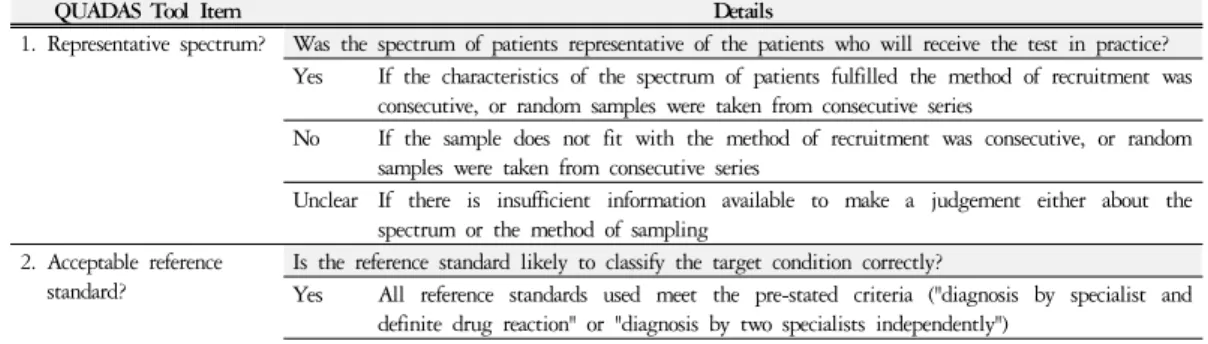
QUADAS Tool Item Details
1. Representative spectrum? Was the spectrum of patients representative of the patients who will receive the test in practice?
Yes If the characteristics of the spectrum of patients fulfilled the method of recruitment was consecutive, or random samples were taken from consecutive series
No If the sample does not fit with the method of recruitment was consecutive, or random samples were taken from consecutive series
Unclear If there is insufficient information available to make a judgement either about the spectrum or the method of sampling
2. Acceptable reference standard?
Is the reference standard likely to classify the target condition correctly?
Yes All reference standards used meet the pre-stated criteria ("diagnosis by specialist and definite drug reaction" or "diagnosis by two specialists independently")
Table 1. QUADAS Tool Used on the Study
I. 緖論
사상의학에 있어 체질진단은 건강상태의 판단과 병증의 진단, 예후의 예측 및 건강관리 등에 있어 전제 되어야 할 조건이다. 설문 분야는 건강측정설문과 같 이 진단도구로서 흔히 사용되고 있어1 사상의학에서 도 설문을 활용한 체질진단 연구는 꾸준히 진행되어 왔다.2
사상체질 진단을 위한 설문지 연구는 1985년 사상 변증론 소고3로부터 시작되어, 사상체질변증내용설 문조사지(Ⅰ)의 작성,4타당화연구가 있었다.5후속 연 구로서 1993년 사상체질분류검사지(QSCC)가 개발, 타당화 연구가 진행되었으며6, 이후 사상체질변증내 용설문조사지(Ⅰ) 중에서 문항적격도가 높은 문항을 QSCC에 첨가하고 설문문항을 전문가와 같이 논의하 는 과정을 거쳐 QSCCⅡ를 개발하고, 이에 대해 표준 화 연구와 타당화 연구가 이뤄졌다.7,8 그러나, QSCCⅡ 의 체질진단 정확률이 51%정도라는 비관적인 연구가 있었고9, 태양인의 진단이 불가능하다는 약점이 지적 되었다.10이러한 문제점을 극복하기 위해 기존설문지 를 중심으로 새로운 사상체질설문지 개발 연구가 있 었으며,11이와는 별개로 체질척도를 개선하고 문항이 축소된 QSCCⅡ+ 개발 연구12 또한 있었다.13그러나 이전에 제기된 문제점들을 완전히 해결하지 못하여 2005년에는 사상체질의학회와 한국한의학연구원이 주축이 되어 의사용 설문지와 환자용 설문지로 구성 된 새로운 사상체질진단 설문지(SSCQ 또는 SDQ)를
개발, 타당성 및 표준화 연구를 진행하였다.14,15 이와 는 독립적인 방향으로, 양인과 음인을 먼저 나누고 이후 단계에서 음인 중에서 태음인과 소음인, 양인 중에서 태양인과 소양인을 나누는 2단계 방식의 설문 (TS-QSCD)연구 또한 있었다.16,17
이상과 같이 다양한 연구가 진행되었으나 각 연구 들의 연구수행방법이나 연구보고방법은 각자 다르게 이루어졌다. 근거중심의학(Evidence Based Medicine)이 전통의료분야에서도 강조되는 현시점에서 설문지를 사용한 사상체질 진단검사의 진단정확률 역시 구체적 근거를 제시하여야 할 필요가 있는데, 각 방법론이 상이하다면 근거력을 담보하기 어렵다. 본 논문에서 는 객관적으로 연구들을 선정하고 각 연구들의 방법 론을 평가하여 향후 보다 나은 진단정확률 연구를 위 한 제안을 하고자 하였다.
Ⅱ. 硏究方法
본 연구에서는 체질진단설문지의 정확률을 보고하 고 있는 연구들을 검색하고, 이를 Quality Assessment of Diagnostic Accuracy Studies (이하 QUADAS) 도구에 근거하여 검토함으로써 기존의 설문지를 사용한 체질 진단 정확률 연구의 방법론을 평가하였다.18 QUADAS 도구란 진단정확률을 보고하는 연구에서 나타날 수 있는 비뚤림 위험 평가 도구 (Risk of bias assessment) 로서 Table 1과 같은 내용으로 이루어졌다.
QUADAS Tool Item Details No diagnosis by only one specialist
Unclear "diagnosis by specialist and unclear drug reaction" or "diagnosis by two specialists dependently"
3. Acceptable delay between tests?
Is the time period between reference standard and index test short enough to be reasonably sure that the target condition did not change between the two tests?
Yes If the time between tests was shorter than 6 months No If the time between tests was longer than 6 months Unclear If information on timing of tests is not provided 4. Partial verification
avoided?
Did the whole sample or a random selection of the sample, receive verification using the intended reference standard?
Yes If all patients, or a random selection of patients, who received the index test went on to receive verification of their status using a reference standard, even if the reference standard was not the same for all patients
No If some of the patients who received the index test did not receive verification of their true state, and the selection of patients to receive the reference standard was not random Unclear If this information is not reported by the study
5. Differential verification avoided?
Did patients receive the same reference standard irrespective of the index test result?
Yes If the same reference standard was used in all patients No If the choice of reference standard varied between individuals Unclear If it is unclear whether different reference standards were used
6. Incorporation avoided? Was the reference standard independent of the index test (i.e. the index test did not form part of the reference standard)?
Yes If the index test did not form part of the reference standard No If the reference standard formally included the result of the index test
Unclear If it is unclear whether the results of the index test were used in the final diagnosis 7. Reference standard results
blinded?
Were the reference standard results interpreted without knowledge of the results of the index test?
Yes If test results (index or reference standard) were interpreted blind to the results of the other test, or blinding is dictated by the test order
No If it is clear that one set of test results was interpreted with knowledge of the other Unclear If it is unclear whether blinding took place
8. Index test results blinded?
Were the index test results interpreted without knowledge of the results of the reference standard?
Yes If test results (index or reference standard) were interpreted blind to the results of the other test, or blinding is dictated by the test order
No If it is clear that one set of test results was interpreted with knowledge of the other Unclear If it is unclear whether blinding took place
9. Relevant clinical information?
Were the same clinical data available when test results were interpreted as would be available when the test is used in practice?
Yes If the clinical data available met the pre-specified criteria (sex, age, hight, weight, BMI) No If clinical data usually available were withheld, or if more information than is usually
available was provided
Unclear If information about the clinical data available was not stated 10. Uninterpretable results
reported?
Were uninterpretable/ intermediate test results reported?
Yes If the number of uninterpretable test results is stated, or if the number of results reported agrees with the number of patients recruited (indicating no uninterpretable test results) No If it states that uninterpretable test results occurred or were excluded and does not report how many Unclear If it is not possible to work out whether uninterpretable results occurred
11. Withdrawals explained? Were withdrawals from the study explained?
Yes If it is clear what happened to all patients who entered the study, for example if a flow diagram of study participants is reported explaining any withdrawals or exclusions, or the numbers recruited match those in the analysis
No If it appears that some of the patients who entered the study did not complete the study, i.e. did not receive both the index test and reference standard, and these patients were not accounted for
Unclear If it is unclear how many patients entered and hence whether there were any withdrawals
1. 연구 선정 기준
검토 대상에 포함될 연구들을 선택하기 위해 다음 과 같은 포함기준을 사전정의하였다.
․연구디자인: 연구디자인에는 제한을 두지 않았다.
․대상자: 한국 성인을 대상으로 하였다. (유소아, 청 소년 및 외국인을 대상으로 한 연구는 제외하였다) 설문개발과 타당성 검토 등을 동시에 보고하는 연 구의 경우 설문지개발을 위한 대상자는 제외하고 타당성 검토 (진단정확률 보고) 에 활용된 인원만을 대상자로 하였다.
․설문종류: 사상체질 진단을 목적으로 하여 활용된 설문지 양식의 검사법을 모두 포함하였다.
․진단대상: 사상체질 중 태음인, 소음인, 소양인의 체질진단을 대상 상태로 하였다. (태양인 진단은 본 연구에서는 제외하였다)
․참고 표준 (Reference standard(s)) : 참고 표준 (Reference standard(s)) 이란 대상이 되는 질환 또는 상태를 확 인하는데 가장 정확하다고 합의된 방법을 말한 다.19본 연구에서는 전문가진단과 이를 뒷받침할 수 있는 구체적 약진기록이 있는 체질진단 및 전문 가 2인 이상의 독립적 체질진단을 참고 표준으로 하였다. 전문가 1인의 진단이 이루어진 경우도 포 함하되 위의 참고 표준과는 구분하였다.
2. 연구 검색 방법
1) 전자 문헌 검색전자 Data Base 문헌검색을 위해서는 아래와 같은 검색전략을 수립하였다.
․문헌검색은 MEDLINE, The Cochrane Library 및 Korean Studies Information Service System (KISS), DBPIA 를 대상으로 하였다.
․모든 검색 자료는 출판된 날짜를 기준으로 1985년 1월부터 2010년 12월 사이의 자료로 한정하였다.
․사용된 언어는 영어와 한국어로 제한하였다.
․진단검사의 정확률 연구 검색에 있어, “민감도 (Sensitivity)”와 “특이도(Specificity)”가 권장되나, 아 직까지는 데이터베이스들에서 일관되게 사용되고 있지 않으며, 또한 진단검사의 정확률이 연구의 첫 번째 목적이 아니어서 감추어져 있는 경우가 있어19 본 연구에서는 광범위한 주제어를 선택하여 검색어 로 Title/Abstract Field에서 영문의 경우 [“con- stitution” AND “diagnosis”] OR [“constitution” AND
“questionnaire”]를 사용하고 국문의 경우 [“체질” AND
“진단”] OR [“체질” AND “설문”]을 사용하였다.
2) 그 외 검색
한의학 주제의 연구들이 전자 데이터베이스에 모 두 정리되어 있지 않은 점을 감안하여, 주요 한의학 관련 저널(사상체질의학회지, 대한한의학회지, 동의 생리병리학회지, 한방내과학회지, 한국한의학연구원 논문집)을 Hand-search하였다.
그리고 전자 문헌 검색 및 Hand-search에서 발견된 논문의 참고문헌 목록 또한 확인하였다. 이 과정에서 발견되는 학위논문 역시 포함하도록 하였다.
3. 연구 선정 및 평가
1) 연구 선정연구의 선별을 위해서, 아래의 기준에 따라 초록 및 본문을 확인하였다.
․사상체질 진단을 위해 설문지를 사용하여 “체질진 단 정확률”(논문에 따라 “일치율”, “정확률”, “진단 정확률”, “감별정확률”, “평균진단정확률”, “정판별 력”, “오분류율” 등)의 결과를 도출한 연구를 대상 으로 하였다.
․설문지를 사용했다 하더라도 “체질진단 정확률”을 보고하지 않은 논문은 제외하였다.
․동일한 설문지를 동일한 대상자에 사용한 복수의 논문은 그 결과를 취합하여 하나의 연구로 취급하 였다.
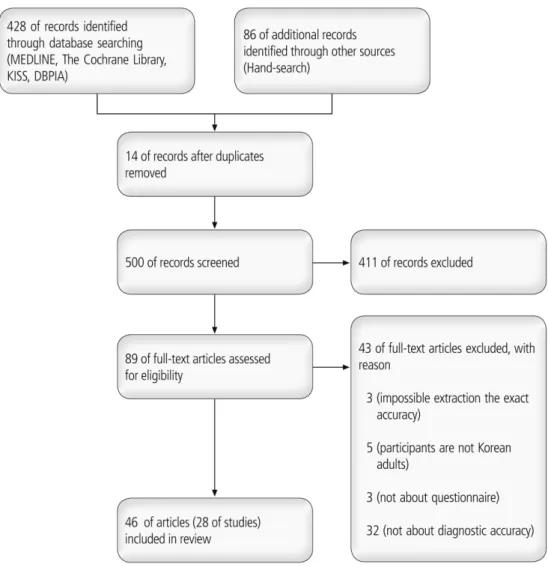
FIgure 1. Study flow diagram: result of the search 상기의 방법으로 두 명의 연구자가 독립적으로 대 상연구를 선택하여 비교하고, 일치하지 않는 점은 논 의를 통한 합의에 따르기로 하였다.
2) 연구 평가
선정된 연구는 QUADAS 도구에 근거하여 사전정 의한 내용에 따라 평가되었다. 그리고 이외에도 각 연구에서 보여주고 있는 체질진단 정확률의 Training/Test 값 여부 또한 확인하였다. 대상이 된 하 나의 표본집단에서 도출된 분석방법 또는 판별식 등
을 동일한 집단에 적용하여 나온 진단정확률을 Training값이라 하고, 전혀 다른 집단에 적용하여 나온 진단정확률을 Test값이라 하는데, Training값은 검사 도구의 내적타당도를 나타내는 반면 Test값은 검사도 구의 외적타당도를 나타내는 값이다. 이상의 평가는 두 명의 독립된 연구자가 독립적으로 수행하였으며, 그 결과가 일치하지 않는 점은 연구자간의 논의를 통 한 합의에 따르기로 하였다.
Study Participants size Questionnaire Type *Training/Test Reference Standard(s)
Beum SG. 2008 2532 SSCQ Training Definite drug reaction
Choi KJ et al.. 2006 587 QSCCⅡ+ Test Definite drug reaction
Jang DM. 2003 344 QSCCⅡ+ Training Others
Jang ES et al.. 2007 255 QSCCⅡ Test Others
Jang ES. 2010 958 †KIOM CRF Training Definite drug reaction
Jung HJ et al.. 2000 53 QSCCⅡ Test Definite drug reaction
Jung SI. 2008 2223 SSCQ Training Others
Kim DL. 1994 65 ‡Song's Test Others
Kim JW et al.. 2006 259 SSCQ Training Definite drug reaction
Kim JW et al..1991 44 Unknown Training Others
Kim KK et al.. 2004 629 QSCCⅡ Test Definite drug reaction
Kim SB et al.. 2000 758 QSCCⅡ Training Others
Kim SH et al.. 1993 63 QSCC Training Others
Kim SH et al.. 1995 244 QSCCⅡ Training Others
Kim TG et al.. 2000 105 §Questionnaire(Ⅲ) Training Others
Kim YW et al.. 1999 75 §Questionnaire(Ⅲ) Test Others
Kim YW et al.. 2003 1051 QSCCⅡ Training Definite drug reaction
Kim YW et al.. 2006 151 TS-QSCD Training Others
Koh BH. 1993 122 QSCC&16PF Training Others
Lee EJ et al.. 1995 328 Survey questionnaire for Sasang identification(Ⅰ) Training Others
Lee JC et al.. 1993 24 QSCC&16PF Training Others
Lee SG et al.. 2003 508 QSCCⅡ Training Others
Park EK et al.. 2001 200 QSCCⅡ only 16 Training Others
Park HS et al.. 2002 217 QSCCⅡ only 7 Training Definite drug reaction
Park SS et al.. 2003 285 QSCCⅡ only 16 Test Others
Ro SH et al.. 1996 601 QSCC Training Others
Seul YK. 2006 398 SSCQ Training Definite drug reaction
Shin DY et al.. 2009 343 TS-QSCD Training Others
* Training/Test: the value of Training set/the value of Test set (Training set: The data used to construct or discover a predictive relationship / Test set: a set of data that is independent of the training data, but that follows the same probability distribution as the training data
†KIOM CRF: CRF of "Construction of Sasang Constitutional Clinical Information collecting system for Scientific Diagnosis" by Korea Institute of Oriental Medicine (KIOM)
‡Song's: Questionnaire from "Song Il-Byung. An Introduction to Sasang Constitutional Medicine. Jimoondang, Seoul. 2005"
§ Questionnaire(Ⅲ): New questionnaire for Sasang constitutional classification (Re-constructed questionnaire using Survey questionnaire for Sasang identification(I) and QSCC II)
Table 2. Summary of Studies in Review
Ⅲ. 結果
1. 연구 선정
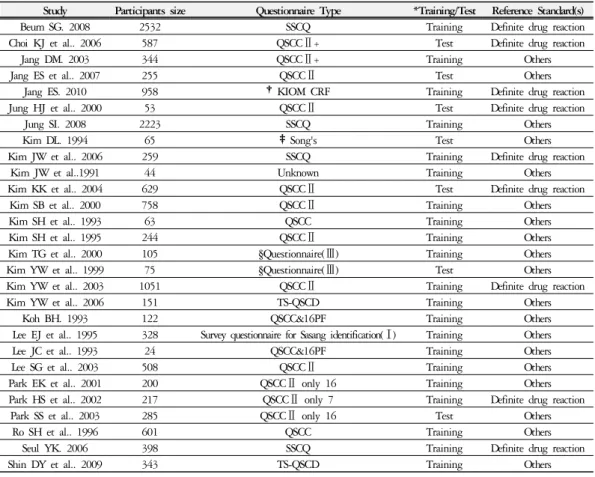
연구 검색 및 선정 과정은 Fig. 1과 같으며, 선정된 연구들은 Table 2와 같다. (선정된 연구 목록과 해당 논문은 부록 참조)
2. 연구 평가
각 연구들을 QUADAS 도구 항목에 따라 평가한
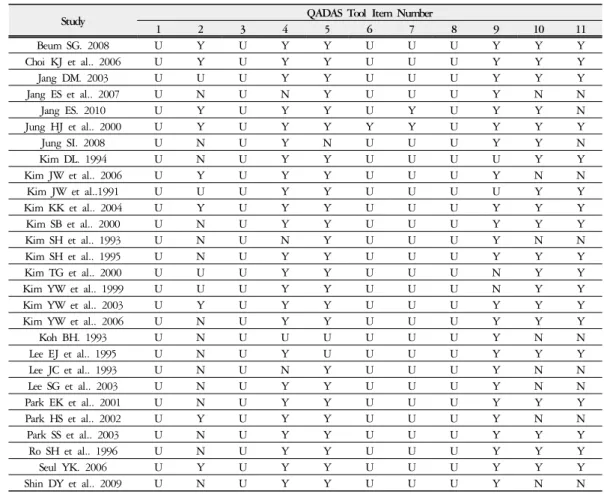
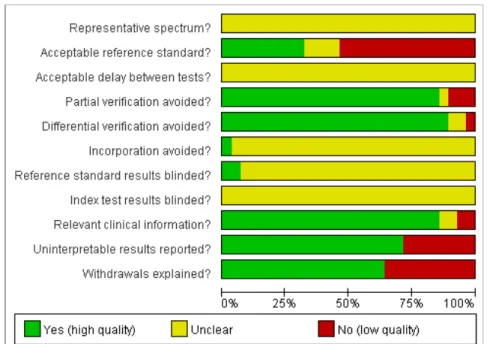
결과는 Table 3과 같으며, 이를 QUADAS 도구 항목별 로 어떠한 비율로 평가되었는지를 표시하면 Fig. 2와 같다.
Partial verification, Differential verification, Relevant clinical information 등 세 가지 항목에 대해서는 비교적 많은 연구에서 잘 기술되어 낮은 비뚤림 위험을 보이고 있다. 반면 Acceptable reference standard, Uninterpretable results reported, Withdrawals explained 등 세 가지 항목 에서는 기술되지 않은 비율이 높아 상대적으로 많은
Study QADAS Tool Item Number
1 2 3 4 5 6 7 8 9 10 11
Beum SG. 2008 U Y U Y Y U U U Y Y Y
Choi KJ et al.. 2006 U Y U Y Y U U U Y Y Y
Jang DM. 2003 U U U Y Y U U U Y Y Y
Jang ES et al.. 2007 U N U N Y U U U Y N N
Jang ES. 2010 U Y U Y Y U Y U Y Y N
Jung HJ et al.. 2000 U Y U Y Y Y Y U Y Y Y
Jung SI. 2008 U N U Y N U U U Y Y N
Kim DL. 1994 U N U Y Y U U U U Y Y
Kim JW et al.. 2006 U Y U Y Y U U U Y N N
Kim JW et al..1991 U U U Y Y U U U U Y Y
Kim KK et al.. 2004 U Y U Y Y U U U Y Y Y
Kim SB et al.. 2000 U N U Y Y U U U Y Y Y
Kim SH et al.. 1993 U N U N Y U U U Y N N
Kim SH et al.. 1995 U N U Y Y U U U Y Y Y
Kim TG et al.. 2000 U U U Y Y U U U N Y Y
Kim YW et al.. 1999 U U U Y Y U U U N Y Y
Kim YW et al.. 2003 U Y U Y Y U U U Y Y Y
Kim YW et al.. 2006 U N U Y Y U U U Y Y Y
Koh BH. 1993 U N U U U U U U Y N N
Lee EJ et al.. 1995 U N U Y U U U U Y Y Y
Lee JC et al.. 1993 U N U N Y U U U Y N N
Lee SG et al.. 2003 U N U Y Y U U U Y N N
Park EK et al.. 2001 U N U Y Y U U U Y Y Y
Park HS et al.. 2002 U Y U Y Y U U U Y N N
Park SS et al.. 2003 U N U Y Y U U U Y Y Y
Ro SH et al.. 1996 U N U Y Y U U U Y Y Y
Seul YK. 2006 U Y U Y Y U U U Y Y Y
Shin DY et al.. 2009 U N U Y Y U U U Y N N
* QADAS Tool Item Number 1. Representative spectrum?
2. Acceptable reference standard?
3. Acceptable delay between tests?
4. Partial verification avoided?
5. Differential verification avoided?
6. Incorporation avoided?
7. Reference standard results blinded?
8. Index test results blinded?
9. Relevant clinical information?
10. Uninterpretable results reported?
11. Withdrawals explained?
* Y: Yes, N: No, U: Unclea
Table 3. Methodological Review Summary
비뚤림 위험성을 보이고 있다. Reference standard 기준 으로 삼은 “전문가진단과 구체적 약진기록” 또는 “전 문가 2인 이상의 독립진단”을 명확히 제시한 경우는 9건의 연구였으며, 15건의 연구에서는 전문가 1인의 진단으로 되어 있었다. 4건의 경우는 체질처방을 사용 하였다고는 기술하고 있으나 기간, 복용량 등을 구체 적으로 명시하지는 않았다. Uninterpretable results re- ported, Withdrawals explained 부분에서는 상세 이유에
대한 기술 없이 최초 참여 피험자와 정확률 보고 피험 자의 총수가 일치하지 않는 경우가 많았다.
Representative spectrum, Acceptable delay between tests, Incorporation avoided, Reference standard results blinded, Index test results blinded 등 다섯 가지 항목에 있어서는 연구 자체에서 전혀 기술하고 있지 않은 경우가 대부 분이었다.
Figure 2. Methodological review graph
Ⅳ. 考察 및 結論
1. 선정된 연구들의 특성 요약
사전 정의된 선택기준에 따라 총 28건의 연구(46건 의 논문)가 선정되었다. 사용된 설문 종류에 따라서는 QSCCⅡ가 10건으로 가장 높은 빈도로 사용되었으며 QSCC와 SSCQ가 각각 4건, QSCCⅡ+, 새로운 설문지 (Ⅲ), TS-QSCD가 각각 2건이었으며, 사상변증내용설 문조사지(Ⅰ), 알기쉬운 사상의학 수록 설문지, KIOM CRF 설문지, 상세불명의 설문지가 각각 1건씩 사용되 었다. 참고 표준(Reference standard(s))으로 ‘전문가진단 과 이를 뒷받침할 수 있는 구체적 약진기록’인 경우가 9건이었다. 나머지 19건은 전문가 1인의 진단을 Reference standard(s)로 적용하고 있었으며 그 가운데 4건은 불명확한 약진을 포함하고 있었고, 1건은 전문 가진단과 QSCCⅡ결과 일치를 사용하고 있었다.
Training/Test 값 여부에 따라서는 Training 값만을 제 시하는 경우가 21건이었으며 Test값을 제시하고 있는 경우는 7건이었다.
2. 사상체질 진단검사 정확률 연구의 방법론에 대한 고찰
본 논문에서 대상이 된 연구들을 진단연구의 연구 방법론을 고찰하여 체질진단 연구에서 간과되는 부분 들에 대해 살펴보면 아래와 같다.
1) 연구 대상자의 모집
연구 대상자에서는 질병의 경중 상태에 의해 발생 할 수 있는 spectrum bias와 대상자 모집에서 발생할 수 있는 selection bias를 방지해야 한다.20이와 같은 임의적 대상자 모집을 방지하기 위해서 일정기간동안 연속된 순서로 대상자를 모두 등록하거나 또는 무작 위 선택 방법이 권고되고 있으나, 본 연구에서의 28건 의 연구는 대상자의 모집 방법에 대해서는 전혀 언급 하고 있지 않았다. 예컨대 동일한 소음인을 진단하기 위해서 대상자를 모집한다 하더라도 소증의 한열상태 가 인위적으로 편중된다면 실제와 다른 진단 정확률 을 보일 것이라고 추정할 수 있다. 이는 다른 체질에서
도 마찬가지로 적용될 수 있기 때문에 spectrum bias와 selection bias를 피하기 위해서는 대상자의 모집 방법 과 아울러 연구디자인을 사전에 명확히 하고 이를 기 술할 필요가 있을 것이다.
2) 적합한 참고 표준 (Reference standard(s))의 선정
진단정확률을 평가하기 위해서는 체질을 이상적으 로 진단할 수 있는 Gold standard(s)가 필요하나 현실 여건상 이를 완전히 만족할 수 있는 참고표준은 아직 존재하지 않는다. 따라서 가장 타당한 방법을 규정하 여 모든 연구의 참고표준을 동일하게 할 필요가 있으 며 이는 연구간 비교 또한 수월하게 할 수 있을 것이다.
본 연구에서는 9건의 연구가 전문가 진단과 구체적인 약진기록을 참고표준으로 하고 있기는 하나 구체적 약진기록의 세부적 내용에서는 복용량, 복용기간, 방 문횟수 등 서로 다른 서술방법을 사용하고 있다. 약진 기록을 참고표준으로 한다 하더라도 보다 구체적으로 일치된 방법을 규정할 필요가 있을 것으로 사료된다.
그리고 다른 측면에서는 약진기록만을 Reference standard(s)로 삼을 경우 모든 연구대상자가 의료기관 에 방문한 환자군이 되기 때문에 이와 같은 표본집단 이 건강한 일반인구집단을 대표할 수 있는지의 문제 가 발생할 수 있다. 이와 같은 문제를 피하기 위해서는 복수 전문가에 의한 독립진단 결과의 일치와 같은 다 른 방안 역시 모색되어야 할 것으로 생각된다.
3) 체질진단 설문검사와 참고 표준
(Reference standard(s))의 시행 시간 간격 시간경과에 의해 대상자의 상태가 달라질 수 있기 때문에 평가대상이 되는 검사와 참고표준은 서로 다 른 시기에 진행되지 않아야 한다. 기본적으로 체질은 선천적이며 불변인 것으로 받아들여지지만 실제 설문 문항을 구성하는 내용 중에는 시점에 따라 달라질 수 있는 신체증상을 포함하고 있기 때문에 이에 대한 고려 역시 어느 정도 필요할 것이다. 현재 많은 수의
연구에서 소증조사의 범위를 6개월 혹은 1년으로 하고 있는데 이에 대한 규정 역시 정할 필요가 있을 것이다.
4) 체질진단 설문검사와 참고 표준 (Reference standard(s))의 상호독립성 설문검사는 참고표준인 전문가 진단의 일부로 사 용되지 않아야 하며, 상호간에 맹검상태로 진행되어 야 한다. 그러나 이 부분 역시 리뷰 대상이 된 연구들에 서 상당 부분 다루어지고 있지 않다. 연구 프로토콜이 먼저 정해지고 진행되는 연구가 아닌, 임상 진료 데이 터를 후향적으로 조사한 연구의 경우 설문결과가 전 문가 진단에 영향을 미치거나 상호간에 맹검이 되지 않는 경우가 많고 이럴 경우 진단율 평가에 있어 과장 된 결과를 가져올 수 있다. 따라서 참고표준이라 할 수 있는 전문가 진단이 설문검사로부터 완전히 독립 되어 있는지, 그리고 상호간에 맹검이 이루어져 있는 지 명확히 하고 기술할 필요가 있다.
5) 불명확한 검사 결과 및 도중 탈락자에 대한 기술 불명확한 검사 결과나 중간 탈락자를 의도적으로 배제하고 진단율을 평가하면 과장된 결과가 나올 수 있기 때문에 이에 대한 명확한 기술이 필요하며 최초 연구에 들어온 대상자들에게 어떠한 상황들이 발생하 였는지 일목요연하게 보여줄 필요가 있다. 그러나 리 뷰 대상이 된 연구들에서 상당수가 이에 대해 기술하 지 않거나 연구 과정상의 내용에 대한 기술 없이 최초 대상자와 진단율 평가에 사용된 대상자 수가 일치하 지 않는 수가 많았다. 일반 치료기술 평가를 위한 임상 연구와 마찬가지로 연구 대상자에 대한 Flow chart를 제시해야 할 것이다.
6) Training/Test 값의 제시
28건 연구 중 75%에 해당하는 21건의 연구들이 Training 값만을 제시하고 있었다. Training 값이란 분 석대상이 되는 표본집단에 기반한 수식 혹은 판별식 을 다시 동일한 표본집단에 적용하여 나온 진단율이
기 때문에 대상집단에서는 최적화된 좋은 결과를 가 져올 수 있으나, 다른 표본집단에 적용했을 때의 결과 인 Test 값을 제시하지 않는다면 그 결과의 외적 타당 도를 확인하기 어렵다. QSCCⅡ에 대한 진단정확률 연구에서 김7은 70.08%라고 보고하고 있으나 박9은 51%미만이라고 보고하고 있는 이유는 전자가 Training 값을 제시하고 있는 것에 비해 후자는 Test 값을 제시하고 있기 때문이다. 무작위 모집단을 대상 으로 한 진단검사로서의 의미를 가지려면 Training값 이 아닌 다른 집단에 적용한 Test값을 통한 평가가 필요하며 진단율 연구에 있어서 Test값을 연구결과로 제시하는 것이 반드시 필요할 것이다.
본 연구에서는 체질진단설문지의 정확률을 보고하 고 있는 연구들을 선정하여, 이를 QUADAS 도구에 근거하여 검토함으로써 기존의 설문지를 사용한 체질 진단 정확률 연구의 방법론을 평가하고 개선점을 모 색하고자 하였다. 이외에도 진단정확률 연구를 보고 하는 논문에는 전술한 내용들을 포함하여 여러 부분 에 있어 서술의 정확성이 필요하다. 정확한 논문서술 을 위해 연구방식에 따라 가이드라인 혹은 체크리스 트가 개발되어 있는데 진단정확률 연구의 경우 The Standards for Reporting of Diagnostic Accuracy (STARD) 체크리스트가 개발되어 있다.21물론 이는 질병진단을 기준으로 한 양방적 체크리스트이지만 이를 토대로 체질진단에 적합한 체크리스트를 구성하는데 기초로 삼을 수 있을 것이다.
이상의 결과로 향후 보다 나은 체질진단 정확률 연구를 진행하는데 있어 도움이 될 수 있으리라 사료 된다.
Ⅴ. 感謝의 글
이 논문은 2012년도 한국한의학연구원 기관목적 사업(No.K12070)의 지원을 받아 수행된 연구입니다.
Ⅵ. 參考文獻
1. Ware JE, Sherbourne CD. The MOS 36-item short-form health survey (SF-36): I. Conceptual framework and item selection. MedCare. 1992;30(6):473-83.
2. Lee SW, Jang ES, Lee J, Kim JY. Current researches on the methods of diagnosing sasang constitution: an overview. eCAM. 2009;6(S1):43-9.
3. Koh BH, Song IB. An essay on pattern identification of Sasang constitution. J Korean Oriental Med. 1985;
6(1):40-7. (Korean)
4. Koh BH, Song IB. Study for pattern identification methodology of Sasang constitution. J Korean Oriental Med. 1987;8(1):146-60. (Korean)
5. Lee EJ, Koh BH, Song IB. The Study on The Validity of "Questionnaire of Sasang Constitution Classification (I)". J Sasang Constitut Med. 1995;7(2):89-100. (Korean) 6. Kim SH, Koh BH, Song IB. A Validation Study of
Questionnaire of Sasang Constitutional Classification (QSCC). J Sasang Constitut Med. 1993;5(1):67-85.
(Korean)
7. Kim SH, Koh BH, Song IB. A study on the stand- ardization of QSCCII (Questionnaire for the Sasang Constitution Classification II). J Sasang Constitut Med.
1995;7(1):187-246. (Korean)
8. Lee JC, Koh BH, Song IB. The Validation Study of the Questionnaire of Sasang Constitution Classification.
J Sasang Constitut Med. 1996;8(1): 247-94. (Korean) 9. Park HS, Ju JC, Kim JH, Kim KY. A Study on clinical
application of the QSCC II (Questionnaire for the Sasang Constitution Classification II). J Sasang Constitut Med. 2002;14(2):35-44. (Korean)
10. Sul YK, Jeon SH, Kwon SD, Kim H, Kim JY, Lee EJ, Kim KK. Importance Analysis of Questionnaire for Doctors and Questionnaire for Patients. J Sasang Constitut Med. 2006;18(3):94-123. (Korean) 11. Kim YW, Kim JW. The Study in Objectification
of the Diagnosis of Sasang Constitution (According to Analysis of the Past Questionnaires). J Sasang Constitut Med. 1999;11(2):151-179. (Korean)
12. Kim SB, Lee JH, Park GS, Jeong YJ, Lee SK, Song IB. A Study on responses to the questionnaire based on of revised Sasang Constitution Classification Ⅱ (QSCCⅡ+). J Sasang Constitut Med. 2001;13(3):
15-22. (Korean)
13. Lee EJ, Kim JW, Kwak CK, Yoo JH, Kim KK, Choi SM. The Analysis of Self-checking Questionnaires for Identifing Sasangin. J Sasang Constitut Med. 2003;
15(3):74-87. (Korean)
14. Yoo JH, Kim JW, Kim KK, Kim JY, Koh BH, Lee EJ. Sasangin diagnosis questionnaire: test of reliability.
J Altern Complement Med 2007;13(1):111-22.
15. Lee SW, Joo JC, Lee SK, Lee HJ, Jang ES. A Study on the Response Differences to the Sasang Constitution Questionnaire by Sasang Constitutions. J Sasang Constitut Med. 2007;19(3):89-98. (Korean)
16. Kim YW, Shin DY, Kim JH, Choi DS, Lim MK, Lee KL, Song JM. A Development of the Two Step Questionnaire for the Sasang Constitution Diagnosis
(TS-QSCD). J Sasang Constitut Med. 2006;18(1):
75-90. (Korean)
17. Shin DY, Song JM. A Study on the Standardization of TS-QSCD. J Sasang Constitut Med. 2009;21(1):
99-126. (Korean)
18. Whiting P, Rutjes AWS, Reitsma JB, Bossuyt PM, Kleijnen J. The development of QUADAS: a tool for the quality assessment of studies of diagnostic accuracy included in systematic reviews. BMC Med Res Methodol 2003,3:25.
19. Mariska M.G. Leeflang, Jonathan J. Deeks, Constantine Gatsonis, Patrick M.M. Bossuyt.
Systematic Reviews of Diagnostic Test Accuracy.
Annals of Internal Medicine 2008;149:889-97.
20. Deeks JJ, Bossuyt PM, Gatsonis C (editor). Cochrane Handbook for Systematic Reviews of Diagnostic Test Accuracy Version 1.0.0. Oxford, UK:The Cochrane Collaboration, 2009.
21. Bossuyt PM, Reitsma JB, Bruns DE, Gatsonis CA, Glasziou PP, Irwig LM, et al. Towards complete and accurate reporting of studies of diagnostic accuracy: the STARD initiative. BMJ 2003;326:41-4.
Appendix
References of Included Studies
Beum SG, 2008
Beum SG. Study on development of classification model and implementation for diagnosis system of Sasang con- stitution [사상체질 분류모형 개발 및 진단시스템 구현에 관한 연구]. 동의대 박사학위논문 2008.
Choi KJ et al., 2006
Choi KJ, Choi YS, Cha JH, Hwang MW, Lee SK, Koh BH, Song IB. A Study on the Reliability and Validity test of the QSCC II+ (Revised Questionnaire for the Sasang Constitution Classification) [개정된 사상체질분류검사 지II의 신뢰도와 타당도에 대한 연구]. Journal of Sasang Constitutional Medicine 2006;18(1):62-74.
Choi KJ. A Study on the Reliability and Validity test of the QSCC II+ (Revised Questionnaire for the Sasang Constitution Classification) [개정된 사상체질분류검사지II (QSCC II+) 의 신뢰도와 타당도에 대한 연구]. 경희 대 석사학위논문 2006.
Jang DM, 2003
Jang DM. The Validation study of the QSCC II+ (revised Questionnaire for the Sasang Constitution Classification II) [개정된 사상체질분류검사지 (QSCC II+) 의 타당화 연구]. 경희대 석사학위논문 2003.
Jang ES et al., 2007
Jang ES, Baek YH, Kim HS, Lee SW. The Study on Sensitivity and Specificity of Sasang Constitution Diagnosis Methods [사상체질 진단법의 민감도와 특이도에 관한 연구]. Korean Journal of Oriental Medicine 2007;13(3):125-131.
Jang ES, 2010
Jang ES. A Development of Sasang Constitution Diagnosis Program based on Characteristics of Body Shape Face Physiological Symptom and Personality [체형 안면 소증 및 성정 특성 기반 사상체질 진단 프로그램 개발].
원광대 박사학위논문 2010.
Jung HJ et al., 2000
Jung HJ, Chou LS, Yoo JY, Shin DE, Han CH. Comparison study on Constitution Classification between QSCC II and Clinical Research [사상체질분류검사지 (QSCC II) 를 이용한 체질감별방법에 대한 비교연구]. Journal of Korean Oriental Medicine 2000;21(4):73-83.
Jung SI, 2008
Jeon SH, Jeong SI, Kwon SD, Park SJ, Kim KK, Kim JW. A Study on the Diagnostic Accuracy Rate of the Sasang Constitution Questionnaire for Doctors Used in the On-line System [온라인 진단시스템에 사용되는 의사용 체질진단함수의 진단정확률 연구]. Journal of Sasang Constitutional Medicine 2008;20(3):82-93.
Jung SI. The study of Diagnosis accuracy rate of Dignostic Questionaire of Sasang constitution for doctors and patients, Used in On-line system [온라인 진단시스템에 사용되는 의사용, 환자용 설문지 사상체질진단함수의 진단정확률연구]. 동의대학교 박사학위논문 2008.
Kim DL, 1994
Kim DL. 설문지를 이용한 체질감별방법의 신뢰도에 관한 연구. Journal of Sasang Constitutional Medicine 1994;6(1):89-94.
Kim JW et al., 2006
Kim JW, Jeong SI, Kim KG, Lee EJ, Kim JY, Lee YT. Validity Study of the Questionnaire for Doctors for Sasang Constitution Diagnosis [의사용 체질진단지의 타당화 연구]. Korean Journal of Oriental Physiology &
Pathology 2006;20(1):209-214.
Kim JW et al.,1991
Cho YT, Song IB. 입원환자 53례의 체질변증을 위한 설문 통계분석 (태음인 중심으로). Journal of Sasang Constitutional Medicine 1991;3(1):105-120.
Kim JW, Koh BH. 입원환자 53례의 체질변증을 위한 설문 통계분석 (소음인, 소양인 중심으로). Journal of Sasang Constitutional Medicine 1991;3(1):89-103.
Kim KK et al., 2004
Kim KK, Kim JW, Lee EJ, Kim JY, Choi SM. Study on Classification Function into Sasang Constitution Using Data Mining Techniques [데이터마이닝 기법을 이용한 사상체질 판별함수에 관한 연구]. Korean Journal of Oriental Physiology & Pathology 2004;18(6):1938-1944.
Kim SB et al., 2000
Jang HL, Lee EJ, Koh BH, Song IB. A study on the validity to make a dignosis of Taeumin by QSCC II (Questionnaire for the Sasang Constitution Classification II) [사상체질분류검사지 (QSCC) II 에 의한 태음인 진단의 타당성 연구]. Journal of Sasang Constitutional Medicine 2001;13(1):45-50.
Jang HL. A study on the validity to make a diagnosis of Taeumin by QSCC II (Questionnaire for the Sasang Constitution Classification II) [사상체질분류검사 (QSCC) II 에 의한 태음인 진단의 타당성 연구]. 경희대
석사학위논문 2001.
Kim SB, Lee SK, Lee EJ, Koh BH, Song IB. A study on the validity to make a diagnosis of Soeumin by QSCC II (Questionnaire for the Sasang Constitution Classification II) [사상체질분류검사지 (QSCC) II 에 의한 소음인 진단의 타당성 연구]. Journal of Sasang Constitutional Medicine 2000;12(2):94-103.
Kim SB. A study on the validity to make a diagnosis of Soeumin by QSCC II (Questionnaire for the Sasang Constitution Classification II) [사상체질분류검사지 (QSCC) II 에 의한 소음인 진단의 타당성 연구]. 경희대 석사학위논문 2001.
Na DW. A Study on the validity to make a diagnosis of Soyangin by QSCC II (Questionnaire for the Sasang Constitution Classification II) [사상체질분류검사 (QSCC II) 에 의한 소양인 진단의 타당성 연구]. 경희대 석사학위논문 2001.
Kim SH et al., 1993
Kim SH. A Validation Study of Questionnaire of Sasang Constitutional Classification (QSCC) [사상체질분류검사 (QSCC) 의 타당화연구]. 경희대 석사학위논문 1992.
Kim SH, Koh BH, Song IB. A Validation Study of Questionnaire of Sasang Constitutional Classification (QSCC) [사상체질분류검사 (QSCC) 의 타당화연구]. Journal of Sasang Constitutional Medicine 1993;5(1):67-85.
Kim SH et al., 1995
Kim SH, Koh BH, Song IB. 사상체질분류검사지 (QSCC) II 의 표준화 연구 -각 체질집단의 군집별 Profile 분석을 중심으로-. Journal of Sasang Constitutional Medicine 1995;7(1):187-246.
Kim SH. A study on the standardization of QSCCII (Questionnaire for the Sasang Constitution Classification II) [사상체질분류검사지 (QSCC) II 의 표준화 연구]. 경희대 박사학위논문 1996.
Kim TG et al., 2000
Kim TG, Kim JW. The Study for clinical application of The New Sasang Constitution Questionnaire [새로운 사상체질 설문지의 임상적 활용에 관한 연구]. Journal of Sasang Constitutional Medicine 2000;12(1):173-185.
Kim YW et al., 1999
Kim YW, Kim JW. The Study in Objectification of the Diagnosis of Sasang Constitution (According to Analysis of the Past Questionnaires) [사상체질진단의 객관화에 관한 연구 (기존 설문지의 분석을 중심으로)]. Journal of Sasang Constitutional Medicine 1999;11(2):151-179.
Kim YW. The Study in Objectification of the Diagnosis of Sasang Constitution (According to Analysis of the Past Questionnaires) [사상체질진단의 객관화에 관한 연구 (기존 설문지의 분석을 중심으로)]. 동의대 석사학위 논문 2000.
Kim YW et al., 2003
Kim YW, Lee EJ, Choi SM, Kim JH, Jung SI, Lee HM, Kim JW. The Study sbout the QSCC II for the Diagnosis of Sasang Constitution (Around the Analysis of Subjects) [사상체질진단을 위한 사상체질분류검사지II (QSCC II) 의 연구 (문항분석을 중심으로)]. Journal of Sasang Constitutional Medicine 2003;15(3):11-21.
Kim YW. The Study About The QSCC II For The Diagnosis of Sasang Constitution [사상체질진단을 위한 사상체질분류검사지II (QSCCII) 의 연구]. 동의대 박사학위논문 2004.
Kim YW et al., 2006
Kim YW, Shin DY, Kim JH, Choi DS, Lim MK, Lee KL, Song JM. A Development of the Two Step Questionnaire for the Sasang Constitution Diagnosis (TS-QSCD) [사상체질 진단을 위한 2단계 설문지 (TS-QSCD) 의 개발 연구]. Journal of Sasang Constitutional Medicine 2006;18(1):75-90.
Kim YW. A Development of the Two Step Questionnaire for the Sasang Constitution Diagnosis (TS-QSCD) [사상체 질 진단을 위한 2단계 설문지 (TS-QSCD) 의 개발 연구]. 2005.
Koh BH, 1993
Koh BH. The Study of Analysis with Sixteen Personality Factor in Sasang Constitution [사상체질별 성격요인분석에 관한 연구]. 대한한의학회지 1993;14(2):64-76.
Lee EJ et al., 1995
Lee EJ, Koh BH, Song IB. The Study on The Validity of "Questionnaire of Sasang Constitution Classification (I)" [사상변증내용 설문조사지 (I) 의 타당화 연구]. Journal of Sasang Constitutional Medicine 1995;7(2):89-100.
Lee EJ. The Study on The Validity of "Questionnaire of Sasang Constitution Classification (I)" [사상변증내용 설문조사지 (I) 의 타당화 연구]. 경희대 석사학위논문 1995.
Lee JC et al., 1993
Lee JC, Koh BH, Song IB. The Validation Study of the Questionnaire of Sasang Constitution Classification:
Comparative Analysis with Sixteen Personality Factor Questionnaire (16PF) [사상체질분류검사의 준거타당화 연구 (성격요인검사-16PF-와의 비교 연구)]. Journal of Sasang Constitutional Medicine 1993;5(1):87-104.
Lee JC. The Validation Study of the Questionnaire of Sasang Constitution Classification: Comparative Analysis with Sixteen Personality Factor Questionnaire (16PF) [사상체질분류검사의 준거타당화 연구 (성격요인검사 -16PF-와의 비교 연구)]. 경희대 석사학위논문 1992.
Lee SG et al., 2003
Lee SG, Kwak CK, Lee EJ, Koh BH, Song IB. The Study on the Upgrade of QSCC II (II) - The study on the re-validity of QSCC II - [사상체질분류검사지 (QSCC II) 의 Upgrade 연구 (II) - 사상체질분류검사지 (QSCC
II) 의 재타당화 연구]. Journal of Sasang Constitutional Medicine 2003;15(1):39-49.
Lee SG. The study on the re-validity of QSCC II (Questionnaire for the Sasang Constitution Classification II) [사상체질분류검사지 (QSCC II) 의 재타당화 연구]. 경희대 석사학위논문.
Park EK et al., 2001
Park EK, Lee YS, Park SS. A study of constitution diagnosis using decision tree method [의사결정나무법을 이용한 체질진단에 관한 연구]. Journal of Sasang Constitutional Medicine 2001;13(2):144-155.
Park HS et al., 2002
Park HS, Ju JC, Kim JH, Kim KY. A Study on clinical application of the QSCC II (Questionnaire for the Sasang Constitution Classification II) [사상체질분류검사지 (QSCC II) 의 임상적 활용에 관한 연구]. Journal of Sasang Constitutional Medicine 2002;14(2):35-44.
Park HS. A Study on clinical application of the QSCC II (Questionnaire for the Sasang Constitution Classification II) [사상체질분류검사지 (QSCC II) 의 임상적 활용에 관한 연구]. 원광대 석사학위논문 2001.
Park SS et al., 2003
Park SS, Choi JY. The Characteristics of Questionnaire Response Using decision tree method [의사결정나무법을 이용한 설문지의 응답특성에 대한 임상적 검토]. Journal of Sasang Constitutional Medicine 2003;15(3):177-186.
Ro SH et al., 1996
Ro SH, Lee EJ, Hong SC, Koh BH, Song IB. 사상체질분류검사의 타당화 방안 모색을 위한 설문조사 결과분석.
Journal of Sasang Constitutional Medicine 1996;8(2):239-253.
Ro SH. The Study on Validity of "Questionnaire of Sasang Constitution Classification" [사상체질분류검사(QSCC)의 타당화 방안 모색을 위한 설문조사 결과분석]. 경희대 석사학위논문 1996.
Seul YK, 2006
Seul YK. The study on sasang constitutional discriminant function through integration study of Questionaire for doctors and patients [의사용, 환자용설문지 통합연구에 의한 사상체질판별함수에 대한 연구]. 동의대 박사학 위논문 2006.
Shin DY et al., 2009
Shin DY, Song JM. A Study on the Standardization of TS-QSCD [사상체질 진단을 위한 2단계 설문지 (TS-QSCD) 의 표준화 연구]. Journal of Sasang Constitutional Medicine 2009;21(1):99-126.
Shin DY. A Study on the Standardization of TS-QSCD [사상체질 진단을 위한 2단계 설문지 (TS-QSCD) 의 표준화 연구]. 우석대 박사학위논문 2008.