Infection &
Chemotherapy
http://dx.doi.org/10.3947/ic.2014.46.4.257 Infect Chemother 2014;46(4):257-260
ISSN 2093-2340 (Print) · ISSN 2092-6448 (Online)
Received: July 25, 2013 Revised: September 17, 2013 Accepted: October 16, 2013 Corresponding Author : Jun Yong Choi, MD, PhD
Department of Internal Medicine, Yonsei University College of Medicine, 50 Yonsei-ro, Seodaemun-gu, Seoul 120-752, Korea
Tel: +82-2-2228-1974, Fax: +82-2-393-6884 E-mail: [email protected]
This is an Open Access article distributed under the terms of the Creative Commons Attribution Non-Commercial License (http://creativecommons.org/licenses/by-nc/3.0) which permits unrestricted non-commercial use, distribution, and repro- duction in any medium, provided the original work is properly cited.
Copyrights © 2014 by The Korean Society of Infectious Diseases | Korean Society for Chemotherapy
www.icjournal.org
A Case of Rectal Squamous Cell Carcinoma with Metachronous Diffuse Large B Cell Lymphoma in an HIV-Infected Patient
Heun Choi
1, Hye Won Lee
1, Hea Won Ann
1, Jae Kyung Kim
1, Hua Pyong Kang
1, Sun Wook Kim
1, Nam Su Ku
1,2, Sang Hoon Han
1,2, June Myung Kim
1,2, and Jun Yong Choi
1,21Department of Internal Medicine, and 2AIDS Research Institute, Yonsei University College of Medicine, Seoul, Korea
Diffuse large B cell lymphoma (DLBCL) is one of the most common acquired immune deficiency syndrome (AIDS)-defining malignancies among human immunodeficiency virus -infected patients, and rectal cancer has recently emerged as a prevalent non-AIDS-defining malignancy. We report a case of rectal squamous cell carcinoma that was metachronous with DLBCL in an HIV-infected patient who was receiving highly active antiretroviral therapy. The patient was diagnosed with DLBCL and showed complete remission after chemotherapy. Follow-up imaging showed increased uptake at the rectum, previously treated as lym- phoma. Repeated biopsy was performed and squamous cell carcinoma of the rectum was reported. After concurrent chemora- diation therapy, curative resection was performed.
Key Words: HIV; AIDS-related lymphoma; Squamous cell carcinoma; Oncogenic viruses
Case Report
Introduction
Human immunodeficiency virus (HIV) infection can cause defects in cell-mediated immunity, and these defects increase the incidence of various malignancies [1]. Acquired immune deficiency syndrome (AIDS)-defining malignancies include Kaposi’s sarcoma, non-Hodgkin’s lymphoma, primary central nervous system lymphoma, and invasive cervical cancer [2].
Highly active antiretroviral therapy (HAART) has led to a dra- matic decrease in AIDS-related mortality as well as the inci-
dence of opportunistic infections and AIDS-defining malig- nancies [3]. However, many cancers not previously identified as AIDS-defining malignancies are now emerging as import- ant causes of death in persons living with HIV [4-6]. Such non-AIDS-defining malignancies include anal, liver, skin, and other cancers.
The mechanisms underlying increased cancer risk are not completely understood. An increased prevalence of oncogen- ic viral coinfection can explain the higher incidence of partic- ular cancers such as liver, cervical, and anal cancer, as well as
Choi H, et al. • Metachromous rectal squamous cell carcinoma in an HIV infected patient www.icjournal.org
258
non-Hodgkin’s lymphoma.
In South Korea, there are no clear patterns in the relative in- crease of non-AIDS-defining malignancies and the reduction of AIDS-defining malignancies after HAART [7, 8]. Non-Hod- gkin’s lymphoma is most frequently observed in AIDS-defin- ing malignancies, and gastrointestinal malignancies are com- mon among non-AIDS-defining malignancies [8]. Although men who have sex with men (MSM) are at highest risk for HIV acquisition in South Korea, the anal cancers associated with HPV infection are rarely reported. The concurrence of non-Hodgkin’s lymphoma and squamous cell carcinoma in the rectum in HIV-infected MSM has not been reported yet.
We report a case of rectal squamous cell carcinoma that oc- curred with metachronous diffuse large B cell lymphoma in an HIV-infected MSM.
Case Report
A 51-year-old homosexual male with 10-year history of HIV infection presented to the emergency department with com- plaints of repeated bloody stool (three instances). He had re- ceived HAART, but his HAART treatment regimen had to be
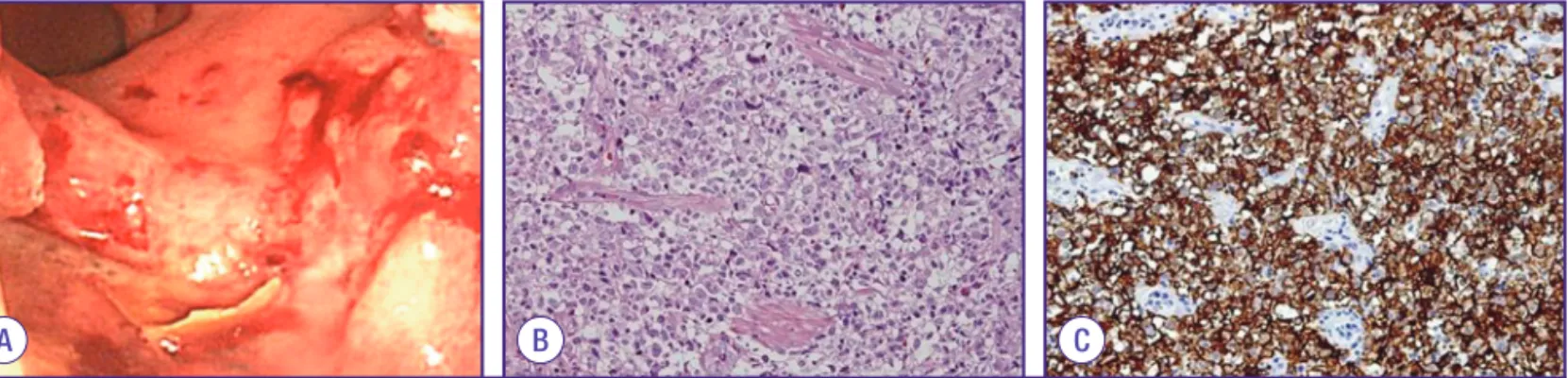
altered several times due to adverse events, poor adherence and virologic failure. He was taking lamivudine, stavudine, lopinavir-ritonavir and abacavir at the time of admission. He had no history of opportunistic infections since his diagnosis in 1997. He denied any symptoms, including fevers, chills, night sweats or weight loss, except hematochezia. On physical examination, the abdomen was soft and there were no palpa- ble masses or tenderness. He had a notable mass on digital rectal examination. His CD4+ T cell count was 116/mm3, and his HIV viral load was 2,730 copies/mL. Epstein Barr virus (EBV) polymerase chain reaction (PCR) showed 27,750 cop- ies/mL. Sigmoidoscopy demonstrated a 75% circumferential ulceroinfiltrative lesion in the rectum and a biopsy was per- formed (Fig. 1A). Pathologic diagnosis was diffuse large B-cell lymphoma with CD20 (+), CD3 (-), cytokeratin (-), and Ki-67 (90%) (Fig. 1B and C). The staging work-up including a bone marrow study revealed lymphoma of the anorectum, naso- pharynx, upper neck lymph node, and bone marrow with Ann Arbor stage IV in July 2007. Chemotherapy was initiated with a regimen of rituximab combined with etoposide, vincristine, doxorubicin, cyclophosphamide, and prednisone for 4 cycles, and vincristine, doxorubicin, cyclophosphamide, and for 2 cy- cles. The patient achieved complete remission in February 2008.
Figure 1. (A) 75% circumferential ulceroinfiltrative lesion in the rectum. (B) H&E stain (×400): Diffuse large B-cell lymphoma. (C) Immunohistochemical stain: CD 20 positive.
A B C
Figure 2. (A) Ulcerative polypoid lesion in the rectum. (B) H&E stain (×200): Squamous epithelial dysplasia, high grade. (C) H&E stain (×400): Squa- mous cell carcinoma.
A B C
http://dx.doi.org/10.3947/ic.2014.46.4.257 • Infect Chemother 2014;46(4):257-260
www.icjournal.org 259
Positron emission tomography-computed tomography per- formed in December 2011 showed higher fluorodeoxyglucose uptake in the rectum. In January 2012, a sigmoidoscopy and bi- opsy were performed and the pathologic diagnosis was high- grade squamous epithelial dysplasia (Fig. 2A and B). There was no continuity between rectal lesion and anal epithelium. At that time, the patient’s HIV viral load titer was 80 copies/mL, and his CD4+ T cell count was 312/mm3 with a regimen of lamivu- dine-abacavir, darunavir, ritonavir and etravirine. Well-differen- tiated squamous cell carcinoma could not be ruled out and the clinical stage was T2N1M0, IIIA. Concurrent chemoradiation therapy was initiated with 5-fluorouracil and mitomycin C. After treatment, there was no evidence of disease.
In February 2013, follow-up sigmoidoscopy showed a re- curred mass in the rectum. Well-differentiated squamous cell carcinoma was diagnosed with sigmoidoscopic biopsy and the patient was treated with laparoscopic-assisted abdomino- perineal resection (Fig. 2C); the pathologic stage was deter- mined to be T2N0M0, I. The patient continued to visit the out- patient department after discharge without significant complaint or sign of recurrence.
Discussion
In the past, opportunistic infection was the main cause of death in HIV-infected patients; however, with the advent of HAART, HIV-infected patients are surviving for much longer and instead are facing chronic diseases such as cardiovascular disease, liver disease, and cancer [6]. HAART has led to a great decrease in the incidence of opportunistic infections and AIDS-defining malignancies [3]. In the HAART era, we can as- sume a decrease in the proportion of AIDS-defining malignan- cies, but an increase in non-AIDS-defining malignancies [9, 10].
In South Korea, there has been no evidence of change in the incidence of AIDS-defining malignancies or non-AIDS-defin- ing malignancies [7, 8]. Seol et al. investigated the prevalence of malignancies in HIV-infected patients, and reported similar incidence of AIDS-defining and non-AIDS-defining malignan- cies during the pre-HAART and HAART period, respectively [8].
Cancer occurred in 27 (4%) out of 683 HIV-infected persons.
Choe et al. reported approximately the same prevalence with cancer occurring in 33 patients (3.75%) out of 850 patients [7].
Choe et al. did not draw any conclusion about whether the in- cidence of AIDS-defining malignancies decreased after HAART, however, because of the small size of the study popu- lation. Two studies from South Korea showed only 3 rectal ad-
enocarcinoma cases among 59 HIV-infected patients with malignancies [7, 8]. One anal squamous cell carcinoma was reported but rectal squamous cell carcinoma was not report- ed.
The majority of colorectal malignancies both in the general population and among HIV-infected patients are adenocarci- nomas. However, higher proportions of other cancer histologies were identified unlike those seen in the general population [11].
Compared to the general population, more HIV-infected pa- tients were diagnosed with squamous cell carcinoma (2.5% vs.
0.04%, respectively), small cell carcinoma (1.6% vs. 0.08%, re- spectively), and leiomyosarcoma (0.9% vs. 0.04%, respectively).
HIV infection increases susceptibility to virally promoted cancers such as Burkitt’s lymphoma and Hodgkin’s lymphoma (EBV infection), Kaposi’s sarcoma (human herpesvirus-8 [HHV- 8] infection), and anogenital carcinoma (HPV infection) [12].
Several HPV types have been known as the oncogenic agents responsible for the cervical squamous carcinomas. Molecular mechanisms for HPV-associated carcinogenesis have been de- scribed, mediated by HPV E6 and E7 oncoproteins [13]. Recent studies reported that the most common HPV type detected in anal squamous cell carcinoma is HPV 16, but non HPV 16 sub- types were also detected [11, 14, 15]. Unfortunately, in this case, PCR test for HPV was not performed.
In the present case, the CD4+ T cell count was 116/mm3 at DLBCL diagnosis and 312/mm3 at squamous cell carcinoma diagnosis, respectively. A CD4+ T cell count below 200/mm3 was reported to have a meaningful relationship with the oc- currence of malignancy in Choe’s study [7]. There was an in- crease in the proportion of patients with CD4+ T cell counts above 200/mm3, which emphasizes the risk of malignancy, even in the context of immune reconstitution [16]. It is clear that the importance of early diagnosis and prevention of can- cer in HIV-infected patients should be emphasized.
Non-AIDS-defining malignancy such as HPV-associated anorectal cancer is an emerging problem for HIV-infected persons in South Korea. The screening and prevention of can- cers should be included in the clinical care of HIV-infected in- dividuals.
Acknowledgment
This research was supported by the Basic Science Research- Program through the National Research Foundation of Korea (NRF) funded by the Ministry of Education, Science and Tech- nology (NRF-2013R1A1A2005412).
Choi H, et al. • Metachromous rectal squamous cell carcinoma in an HIV infected patient www.icjournal.org
260
References
1. Goedert JJ, Coté TR, Virgo P, Scoppa SM, Kingma DW, Gail MH, Jaffe ES, Biggar RJ. Spectrum of AIDS-associated ma- lignant disorders. Lancet 1998;351:1833-9.
2. Anonymous. 1993 revised classification system for HIV in- fection and expanded surveillance case definition for AIDS among adolescents and adults. MMWR Recomm Rep 1992;41:1-19.
3. Palella FJ Jr., Baker RK, Moorman AC, Chmiel JS, Wood KC, Brooks JT, Holmberg SD; HIV Outpatient Study Inves- tigators. Mortality in the highly active antiretroviral thera- py era: changing causes of death and disease in the HIV outpatient study. J Acquir Immune Defic Syndr 2006;43:27- 34.
4. Patel P, Hanson DL, Sullivan PS, Novak RM, Moorman AC, Tong TC, Holmberg SD, Brooks JT; Adult and Adolescent Spectrum of Disease Project and HIV Outpatient Study In- vestigators. Incidence of types of cancer among HIV-Infect- ed persons compared with the general population in the United States, 1992-2003. Ann Intern Med 2008;148:728- 36.
5. Crum-Cianflone N, Hullsiek KH, Marconi V, Weintrob A, Ganesan A, Barthel RV, Fraser S, Agan BK, Wegner S.
Trends in the incidence of cancers among HIV-infected persons and the impact of antiretroviral therapy: a 20-year cohort study. AIDS 2009;23:41-50.
6. Sackoff JE, Hanna DB, Pfeiffer MR, Torian LV. Causes of death among persons with AIDS in the era of highly active antiretroviral therapy: New York City. Ann Intern Med 2006;145:397-406.
7. Choe PG, Song JS, Cho JH, Kim SH, Park KH, Bang JH, Park WB, Kim HB, Kim DW, Kim TY, Heo DS, Oh MD, Kim NJ, Choe KW. Malignancies in patients with human im- munodeficiency virus infection in South Korea. Infect Chemother 2006;38:367-73.
8. Seol YM, Song MG, Choi YJ, Lee SH, Kim SI, Chung JS, Kwak IS, Cho GJ, Lee H, Jung DS, Moon CS, Park JY. Trends in cancer risk among South Korean patients infected with hu-
man immunodeficiency virus. Korean J Med 2009;76:554- 63.
9. Besson C, Goubar A, Gabarre J, Rozenbaum W, Pialoux G, Châtelet FP, Katlama C, Charlotte F, Dupont B, Brousse N, Huerre M, Mikol J, Camparo P, Mokhtari K, Tulliez M, Salmon-Céron D, Boué F, Costagliola D, Raphaël M.
Changes in AIDS-related lymphoma since the era of high- ly active antiretroviral therapy. Blood 2001;98:2339-44.
10. Matthews GV, Bower M, Mandalia S, Powles T, Nelson MR, Gazzard BG. Changes in acquired immunodeficiency syn- drome-related lymphoma since the introduction of highly active antiretroviral therapy. Blood 2000;96:2730-4.
11. Varnai AD, Bollmann M, Griefingholt H, Speich N, Schmitt C, Bollmann R, Decker D. HPV in anal squamous cell car- cinoma and anal intraepithelial neoplasia (AIN). Impact of HPV analysis of anal lesions on diagnosis and progno- sis. Int J Colorectal Dis 2006;21:135-42.
12. Fakhry C, D'Souza G, Sugar E, Weber K, Goshu E, Minkoff H, Wright R, Seaberg E, Gillison M. Relationship between prevalent oral and cervical human papillomavirus infec- tions in human immunodeficiency virus-positive and -negative women. J Clin Microbiol 2006;44:4479-85.
13. zur Hausen H. Papillomaviruses causing cancer: evasion from host-cell control in early events in carcinogenesis. J Natl Cancer Inst 2000;92:690-8.
14. Cornall AM, Roberts JM, Garland SM, Hillman RJ, Grulich AE, Tabrizi SN. Anal and perianal squamous carcinomas and high-grade intraepithelial lesions exclusively associ- ated with "low-risk" HPV genotypes 6 and 11. Int J Cancer 2013;133:2253-8.
15. Wong AK, Chan RC, Aggarwal N, Singh MK, Nichols WS, Bose S. Human papillomavirus genotypes in anal intraep- ithelial neoplasia and anal carcinoma as detected in tissue biopsies. Mod Pathol 2010;23:144-50.
16. Barclay LR, Buskin SE, Kahle EM, Aboulafia DM. Clinical and immunologic profile of AIDS-related lymphoma in the era of highly active antiretroviral therapy. Clin Lym- phoma Myeloma 2007;7:272-9.