www.e-enm.org
Prognosis of Differentiated Thyroid Carcinoma with Initial Distant Metastasis: A Multicenter Study in Korea
Hosu Kim1,2, Hye In Kim1,*, Sun Wook Kim1, Jaehoon Jung2, Min Ji Jeon3, Won Gu Kim3, Tae Yong Kim3, Hee Kyung Kim4, Ho-Cheol Kang4, Ji Min Han5, Yoon Young Cho6, Tae Hyuk Kim1, Jae Hoon Chung1
1Division of Endocrinology and Metabolism, Department of Medicine, Thyroid Center, Samsung Medical Center,
Sungkyunkwan University School of Medicine, Seoul; 2Division of Endocrinology, Department of Medicine, Gyeongsang National University Changwon Hospital, Gyeongsang National University School of Medicine, Changwon; 3Division of Endocrinology and Metabolism, Department of Internal Medicine, Asan Medical Center, University of Ulsan College of Medicine, Seoul; 4Division of Endocrinology and Metabolism, Department of Internal Medicine, Chonnam National University Medical School, Gwangju; 5Division of Endocrinology and Metabolism, Department of Medicine, Samsung Changwon Hospital, Sungkyunkwan University School of Medicine, Changwon; 6Division of Endocrinology and Metabolism, Department of Medicine, Gyeongsang National University Hospital, Gyeongsang National University School of Medicine, Jinju, Korea Background: Most patients with differentiated thyroid cancer (DTC) have a favorable prognosis. However, patients with DTC and initial distant metastasis have not been commonly found, and their clinical characteristics have seldom been reported. In this study, we analyzed the clinical features and prognosis of patients with DTC and initial distant metastasis in Korea.
Methods: We retrospectively reviewed the clinical data of 242 patients with DTC and initial distant metastasis treated from 1994 to 2013, collected from five tertiary hospitals in Korea.
Results: The patients’ median age was 51 years, and 65% were women. They were followed for a median of 7 years. Lung was the most common site of distant metastasis: only lung 149 patients (62%), only bone 49 (20%), other single site one (pleura), and com- bined sites 43 (40 were lung and bone, two were bone and other site, and one was lung and other site). At the time of diagnosis, 50 patients (21%) had non-radioactive iodine (RAI) avidity. Five-year disease-specific survival (DSS) was 85% and 10-year DSS was 68%, which were better than those in previous studies. After multivariate analysis, old age, male sex, metastatic site, and histologic type (follicular type) were significant factors for poor prognosis. However, negative RAI avidity status was not a significant prog- nostic factor after adjusting for other variables.
Received: 30 January 2018, Revised: 3 May 2018, Accepted: 10 May 2018 Corresponding authors: Jae Hoon Chung
Division of Endocrinology and Metabolism, Department of Medicine, Thyroid Center, Samsung Medical Center, Sungkyunkwan University School of Medicine, 81 Irwon-ro, Gangnam-gu, Seoul 06351, Korea
Tel: +82-2-3410-3434, Fax: +82-2-3410-3849, E-mail: [email protected] Tae Hyuk Kim
Division of Endocrinology and Metabolism, Department of Medicine, Thyroid Center, Samsung Medical Center, Sungkyunkwan University School of Medicine, 81 Irwon-ro, Gangnam-gu, Seoul 06351, Korea
Tel: +82-2-3410-6049, Fax: +82-2-3410-3849, E-mail: [email protected]
*Current affiliation: Division of Endocrinology and Metabolism, Department of Medicine, Samsung Changwon Hospital, Sungkyunkwan University School of Medicine, Changwon, Korea
Copyright © 2018 Korean Endocrine Society
This is an Open Access article distributed under the terms of the Creative Com- mons Attribution Non-Commercial License (http://creativecommons.org/
licenses/by-nc/4.0/) which permits unrestricted non-commercial use, distribu- tion, and reproduction in any medium, provided the original work is properly cited.
INTRODUCTION
Papillary thyroid carcinoma (PTC) and follicular thyroid carci- noma (FTC) are often referred to together as differentiated thy- roid cancer (DTC). Recently, the incidence of DTC has been in- creasing worldwide [1-3]. Despite the increase in incidence, most patients with DTC have a favorable prognosis [4,5]. How- ever, 1% to 9% of patients with DTC present with distant me- tastasis at the time of diagnosis, and the mortality rate is signifi- cantly higher when initial distant metastasis is present [6-9].
Previous studies of DTC with distant metastasis show incon- sistent results. Long-term survival rates range from 13% to 100% [9-12]. This difference is thought to be due to heterogene- ity among patients. Because of the rarity of the disease, most of the previous studies did not distinguish distant metastasis at ini- tial diagnosis from distant metastasis found during follow-up.
However, these two groups had different disease entities, dis- ease characteristics, and prognoses [10]. Furthermore, primary tumor histology and site of distant metastasis are associated with different disease characteristics and prognosis [8,9,13,14].
Therefore, enrollment of a homogenous group is necessary to evaluate the disease characteristics more clearly.
The epidemiology of thyroid cancer has recently been chang- ing [15,16]. Earlier diagnoses of thyroid cancer have increased since the introduction of high-resolution ultrasound sonography.
New therapeutic modalities, such as tyrosine kinase inhibitors (TKIs), have been developed for the treatment of radioactive io- dine (RAI)-refractory DTC [17,18]. Therefore, the current prog- nosis of DTC with distant metastasis might be different from the past. In this study, we analyzed the clinical characteristics and long-term prognoses of Korean patients with DTC and ini- tial distant metastasis.
METHODS
We reviewed the clinical data of 242 patients with DTC and ini- tial distant metastasis at the time of diagnosis that had been treated between 1994 and 2013 at Samsung Medical Center, Asan Medical Center, Chonnam National University Hwasun Hospital, Samsung Changwon Hospital, and Gyeongsang Na-
tional University Hospital. Duplicated patients were identified by chart review and were treated as one person at the time of analysis. The Institutional Review Board at each participating hospital approved this study (IRB number: SMC 2017-02-058, IRB 2017-0601, CNUHH-2017-069, SCMC2017-11-001, 2017-10-009). Informed consent was waived due to retrospec- tive design.
Initial distant metastasis was defined as distant metastasis de- tected before or within 6 months after initial treatment. Distant metastasis was found by pathological confirmation or imaging studies such as whole-body scan (WBS), computed tomography (CT), magnetic resonance imaging, bone scan, or positron emis- sion tomography (PET) scans [19]. Distant metastasis was clas- sified according to the metastatic site: (1) only lung, (2) only bone, (3) combined, and (4) other site metastasis. Lung metasta- sis included micronodular (smaller than 1 cm), macronodular (larger than 1 cm), and miliary lung metastasis. Bone metastasis included solitary or multiple bone metastases. The combined group included cases where two or more different metastatic sites were found. Iodine avidity was determined by visual up- take in the known site of metastatic disease by WBS after RAI therapy [8].
Various factors that influence distant metastasis were re- viewed for analysis. Age at initial diagnosis, gender, histologic finding of thyroid cancer after surgery, data on additional thera- py for distant metastasis, and RAI avidity of the metastatic site were included for analysis. Histologic findings of thyroid cancer included primary tumor histology (PTC, FTC, Hürthle cell car- cinoma [HTC]), tumor size, lymph node metastasis, extrathy- roidal extension, involvement of resection margin, and lympho- vascular invasion. Additional therapy included RAI therapy, TKI, external radiotherapy, and systemic chemotherapy. Dis- ease-specific death and survival were used for prognostic analy- sis.
Statistical analysis
Continuous data were expressed as mean±standard deviation.
Data on categorical characteristics were expressed as percent values or absolute numbers. For comparisons of clinical and pathological characteristics between the initial distant metasta- Conclusion: The prognosis of Korean patients with DTC and initial distant metastasis was better than in previous studies. Old age, male sex, metastasis site, and histologic type were significant prognostic factors.
Keywords: Differentiated thyroid cancer; Neoplasm metastasis; Radioactive iodine; Prognosis
www.e-enm.org sis groups, a chi-sqaure test was used for categorical data and t test was used for continuous data. A multivariate Cox propor- tional hazard model applying the backward elimination method was used to identify factors associated with disease-specific death. P<0.05 was considered significant. Statistical analysis was performed using SPSS software version 23 (IBM Co., Ar- monk, NY, USA).
RESULTS
Baseline characteristics
We studied 242 Korean patients with DTC and initial distant metastasis. The incidence of initial distant metastasis was 0.7%
during the study period. The baseline characteristics of enrolled patients are shown in Table 1. Their median age was 51.0±17.1 years with a range from 13 to 79 years, and 65% were women.
They were followed for a median of 7 years (interquartile range, 4.1 to 10.1). PTC was diagnosed in 175 patients (72%), FTC in 62 (26%), and HTC in five (2%). Among PTC subtypes, classic PTC was 147, follicular variant PTC was six, and other type of PTC was six. The median primary tumor size representing ini- tial distant metastasis was 2.8 cm (interquartile range, 0.1 to 11.5). Gross extrathyroidal extension was found in 87 patients (36%), and positive resection margin was detected in 69 patients (29%). Nearly all patients had undergone total thyroidectomy (97%) and RAI therapy (99%), respectively.
Characteristics of initial distant metastasis
Of the 242 enrolled patients, 149 (62%) were classified as only lung metastasis, 49 patients (20%) were classified as only bone metastasis, and 43 patients (18%) were classified as combined metastasis. One patient presented with only pleural metastasis.
Among other site metastasis except lung and bone, three pa- tients showed pleural metastasis and one patient showed brain metastasis. Pleural metastasis was found in CT and brain metas- tasis was found in PET CT.
Among the only lung metastasis group, 87 patients (58%) were classified with micronodular lung metastasis, 24 (16%) with macronodular lung metastasis, and 38 (26%) with miliary metastasis. Among the only bone metastasis group, 17 patients (35%) were classified with single bone metastasis and 32 (65%) with multiple bone metastases (Fig. 1). The combined metasta- sis group included 40 patients with lung and bone, two with bone and other site, and one with lung and other site metastasis.
Only lung metastasis was more frequent in PTC than in FTC (79% vs. 13%, P<0.001), and only bone metastasis was more Table 1. Baseline Characteristics of Differentiated Thyroid Can-
cer Patients with Initial Distant Metastasis
Characteristic Total enrolled patients
Age, yr 51.0±17.1
Female sex 157 (64.9)
Type of thyroid surgery
Total thyroidectomy 234 (96.7)
Lobectomy 8 (3.3)
RAI treatment
Yes 240 (99.2)
No 2 (0.8)
Initial neck dissection
No 37 (15.3)
Yes 205 (84.7)
Tumor histology
PTC 175 (72.3)
FTC 62 (25.6)
HTC 5 (2.1)
Tumor size, cm 2.8±2.0
ETE
No 61 (25.1)
Microscopic ETE 94 (38.9)
Gross ETE 87 (36.0)
Resection margin
Positive 69 (28.5)
Negative 173 (71.5)
No. of resected LN 17.5±25.8
No. of initial LN metastasis 6.0±11.2 Lymphatic invasion
Yes 70 (28.9)
No 172 (71.1)
Vascular invasion
Yes 45 (18.6)
No 197 (81.4)
T stage
T1 64 (26.4)
T2 79 (32.6)
T3a 50 (20.7)
T3b 33 (13.6)
T4a 11 (4.5)
T4b 4 (1.7)
N stage
N0 77 (31.8)
N1a 38 (15.7)
N1b 126 (52.1)
Values are expressed as mean±SD or number (%).
RAI, radioactive iodine; PTC, papillary thyroid carcinoma; FTC, follic- ular thyroid carcinoma; HTC, Hürthle cell carcinoma; ETE, extrathy- roidal extension; LN, lymph node.
242 Initial distant metastasis group
149 Lung metastasis only (61.6%)
24 Macro (16.1%) 87 Micro
(58.4%) 38 Miliary
(25.5%) 17 Solitary
(34.7%) 32 Multiple
(65.3%) 1 Pleura (100%) 49 Bone metastasis only
(20.3%) 1 Other site
(0.4%) 43 Initial combined metastasis
(17.8%) Lung and bone: 40 Bone and other: 2 Lung and other: 1
Fig. 1. Classification of initial distant metastasis in this study. A total of 242 patients were diagnosed with initial distant metastasis. Patients were classified according to site of distant metastasis. Diagnoses were as follows: 149 with lung only, 49 with bone only, and 43 with com- bined metastasis. One patient was diagnosed with other site only metastasis. Lung metastasis was subdivided into micronodular, macronod- ular, and miliary metastasis. Bone metastasis was subdivided into solitary and multiple metastases.
100
50
0
100
50
0
100
50
0
100
50
0
100
50
0
Survival (%)Survival (%)Survival (%) Survival (%)Survival (%)
Follow-up time (yr)
Follow-up time (yr)
Follow-up time (yr)
Follow-up time (yr)
Follow-up time (yr) Age <55
PTC
Lung only metastasis
Female
RAI avid
(5 years survival rate: 93.5%)
(5 years survival rate: 87.9%)
(5 years survival rate: 87.4%)
(5 years survival rate: 86.8%)
(5 years survival rate: 87.5%) (5 years survival rate: 70.0%)
(5 years survival rate: 71.7%)
(5 years survival rate: 81.8%) (5 years survival rate: 63.9%)
(5 years survival rate: 78.3%)
(5 years survival rate: 73.3%) Log rank test P<0.001
Log rank test P<0.001
Log rank test P<0.001
Log rank test P=0.002
Log rank test P<0.001
Age >55
FTC
Bone only metastasis Combined metastasis
Male
Non-RAI avid DSD according to age
DSD according to primary tumor histology
DSD according to metastatic site
DSD according to sex
DSD according to RAI avidity 5 10 15 20
5 10 15 20
5 10 15 20
5 10 15 20
5 10 15 20
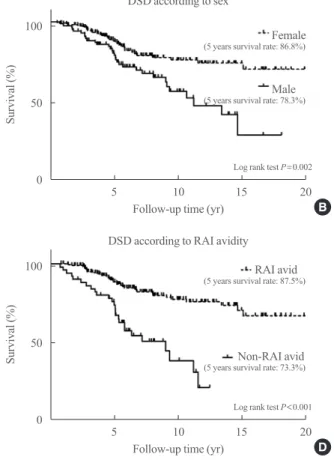
Fig. 2. Survival analysis according to risk factors in patients with differentiated thyroid carcinoma and initial distant metas- tasis. A Kaplan-Meier analysis and log-rank test were used to evaluate the risk factors for disease-specific death (DSD). (A) Age (>55 years), (B) male sex, (C) tumor histology (follicular thyroid carci noma [FTC] rather than papillary thyroid carcino- ma [PTC]), (D) radioactive iodine (RAI) avidity (non-RAI avidity), and (E) metastatic site were sig nificant risk factors for DSD. HTC, Hürthle cell carcinoma.
A
C
E
B
D HTC
www.e-enm.org frequent in FTC than in PTC (50% vs. 8%, P<0.001).
Among 242 patients, 50 (21%) had non-RAI avidity. Accord- ing to the metastatic site, 25 of the patients (17%) with only lung metastasis, six of the patients (12%) with only bone metas- tasis, 18 of the patients (42%) with combined metastasis, and one of the patients with pleural metastasis had non-RAI avidity, respectively. The combined metastasis group (42%) had a high- er rate of non-RAI avidity than the other lung and bone only groups.
Treatment response and survival characteristics
A total of 240 patients (99%) had undergone initial RAI therapy.
Two patients were not treated with RAI for personal reasons.
TKI was used in 20 patients (8%) and systemic chemotherapy in 10 patients (4%). External radiotherapy was performed on 54 patients (22%) with bone metastasis.
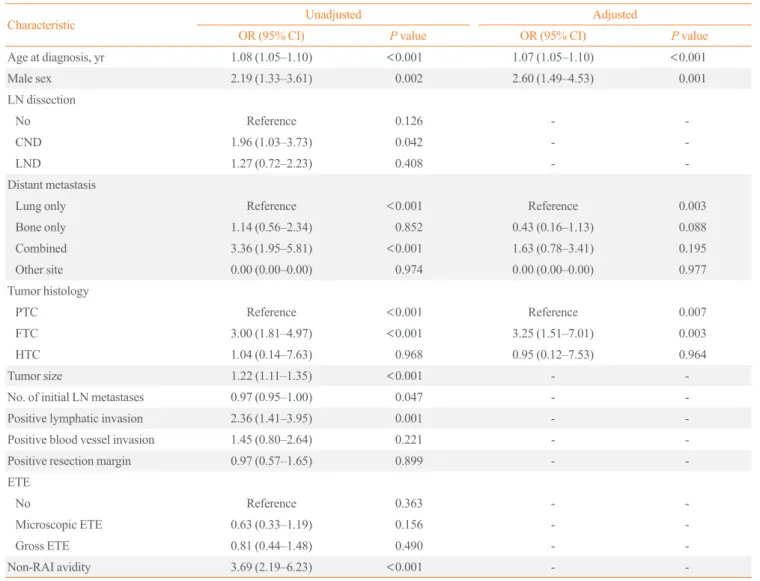
Sixty-three patients (26%) died of thyroid cancer after a me- dian of 5 years (interquartile range, 0.5 to 15.1) after initial sur- gery. The 5-year survival rate was 84.8%, the 10-year survival rate was 68.1%, and the 15-year survival rate was 59.4%. Ka- plan-Meier analysis and a log-rank test were used to evaluate the risk factors for disease-specific death. Age (>55 years), male sex, tumor histology (FTC), site of distant metastasis (combined metastasis), and non-RAI avidity were significant risk factors for disease-specific death (Fig. 2). After adjustment for all other variables using a Cox proportional hazard model,
Table 2. Prognostic Factors for Disease Specific Death in Patients with Differentiated Thyroid Cancer and Initial Distant Metastasis
Characteristic Unadjusted Adjusted
OR (95% CI) P value OR (95% CI) P value
Age at diagnosis, yr 1.08 (1.05–1.10) <0.001 1.07 (1.05–1.10) <0.001
Male sex 2.19 (1.33–3.61) 0.002 2.60 (1.49–4.53) 0.001
LN dissection
No Reference 0.126 - -
CND 1.96 (1.03–3.73) 0.042 - -
LND 1.27 (0.72–2.23) 0.408 - -
Distant metastasis
Lung only Reference <0.001 Reference 0.003
Bone only 1.14 (0.56–2.34) 0.852 0.43 (0.16–1.13) 0.088
Combined 3.36 (1.95–5.81) <0.001 1.63 (0.78–3.41) 0.195
Other site 0.00 (0.00–0.00) 0.974 0.00 (0.00–0.00) 0.977
Tumor histology
PTC Reference <0.001 Reference 0.007
FTC 3.00 (1.81–4.97) <0.001 3.25 (1.51–7.01) 0.003
HTC 1.04 (0.14–7.63) 0.968 0.95 (0.12–7.53) 0.964
Tumor size 1.22 (1.11–1.35) <0.001 - -
No. of initial LN metastases 0.97 (0.95–1.00) 0.047 - -
Positive lymphatic invasion 2.36 (1.41–3.95) 0.001 - -
Positive blood vessel invasion 1.45 (0.80–2.64) 0.221 - -
Positive resection margin 0.97 (0.57–1.65) 0.899 - -
ETE
No Reference 0.363 - -
Microscopic ETE 0.63 (0.33–1.19) 0.156 - -
Gross ETE 0.81 (0.44–1.48) 0.490 - -
Non-RAI avidity 3.69 (2.19–6.23) <0.001 - -
Cox proportional hazard regression model was performed.
OR, odds ratio; CI, confidence interval; LN, lymph node; CND, central neck dissection; LND, lateral neck dissection; PTC, papillary thyroid carcinoma;
FTC, follicular thyroid carcinoma; HTC, Hürthle cell carcinoma; ETE, extrathyroidal extension; RAI, radioactive iodine.
old age, male sex, tumor histology (FTC), and site of distant metastasis were independent risk factors for disease-specific death (Table 2). Combined metastasis had a worse prognosis than single-organ metastasis by univariate log-rank test, but there was no statistical significance according to the multivari- ate Cox proportional hazard model (hazard ratio, 1.63; 95%
confidence interval, 0.78 to 3.41; P=0.195). The following prognostic factors were stratified according to age: site of me- tastasis, tumor histology, and RAI avidity. After this stratifica- tion, bone and combined metastasis, FTC, and non-RAI avidity were increased with age (Fig. 3).
DISCUSSION
We analyzed 242 patients with DTC and initial distant metasta- sis. To the best of our knowledge, this study was the largest study investigating DTC and initial distant metastasis, specifi- cally regarding long-term prognosis and recent treatment status.
The 10-year survival rate associated with DTC and initial dis- tant metastasis was 68.1%, which was higher than in previous reports. Age, gender, histology, and site of distant metastasis
were revealed to be the prognostic factors.
Survival rates in this study were higher than in other studies.
Ruegemer et al. [20] reported that the 5- and 10-year survival rates of DTC with distant metastasis were 35% and 25%, re- spectively. Recently, Nixon et al. [14] reported that the 5-year disease-specific survival rate was 68% in 52 patients with DTC and initial distant metastasis at the Memorial Sloan-Kettering Cancer Center. In our study, the 5- and 10-year disease-specific survival rates were 84.8% and 68.1%, respectively. These dis- crepancies could be explained by a few differences. First, the study population is different. In a study by Shaha et al. [21], 43% (19/44) of the patients had PTC, 41% (18/44) had FTC, and 16% (7/44) had HTC, respectively. However, in our study, pa- tients with PTC were predominant (PTC 72% [175/242] vs.
FTC/HTC 28% [67/242]). In another study in Korea, patients with PTC were also predominant (72%) [22]. The survival rate of patients with DTC with distant metastasis in our study should be better than that in the Western studies, because of good prog- nosis associated with PTC compared to FTC and HTC [8, 9,13,14]. Second, some patients with early diagnosis of DTC, such as those with papillary thyroid microcarcinomas (PTMC)
100 80 60 40 20 0
100 80 60 40 20 0
100 80 60 40 20 0
(%)(%) (%)
Age (yr)
Age (yr)
Age (yr) Distant metastasis according to age
RAI avidity according to age
Tumor histology according to age
10 20 30 40 50 60 70
10 20 30 40 50 60 70
10 20 30 40 50 60 70
Fig. 3. Prognostic factors according to change of age. When the prognostic factors site of distant metastasis, tumor histology, and radioactive iodine (RAI) avidity were stratified according to age, (A) the bone only/combined metastasis group, (B) fol- licular thy roid carcinoma (FTC), and (C) non-RAI avidity were increased with age. However, lung only group, papillary thyroid carcinoma (PTC), and RAI avidity decreased according to age.
HTC, Hürthle cell carcinoma.
A
C
B Lung only metastasis
RAI avid
PTC Bone only metastasis
Non-RAI avid
FTC
Combined metastasis HTC
www.e-enm.org less than 1 cm in diameter, were enrolled in our study [15,16].
Patients with PTMC accounted for 11% (19/174) of total PTC patients. Therefore, early detection of metastatic cancer may af- fect better prognosis than previous studies. Third, new therapeu- tic modalities such as TKI were available in our study and they might have increased the survival rate, although a limited num- ber of patients had undergone additional therapy (TKI 8%, che- motherapy 4%) [17,18].
In the previous study, the prognostic factors associated with initial distant metastasis were age, number of involved organs, RAI avidity, extent of metastasis, and symptoms [10,12,14,20, 23]. In our study, older age, male sex, FTC, combined metasta- sis, and non-RAI avidity were associated with poor prognosis in a univariate log-rank test (Fig. 2). The non-RAI avidity and combined metastasis groups had poor prognosis (P<0.001).
However, when the multivariate Cox proportional hazard model
was used to adjust for the other variables, RAI avidity and com- bined metastasis were no longer significant (Table 2). As age in- creased, the ratio of FTC, combined metastasis, and non-RAI avidity were increased, which had a negative impact on progno- sis (Fig. 3). This likely reflects that older patients tended to pres- ent with more aggressive clinical behaviors of metastatic DTC.
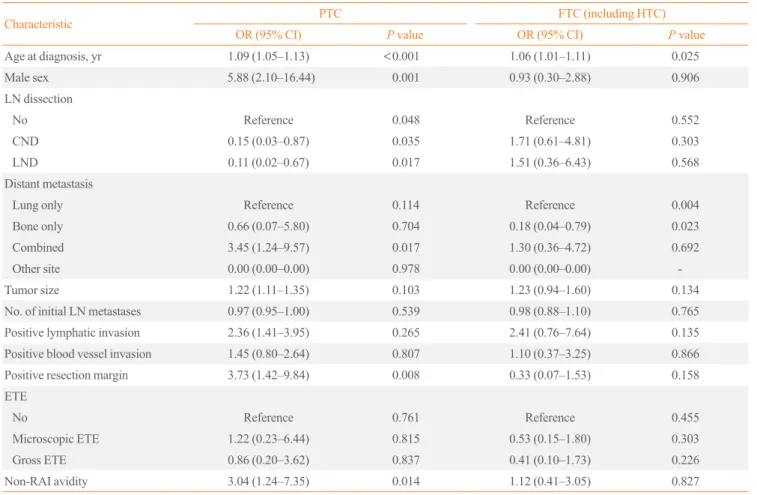
When the patients were divided into PTC and FTC (including HTC) to analyze the factors affecting the prognosis, significant factors which affecting prognosis were different (Table 3). The factors affecting disease specific death of PTC were old age, site of metastasis (combined>lung metastasis), positive resec- tion margin, and non-RAI avidity. However, only old age and site of metastasis (lung only>bone only) were significant prog- nostic factor for FTC. Because the numbers of FTC patients were relatively small, reassignment of a few cases might have changed the results.
Table 3. Prognostic Factors for Disease Specific Death in Patients with Differentiated Thyroid Cancer and Initial Distant Metastasis Ac- cording to Pathologic Subtype
Characteristic PTC FTC (including HTC)
OR (95% CI) P value OR (95% CI) P value
Age at diagnosis, yr 1.09 (1.05–1.13) <0.001 1.06 (1.01–1.11) 0.025
Male sex 5.88 (2.10–16.44) 0.001 0.93 (0.30–2.88) 0.906
LN dissection
No Reference 0.048 Reference 0.552
CND 0.15 (0.03–0.87) 0.035 1.71 (0.61–4.81) 0.303
LND 0.11 (0.02–0.67) 0.017 1.51 (0.36–6.43) 0.568
Distant metastasis
Lung only Reference 0.114 Reference 0.004
Bone only 0.66 (0.07–5.80) 0.704 0.18 (0.04–0.79) 0.023
Combined 3.45 (1.24–9.57) 0.017 1.30 (0.36–4.72) 0.692
Other site 0.00 (0.00–0.00) 0.978 0.00 (0.00–0.00) -
Tumor size 1.22 (1.11–1.35) 0.103 1.23 (0.94–1.60) 0.134
No. of initial LN metastases 0.97 (0.95–1.00) 0.539 0.98 (0.88–1.10) 0.765
Positive lymphatic invasion 2.36 (1.41–3.95) 0.265 2.41 (0.76–7.64) 0.135
Positive blood vessel invasion 1.45 (0.80–2.64) 0.807 1.10 (0.37–3.25) 0.866
Positive resection margin 3.73 (1.42–9.84) 0.008 0.33 (0.07–1.53) 0.158
ETE
No Reference 0.761 Reference 0.455
Microscopic ETE 1.22 (0.23–6.44) 0.815 0.53 (0.15–1.80) 0.303
Gross ETE 0.86 (0.20–3.62) 0.837 0.41 (0.10–1.73) 0.226
Non-RAI avidity 3.04 (1.24–7.35) 0.014 1.12 (0.41–3.05) 0.827
Multivariate Cox proportional hazard regression model was performed.
PTC, papillary thyroid carcinoma; FTC, follicular thyroid carcinoma; HTC, Hürthle cell carcinoma; OR, odds ratio; CI, confidence interval; LN, lymph node; CND, central neck dissection; LND, lateral neck dissection; ETE, extrathyroidal extension; RAI, radioactive iodine.
In our study, there were two noteworthy features. One was that the youngest patient diagnosed with initial distant metastasis was 13 years old. This finding indicates that distant metastasis can occur even in children. The other was that initial distant metasta- sis was found in a patient whose primary tumor size was 0.1 cm in diameter, although this was an extremely rare finding. Distant metastases have usually been observed in DTC patients with tu- mors ≥0.8 cm [24]. Therefore, careful evaluation should be nec- essary even in young patients or patients with very small tumors.
Our study has several limitations. First, it was a retrospective multicenter study, and therefore some data were missing during the long-term follow-up. Also, the centers did not use the same guidelines for evaluation and treatment. Second, the proportion of patients with initial distant metastasis might have been over- estimated because patients were selected from the institutional databases of tertiary care centers. Third, molecular markers such as BRAFV600E or telomerase reverse transcriptase (TERT) pro- moter mutations could not be used for prognostic analysis.
Fourth, despite the relatively large number of DTC patients with initial distant metastasis, the numbers in some subgroups were small. Additional nationwide studies will be needed for detailed subgroup analyses. Nevertheless, this study has strength as the first large cohort study in patients with DTC and initial distant metastasis in Korea. This study presented a prevalence of initial distant metastasis in DTC patients, and also showed the distri- bution of initial metastasis sites, rate of initial RAI refractori- ness in initial distant metastasis patients. Also it showed recent trend in treatment for advanced metastatic DTC patients and mortality. These results may be helpful in further clinical re- search and patient management.
In conclusion, this study showed the clinical characteristics and long-term prognosis of Korean patients with DTC and ini- tial distant metastasis. Age, gender, tumor histology, and meta- static site were the prognostic factors for patients with DTC and initial distant metastasis, and their survival rates were better compared to those in other reports.
CONFLICTS OF INTEREST
No potential conflict of interest relevant to this article was re- ported.
ACKNOWLEDGMENTS
This work was supported by the Korean Endocrine Society of EnM Research Award 2017.
AUTHOR CONTRIBUTIONS
Conception or design: T.H.K., J.H.C. Acquisition, analysis, or interpretation of data: H.K., H.I.K., S.W.K., J.J., M.J.J., W.G.K., T.Y.K., H.K.K., H.C.K., J.M.H., Y.Y.C. Drafting the work or re- vising: H.K., T.H.K. Final approval of the manuscript: T.H.K., J.H.C.
ORCID
Hosu Kim https://orcid.org/0000-0002-6278-3325 Hye In Kim https://orcid.org/0000-0002-7865-0172 Sun Wook Kim https://orcid.org/0000-0002-6858-3439 Jaehoon Jung https://orcid.org/0000-0002-5444-1229 Min Ji Jeon https://orcid.org/0000-0002-1297-107X Won Gu Kim https://orcid.org/0000-0002-8404-7759 Tae Yong Kim https://orcid.org/0000-0003-4982-4441 Hee Kyung Kim https://orcid.org/0000-0002-1617-3171 Ho-Cheol Kang https://orcid.org/0000-0002-0448-1345 Ji Min Han https://orcid.org/0000-0002-7881-9732 Yoon Young Cho https://orcid.org/0000-0002-4599-2889 Tae Hyuk Kim https://orcid.org/0000-0002-7975-2437 Jae Hoon Chung https://orcid.org/0000-0002-9563-5046
REFERENCES
1. Durante C, Montesano T, Torlontano M, Attard M, Monzani F, Tumino S, et al. Papillary thyroid cancer: time course of recurrences during postsurgery surveillance. J Clin Endocri- nol Metab 2013;98:636-42.
2. Olaleye O, Ekrikpo U, Moorthy R, Lyne O, Wiseberg J, Black M, et al. Increasing incidence of differentiated thyroid cancer in South East England: 1987-2006. Eur Arch Otorhi- nolaryngol 2011;268:899-906.
3. Pires BP, Alves PA Jr, Bordallo MA, Bulzico DA, Lopes FP, Farias T, et al. Prognostic factors for early and long-term re- mission in pediatric differentiated thyroid carcinoma: the role of sex, age, clinical presentation, and the newly pro- posed American Thyroid Association risk stratification sys- tem. Thyroid 2016;26:1480-7.
4. Cho BY, Choi HS, Park YJ, Lim JA, Ahn HY, Lee EK, et al.
Changes in the clinicopathological characteristics and out- comes of thyroid cancer in Korea over the past four decades.
Thyroid 2013;23:797-804.
5. Kim H, Kim TH, Choe JH, Kim JH, Kim JS, Oh YL, et al.
Patterns of initial recurrence in completely resected papil-
www.e-enm.org lary thyroid carcinoma. Thyroid 2017;27:908-14.
6. Massin JP, Savoie JC, Garnier H, Guiraudon G, Leger FA, Bacourt F. Pulmonary metastases in differentiated thyroid carcinoma. Study of 58 cases with implications for the pri- mary tumor treatment. Cancer 1984;53:982-92.
7. Pittas AG, Adler M, Fazzari M, Tickoo S, Rosai J, Larson SM, et al. Bone metastases from thyroid carcinoma: clinical characteristics and prognostic variables in one hundred for- ty-six patients. Thyroid 2000;10:261-8.
8. Sampson E, Brierley JD, Le LW, Rotstein L, Tsang RW.
Clinical management and outcome of papillary and follicu- lar (differentiated) thyroid cancer presenting with distant metastasis at diagnosis. Cancer 2007;110:1451-6.
9. Schlumberger M, Tubiana M, De Vathaire F, Hill C, Gardet P, Travagli JP, et al. Long-term results of treatment of 283 patients with lung and bone metastases from differentiated thyroid carcinoma. J Clin Endocrinol Metab 1986;63:960-7.
10. Lee J, Soh EY. Differentiated thyroid carcinoma presenting with distant metastasis at initial diagnosis clinical outcomes and prognostic factors. Ann Surg 2010;251:114-9.
11. Shaha AR, Ferlito A, Rinaldo A. Distant metastases from thyroid and parathyroid cancer. ORL J Otorhinolaryngol Relat Spec 2001;63:243-9.
12. Shoup M, Stojadinovic A, Nissan A, Ghossein RA, Freed- man S, Brennan MF, et al. Prognostic indicators of out- comes in patients with distant metastases from differentiated thyroid carcinoma. J Am Coll Surg 2003;197:191-7.
13. Lang BH, Wong KP, Cheung CY, Wan KY, Lo CY. Evaluat- ing the prognostic factors associated with cancer-specific survival of differentiated thyroid carcinoma presenting with distant metastasis. Ann Surg Oncol 2013;20:1329-35.
14. Nixon IJ, Whitcher MM, Palmer FL, Tuttle RM, Shaha AR, Shah JP, et al. The impact of distant metastases at presenta- tion on prognosis in patients with differentiated carcinoma of the thyroid gland. Thyroid 2012;22:884-9.
15. Ahn HS, Kim HJ, Kim KH, Lee YS, Han SJ, Kim Y, et al.
thyroid cancer screening in South Korea increases detection
of papillary cancers with no impact on other subtypes or thyroid cancer mortality. Thyroid 2016;26:1535-40.
16. Lubitz CC, Sosa JA. The changing landscape of papillary thyroid cancer: epidemiology, management, and the impli- cations for patients. Cancer 2016;122:3754-9.
17. Brose MS, Nutting CM, Jarzab B, Elisei R, Siena S, Bastholt L, et al. Sorafenib in radioactive iodine-refractory, locally ad- vanced or metastatic differentiated thyroid cancer: a ran- domised, double-blind, phase 3 trial. Lancet 2014;384:319- 28.
18. Schlumberger M, Tahara M, Wirth LJ, Robinson B, Brose MS, Elisei R, et al. Lenvatinib versus placebo in radioiodine- refractory thyroid cancer. N Engl J Med 2015;372:621-30.
19. Haugen BR. 2015 American Thyroid Association manage- ment guidelines for adult patients with thyroid nodules and differentiated thyroid cancer: what is new and what has changed? Cancer 2017;123:372-81.
20. Ruegemer JJ, Hay ID, Bergstralh EJ, Ryan JJ, Offord KP, Gorman CA. Distant metastases in differentiated thyroid carcinoma: a multivariate analysis of prognostic variables. J Clin Endocrinol Metab 1988;67:501-8.
21. Shaha AR, Shah JP, Loree TR. Differentiated thyroid cancer presenting initially with distant metastasis. Am J Surg 1997;
174:474-6.
22. Jeon MJ, Kim WG, Kim TH, Kim HK, Kim BH, Yi HS, et al. Disease-specific mortality of differentiated thyroid can- cer patients in Korea: a multicenter cohort study. Endocrinol Metab (Seoul) 2017;32:434-41.
23. Durante C, Haddy N, Baudin E, Leboulleux S, Hartl D, Travagli JP, et al. Long-term outcome of 444 patients with distant metastases from papillary and follicular thyroid car- cinoma: benefits and limits of radioiodine therapy. J Clin Endocrinol Metab 2006;91:2892-9.
24. Roti E, Rossi R, Trasforini G, Bertelli F, Ambrosio MR, Bu- sutti L, et al. Clinical and histological characteristics of papil- lary thyroid microcarcinoma: results of a retrospective study in 243 patients. J Clin Endocrinol Metab 2006;91:2171-8.