253
A Case of Combined POEMS Syndrome and Multiple Myeloma with Positive M protein Only on Immunofixation
Jae Hoon Yang1, Joo Young Jung1, Chan-Soo So1, Yu Jin Lim1, Seung-Yong Han1, Sarah Park1, Jung Han Kim2, Mina Hur3, Gyung Kyu Lee4, Jung-Weon Shim5, Young Iee Park6
1Division of Internal Medicine, Hangang Sacred Heart Hospital, 2GangNam Sacred-heart Hospital,
3Division of Laboratory Medicine, 4Division of Radiology, 5Division of Pathology,
Hangang Sacred Heart Hospital, 6Divison of Internal Medicine, National Medical Center, Seoul, Korea
POEMS syndrome is a plasma cell proliferative disorder is characterized by the presence of peripheral neuropathy (P), organomegaly (O), monoclonal gammopathy (M), endocrinopathy or edema (E) and skin change (S). It can be rarely related to multiple myeloma. A 48-year-old man was admitted to our hospital due to paresthesia of both inguinal areas and weakness of both lower extremities. He had a history of Castleman’s disease, and showed features of polyneuropathy, multiple osteoblastic lesions, hepato- splenomegaly, pretibial pitting edema, and papilledema. The serum and urine electrophoresis were neg- ative, but urine immunofixagion could detect monoclonal protein. Plasmacytoma was confirmed through the biopsy for the osteoblastic lesions. We present a case of combined POEMS syndrome and multiple myeloma with positive M protein only on immunofixation in order to share our experience with physicians and specialists. (Korean J Hematol 2008;43:253-257.)
Key Words: POEMS syndrome, Multiple myeloma, Osteoblastic lesion
접수:2008년 6월 23일, 수정:2008년 10월 27일 승인:2008년 11월 1일
교신저자:정주영, 서울시 영등포구 영등포동 7가 94-200
150-719, 한림대학교 의과대학 한강성심병원 Tel: 02-2639-5400, Fax: 02-2677-9756
E-mail: [email protected]
Correspondence to:Joo Young Jung
Division of Internal Medicine, Hangang Sacred Heart Hospital 94-200, 7ga, Yeongdeungpo-dong, Yeongdeungpo-gu, Seoul Tel: +82-2-2639-5400, Fax: +82-2-2677-9756
E-mail: [email protected] INTRODUCTION
POEMS syndrome is a paraneoplastic syndrome associated with plasma cell disorder and consists of polyneuropathy, organomegaly, endocrinop- athy, monoclonal gammopathy and skin change.5) It is one of the conditions that can be related to multiple myeloma, other conditions can also be associated such as radiculopathy and peripheral neuropathy.1)
We have experienced a case of POEMS syn- drome and multiple myeloma with minimally de- tected M-protein only in urine immunofixation.
We report a case to share our experience in diag- nosis and management with our colleagues.
CASE REPORT
A 48-year-old man was admitted because of paresthesia of both inguinal areas and a burning sensation and weakness of both lower extremities on 13 September 2003. He was diagnosed as Castleman’s disease a month before admission at different hospital without any medication history.
He appeared alert. The body temperature was 37oC, the pulse was regular at 85 beats per mi- nute, and the respiratory rate was 18 breaths per minute. The blood pressure was 130/76mmHg.
On physical examination, bilateral pretibial pit- ting edema and ascites were present. Enlarged, non-tender lymph nodes were palpated in the
Fig. 1. Pelvic MRI showed multifocal osteoblastic lesions at pelvic bone, sacrum, and L5 (white arrows).
platelet counts of 207,000/mm. The PT/aPTT levels were within normal limits, and the periph- eral blood smear showed no significant abnormalities. The serum uric acid level was 4.5mg/dL, the serum calcium level was decreased to 7.7mg/dL, and the blood urea nitrogen and creatinine levels were increased to 40.8mg/dL and 1.7mg/dL respectively. The serum total pro- tein and albumin were 6.0 g/dl and 3.3g/dL, re- spectively, and AST, ALT, alkaline phosphatase levels were 14IU/L, 11IU/L, and 176IU/L, respectively. The serum LDH was 247IU/L, the glucose level was increased to 1,296 mg/dL with HbA1C of 10.3%. Serum electrolytes showed so- dium of 126mEq/L, potassium of 5.4 mEq/L, and chloride of 93mEq/L. Thyroid function test showed T3 of 33.6ng/dL (n: 60∼181), TSH of 0.76uIU/mL (n: 0.35∼5.5) and free T4 of 0.78ng/dL (n: 0.89∼1.76), may implicating hypo- thyroidism or nonthyroidal illness. A 24-hour urine protein was 300.3g/day. A serum β2-micro- globulin was elevated to 6.2ug/mL, but there was no detectable M peak in serum and urine nor Bence-Jones proteinuruia in protein eletrophore- sis. A serum immunofixation test showed no ab-
roiliac joint. A nerve conduction velocity showed the finding of a neuromotor polyneuropathy with demyelination. We performed a pelvic MRI (Fig.
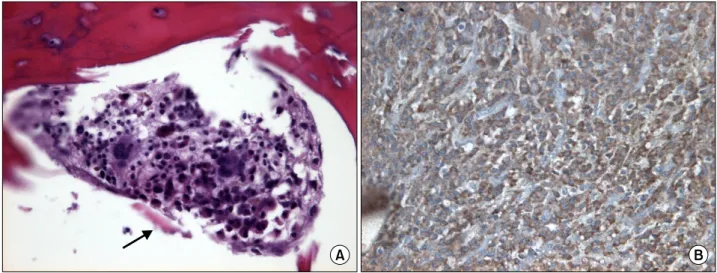
1) to confirm multiple osteoblastic lesions which were showed in the ilium on an abdominal X-ray film. An iliac bone biopsy showed sheets of plas- ma cells filling marrow spaces. The morphology of these plasma cells was not highly anaplastic, but they did destroy regional bone tissue. The immunohistochemical stain for immunoglobulin chains showed positive reaction for lambda light chains (Fig. 2).
Therefore, the patient was satisfied the diag- nostic criteria for POEMS syndrome, and multi- ple myeloma, stage IIIA accorging to Durie- Salmon stage. We started chemotherapy with cy- clophosphamide and prednisolon from 26 Sep- tember and showed 1% of plasma cells from bone marrow aspiration after the second cycle of che- motherapy. He was admitted to hospital again with refractory ascites and diagnosed as the end-stage renal disease on 16 November, and then recieved hemodialysis. During the treat- ment, serum β2-microglobulin was not checked and serum albumin was decreased from 3.3g/dL
Fig. 2. Eccentrically placed nuclei of neoplastic plasma cells with basophilic cytoplasm and a sequestrum (black arrow) (Bone biopsy, H&E stain, ×400, A) and positive staining for λ chain (×400, B).
to 2.7g/dL since hemodialysis. The patient com- pleted the 6th cycle of chemotherapy on 10 February 2004 and one month later, hemodialysis should be discontinued due to hypotension. As a consequence, the patient died due to his poor general condition, uremic encephalopathy, pneu- monia complicated with septic shock on 18 March 2004.
DISCUSSION
This is a case of POEMS syndrome with multi- ple myeloma whose M protein was detected only in urine immunofixation. The pathogenesis of POEMS syndrome is very complex, through hy- perestrogenemia,2) and HHV-83) infection have been hypothesized to contribute to its pathoge- nesis. Furthermore, the coagulation pathway and its relationship to VEGF,4) have been projected to play a role. Unfortunately in this case, serum VEGF was not checked. For a diagnosis of POEMS, polyneuropathy and a monoclonal plas- ma cell disorder should be present, in addition to at least one other major criterion and one mi- nor criterion.5) In order to diagnose multiple myeloma, at least 10% of plasma cells from a bone marrow aspiration or M-protein more than 3g/dL should be detected. But any percentage of
plasma cells in bone marrow or M protein can be allowed to the diagnosis of multiple myeola if re- lated organ or tissue injury was documented.6) In this case, the patient had the features of poly- neuropathy, hepatosplenomegaly, pretibial pitting edema, newly diagnosed diabetes mellitus, papil- ledema and a history of Castleman’s disease, and there were osteoblastic bone lesions which was proven as plasmacytoma. Initially we thought of non-secretory multiple myeloma (NSMM) with POEMS syndrome, because of the absence of urine and serum M-protein in electrophoresis un- til urine immunofixation detected minimal M- protein. Therefore we were able to make a diag- nosis of POEMS syndrome with multiple myelo- ma whose M protein detected minimally only in urine immunofixation.
NSMM can be classified as non-producer or producer type by production of M-protein from plasma cells.7) In the non-producer type, the dis- order originates from reticular cells rather than the plasma cells and seems to block the protein production process from plasma cells.8) In other words, the possible mechanism is considered as a defect of the production process or transport system of immunoglobulin. Immunoglobulin can be seen in the cytoplasm in the producer type;
such patients produce, but are unable to se-
and deposited to the tissues, and are not found in serum and urine.10) It caused severe protei- nuria and chronic kidney disease because of dep- osition of light chains in the kidneys.
Recently, there is a report of a serum free light-chain assay which is useful for diagnosis and monitoring of many patients with NSMM.11) According to Drayson et al, increased concen- trations of either κ or λ free light chains were detected in 19 of 28 patients with NSMM by us- ing the serum free light-chain measurement.12) Therefore, we expect a decrease in the incidence of NSMM in the future. The direct immunoflu- orescence test can be useful for identifying the subtypes, and presence of immunoglobulin, but we could not perform any of these tests in this case.
The treatment options for multiple myeloma are systemic pulse steroid therapy, combination chemotherapy with alkylating agents (melphalan, cyclophosphamide) and prednisolone, or VAD (vincristine, adriamycin and dexamethasone), thalidomide, bortezomib, and autologous or allo- genic stem cell transplantation. Radiotherapy is effective for localized osteoblastic bone lesions in POEMS syndrome,13) but chemotherapy and pe- ripheral blood stem cell transplantation should be considered in patients with diffuse osteoblastic bone lesions.14) In our case, we had limited treat- ment options because of the patient’s poor eco- nomic status and osteoblastic bone lesions. The patients and his family declined the high dose chemotherapy followed by stem cell transplan- tation and oral melphalan. Therefore, we treated the patient with cyclophosphamide and predni- solone.
The prognosis of multiple myeloma is poor
renal failure and infection might have played a role in shortening the survival.
The diagnosis and treatment were difficult in this case because of the negative M protein from serum and urine electrophoresis and the low soci- oeconomic status of the patient. In addition, there were no correlation between the treatment effect and prognosis. Therefore, if patients are having unexplained polyneuropathy, the serum VEGF level and symptoms or signs of POEMS syndrome should be determined, these two meth- ods are the best ways to distinguish POEMS from other entities such as chronic inflammatory de- myelinating polyneuropathy, Guillan-Barre, mon- oclonal gammopathy associated peripheral neuro- pathy and AL amyloidosis.5) Further, the serum free light chain assay, a bone marrow aspiration and biopsy, skin and lymph node inspection, and examination of the endocrine system should be considered.6) Further studies for better treatment modalities of the POEMS syndrome with multi- ple myeloma must be pursued.
요 약
POEMS 증후군은 형질세포질환의 하나로 말초신경병 증 (P), 장기비대증 (O), 내분비병증 (E), 단클론감마병 증 (M), 그리고 피부변화 (S)를 특징으로 한다. 이는 다 발성 골수종과 연관되어 나타날 수 있으며 진단이 힘들 고 드물게 발생한다. 48세 남자가 양측 서혜부의 타는 듯한 이상 감각과 양측 하지의 약화를 주소로 내원하였 다. 환자는 캐슬만병의 과거력이 있었고, 입원 당시 말초 신경병증, 뼈형성병변, 간비장종대, 하지 부종, 유두 부 종이 보였다. 다발성 골수종을 의심하여 혈청 및 소변 전기영동 검사를 시행하였으나 음성이었으며 소변 전기 영동면역고정법에서만 M 단백이 관찰되었다. 그러나, 뼈병변에 대해 조직검사 결과 형질세포종 확인되어 다
발성 골수종으로 진단되었다. 환자는 POEMS 증후군과 다발성 골수종으로 진단되었고 진단과 치료 과정의 경 험을 공유하고자 증례를 보고한다.
REFERENCES
1) Dispenzieri A, Kyle RA. Neurological aspects of mul- tiple myeloma and related disorders. Best Pract Res Clin Haematol 2005;18:673-88.
2) Soubrier MJ, Dubost JJ, Sauvezie BJ. POEMS syn- drome: a study of 25 cases and a review of the literature. French study group on POEMS syn- drome. Am J Med 1994;97:543-53.
3) Bélec L, Mohamed AS, Authier FJ, et al. Human herpesvirus 8 infection in patients with POEMS syn- drome-associated multicentric Castleman's disease.
Blood 1999;93:3643-53.
4) Tokashiki T, Hashiguchi T, Arimura K, Eiraku N, Maruyama I, Osame M. Predictive value of serial platelet count and VEGF determination for the man- agement of DIC in the Crow-Fukase (POEMS) syn- drome. Intern Med 2003;42:1240-3.
5) Dispenzieri A. POEMS syndrome. Blood Rev 2007;
21:285-99.
6) Rajkumar SV, Dispenzieri A, Fonseca R, et al.
Thalidomide for previously untreated indolent or smoldering multiple myeloma. Leukemia 2001;15:
1274-6.
7) Doster DR, Folds J, Gabriel DA. Nonsecretory multi- ple myeloma. Arch Pathol Lab Med 1988;112:
147-50.
8) Tominaga N, Katagiri S, Hamaguchi Y, et al. Plasma cell leukaemia of non-producer type with missing light chain gene rearrangement. Br J Haematol 1988;69:213-8.
9) Cogné M, Guglielmi P. Exon skipping without splice site mutation accounting for abnormal immunoglob- ulin chains in nonsecretory human myeloma. Eur J Immunol 1993;23:1289-93.
10) Matsuzaki H, Yoshida M, Akahoshi Y, Kuwahara K, Satou T, Takatsuki K. Pseudo-nonsecretory multiple myeloma with light chain deposition disease. Acta Haematol 1991;85:164-8.
11) Singhal S, Stein R, Vickrey E, Mehta J. The se- rum-free light chain assay cannot replace 24-hour urine protein estimation in patients with plasma cell dyscrasias. Blood 2007;109:3611-2.
12) Drayson M, Tang LX, Drew R, Mead GP, Carr- Smith H, Bradwell AR. Serum free light-chain meas- urements for identifying and monitoring patients with nonsecretory multiple myeloma. Blood 2001;97:
2900-2.
13) Iwashita H, Ohnishi A, Asada M, Kanazawa Y, Kuroiwa Y. Polyneuropathy, skin hyperpigmen- tation, edema, and hypertrichosis in localized osteo- sclerotic myeloma. Neurology 1977;27:675-81.
14) Dispenzieri A, Moreno-Aspitia A, Suarez GA, et al.
Peripheral blood stem cell transplantation in 16 pa- tients with POEMS syndrome, and a review of the literature. Blood 2004;104:3400-7.
15) Wilson JA, Jacobs A. ABO discrepancy in a multiple myeloma patient: a case study. Clin Lab Sci 2002;
15:204-7.