http://dx.doi.org/10.4174/astr.2016.91.1.1 Annals of Surgical Treatment and Research
Influence of body habitus on the surgical outcomes of bilateral axillo-breast approach robotic thyroidectomy in papillary thyroid carcinoma patients
Hee Seung Lee1, Young Jun Chai2,3, Su-Jin Kim2,4,5, June Young Choi2,6, Kyu Eun Lee2,4,5
1Department of Surgery, Dongguk University Gyeongju Hospital, Dongguk University College of Medicine, Gyeongju,
2Cancer Research Institute, Seoul National University College of Medicine, Seoul, 3Department of Surgery, Seoul Metropolitan Government-Seoul National University Boramae Medical Center, Seoul, 4Department of Surgery, Seoul National University Hospital, Seoul National University College of Medicine, Seoul, 5Division of Surgery, Thyroid Center, Seoul National University Cancer Hospital, Seoul, 6Department of Surgery, Seoul National University Bundang Hospital, Seoul National University College of Medicine, Seongnam, Korea
INTRODUCTION
The incidence and prevalence rates of thyroid cancer are increasing worldwide. Moreover, the proportion of patients with papillary thyroid carcinoma (PTC) is steadily increasing
[1,2], and PTC is 11 times more common in women than in men [3]. In the surgical treatment of PTC, when surgical techniques provideequivalent results regarding safety and completeness, patients consider cosmetic aspects. Therefore, access surgery was developed to prevent the occurrence of neck scars.
Purpose: Obesity is associated with a number of medical comorbidities and is considered a risk factor for surgical compli
cations. The purpose of this study was to analyze the influence of body habitus including obesity on the surgical outcomes of the Bilateral axillobreast approach (BABA) robotic thyroidectomy (RoT) in papillary thyroid carcinoma (PTC) patients.
Methods: The medical records of 456 PTC patients who underwent BABA RoT between January 2011 and December 2012 were reviewed, and 310 women PTC patients who had undergone BABA robotic total thyroidectomy with central lymph node dissection were examined. Body habitus were evaluated by measuring body mass index (BMI), body surface area, and neck circumference. We divided the patients into BMI < 25 kg/m2 and BMI ≥ 25 kg/m2 groups. Clinicopathological data, surgical outcomes, and postoperative complications were evaluated.
Results: Clinicopathological characteristics did not differ between the 2 BMI groups. The creation of working space time (P = 0.210) and other surgical outcomes showed no significant differences between the groups. There were no statistically significant differences between body habitus indexes and postoperative length of hospital stay, number of retrieved central lymph nodes, postoperative thyroglobulin levels, occurrence of hypoparathyoidism, recurrent laryngeal nerve injury and wound complication.
Conclusion: Patient with large body habitus undergoing BABA RoT were not at an increased risk of surgical complications and showed good surgical outcomes. BABA RoT may be a good alternative operative method for PTC patients for whom cosmetic outcome is an important consideration.
[Ann Surg Treat Res 2016;91(1):1-7]
Key Words: Robotic thyroidectomy, Body habitus
Received March 18, 2016, Reviewed March 25, 2016, Accepted April 11, 2016
Corresponding Author: Kyu Eun Lee
Department of Surgery, Seoul National University Hospital, Seoul National University College of Medicine, 101 Daehak-ro, Jongno-gu, Seoul 03080, Korea
Tel: +82-2-2072-2081, Fax: +82-2-766-3975 E-mail: [email protected]
Copyright ⓒ 2016, the Korean Surgical Society
cc Annals of Surgical Treatment and Research is an Open Access Journal. All articles are distributed under the terms of the Creative Commons Attribution Non- Commercial License (http://creativecommons.org/licenses/by-nc/4.0/) which permits unrestricted non-commercial use, distribution, and reproduction in any medium, provided the original work is properly cited.
Bilateral axillo-breast approach (BABA) robotic thyroidectomy (RoT), which has been performed since 2008, is a remote access surgery technique in which four ports areplaced in the areola and axilla. BABA and other RoT approaches have achieved good oncologic outcomes and excellent cosmetic results for patients with PTC [4-7].
Obesity, which is widespread and increasing, is associated with the developmentof diabetes mellitus, hypertension, car- diovascular disease, heart failure, and death from all causes [8]. In addition, obese patients pose technical and clinical challenges to the surgeons, andstudies report that high BMI is a risk factor for postoperativecomplications, specifically surgical site infection (SSI), wound dehiscence, pulmonary embolism, and renal failure [9].
Studies suggest that obesityaffectsthe surgical outcomes of thyroidectomy [10-12]; however, to date, the influence of body habitus, including obesity, on thyroid robotic surgery has not been described in detail [13], and there are no studies that specifically address this association in patients undergoing BABA RoT. The aim of the present study was to evaluate the effect of body habitus on the surgical outcomes of patients undergoing BABA RoT.
METHODS
Patients
Between January 2011 and December 2012, 456 PTC patients underwent BABA RoT at Seoul National University Hospi- tal, Seoul, Korea. BABA RoT was performed in patients with tumors smaller than 4 cm and without evidence of invasion to the trachea, esophagusor recurrent laryngeal nerve (RLN).
Prophylactic ipsilateral or bilateral central lymph node dissec- tion (CLND) was performed.This study was conducted as a retrospective analysis of prospectively collected data. All procedures were performed by three skilled surgeons who had overcome the learning curve.
All candidate patients underwent CT to evaluate the location of tumors and lymph node (LN) status following the procedure used for open thyroidectomy patients. This studywas directed at women PTC patients who had undergone BABA robotic total thyroidectomy with CLND with the aim of settling the gender ratio and standardizing surgical procedures.
This study was approved by the Institutional Review Board of Seoul National University Hospital (approval number: H-1401- 120-550).
Body habitus
Body habitus was defined according to body mass index (BMI;
kg/m2), body surface area (BSA; height in centimeters × weight in kg/36001/2), and neck circumference (NC; cm). According to the World Health Organization classification, patients were
assigned into the following three categories: normal and under- weight, BMI < 25 kg/m2; overweight, 25–29.9 kg/m2; and obese, BMI ≥ 30 kg/m2 [1,14]. In this study, we divided patients into 2 groups: group A, normal BMI group (BMI < 25 kg/m2); group B, high BMI group (BMI ≥ 25 kg/m2).
BSA was calculated using the Mosteller formula [15]. NC was measured horizontally at a level just below the thyroid cartilage on neck CT images, which were obtained preoperatively.
Surgical methods
The BABA RoT procedure was described previously [4]. Briefly, the procedure involves 4 stages, namely the creation of a work- ing space, robot docking, console time (in operations using the da Vinci system console), and closure.
Patients were placed under general anesthesia and positioned in the supine position, with their neck extended. After draping, the creation of a working space was started by hydrodissection.
Incisions were made bilaterally at the superomedial edge of the breast areola and the axillary folds. The flap extended from thethyroid cartilage superiorly to 2 cm below the clavi- cleinferiorly and from just beyond the medial border ofthe ster- nocleidomastoid muscle laterally using a vascular tunneler. The working space was developed using low pressure (5–6 mmHg) insufflations of CO2 gas. Four ports were inserted, and robot docking was performed.
The midline of the strap muscle was identified and separated.
After visualizing the structures, the isthmus was divided with ultrasonic shears. Thyroidectomy was performed while preserving the parathyroid glands and RLN. Lesion-side central compartment dissection was performed, and the contralateral lobe was dissected in the same manner.
After complete removal of the thyroid, the operative field was irrigated with saline, and meticulous hemostasis was achieved.
The midline was closed by robotic endosuturing.
Surgical outcomes
Evaluation of surgical outcomes was based on the following factors: operation time, length of hospital stay, number of retrieved central LNs, postoperative suppressed serum thyroglobulin (Tg) levels, stimulated serum Tg levels, and post- operative complications. Total operation time was subdivided into three periods as follows: working space creation time (time from hydrodissection to the placing of four trocars and CO2 gas insufflation, before robot docking), console time (the actual time required for thyroidectomy with LN dissection), and periconsole time (time required for robot docking and skin closure after console time).
To assess surgical completeness, postoperatively suppressed serum Tg levels and stimulated serum Tg levels were measured.
The radioactive iodine (RAI) treatment protocol was described in detail in a previous report [16]. The first RAI treatment
was performed 3 months after surgery, and the second RAI treatment was carried out approximately 9 months after sur gery (6 months after the first RAI treatment). Ablation was consi- dered successful when the stimulated Tg level at the second RAI treatment was ≤ 1.0 ng/mL in the absence of anti-Tg antibody.
Serum Tg levels were assessed and neck ultrasonography was performed every 6 or 12 months during the follow-up period.
Serum total calcium, ionized calcium, phosphorus, and para- thyroid hormone (PTH) levels were assessed to evaluate the development of hypoparathyroidism during hospitalization. A serum total calcium level of < 8 mg/dL with a hypocalcemic symptom during hospitalization was defined as transient hypoparathyroidism. Permanent hypoparathyroidism was defined as a serum PTH level of < 15 pg/mL with an ongoing requirement for oral calcium supplementation after 12 months [5]. In all patients, RLN function was assessed by evaluating vocal cord movement using preoperative video laryngoscopy.
A return of vocal cordmovement within 6 postoperative months was diagnosed as transient RLN palsy, whereas vocal cord movement abnormalities persisting after 6 months were diagnosed as permanent RLN [5].
All patients were examined for wound complications, such as wound hematoma, seroma formation, SSI, and deformities of the areola or breast shape. Patients were routinely followed up at 2 weeks, 3 months, and 6 months postoperatively.
Statistical analyses
Statistical analysis was performed using the IBM SPSS Statistics ver. 22.0 (IBM Co., Armonk, NY, USA). Univariate analysis was performed using the Student t-test, Mann- Whitney, chi-square, or Fisher exact tests. Statistical significance in this study was set at P ≤ 0.05. For other continuous body habitus parameters, Spearman correlation analysis was used to determine the trends of surgical outcomes with respect to BSA and NC. The adjusted odds ratios and 95% confidence intervals are reported.
RESULTS
Clinicopathologic characteristics
A total of 310 women PTC patients underwent BABA robotic total thyroidectomy with CLND with a mean age of 41.24 ± 9.6 years. Table 1 shows the demographic characteristics. The mean BMI was 22.6 ± 3.7 kg/m2; 262 patients (84.5%) were grouped in the normal BMI group, 41 patients (13.2%) in the overweight BMI group, and 7 patients (2.3%) in the obese BMI group, representing for a total of 48 patients (15.5%) in the high BMI group.A total of 185 patients (59.7%) received RAI ablation, whereas 125 patients (40.3%) did not. The mean stimulated Tg level of patients at the first RAI ablation was 0.7 ng/mL (range, <0.1–16.91 ng/mL). The percentage of patients
who had stimulated Tg levels < 1.0 ng/mL and <2.0 ng/mL was 60.5% (112 of 185) and 95.1% (176 of 185), respectively. The median stimulated Tg levels of the 2 groups were 0.6 and 0.8 ng/mL. Among patients who did not receive RAI ablation, the median stimulated Tg level at 3 months postoperatively was <
0.1 ng/mL (range, <0.1–8.26 ng/mL), and 95.2% (119 of 125) of patients had a suppressed Tg level of < 1.0 ng/mL. The median suppressed Tg levels of the groups A and B were 0.5 and 0.7 ng/mL, respectively. During the mean follow-up period of 34 months, none of the 310 patients experienced locoregional recurrence or metastasis.
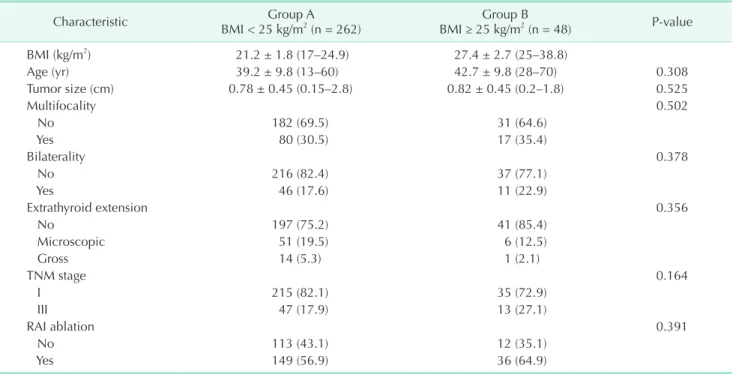
Mean age, tumor size, tumor multifocality, tumor bilaterality, extrathyroid extension, TNM stage, and RAI ablation did not differ significantly between groups A and B (Table 2).
Surgical outcomes
Regarding postoperative outcomes, total operation time (group A, 167.2 ± 34.9 minutes; group B, 173.7 ± 38.0 minutes;
P = 0.240), creation of working space time (group A, 42.8 ± 13.0 minutes; group B, 44.5 ± 13.1 minutes; P = 0.210), console time (group A, 92.2 ± 26.3 minutes; group B, 87.8 ± 26.2 minutes; P
= 0.395), and periconsole time (group A, 71.6 ± 21.1 minutes;
group B, 76.4 ± 17.9 minutes; P = 0.250) showed no significant differences between the groups. There was no significant difference in the mean length of hospital stay. Regarding surgical completeness, numberof retrieved central nodes (group A, 5.3 ± 4.0; group B, 4.9 ± 3.2; P = 0.784), postoperatively Table 1. Patient demographic characteristics (n = 310)
Characteristic Value
Age (yr) 41.2 ± 9.6 (13–70)
Body mass index (kg/m2) 22.6 ± 3.7 (16–38.8)
<25 262 (84.5)
25–29.9 41 (13.2)
≥30 7 (2.3)
Tumor size (cm) 0.8 ± 0.54 (0.1–3)
TNM stage
I 248 (80.0)
II 1 (0.3)
III 61 (19.7)
Multifocality 97 (31.3)
Bilaterality 57 (18.4)
Extrathyroid extension
No 238 (76.8)
Microscopic 57 (18.4)
Gross 15 (4.8)
RAI ablation
No 125 (40.3)
Yes 185 (59.7)
Values are presented as mean ± standard deviation (range) or number (%).
RAI, radioactive iodine.
suppressed serum Tg level (group A, 0.6 ng/mL [range, <0.1–10.3 ng/mL]; group B, 0.8 ng/mL [range, <0.1–12.4]; P = 0.356) and stimulated Tg level (group A, 0.5 ng/mL [range, <0.1–22.1 ng/
mL]; group B, 0.7 ng/mL [<0.1–16.9 ng/mL]; P = 0.283) were not significantly different between the BMI groups.
The incidence of transient hypoparathyroidism and perma- nent hypoparathyroidism did not differ significantly between
groups A and B. Transient RLN injury and permanent RLN injury were not significantly associated with BMI. Of 2 cases of wound complications, 1 was subareolar wound hematoma, and 1 was SSI, with no significant differences between the BMI groups (group A, 2 [0.8%]; group B, 0 [0%]; P = 0.714) (Table 3).
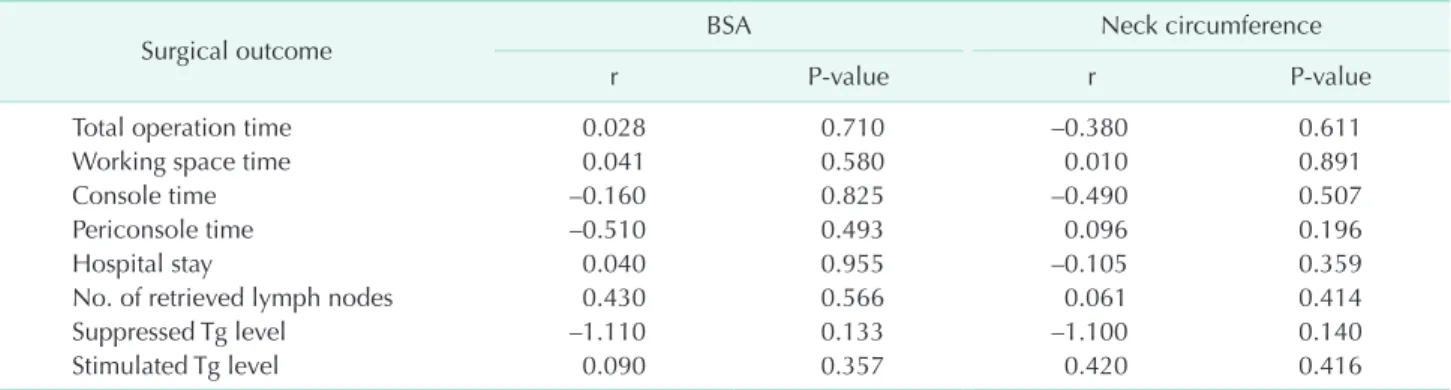
As shown in Table 4, surgical outcomes, number of retrieved central nodes (P = 0.566, r = 0.430), postoperatively suppressed Table 2. Relationship between clinicopathological characteristics and BMI groups
Characteristic Group A
BMI < 25 kg/m2 (n = 262) Group B
BMI ≥ 25 kg/m2 (n = 48) P-value
BMI (kg/m2) 21.2 ± 1.8 (17–24.9) 27.4 ± 2.7 (25–38.8)
Age (yr) 39.2 ± 9.8 (13–60) 42.7 ± 9.8 (28–70) 0.308
Tumor size (cm) 0.78 ± 0.45 (0.15–2.8) 0.82 ± 0.45 (0.2–1.8) 0.525
Multifocality 0.502
No 182 (69.5) 31 (64.6)
Yes 80 (30.5) 17 (35.4)
Bilaterality 0.378
No 216 (82.4) 37 (77.1)
Yes 46 (17.6) 11 (22.9)
Extrathyroid extension 0.356
No 197 (75.2) 41 (85.4)
Microscopic 51 (19.5) 6 (12.5)
Gross 14 (5.3) 1 (2.1)
TNM stage 0.164
I 215 (82.1) 35 (72.9)
III 47 (17.9) 13 (27.1)
RAI ablation 0.391
No 113 (43.1) 12 (35.1)
Yes 149 (56.9) 36 (64.9)
Values are presented as mean ± standard deviation (range) or number (%).
BMI, body mass index; RAI, radioactive iodine.
Table 3. Relationship between BMI groups and surgical outcomes
Characteristic Group A
BMI < 25 kg/m2 (n = 262) Group B
BMI ≥ 25 kg/m2 (n = 48) P-value
Total operation time (min) 167.2 ± 34.9 173.7 ± 38.0 0.240
Creation of working space time (min) 42.8 ± 13.0 44.5 ± 13.1 0.210
Console time (min) 92.2 ± 26.3 87.8 ± 26.2 0.395
Periconsole time (min) 71.6 ± 21.1 76.4 ± 17.9 0.250
Hospital stay (day) 3.3 ± 0.6 3.2 ± 0.6 0.472
No. of retrieved lymph nodes 5.3 ± 4.0 4.9 ± 3.2 0.784
Suppressed Tg level (ng/mL) 0.6 (<0.1–10.3) 0.8 (<0.1–12.4) 0.356
Stimulated Tg level (ng/mL) 0.5 (<0.1–22.1) 0.7 (<0.1–16.9) 0.283
Postoperative complications
Transient hypoparathyroidism 99 (37.8) 22 (45.8) 0.293
Permanent hypoparathyroidism 3 (1.1) 0 (0) 0.603
Transient RLN injury 37 (14.1) 4 (8.3) 0.358
Permanent RLN injury 2 (0.8) 0 (0) 0.714
Wound complications 2(0.8) 0 (0) 0.714
Values are presented as mean ± standard deviation, median (range), or number (%).
BMI, body mass index; Tg, thyroglobulin; RLN, recurrent laryngeal nerve.
serum Tg level (P= 0.133, r = –1.110) and stimulated Tg level (P = 0.357, r = 0.090) were not significantly associated with differences in BSA. Periconsole time (P = 0.196, r = 0.096), other operation times, surgical completeness indexeswere not significantly associated with differences in NC. The occurrence of transient hypoparathyroidism (no, 1.57 ± 0.1 m2; yes, 1.59
± 0.12 m2; P = 0.242) and other surgical complications did correlate statistically with BSA or NC (Table 5).
DISCUSSION
The incidence and prevalence of papillary thyroid cancer is increasing worldwide, and it is more common in women than in men [1-3]. Studies have demonstrated the advantages of robotic surgery over traditional open surgery, such as better cosmetic outcomes, reduced postoperative nausea, and reduced pain [7,10,17,18]. Especially in thyroid surgery, robotic
techniques achieve good oncologic outcomes and do not result in neck scars [5-7,13,17,19,20].
Obesity and being overweight are major public health pro- blems, and the rates of obesity are increasing [8]. Obesity is a known risk factor for postoperative morbidity [9,21]. Excess fatty tissue is more likely to become necrotic and is associated with SSI and wound complications. Obesity is considered a risk factor for BABA RoT for the following reasons: first, it can affect the creation of a working space. During the creation of working space, the surgeon generates a flap using the sub- cutaneous layer, which occurs after the administration of anesthesia in BABA RoT. Obesity can cause the collapse of the working space because of excessive weight and tension from the patients’ thick subcutaneous flap. In addition, it may affect the incidence of wound complications such as wound hematoma, seroma formation, SSI, and deformities of the areola and breast shape. Buerba et al. [10] and Finel et al. [12] reported Table 4. Correlation between BSA, neck circumference, and surgical outcomes
Surgical outcome BSA Neck circumference
r P-value r P-value
Total operation time 0.028 0.710 –0.380 0.611
Working space time 0.041 0.580 0.010 0.891
Console time –0.160 0.825 –0.490 0.507
Periconsole time –0.510 0.493 0.096 0.196
Hospital stay 0.040 0.955 –0.105 0.359
No. of retrieved lymph nodes 0.430 0.566 0.061 0.414
Suppressed Tg level –1.110 0.133 –1.100 0.140
Stimulated Tg level 0.090 0.357 0.420 0.416
BSA, body surface area; Tg, thyroglobulin; RLN, recurrent laryngeal nerve.
Table 5. BSA, neck circumference, and postoperative complication
Postoperative complication BSA (m2) P-value Neck circumference (cm) P-value
Transient hypoparathyroidism 0.242 0.897
No 1.57 ± 0.10 35.7 ± 2.4
Yes 1.59 ± 0.12 35.8 ± 2.9
Permanent hypoparathyroidism 0.492 0.441
No 1.58 ± 0.11 35.8 ± 2.6
Yes 1.54 ± 0.05 36.9 ± 1.2
Transient RLN injury 0.839 0.323
No 1.58 ± 0.11 35.8 ± 2.7
Yes 1.54 ± 0.05 35.5 ± 1.9
Permanent RLN injury 0.525 0.653
No 1.58 ± 0.11 35.8 ± 2.6
Yes 1.63 ± 0.13 34.9 ± 3.9
Wound complications 0.902 0.509
No 1.59 ± 0.09 35.8 ± 2.6
Yes 1.58 ± 0.11 34.5 ± 0.6
Values are presented as mean ± standard deviation.
BSA, body surface area; RLN, recurrent laryngeal nerve.
that obese patients had operations of greater duration and more wound complications in conventional thyroidectomy than nonobese patients. Previous work from our group showed that the morbidity of BABA RoT is similar to that of conventional surgery cases, and immediate postoperative bleeding did not occur in patients who underwent BABA RoT [6].
BSA is a measurement of the body surface that is often used in the clinical setting. Several formulas have been developed over the years, with the Mosteller formula gaining support as a standard because it is simple and easily calculated with a hand-held calculator [15]. Unlike BMI, BSA is related to height; therefore, it is associated with a greater number of anthropometric features that can affect perioperative outcomes compared with those related to BMI [22]. In the present study, BSA was associated with working space time and total operation time, whereas it was not associated with surgical outcomes or complications in female patients. NC is a valid marker of obesity that correlates well with other anthropometric measurements;
it is an accurate indicator of upper-body fat distribution, which is closely correlated with visceral adiposity [23,24]. The amount of subcutaneous fat in the upper body may be associated with the complications of surgery. In the present study, NC was associated with working space time, whereas it showed no correlation with surgical outcomes or complications in female patients.
Serum Tg level is a useful indicator of residual disease during the postoperative follow-up of patients who undergo total thyroidectomy, and it is an indicator of surgical completeness [25]. Although the levels may be measured while thyroid- stimulating hormone (TSH) is suppressed, the test is more sensitive when TSH is stimulated [26]. Stimulated Tg level is directly related to the amount of residual thyroid tissue [27,28], and it is a useful method to predict persistent or recurrent disease by measuring the thyroid bed 131I uptake after first RAI ablation [27]. A previous study showed that 48.3% of 729
patients with low-risk thyroid carcinoma had a stimulated Tg level <1 ng/mL [28]. This study showed good results compared with those of conventional total thyroidectomy, as reported previously.
A previous study has shown that transient hypoparathyroid- ism after thyroidectomy is a common occurrence (1.6%–50%
of interventions) [29], and the rate of permanent hypo- parathyroidism after thyroidectomy is reported to range from 0% to 1.3% [30]. The incidence of this complication in our study was not statistically significantly different between the groups and did not significantly depart from the rates reported in the literature. Permanent RLN palsy after conventional total thyroidectomy is reported to occur in 0%–1.3% of cases. In this study, we found that 2 cases (0.8%) had permanent RLN, although the incidence of RLN has been reported not to be statistically significant between BMI groups [25].
The present study has several limitations. Firstly, the data was retrospectively analyzed, which could have resulted in bias inthe selection of BABA RoT patients. Secondly, the low number of obese patents analyzed limited the accuracy of the statistical analysis. Despite these limitations, the present study indicates that BABA RoT offers surgical completeness and oncological safety in patients with different body habitus and may be a good alternative operative method for PTC patients.
CONFLICTS OF INTEREST
No potential conflict of interest relevant to this article was reported.
ACKNOWLEDGEMENTS
This study was supported by the Korean Foundation for Cancer Research (grant number: CB-2011-03-01).
1. Jung KW, Won YJ, Kong HJ, Oh CM, Seo HG, Lee JS. Cancer statistics in Korea: inci- dence, mortality, survival and prevalence in 2010. Cancer Res Treat 2013;45:1-14.
2. Pellegriti G, Frasca F, Regalbuto C, Squatrito S, Vigneri R. Worldwide increasing inci- dence of thyroid cancer: up date on epide- miology and risk factors. J Cancer Epide- miol 2013;2013:965212.
3. Davies L, Welch HG. Current thyroid can-
cer trends in the United States. JAMA Otolaryngol Head Neck Surg 2014;140:317- 22.
4. Lee KE, Choi JY, Youn YK. Bilateral axillo- breast approach robotic thyroidectomy.
Surg Laparosc Endosc Percutan Tech 2011;
21:230-6.
5. Lee KE, Kim E, Koo do H, Choi JY, Kim KH, Youn YK. Robotic thyroidectomy by bilateral axillo-breast approach: review
of 1,026 cases and surgical completeness.
Surg Endosc 2013;27:2955-62.
6. Lee KE, Koo do H, Im HJ, Park SK, Choi JY, Paeng JC, et al. Surgical completeness of bilateral axillo-breast approach robo tic thyroidectomy: comparison with conven- tional open thyroidectomy after propen- sity score matching. Surgery 2011;150:
1266-74.
7. Wang YC, Liu K, Xiong JJ, Zhu JQ. Robotic
REFERENCES
thyroidectomy versus conventional open thyroidectomy for differentiated thyroid cancer: meta-analysis. J Laryngol Otol 2015;129:558-67.
8. Lawrence VJ, Kopelman PG. Medical con- sequences of obesity. Clin Dermatol 2004;
22:296-302.
9. Merkow RP, Bilimoria KY, McCarter MD, Bentrem DJ. Effect of body mass index on short-term outcomes after colectomy for cancer. J Am Coll Surg 2009;208:53-61.
10. Buerba R, Roman SA, Sosa JA. Thyroidec- tomy and parathyroidectomy in patients with high body mass index are safe over- all: analysis of 26,864 patients. Surgery 2011;150:950-8.
11. Duke WS, White JR, Waller JL, Terris DJ. Endoscopic thyroidectomy is safe in patients with a high body mass index.
Thyroid 2014;24:1146-50.
12. Finel JB, Mucci S, Branger F, Venara A, Lenaoures P, Rodien P, et al. Thyroidec- tomy in patients with a high BMI: a safe surgery? Eur J Endocrinol 2014;171:99-105.
13. Lee S, Park S, Lee CR, Son H, Kim J, Kang SW, et al. The impact of body habitus on the surgical outcomes of transaxillary single-incision robotic thyroidectomy in papillary thyroid carcinoma patients. Surg Endosc 2013;27:2407-14.
14. World Health Organization. Obesity and overweight [Internet]. Geneva: World Health Organization; c2016 [cited 2013 Apr 22]. Available from: http://www.who.
int/mediacentre/factsheets/fs311/en/.
15. Mosteller RD. Simplified calculation of body-surface area. N Engl J Med 1987;317:
1098.
16. Chai YJ, Kim SJ, Kim SC, Koo do H, Min HS, Lee KE, et al. BRAF mutation in folli- cular variant of papillary thyroid carci-
noma is associated with unfavourable clinicopathological characteristics and malignant features on ultrasonography.
Clin Endocrinol (Oxf) 2014;81:432-9.
17. Ryu HR, Lee J, Park JH, Kang SW, Jeong JJ, Hong JY, et al. A comparison of post- operative pain after conventional open thyroidectomy and transaxillary single- incision robotic thyroidectomy: a pro spec- tive study. Ann Surg Oncol 2013;20:2279- 84.
18. Yoo JY, Chae YJ, Cho HB, Park KH, Kim JS, Lee SY. Comparison of the incidence of postoperative nausea and vomiting bet- ween women undergoing open or robot- assisted thyroidectomy. Surg Endosc 2013;
27:1321-5.
19. Kim HY, d'Ajello F, Woo SU, Son GS, Lee JB, Bae JW. Robotic thyroid surgery using bilateral axillo-breast approach: personal initial experience over two years. Minerva Chir 2012;67:39-48.
20. Kwon H, Koo do H, Choi JY, Kim E, Lee KE, Youn YK. Bilateral axillo-breast ap- proach robotic thyroidectomy for Graves' disease: an initial experience in a single institute. World J Surg 2013;37:1576-81.
21. Gedaly R, McHugh PP, Johnston TD, Jeon H, Ranjan D, Davenport DL. Obesity, dia- betes, and smoking are important deter- minants of resource utilization in liver resection: a multicenter analysis of 1029 patients. Ann Surg 2009;249:414-9.
22. Vaccaro CA, Vaccarezza H, Rossi GL, Mentz R, Im VM, Quintana GO, et al. Body sur- face area: a new predictor factor for con- version and prolonged operative time in laparoscopic colorectal surgery. Dis Colon Rectum 2012;55:1153-9.
23. Ben-Noun L, Sohar E, Laor A. Neck cir-
cumference as a simple screening mea- sure for identifying overweight and obese patients. Obes Res 2001;9:470-7.
24. Yang L, Samarasinghe YP, Kane P, Amiel SA, Aylwin SJ. Visceral adiposity is closely correlated with neck circumference and represents a significant indicator of in- sulin resistance in WHO grade III obesi ty.
Clin Endocrinol (Oxf) 2010;73:197-200.
25. American Thyroid Association (ATA) Guide lines Taskforce on Thyroid Nodules and Differentiated Thyroid Cancer, Cooper DS, Doherty GM, Haugen BR, Kloos RT, Lee SL, et al. Revised American Thy roid Association management guide- lines for patients with thyroid nodules and differentiated thyroid cancer. Thyroid 2009;19:1167-214.
26. Tuttle RM, Ball DW, Byrd D, Dilawari RA, Doherty GM, Duh QY, et al. Thyroid carci- noma. J Natl Compr Canc Netw 2010;8:
1228-74.
27. Cailleux AF, Baudin E, Travagli JP, Ricard M, Schlumberger M. Is diagnostic iodine- 131 scanning useful after total thyroid ablation for differentiated thyroid cancer?
J Clin Endocrinol Metab 2000;85:175-8.
28. Schlumberger M, Catargi B, Borget I, Deandreis D, Zerdoud S, Bridji B, et al.
Stra tegies of radioiodine ablation in pa- tients with low-risk thyroid cancer. N Engl J Med 2012;366:1663-73.
29. Lecerf P, Orry D, Perrodeau E, Lhommet C, Charretier C, Mor C, et al. Parathyroid hor mone decline 4 hours after total thy roidectomy accurately predicts hypo- calcemia. Surgery 2012;152:863-8.
30. Randolph G. Surgery of the thyroid and para thyroid glands. Philadelphia: W.B.
Saunders; 2003.