1)
서 론
소아 요로감염(urinary tract infection, UTI) , 2은 세 미만 영유아의 무병터 발열(fever without a focus)의
이 연구는 한국소아감염병학회 학술연구상의 재정 지원에 의하여 이
* 루어졌음
접수 :2010년 월5 25 ,일 수정:2010년 월7 12일 승인 :2010년 월7 14일
책임저자 : 강진한 가톨릭대학교 의과대학 소아과학교실, Tel : 02)2258-6183, Fax : 02)537-4544
E-mail : [email protected]
가장 흔한 원인이 되며 소아 응급실을 방문하는 원인의 을 차지할 정도로 임상에서 흔하게 접할 수 있
5-14% ,
는 질환이다1, 2). 발열이 나타난 UTI 환아의 60% 이상 은 신 실질을 침범하는 신우신염으로 진행성 신질환을, 유발시켜 영구적 신기능 장애를 초래할 수 있다3, 4). 대장 균(Escherichia coli, E. coli 은) UTI의 65-90%을 차 지하는 가장 흔한 원인균주이며 대장균이외 균주, (non- E. coli 로는) Klesiella spp.와Proteus spp., Citrobac- ter spp., Enterococcus spp. 등이 알려져 있다5-7).
가 의심될 경우에는 패혈증으로 악화되거나 신손
UTI ,
소아 요로감염의 원인균주별 임상양상과 항생제 내성률 : 대장균과 비대장균의 비교
가톨릭대학교 의과대학 소아과학교실
배이영 이수영 정대철 강진한 ㆍ ㆍ ㆍ
Clinical Characteristics and Antibiotic Resistance of Urinary Tract Infections in Children: Escherichia. coli Versus Non- E. coli
E-Young Bae, M.D., Soo-Young Lee, M.D., Dae-Chul Jeong, M.D., and Jin Han Kang, M.D.
Departments of Pediatrics, College of Medicine, The Catholic University of Korea, Seoul, Korea
Purpose : We aimed to compare the clinical features and antibiotic resistance of urinary tract infection (UTI) caused by pathogens other thanE. coli (non-E. coli) with UTI caused by E. coli in children.
Methods : We enrolled patients with culture-proven UTI, who were admitted to the study hospital from September 2008 to August 2009. We investigated clinical data of patients with UTI and antibiotic resistance of isolated strains. For compari- son, patients were divided according by results of the urine culture intoE. coli and non-E. coli UTI groups.
Results : A total of 84 patients participated in this study. Twenty one cases (25.0%) were caused by non-E. coli pathogens.
Frequency of non-E. coli UTI differed according to age and sex: male <6 months , 10.5%; male‘ ’ ‘ ≥6 months , 50.0%; female’ ‘
<6 months , 43.7%; and female’ ‘ ≥6 months , 25.0% (’ P =0.014). More patients who received previous antibiotic treatment (P =0.017), but fewer patients who showed hematuria (P =0.014) were included in the non-E. coli UTI group than in the E. coli UTI group. Comparison of antibiotic resistance showed that the non-E. coli UTI group possessed more strains that were resistant to cefazolin, cefotaxime, imipenem, trimethoprim/sulfamethoxazole (TMP/SMZ) and tetracycline than theE.
coli UTI group (P <0.05).
Conclusion : Increased incidence, different distribution by age and sex, and high antibiotic resistance of non-E. coli UTI should be considered in selection of empirical antibiotics for treatment of UTI in children. (Korean J Pediatr Infect Dis 2010;17:67-73)
Key Words : Urinary tract infections, Uropathogens, Drug resistance, Bacterial
상으로 진행할 가능성을 최소화하기 위하여 배양검사 결, 과를 확인하기 전에 항생제 치료를 시작하여야 한다1, 8). 따라서 광범위한 역학자료와 근거 중심 의학(evidence- based medicine)자료를 토대로, UTI의 초기 치료에 활 용될 수 있는 항생제들이 추천되고 있다8-10). 하지만 대 다수의 항생제는 주로E. coli의 치료에 집중되었고 원인 균주의 10-35%를 차지하는 non-E. coli에 대한 자료 는 부족한 실정이다 최근 국외연구에서는 입원한 소아에. 서 non-E. coli에 의한 UTI (non-E. coliUTI)의 빈도 와 해당 균주의 항생제 내성률 증가를 보고하기도 하였다
11).
이러한 측면에서 연구자들은 국내 소아 UTI에서 non-E. coli UTI의 빈도를 대략적으로 파악하고 원인 균주별(E. coli vs. non-E. coli 임상양상과 항생제 내) 성률을 비교하고자 본 연구를 계획하였다.
대상 및 방법
대 상1.
년 월부터 년 월까지 가톨릭대학교 인천 2008 9 2009 8
성모병원 소아청소년과에UTI로 입원한 환아 중에서 원 인균주가 확인된 환아들을 대상으로 하였다 즉 임상적. , 으로UTI가 의심12) [발열 체온; >38.0 +℃ 농뇨 소변 백; 혈구 수 >5 /high-power field (HPF)]개 되어 입원한 환아 중 무균 채뇨백뇨 소변을 가리지 못하는 영 유, ( ㆍ 아 혹은 청결 채취 중간뇨 연장아 배양검사에서) ( ) 1.0×
105colony-forming units (CFU)/mL 이상의 단일 균 주가 배양 증명된(culture-proven)경우로 제한하였다. 퇴원시 최종진단명이 UTI이었더라도 배양검사에서 균, 주가 확인되지 않았거나 가지 이상의 균주가 검출된 경2 우는 연구에서 제외시켰다.
방 법 2.
대상 환아의 인구학적 특징 임상양상과 검사소견 원, , 인균주와 항생제 내성률을 전향적으로 관찰하여 기록하
였다 전체 연구계획은 연구 시작 전에 임상연구 심사위. 원회(Institutional Review Border, IRB)의 승인을 받 았다.
원인균주와 인구학적 특징 1)
배양 증명된 균주의 빈도를 조사하였고 원인균주별, 특징을 비교하기 위하여 균주들을E. coli와 non-E. coli 로 크게 두 군으로 양분하였다 성별 연령별 특징을 조. ㆍ 사하기 위하여 대상 환아를 개 연령군 개월 미만, 5 (6 , 6-
개월 개월 개월 개월 이상 으로 세
12 , 12-24 , 24-60 , 60 ) 분하였다.
임상양상과 검사소견 2)
대상 환아의 입원 전 과거력 항생제 복용 여부 내원, , 시 발열의 양상 입원기간 혈액검사 소변검사 및 영상, , , 의학 소견 등의 관찰항목을 조사하였다 혈액검사에서. 백혈구 수와 C-반응단백(C-reactive protein, CRP) 를 소변검사에서 농뇨 이외 혈뇨와 단백뇨, , , nitrite반응 유무를 확인하였다 신장의 구조적 이상을 평가하기 위. 하여 모든 환아들은 신 초음파와 혹은 배뇨성 방광요도, / 조영술(voiding cystourethrography, VCUG)을 시행 받았고 그 결과는 소아를 전담하는 영상의학과 전문의, 가 객관적 기준13, 14)을 토대로 판독하였다.
항생제 내성률 3)
원인균주의 최소억제농도(minimal inhibitory con- 는
centration, MIC) Clinical and Laboratory Stan- 의 방법
dards Institute (CLSI) 15)에 따라 미생물 자동 화 기기인 VITEK 2 (Bio-Merieux, Durham, NC, 를 이용하여 측정하였다 모든 균주에 대하여 공통
USA) .
적으로 ampicillin, amoxicillin/clavulanate, ciproflo- 및
xacin, imipenem, tetracycline trimethoprim/sul- 에 대한 내성률을 확인하 famethoxazole (TMP/SMX)
였고 그람음성균은, amikacin, cefazolin, cefotaxime,
및 에 대한 내성률
gentamicin piperacillin/tazobactam
과extended spectrum beta-lactamase (ESBL)생성 유무를 그람양성균은, clindamycin, erythromycin, pe-
및 에 대한 내성률을 추가로 조사하
nicillin vancomycin
였다 감수성 결과가 중등도. (intermediate)을 보인 경우
는 내성으로 간주하였다.
통계분석 3.
범주형 자료의 분석에는 chi-square test 혹은Fis- 를 수치형 자료의 분석에는
her s exact test ,’ unpaired 를 이용하여 각 군을 비교하였다 모든 자료의 정
t-test .
리와 분석은 SPSS for Windows (version 12.0, SPSS 을 이용하였으며
Inc., Chicago, IL, USA) P 값이 0.05 미만인 경우를 통계적으로 유의한 것으로 판정하였다.
결 과
원인균주별 빈도와 인구학적 특징 1.
연구기간 1년 동안 111명의 UTI환아가 입원하였고 이 중 84 (75.7%)명 에서 원인균주가 확인되었다 배양. 증명된84명 중E. coli가63 (75.0%)주 로 가장 많았고, Enterococcus spp., 8 (9.5%),주 Klesiella spp., 7주
이었으며
(8.3%) , Citrobacter spp.와 Enterobacter spp., Group B Streptococcus는 각각 주2 (2.4%)이었 다 즉. , Non-E. coli UTI의 빈도는 25.0% (21/84 )주 였다.
전체84명 중 남아는48 (57.1%),명 여아는36 (42.9명 으로 남녀비는 이었고 평균연령은
%) 1:0.75 14.83 29.35± 개월 범위( ; 1.4개월-12.8 )세 이었다 연령군별로는. 6개 월 미만 연령군이 54 (64.3%)명 으로 가장 많았고, 6-
개월 연령군은 명 개월 명
12 14 (16.7%), 12-24 5 (5.9
개월 명 개월 이상은 명
%), 24-60 4 (4.8%), 60 7 (8.3%) 이었다(Table 1). 연령군을 크게 6개월 미만과 6개월 이상으로 양분하여 성별 연령군별 군으로 비교할 때, ㆍ 4 ,
개월 미만 남아군은 전체 연구대상의
6 45.2% (38/84
명 로 가장 높은 빈도를 차지하였다) (Fig. 1). 성별 연ㆍ 령군별 non-E. coli UTI의 빈도는 개월 미만 남아군6
례 개월 이상 남아군 례
10.5% (4/34 ), 6 50.0% (5/10 ),
개월 미만 여아군 례 개월 이상 여아
6 43.7% (7/16 ), 6
군 25.0% (5/20 )례 였다 즉. , 6개월 미만 남아군은 다른 군들에 비해 가장 높은, E. coli UTI (89.5%)의 분포와 가장 낮은 non-E. coli UTI (10.5%)의 분포를 보였다 (P =0.014).
임상양상과 검사소견 2.
과거 병력이 있는 환아는 명9 (10.7%)이었고 이 중6
Table 1. Distribution of Gender and Uropathogens by Age Group Total
n=84 (%)
Age Group
<6 months
n=54 (%) 6-12 months
n=14 (%) 12-24 months
n=5 (%) 24-60 months
n=4 (%) ≥60 months n=7 (%) Gender
Male Female Uropathogen
Escherichia coli Non-E.coli
48 (57.1) 36 (42.9) 63 (75.0) 21 (25.0)
38 (70.4) 16 (29.6) 43 (79.6) 11 (20.4)
5 (35.7) 9 (64.3) 10 (71.4)
4 (28.6)
3 (60.0) 2 (40.0) 1 (20.0) 4 (80.0)
2 (50.0) 2 (50.0) 2 (50.0) 2 (50.0)
0 ( 0.0) 7 (100.0) 7 (100.0) 0 ( 0.0) Fig. 1. Distribution of uropathogens by age and sex.
There were more Escherichia coliUTI, but fewer non- E. coliUTI in the ‘male <6 months’ group than in other groups (P=0.014).
명은 UTI 병력(E. coli군 명5 , non-E. coli군 명 이1 ) 있었고 신증후군 천식 발달장애가 각각 명이었다 입, , 1 . 원 전 항생제를 복용했던 환아는 41 (48.8%)명 이었고 응급실을 통해 입원한 환아는 65 (77.4%)명 이었다 내. 원 당시 평균 발열기간은3.51 1.67± 일이었으며 평균 체 온은38.64 0.65± ℃이었다 평균 입원기간은. 5.18 1.76± 일이었다.
혈액검사에서 평균 백혈구 수는 14,465 6,502/mm± 3 이었으며, CRP의 평균값은42.10 46.27 mg/dL (± 정상 이었다 소변검사에서 농뇨 이외 혈뇨 적혈구 수
<5.0) . , (
가 명 단백뇨 는
5/HPF) 26 (31.0%), ( 30 mg/dL) 37
≥ ≥
명(44.6%), nitrite양성반응이26 (31.0%)명 에서 관찰 되었다 신 초음파 검사에서. 41.3% (33/80 ;명 편측 수 신증31 ,명 양측 수신증 명2 ), VCUG에서23.5% (8/34 명; I-II등급 역류 명4 , III-V등급 역류 명 의 이상소4 ) 견이 관찰되어 신장의 구조적 이상이 신 초음파 와 혹은/
에서 확인된 환아는 명 이었다
VCUG 35 (41.7%) .
원인균주별 비교에서, non-E. coli군에 입원 전 항생 제를 치료받은 환아의 비율이 높았다는 것(P=0.017)과 E. coli군에 혈뇨가 동반된 환아의 비율이 높았다는 것(P = 이외 임상양상과 검사소견에서 유의한 차이는 0.014) ,
없었다(Table 2).
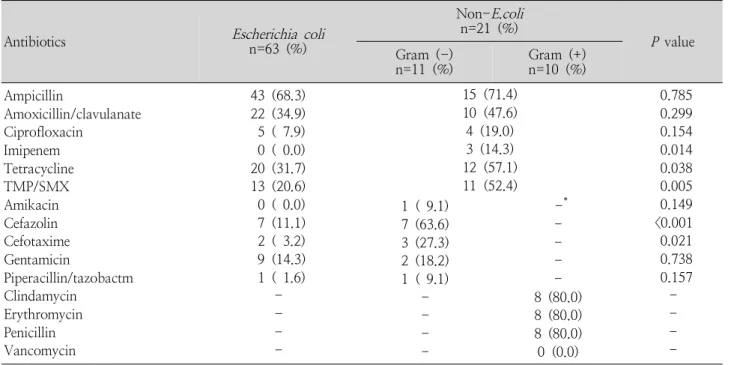
항생제 내성률 3.
항생제 내성률은ampicillin 69.0% (58/84 ), amo-주 주
xicillin/clavulanate 38.1% (32/84 ), ciprofloxacin
주 주
10.7% (9/84 ), imipenem 3.6% (3/84 ), tetracy-
주 주
cline 38.1% (32/84 ), TMP/SMX 28.6% (24/84 ),
주 주
amikacin 1.4% (1/74 ), cefazolin 18.9% (14/74 ), 주
cefotaxime 6.8% (5/74 ), gentamicin 14.9% (11/
주 및 주 였다
74 ) piperacillin/tazobactam 2.7% (2/74 ) . 그람음성균 중에서 ESBL 생성 균주는 5.4% (4/74 ;주 E. coli 주2 ,Klesiella 주 였고 이 균주들은2 ) , ampicillin,
에 주 내성을 보였으
cefazolin, cefotaxime 100% (4/4 )
며, TMP/SMX 75% (3/4 ), amoxicillin/clavulanate,주
각각 주
gentamicin, tetracycline 50% (2/4 ), pipera- 주
cillin/tazobactam 25% (1/4 ), amikacin, ciprofloxa-
각각 주 의 내성률을 보였다
cin, imipenem 0.0% (0/4 ) . 또한 그람양성균은, clindamycin, erythromycin, peni-
각각 주
cillin 80.0% (8/10 ), vancomycin 0.0% (0/10 주 의 내성률을 보였다) .
원인균주별 내성률 비교에서 전체 균주에 대한 가지, 6 항생제(ampicillin, amoxicillin/clavulanate, ciproflo-
Table 2. Demographic Clinical and Laboratory Characteristics of Children with Urinary Tract Infections
Characteristics Escherichia coli
(n=63) Non-E.coli
(n=21) P value
Gender male, n (%) Age (month), mean (SD) Past medical history, n (%)
Previous antimicrobial treatment, n (%) Admission via Emergency Room, n (%) Duration of fever (days), mean (SD) Maximal temperature ( ), mean (SD)℃ Hospitalization duration (days), mean (SD) Peripheral leukocyte count (/mm3), mean (SD) C-reactive protein (mg/dL), mean (SD) Hematuria, n (%)
Proteinuria, n (%)
Urine nitrite positive, n (%) Renal abnormality*, n (%)
39 (61.9) 16.28 (32.98)
8 (12.7) 26 (41.3) 50 (79.4) 3.49 (1.68) 38.66 (0.65) 5.33 (1.60) 14,893 (6,889)
45.48 (49.65) 24 (38.1) 30 (48.4) 22 (34.9) 26 (41.3)
9 (42.9) 10.49 (12.16)
1 (4.8) 15 (71.4) 15 (71.4) 3.57 (1.60) 38.59 (0.66) 4.71 (2.12) 13,180 (5,100)
31.95 (33.12) 2 (9.5) 7 (33.3) 4 (19.0) 9 (42.9)
0.127 0.244 0.309 0.017 0.452 0.852 0.708 0.163 0.299 0.248 0.014 0.230 0.173 0.898
*was confirmed on the radiologic evaluation of renal ultrasonography and/or voiding cystourethrography
의 내성률 xacin, imipenem, tetracycline, TMP/SMX)
은E. coli군보다 non-E. coli군에서 모두 높았고 그람, 음성균에 대한 가지 항생제5 (amikacin, cefazolin, cefo- 의 내성 taxime, gentamicin, piperacillin/tazobactam) 률도 E. coli군보다 non-E. coli군에서 모두 높았다
이 중
(Table 3). imipenem, tetracycline, TMP/SMX, 에 대해서는 통계적으로 유의하였 cefazolin, cefotaxime
다(P<0.05). ESBL양성률은 E. coli군3.2% (2/63균 주 보다) non-E. coli군에서18.2% (2/11 )주 로 높았으 나 통계적으로 유의하지 않았다(P =0.103). E. coli군과 non-E. coli군 모두에서 상대적으로 낮은 내성률을 보 인 항생제는 amikacin (0.0-9.1%), piperacillin/tazo- bactam (1.6-9.1%), imipenem (0.0-14.3%), gen- tamicin (14.3-18.2%), ciprofloxacin (7.9-19.0%) 이었다.
고 찰
본 연구에서 저자들은 소아 UTI의 원인균주(E. coli
vs. non-E. coli 가 인구학적 특징에 따라 차이를 보일) 수 있다는 것과 E. coli과 비교하여 상대적으로 높은 non-E. coli의 항생제 내성률을 확인하였다.
는 대부분 하부 위장관 혹은 회음부 주위에 서식 UTI
하는 균주의 상행성 감염에 의해 발생된다1). 가장 흔한 원인균주는 E. coli이며, non-E. coli UTI의 빈도는 약
에 해당한다고 알려져 있다
10-35% 5-7). Marcus 등11) 은 입원한 UTI환아 중에서non-E. coli UTI의 빈도가 주 를 차지할 정도로 증가하였다는 보고 40% (70/175 )
와 함께 치료과정에서, non-E. coli에 대한 고려가 필요 하다고 강조하였다 국내. UTI 원인균주 연구에서도 non-E. coliUTI가 32.9% (56/170 )주 에 해당하는 보 고가 있었다16). 본 연구 결과에서 non-E. coli UTI의 빈도는 25.0% (21/84 ) ,주 로 연구병원의 과거자료17-19)
년 월 년 월 주 년 월
[01 1 -03 2 , 14.0% (8/57 ); 04 10 -
년 월 주 개 병원 다기관 연구
05 9 , 10.9% (23/211 ; 5 );
년 월 월 월 주 와 비교할 때
04 1 -06 12 , 16.7% (14/84 )] , 높은 빈도였다 또한 성별 연령군별 비교에서. ㆍ , non-E.
coli UTI의 빈도는 다른 성별 연령군ㆍ (25.0-50.0%)보
Table 3. Antibiotic Resistance of Uropathogens
Antibiotics Escherichia coli
n=63 (%)
Non-E.coli n=21 (%)
P value Gram (-)
n=11 (%) Gram (+)
n=10 (%) Ampicillin
Amoxicillin/clavulanate Ciprofloxacin
Imipenem Tetracycline TMP/SMX Amikacin Cefazolin Cefotaxime Gentamicin
Piperacillin/tazobactm Clindamycin
Erythromycin Penicillin Vancomycin
43 (68.3) 22 (34.9) 5 ( 7.9) 0 ( 0.0) 20 (31.7) 13 (20.6) 0 ( 0.0) 7 (11.1) 2 ( 3.2) 9 (14.3) 1 ( 1.6)
- - - -
15 (71.4) 10 (47.6) 4 (19.0) 3 (14.3) 12 (57.1) 11 (52.4)
0.785 0.299 0.154 0.014 0.038 0.005 0.149
<0.001 0.021 0.738 0.157
- - - - 1 ( 9.1)
7 (63.6) 3 (27.3) 2 (18.2) 1 ( 9.1)
- - - -
-* - - - - 8 (80.0) 8 (80.0) 8 (80.0) 0 (0.0)
*not available
Abbreviations : TMP/SMX, trimethoprim/sulfamethoxazole
다 6개월 미만 남아군(10.5%)에서 유의하게 낮았다 이러한 인구학적 특징에 따른 원인균주의 분포 (Fig. 1).
차이와 과거보다 증가된 non-E. coli UTI의 빈도는 치료를 위한 초기 항생제 선택에서 고려되어야 할 UTI
사항으로 여겨진다.
원인균주별(E. coli vs. non-E. coli 임상양상의 비) 교에서 non-E. coli UTI ,는 E. coli UTI와 비교하여, 발열의 양상과 검사소견에서 상대적으로 경한 양상을 보 이며 요로 기형이 동반되는 경우가 흔한 것으로 알려져 있다16, 20, 21). 본 연구에서도non-E. coliUTI군은 상대 적으로 발열의 정도와 혈액 및 소견검사에서 이상소견이 심하지 않았고 입원기간은 짧았으나 신장의 구조적 이, 상의 비율은 다소 높게 관찰되었다 (P >0.05) (Table
다른 국내외 연구
2). 16, 20, 21)와 비교할 때 유사한 결과,
이었지만 통계적으로 유의하지 못한 것은 본 연구가 일 개 대학병원에서 짧은 기간 동안에 시행되어 대상수가 적었다는 제한점에서 기인한다고 여겨진다 따라서 소아. ,
중에서
UTI non-E. coli UTI을 구분할 예측인자(pre- 에 관한 추가적인 연구가 필요하다고 판단된다
dictor) .
본 연구 결과의 항생제 감수성 검사에서, 10%이내의 내성률을 보인 항생제는 amikacin (1.4%), piperacillin/
tazobactam (2.7%), imipenem (3.6%), cefotaxime 였고 상대적으로 높은 (6.8%), ciprofloxacin (10.7%) ,
내성률을 보인 것은 ampicillin (69.0%), amoxicillin/
이었다 clavulanate (38.1%), tetracycline (38.1%) .
를 생성하는 개 균주는
ESBL 4 ampicillin, cefazolin, 에도 높은 내성률
cefotaxime, TMP/SMX (75.0-100%) 을 보였고, amikacin, ciprofloxacin, imipenem, pipe-
에는 상대적으로 낮은 내성률 racillin/tazobactam (0.0-
를 보였다 원인균주별 내성률 비교에서
25.0%) . , non-
E. coli 군은 E. coli 군보다 전반적으로 높은 내성률을 보였으며 몇몇 항생제에 대해서는 유의하게 높은 내성, 률을 보였다(Table 3). 본 연구의 non-E. coli의 내성 률은 국외 결과11)와 비교할 때 상대적으로, amoxicillin/
의 내성률 은 높았고
clavulanate (39.0% vs. 47.6%) 3 세대cephalosporin의 내성률(27.3% vs. 43.0%)은 낮
았다는 것을 제외하고는 유사한 결과이다 두 연구의 결, . 과를 종합해 볼 때,E. coli군과 non-E. coli군 모두에서 상대적으로 낮은 내성률을 보인 항생제는 amikacin (0.0-18.0%), imipenem (0.0-14.3%), gentamicin (9.0-18.2%), ciprofloxacin (3.0-19.0%), pipera-
혹은 이었
cillin piperacillin/tazobactam (1.6-21.0%) 다.
요약하면 증가 추세의, non-E. coliUTI빈도와 성별 연령군별 원인균주의 다른 분포,
ㆍ E. coli에 비해 상대
적으로 높은 non-E. coli의 항생제 내성률은 소아 UTI 치료과정에서 고려되어야 할 사항이다 향후 소아. non- E. coli UTI의 역학적 변화와 E. coli UTI와 non-E.
coli UTI을 구분할 예측인자에 관한 연구가 필요할 것이 다.
요 약
목 적 : 소아UTI에서non-E. coli UTI의 빈도를 확 인하고 원인균주별(E. coli vs. non-E. coli 임상양상) 과 항생제 내성률을 비교하고자 하였다.
방 법 :2008년 9월부터 2009년 8월까지 UTI 입원 환아 중에서 원인균주가 배양 증명된 환아들을 대상으로 하였다 인구학적 특징 임상양상 검사소견 원인균주와. , , , 항생제 내성률을 전향적으로 조사하였다.
결 과 : 전체84명 중E. coliUTI은63 (75.0%)명 이 었고 non-E. coli UTI은 21 (25.0%)명 이었다 성별. ㆍ 연령군에 따라서 non-E. coli의 분포는 차이를 보였다 :
개월 미만 남아군 개월 이상 남아군
6 , 10.5%; 6 , 50.0%;
개월 미만 여아군 개월 이상 여아군
6 , 43.7%; 6 , 25.0%
(P =0.014). E. coli UTI군에 비해, non-E. coli UTI 군에는 입원 전 항생제를 치료받은 환아의 비율이 높았 고(P=0.017), 혈뇨가 동반된 환아의 비율은 낮았다 (P =0.014). E. coli 보다 non-E. coli는 cefazolin과 에 대 cefotaxime, imipenem, TMP/SMX, tetracycline 해 높은 내성률을 보였다(P <0.05).
결 론 : 소아 UTI치료과정에서 증가 추세의, non-E.
coli UTI 빈도와 성별 연령군별 원인균주의 차이ㆍ , E.
coli 보다 높은 non-E. coli의 항생제 내성률은 고려되 어야 할 사항이다.
References
1) Elder JS. Urologic disorders in infants and children. In:
Kliegman RM, Behrman RE, Jenson HB, Stanton BE, editors. Nelson Textbook of Pediatrics. 18th ed. Phila- delphia: WB Saunders Co, 2007:2223-8.
2) Shaikh N, Morone NE, Bost JE, Farrell MH. Prevalence of urinary tract infection in childhood: a meta-analysis.
Pediatr Infect Dis J 2008;27:302-8.
3) Hoberman A, Charron M, Hickey RW, Baskin M, Kear- ney DH, Wald ER. Imaging studies after a first febrile urinary tract infection in young children. N Engl J Med 2003;348:195-202.
4) Hoberman A, Wald ER. Treatment of urinary tract infec- tions. Pediatr Infect Dis J 1999;18:1020-1.
5) Ashkenazi S, Even-Tov S, Samra Z, Dinari G. Uropatho- gens of various childhood populations and their antibiotic susceptibility. Pediatr Infect Dis J 1991;10:742-6.
6) Hellerstein S. Urinary tract infections: old and new concepts. Pediatr Clin North Am 1996;42:1433-57.
7) Hoberman A, Wald ER, Hickey RW, Baskin M, Charron M, Majd M, et al. Oral versus initial intravenous therapy for urinary tract infections in young febrile children.
Pediatrics 1999;104:79-86.
8) Committee on Quality Improvement. Subcommittee on Urinary Tract Infections. Practice parameter: the diag- nosis, treatment, and evaluation of the initial UTI in fe- brile infants and young children. Pediatrics 1999;103:
843-52.
9) Bagga A, Babu K, Kanitkar M, Srivastava RN. Consensus statement on management of urinary tract infections.
Indian Pediatr 2001;38:1106-15.
10) Gupta K. Emerging antibiotic resistance in urinary tract pathogens. Infect Dis Clin North Am 2003;17:243-59.
11) Marcus N, Ashkenazi S, Yaari A, Samra Z, Livni G.
Non-Escherichia coliversusEscherichia colicommunity-
acquired urinary tract infections in children hospitalized in a tertiary center: relative frequency, risk factors, anti- microbial resistance and outcome. Pediatr Infect Dis J 2005;24:581-5.
12) Cheng CH, Tsau YK, Lin TY. Effective duration of anti- microbial therapy for the treatment of acute lobar neph- ronia. Pediatrics 2006;117:e84-9.
13) Fernbach SK, Maizels M, Conway JJ. Ultrasound grading of hydronephrosis: introduction to the system used by the Society for Fetal Urology. Pediatr Radiol 1993;23:
478-80.
14) Belman AB. Vesicoureteral reflux. Pediatr Clin North Am 1997;44:1171-90.
15) Clinical and Laboratory Standards Institute. Performance standards for antimicrobial susceptibility testing. Fifth informational supplement, M100-S15. Wayne, PA:
CLSI, 2005.
16) Jung HJ, Aum JA, Jung SJ, Huh JW. Different characte- ristic betweenEscherichea coliand non-Escherichea coli urinary tract infection. Korean J Pediatr 2007;50:457-61.
17) Lee SY, Cho SH, Kim SM, Jeong DC, Chung SY, Lee KY, et al. Urinary tract infection in febrile infants with pyuria. Korean J Pediatr Infect Dis 2004;11:90-100.
18) Lee SY, Lee JH, Kim JH, Hur JK, Kim SM, Ma SH, et al. Susceptibility tests of oral antibiotics including cefixime againstEscherichia coli, isolated from pediatric patients with community acquired urinary tract infec- tions. Korean J Pediatr 2006;49:777-83.
19) Han SB, Ko YM, Lee SY, Jeong DC, Kang JH, Lee KY, et al. The significance of99mtechnetium dimercaptosucci- nic acid (DMSA) scan as a substitute for voiding cystou- rethrography (VCUG) in evaluating children with first febrile urinary tract infection. J Korean Soc Pediatr Nephrol 2007;11:220-8.
20) Friedman S, Reif S, Assia A, Levy I. Clinical and labo- ratory characteristics of non-E. coliurinary tract infec- tions. Arch Dis Child 2006;91:845-6.
21) Joung JK, Choi CS, Kim SJ, Park SH, Kim JH, Koh DK. Comparsion of urinary tract infections caused by Escherichea coli and non-E. coli in infants. Korean J Pediatr Infect Dis 2009;16:162-6.