https://doi.org/10.14734/PN.2018.29.3.133 pISSN 2508-4887•eISSN 2508-4895
Nam Rri Kim, MD1, Soo Hyun Kim, MD1, Suk-Joo Choi, MD, PhD1, Soo-young Oh, MD, PhD1, Jung-sun Kim, MD, PhD2, Cheong-Rae Roh, MD, PhD1, Jong-Hwa Kim, MD, PhD1 Departments of 1Obstetrics and Gynecology, 2Pathology, Samsung Medical Center, Sungkyunkwan University School of Medicine, Seoul, Korea
Placental chorioangioma is the most common non-trophoblastic and hamartoma-like tumor and has generally good prognosis if the size is small. The incidence of a placental chorioangioma is an estimated 1% of all deliveries. The size of a chorioangioma is considered significant if it is larger than 4 cm, since fetal compromise can occur due to circulatory overload. Very rarely, a placental chorioan- gioma can directly exert fetal circulation to cause fetal cerebral ischemic stroke, especially in giant placental chorioangiomas which are defined as more than 4-5 cm in diameter. Here, we report a case of a huge chorioangioma, sized 7×5 cm with thrombo-occlusion in the placenta associated with neo- natal stroke. Perinatal stroke and giant placental chorioangioma are each very rare. Moreover, the combination is extremely rare as is expected. Our case implicates that placental examination should be considered as an important diagnostic workup in cases of perinatal stroke with unknown etiology.
Key Words: Placental chorioangioma, Perinatal stroke, Perinatal cerebral infarction
Introduction
Placental chorioangioma is the most common non-trophoblastic and hamartoma-like tumor originating from capillaries or larger vessels. Its incidence is in 1% of all placentas1,2 and its size is significant because if a chorioangioma is larger than 4 cm, circulation can be affected, resulting in fetal compromise. For example, polyhydramnios, preterm delivery, fetal anemia or thrombocytopenia, pre-eclampsia and fetal hydrops can be seen.3,4 Especi- ally giant placental chorioangiomas, which are defined as more than 4-5 cm with an esti- mated prevalence varying from 0.002% to 0.01%, are associated with high prevalence of pregnancy complications and poor perinatal outcomes.5
A perinatal stroke refers to a stroke occurring in a period up to the 28th day of life and its incidence is about 0.025%.4,6,7 In addition, a chorioangioma can cause fetal cerebral ischemic stroke so obstetrician and pediatrician should aware of it.8 Chorioangioma can be the cause of the tendency of thrombosis due to the characteristics of a tortuous vascular system. We report a case of a huge chorioangioma with thrombo-occlusion in the placenta associated with neonatal stroke.
Case
A 31-year-old pregnant woman with gravida 0 para 0 was transferred from a local clinic to this hospital for delivery due to a large placental mass at 36 weeks of gestation. During Received: 20 February 2018
Revised: 8 June 2018 Accepted: 13 July 2018 Corresponding author Soo-young Oh, MD, PhD Department of Obstetrics and Gynecology, Samsung Medical Center, Sungkyunkwan University School of Medicine, 81 Irwon-ro, Gangnam-gu, Seoul 06351, Korea Tel: +82-2-3410-3517
Fax: +82-2-3410-0630
E-mail: [email protected] Copyright© 2018 by The Korean Society of Perinatology
This is an Open Access article distributed under the terms of the Creative Com- mons Attribution Non-Commercial License (http://creativecommons.org/
license/by-nc/4.0/), which permits unrestricted non-commercial use, distribution, and reproduction in any
Perinatal Stroke Associated with Placental
Chorioangioma: A Rare Case and Review
of Literature
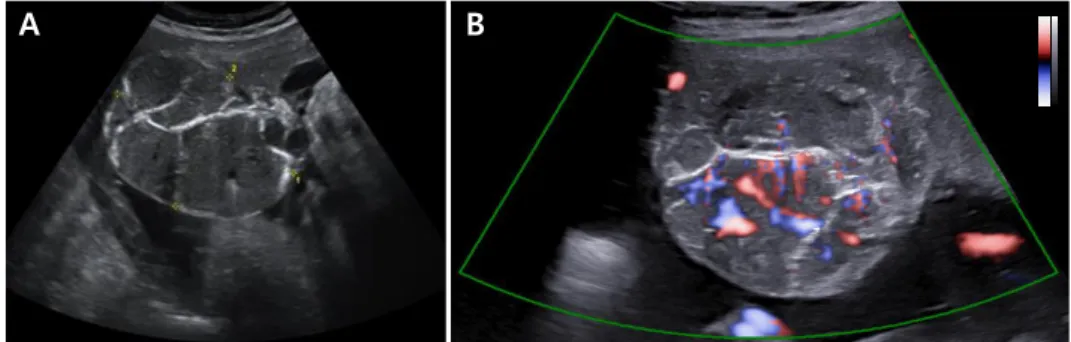
nography in the second trimester, serum screening test, gesta- tional diabetes and routine laboratory test. Through ultrasono- graphy, large for gestational age with polyhydramnios, esti- mated fetal weight was 3,561 g (>90 percentile) and amniotic fluid index was 26.46 cm (deepest 9.52 cm), a 7×5 cm-sized placental mass (Fig. 1) was found. We considered fetal Beckwith- Wiedemann syndrome as one differential diagnosis. Because cephalopelvic disproportion was clinically suspected, elective cesarean delivery was planned after careful counseling with the patient.
A 3,740 g female infant was born by elective cesarean section at 39 weeks of gestation with Apgar score of 8 and 8 at 1 and 5 minutes, respectively. The baby showed no gross anomaly and in the fetal side of the placenta, there was a 7×7 cm-sized round and well circumscribed mass suggesting chorioangioma.
The arterial pH of cord blood at birth was 7.298 and base ex- cess was negative 2.3 mmol/L. The baby was moved to a nur- sery room and the only abnormal finding from physical examina- tion by a pediatrician was increased head circumference (37.5 cm, >90 percentile). Overall her activity was good and oral feeding was appropriate.
Thirty hours after birth, unexpectedly, the baby manifested tonic-clonic movement at right upper and lower limb twice and thus an anticonvulsive agent (phenobarbital) was initially in- fused, there were no risk factors of epilepsy at neonatal period, and no familial history of epilepsy. The brain ultrasonography taken at the day after birth showed asymmetrical ventricles with irregular choroid plexus contour, otherwise no abnormal findings associated with this event (Fig. 2A). An echocardiogram
showed just a small patent ductus arteriosus and physiologic atrial septal defect. Abdominal ultrasonography showed no specific findings. On day 3 after birth, electroencephalography was done and showed normal. After the phenobarbital treat- ment, no more seizures occurred.
As for a diagnostic workup for perinatal stroke, the platelet count was 260,000/μL, Hemoglobin and hematocrit were 17.2 g/dL and 50.7%, respectively. A blood culture showed no micro- organism. Coagulation studies showed a serum fibrinogen level of 347 mg/dL within normal range. International normalized ratio (INR) INR level of 0.85, antithrombin III level of 68% (60- 89%), protein C activity level of 40% (28-54%) and protein S activity level of 67% (33-67%) were within normal limits. Serum ammonia increased to a level of 93.1 μmol/L (11.2-48.2 μmol/L).
Brain magnetic resonance (MR) imaging was done on day 7 after birth and showed acute infarction in the left temporo- parieto-occipital area that was supposed to be a venous infarct due to a superior sagittal sinus thrombus or arterial infarcts on the posterior division of middle cerebral artery territory and diffuse excessive high signal intensity of white matter on T2W1 (Fig. 2B). Follow-up brain ultrasound was done on day 8 and showed no demonstrable superior sagittal sinus thrombosis or hemorrhage, but mild asymmetrical parenchymal swelling with slightly increased echogenicity involving the left temporo- parietal area due to acute infarct. A further workup was done for the etiology of cerebral infarction. Serum examination for toxoplasmosis, rubella, cytomegalovirus, and herpes simplex type 1 & 2 IgM were negative. Ammonia level was normalized to 47.0 μmol/L on day 7 after birth and newborn screening test
A B
Fig. 1. (A) In ultrasonographic examination at 36 weeks of gestation, a 7×5 cm sized well circum- scribed, round, heterogeneous mixed echoic mass along the fetal surface of the placenta was seen. (B) It looks chorioangioma and with color Doppler sonography increased blood flow was seen along the hypoechoic portion of mass. Giant chorioangioma measuring more than 4 cm has a risk of shunting of blood flow from fetus to mass.
formed by a pathologist (JSK). Microscopically, the placental mass was mainly composed of benign capillary proliferation, characteristic of chorioangioma. Multifocal infarcts and calcifi- was negative. Cerebospinal fluid analysis and culture were done
and showed no specific findings.
A thorough placental pathologic exam was requested and per-
A B
Fig. 2. (A) The brain ultrasonography taken at the day after birth showed asymmetrical ventricles with irregular choroid plexus contour, otherwise no abnormal findings asso- ciated with this event. (B) Seven days after birth, brain magnetic resonance imaging was done and the arrow indicates acute infarction in left temporo-parieto-occipital area (arrows) that supposed venous infarcts due to superior sagittal sinus thrombus or arterial infarct on posterior division of middle cerebral artery territory.
A
D C
B
Fig. 3. Pathological findings of the placental mass. (A) A lobulated solid mass (arrows) is present at the periphery of the placental disc. (B) The cut surface of the mass is pinkish brown with multi focal tan brown or yellow degenerating areas. (C) Microsco- pically, the mass is composed of pro liferating capillaries (lower area) with multifocal infarction (upper left area). The adjacent large vessels show fibrin deposition in the wall with early thrombi (arrows). (D) The magnified image of the inset in (C). Original magnification in (C) 10×, (D) 50×.
cations were identified in the mass. Adjacent vessels showed intimal fibrin deposition and early thrombi (Fig. 3).
Two months after birth, brain MR imaging and MR angiography follow up were done and showed attenuation of left distal middle cerebral artery branch due to previous arterial obstruction or secondary changes after infarction. In addition, progression of encephalomalacia of the left parietal lobe was seen (Fig. 4).
Fortunately her performance was good without any problem and she grew up normally till 6 months after birth. She took phe- nobarbital 10 mg twice a day and stopped taking anticonvulsant at 4 months after birth.
Discussion
If placental chorioangioma was found prenatally, small size of tumor (usual cut-off is 4 cm), has a good prognosis, and can be managed conservatively. However, larger size chorioangiomas should be managed considering risk of fetal compromise.5,8 Without any sign of fetal compromise, term delivery is reason- able.8 Otherwise, when hemodynamically unstable condition or fetal hydrops develop, and if in early 3rd trimester or late 2nd trimester, delivery is acceptable; but at an even earlier gesta- tional age, fetal intervention should be considered.8 Intervention for ligation of vessels using fetoscopic devascularization, laser or alcohol ablation can interrupt blood supply from tumor to
fetus.1,2,5
We reviewed all cases and articles of perinatal stroke asso- ciated with placental chorioangioma and according to one review article of 99 cases, rate of placental chorioangioma at less than 4 cm, between 4 and 5 cm, more than 5 cm is 9.0%, 12.2%, 78.8%, respectively. As expected, the rate of perinatal complications increases as the size of the placenta increases.
When placental chorioangioma is less than 4 cm, 44% of these had co-existing fetal complications, but all had a good perinatal outcome. When the placental tumor was reported as measuring between 4 and 5 cm, all had perinatal complications and 25% of these were associated with a stillborn baby. In 78 cases, the
“tumor” was reported to be >5 cm, there was a reported fetal and perinatal mortality of 28.2% (13 fetal deaths and 9 still- births).9 Fifty to 94% were associated with a wide variety of fetal complications, including polyhydramnios, growth restric- tion, anemia and non-immune hydrops.10
Since a chorioangioma is characterized through being in nu- merous narrow and tortuous vascular systems, thrombotic tendency can complicate and manifest as perinatal stroke.11 In this case, there is no evidence for coagulation abnormality which can be attributed for causes of perinatal stroke. Instead, placental pathologic examination showed obvious focal infarc- tion and fibrin cushions near the vessels that did not allow enough perfusion to fetus. Therefore, we posit that those lead to the consequence of perinatal stroke.
B
A B
Fig. 4. (A) Two months after birth, brain magnetic resonance (MR) imaging and MR angiography follow up was done and showed attenuation of left distal middle cerebral artery branch due to previous arterial obstruction or secondary changes after infarction. (B) Progression of encephalo- malacia of the left parietal lobe was seen.
We found two similar cases where emboli originating from chorioangioma caused multiple neonatal cerebral infarcts. One was born at 40 weeks by cesarean section due to decreased fetal movement repeatedly and low biophysical profile. The other was born at 36 weeks due to preterm premature rupture of membranes.5,11
A perinatal ischemic stroke was defined as a group of hetero- geneous conditions in which there is focal disruption of cerebral blood flow secondary to arterial or cerebral venous thrombosis or embolization, between 20 weeks of fetal life through to the 28th postnatal day, confirmed by neuroimaging or neuropatho- logical studies.6 Ischemic perinatal stroke causes neurological disability in childhood, and 1/3 of all strokes in children occur during the perinatal period.7,12 The incidence of perinatal stroke is 1:4,000, indicating rarity. Nevertheless, perinatal stroke is recognized as a cause of neurological disability in children, which is why there should be more awareness.7,12 Usually, non- specific clinical symptoms are seen in this age group and com- mon presentations are seizure, encephalopathy, apnea and abnormal tone. The only relatively specific symptom is seizure during the first 3 days to 1 week of life.7,13 Unfortunately, focal neurological deficit was seen in only 30% of patients, and 95%
of whom demonstrated a lateralizing hemiparesis.13 Therefore, stroke should be ruled out by brain imaging.7
There are various risk factors of perinatal stroke and they are classified as maternal, fetal and placental factors. Maternal factors are preeclampsia, chorioamnionitis, coagulation disorder, etc. Fetal factors are congenital heart disease. In addition, gender, race and dehydration can also be risk factors of perinatal stroke. Lastly, placental factors include placental thrombosis, abruption or infection.12,13 Likewise ischemic strokes are caused by arterial occlusion due to thrombosis or embolism, in which case we suggest placental thrombosis due to chorioangioma as a risk factor of perinatal stroke.7
Perinatal stroke and giant placental chorioangioma are rare individually, and in combination exceedingly so. Our case im- plicates that placental examination should be considered as an
important diagnostic workup in cases of perinatal stroke with unknown etiology.
Conflict of Interest
No potential conflict of interest relevant to this article was reported.
References
1) Amer HZ, Heller DS. Chorangioma and related vascular lesions of the placenta--a review. Fetal Pediatr Pathol 2010;29:199-206.
2) Kodandapani S, Shreshta A, Ramkumar V, Rao L. Chorioangioma of placenta: a rare placental cause for adverse fetal outcome. Case Rep Obstet Gynecol 2012;2012:913878.
3) Wu Z, Hu W. Clinical analysis of 26 patients with histologically proven placental chorioangiomas. Eur J Obstet Gynecol Reprod Biol 2016;199:
156-63.
4) Mineyko A, Kirton A. The black box of perinatal ischemic stroke patho- genesis. J Child Neurol 2011;26:1154-62.
5) Zanardini C, Papageorghiou A, Bhide A, Thilaganathan B. Giant placental chorioangioma: natural history and pregnancy outcome. Ultrasound Obstet Gynecol 2010;35:332-6.
6) Li C, Miao JK, Xu Y, Hua YY, Ma Q, Zhou LL, et al. Prenatal, perinatal and neonatal risk factors for perinatal arterial ischaemic stroke: a systematic review and meta-analysis. Eur J Neurol 2017;24:1006-15.
7) Deeg KH. Sonographic and Doppler sonographic diagnosis of neonatal ischemic stroke. Ultraschall Med 2017;38:360-76.
8) Ghidini A, Locatelli A. Diffuse placental chorioangiomatosis causing multiple fetal cerebral embolism: a case report. J Reprod Med 2006;51:
321-4.
9) Al Wattar BH, Hillman SC, Marton T, Foster K, Kilby MD. Placenta chorio- angioma: a rare case and systematic review of literature. J Matern Fetal Neonatal Med 2014;27:1055-63.
10) Zanardini C, Papageorghiou A, Bhide A, Thilaganathan B. Giant placental chorioangioma: natural history and pregnancy outcome. Ultrasound Obstet Gynecol 2010; 35:332-6.
11) Das S, Ankola P, Chiechi M, Sandhu J. Perinatal cerebral arterial infarction associated with a placental chorioangioma. Am J Perinatol 2008;25:381-3.
12) Roh CR. Ischemic perinatal stroke. Korean J Obstet Gynecol 2009;52:
391-7.
13) Lehman LL, Rivkin MJ. Perinatal arterial ischemic stroke: presentation, risk factors, evaluation, and outcome. Pediatr Neurol 2014;51:760-8.