서 론
지난 30년간 유방암의 국소치료에 있어서 외과적 절제의 범위와
역할에 관한 많은 변화가 있었다.(1) NSABP B-06 trial과 Milan I trial로 대표되는 전향적 무작위 연구를 통해 조기 유방암의 치 료에 있어 유방보존수술과 방사선치료를 병행하는 것이 유방전절 제술과 비교하여 생존율의 차이가 없음이 보고되면서 유방보존수 술은 조기유방암의 표준 술식으로 자리잡았다.(2,3) 최근 유방암 환자의 삶의 질에 대한 관심의 증가에 따라 유방수술 시 미용에 대 한 요구는 점점 증가하고 있으며, 종양의 생물학적 특징의이해, 보 조적 항암, 방사선, 호르몬 치료의 발전으로 유방암 수술 후 생존 Purpose: Nearly half of all breast cancers are treated with
breast conserving therapy (BCT). The purpose of this study was to identify the risk factors for ipsilateral breast tumor recurrence (IBTR) after BCT in T1 and T2 breast cancer patients. Methods: The medical records of 294 T1 or T2 breast cancer patients who underwent BCT at Seoul National University Hospital between January 1998 and December 2002 were retrospectively reviewed. Kaplan-Meier curves and Cox proportional regression analysis were used to iden- tify the significant clinicopathologic factors that influence IBTR.
Results: Among the 294 patients, 12 patients (4.8%) devel- oped IBTR after a median follow-up of 82 months. Univariate analysis demonstrated that younger age (≤35 year) had significant associations with IBTR (p=0.006). Tumor size,
lymph node status, histologic grade, extensive intraductal component, lymphovascular invasion, and close resection margins were not significant factor associated with IBTR. The triple negative breast cancer subtype also did not have sig- nificant association with IBTR. Multivariate analysis showed that the younger age at diagnosis was a significant predictor of IBTR with a HR of 3.86 (p=0.036; 95% CI, 1.09-13.60).
Conclusion: Younger age at diagnosis (≤35) may be asso- ciated with an increased risk of IBTR in patients who under- went BCT.
Key Words: Age factors, Breast neoplasms, Breast conserving therapy, Local neoplasm recurrence
중심단어: 젊은연령, 유방암, 유방보존수술, 국소재발
Factors Affecting the Ipsilateral Breast Tumor Recurrence after Breast Conserving Therapy in Patients with T1 and T2 Tumors
Ji Hoon Kim, Wonshik Han, Hyeong-Gon Moon
1, Eunyoung Ko, Jong Won Lee
2, Eun-Kyu Kim
3, In-Ae Park
4, Sung Whan Ha
5, Eui Kyu Chie
5, Seung Keun Oh, Yeo-Kyu Youn, Sung-Won Kim, Ki-Tae Hwang, Dong-Young Noh
Department of Surgery, Seoul National University College of Medicine, Seoul; 1Department of Surgery, College of Medicine, Gyeongsang National University, Jinju; 2Department of Surgery, University of Ulsan, College of Medicine and Asan Medical Center, Seoul; 3Department of Surgery, Korea Institution and Medical Science, Korea Cancer Center Hospital, Seoul; Departments of 4Pathology and 5Radiation Oncology, Seoul National University College of Medicine, Seoul, Korea
Breast Cancer
O R I G I N A L A R T I C L E
김지훈ㆍ한원식ㆍ문형곤1ㆍ고은영ㆍ이종원2ㆍ김은규3ㆍ박인애4ㆍ하성환5ㆍ지의규5ㆍ오승근ㆍ윤여규ㆍ김성원ㆍ황기태 노동영
서울대학교 의과대학 외과학교실, 1경상대학교 의과대학 외과학교실, 2울산대학교 의과대학 외과학교실,
3원자력의학원 외과, 서울대학교 의과대학4병리학교실∙5방사선종양학교실
T1 및 T2 유방암의 유방보존수술 후에 동측 유방 내 국소재발의 위험 요인 분석
책임저자: 한원식
110-744 서울시 종로구 연건동 28, 서울대학교병원 외과 Tel: 02-2072-1958, Fax: 02-766-3975
E-mail: [email protected]
접수일: 2009년 7월 21일 게재승인일: 2009년 10월 22일 본 논문은 2008년 대한외과학회 추계학술대회에서 구연 발표되었음.
324
율이 증가하면서, 국내에서의 유방보존수술의 적용 역시 증가 추 세에 있다.(4) 그러나 유방의 보존수술은 보조적 방사선치료에도 불구하고 남아있는 유방조직에서 다시 유방암이 발생할 수 있는위 험이유방전절제술에비해증가한다는단점이있다. National Sur- gical Adjuvant Breast and Bowel Project (NSABP) B-06의 경우 20년의 추적관찰기간 동안 14.3%의 동측 유방 내 재발(ipsi- lateral breast tumor recurrence, IBTR)을 보고하였다.(2)
최근 들어 Early Breast Cancer Trialists’Collaborative Group (EBCTCG) overview에서 유방암의 국소재발에 의하여 환자의 사망률이 증가한다는 가능성이 제시됨으로써 수술과 방사 선치료 등 유방암의 국소치료의 중요성이 다시 강조되고 있다.(5) 또한 림프절 전이를 동반하고 보조항암치료를 받은 유방암환자를 대상으로 한 최근 5개의 NSABP 연구를 분석한 결과, 동측 유방 내 재발을 경험한 환자의 5년 생존율은 59.9%로 보고되어 동측 유방 내 재발을 예측하고 방지하는 것이 중요하다는 것을 시사하 였다.(6) 국내에서도 유방보존수술을 시행 받은 한국인 유방암환 자를 대상으로 보고한 치료성적들이 이미 있으나 대부분의 연구들 이 30개월 정도의 추적관찰의 결과를 보고하였으므로 장기간에 걸쳐 발생하는 동측 유방 내 재발의 위험인자를 잘 반영하지 못하 였다는 단점이 있었다.(7,8)
본 연구의 목적은 단일 기관에서 치료받은 환자군을 장기간 추 적 관찰한 결과를 통해 한국인 유방암환자에서 유방 보존수술 후의 동측 유방 내 재발의 빈도와 그 발생에 영향을 미치는 인자를 규명 하는 것이다. 또한 최근의 연구들에서 분자생물학적 아형(mole- cular subtype)에 따라 재발의 양상이나 시기 등의 차이가 있고, 특히 삼중음성(triple-negative) 아형에서 동측 유방 내 재발의 빈도가 높다는 보고가 있었으므로 한국인 유방암에서도 그러한 양상이 나타나는 지에 관해서도 알아보았다.(9)
방 법
연구대상
1998년 1월부터 2002년 12월까지 서울대학교병원 외과에서 침습성 유방암으로 진단받고 원격전이가 없는 환자로서, 유방보 존수술을 시행 받은 후 American Joint Committee on Cancer (2002년, 6판) 병기가 T1, T2인 환자들의 의무기록을 후향적으 로 검토하였다. 본 기관에 내원하기 전에 이미 타 기관에서 병변 의 절제 생검술을 시행하고 병리학적인 종양 크기의 기록이 없이 타 기관의 영상 기록만 있고 절제생검 전 초음파 또는 유방촬영에 서 종양의 크기가 5 cm 이하이며 유방보존수술 후 최종 병리조직 검사상 잔여 병변이 없는 경우 대상환자에 포함시켰다.
임상병리학적인자
의무기록 분석을 통하여 조직학적으로 확인된 동측 유방 내 재 발을 분석하였다. 환자의 수술 당시 연령, 종양의 크기, 액와림프 절 전이 여부, 조직학적 등급, 광범위 관내상피병소(extensive intraductal component, EIC), 에스트로겐수용체(ER), 프로게 스테론수용체(PR), HER-2 등에 따른 차이를 비교하였다. 환자 의 연령은 35세 이하와 35세 초과의 두 군으로 나누어 분석하였다.
종양의 ER, PR, HER-2의 발현은 면역조직화학염색법을 이용하 였으며, 자세한 검사방법 및 양성의 판정은 이전 논문에서 기술하 였다.(10) 연구대상의 환자들이 치료받은 시기에는 HER-2 발현 에 관한 Fluorescence in situ hybridization (FISH)은 행하지 않았으므로 대부분의 환자에서는 FISH 결과가 없었으며, HER- 2 발현의 분류는 면역염색 2 positive 이상의 경우를 과발현된다 고 정의하였다. 유방암의 분자생물학적 아형은 환자들의 수술 후 ER, PR, HER-2 단백질의 면역조직화학적 발현에 따라서, 모두 음성인 경우를 삼중음성유방암(triple negative breast cancer, TNBC) 아형, 세 인자 중 한 가지라도 양성인 경우를 비삼중음성 유방암(non-TNBC)으로 분류하였다.(11)
치료방법
연구기간 동안 본 기관에서 유방보존수술이 가능할 것으로 판 단된 환자들에 대해서는 모든 예에서 수술 중 절제연의 동결절편 검사를 시행하였고, 절제연에 종양이 있는 경우 즉시 재절제 또는 유방전절제술로 전환하였다. 동결절편검사에서 종양이 없었으나 영구조직표본에서 종양이 발견된 모든 경우 절제연에 종양이 발견 되지 않을 때까지 재절제 또는 유방 전절제술로 전환하였기에 모 든 환자에서 종양의 절제연은‘종양 없음’상태였다. 동결절편검 사나 최종병리검사의 결과에 따라 전절제를 받은 환자들은 분석에 서 제외되었다. 모든 환자에서 수술 후 동측 유방에 방사선 치료를 시행하였다. 방사선치료는 6-10 MV의 광자선을 이용하여 1회 1.8 Gy씩 28회에 걸쳐서 50.4 Gy를 전체 유방에 조사한 후, 종 양이 있었던 부위에 전자선을 이용하여 1회 2 Gy씩 10 Gy의 추가 조사를 실시하여, 종양부위에 대한 총조사선량은 60.4 Gy이었다.
환자 중 4개 이상의 림프절 전이가 있는 환자에서는 액와 및 쇄골 상림프절에 대한 영역림프절 방사선치료를 병행하였다. 림프절 음성의 유방암 중 고위험군과 림프절 양성의 유방암에 대해서는 항암화학요법을 시행하였다. 약제는 anthracyline 기반의 복합 화학요법이 대부분이었고, 일부 환자에서 CMF (cyclophos- phamide+methotrexate+5-FU) 6 싸이클이 시행되었다. 호 르몬수용체 양성의 종양을 가진 환자에서는 항호르몬 치료를 시 행하였다.
통계분석
추적기간은 수술 후 마지막 외래 방문일까지, 무재발 생존기간 은 수술 후 임상적 또는 병리적으로 동측 유방 내 재발을 진단한 날짜까지로 정의하였다. Kaplan-Meier법을 이용하여 환자의 생존곡선을 구하였고 각 군 간의 차이는 log-rank test로 검정 하였다. 다변량분석은 Cox regression model을 이용하였으며 p 값이 0.05 미만인 경우 통계적으로 유의한 차이가 있다고 판정 하였다. 모든 통계적 분석은 SPSS, version 12.0 (SPSS Inc, Chicago, USA) 소프트웨어를 사용하여 시행하였다.
결 과
임상병리학적특성
1998년 1월부터 2002년 12월까지 본 기관에서 유방보존수술 을 받은 환자 중 상기의 기준을 충족하여 연구에 포함된 환자는 294명이었으며 중앙 추적기간은 82개월(19-127개월)이었다.
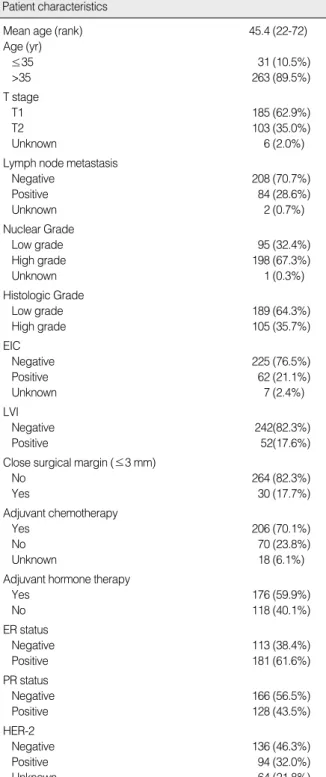
대상환자 294명의 임상병리적 특징은 Table 1에 기술하였다.
이 중 35세 이하의 젊은 환자가 31명(10.5%)이었다. 종양의 크기 에 따라서는 2 cm 이하가 185명(62.9%)이었다. 액와 림프절 전 이는 84명(28.6%)에서 관찰되었다. 상피내암을 포함하여 종양과 가장 가까운 절제연까지 거리가 3 mm 이하인 경우 근접 절제연 으로 정의하였을 때, 30명(17.7%)의 환자가 이에 해당하였다. 치 료 방법에서 기술한 이유에 따라 분석 대상 중에서 절제연이 양성 인 예는 없었다. 전체 환자 중 70.1%에서 수술 후 항암치료를 시 행하였다. 앞서 기술한 정의에 따라 분류하였을 때 전체 환자 중 TNBC가 19.7%를 차지하였다.
동측유방내재발에 영향을미치는인자-단변량, 다변량분석 대상 환자 중 추적 기간 중 12명(4.8%)에서 동측 유방 내 재발 이 발생하였다. 보존수술 후 유방내 재발에 영향을 미치는 인자들 을 단변량분석하였을 때, 진단 당시 연령이 35세 이하로 젊은 환 자(p=0.006)에서 유의하게 동측 유방 내 재발의 위험이 높았다 (Table 2). 종양의 크기나 림프절 전이 여부, 조직학적 등급, AJCC 병기, 광범위 관내상피병소, 림프혈관침습, 종양의 절제연 근접 여부 등은 유의한 연관성을 보이지 않았다. 호르몬수용체 발현 여 부와 TNBC인 경우도 동측 유방 내 재발과 유의한 연관성을 보이 지 않았다. HER-2 면역염색 결과가 2 positive인 환자 51명을 분석에서 제외하고, 0, 1+인 경우를 음성, 3+인 경우만을 양성으 로 간주하여 분석했을 때에도 TNBC와 non-TNBC의 동측 유방 내 재발의 유의한 차이는 없었다.
35세 이하의 젊은 연령의 환자는 그 이상의 연령의 환자에 비해 조직학적 등급의 높은 종양을 가진 경우가 많았으며 에스트로겐
수용체 음성의 종양이 유의하게 많았다 (Table 3). 조직학적 등급 과 호르몬수용체 발현의 정도를 보정한 Cox regression 모델을 이용한 다변량분석에서는 35세 이하의 젊은 연령만이 동측 유방
EIC=Extensive Intraductal Component; LVI=Lymphovascular Invasion;
ER=estrogen receptor; PR=progesterone receptor.
Mean age (rank) 45.4 (22-72)
Age (yr)
≤35 31 (10.5%)
>35 263 (89.5%)
T stage
T1 185 (62.9%)
T2 103 (35.0%)
Unknown 6 (2.0%)
Lymph node metastasis
Negative 208 (70.7%)
Positive 84 (28.6%)
Unknown 2 (0.7%)
Nuclear Grade
Low grade 95 (32.4%)
High grade 198 (67.3%)
Unknown 1 (0.3%)
Histologic Grade
Low grade 189 (64.3%)
High grade 105 (35.7%)
EIC
Negative 225 (76.5%)
Positive 62 (21.1%)
Unknown 7 (2.4%)
LVI
Negative 242(82.3%)
Positive 52(17.6%) Close surgical margin (≤3 mm)
No 264 (82.3%)
Yes 30 (17.7%)
Adjuvant chemotherapy
Yes 206 (70.1%)
No 70 (23.8%)
Unknown 18 (6.1%)
Adjuvant hormone therapy
Yes 176 (59.9%)
No 118 (40.1%)
ER status
Negative 113 (38.4%)
Positive 181 (61.6%)
PR status
Negative 166 (56.5%)
Positive 128 (43.5%)
HER-2
Negative 136 (46.3%)
Positive 94 (32.0%)
Unknown 64 (21.8%)
Table 1. Clinicopathologic information of studied patients
Patient characteristics
내 재발 발생과 연관되는 유의한 인자로 관찰되었다(p=0.036;
hazard ratio [HR], 3.86; 95% confidence interval [CI], 1.09- 13.60). Figure 1은 35세 이하의 젊은 연령과 35세 이상의 연령 에서의 무재발 생존율 곡선을 도시하였다.
고 찰
조기 유방암에 있어서 유방보존수술은 표준 술식으로 인정되 고 있다. 젊은 연령의 환자,(12,13) BRCA 유전자 돌연변이 보인 자,(14) 유두와 가까운 위치의 종양,(15) 광범위 관내상피병소의 정도,(16) 혈관 및 림프관의 침범,(17) 소엽상 암(18) 등의 인자를 Table 2. Results of univariate and multivariate analysis for factors affecting ipsilateral breast tumor recurrence
Variable Category
RR 95% CI p-value
p-value
Univariate analysis Multivariate analysis
Age group ≤35 vs >35 0.006 3.86 1.09-13.60 0.036
Histologic grade High vs Low 0.099 2.03 0.57-7.27 0.274
T stage T2 vs T1 0.443
Lymph node Positive vs Negative 0.635 AJCC stage Stage I, II, and III 0.209 Nuclear grade Grade 3 vs Grade 1,2 0.881
LVI Present vs Absent 0.095
EIC Present vs Absent 0.342
Surgical margin Close vs Clear 0.313
ER status Positive vs Negative 0.402 1.01 0.29-3.56 0.987
PR status Positive vs Negative 0.667 HER-2 status Positive vs Negative 0.755 Chemotherapy Done vs Not done 0.667
TNBC type TNBC vs Non-TNBC 0.498
AJCC=American Joint Committee on Cancer; EIC=extensive intraductal component; LVI=lymphovascular invasion; ER=estrogen receptor; PR=
progesterone receptor; TNBC=triple negative breast cancer; Non-TNBC=non triple negative breast cancer.
LN=lymph node; EIC=extensive intraductal component; LVI=lympho- vascular invasion.
T stage
T1 13 (46.4%) 172 (66.2%) 0.060
T2 15 (53.6%) 88 (33.8%)
Nodal metastasis
LN negative 20 (66.7%) 188 (71.8%) 0.532 LN positive 10 (33.3%) 74 (28.2%)
Nuclear grade
Low grade 14 (45.2%) 81 (30.9%) 0.154 High grade 17 (54.8%) 181 (69.1%)
Histologic Grade
Low grade 12 (38.7%) 177 (67.3%) 0.003 High grade 19 (61.3%) 86 (32.7%)
Margin status
Clear margin 26 (83.9%) 238 (90.5%) 0.224 Close margin 5 (16.1%) 25 (9.5%)
Estrogen receptor
Negative 19 (61.3%) 94 (35.7%) 0.010 Positive 12 (38.7%) 169 (64.3%)
HER-2 overexpression
Negative 16 (61.5%) 120 (58.8%) 0.835 Positive 10 (38.5%) 84 (41.2%)
EIC
Absent 27 (93.1%) 198 (76.7%) 0.054 Present 2 (6.9%) 60 (23.3%)
LVI
Absent 21 (67.7%) 221 (84.0%) 0.042 Present 10 (32.3%) 42 (16.0%)
Table 3. Clinicopathological characteristics of patients accord- ing to age at time of diagnosis
Age ≤35 Age >35 p
Cumulative survival
1.0
0.8
0.6
0.4
0.2
0.0
0 2 4 6 8 10 12
Yeats after surgery IBTR-free survival
p=0.006
≤35
Figure 1. Kaplan-Meier survival curves according to patients’ age.
>35
가진 경우는 유방보존술 후 국소재발이 상대적으로 높다는 보고 들이 있으나 현재까지의 증거로는 이러한 인자들이 유방보존술의 금기로 여겨지고 있지는 않다.(15)
본 연구에서는 유일하게 젊은 진단 연령만이 유방 내 재발에 유 의하게 영향을 미치는 요인으로 나왔으며, 약 7년의 관찰 기간 중 35세 이하의 여성인 경우 더 높은 연령의 여성에 비해 유방 내 재 발의 위험이 4배 높은 것으로 나타났다. 이러한 유방내 재발과 연 령과의연관성은 이전의연구에서도보고된바있다.(12,13,19-24) Voogd 등(13)은 European Organisation for Research and Treatment of Cancer와 Danish Breast Cancer Cooperative Group 데이터의 분석을 통해 60세 이상의 여성에 비해 35세 이 하의 여성에서 유방 보존수술 후 국소재발의 위험이 9배 높다고 하였으며, Jobsen 등(22)은 40세 미만의 연령이 T1N0의 유방암 으로 유방 보존수술을 한 경우에 유방 내 재발을 예측하는 유일한 인자라고 하였다. 동양의 연구로는 Komoike 등(23)이 젊은 연령, 외과 절제연 양성, 방사선치료를 생략한 경우 등을 유방 내 재발의 유의한 예측 인자로 제시하였으며, 국내 연구로는 Kim 등(24)이 젊은 연령, 전이된 림프절의 개수, 종양의 핵등급 등을 유의하게 보고하였다. 이들 연구 결과를 볼 때, 젊은 여성에서 유방 보존수 술 후에 국소재발의 빈도가 높은 것은 확실한 것으로 보인다. 그러 나 이러한 연구결과에도 불구하고 연령인자 자체가 유방보존술의 금기가 되지는 않는다. 이는 젊은 연령에서도 유방전절제술을 실 시한 군과 비교하여 국소재발률이나 생존율에 차이가 없기 때문 이다.(1)
유방암 환자에서 예후를 분석함에 있어 연령의 경계를 정하는 데에는 논란이 있을 수 있지만 기존의 많은 연구들이 35세 혹은 40세를 기준으로 하고 있으며, 최근의 연구에서 한국인 유방암 환 자에서 35세를 기준으로 하는 것이 가장 유의한 분별값이 된다는 보고에 따라 35세 이하와 이상으로 환자군을 구분하였다.(25,26) 고령의 나이와 동측 유방 내 재발의 연관성에 관한 기존의 보고가 없었고, 본 연구에 포함된 환자 중 60세 이상의 고령 환자는 15명 에 불과하여 고령의 나이와의 연관성에 대해서는 본 연구에서 분 석하지 않았다.
본 연구에서는 종양과 절제연과의 거리가 3 mm 이하로 근접 한 경우와 3 mm 이상인 경우에 유방 내 재발에 차이가 없음을 보 여주고 있다. 그러나 아직까지 유방보존수술에 있어 적절한 절제 연의 정의는 논란이 있으므로 본 연구에서 보인 절제연과 유방 내 재발의 연관성에 대한 결과는 주의 깊게 해석되어야 하며 다른 기 관의 치료방침에 영향을 줄 수 있는 일반화에 있어서는 특히 조심 하여야 한다.(27) 유방보존수술의 중요한 목적 중 하나인 유방의 미용적 결과는 절제된 조직의 용적에 반비례한다는 보고도 있으므 로 본 연구의 결과는 절제연이 병리적으로 음성일 정도의 유방조
직절제로도 동등한 치료성적을 얻을 수 있다면 추가적인 넓은 절 제연을 얻기 위한 광범위한 절제는 필요하지 않음을 시사한다.(28) 최근의 국내 연구에서도 병리적으로 절제연 음성을 획득한 경우 사분절제술(quadrantectomy)과 종양절제술(lumpectomy)은 국소재발률에 영향을 미치지 않음을 보고한 바 있다.(29) 이에 대 한 반론으로는, 절제연 자체가 통상적으로 불규칙하며 모든 절제 연을 병리학적으로 관찰하기는 기술적으로 어렵기 때문에 절제연 음성이 유방에서 암조직의 완전 절제를 반드시 의미하지는 않는 다는 것이다. Veronesi 등(30)은 조기유방암에서 방사선치료와 병행한 결과 사분절제술이 종양절제술보다 국소재발률이 더 낮다 고 보고하기도 하였다. 근접 절제연의 정의가 표준화되어 있지 않 다는 것이 또 하나의 문제인데, 적절한 절제연의 길이에 대해서는 아직도 논란이 있다.(31-35)
본 연구에서는 에스게스테론수용체, 프로게스테론수용체, HER-2 면역조직화학검사로 분류한 TNBC과 non-TNBC 간 에 IBTR의 유의한 차이를 확인할 수 없었다. Haffty 등(36)은 Yale 대학에서 치료받은 482명의 환자를 대상으로 한 분석에서 TNBC과 non-TNBC 간에 동측 유방 내 재발이 없는 무병생존 율에 있어서 유의한 차이가 없음을 보고하였으며, Dent 등(13)은 Toronto에서 치료받은 1,601명의 환자의 분석결과에서 전이의 양상에 있어서는 차이를 보이긴 하였지만 TNBC과 non-TNBC 간 국소재발률 차이 자체는 유의하지 않음을 보고하였다. 그러나 이 연구들은 1980년대라는 비교적 예전에 치료받은 환자를 대상 으로 분석하여 최근의 영상기법 등의 변화가 반영되지 않았다는 단점이 있으며, 실제로 두 연구에서 5년 국소재발률은 17%와 13%
에 달하는 등 최근의 유방암치료 성적과는 차이를 보였다. 본 연 구에서도 7년간의 추적관찰 기간동안 동측 유방 내 재발은 4.8%
에 불과하여 이들의 연구와는 큰 차이를 보인다. 최근 Nguyen 등(9)의 연구에서는 5년간 2.3%의 동측 유방 내 재발을 보고하였 으며, luminal A 아형에 비해 TNBC와 HER-2 아형이 각각 7.1 배와 9.2배의 위험도의 증가를 보였다. 따라서 향후 대규모 환자 들을 대상으로 한 분석을 통해 TNBC의 국소재발과의 연관성은 추가로 연구되어야 할 것이다.
본 연구의 한계는 다음과 같다. 우선 연구의 대상이 된 환자의 표본 수가 충분치 않아 결과적으로 동측 유방 내 재발의 발생수가 12예에 불과하여 통계적 유의성을 발굴하기에 한계가 있었으며, HER-2 아형을 구분하는 데 있어서 연구의 대상이 된 환자의 상 당수가 HER-2 FISH 검사를 본격적으로 하기 전에 치료받은 환 자들로 그 정확도의 측면에서도 한계가 있다. 또한 종양의 크기가 5 cm보다 큰 T3 환자들이 연구대상에서 제외된 점도 최근 큰 종 양에서도 유방보존술의 시행이 늘고 있는 점을 고려하면 연구의 단점으로 판단된다. 따라서 향후 보다 더 대규모의 한국인유방암
환자의 자료를 기반으로 유방 내 재발의 위험인자를 분석하는 후 속연구가 필요하다.
결 론
본 연구에서는 단일기관에서 치료받은 294명의 T1 및 T2 유방 암 환자를 대상으로, 유방보존술 이후의 동측 유방 내 재발에 영향 을 미치는 인자를 분석하였고 결론적으로 35세 이하의 연령이 동 측 유방 내 재발에 유의한 차이를 보이는 인자였다. 또한 TNBC 아형에서 non-TNBC 아형에 비해 상대적으로 높은 동측 유방 내 재발률을 보이기는 하였으나 통계적 유의성은 보이지 않았다. 본 연구의 결과 젊은 여성의 유방암보존수술 시 보다 적절한 영상적 검사와 보조적 치료, 그리고 더 빈번한 추적관찰이 필요할 것으로 생각된다.
참고문헌
1. Morrow M, Harris JR. Local Management of Invasive Cancer: Breast.
In: Harris JR, Lippman ME, Morrow M, Osborne CK. Diseases of the Breast. 3rd ed. Philadelphia: Lippincott Williams & Wilkins;
2004. p.719-44.
2. Fisher B, Anderson S, Bryant J, Margolese RG, Deutsch M, Fisher ER, et al. Twenty-year follow-up of a randomized trial comparing total mastectomy, lumpectomy, and lumpectomy plus irradiation for the treatment of invasive breast cancer. N Engl J Med 2002;347:
1233-41.
3. Veronesi U, Cascinelli N, Mariani L, Greco M, Saccozzi R, Luini A, et al. Twenty-year follow-up of a randomized study comparing breast-conserving surgery with radical mastectomy for early breast cancer. N Engl J Med 2002;347:1227-32.
4. Ahn SH, Yoo KY, Korean Breast Cancer Society. Chronological changes of clinical characteristics in 31,115 new breast cancer patients among Koreans during 1996-2004. Breast Cancer Res Treat 2006;99:
209-14.
5. Clarke M, Collins R, Darby S, Davies C, Elphinstone P, Evans E, et al. Effects of radiotherapy and of differences in the extent of surgery for early breast cancer on local recurrence and 15-year survival: An overview of the randomised trials. Lancet 2005;366:2087-106.
6. Wapnir IL, Anderson SJ, Mamounas EP, Geyer CE Jr, Jeong JH, Tan-Chiu E, et al. Prognosis after ipsilateral breast tumor recurrence and locoregional recurrences in five national surgical adjuvant breast and bowel project node-positive adjuvant breast cancer trials. J Clin
Oncol 2006;24:2028-37.
7. Kang SH, Lee SJ. The effect of margin width on local recurrence after breast conservation therapy. J Korean Surg Soc 2007;73:385-94.
8. Suh CO, Chung EJ, Lee HD, Lee KS, Oh KK, Kim GE. Risk factors for recurrence after conservative treatment in early breast cancer. J Korean Soc Ther Radiol 1997;15:331-8.
9. Nguyen PL, Taghian AG, Katz MS, Niemierko A, Abi Raad RF, Boon WL, et al. Breast cancer subtype approximated by estrogen receptor, progesterone receptor, and her-2 is associated with local and distant recurrence after breast-conserving therapy. J Clin Oncol 2008;26:2373-8.
10. Lee JW, Han W, Ko E, Cho J, Jung SY, Kim EK, et al. Alteration of estrogen receptor, progesterone receptor, and her-2 expression in breast cancer after neoadjuvant chemotherapy. J Breast Cancer 2007;
10:206-10.
11. Dent R, Trudeau M, Pritchard KI, Hanna WM, Kahn HK, Sawka CA, et al. Triple-negative breast cancer: clinical features and patterns of recurrence. Clin Cancer Res 2007;13:4429-34.
12. Arriagada R, Le MG, Guinebretiere JM, Dunant A, Rochard F, Tursz T. Late local recurrences in a randomised trial comparing conservative treatment with total mastectomy in early breast cancer patients. Ann Oncol 2003;14:1617-22.
13. Voogd AC, Nielsen M, Peterse JL, Blichert-Toft M, Bartelink H, Overgaard M, et al. Differences in risk factors for local and distant recurrence after breast-conserving therapy or mastectomy for stage i and ii breast cancer: Pooled results of two large european randomized trials. J Clin Oncol 2001;19:1688-97.
14. Haffty BG, Harrold E, Khan AJ, Pathare P, Smith TE, Turner BC, et al. Outcome of conservatively managed early-onset breast cancer by brca1/2 status. Lancet 2002;359:1471-7.
15. Benson JR, Jatoi I, Keisch M, Esteva FJ, Makris A, Jordan VC. Early breast cancer. Lancet 2009;373:1463-79.
16. Jacquemier J, Kurtz JM, Amalric R, Brandone H, Ayme Y, Spitalier JM. An assessment of extensive intraductal component as a risk factor for local recurrence after breast-conserving therapy. Br J Cancer 1990;
61:873-6.
17. Borger J, Kemperman H, Hart A, Peterse H, van Dongen J, Bartelink H. Risk factors in breast-conservation therapy. J Clin Oncol 1994;12:
653-60.
18. Sasson AR, Fowble B, Hanlon AL, Torosian MH, Freedman G, Bo- raas M, et al. Lobular carcinoma in situ increases the risk of local recurrence in selected patients with stages i and ii breast carcinoma
treated with conservative surgery and radiation. Cancer 2001;91:1862-9.
19. Fourquet A, Campana F, Zafrani B, Mosseri V, Vielh P, Durand JC, et al. Prognostic factors of breast recurrence in the conservative mana- gement of early breast cancer: a 25-year follow-up. Int J Radiat Oncol Biol Phys 1989;17:719-25.
20. Locker AP, Ellis IO, Morgan DA, Elston CW, Mitchell A, Blamey RW. Factors influencing local recurrence after excision and radio- therapy for primary breast cancer. Br J Surg 1989;76:890-4.
21. Freedman GM, Hanlon AL, Fowble BL, Anderson PR, Nicolaou N.
Recursive partitioning identifies patients at high and low risk for ipsi- lateral tumor recurrence after breast-conserving surgery and radiation.
J Clin Oncol 2002;20:4015-21.
22. Jobsen JJ, van der Palen J, Meerwaldt JH. The impact of age on local control in women with pt1 breast cancer treated with conservative surgery and radiation therapy. Eur J Cancer 2001;37:1820-7.
23. Komoike Y, Akiyama F, Iino Y, Ikeda T, Akashi-Tanaka S, Ohsumi S, et al. Ipsilateral breast tumor recurrence (IBTR) after breast-con- serving treatment for early breast cancer: risk factors and impact on distant metastases. Cancer 2006;106:35-41.
24. Kim KJ, Huh SJ, Yang JH, Park W, Nam SJ, Kim JH, et al. Treatment results and prognostic factors of early breast cancer treated with a breast conserving operation and radiotherapy. Jpn J Clin Oncol 2005;
35:126-33.
25. Han W, Kim SW, Park IA, Kang D, Youn YK, Oh SK, et al. Young age: an independent risk factor for disease-free survival in women with operable breast cancer. BMC Cancer 2004;4:82.
26. Han W, Kang SY, Korean Breast Cancer Society. Relationship bet- ween age at diagnosis and outcome of premenopausal breast cancer:
age less than 35 years is a reasonable cut-off for defining young age- onset breast cancer. Breast Cancer Res Treat 2010;119:193-200.
27. Luini A, Rososchansky J, Gatti G, Zurrida S, Caldarella P, Viale G, et al. The surgical margin status after breast-conserving surgery: dis- cussion of an open issue. Breast Cancer Res Treat 2009;113:397-402.
28. Wazer DE, DiPetrillo T, Schmidt-Ullrich R, Weld L, Smith TJ, Mar-
chant DJ, et al. Factors influencing cosmetic outcome and compli- cation risk after conservative surgery and radiotherapy for early-stage breast carcinoma. J Clin Oncol 1992;10:356-63.
29. Noh WC, Paik NS, Kim MS, Yang KM, Cho CK, Choi DW, et al.
Ipsilateral breast tumor recurrence after breast-conserving therapy: a comparison of quadrantectomy versus lumpectomy at a single in- stitution. World J Surg 2005;29:1001-6.
30. Veronesi U, Volterrani F, Luini A, Saccozzi R, Del Vecchio M, Zucali R, et al. Quadrantectomy versus lumpectomy for small size breast cancer. Eur J Cancer 1990;26:671-3.
31. Freedman G, Fowble B, Hanlon A, Nicolaou N, Fein D, Hoffman J, et al. Patients with early stage invasive cancer with close or positive margins treated with conservative surgery and radiation have an in- creased risk of breast recurrence that is delayed by adjuvant systemic therapy. Int J Radiat Oncol Biol Phys 1999;44:1005-15.
32. Park CC, Mitsumori M, Nixon A, Recht A, Connolly J, Gelman R, et al. Outcome at 8 years after breast-conserving surgery and radiation therapy for invasive breast cancer: influence of margin status and sys- temic therapy on local recurrence. J Clin Oncol 2000;18:1668-75.
33. Peterson ME, Schultz DJ, Reynolds C, Solin LJ. Outcomes in breast cancer patients relative to margin status after treatment with breast- conserving surgery and radiation therapy: the university of pennsy- lvania experience. Int J Radiat Oncol Biol Phys 1999;43:1029-35.
34. Solin LJ, Fowble BL, Schultz DJ, Goodman RL. The significance of the pathology margins of the tumor excision on the outcome of pati- ents treated with definitive irradiation for early stage breast cancer.
Int J Radiat Oncol Biol Phys 1991;21:279-87.
35. Singletary SE. Surgical margins in patients with early-stage breast cancer treated with breast conservation therapy. Am J Surg 2002;
184:383-93.
36. Haffty BG, Yang Q, Reiss M, Kearney T, Higgins SA, Weidhaas J, et al. Locoregional relapse and distant metastasis in conservatively managed triple negative early-stage breast cancer. J Clin Oncol 2006;
24:5652-7.