S. H. Kwon ・ W. Kim ・ M. Kwon ( )
College of Life Science and Biotechnology, Korea University, Seoul 136-701, Korea
e-mail: [email protected] H. K. Kwon
Institute of Life Science and Natural Resources, College of Life Science and Biotechnology, Korea University, Seoul 136-701, Korea
S. H. Kwon ・ E. W. Noh ・ Y. I. Choi ( )
Division of Forest Biotechnology, Korea Forest Research Institute, Suwon 441-350, Korea
e-mail: [email protected]
*Co-Corresponding author : M. Kwon ・ Y. I. Choi
Identification of salt and drought inducible glutathione S-transferase genes of hybrid poplar
Soon-Ho Kwon ・ Hye-Kyoung Kwon ・ Wook Kim ・ Eun Woon Noh ・ Mi Kwon* ・ Young Im Choi*
Received: 25 November 2013 / Revised: 28 November 2013 / Accepted: 29 January 2014
ⓒKorean Society for Plant Biotechnology
Abstract Recent genome annotation revealed that Populus trichocarpa contains 81 glutathione S-transferase (GST) genes. GST genes play important and varying roles in plants, including conferring tolerance to various abiotic stresses.
Little information is available on the relationship – if any – between drought/salt stresses and GSTs in woody plants. In this study, we screened the PatgGST genes in hybrid poplar (Populus alba × Populus tremula var. glandulosa) that were predicted to confer drought tolerance based on our expression analysis of all members of the poplar GST superfamily following exposure to salt (NaCl) and drought (PEG) stresses, respectively. Exposure to the salt stress resulted in the induction of eight PatgGST genes and down-regulation of one PatgGST gene, and the level of induction/repression was different in leaf and stem tissues. In contrast, 16 PatgGST genes were induced following exposure to the drought (PEG) stress, and two were down-regulated. Taken together, we identified seven PatgGSTs (PatgGSTU15, PatgGSTU18, PatgGSTU22, PatgGSTU27, PatgGSTU46, PatgGSTU51 and PatgGSTU52) as putative drought tolerance genes based on their induction by both salt and drought stresses.
Keywords Glutathione S-transferases, salt stress, drought stress, Populus alba × Populus tremula var. glandulosa
Introduction
Gene/genomic duplication events have been very common occurrences during the evolution of eukaryotes. Some of these duplicated genes/genomic sequences would have been prone to mutation and may have acquired novel functions in additional to their original function(s), or they may have changed their original function(s) completely. In extreme cases, they might have become pseudogenes (Hughes 1994;
Force et al. 1999; Moore and Purugganan 2005). Thus, it is not at all uncommon to identify duplicated genes in eukaryotes, especially in plants (Tuskan et al. 2006). These duplicated copies of the genes form a unique gene family and it is a commonly accepted assumption that all of those genes have evolved and diversified after repeated duplication events, as exemplified by the glutathione S-transferase (GST) gene family in plants. GSTs (EC 2.5.1.18) are multi-functional proteins that can be found in all organisms (Smith et al.
2004). They protect cells from both biotic and abiotic stresses, including xenobiotics, heavy metals, pathogens, and oxidative bursts (Kampranis et al. 2000; Mueller et al. 2000; Agrawal et al. 2002).
Plant GSTs are subdivided into eight distinct classes.
These are Phi, Tau, Theta, Zeta, Lambda, glutathione-dependent dehydroascorbate reductases (DHARs), tetrachlorohydroquinone dehalogenase (TCHQD) (Basantani and Srivastava 2007) and γ-subunit of the eukaryotic translation elongation factor 1B (EF1Bγ) with last subfamily only being included as a member of the GST family based on structural similarities to GSTs (Jeppesen et al. 2003; Oakley 2005; Lan et al.
2009). Among these, Phi and Tau are plant specific whereas the Theta and Zeta classes are found in mammals, fungi, and insects (Sheehan et al. 2001; Smith et al. 2004). In plants, each GST family has a large number of members.
For example, the GST gene family in Arabidopsis thaliana has 53 members (Dixon et al. 2002; Wagner et al. 2002), 79 members in Oryza sativa (Soranzo et al. 2004) and 81 R es earc h Arti cle
Fig. 1 Shoot-tip cultures of the hybrid poplar [Populus alba × P. tremula var. glandulosa (Patg)] for stress treatments
members in Populus trichocarpa (Lan et al. 2009). In Populus trichocarpa, the Tau and Phi GSTs were the most numerous, being represented by 58 and 9 members, respectively (Lan et al. 2009). The Lambda, DHAR, and EF1Bγ GST classes were each represented by three members, both the Zeta and Theta classes by two members, and the TCHQD class by just one member (Lan et al. 2009).
GST genes play very important and varying roles in plants. Some of the roles reported to date include conferring tolerance to oxidative stress and UV-radiation, protecting cells from biotic and abiotic stress, and providing defense against cadmium toxicity (Kampranis et al. 2000; Loyall et al. 2000; Agrawal et al. 2002; Bianchia et al. 2002).
Tau- and Phi class GTSs, the two largest classes and the most abundant GSTs in plants, participate in endogenous cellular metabolism by functioning as glutathione peroxidases that counteract oxidative stress, as flavonoid-binding proteins and as stress signaling proteins (Dixon et al. 2002; Mueller et al. 2000; Loyall et al. 2000; Basantani and Srivastava 2007). Although detailed knowledge of the physiological and molecular mechanisms of tolerance to stress in plants is not yet available, considerable evidence has been accumulated to indicate that GSTs play a protective role in mitigating the effects of drought and salinity stresses in plants (George et al. 2010; Ji et al. 2010; Wei et al. 2010; Jha et al. 2011;
Chen et al. 2012). For example, Ji et al. (2010) observed that the overexpression of Glycine soja GST gene in tobacco enhanced the drought and salt stress tolerance of the transgenic tobacco plants. In another study, transgenic tobacco plants overexpressing the Salicornia brachiata GST gene were more tolerant of the salt stress condition than wild-type tobacco plants (Jha et al. 2011).
Poplar species are fast-growing temperate woody plants with high potential for biomass production. The recent sequencing of the entire genome of P. trichocarpa has led to an abundance of gene expression data becoming available.
Based on poplar genome annotation, Lan et al. (2009) showed that Populus spp. have the largest GST family known to date. Thus, this plant would appear to be an ideal model species to study the function of GSTs in plants.
GSTs are a particularly interesting research topic since the functions of some GST genes might be fully or partially overlapping in terms of salt and drought stress tolerance.
In this study, our aim was to screen the members of the poplar GST family that respond to salt and drought stresses by semi-quantitative reverse transcriptase (RT)-PCR analysis.
Seven members of the Tau class of the GST family were screened based on transcript levels in the hybrid poplar (Populus alba × P. tremula var. glandulosa) under conditions
of salt (NaCl) and drought [polyethylene glycol (PEG)]
stresses.
Materials and methods
Plant culture and stress treatments
A hybrid aspen clone BH1 [Populus alba × P. tremula var. glandulosa (Patg)] was vegetatively propagated via shoot-tip culture on solid rooting medium [half-strength MS medium (Murashige and Skoog 1962) supplemented with 3% sucrose, 0.2 mg/L indole-3-butyric acid, and 0.8%
agar; pH 5.8]. The cultures were maintained at 22°C and 40% humidity under white-fluorescent lighting provided at an intensity of 200 µmol/m2s for 16 h per day. The plants were subcultured at 4-week intervals until being transferred into liquid medium prior to the stress treatments. For the stress treatments, plants were removed from the solid medium, washed with sterile distilled water, and placed in test tubes containing liquid medium with the same composition as the rooting medium (except for a higher concentration of agar) supplemented with 150 mM NaCl or 10% PEG 6000. Plants were harvested after 0 (Control), 30 m, or 2 h exposure to the stress (Fig. 1).
RNA extraction and cDNA library construction
Fresh tissues (leaves and stems) were ground into a fine powder in liquid nitrogen using a mortar and pestle. After homogenization, total RNA was purified using the RNeasy Plant Mini kit (Qiagen, Venlo, The Netherlands). The quality and quantity of purified total RNA were confirmed by spectrophotometric analysis and gel electrophoresis. Total RNA (5 μg) was used to synthesize first-strand cDNAs by the PrimeScript™ RT Reagent kit (TaKaRa, Otsu, Japan).
Table 1. Primers for reverse transcription (RT)-PCR that were newly designed based on the sequence information of Populus trichocarpa in the Phytozyme database (http://www.phytozome.net)
Gene Primer name Sequence (5′ to 3′) PatgGSTU6 GSTU6-F
GSTU6-R
TTGGAAGGAGAGCTTGGAGA CTTCCTCAGCATCACAACGA PatgGSTU41 GSTU41-F
GSTU41-R
GAAGGGACATGGAAGCAAAA TCCACAATTCCGATCCTCTC PatgGSTU43 GSTU43-F
GSTU43-R
CCAGTGCTTGTTCATGATGG TTGCCTTTTCCTGTTGCTCT PatgGSTU44 GSTU44-F
GSTU44-R
AGGGACAAGAGAAGGCAACA GATGCAAACGAGGGAAGCTA PatgGSTU45 GSTU45-F
GSTU45-R
CGAGAAGTGTATGCCTGCAA CCCAACCAGAAGCCTATGAA PatgGSTU55 GSTU55-F
GSTU55-R
TTTTGGGGATGAGAGCTTTG AAACCTCCTTCTGGCCACTT PatgDHAR3 DHAR3-F
DHAR3-R GAAAGGTCCCAGTGGTGAAA TCCAATGCCTTCAATTCCTC PatgGSTT2 GSTT2-F
GSTT2-R
TTTGGTCGACCTCTGAATCC TGCGATCCGTTTCATCTGTA PatgGSTZ1 GSTZ1-F
GSTZ1-R
AACCTTGCAAAAGGAGAGCA CACCAAAGCCAGCATATGAA PatgEF1Bγ3 EF1Bγ3-F
EF1Bγ3-R CTGAACAAGGTCGGTGGATT TGTCAACCTTGGTCCATTCA Transcript analysis by semi-quantitative RT-PCR
The expression of GST genes under our drought or salt treatment conditions was analyzed with five replicates. The poplar β-actin gene was used as a control gene. The actin forward primer sequence was 5'-GCCATCTCTCATCGGA ATGGAA-3', and the reverse primer sequence was 5'-AGG GCAGTGATTTCCTTGCTCA-3'. RT-PCR assays were performed with the PCR PreMix 20 Reaction kit (Bioneer, Daejeon, Korea) on a thermocycler (model T3000; Biometra GmbH, Göttingen Germany). Some of the GST primers for the semi-quantitative RT-PCR assays were designed according to the previously reported primer sequences for P. trichocarpa GST genes (Lan et al. 2009), and the remaining ten pairs were designed in our study (Table 1). The cycling conditions of the semi-quantitative RT-PCR assays consisted of 30 cycles of an initial denaturation at 95°C for 5 m, denaturation at 95°C for 30 s, and annealing at 54 ~ 63°C, and extension at 72°C for 40 s. The amplified products were run on a 1 % agarose gel and visualized by UV-light.
Results
Design of RT-PCR primers for hybrid poplar transcript analysis
Prior to the semi-quantitative RT-PCR assays, primers designed on the basis of the genome of P. trichocarpa (Lan et al.
2009) were tested using cDNA synthesized from our hybrid poplar grown in the normal growth media. We detected 43 putative PatgGST transcripts among the 81 PatgGSTs identified in our hybrid poplar (data not shown), of which only ten PatgGST transcripts were detected using the newly designed primers listed in Table 1. The transcripts of the remaining 38 PatgGST genes were not detected by RT-PCR.
Possible explanations for this failure to obtain amplification products include sequence differences at the priming sites between the two poplar species, development- and/or or tissue type-specific expression, and/or inducible expression under specific environmental conditions.
Isolation of salt stress response genes in hybrid poplar Semi-quantitative analysis of the expression of the 81 PatgGST genes of hybrid poplar (P. alba × P. tremula var. glandulosa) was performed following exposure of the plants to 150 mM NaCl treatment for 30 m and 2 h (Fig. 1). Eight of the 43 PatgGST genes amplified under the salt stress condition were up-regulated. Of these, five (PatgGSTU15, PatgGSTU18, PatgGSTU27, PatgGSTU45 and PatgGSTU46) were up-regulated in either the leaves (PatgGSTU27 and Patg GSTU46) or the stem (PatgGSTU15, PatgGSTU18 and Patg GSTU45), and three (PatgGSTU22, Patg GSTU51 and Patg GSTU52) were induced in both the leaves and stems (Fig.
2). In contrast, PatgGSTU9 expression was down- regulated by the NaCl treatment (Fig. 2). Almost all of the other Patg GST genes amplified under this specific stress condition did not show any visible change in the expression level when compared with untreated control tissues (data not shown).
Isolation of PEG response genes in hybrid poplar
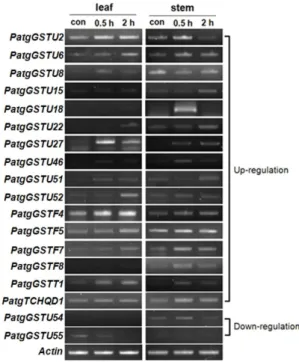
Drought-associated oxidative stress was induced in our study by adding 10% PEG 6000 to the growth media and sampling the plants at 30 m and 2 h. Of the 43 PatgGST genes amplified, 16 were up-regulated at the transcription level following the 10% PEG 6000 treatment (Fig. 3). Most of them were up-regulated in both the leaf and stem tissues, but PatgGSTF8 was induced only in the stem (Fig. 3). Among the 16 PatgGST genes that were up-regulated in the presence of 10% PEG were seven PatgGST genes that were induced
Fig. 2 Transcript analysis of Patg glutathione S-transferases (PatgGSTs) with NaCl treatment by semi-quantitative reverse transcriptase (RT)-PCR. con ; Control (baseline)
Fig. 3 Transcript analysis of PatgGSTs with 10% PEG 6000 treatment by semi-quantitative RT-PCR. TCHQD ; Tetrachloro- hydroquinone dehalogenase, con ; Control (baseline)
in the NaCl treatment: PatgGSTU15, PatgGSTU18, PatgGSTU22, PatgGSTU27, PatgGSTU46, PatgGSTU51, and PatgGSTU52 (Figs. 2 and 3). In contrast, PatgGSTU54 and PatgGSTU55 were down-regulated following exposure to PEG 6000 (Fig. 3).
Discussion
Glutathione S-transferases of many plant species, including Arabidopsis (Bianchi et al. 2002), wild soybean (Wei et al. 2010), Amaranthaceae (Jha et al. 2011), and wheat (Gallé et al. 2009), have been implicated in salt stress and
drought tolerance. However, poplar GSTs have not been characterized in terms of tolerance against abiotic stress, including salt and drought. Consequently, our aim was to isolate putative candidate genes as first step toward understanding the mechanism of salt and drought tolerance in woody plants.
Based on our semi-quantitative RT-PCR results, we were able to identify 17 poplar PatgGST genes that responded to either salt- or oxidative stress-mediated drought: PatgGSTU2, PatgGSTU6, PatgGSTU8, PatgGSTU15, PatgGSTU18, Patg GSTU22, PatgGSTU27, PatgGSTU45, PatgGSTU46, PatgGSTU51, PatgGSTU52, PatgGSTU58, PatgGSTF4, PatgGSTF5, Patg GSTF7, PatgGSTF8, PatgGSTT1, and PatgTCHQD1. These genes were subjected to real-time RT-PCR to confirm their induction at the transcription level under the specific stress condition tested (data not shown). Among the eight subclasses of the poplar GST gene family, several GST genes belonging to the Tau subclass were identified as inducible under both the salt and PEG stress (Figs. 2 and 3).
Members of the Tau class of GST (GSTU) genes are plant specific and well-known for their role in herbicide detoxification (Axarli et al. 2009). Recently, extensive analysis of 81 GST family members in Populus were conducted by Lan et al. (2009), which includes phylogenetic relationships among them, their chromosomal locations, gene expression patterns in the different tissue types, and protein structural features. However, their physiological roles regarding to the stress tolerance have not been reported yet. In our study, analysis of the transcriptional levels of Populus GSTs by semi-quantitative RT-PCR led to the identification of candidate genes for salt and drought tolerance. These include Patg GSTU15, PatgGSTU18, PatgGSTU22, PatgGSTU27, PatgGSTU46, PatgGSTU51 and PatgGSTU52. These genes can be used in future investigations to study the mechanism(s) of abiotic stress tolerance as well as in genetic engineering attempts to improve the tolerance of woody plants to various stresses.
Acknowledgments
This study was carried out with the financial support of
‘Forest Science & Technology Projects (Project No. S111212 L18010)’ grant provided by the Korea Forest Service. We would like to give special thanks to Korea Forest Research Institute for supporting Soon-Ho Kwon (FG 0702-2002-01 and FG 0702-2012-01).
References
Agrawal GK, Jwa NS, Rakwal R (2002) A pathogen-induced novel
rice (Oryza sativa L.) gene encodes a putative protein homologous to type II glutathione S-transferases. Plant Sci 163:1153-1160
Axarli I, Dhavala P, Papageorgiou AC, Labrou NE (2009) Crystallographic and functional characterization of the fluorodifen-inducible glutathione transferase from Glycine max reveals an active site topography suited for diphenylether herbicides and a novel L-site. J Mol Bio 385:984-1002 Basantani M, Srivastava A (2007) Plant glutathione transferases -
A decade falls short. Can J Bot 85:443-456
Bianchi MW, Roux C, Vartanian N (2002) Drought regulation of GST8, encoding the Arabidopsis homologue of ParC/Nt107 glutathione transferase/peroxidase. Physiol Plant 116:96-105 Chen JH, Jiang HW, Hsieh EJ, Chen HY, Chien CT, Hsieh HL, Lin
TP (2012) Drought and salt stress tolerance of an Arabidopsis Glutathione S-Transferase U17 knockout mutant are attributed to the combined effect of glutathione and abscisic acid. Plant Physiol 158:340-351
Dixon DP, Davis BG, Edwards R (2002) Functional divergence in the glutathione transferase superfamily in plants: identification of two classes with putative functions in redox homeostasis in Arabidopsis thaliana. J Biol Chem 277:30859-30869 Force A, Lynch M, Pickett FB, Amores A, Yan YL, Postlethwait J
(1999) Preservation of duplicate genes by complementary, degenerative mutations. Genetics 151:1531-1545
Gallé A, Csiszár J, Secenji M, Guóth A, Cseuz L, Tari I, Györgyey J, Erdei L (2009) Glutathione transferase activity and expression patterns during grain filling in flag leaves of wheat genotypes differing in drought tolerance: Response to water deficit. J Plant Physiol 166:1878-1891
George S, Venkataraman G, Parida A (2010) A chloroplast- localized and auxin-induced glutathione S-transferase from phreatophyte Prosopis juliflora confer drought tolerance on tobacco. J Plant Physiol 167:311-318
Hughes A L (1994) The evolution of functionally novel proteins after gene duplication. Proc Biol Sci 256:119-124
Jeppesen MG, Ortiz P, Shepard W, Kinzy TG, Nyborg J, Andersen GR (2003) The crystal structure of the glutathione S-transferase-like domain of elongation factor 1B gamma from Saccharomyces cerevisiae. J Biol Chem 278:47190-47198
Jha B, Sharma A, Mishra A (2011) Expression of SbGSTU (tau class glutathione S-transferase) gene isolated from Salicornia brachiata in tobacco for salt tolerance. Mol Biol Rep 38:4823-4832
Ji W, Zhu Y, Li Y, Yang L, Zhao X, Cai H, Bai X (2010) Over-expression of a glutathione S-transferase gene, GsGST, from wild soybean (Glycine soja) enhances drought and salt tolerance in transgenic tobacco. Biotechnol Lett 32:1173-1179 Kampranis SC, Damianova R, Atallah M, Toby G, Kondi G,
Tsichlis PN, Makris AM (2000) A novel plant glutathione S-transferase/peroxidase suppresses Bax lethality in yeast. J Biol Chem 275:29207-29216
Lan T, Yang ZL, Yang X, Liu YJ, Wang XR, Zenga QY (2009) Extensive functional diversification of the Populus glutathione S-transferase supergene family. Plant Cell 21:3749-3766
Loyall L, Uchida K, Braun S, Furuya M, Frohnmeyer H (2000) Glutathione and a UV light-induced glutathione S-transferase are involved in signalling to chalcone synthase in cell cultures.
Plant J 25:237-245
Moore RC, Purugganan MD (2005) The evolutionary dynamics of plant duplicate genes. Curr Opin Plant Biol 8:122-128 Mueller LA, Goodman CD, Silady RA, Walbot V (2000) AN9, a
petunia glutathione S-transferase required for anthocyanin sequestration, is a flavonoid-binding protein. Plant Physiol 123:1561-1570
Oakley AJ (2005) Glutathione transferases: New functions. Curr Opin Struct Biol 15:716-723
Smith AP, DeRidder BP, Guo WJ, Seeley EH, Regnier FE, Goldsbrough PB (2004) Proteomic analysis of Arabidopsis glutathione S-transferases from benoxacor- and copper-treated seedlings. J Biol Chem 279:26098-26104
Soranzo N, Sari-Gorla M, Mizzi L, De Toma G, Frova C (2004) Organisation and structural evolution of the rice glutathione S-transferase gene family. Mol Genet Genomics 271:511-521 Sheehan D, Meade G, Foley VM, Dowd CA (2001) Structure,
function and evolution of glutathione transferases: implications for classification of non-mammalian members of an ancient enzyme superfamily. Biochem J 360:1-16
Tuskan GA, Difazio S, Jansson S, Bohlmann J, Grigoriev I, Hellsten U, Putnam N, Ralph S, Rombauts S, Salamov A, Schein J, Sterck L, Aerts A, Bhalerao RR, Blaudez D, Boerjan W, Brun A, Brunner A, Busov V, Campbell M, Carlson J, Chalot M, Chapman J, Chen GL, Cooper D, Coutinho PM, Couturier J, Covert S, Cronk Q, Cunningham R, Davis J, Degroeve S, Déjardin A, Depamphilis C, Detter J, Dirks B, Dubchak I, Duplessis S, Ehlting J, Ellis B, Gendler K, Goodstein D, Gribskov M, Grimwood J, Groover A, Gunter L, Hamberger B, Heinze B, Helariutta Y, Henrissat B, Holligan D, Holt R, Huang W, Islam-Faridi N, Jones S, Jones-Rhoades M, Jorgensen R, Joshi C, Kangasjärvi J, Karlsson J, Kelleher C, Kirkpatrick R, Kirst M, Kohler A, Kalluri U, Larimer F, Leebens-Mack J, Leplé JC, Locascio P, Lou Y, Lucas S, Martin F, Montanini B, Napoli C, Nelson DR, Nelson C, Nieminen K, Nilsson O, Pereda V, Peter G, Philippe R, Pilate G, Poliakov A, Razumovskaya J, Richardson P, Rinaldi C, Ritland K, Rouzé P, Ryaboy D, Schmutz J, Schrader J, Segerman B, Shin H, Siddiqui A, Sterky F, Terry A, Tsai CJ, Uberbacher E, Unneberg P, Vahala J, Wall K, Wessler S, Yang G, Yin T, Douglas C, Marra M, Sandberg G, Van de Peer Y, Rokhsar D (2006) The genome of black cottonwood, Populus trichocarpa (Torr. & Gray). Science 313:1596-1604 Wagner U, Edwards R, Dixon DP, Mauch F (2002) Probing the diversity of the Arabidopsis glutathione S-transferase gene family. Plant Mol Biol 49:515-532
Wei J, Yanming Z, Yong L, Liang Y, Xiaowen Z, Hua C, Xi B (2010) Over-expression of a glutathione S-transferase gene, GsGST, from wild soybean (Glycine soja) enhances drought and salt tolerance in transgenic tobacco. Biotechnol Lett 32:1173-1179
Supplementary Table 1. Primers designed by Lan et al. (2009) were initially used for RT-PCR in this experiment Gene Primer name Sequence (5'-3') Gene Primer name Sequence (5'-3') GSTU1 PtGSTU1RT1 TGTTGACAACAAGGTGTATTTTCCT GSTU42 PtGSTU42RT1 ACTTGAGCAACGGAAAGAGTGAT
PtGSTU1RT2 GCCTCTATGCTAAAGTTACCAAATG PtGSTU42RT2 TCCATATCTTCCTAGAAAGGTTATTACC GSTU2 PtGSTU2RT1 ATTTTGTTGACAAAAAGATGTATGACT GSTU43 PtGSTU43EX1 AGATATCATGGTAGGTGTGAAGCTCTTCG
PtGSTU2RT2 ACATCTTCCTCAGCATCACAACA PtGSTU43EX2 TGAATTCTTACTAATGGTGATGGTGGCAAG GSTU3 PtGSTU3RT3 CTGGGCAGATTTTGTTGATAAGA GSTU44 PtGSTU44EX1 AGATATCATGGAAGAAGTGAAGCTACTAGG
PtGSTU3RT4 ACATCAACGTAGCCGAGAGTCTT PtGSTU44EX2 TAAGCTTTTATCATCTTGGTGGAAAAATAC GSTU4 PtGSTU4RT3 GTCCATGATGGGAAACCTATTTT GSTU45 PtGSTU45-EX1 AGATATCATGGCTGAAGTGAAGTTGCT
PtGSTU4RT4 CCTCCCAAGGTCATATACCTTCTTA PtGSTU45-EX2 TGAATTCTTACTAATACTTCCAAGAGGAAGC GSTU5 PtGSTU5RT1 ATTTGTGGAACAAAGGTGCTTTATA GSTU46 PtGSTU46RT3 AATTTACTGAGGAGAAGTGTCTGATG
PtGSTU5RT2 CATATCTTCTTCCCAAAATAATTTACC PtGSTU46RT4 CAGCCCATTGCTAGATCTAAATAA GSTU6 PtGSTU6RT1 GATTTGTGGAACAAAGGTGATTTACT GSTU47 PtGSTU47RT1 AACTTCAAGGACGAGCCCATAA
PtGSTU6EX2 TCTCGAGTTACTACTCAAGCCCAAACT PtGSTU47RT2 ACGGTATGCCCTTCAGTTTCAG GSTU7 PtGSTU7RT3 GAATCCTGTTCACTCGAAAATCCT GSTU48 PtGSTU48RT1 AACTTCAAGGACGAGCCCATAA
PtGSTU7RT4 CGAGGTCATATATCTTTTTGTCAACA PtGSTU48RT2 ACGGTATGCCCTTCAGTTTCAG GSTU8 PtGSTU8RT3 TGTCGACAAAAAGATATATGACTTTG GSTU49 PtGSTU49RT1 TGACAAGAAGGCGTACCGTTC
PtGSTU8RT4 GAAAGGAAGTAGTGCTACATCAACAT PtGSTU49RT2 GCAATCAACTTGGGGCACTC GSTU9 PtGSTU9RT3 GTCCATGATGGAAAACCTATTTG GSTU50 PtGSTU50RT1 CATGGCCTAGTCCTTTCAGTTATA
PtGSTU9RT4 CCAAGGTCATATAACTTTTTGTCAA PtGSTU50RT2 GAGGAAATTTCTGGGGTTCA GSTU10 PtGSTU10RT1 TGTTGACAAAAAGATATATGCCCTC GSTU51 PtGSTU51RT2 CACTCCATTCATCTTCTCTATGGC
PtGSTU10RT2 TCATAGGCATAAAACCAGCAAAG PtGSTU51EX3 AGAATTGCCCTTAATATTAAATCTGC GSTU11 PtGSTU11RT1 TGTTAAAGAGGAAGAGCTTGAGATG GSTU52 PtGSTU52RT1 TTGTTATTCTTGAGTTTATCGATGAG
PtGSTU11RT2 AAGGCTATATCTGCCATCCCTAC PtGSTU52RT2 GCTTCAACGGCCAGTTTTAT GSTU12 PtGSTU12RT3 GGTGGAGACAGTATTGGGATAGC GSTU53 PtGSTU53RT1 TTAAGCTGCTAGGAACATGGC
PtGSTU12RT4 CTTAAAGAAGGTAACCGACCAGC PtGSTU53RT2 CGAGGAAATTTCTGAGGTTCC GSTU13 PtGSTU13RT1 TTGCGAGTCCATGATCATTGTG GSTU54 PtGSTU54RT3 CTGGGCAGATTTTGTTGATAAGA
PtGSTU13RT2 CCTTTAGCATGAAACATTCTCCG PtGSTU54RT4 CATCAACGTAACCGAGGGTGTC GSTU14 PtGSTU14RT1 CATAAGAAGGTTCCGGTACTTGTTC GSTU55 PtGSTU55RT1 CATCGACAAGAAGATGTATCCTACTG
PtGSTU14RT2 TTCTCTTCTTCAGTCGCTCGG PtGSTU55RT2 AACTCGGCAACCATGCTCC GSTU15 PtGSTU15RT3 TTGACAAGAAGATATATAACAATGCC GSTU56 PtGSTU56RT1 TCAGATGTTCAGGAGAGAACTCGA
PtGSTU15RT4 TCCATGCAGTGATCTTTGGAC PtGSTU56RT2 GTATGGGTCAGGTAGGTTCTTGG GSTU16 PtGSTU16RT1 ATTGAGGCTGAGTGTCCAAGGT GSTU57 PtGSTU57RT1 GCCTCTTGCCTGATGATCCTT
PtGSTU16RT2 TTCTTCTTGAGCAGCAACACGT PtGSTU57RT2 CTGAGACTCCATTGGGCAAAAG GSTU17 PtGSTU17RT3 CATTGACAAGAAGATATATAACAATGC GSTU58 PtGSTU58RT1 TGAAACGTGGAAGCAGTCTCC
PtGSTU17RT4 CATGCAGCGATCATTGGAA PtGSTU58RT2 GCAATAAAAAGGGACTAAGGCAAC GSTU18 PtGSTU18RT1 TGATGACAAGGTCCTCCAGTCA GSTF1 PtGSTF1RT1 TAGTGTCCCAGTAGACGAAGCCT
PtGSTU18RT2 CAAGGTCTGCTAGTCCAATTGC PtGSTF1RT2 AGTCCACCACCTGTTTACATTCTT GSTU19 PtGSTU19RT1 TGACATCTCATATGGACTATTCGTTTA GSTF2 PtGSTF2RT1 TTCGCACCAAGAATGAATATCC
PtGSTU19RT2 GCAACTTATCATTGTCGGGATG PtGSTF2RT2 AAAGATGTCCCTTGTCCGTAGC GSTU21 PtGSTU21RT1 GCTCGGTTTTGGATTCAATATG GSTF3 PtGSTF3RT1 ACCTCTCGTGTTCTGACTTGTCTG
PtGSTU21RT2 AAGCCAACAAGTGAAGAGTCCAA PtGSTF3RT2 CGTAGCCAGTTTCCTTGAATCTT GSTU22 PtGSTU22RT3 TTGGGGTGGTTGAGAACCAC GSTF4 PtGSTF4RT1 TAAAGTCCACGGAAGCACCC
PtGSTU22RT4 TAGGAGTTCGAGCTGGCTGC PtGSTF4RT2 CCGTGGGCAATGTATTGAGTG GSTU23 PtGSTU23RT1 GAGCCATGATACGCTTTTGGA GSTF5 PtGSTF5RT1 TGAAACTCCATGGAAGCGTTT PtGSTU23RT2 TATCTTTTCTATGACGTCAACGGTT PtGSTF5RT2 CCAGTTGAGTCCCCTTGCTG GSTU24 PtGSTU24RT1 ACTCTTGCAATACAATCCTATCCAC GSTF6 PtGSTF6RT1 TTGAAACTCCATGGAACCCCTA
PtGSTU24RT2 TTGATTGCAAAACCTTATCATCAC PtGSTF6RT2 CCCAGTTGAGTCCCCTTGCTA GSTU25 PtGSTU25EX1 AGATATCATGGCAGAAGTGAAGCTACATG GSTF7 PtGSTF7RT1 CTCTCGCGTGCTGACATGC
PtGSTU25EX2 TGAATTCTTACTAGTTCTTGCCTAACTTCTCC PtGSTF7RT2 GTAGCCAGTCCCCTTGAACTTC
Supplementary Table 1. Primers designed by Lan et al. (2009) were initially used for RT-PCR in this experiment (continued) Gene Primer name Sequence (5'-3') Gene Primer name Sequence (5'-3')
GSTU26 PtGSTU26RT1 TTTGCTGAAGAGAAGTGTTTGATG GSTF8 PtGSTF8RT1 TGAAGACCGTGGACCGAATC PtGSTU26RT2 CAGCTTCTTCCATAACATTCAGC PtGSTF8RT2 TTTTCCTCGTAAGTCCTGACCAG GSTU27 PtGSTU27RT1 CTACTGGATTTTGAGATGAGTCCC GSTF9 PtGSTF9RT1 CCCGTGTATTGCTTTGCTTATCT
PtGSTU27RT2 CAATAGGATAAATCTTCTTGTCGATG PtGSTF9RT2 TTGCTCGTGATTCTGACAATAGTG GSTU28 PtGSTU28RT1 TGGATAAACATATTTTCCCAAACG DHAR1 PtGSTH1RT1 AAGGGTATTGCTTACTTTGGAGG
PtGSTU28RT2 TAGAAAAAGTTGAAGAAGGGAATAAGT PtGSTH1RT2 AGGTGGAATTGCCAATGGTG GSTU29 PtGSTU29RT1 TGGATAAACATATTTTCCCAAACG DHAR2 PtGSTH2RT1 TCATCTTAAAGCACACGGTCCA
PtGSTU29RT2 AATCGGCTTTCCTTCATGGA PtGSTH2RT2 ATGATATGTTCCTTAGCAGCCTTG GSTU30 PtGSTU30RT1 TTGATGAGGTGTGGAAGGATAGC DHAR3 PtGSTH3RT1 GGCATCTCAAGGGTCCTTTCAT
PtGSTU30RT2 AGTGCTATATCAACGTAGCCGATG PtGSTH3RT2 ACATGTTCCTCGGCAGCTCTT GSTU31 PtGSTU31RT1 GGACTTGAGGGACAAGAGTGCA GSTL1 PtGSTL1RT1 CACAATAACGAAGTGAAAGGAGAGTC
PtGSTU31RT2 GAAGGTAGCAAAGGAGTCTTGCC PtGSTL1RT2 TTTGAATGTGGAATTATTGGCTTT GSTU32 PtGSTU32RT1 CGAGGGACGAGATCACAAAAT GSTL2 PtGSTL2RT1 CTCCTACACTGATACATTCAACCGT
PtGSTU32RT3 ATCTCAAATACCTTCTTGTCAATAAAA PtGSTL2RT2 AACACTTCTGACAGGAAGATGCAG GSTU33 PtGSTU33RT1 GAACTTGAGGGACAAGAGTGCAT GSTL3 PtGSTL3RT1 AATTCAACGGCACAGTGTATACTG PtGSTU33RT3 TCTCGAATACCTTCTTGTCAATAAAA PtGSTL3RT2 GCAAGAAGATATTGAGTCTTTCAACA GSTU34 PtGSTU34RT1 TGACAAGAAGGTTTTTGATGCAAC GSTT1 PtGSTT1RT1 CATGGTGCAGCTGAATATGTCA
PtGSTU34RT2 CCACTATATCGACAAACCCAAAGG PtGSTT1RT2 GCTGCAATCCTTTTCATCCAA GSTU35 PtGSTU35RT1 TGACAAGAAGGTTTTTGATGCAAC GSTT2 PtGSTT2RT1 TCGCGGCTCAGTTGAATTTAT PtGSTU35RT2 CCACTATATCGACAAACCCAAAGG PtGSTT2RT2 GCTATGGATGGTTGGCTACTGC GSTU36 PtGSTU36RT3 GAGTTATCAAGGGTGCTTCCTTT GSTZ1 PtGSTZ1RT1 AAATCTCCAAGTTGCCAGTATCG
PtGSTU36RT4 CTTTCACCGCCGAAAAACTT PtGSTZ1RT2 GTAGCAATCTGTGGGGCCAA GSTU37 PtGSTU37RT1 AAGGGTGCTGCCTTTAGTGC GSTZ2 PtGSTZ2RT1 TGGTCCAGATGAGGTGATTCC
PtGSTU37RT2 AGTCTCTTCATGGAGCCAGTCAC PtGSTZ2RT2 CCTTGATAGAAGAGGGAACTGAGTC GSTU38 PtGSTU38RT1 CAAGGGTGCTTCCTTTAGGGA EF1Bγ1 PtGSTG1RT1 ATTTTGCGCTGGTTCATACCA
PtGSTU38RT2 CGAGGCAAAGTGGCTGGTTC PtGSTG1RT2 AAATCCCAAAGTCAGGTTACAGG GSTU39 PtGSTU39RT1 GACTTGATGAACGGAAAGAGTGAT EF1Bγ2 PtGSTG2RT1 CGTATTGTATGCCGGTAAGACG
PtGSTU39RT3 CCTAGAAAGATCATTTATCTTTTTATCAA PtGSTG2RT2 CAATTGCATTGCTCTCGAAGATA GSTU40 PtGSTU40RT3 ACTACATCGACAAGAAGATTTATCCTAT EF1Bγ3 PtGSTG3RT1 ACTCCTGAAGGTCCCGTGTTT
PtGSTU40RT4 GGTGTAAAAGAAGCTGTAGAACGG PtGSTG3RT2 CTGGAGGAAGGTACGGTTGAT GSTU41 PtGSTU41EX1 AGATATCATGGAAAAGGGAGTGAAACTTTTTAA TCHQD1 PtTCHQ1RT1 TGGCTCGCTTAGTCCTCTTGAA
PtGSTU41EX2 TGAATTCTTATCAGGCATGAGGTGCTGC PtTCHQ1RT2 ACTTCTGAAACGAACAAAGCACC
![Fig. 1 Shoot-tip cultures of the hybrid poplar [Populus alba × P. tremula var. glandulosa (Patg)] for stress treatments](https://thumb-ap.123doks.com/thumbv2/123dokinfo/5441498.235058/2.892.464.815.862.1082/shoot-cultures-hybrid-poplar-populus-tremula-glandulosa-treatments.webp)