ISSN: 2233-601X (Print) ISSN: 2093-6516 (Online)
− 232 −
Received: December 26, 2018, Revised: February 24, 2019, Accepted: February 25, 2019, Published online: August 5, 2019
Corresponding author: Han Ki Park, Division of Cardiovascular Surgery, Department of Thoracic and Cardiovascular Surgery, Severance Cardiovascular Hospital, Yonsei University College of Medicine, 50-1 Yonsei-ro, Seodaemun-gu, Seoul 03722, Korea (Tel) 82-2-2228-8480 (Fax) 82-2-313-2992 (E-mail) [email protected]
© The Korean Society for Thoracic and Cardiovascular Surgery. 2019. All right reserved.
This is an open access article distributed under the terms of the Creative Commons Attribution Non-Commercial License (http://creativecommons.org/
licenses/by-nc/4.0) which permits unrestricted non-commercial use, distribution, and reproduction in any medium, provided the original work is properly cited.
Emergency Pulmonary Artery–to-Systemic Artery Shunt to Break the Positive Feedback Loop of a Pulmonary Hypertensive Crisis after Neonatal Coarctation Repair
Yu Rim Shin, M.D., Young Ho Yang, M.D., Young-Hwan Park, M.D., Han Ki Park, M.D., Ph.D.
Division of Cardiovascular Surgery, Department of Thoracic and Cardiovascular Surgery, Severance Cardiovascular Hospital, Yonsei University College of Medicine, Seoul, Korea
A 2.5-kg neonate with coarctation of the aorta and a small left ventricle experienced a severe pulmonary hy- pertensive crisis. An emergency pulmonary artery-to-systemic artery shunt was placed to break the positive feedback loop caused by pulmonary hypertension and functional mitral stenosis. This shunt provided immedi- ate relief of suprasystemic pulmonary hypertension and the resultant low cardiac output.
Key words: 1. Hypoplastic left heart syndrome 2. Pulmonary hypertension
3. Aortic coarctation 4. Shunts
Case report
Underdevelopment of the left ventricle is common in neonates with aortic coarctation [1,2]. Despite the small size of the left ventricle at the initial presen- tation, many patients demonstrate catch-up growth of the left ventricle after successful coarctectomy [3,4].
However, some patients suffer from low cardiac out- put generated by a vicious cycle in which small left ventricular volume results in diastolic failure, which aggravates pulmonary hypertension, further com- pressing the left ventricle early after the coarctec- tomy. This devastating event does not preclude the possibility of successful biventricular repair because many patients are stabilized after immediate post- operative adaptation.
We report the case of a male neonate with coarc-
tation of the aorta with a small left ventricle who overcame a pulmonary hypertensive crisis with a pulmonary artery-to-systemic artery shunt after coarctectomy.
A male neonate with a birth weight of 2.05 kg at 35 weeks of gestation was diagnosed with coarcta- tion of the aorta after birth. Echocardiography dem- onstrated aortic coarctation with a hypoplastic aortic arch and a small aortic valve annulus (5 mm; Z-score,
−2.34). The left ventricle was small, measured as 73% of the nomogram. No ventricular septal defect was found, and the patent ductus arteriosus was 4 mm in size. A 3-mm atrial septal defect was present.
Because the neonate was delivered prematurely, he was put on mechanical ventilation, and repair was delayed as long as pulmonary congestion did not develop. The baby underwent resection of aortic
Korean J Thorac Cardiovasc Surg 2019;52:232-235 □ CASE REPORT □
https://doi.org/10.5090/kjtcs.2019.52.4.232
Pulmonary–Systemic Artery Shunt for Pulmonary Hypertensive Crisis
− 233 −
Fig. 1. (A) Postoperative echo- cardiogram after coarctation repair demonstrating the LV being squash- ed by the RV with suprasystemic pressure. (B) Chest radiography af- ter coarctation repair demonstrating severe pulmonary congestion. LV, left ventricle; RV, right ventricle.
Fig. 2. Main pulmonary artery-to-innominate artery shunt with a 4-mm expanded polytetrafluoroethylene vascular graft.
coarctation and extended end-to-side anastomosis un- der regional cerebral perfusion and moderate hypo- thermia at 28 days after birth when his body weight reached 2.5 kg. The neonate was doing well immedi- ately after the repair, but soon developed progressive low cardiac output. Echocardiography showed a smaller left ventricle with interventricular septal bowing (Fig. 1A). The impinged mitral valve devel- oped functional mitral stenosis, and the left atrium was dilated. Pulmonary venous congestion was evi- dent on chest radiography (Fig. 1B). Suprasystemic pulmonary hypertension led to progressive dilation of the right ventricle, resulting in a more compressed left ventricle. His systemic blood pressure was ap- proximately 50 mm Hg (systolic). Severe hypercarbia and hypoxemia caused by pulmonary venous con- gestion worsened despite high-frequency oscillatory ventilation with maximum settings. No improvement was shown despite conventional medical treatment using inotropes and inhaled nitric oxide. Emergency placement of a pulmonary artery-to-systemic artery shunt was performed instead of giving up on the left ventricle by performing a Norwood procedure (Fig.
2). Systemic blood pressure and oxygen saturation could not be maintained with a conventional anes- thesia machine. Therefore, inhalation of nitric oxide and high-frequency oscillatory ventilation were main- tained intraoperatively. The main pulmonary artery was partially clamped with a Satinsky clamp, and we waited for a few minutes to ensure that severe desa- turation did not occur. Heparin (150 IU/kg) was ad- ministered intravenously. Subsequently, the in- nominate artery was snared both proximally and distally. The innominate artery was opened along the
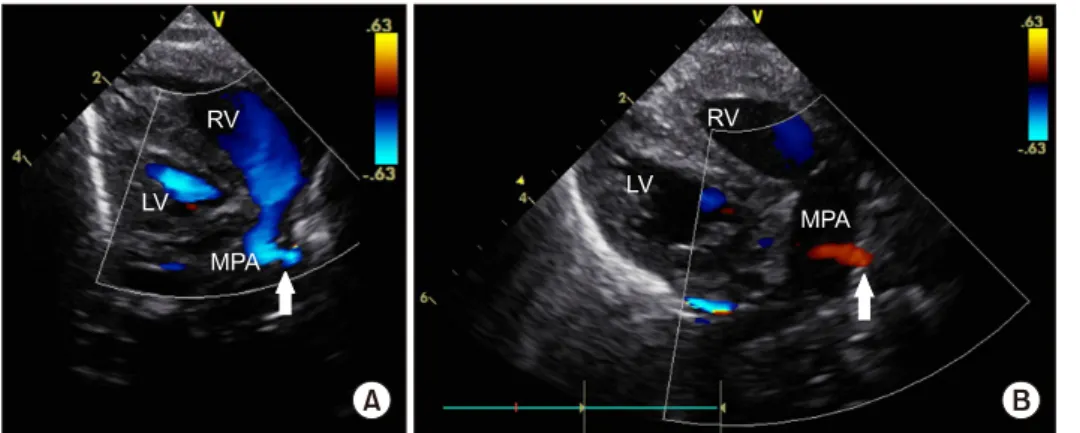
previous cannulation site, and the distal end of a 4-mm expanded polytetrafluoroethylene vascular graft was anastomosed in an end-to-side manner. The main pulmonary artery was partially re-clamped, and the proximal anastomosis of the shunt was com- pleted. An intraoperative echocardiogram demon- strated flow from the main pulmonary artery to the innominate artery through the shunt (Fig. 3A). The compressed left ventricle partially recovered its volume. The dilated right ventricle was relieved.
Peripheral oxygen saturation remained at approx- imately 80% to 90%, and systemic blood pressure increased to 70 mm Hg (systolic). The suprasystemic right ventricular pressure was effectively relieved with the shunt. Cardiac output stabilized in 2 days after placement of the shunt. Peripheral oxygen satu- ration gradually increased to the mid-90% range, and serial echocardiography revealed changes in the bi-
Yu Rim Shin, et al
− 234 −
Fig. 3. (A) Right-to-left shunting through the MPA-to-innominate ar- tery shunt (arrow). (B) Reversal of the MPA-to-innominate artery shunt direction (arrow). LV, left ventricle;
RV, right ventricle; MPA, main pul- monary artery.
directional shunt, as it converted to a continuous left-to-right shunt (Fig. 3B). On day 3, the patient’s diastolic blood pressure remained relatively low, mimicking the left-to-right shunting of a large patent ductus arteriosus. Therefore, the shunt was partly closed with a clip and completely closed a day later with sternum closure. The neonate showed adequate cardiac output afterwards, and pulmonary congestion improved.
Institutional review board approval was waived due to the retrospective nature of the report.
Discussion
The immediate postoperative period after coarctec- tomy in patients with a small left ventricle is critical.
Despite good contractile function of the ventricles, patients with a small left ventricle are prone to de- veloping functional mitral stenosis. This may lead to the aggravation of pre-existing pulmonary hyper- tension [3]. In addition, surgical stress from the com- plex operation and the vulnerability of pulmonary vascular resistance in newborns contribute to the de- velopment of suprasystemic pulmonary hypertension.
The dilated right ventricle with suprasystemic pres- sure compresses the left ventricle, leading to the vi- cious cycle of a pulmonary hypertensive crisis and low cardiac output. Although this devastating phe- nomenon is potentially fatal, it is not appropriate to conclude that biventricular repair will necessarily be inadequate in these patients. After stabilization from the immediate postoperative changes, many patients do not experience low cardiac output and eventually show adequate catch-up growth of the left ventricle.
Therefore, it is ideal to overcome the acute, unstable
period rather than to abandon the small left ventricle and proceed to the Norwood procedure. In the set- ting of the aforementioned positive feedback loop of a pulmonary hypertensive crisis, a pulmonary ar- tery-to-systemic artery shunt is an effective way to alleviate compression of the left ventricle by the su- prasystemic right ventricle. From a technical point of view, moreover, placement of the shunt is extremely simple and safe, even in a severely decompensated patient. The size of the shunt tube was chosen based on clinical judgment; however, a 4-mm tube was ef- fective in relieving the suprasystemic right ven- tricular pressure without acute volume overload to the left ventricle when the pulmonary hypertension improved.
In conclusion, suprasystemic pulmonary hyper- tension after coarctectomy leads to severe low car- diac output in patients with a small left ventricle. A pulmonary artery-to-systemic artery shunt is an ef- fective and safe method to relieve right ventricular pressure and restore cardiac output in an acute setting.
Conflict of interest
No potential conflict of interest relevant to this ar- ticle was reported.
ORCID
Yu Rim Shin: https://orcid.org/0000-0001-7685-0018 Young Ho Yang: https://orcid.org/0000-0002-0977-0525 Young-Hwan Park: https://orcid.org/0000-0001-9802-8017 Han Ki Park: https://orcid.org/0000-0002-7472-7822
Pulmonary–Systemic Artery Shunt for Pulmonary Hypertensive Crisis
− 235 −
References
1. Hickey EJ, Caldarone CA, McCrindle BW. Left ventricular hypoplasia: a spectrum of disease involving the left ven- tricular outflow tract, aortic valve, and aorta. J Am Coll Cardiol 2012;59(1 Suppl):S43-54.
2. Tani LY, Minich LL, Hawkins JA, et al. Spectrum and influ- ence of hypoplasia of the left heart in neonatal aortic
coarctation. Cardiol Young 2000;10:90-7.
3. Brown SC, Eyskens B, Boshoff D, et al. Bailout shunt/band- ing for backward left heart failure after adequate neo- natal coarctectomy in borderline left hearts. Interact Cardiovasc Thorac Surg 2016;23:929-32.
4. Phoon CK, Silverman NH. Conditions with right ventricular pressure and volume overload, and a small left ventricle:
“hypoplastic” left ventricle or simply a squashed ven- tricle? J Am Coll Cardiol 1997;30:1547-53.