• 검색 결과가 없습니다.

Verrucous Carcinoma of the Lower Lip: A Case Report

N/A
N/A
Protected

Academic year: 2021

Share "Verrucous Carcinoma of the Lower Lip: A Case Report"

Copied!
4
0
0

로드 중.... (전체 텍스트 보기)

전체 글

(1)

www.kaom.org

ISSN 2288-9272 J Oral Med Pain 2014;39(2):78-81 http://dx.doi.org/10.14476/jomp.2014.39.2.78

Verrucous Carcinoma of the Lower Lip: A Case Report

Sae-Ah Sun

1

, Kyung-Eun Lee

1,2

, Bong-Jik Suh

1,2

1

Department of Oral Medicine, School of Dentistry, Chonbuk National University, Jeonju, Korea

2

Institute of Oral Bioscience, Chonbuk National University, Jeonju, Korea

Received April 14, 2014 Revised April 26, 2014 Accepted May 13, 2014

Verrucous carcinoma is a relatively rare variant of well differentiated squamous cell carcinoma first described by Ackerman in 1948. It is distinct in its slow progression, exophytic cauliflower like growth, low grade malignancy and low incidence of metastasis. The oral cavity is one of the predilection sites for verrucous carcinoma. In the oral cavity, the gingiva and buccal muco- sa are the common site. Verrucous carcinoma of the lip is clinically quite rare and only several cases of that were reported in the world. The aim of this study is to report an unusual case of verrucous carcinoma of the lower lip.

Key Words: Lip; Verrucous carcinoma

Correspondence to:

Bong-Jik Suh

Department of Oral Medicine, School of Dentistry, Chonbuk National University, 567, Baekje-daero, Deokjin-gu, Jeonju 561-756, Korea Tel: +82-63-250-2060

Fax: +82-63-250-2058 E-mail: [email protected]

dermatologic clinic, but the regimen was not effective. She has no relevant history except for hypertension.

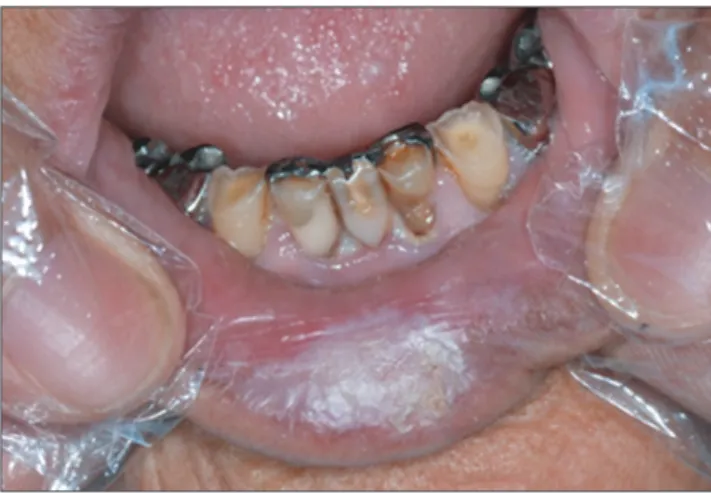
On clinical examination, there was a whitish hyperkera- totic lesion on the right lower lip with pain (Fig. 1). No lymphadenopathy was detected on the neck or sublingual area. The punch biopsy was performed in company with la- ser treatment and the biopsy specimen was reported as mild to moderate epithelial dysplasia. After three weeks of laser

INTRODUCTION

Verrucous carcinoma is an unusual, non-metastasizing, distinct variant of well differentiated squamous cell carci- noma. The term verrucous carcinoma was first described by Ackermann

1)

in 1948, hence the tumor is also known as “verrucous carcinoma of Ackermann” or “Ackermann’s tumor”.

2)

The oral cavity is the most common site of occur- rence for verrucous carcinoma.

2)

However, oral verrucous carcinoma is a rare tumor, diagnosed in only 1 to 3 of ev- ery 1,000,000 persons each year.

3,4)

In addition, verrucous carcinoma of lips is considered as extremely rare and few studies are available. We describe our experience with this unusual case of verrucous carcinoma of the lower lip.

CASE REPORT

In September 2012, a 75-year-old female patient pre- sented to the Department of Oral Medicine at the Chonbuk National University Hospital (Jeonju, Korea) with a com- plaint of the swelling and pain of the lower lip for about three years. The lesion of lower lip had been treated at a

Case Report

JOMP

Journal of Oral Medicine and Pain

Fig. 1. Whitish hyperkeratotic lesion on the lower lip at the first visit.

Copyright

2014 Korean Academy of Orofacial Pain and Oral Medicine. All rights reserved.

(2)

79 Sae-Ah Sun, et al. Verrucous Carcinoma of the Lower Lip

www.kaom.org

and removal of the lesion. Microscopic examination of the surgical specimen revealed the presence of marked prolif- eration with down growth of epithelium into the connective tissue without invasion (Fig. 5) and was confirmed verru- cous carcinoma.

DISCUSSION

Verrucous carcinoma is a rare form of well differentiated squamous cell carcinoma. This tumor is distinct in its slow growth and no metastatic potential.

2,4)

But this lesion can be locally destructive despite its deceptively benign clinical behavior if not treated.

1,5)

It is predominantly seen in elderly males over the sixth decade.

6,7)

Ackerman

1)

first described treatment, the treated lesion was not healed and showed

erosion with bleeding tendency (Fig. 2).

In December 2012 (after 6 weeks of treatment), the ero- sion was disappeared, but the hyperkeratotic lesion was recurrent. And then mild paresthesia on the area of laser treatment was presented (Fig. 3).

In January 2013 (after 3 months of treatment), new ero- sive lesion was developed in the center of hyperkeratotic lesion (Fig. 4). She was referred to Department of Oral and Maxillofacial Surgery for more evaluation and removal of the lesion.

In March 2013, incisional biopsies were performed at the boundary of the lesion and the biopsy specimens were re- ported as mild to moderate epithelial dysplasia.

In April 2013, surgical excision of the lesion was per- formed under general anesthesia for definitive diagnosis

Fig. 2. Unhealed and erosive wound after 3 weeks of laser treatment showing bleeding tendency (arrow).

Fig. 3. Recurrent hyperkeratotic lesion without erosion after 6 weeks of treatment.

Fig. 4. Erosive lesion in the center of hyperkeratotic lesion of the lower lip after 3 months of treatment (arrow).

Fig. 5. Microscopic findings of operation specimen showing marked

keratosis and downward invasion of epidermal keratinocytes with a

blunt border and a pushed-down appearance (H&E staining, ×100).

(3)

80 J Oral Med Pain Vol. 39 No. 2, June 2014

www.kaom.org

diagnosis of verrucous carcinoma is not so difficult. But in some cases, small or superficial biopsy specimens will show only hyperkeratosis, acanthosis and papillomatosis.

4,17)

In our case, first and second biopsy specimens were just diag- nosed as epithelial dysplasia. Because verrucous carcinoma is a benign-appearing lesion with “pushing” borders, and the basement membrane can appear to be intact, it can be mistaken as a benign lesion histologically.

8)

Deeper adequate biopsy and sufficient volume of biopsy specimen must be taken whenever the clinician suspects verrucous carcinoma for definitive diagnosis. However, in oral region, it is often difficult technically to obtain enough amount of the speci- men. In fact, multiple biopsies may be required to confirm the diagnosis of verrucous carcinoma.

18,19)

Once a diagnosis of verrucous carcinoma has been es- tablished, complete resection of the tumor is considered as the treatment of choice.

10,20)

In almost all cases of verrucous carcinoma, neck dissection is not necessary because lymph node metastases are extremely rare.

17)

Verrucous carcinoma has a good prognosis when treated early with local exci- sion; Extensive lesions, however, may require more-aggres- sive procedures.

19)

Finally, it is important to diagnose accu- rately the verrucous carcinoma for preventing the most ex- tensive involvement of adjacent areas and/or wide surgical resection of the tumor.

CONFLICT OF INTEREST

No potential conflict of interest relevant to this article was reported.

REFERENCES

1. Ackerman LV. Verrucous carcinoma of the oral cavity. Surgery 1948;23:670-678.

2. Walvekar RR, Chaukar DA, Deshpande MS, et al. Verrucous carci- noma of the oral cavity: a clinical and pathological study of 101 cases. Oral Oncol 2009;45:47-51.

3. Bouquot JE. Oral verrucous carcinoma. Incidence in two US pop- ulations. Oral Surg Oral Med Oral Pathol Oral Radiol Endod 1998;

86:318-324.

4. Kumar RBC, Raj AC. Verrucous carcinoma of lip-an unusual pre- sentation. Amrita Journal of Medicine 2012;8:40-42.

5. Koch BB, Trask DK, Hoffman HT, et al; Commission on Cancer, American College of Surgeons; American Cancer Society. Na- tional survey of head and neck verrucous carcinoma: patterns of

this tumor of the oral mucous membrane, which is now also known as “verrucous carcinoma of Ackermann” or

“Ackerman’s tumor”.

2)

The term verrucous is used because of its exophytic squamous mucosal or cutaneous tumors that are heaped above the epithelial surface with a papillary mi- cronodular appearance.

5)

This tumor may occur in several locations in the head and neck with the most common sites being the oral cavity (55.9%).

5,8)

Extra-oral sites of occurrence are larynx, esoph- agus, paranasal sinus, skin, penis, vulva, uterine cervix and it also from odontogenic cyst lining.

4)

The most com- mon site of the tumor in the oral cavity is gingiva followed by buccal mucosa.

5)

Verrucous carcinoma of the lip is very rare. In 1981, lip verrucous carcinoma was first introduced by Diaz-Pérez et al.

9)

Because it is unusual and can be diffi- cult to diagnose, the treatment may be delayed.

Verrucous carcinoma is usually exophytic papillary in na- ture with pebbled surface. But it may always not appear as typical appearance. In this case, the patient presented with a hyperkeratotic lesion without papillomatous surface.

The etiology of verrucous carcinoma is not completely established, though a few studies have shown an associa- tion with earlier injuries and scars, as well as with chronic inflammation.

10,11)

Tobacco including snuff use is also as- sociated with development of verrucous carcinoma.

2-4)

Verrucous carcinoma is so closely aligned with the use of snuff and chewing tobacco that it has been called the “snuff dipper’s cancer”.

3)

There was no history of trauma or tobacco in our case. Human papillomavirus (HPV) has also been im- plicated as the cause for verrucous carcinoma.

12-15)

Although the role of human papilloma virus in the etiology of verru- cous carcinoma is still unclear, HPV-deoxyribonucleic acid (DNA) types 6, 11, 16, and 18 has been identified by poly- merase chain reaction (PCR), restriction fragment analy- sis, and DNA slot-blot hybridization in verrucous carcino-

mas.

12-14)

However, HPV has not consistently been identified

in all such carcinomas.

16)

It is regrettable for us not to have checked HPVs in our case. Further studies must be required to clarify the etiology of verrucous carcinoma.

Microscopically this tumor is characterized by predomi-

nant exophytic overgrowth of well-differentiated keratin-

izing epithelium having minimal atypia associated with in-

tense chronic inflammatory infiltrate.

1,7)

The pathological

(4)

81 Sae-Ah Sun, et al. Verrucous Carcinoma of the Lower Lip

www.kaom.org cinoma by polymerase chain reaction. Mod Pathol 1993;6:669- 672.

14. Noble-Topham SE, Fliss DM, Hartwick RW, et al. Detection and typing of human papillomavirus in verrucous carcinoma of the oral cavity using the polymerase chain reaction. Arch Otolaryn- gol Head Neck Surg 1993;119:1299-1304.

15. Fliss DM, Noble-Topham SE, McLachlin M, et al. Laryngeal ver- rucous carcinoma: a clinicopathologic study and detection of human papillomavirus using polymerase chain reaction. Laryn- goscope 1994;104:146-152.

16. Johnson TL, Plieth DA, Crissman JD, Sarkar FH. HPV detection by polymerase chain reaction (PCR) in verrucous lesions of the upper aerodigestive tract. Mod Pathol 1991;4:461-465.

17. Kawakami M, Yoshimura K, Hayashi I, Ito K, Hyo S. Verrucous carcinoma of the tongue: report of two cases. Bull Osaka Med Coll 2004;50:19-22.

18. Strojan P, Smid L, Cizmarevic B, Zagar T, Auersperg M. Verrucous carcinoma of the larynx: determining the best treatment option.

Eur J Surg Oncol 2006;32:984-988.

19. Orvidas LJ, Olsen KD, Lewis JE, Suman VJ. Verrucous carcinoma of the larynx: a review of 53 patients. Head Neck 1998;20:197-203.

20. Kang CJ, Chang JT, Chen TM, Chen IH, Liao CT. Surgical treat- ment of oral verrucous carcinoma. Chang Gung Med J 2003;26:

807-812.

presentation, care, and outcome. Cancer 2001;92:110-120.

6. Waskowska J, Koszowski R, Raczkowska-Siostrzonek A, Stem- plewska K. Verrucous carcinoma of the tongue-a rare case study.

Cent Eur J Med 2012;7:145-148.

7. Oliveira DT, de Moraes RV, Fiamengui Filho JF, Fanton Neto J, Landman G, Kowalski LP. Oral verrucous carcinoma: a retrospec- tive study in São Paulo Region, Brazil. Clin Oral Investig 2006;10:

205-209.

8. Miller ME, Martin N, Juillard GF, Bhuta S, Ishiyama A. Temporal bone verrucous carcinoma: outcomes and treatment controversy.

Eur Arch Otorhinolaryngol 2010;267:1927-1931.

9. Diaz-Pérez JL, Moreno J, Burgos J. Ackerman’s verrucous carci- noma on the lower lip. Med Cutan Ibero Lat Am 1981;9:105-110.

10. Kwon HB, Choi YS, Lee JH, et al. Treatment of verrucous carci- noma of the lower lip with topical imiquimod (aldara

) and deb- ulking therapy. Ann Dermatol 2011;23(Suppl 1):S68-S71.

11. Zielonka E, Goldschmidt D, de Fontaine S. Verrucous carci- noma or epithelioma cuniculatum plantare. Eur J Surg Oncol 1997;23:86-87.

12. Lübbe J, Kormann A, Adams V, et al. HPV-11- and HPV-16- associated oral verrucous carcinoma. Dermatology 1996;192:217- 221.

13. Shroyer KR, Greer RO, Fankhouser CA, McGuirt WF, Marshall R.

Detection of human papillomavirus DNA in oral verrucous car-

수치

Fig. 1. Whitish hyperkeratotic lesion on the lower lip at the first  visit.
Fig. 4. Erosive lesion in the center of hyperkeratotic lesion of the  lower lip after 3 months of treatment (arrow).

참조

관련 문서

While regional recurrence is one of most im- portant prognostic factors in oral cavity cancer, the optimal management of recurrent lymph node metastasis is worthy of

coordinated Sr(1), 8-foldcoordinated Sr(2), and 4-fold-coordinated Al 3+ cation sites in

하악지의 내면 한가운데 있으며, 하치조신경과 혈관이

웹 표준을 지원하는 플랫폼에서 큰 수정없이 실행 가능함 패키징을 통해 다양한 기기를 위한 앱을 작성할 수 있음 네이티브 앱과

이하선의 실질 속에서 하악경의 후내측에서 나와 하악지의 내측면을 따라 앞으로 간다. (귀밑샘 부위에서 갈라져 나와

When the binding sites of actin are exposed, the myosin head attaches to a binding site. The myosin head flexes, pulling the thin filament past the

The index is calculated with the latest 5-year auction data of 400 selected Classic, Modern, and Contemporary Chinese painting artists from major auction houses..

1 John Owen, Justification by Faith Alone, in The Works of John Owen, ed. John Bolt, trans. Scott Clark, "Do This and Live: Christ's Active Obedience as the