ABSTRACT
Background: Asbestos exposure causes asbestos-related diseases (ARDs) including asbestosis, malignant mesothelioma, lung cancer, laryngeal cancer, and ovarian cancer.
Although Korea used substantial amounts of asbestos in the past, no study has focused on its occupational burden of disease (OBD). Therefore, this study aimed to determine the OBDs of ARDs in Korea.
Methods: The CARcinogen Exposure (CAREX) database was used to determine the proportion of exposed population. Relative risks for lung cancer, laryngeal cancer, and ovarian cancer were used to determine the population-attributable fraction. Data for deaths caused by ARDs during 1998–2013 were obtained from the World Health Organization mortality database. The potential years of life lost (PYLL) and annual average PYLL (APYLL) indicated OBDs.
Results: In Korea, the number of ARD-attributable deaths and PYLL due to all ARDs during 1998–2013 were 4,492 and 71,763.7, respectively. The number of attributable deaths and PYLL due to asbestosis, malignant mesothelioma, lung cancer, laryngeal cancer, and ovarian cancer were 37 and 554.2, 808 and 15,877.0, 3,256 and 47,375.9, 120 and 1,605.5, and 271 and 6,331.1, respectively; additionally, the APYLL were 15.0, 19.7, 14.6, 13.4, and 23.4, respectively, and the average age at death was 70.4, 62.6, 69.1, 69.9, and 61.8, respectively. Our study showed that although the use of asbestos has ceased in Korea, the incidence of ARDs tends to increase.
Conclusion: Therefore, efforts to reduce future OBDs of ARDs, including early detection and proper management of ARDs, are needed in Korea.
Keywords: Asbestos; Korea; Asbestos-related Diseases; Potential Years of Life Lost;
Burden of Disease
Original Article
Received: Apr 19, 2017 Accepted: Dec 27, 2017 Address for Correspondence:
Young-Ki Kim, MD, PhD
Department of Occupational, Environmental Medicine, Pusan National University Yangsan Hospital, 20 Geumo-ro, Mulgeum-eup, Yangsan 50612, Republic of Korea.
E-mail: [email protected]
© 2018 The Korean Academy of Medical Sciences.
This is an Open Access article distributed under the terms of the Creative Commons Attribution Non-Commercial License (https://
creativecommons.org/licenses/by-nc/4.0/) which permits unrestricted non-commercial use, distribution, and reproduction in any medium, provided the original work is properly cited.
ORCID iDs Dong-Mug Kang
https://orcid.org/0000-0002-0657-0181 Jong-Eun Kim
https://orcid.org/0000-0001-7711-0353 Young-Ki Kim
https://orcid.org/0000-0001-7368-4245 Hyun-Hee Lee
https://orcid.org/0000-0003-1170-9261 Se-Yeong Kim
https://orcid.org/0000-0002-1260-494X Funding
This work was supported by a 2-Year Research Grant (2017) of Pusan National University.
Disclosure
The authors have no potential conflicts of interest to disclose.
Dong-Mug Kang ,1,2,3,4 Jong-Eun Kim ,2,3,5 Young-Ki Kim ,1,3 Hyun-Hee Lee ,4 and Se-Yeong Kim 2,4
1 Department of Preventive, Occupational and Environmental Medicine, School of Medicine, Pusan National University, Yangsan, Korea
2 Department of Occupational and Environmental Medicine, Pusan National University Yangsan Hospital, Yangsan, Korea
3Environmental Health Center, Pusan National University Yangsan Hospital, Yangsan, Korea
4Busan Workers Health Center, Pusan National University, Busan, Korea
5Department of Occupational and Environmental Medicine, GoodGangAn Hospital, Busan, Korea
Occupational Burden of
Asbestos-Related Diseases in Korea, 1998–2013: Asbestosis, Mesothelioma, Lung Cancer, Laryngeal Cancer, and Ovarian Cancer
Preventive Medicine, Occupation &
Environmental Medicine
Author Contributions
Conceptualization: Kang DM. Data curation:
Kang DM, Lee HH. Analysis: Kang DM, Kim JE. Methodology: Kang DM, Kim SY, Kim YK.
Investigation: Kang DM, Lee HH. Writing - original draft: Kang DM. Writing - review &
editing: Kim SY, Kim YK.
INTRODUCTION
Asbestos is a major occupational and environmental risk factor for workers and civilians, as it causes asbestos-related diseases (ARDs) including lung fibrosis (asbestosis), pleural fibrosis (plaque and thickening), lung cancer, peritoneal and pleural malignant mesothelioma, laryngeal cancer, and ovarian cancer.1,2 The occupational burden of disease (OBD) of ARDs is largely studied worldwide. The World Health Organization (WHO) estimated that approximately 125 million people could be exposed to asbestos at the workplace, which results in at least 10,700 deaths per year due to lung cancer, malignant mesothelioma, and asbestosis.3 In addition, the WHO has reported high OBDs of ARDs: From 1994 to 2010, occupational asbestos exposure has led to 1,523,000 disability-adjusted life years (DALYs), 2.18 million potential years of life lost (PYLL) from 128,015 deaths due to malignant
mesothelioma, and 180,000 PYLL from 13,885 deaths due to asbestosis.2 Furthermore, OBDs of ARDs worldwide,4,5 in each continent,6 in countries in Europe,7 in USA,8 and in Japan9 have been previously reported.
The total amount of asbestos used in Korea, including that from mined and imported sources, is approximately 2–2.8 million tons, which comes from approximately 1,500 asbestos sources including 42 asbestos mines, 199 asbestos factories, and 17 asbestos- processing plants.10 In Korea, occupational ARDs have been compensated by the industrial accident-compensation insurance act (IACIA) since 1963, and the number of compensated occupational ARD cases in Korea has increased after the first recognized case of occupational cancer in an asbestos textile factory in 1993.1 In particular, the number of reported cases of environmental ARDs has rapidly increased since 2011, after the release of Asbestos Injury Relief Act (AIRA) in Korea.11,12
Although the number of cases of ARDs is increasing in the country, studies on OBDs of ARDs are lacking in Korea. Therefore, this study aimed to estimate the proportion of occupationally exposed population and determine the OBDs of ARDs in Korea, and compare the results from Korea with those from other countries.
METHODS
Data collection
The CARcinogen Exposure (CAREX) database was developed by the Finish Institute of Occupational Health and is used to estimate the exposed population.13 CAREX is a widely used tool for estimation of occupational exposure to carcinogens in Europe and other parts of the world, including Korea.14-18 The number of working people according to the standard industrial code (SIC) was multiplied by the CAREX proportion and turnover rate (TOR) as per the following formula. In addition, a turnover factor of 4 was applied.4,19
Exposed population = ∑ [(each No. SIC) × (CAREX proportion) × TOR]
where TOR is the turnover rate.4
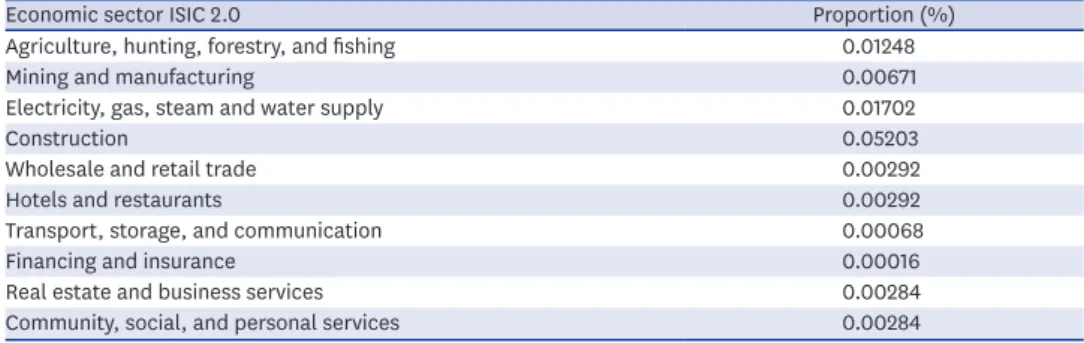
Table 1 shows the proportion of workers exposed to asbestos in each economic sector of the CAREX database according to the International SIC (ISIC) 2.0. The exposed number of workers was estimated according to the Korean SIC (KSIC) by using the Economically Active
Population Survey of Korea 1989–2013.20 Because ARDs, including asbestosis and cancers, have a minimum of 10 years of latency period,12 the exposed population before at least 10 years from ARDs was our study topic. Although the exposed population in 1979–2003 was of concern, the subcategory of KSIC to match ISIC was available since 1991. Hence, the exposed population of 1991–2003 could be estimated. KSIC was converted into the ISIC 2.0, and the exposed proportion provided by CAREX was applied.
We estimated the population-attributable fraction (PAF) from the relative risk (RR) of ARDs and estimated the risk groups. The following formula was used for calculating PAF:
PAF = P × (RR − 1)/[P × (RR − 1) + 1]
where P is the proportion of the population exposed.
The RRs of lung cancer, laryngeal cancer, and ovarian cancer due to asbestos exposure were obtained from a previous meta-analysis (Table 2).21-23 Among the ARDs, malignant mesothelioma and asbestosis were considered 100% attributable to asbestos. To calculate the disease burden due to premature death, we estimated the PYLL and annual average PYLL (APYLL) using the following formula:
PYLL = ∑ Digj × Leigj
where Digj is the number of deaths for age group gi and Leigj is the life expectancy for age group gi
APYLL = PYLL/No. of deaths
Life expectancy tables from a previous study in Korea were used for each age group.24 Data on the number of deaths and life expectancy due to asbestosis, malignant mesothelioma, lung cancer, laryngeal cancer, and ovarian cancer in each age group were collected from WHO mortality database, which is an official compilation of data from member-state Table 1. Data of workers exposed to asbestos according to economic sectors from the CAREX database
Economic sector ISIC 2.0 Proportion (%)
Agriculture, hunting, forestry, and fishing 0.01248
Mining and manufacturing 0.00671
Electricity, gas, steam and water supply 0.01702
Construction 0.05203
Wholesale and retail trade 0.00292
Hotels and restaurants 0.00292
Transport, storage, and communication 0.00068
Financing and insurance 0.00016
Real estate and business services 0.00284
Community, social, and personal services 0.00284
CAREX = CARcinogen Exposure, ISIC = international standard industrial code.
Table 2. Relative risks and population-attributable fractions in this study
Cancer type Study RR PAF
Lung cancer Moon et al.21 1.81 3.46
Laryngeal cancer Institute of Medicine22 1.44 1.91
Ovarian cancer Camargo et al.23 1.77 3.29
RR = relative risk, PAF = population-attributable fraction.
governments.25 Since the database has been widely used for OBDs of asbestos,4-7,9 this study used this database for compatibility. Since the mortality data from the WHO for Korea was fully available from 1998, we used data from 1998 to 2013, i.e., 16 years. A literature review was performed to determine the OBD of asbestos in other countries using the PubMed database. The following search terms were used: “asbestos” or “asbestosis” or
“mesothelioma” or “lung cancer” or “laryngeal cancer” or “ovarian cancer” and “disease burden” or “PYLL” or “YPLL.” Only 7 articles were selected from among 2,591 articles by using these search terms.4-6,8,14,26,27 Full text review of the relevant articles was conducted and Google scholar search engine was used to find other studies.
RESULTS
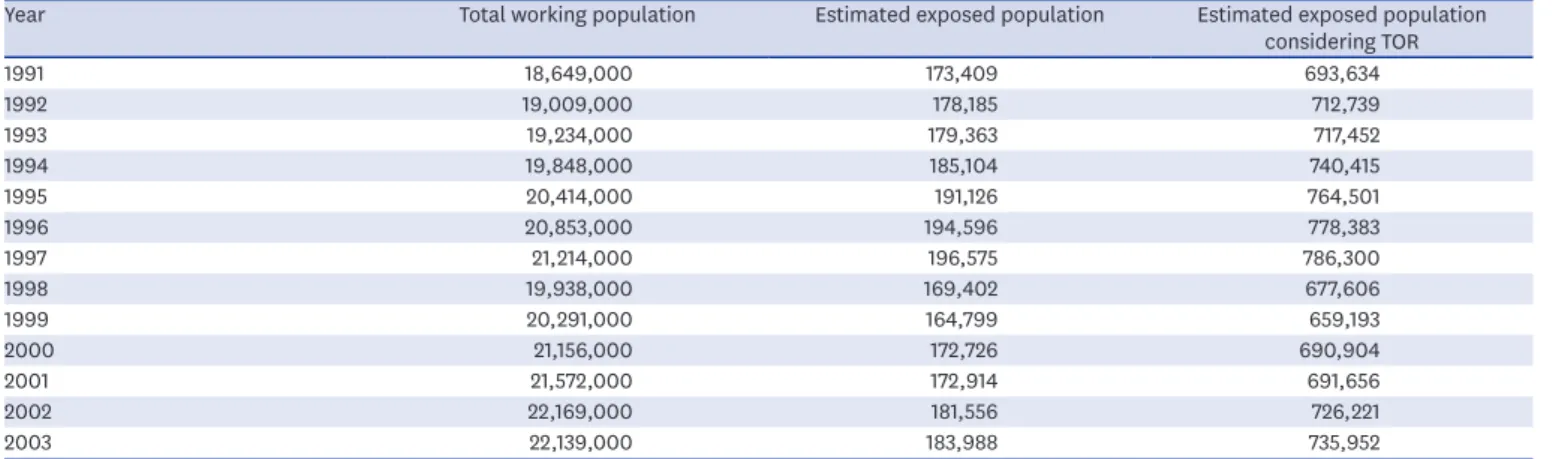
The minimum total working population was 19,938,000 people in 1999, and the maximum was 24,681,000 people in 2012 (Table 3). The minimum and maximum estimated exposed population from 1998 to 2013, considering a TOR of 4, was 659,193 in 1999 and 745,914 in 2007.
The number of deaths, PYLL, APYLL, and average age at death due to asbestosis, malignant mesothelioma, lung cancer, laryngeal cancer, and ovarian cancer from 1998 to 2013 are presented in Table 4. The total number of ARD attributable deaths and PYLL due to
asbestosis, malignant mesothelioma, lung cancer, laryngeal cancer, and ovarian cancer were 37 and 554.2; 808 and 15,877.0; 3,256 and 47,375.9; 120 and 1,605.5; and 271 and 6,331.1, respectively. The proportion of women among them was 43.2%, 31.7%, 26.3%, 11.7%, and 100%, respectively. The proportion of deaths and PYLL due to asbestosis, malignant mesothelioma, lung cancer, laryngeal cancer, and ovarian cancer in the total population were 0.8% and 0.8%; 18.0% and 22.0%; 72.5% and 66.0%; 2.7% and 2.2%; and 6.0% and 8.8%, respectively. The average number of deaths and PYLL in these groups were 2.3 and 34.6;
50.5 and 993.6; 203.5 and 2,961.0; 7.5 and 100.3; and 16.9 and 395.7, respectively (Table 4).
Furthermore, the annual proportion of deaths due to asbestosis was 4.6% compared to that due to malignant mesothelioma (Table 4). The APYLL were 15.0, 19.7, 14.6, 13.4, and 23.4, respectively. The average age at death was 70.4, 62.6, 69.1, 69.9, and 61.8, respectively.
The OBDs of other countries are presented in Table 5. In 2000, asbestosis resulted in 7,000 deaths with 76,056 PYLL and 13.3 APYLL worldwide. During 1995–2010, asbestosis resulted
Table 3. Population exposed to asbestos each year (1991–2003)
Year Total working population Estimated exposed population Estimated exposed population
considering TOR
1991 18,649,000 173,409 693,634
1992 19,009,000 178,185 712,739
1993 19,234,000 179,363 717,452
1994 19,848,000 185,104 740,415
1995 20,414,000 191,126 764,501
1996 20,853,000 194,596 778,383
1997 21,214,000 196,575 786,300
1998 19,938,000 169,402 677,606
1999 20,291,000 164,799 659,193
2000 21,156,000 172,726 690,904
2001 21,572,000 172,914 691,656
2002 22,169,000 181,556 726,221
2003 22,139,000 183,988 735,952
TOR = turnover rate.
Table 4. Number of cases attributable to asbestosis and mesothelial, lung, laryngeal, and ovarian cancers by sex, and their PYLL, APYLL, and average age at death YearAsbestosis (WHO DB)Malignant mesothelioma (RR: 1.00)Lung cancer (RR: 1.81)Laryngeal cancer (RR: 1.44)Ovarian cancer (RR: 1.77) TMFPYLLAPYLLAgeTMFPYLLAPYLLAgeTMFPYLLAPYLLAgeTMFPYLLAPYLLAgeFPYLLAPYLLAge 199821133.316.664.5241410536.422.457.0147110372,135.514.565.91091132.013.26711250.122.758.7 199921135.917.96216124252.815.860.4160119412,325.314.566.41082134.813.567.111260.723.758.5 20000000.00.0021165421.420.160.6178132462,590.114.666.91091136.913.767.213292.122.560.7 20010000.00.0024168399.816.764.7181135462,598.914.467.51091136.813.767.515336.522.460.9 200221123.111.672271710482.917.964.2194143512,747.214.268.21091132.313.268.915325.321.761.7 20030000.00.00342410679.620.060.4199146532,833.314.268.5981119.513.36915324.421.662.3 20040000.00.00382612737.119.462.5205152532,945.514.468.7871104.213.069.816363.722.761.8 20050000.00.00442915940.921.460.1210155553,044.414.569981122.613.669.418406.822.662.5 200621125.112.5725738191,167.620.561.7213159543,060.914.469.576190.112.970.817398.623.461.8 200721122.311.174.55842161,167.620.162.1215159563,085.914.469.876191.413.170.819439.523.162.5 200821159.229.6526749181,221.018.264.8218161573,135.814.470.254163.112.671.719435.922.963 200963374.512.473.76940291,332.419.365.0214156583,148.214.770.354167.413.571.219458.724.162.3 201021120.510.2777044261,383.719.864.5223163603,215.614.470.955067.913.671.120467.523.463.4 2011105516816.8708163181,571.419.464.1224162623,242.814.571.154166.013.27220476.423.863.3 201265158.79.8778158391,841.022.764.1234171633,353.414.371.455066.413.371.720483.524.262.7 201310133.633.6529754271,761.418.266.0241176653,912.916.271.655074.314.972.523611.526.662.9 Total371916554.21570.480852825615,897.0019.762.63,2562,39985747,375.9014.669.1120106141,605.5013.469.92716,331.1023.461.8 Annual mean2.31.31.134.611.446.750.533.916.6993.619.562.6203.5149.953.62,961.014.569.17.56.60.9100.413.469.916.9395.723.261.8 F (%)43.231.726.311.7100.0 WHO = World Health Organization, RR = relative risk, T = total, M = male, F = female, PYLL = potential years of life loss, APYLL = annual average PYLL, Age = average age at death. Table 5. Occupational disease burden of asbestos-related diseases worldwide AsbestosisMalignant mesothelioma CountryWorld5Europe7USA8Japan9World6Africa6Americas6Asia6Europe6Oceania6Europe7USA8Japan9 Year20001994–20101999–20101995–20101994–20001994–20101999–20101995–2010 Deaths Total7,0005,7286,290620128,0152,69235,12114,62971,1524,42171,55529,63913,577 Male5,3336,035100,14356,32723,785 Female39525527,87115,2285,855 Annual mean7,000337524397,5304,2091,470849 PYLL Total380,000a76,05656,90735,5792,175,69841,659582,883281,0701,194,43975,6461,202,333370,098277,028 Male63,25954,7661,532,759855,171291,090 Female5,2732,142512,105271,49578,007 Annual mean380,0004,4744,7422,224127,98270,72630,84217,314 APYLL13.317.015.516.619.216.817.116.8 Age73.579.069.263.469.368.469.469.869.474.0 Female (%)6.95.121.821.319.8 Asbestosis proportionb (%)8.021.24.6 PYLL = potential years of life loss, APYLL= annual average PYLL. aDisability-adjusted life year; bAsbestosis/(asbestosis + MM).
in 620 deaths with 35,579 PYLL in Japan. The number of deaths, PYLL, APYLL, and average age at death due to asbestosis in Europe in 1994–2010 were 5,728, 76,056, 13.3, and 73.5, respectively. The proportion of women affected by asbestosis in Europe in this period was 6.9%. The number of deaths, PYLL, and average age at death due to asbestosis in USA in 1999–2010 were 6,290, 56,907, and 79.0, respectively. The proportion of women affected by asbestosis in USA in this period was 5.1%.
The number of deaths, PYLL, APYLL, and average age at death due to malignant
mesothelioma worldwide in 1994–2000 were 129,015; 2,175,698; 17.0; and 19.2, respectively.
The proportion of women affected by malignant mesothelioma worldwide in this period was 21.8%. The number of deaths, PYLL, APYLL, and average age at death due to malignant mesothelioma in Europe in 1994–2010 were 71,555; 1,202,333; 16.8; and 69.4, respectively.
The proportion of women affected by malignant mesothelioma in Europe in this period was 21.3%. The number of deaths, PYLL, and average age at death due to malignant mesothelioma in USA in 1999–2010 were 29,639; 370,098; and 74.0, respectively. The proportion of women affected by malignant mesothelioma in USA in this period was 19.8%.
The number of deaths and PYLL due to malignant mesothelioma in Japan in 1995–2010 was 13,577 and 277,028, respectively.
Based on calculations from the data in Table 5, the mean number of annual deaths and PYLL due to asbestosis in worldwide, Europe, USA, and Japan are 7,000 and 380,000; 337 and 4,474; 524 and 4,742; and 39 and 2,224, respectively. In addition, the mean deaths and PYLL due to malignant mesothelioma in worldwide, Europe, USA, and Japan were 7,530 and 127,982; 4,209 and 70,726; 1,470 and 30,842; 849 and 17,314, respectively. The annual proportion of death due to asbestosis compared to that due to malignant mesothelioma was 8.0% in Europe, 21.2% in USA, and 4.6% in Japan.
The annual average number of deaths attributable to laryngeal cancer due to asbestos was 7.5 in Korea, 5.8 in Argentina, 13.6 in Brazil, 2.8 in Colombia, and 3.6 in Mexico.14 Furthermore, the number of cases of death attributable to ovarian cancer was 16.9 in Korea, 2.8 in
Argentina, 8.6 in Brazil, and 1.8 in Colombia, and 4.4 in Mexico.
DISCUSSION
Lung cancer showed the majority proportion, highest number of attributable deaths, and most PYLL among all ARDs in Korea. This could be due to the high incidence and mortality of lung cancer in Korea.25 Although lung cancer was the most important ARD with the highest OBD in Korea, the compensation for occupational or environmental ARDs provided by the IACIA or AIRA was very low.12 We also found that the mean number of deaths and PYLL due to malignant mesothelioma in Korea was much lower than that worldwide, in Europe, in USA, and in Japan. Considering that 170 tons of asbestos can cause 1 death from malignant mesothelioma,27 the use of 240–280 million tons of asbestos used in Korea might have a much bigger impact on the number of deaths caused by malignant mesothelioma than specified in the WHO mortality database.25 This discrepancy can be explained by the low use of crocidolite and sprayed asbestos in Korea as compared to other countries or a lag in the latency period.12 The latency period in Korea might not have passed yet since the rapid increase in asbestos usage. The mean number of annual deaths and PYLL due to asbestosis in Korea were much lower than those worldwide, in Europe, in USA, and in Japan. The OBDs
of asbestosis in Korea tended to be lower than that in other countries possibly due to the under-diagnosis of asbestosis. When a person with a history of asbestosis dies, the cause of death might not be reported as asbestosis unless he/she has been compensated and dies due to respiratory problems. Moreover, asbestosis is not a popular diagnosis among physicians in Korea. The fact that the first asbestosis case in Korea was reported relatively recently in 1994 might explain the rationale of the under-diagnosis.12 In general, approximately 80% of asbestosis cases could be missed due to non-compensation, and consequently, they might not be listed as asbestosis cases in the mortality statistics.28
Ovarian cancer showed the highest APYLL among all ARDs possibly because of the lowest age at death due to cancer and high life expectancy among women in Korea.24 The average age of death due to asbestosis in Korea was lower than that in Europe and USA, whereas the APYLL in Korea was higher than that in Europe. The average age at death due to malignant mesothelioma in Korea was lower than that worldwide, in Europe, and in USA, and the APYLL in Korea was higher than that worldwide and in Europe. The lower age at death and higher APYLL of ARDs in Korea indicates that the ARDs have higher OBDs in Korea than in the other countries.
Since we found only one study on OBDs of laryngeal and ovarian cancers in our literature search, the comparison of the ARDs was limited. Although the annual average number of deaths attributable to laryngeal cancer due to asbestos varied among countries in that study,14 it was difficult to compare these data directly owing to the population size and stage of industrialization.
The present study has some limitations that need to be addressed. First, this study relies on data of the exposure population from the CAREX database. The industrial structure and asbestos exposure pattern in the industry might differ between Korea and Europe, which could lead to underestimation or overestimation of exposure population. In addition, the TOR of 4 might cause under- or over-estimation of the exposed population. Considering a higher 1-year TOR in Asia (Korea, China, and Japan) than in other areas in 2008, a TOR of 4 might underestimate the exposed population. Second, we applied specific RRs and PAFs based on the exposed population for lung cancer, laryngeal cancer, and ovarian cancer to estimate their asbestos burden. We applied the most-recent and appropriate RRs to the Korean population. However, the RR for lung cancer based on populations including the Korean population21 and RRs for laryngeal cancer and ovarian cancer based on the Korean population were not found. In addition, PAF based on RRs is an indirect method of estimation of disease burden. This might cause both under- or overestimation. These two limitations might be due to the indirect study methods used. To overcome these limitations, direct studies based on large-size, stratified interviews of the working population and cancer patients are needed. Third, we used the WHO mortality database for the outcome of death due to ARDs. These data might underestimate the number of deaths due to asbestosis and malignant mesothelioma. Fourth, although the Korean government has already compensated environmental ARDs since 2011 with AIRA,11 we could not extend the scope of this study to the environmental disease burden. Although a study conducted burden of diseases (BDs) on lung cancer, ovarian cancer, and laryngeal cancer of Korea in general, it did not study asbestos burden.29 Hence, this study is the first one to study BDs of asbestos in Korea.
In conclusion, this is the first study on OBDs of ARDs in Korea and one of the few studies to compare all ARDs including laryngeal and ovarian cancer. Considering the past use
of asbestos in Korea, ARDs are expected to continue to increase. Although Korea has stopped using asbestos, asbestos-containing materials still persist in the environment; their demolition is currently in process. Efforts to reduce the PYLL and APYLL, including early detection and proper management, are needed in Korea.
REFERENCES
1. Kang DM. Health effects of environmental asbestos exposure. J Environ Health Sci 2009;35(2):71-7.
CROSSREF
2. World Health Organization. Asbestos: elimination of asbestos-related diseases. Media centre: WHO fact sheet. http://www.who.int/mediacentre/factsheets/fs343/en/. Accessed December 9, 2016.
3. World Health Organization. International programme on chemical safety, asbestos. http://www.who.int/
ipcs/assessment/public_health/asbestos/en/. Accessed December 9, 2016.
4. Driscoll T, Nelson DI, Steenland K, Leigh J, Concha-Barrientos M, Fingerhut M, et al. The global burden of disease due to occupational carcinogens. Am J Ind Med 2005;48(6):419-31.
PUBMED | CROSSREF
5. Driscoll T, Nelson DI, Steenland K, Leigh J, Concha-Barrientos M, Fingerhut M, et al. The global burden of non-malignant respiratory disease due to occupational airborne exposures. Am J Ind Med 2005;48(6):432-45.
PUBMED | CROSSREF
6. Diandini R, Takahashi K, Park EK, Jiang Y, Movahed M, Le GV, et al. Potential years of life lost (PYLL) caused by asbestos-related diseases in the world. Am J Ind Med 2013;56(9):993-1000.
PUBMED | CROSSREF
7. World Health Organization Regional Office for Europe. The human and financial burden of asbestos.
http://www.who.int/whosis/mort/download/en. Accessed December 9, 2016.
8. Bang KM, Mazurek JM, Wood JM, Hendricks SA. Diseases attributable to asbestos exposure: years of potential life lost, United States, 1999–2010. Am J Ind Med 2014;57(1):38-48.
PUBMED | CROSSREF
9. Furuya S, Takahashi K, Movahed M, Jiang Y. National asbestos profile of Japan: based on the national asbestos profile by the ILO and the WHO. http://envepi.med.uoeh-u.ac.jp/aai/NAPJ/NAPJ.pdf. Accessed December 9, 2016.
10. Kang DM, Kim JE, Kim JY, Lee HH, Hwang YS, Kim YK, et al. Environmental asbestos exposure sources in Korea. Int J Occup Environ Health 2016;22(4):307-14.
PUBMED | CROSSREF
11. Kang DM, Kim JE, Lee YJ, Lee HH, Lee CY, Moon SJ, et al. Environmental health centers for asbestos and their health impact surveys and activities. Ann Occup Environ Med 2016;28(1):68.
PUBMED | CROSSREF
12. Kang DM, Kim YK, Kim JE. Asbestos and environmental diseases. J Korean Med Assoc 2012;55(3):214-22.
CROSSREF
13. Kauppinen T, Toikkanen J, Pedersen D, Young R, Ahrens W, Boffetta P, et al. Occupational exposure to carcinogens in the European Union. Occup Environ Med 2000;57(1):10-8.
PUBMED | CROSSREF
14. Pasetto R, Terracini B, Marsili D, Comba P. Occupational burden of asbestos-related cancer in Argentina, Brazil, Colombia, and Mexico. Ann Glob Health 2014;80(4):263-8.
PUBMED | CROSSREF
15. Peters CE, Ge CB, Hall AL, Davies HW, Demers PA. CAREX Canada: an enhanced model for assessing occupational carcinogen exposure. Occup Environ Med 2015;72(1):64-71.
PUBMED | CROSSREF
16. Blanco-Romero LE, Vega LE, Lozano-Chavarría LM, Partanen TJ. CAREX Nicaragua and Panama: worker exposures to carcinogenic substances and pesticides. Int J Occup Environ Health 2011;17(3):251-7.
PUBMED | CROSSREF
17. Mosavi-Jarrahi A, Mohagheghi MA, Kalaghchi B, Mousavi-Jarrahi Y, Kolahi AA, Noori MK. Estimating the incidence of leukemia attributable to occupational exposure in Iran. Asian Pac J Cancer Prev 2009;10(1):67-70.
PUBMED
18. Choi S, Park D, Kim SW, Ha K, Jung H, Yi G, et al. Estimates of the number of workers exposed to diesel engine exhaust in South Korea from 1993 to 2013. Saf Health Work 2016;7(4):372-80.
PUBMED | CROSSREF
19. Nelson DI, Concha-Barrientos M, Driscoll T, Steenland K, Fingerhut M, Punnett L, et al. The global burden of selected occupational diseases and injury risks: methodology and summary. Am J Ind Med 2005;48(6):400-18.
PUBMED | CROSSREF
20. Statistics Korea. Economically active population survey. http://kostat.go.kr/portal/eng/pressReleases/5/2/
index.board. Accessed December 9, 2016.
21. Moon EK, Son M, Jin YW, Park S, Lee WJ. Variations of lung cancer risk from asbestos exposure: impact on estimation of population attributable fraction. Ind Health 2013;51(1):128-33.
PUBMED | CROSSREF
22. Institute of Medicine. Asbestos: Selected Cancers. Washington, D.C.: National Academies Press; 2006.
23. Camargo MC, Stayner LT, Straif K, Reina M, Al-Alem U, Demers PA, et al. Occupational exposure to asbestos and ovarian cancer: a meta-analysis. Environ Health Perspect 2011;119(9):1211-7.
PUBMED | CROSSREF
24. Statistics Korea. Life tables for Korea, 2015. http://kostat.go.kr/portal/eng/pressReleases/1/index.
board?bmode=read&aSeq=358857. Accessed December 9, 2016.
25. World Health Organization. Health statistics and health information systems. WHO mortality database.
http://www.who.int/whosis/mort/download/en. Accessed December 9, 2016.
26. Kameda T, Takahashi K, Kim R, Jiang Y, Movahed M, Park EK, et al. Asbestos: use, bans and disease burden in Europe. Bull World Health Organ 2014;92(11):790-7.
PUBMED | CROSSREF
27. Tossavainen A. Global use of asbestos and the incidence of mesothelioma. Int J Occup Environ Health 2004;10(1):22-5.
PUBMED | CROSSREF
28. Gan WQ, Demers PA, McLeod CB, Koehoorn M. Population-based asbestosis surveillance in British Columbia. Occup Environ Med 2009;66(11):766-71.
PUBMED | CROSSREF
29. Gong YH, Yoon SJ, Jo MW, Kim A, Kim YA, Yoon J, et al. The burden of cancer in Korea during 2012:
findings from a prevalence-based approach. J Korean Med Sci 2016;31 Suppl 2:S168-77.
PUBMED | CROSSREF