Evaluation of MicroScan MICroSTREP Plus Antimicrobial Susceptibility Panel for Testing Streptococcus pneumoniae
Han-Sung Kim1,2, Jae-Seok Kim1, Chae-Ok Ha2, Wonkeun Song1, Kyu Man Lee1
1
Department of Laboratory Medicine, Hallym University College of Medicine, Seoul, Korea;
2
Department of Laboratory Medicine, Hallym University Sacred Heart Hospital, Anyang, Korea
Background: The MicroScan MICroSTREP plus panel for susceptibility testing of various streptococci, in- cluding Streptococcus pneumoniae, has recently been introduced in Korea. The current study evaluated the usefulness of MicroScan MICroSTREP plus panel for antimicrobial susceptibility test of S. pneumoniae.
Methods: A total of 75 clinical isolates of S. pneumo- niae were tested for antimicrobial susceptibility to pe- nicillin, cefotaxime, ceftriaxone, meropenem, vancomy- cin, clindamycin, erythromycin, and levofloxacin with the MicroScan MICroSTREP plus panel and clinical and laboratory standard institute (CLSI) reference broth microdilution method. For 46 of 75 isolates, ad- ditional susceptibility tests to penicillin and cefotax- ime were performed with Etest.
Results: The overall essential agreement of MICs (wi- thin one dilution of MICs) defined by the MicroScan MICroSTREP plus panel and reference method was
93.0%. Overall there were 11.7% minor, 0.7% major, and 0.7% very major interpretative category errors observed. The results of antibiotic susceptibility test- ing by Etest were similar to those obtained by the MicroScan MICroSTREP plus panel.
Conclusion: The MicroScan MICroSTREP plus panel, a commercial broth microdilution method, has a com- parable accuracy to CLSI broth microdilution method for the resistance testing of S. pneumonia. This pan- el can be used for determining susceptibilities of S.
pneumoniae to a wide variety of antimicrobial agents in clinical microbiology laboratories. (Korean J Clin Microbiol 2008;11:18-22)
Key Words: Streptococcus pneumoniae, Antimicrobial susceptibility test, MicroScan, MICroSTREP plus panel
Received 7 September, 2007, Accepted 16 January, 2008
Correspondence: Jae-Seok Kim, Department of Laboratory Medicine, Hallym University College of Medicine, 445, Gil-dong, Gangdong- gu, Seoul 134-701, Korea. (Tel) 82-2-2224-2327, (Fax) 82-2-2224- 2214, (E-mail) [email protected]
18 서 론
폐렴연쇄구균(Streptococcus pneumoniae)은 임상적으로 중요 한 병원균으로 지역사회획득폐렴, 급성 부비동염 및 중이염의 가장 흔한 원인균이고, 세균성 수막염, 균혈증의 중요한 원인균 이다[1,2]. 폐렴연쇄구균 감염에는 전통적으로 penicillin이 치 료약제로 사용되어 왔으나, 전 세계적으로 penicillin 내성률이 지속적으로 증가하고 있고, 최근 분리되는 균주에서는 macro- lide계 항균제, quinolone계 항균제, trimethoprim-sulfamethox- azole 등 여러 가지 항균제에 내성을 보이는 다제 내성균의 빈 도도 증가하고 있다[3,4]. 따라서 폐렴연쇄구균 감염의 적절한 치료를 위해서 여러 가지 항균제에 대하여 정확한 감수성검사 를 실시하는 것이 필수적이다.
최근 여러 가지 streptococci 균종에 대한 항균제감수성검사를 실시할 수 있는 MicroScan MICroSTREP plus panel (Dade Behring, West Sacramento, CA, USA)이 국내에 소개되었다. 이
방법은 상품화된 액체배지희석법으로 이미 국외에서 시판되고 있던 MicroScan MICroSTREP panel을[2,5] 개량하여, 18가지 항 균제에 대하여 간편하게 최소억제농도(minimal inhibitory con- centration, MIC) 결과를 얻을 수 있는 방법이다. 저자들은 폐렴 연쇄구균의 항균제감수성검사에서 MicroScan MICroSTREP plus panel의 유용성을 평가하고자 하였다.
재료 및 방법
1. 대상 균주2006년 7월부터 10월까지의 기간 동안 각각 서울과 경기도 에 위치한 2개 대학병원에서 분리된 폐렴연쇄구균 75 균주를 대상으로 하였다. 균주들은 객담, 혈액, 농, 각종 도말 및 체액 검체에서 분리되었고, 중추신경계에서 분리된 균주는 없었다.
정도관리 균주로는 S. pneumoniae ATCC 49619 균주를 사용하 였다. 대상 균주들은 −70oC에서 냉동 보관하였다가 계대 배양 하여 사용하였다.
Table 2. Comparison of MICs determined by MICroSTREP plus panel with MICs determined by the CLSI reference method for clinical isolates of S. pneumoniae
No. of MICs by MICroSTREP within indicated
log2 of reference MICs % Agreement
(±1 dilution)
>−2 −2 −1 0 +1 +2 >+2
Penicillin 0 4 33 33 1 3 1 89.3
Cefotaxime 1 4 17 46 6 1 0 92.0
Ceftriaxone 1 6 31 37 0 0 0 90.7
Meropenem 0 10 21 43 0 1 0 85.3
Erythromycin 1 0 2 69 0 1 2 94.7
Clindamycin 0 0 11 59 2 2 1 96.0
Levofloxacin 0 1 19 53 2 0 0 98.7
Vancomycin 0 0 5 39 19 1 0 98.4
Table 1. Antimicrobial resistance properties of clinical isolates used in the study
No. (%) of tested isolates
Susceptible Intermediate Resistant Total Penicillin 26 (34.7) 11 (14.7) 38 (50.7) 75 Cefotaxime 51 (68.0) 17 (22.7) 7 (9.3) 75 Ceftriaxone 44 (58.7) 19 (25.3) 12 (16.0) 75 Meropenem 27 (36.0) 6 (8.0) 42 (56.0) 75 Erythromycin 15 (20.0) 1 (1.3) 59 (78.7) 75
Clindamycin 27 (36.0) 0 48 (64.0) 75
Levofloxacin 71 (94.7) 0 4 (5.3) 75
Vancomycin 64 (100) 0 0 64
2. 대상 항균제
MicroScan MICroSTREP plus panel에 포함된 항균제 중 pen- icillin, cefotaxime, ceftriaxone, meropenem, vancomycin, clinda- mycin, erythromycin, levofloxacin의 8가지 항균제를 평가 대상 으로 하였다.
3. MicroScan MICroSTREP plus panel을 이용한 항균제감수성 검사
제조사의 지침에 따라 MicroScan MICroSTREP plus panel에 포함된 항균제에 대한 대상 균주의 MIC를 측정하였고, CLSI 판정 기준[6]에 따라 감수성, 중간, 내성으로 판정하였다.
MicroScan MICroSTREP plus panel에서 검사하는 항균제 농도 범위는 penicillin 0.03∼4μg/mL, cefotaxime 0.25∼2μg/mL, ceftriaxone 0.25∼2μg/mL, meropenem 0.06∼0.5μg/mL, van- comycin 0.12∼1μg/mL, clindamycin 0.06∼0.5μg/mL, eryth- romycin 0.06∼0.5μg/mL, levofloxacin 0.25∼4μg/mL였다.
4. CLSI 표준방법을 이용한 항균제감수성검사
Clinical and laboratory standards institute (CLSI)에서 제시한
미량액체배지희석법으로[7] 검사하였으며, horse blood (Oxoid, Hampshire, UK) 용해액은 배지의 5%로 맞추어 사용하였다.
MicroScan MICroSTREP plus panel의 항균제 농도 범위에서 8 가지 항균제에 대한 대상 균주의 MIC를 측정하였고, CLSI 판 정 기준[6]에 따라 감수성, 중간, 내성으로 판정하였다. CLSI 법의 항균제 감수성 검사와 MIC 판정은 MicroScan MICro- STREP plus를 시행한 기관과 다른 기관에서 시행한 뒤 검사 결과를 종합하였다.
5. Etest를 이용한 항균제감수성검사
두 곳의 연구기관 중 MicroScan MICroSTREP plus를 검사한 기관에서 분리된 46 균주에 대해서는 Etest를 이용하여 pen- icillin과 cefotaxime에 대한 항균제감수성검사를 실시하였다.
제조사의 지침에 따라 대상 균주의 MIC를 측정하였고, CLSI 판정 기준[6]에 따라 감수성, 중간, 내성으로 판정하였다.
6. MIC 결과의 비교
MicroScan MICroSTREP plus panel의 MIC 결과를 CLSI 표 준방법의 MIC 결과와 비교하였다. MicroScan MICroSTREP plus panel의 MIC 결과와 CLSI 표준방법의 MIC 결과의 차이 가 2배 이내의 희석배수를 보인 경우 일치한 결과(essential agreement)로 판정하였다. Etest의 MIC 결과도 동일한 기준을 적용하여 CLSI 표준방법의 MIC 결과와 비교하였다.
7. 판정 결과의 비교
MicroScan MICroSTREP plus panel의 항균제감수성검사 판 정 결과를 CLSI 표준방법의 판정 결과와 비교하였다. 표준 방 법에서 내성인 결과를 감수성으로 판정한 경우를 “very major error”로, 표준 방법에서 감수성인 결과를 내성으로 판정한 경 우를 “major error”로, 표준 방법에서 감수성 또는 내성인 결과 를 중간으로 판정한 경우와 표준 방법에서 중간인 결과를 감수 성 또는 내성으로 판정한 경우를 “minor error”로 정의하였다.
Table 4. Comparison of MICroSTREP with Etest using CLSI broth microdilution as the reference method No. of MICs within indicated log2 of reference MICs % Agreement
(±1 dilution)
Interpretative category errors (%)
−3 −2 −1 0 +1 +2 Very major Major Minor
Penicillin (n=46) MICroSTREP Etest Cefotaxime (n=46) MICroSTREP Etest
0 1 0 0
4 3 1 2
18 14 11 7
21 23 30 31
1 5 4 6
2 0 0 0
87.0 91.3 97.8 95.7
0 0 0 0
0 0 0 0
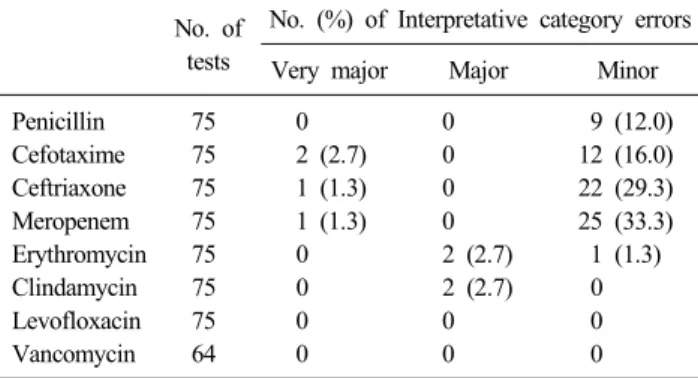
5 (10.9) 6 (13.0) 6 (13.0) 6 (13.0) Table 3. Interpretative category errors determined from a comparison
of MICroSTREP plus panel and the CLSI reference method No. of
tests
No. (%) of Interpretative category errors
Very major Major Minor
Penicillin 75 0 0 9 (12.0)
Cefotaxime 75 2 (2.7) 0 12 (16.0)
Ceftriaxone 75 1 (1.3) 0 22 (29.3)
Meropenem 75 1 (1.3) 0 25 (33.3)
Erythromycin 75 0 2 (2.7) 1 (1.3)
Clindamycin 75 0 2 (2.7) 0
Levofloxacin 75 0 0 0
Vancomycin 64 0 0 0
Etest의 항균제감수성검사 판정 결과도 동일한 기준을 적용하 여, CLSI 표준방법의 판정 결과와 비교하였다.
결 과
총 75 균주를 대상으로 항균제 감수성 검사를 시행하였으며, vancomycin에 대해서는 64 균주를 검사하였다(Table 1). CLSI 표준방법으로 검사한 대상 균주의 penicillin, cefotaxime, van- comycin, clindamycin, erythromycin, levofloxacin에 대한 감수 성률은 연구기관의 연중 항균제 감수성률과 큰 차이가 없었다.
MIC 결과에서 CLSI 표준방법의 결과에 대한 MicroScan MICroSTREP plus panel 결과의 전체적인 일치율은 93.0%였 다. Levofloxacin과 vancomycin에 대해서는 각각 한 균주를 제 외하고는 모두 일치한 MIC 결과를 보인 반면, meropenem (85.3%), penicillin (89.3%), ceftriaxone (90.7%)에 대해서는 비 교적 일치율이 낮았고, 이들 항균제에 대해서는 MicroScan MICroSTREP plus panel의 MIC 결과가 CLSI 표준방법의 결과 에 비하여 낮은 경우가 빈번하게 관찰되었다(Table 2).
판정 결과에서는 MicroScan MICroSTREP plus panel은 minor error 11.7%, major error 0.7%, very major error 0.7%의 결과를 보였다. 특히 MIC 결과에서 비교적 일치율이 낮았던 mer- openem과 ceftriaxone에 대해서는 minor error가 빈번하게 관찰
되었고, 각 1균주에서는 very major error가 있었다(Table 3).
Etest를 병행하였던 46 균주에 대하여 penicillin과 cefotaxime 항균제의 MicroScan MICroSTREP plus panel과 Etest의 결과를 비교하였을 때, CLSI 표준방법과의 일치율과 판정 오류의 빈 도에서 두 방법은 유사한 결과를 보였다(Table 4).
고 찰
폐렴연쇄구균의 항균제감수성검사에서 디스크확산법은 방 법이 간편하고, penicillin 내성을 선별할 수 있으며, macrolide 계 항균제, quinolone계 항균제, vancomycin, trimethoprim- sul- famethoxazole 등의 내성을 판별할 수 있어서 널리 시행되어 왔 으나, penicillin 이외의 beta-lactam 계열 항균제에 대해서는 CLSI의 판정 기준 자체가 없어서[6] 감수성을 검사할 수 없다 는 제한점이 있다. Oxacillin 디스크를 이용한 penicillin 내성 선 별 검사는 penicillin 내성과 중간 폐렴연쇄구균을 감별할 수 없 고, 일부 감수성 균주도 기준치 이하의 억제대를 보일 수 있으 므로, penicillin과 cefotaxime 또는 ceftriaxone의 MIC를 추가적 으로 검사하여야 하며, 뇌척수액에서 분리된 폐렴연쇄구균에 대해서도 MIC를 검사하여야 한다[6]. Penicillin을 비롯한 be- ta-lactam 계열 항균제에 대한 MIC 결과를 측정하는 표준방법 인 CLSI 미량액체배지희석법은 검사 방법이 번거롭고, 많은 노력이 필요하여 통상적인 검사에 이용하기 어렵고, Etest (AB Biodisk, Solna, Sweden)를 이용할 경우 MIC 결과를 얻을 수 있으나[8,9], 여러 가지 항균제를 검사하려면 고가의 시약을 사 용하여야 하는 단점이 있다.
기존에 국외에 시판되었던 MicroScan MICroSTREP panel은 CLSI의 미량액체배지희석법과 같이 3% lysed horse blood가 첨가된 Muller-Hinton 액체 배지를 사용하는 방법으로 냉동 상 태로 보관되고, 10가지 항균제에 대한 감수성 검사가 가능한 제품이었다[2,5]. MicroScan MICroSTREP plus panel은 건조 상태의 panel에 별도로 공급되는 3% lysed horse blood가 포함 된 Muller-Hinton 액체 배지를 첨가하여 검사하는 제품으로 실 온에서 보관하고, 18가지 항균제에 대한 감수성 검사가 가능하 도록 개량되었다. MicroScan MICroSTREP plus panel을 이용
할 경우 다양한 항균제에 대한 감수성을 CLSI 미량액체배지희 석법과 같은 원리를 이용하여 간편하게 검사할 수 있었고, 시 약의 보관도 용이하였다.
저자들의 소속 기관에서 기존에 디스크 확산법으로 검사하던 vancomycin, clindamycin, erythromycin, levofloxacin에 대해서 는 CLSI 표준방법의 MIC 결과와 MicroScan MICroSTREP plus panel의 MIC 결과의 일치율이 높았고, clindamycin과 er- ythromycin에 대해 일부 균주에서 major error가 발견되었으나, 전체적인 판정 결과 오류의 빈도는 매우 낮았다. 저자들의 소 속 기관에서 기존에 Etest로 검사하던 penicillin과 cefotaxime에 대해서는 MicroScan MICroSTREP plus panel과 Etest가 유사한 MIC 결과 일치도와 판정 오류의 빈도를 보여 기존의 Etest를 대체하여 MicroScan MICroSTREP plus panel을 이용하는 데 큰 문제가 없을 것으로 판단하였다.
MicroScan MICroSTREP panel을 대상으로 하였던 한 연구 에서 표준방법의 MIC 결과와 비교하였을 때 penicillin 96.2%, ceftriaxone 96.8%의 MIC 일치율을 보고하였고[5], 또 다른 한 연구에서는 penicillin과 ceftriaxone 모두 100%의 MIC 일치율 을 보고하였다[2]. 이번 연구에서 일부 beta-lactam 계열 항균제 에 대해서 CLSI 표준방법의 MIC 결과와 MicroScan MICro- STREP plus panel의 일치율이 meropenem 85.3%, penicillin 89.3%, ceftriaxone 90.7%로 상대적으로 낮았고, 1∼2 균주에서 는 major error가 있었고, 다수의 minor error가 관찰되었다. 이 전의 MICroSTREP panel에서는 ceftriaxone의 minor error가 9.8%∼12.1%로 보고되었고[2,5], cefotaxime의 경우 12.2%로 보고되었다[2]. 따라서 이 두 항균제의 경우 minor error가 다른 항균제에 비해 상대적으로 높을 것으로 생각되며, 이번 연구에 서 MICroSTREP plus panel의 MIC 결과가 CLSI 표준방법의 결과에 비하여 1단계 정도 일정하게 낮은 농도를 보인 경우가 빈번하였던 점을 고려하면, 균주나 항균제의 희석 과정이 각 검사의 MIC 결과에 영향을 주었을 가능성이 있다. 그러나, 이 번 연구는 각 방법에서 MIC를 중복 검사를 통한 확인 과정 없 이 한 번씩만 측정하였고, MICroSTREP plus panel 검사와 CLSI 액체배지희석법을 동시에 실시하지 않았다는 제한점이 있다.
MicroScan MICroSTREP panel을 이용한 연구에서 결과를 판독하기가 까다롭다는 보고가 있었고[2], 이번 연구에서도 MicroScan MICroSTREP plus panel의 검사 결과는 매우 주의 를 기울여야 판독이 가능하였다. 이번 연구에서는 두 검사법을 각각 다른 기관에서 판독하였으나, 앞으로 검사실에서 실제 사 용하게 된다면 Etest나 CLSI 표준법 등과의 비교를 통해 판독 의 정확성을 기해야 할 것으로 생각한다. 또한, 자동화 장비인 MicroScan WalkAway SI (Dade Behring, Deerfield, IL, USA)를 이용하여 MicroScan MICroSTREP plus panel의 결과를 판독하 게 된다면 더욱 편리하게 이용할 수 있을 것으로 생각한다.
MicroScan MICroSTREP plus panel은 폐렴연쇄구균 이외의 여러 가지 streptococci에 대한 항균제감수성검사도 가능하다.
최근 폐렴연쇄구균 이외의 streptococci에서도 penicillin 내성의 균주가 증가하고 있어서[10,11], 폐렴연쇄구균 이외의 strepto- cocci에 대해서도 다양한 항생제에 대한 정확한 MIC 결과를 검 사할 필요성이 증가하고 있다. 향후 MicroScan MICroSTREP plus panel을 이용한 폐렴연쇄구균 이외의 streptococci의 항균 제감수성검사에 대한 연구도 필요할 것으로 생각한다.
MicroScan MICroSTREP plus panel을 이용할 경우 간편하게 폐렴연쇄구균의 항균제 감수성 결과를 얻을 수 있었고, 기존에 검사하지 않던 다양한 항균제에 대한 MIC 결과를 얻을 수 있 는 장점이 있었다. 임상미생물 검사실에서 폐렴연쇄구균의 항 균제감수성검사를 실시할 때 MicroScan MICroSTREP plus panel을 유용하게 이용할 수 있을 것으로 생각한다.
참 고 문 헌
1. Spellerberg B and Brandt C. Streptococcus. In: Murray PR, Baron EJ, Jorensen JH, Landry ML, Pfaller MA, eds. Manual of clinical microbiology. 9th ed, Washington, D.C.; ASM Press, 2007:412-9.
2. Jorgensen JH, McElmeel ML, Crawford SA. Evaluation of the Dade MicroScan MICroSTREP antimicrobial susceptibility testing panel with selected Streptococcus pneumoniae challenge strains and recent clinical isolates. J Clin Microbiol 1998;36:788-91.
3. Beekmann SE, Heilmann KP, Richter SS, Garcia-de-Lomas J, Doern GV; the GRASP study group. Antimicrobial resistance in Streptococcus pneumoniae, Haemophilus influenzae, Moraxella catarrhalis and group A B-hemolytic streptococci in 2002-03;
Results of the multinational GRASP surveillance program. Int J Antimicrob Agents 2005;25:148-156.
4. Doern GV, Richter SS, Miller A, Miller N, Rice C, Heilmann K, et al. Antimicrobial resistance among Streptococcus pneumoniae in the United States: have we begun to turn the corner on resistance to certain antimicrobial classes? Clin Infect Dis 2005;41:139-48.
5. Guthrie LL, Banks S, Setiawan W, Waites KB. Comparison of MicroScan MICroSTREP, PASCO, and Sensititre MIC panels for determining antimicrobial susceptibilities of Streptococcus pneu- moniae. Diagn Microbiol Infect Dis 1999;33:267-73.
6. Clinical and Laboratory Standards Institute. Performance standards for antimicrobial susceptibility testing; sixteenth informational supplement. CLSI document M100-S16. Wayne, PA; CLSI, 2006.
7. Clinical and Laboratory Standards Institute. Methods for dilution antimicrobial susceptibility tests for bacteria that grow aerobically;
approved standard–seventh edition. CLSI document M7-A7.
Wayne, PA; CLSI, 2006.
8. Jorgensen JH, Ferraro MJ, McElmeel ML, Spargo J, Swenson JM, Tenover FC. Detection of penicillin and extended-spectrum cephalosporin resistance among Streptococcus pneumoniae clinical isolates by use of the E test. J Clin Microbiol 1994;32:159-63.
9. Huh JW, Nah J, Lee SH, Pai CH. Evaluation of the E test for penicillin and cefotaxime susceptibility testing of Streptococcus pneumoniae. Korean J Lab Med 1996;16:330-9.
10. Diekema DJ, Beach ML, Pfaller MA, Jones RN; SENTRY Participants Group. Antimicrobial resistance in viridans group streptococci among patients with and without the diagnosis of
cancer in the USA, Canada and Latin America. Clin Microbiol Infect 2001;7:152-7.
11. Lee H, Kim CK, Lee J, Lee SH, Ahn JY, Hong SG, et al.
Antimicrobial resistance of clinically important bacteria isolated from 12 hospitals in Korea in 2005 and 2006. Korean J Clin Microbiol 2007;10:59-69.
=국문초록=
폐렴연쇄구균에 대한 MicroScan MICroSTREP Plus Panel 항균제감수성검사의 평가
1한림대학교 의과대학 진단검사의학교실, 2한림대학교성심병원 진단검사의학과 김한성1,2, 김재석1, 하채옥2, 송원근1, 이규만1
배경: 최근 여러 가지 streptococci의 항균제감수성검사가 가능한 MicroScan MICroSTREP plus panel (Dade Behring, West Sacramento, CA, USA)이 국내에 소개되었다. 저자들은 폐렴연쇄구균을 대상으로 MicroScan MICroSTREP plus panel을 이 용한 항균제감수성검사를 평가하고자 하였다.
방법: 임상 검체에서 분리된 폐렴연쇄구균 75균주를 대상으로 하였고, MicroScan MICroSTREP plus panel과 clinical and laboratory standards institute (CLSI) 미량액체배지희석법으로 penicillin, cefotaxime, ceftriaxone, meropenem, vancomycin, clindamycin, erythromycin, levofloxacin에 대한 항균제감수성검사를 실시하였다. 46균주의 폐렴연쇄구균에 대해서는 Etest 를 이용하여 penicillin과 cefotaxime에 대한 항균제감수성검사를 추가로 실시하였다.
결과: CLSI 미량액체배지희석법의 결과와 2배 이내의 희석 배수의 결과를 보인 경우를 일치한 MIC 결과를 보인 것으로 간주하였고, MicroScan MICroSTREP plus panel의 전반적인 MIC 결과 일치율은 93.0%였다. 내성과 감수성의 판정에서는 minor error 11.7%, major error 0.7%, very major error 0.7%의 결과를 보였다. Etest 결과와 MicroScan MICroSTREP plus panel의 결과 사이에 큰 차이는 관찰되지 않았다.
결론: MicroScan MICroSTREP plus panel은 MIC 결과를 얻을 수 있는 액체배지희석법으로, 폐렴연쇄구균의 항균제감수성검 사에서 CLSI 미량액체배지희석법과 비교하였을 때 양호한 결과를 보였다. 임상미생물검사실에서 MicroScan MICroSTREP plus panel을 효과적으로 이용할 수 있을 것으로 생각한다. [대한임상미생물학회지 2008;11:18-22]
교신저자 : 김재석, 134-701, 서울시 강동구 길동 445
한림대학교 의과대학 강동성심병원 진단검사의학과 Tel: 02-2224-2327, Fax: 02-2224-2214
E-mail: [email protected]