Survival Outcomes and Predictive Factors for Female Urethral Cancer: Long-term Experience with Korean Patients
The aim of this study was to evaluate female urethral cancer (UCa) patients treated and followed-up during a time period spanning more than 20 yr at single institution in Korea.
We reviewed medical records of 21 consecutive patients diagnosed with female UCa at our institution between 1991 and 2012. After exclusion of two patients due to undefined histology, we examined clinicopathological variables, as well as survival outcomes of 19 patients with female UCa. A Cox proportional hazards ratio model was used to identify significant predictors of prognosis according to variables. The median age at diagnosis was 59 yr, and the median follow-up duration was 87.0 months. The most common initial symptoms were voiding symptoms and blood spotting. The median tumor size was 3.4 cm, and 55% of patients had lesions involving the entire urethra. The most common histologic type was adenocarcinoma, and the second most common type was urothelial carcinoma.
Fourteen patients underwent surgery, and 7 of these patients received adjuvant radiation or systemic chemotherapy. Eleven patients experienced tumor recurrence after primary therapy. Patients with high stage disease, advanced T stage (≥ T3), and positive lymph nodes had worse survival outcomes compared to their counterparts. Particularly, lymph node positivity and advanced T stage were significant predictive factors for all survival outcomes. Tumor location was the only significant predictor for recurrence-free survival.
Although our study included a small number of patients, it conveys valuable information about this rare female urologic malignancy in a Korean population.
Keywords: Female; Urethral Neoplasms; Survival; Outcome Assessment Minyong Kang,1 Chang Wook Jeong,2
Cheol Kwak,2 Hyeon Hoe Kim,2 and Ja Hyeon Ku2
1Department of Urology, Seoul National University Bundang Hospital, Seongnam; 2Department of Urology, Seoul National University Hospital, Seoul, Korea
Received: 31 December 2014 Accepted: 15 April 2015 Address for Correspondence:
Ja Hyeon Ku, MD
Department of Urology, Seoul National University Hospital, 101 Daehak-ro, Jongno-gu, Seoul 110-744, Korea Tel: +82.2-2072-0361, Fax: +82.2-742-4665 E-mail: [email protected]
http://dx.doi.org/10.3346/jkms.2015.30.8.1143 • J Korean Med Sci 2015; 30: 1143-1149
INTRODUCTION
Female urethral cancer (UCa) is a rare malignancy; it accounts for approximately 1% of all female urological cancer (1). Initial signs of UCa, such as voiding symptoms and bloody spotting, are ignored in most patients with female UCa because they are not pathognomonic. In fact, voiding symptoms and bloody spot- ting are common indicators of non-malignant conditions in normal healthy females. Despite improvements in diagnostic imaging, delayed diagnosis remains a challenge in these pati- ents (2). Because initial diagnosis is delayed, female UCa pati- ents often present with large and advanced lesions at initial di- agnosis, which results in poor prognosis (3). More importantly, because female UCa is rare, the key prognostic factors remain poorly defined, and optimal therapeutic strategies are primarily based on limited evidence (4).
Given these challenges, all available evidence should be shar- ed and discussed so that the current knowledge base about fe- male UCa is improved. Additionally, previous studies were large- ly based on Western populations, so more evidence is required to improve our understanding of female UCa in Asian countries.
In this study, we evaluated 19 cases of female UCa in Korea and reported useful information about clinical features, treatment, and prognostic factors.
MATERIALS AND METHODS
We reviewed medical records of 21 consecutive patients diag- nosed with female UCa at our institution between August 1991 and April 2012. After two cases were excluded due to undefined histologic features, we finally examined 19 patients of female UCa. We evaluated the following variables associated with pa- tient characteristics: age, initial presenting symptoms, proce- dure type, whether or not the patient received adjuvant therapy, histologic type, tumor size and location, recurrence and sites, whether or not the patient received salvage therapy, and recur- rence-free (RFS), cancer-specific (CSS) and overall survival (OS).
Tumor location was classified as proximal, distal, and whole urethral involvement, as in a previous report (5). Proximal tu- mors were defined as tumors limited to the proximal two-thirds of the urethra, while tumors were classified as “distal” if they were limited to the distal one-third of the urethra. The surgical Urology
modalities at presentation included mass excision, urethrecto- my, and pelvic exenteration. Pathological stages were determin- ed according to the 7th edition of the American Joint Commit- tee on Cancer (AJCC) staging system (6). Stage Ta, T1, and T2 tumors with N0 and M0 were defined as low stage tumors, while stage T3 and T4 tumors with N1-2 and M1 were classified as high stage tumors (6). The pathological T stage was primarily used to determine T stage. However, in cases where there was no documentation of pathological T stage, clinical T stage was used. Local recurrence was defined as cancer reappearance at the operative sites or in the pelvic cavity, and distant recurrence was tumor relapse at other sites besides the pelvic cavity.
The Kaplan-Meier method was used to calculate survival out- comes (RFS, CSS, and OS) after initial treatment, and log-rank tests were used to determine statistically significant differences between survival curves. We used a Cox proportional hazards model to identify significant predictors of survival outcomes according to clinicopathological variables. We rejected the 2-sid- ed null hypothesis that there was no significant difference in cases where the P value was less than 0.05. Consistently, we re- jected the null hypothesis if the 95% confidence interval (CI) of point estimates excluded 1. All statistical analyses were perform- ed using SPSS software, version 19.0 (IBM Corp., Armonk, NY, USA) and GraphPad Prism (GraphPad Software Inc., La Jolla, CA, USA).
Ethics statements
The institutional review board (IRB) of Seoul National Universi- ty Hospital approved this study (approval number: H-1406-072- 588). Because this study was conducted retrospectively, the IRB waived the requirement for documentation of written informed consent from patients.
RESULTS
Patient characteristics and overall prognoses are summarized in Table 1. Seven patients were diagnosed by physical examina- tion only, not by imaging studies. The median patient age at the time of diagnosis was 59.0 yr, and the median follow-up dura- tion was 87.0 months. Initial presenting symptoms were varied.
Voiding symptoms and blood spotting were the most common and only 1 patients had no symptoms. The median tumor size was 3.4 cm. With regard to tumor staging, 9 patients (47.4%) had low stage tumors and 10 patients (52.6%) had high stage tumors. Additionally, the pathological findings were histologi- cally diverse. Adenocarcinoma was the most common type and urothelial carcinoma was the second most common.
Fig. 1 is a flow chart of the types of primary and adjuvant ther- apy used to treat patients. While 5 patients underwent biopsies without other surgical procedures, 14 patients underwent sur- gery including pelvic exenteration, urethrectomy, and local mass
excision. For the 7 patients who received adjuvant therapy, such as radiation and systemic chemotherapy, there was no domi- nantly employed modality. Overall, 57.9% of these patients (n = 11) experienced tumor recurrence after primary therapy. The rates of lymph node and bone metastases were the same (27.7%), and these were the most common sites of recurrence. Summa- rized information for all 19 patients evaluated in this study is also provided in Table 2.
Fig. S1 shows the oncological outcomes (RFS, CSS, and OS) of the patients in this study. The 5-yr RFS, CSS, and OS rates were 34.8% (standard error [SE] 22.7%-46.9%), 58.9% (SE 46.8%-71.0%), and 58.9% (SE 46.8%-71.0%). All oncological outcomes were significantly different between patients with low stage (stage I-II) and high stage cancer (stage III-IV) (Fig. 2). When patients were classified by T stage, patients with advanced T stages (≥ T3) Table 1. Patient characteristics
Characteristics Total patients (n = 19)
Median age (yr) (IQR) 59.0 (52.0-72.0)
Body mass index (kg/m2) (IQR) 21.90 (20.80-25.79) Initial symptoms, No. (%)
Asymptomatic Voiding symptoms Blood spotting Gross hematuria Others
1 (5.2) 6 (31.6) 6 (31.6) 2 (10.5) 4 (21.1) Median tumor size (cm) (IQR) 3.4 (1.3-4.5) Size classification, No. (%)
< 2 cm 2-4 cm > 4 cm
5 (27.7) 7 (36.8) 6 (31.6) Tumor location, No. (%)
Proximal urethra Distal urethra Entire urethra
2 (11.1) 6 (33.3) 10 (55.6) Surgery type, No. (%)
Mass excision Urethrectomy Pelvic exenteration
6 (42.8) 1 (7.1) 7 (50.1) Tumor stage, No. (%)
Low stage (stage I-II) High stage (stage III-IV)
9 (47.4) 10 (52.6) Histologic type, No. (%)
Adenocarcinoma Urothelial carcinoma Squamous cell carcinoma Mixed type*
9 (47.3) 6 (31.5) 3 (15.8) 1 (5.2)*
Adjuvant therapy, No. (%) None
Radiation therapy Chemotherapy Combined
9 (47.4) 5 (26.3) 3 (15.8) 2 (10.5)
Recurrence, No. (%) 11 (57.9)
Salvage therapy, No. (%) 8 (42.1)
Death, No. (%) All-cause Disease-specific
10 (52.6) 9 (47.4) Median F/U duration, months (95% CI) 87.0 (61.74-202.77)
*One case of mixed tumor was combined with granulosa cell tumor and urothelial carcinoma. IQR, interquartile range; CI, Confidence interval; F/U, follow-up.
Fig. 1. Flow-chart of the treatment courses of the 19 patients with female urethral cancer in this study. The number of patients who were treated with specific modalities is de- scribed for each respective step. RT, radiation therapy; Tx, therapy; CTx, chemotherapy.
Observation (n = 2) Palliative RT
(n = 1) Palliative chemotherapy
(n = 2)
Female urethral cancer (n = 19)
Biopsy (n = 5)
No adjuvant Tx (n = 4) Adjuvant RT
(n = 1) RT & CTx
(n = 1)
RT & CTx (n = 1) Urethrectomy
(n = 1) Adjuvant RT
(n = 1) No adjuvant Tx
(n = 3) Adjuvant RT
(n = 2) Adjuvant CTx
(n = 1) Mass excision
(n = 6)
Surgery (n = 14)
Pelvic exenteration (n = 7)
Table 2. Cancer associated information
Age (yr) Location Size (cm) Type of procedure Histology TMN AJCC staging
Adjuvant
treatment Recurrence site Salvage
treatment Survival Cause of death
75 Entire 4.5 Biopsy UC cT3N2M0 High CTx N N Alive -
70 Proximal 4.6 Mass excision AC pTaN0M0 Low N N N Alive -
74 Entire 4.4 Pelvic exenteration AC pT3N0M0 High N Lung Y Alive -
38 Distal 0.5 Mass excision AC pT1N0M0 Low N N N Alive -
52 Entire 2.9 Pelvic exenteration AC pT3N0M0 High CTx & RT Bone Y Dead UCa
55 Entire 3.6 Pelvic exenteration AC pT4N2M0 High N Pelvic wall Y Dead UCa
61 Entire 2.9 Biopsy UC cT3N2M0 High Neo-adjuvant Iliac LN Y Dead UCa
75 Distal 0.5 Mass excision UC pTaN0M0 Low N N N Alive -
53 Entire 3.9 Pelvic exenteration AC pT3N1M0 High CTx Lung Y Dead UCa
57 Entire 4.1 Pelvic exenteration AC pT4N0M0 High RT Pelvic wall Y Alive -
68 Entire 3.4 Mass excision UC pT2N0M0 Low N N N Alive -
50 Entire 4.5 Pelvic exenteration AC pT4N2M0 High RT Bone & iliac LN N Dead UCa
79 Entire 2.0 Biopsy SC cT3N2M1 High N Liver & Lung N Dead UCa
52 Proximal 6.0 Pelvic exenteration UC & GT pT1N0M0 Low N Bone Y Dead UCa
64 Distal 0.5 Biopsy UC pTaN0M0 Low N N N Dead Other
59 Distal 0.2 Mass excision AC cTaN0M0 Low RT Local recur Y Dead UCa
68 Distal 0.8 Biopsy UC pTisN0M0 Low RT N N Alive -
38 Distal 0.5 Mass excision SC cT0N2M0 High CTx & RT Inguinal LN N Dead UCa
51 Distal 3.0 Urethrectomy SC pT1N0M0 Low RT N N Alive -
UC, urothelial cancer; AC, adenocarcinoma; SC, squamous cell carcinoma; GT, granulosa cell tumor; CTx, chemotherapy; RT, radiotherapy; N, negative; LN, lymph node; UCa, urethral cancer; Y, yes; N, No.
Fig. 2. Comparison of survival outcomes. (A) Recurrence-free survival, (B) cancer- specific survival, and (C) overall survival of female urethral cancer patients according to the American Joint Committee on Cancer staging guidelines analyzed by the Ka- plan-Meier method and log-rank tests.
Proportion of survival (%)
Time after therapy (month)
0 50 100 150 200 100
80
60
40
20
0
Recurrence-free survival
Stage I-II Stage III-IV P < 0.001
A
Proportion of survival (%)
Time after therapy (month)
0 100 200 300 100
80
60
40
20
0
Cancer-specific survival
Stage I-II Stage III-IV P = 0.001
B
Proportion of survival (%)
Time after therapy (month)
0 100 200 300 100
80
60
40
20
0
Overall survival
Stage I-II Stage III-IV P = 0.003
C
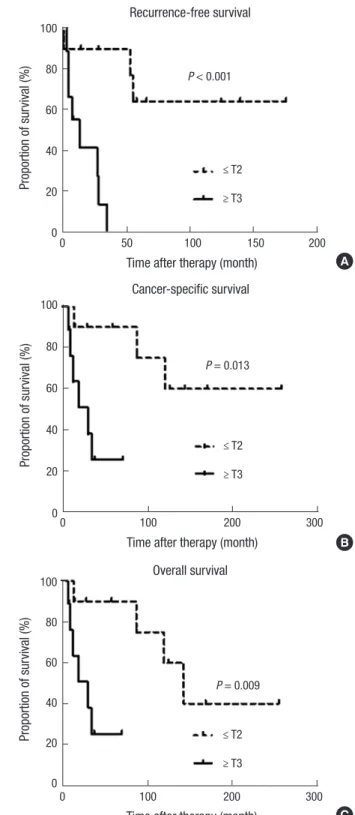
Fig. 3. Comparison of survival outcomes. (A) Recurrence-free survival, (B) cancer- specific survival, and (C) overall survival of female urethral cancer patients according to T stage analyzed by the Kaplan-Meier method and log-rank tests.
Proportion of survival (%)
Time after therapy (month)
0 50 100 150 200 100
80
60
40
20
0
Recurrence-free survival
≤ T2
≥ T3 P < 0.001
A
Proportion of survival (%)
Time after therapy (month)
0 100 200 300 100
80
60
40
20
0
Cancer-specific survival
≤ T2
≥ T3 P = 0.013
B
Proportion of survival (%)
Time after therapy (month)
0 100 200 300 100
80
60
40
20
0
Overall survival
≤ T2
≥ T3 P = 0.009
C
had poor survival outcomes for RFS, CSS and OS compared to patients with localized tumors (≤ T2) (Fig. 3). Patients with pos- itive lymph nodes also had worse survival outcomes by all mea- surements compared to node-negative patients (Fig. 4). How-
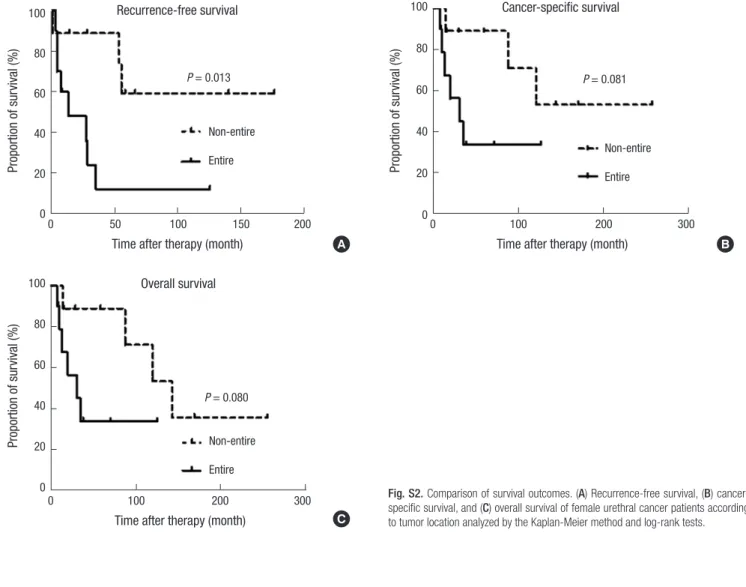
ever, only RFS, but not CSS and OS, was worse in patients with tumors involving the entire urethra compared to patients with proximal or distal tumors (Fig. S2).
To identify predictive factors for oncological outcomes, we
Table 3. Cox proportional hazard ratio analysis to identify predictors of oncological outcomes in the patients with female urethral cancer
Variables RFS CSS OS
HR 95% CI P value HR 95% CI P value HR 95% CI P value
Tumor location
Non-entire urethra Reference Reference Reference
Entire urethra 4.63 1.13-18.90 0.033 - - - - - -
T stage
( ≤ ) T2 Reference Reference Reference
( ≥ ) T3 18.16 2.15-153.55 0.008 10.12 1.21-84.60 0.033 11.31 1.35-94.58 0.025
Lymph node metastases
Negative Reference Reference Reference
Positive 26.96 2.98-243.38 0.003 24.83 2.89-213.46 0.003 27.20 3.16-234.15 0.003
RFS, recurrence-free survival; CSS, cancer-specific survival; OS, overall survival; HR, hazard ratio; CI, confidence interval; AJCC, American Joint Committee on Cancer.
Fig. 4. Comparison of survival outcomes. (A) Recurrence-free survival, (B) cancer- specific survival, and (C) overall survival in female urethral cancer patients according to lymph node status analyzed by the Kaplan-Meier method and log-rank tests.
Proportion of survival (%)
Time after therapy (month)
0 50 100 150 200 100
80
60
40
20
0
Recurrence-free survival
Node (-) Node (+) P < 0.001
A
Proportion of survival (%)
Time after therapy (month)
0 100 200 300 100
80
60
40
20
0
Cancer-specific survival
Node (-) Node (+) P < 0.001
B
Proportion of survival (%)
Time after therapy (month)
0 100 200 300 100
80
60
40
20
0
Overall survival
Node (-) Node (+) P < 0.001
C
used a Cox proportional hazards ratio regression model (Table 3). In this analysis, positive lymph node status and advanced T stage (≥ T3) were the significant factors for prediction of all on- cological outcomes. Additionally, tumor location (entire ure- thral involvement) was the significant predictor only for RFS, and not for CSS or OS.
DISCUSSION
In the present study, we examined the clinical experiences of 19
patients with female UCa at a single tertiary institution. Despite the small sample size and retrospective nature of this study, it is important to report all available evidence so that we can improve our understanding of this rare malignancy. Notably, we found that cancer stage based on the AJCC classification, T stage, and lymph node status were associated with remarkable differences in RFS, CSS, and OS between patient groups in Kaplan-Meier analysis. Patients with high stage tumors (stage III-IV), advanced T stage (≥ T3), and positive lymph nodes had poor outcomes as indicated by all analyzed survival outcomes (RFS, CSS, and OS)
compared to their counterparts. Importantly, lymph node posi- tivity and advanced T stage were significantly predictive for poor outcomes in all survival estimates in Cox regression analysis.
Additionally, involvement of the entire urethra remained as a predictor of RFS, but not CSS or OS.
Other studies support our results regarding the key prognos- tic factors for female UCa. Champ et al. (7) analyzed the female UCa patients in the Surveillance, Epidemiology, and End Re- sults (SEER) database and reported that older age, pathological T stage, lymph node positivity, and non-squamous histology were significantly related to poor CSS. Dimarco et al. (5) sug- gested that pathological T stage was a strong predictive factor for RFS and CSS. Pathological findings about lymph node sta- tus were also shown to predict survival in their study. A single center study by Thyavihally et al. (8) reported that patients with early stage cancer (stage I-II) according to the AJCC staging gui- delines for female UCa had better survival outcomes compared to patients with advanced stage tumors (stage III-IV), regardless of the treatment modality.
Although other variables such as tumor size, histologic type, and treatment modality were not associated with any oncologi- cal outcomes in the present study, these factors have been re- ported as significant prognostic factors for female UCa by other studies. Bracken et al. (3) evaluated 81 cases of female UCa and found that patients with large tumors (> 4 cm) had a lower 5-yr survival rate (about 13%) compared to patients with small tu- mors (< 2 cm), (about 60%). Proximal tumors and lesions that involve the whole urethra have commonly been shown to be associated with poor oncological outcomes compared to distal lesions (9). Benson et al. (10) reported that all patients with prox- imal urethral tumors died, while 50% of patients with distal ure- thral tumors survived. The histologic type of female UCa has also been suggested as a key determinant of prognosis (2, 7, 11).
The predominant tumor types are squamous cell carcinoma and urothelial carcinoma, and localized tumors of these histo- logic types are associated with better survival outcomes com- pared to tumors of less common histologic types, such as ade- nocarcinoma (2, 12, 13). In a study by Meis et al. (14), most pa- tients with adenocarcinoma had locally advanced disease in- volving adjacent tissues or lymph node metastasis, and approx- imately 60% of these patients experienced cancer-related death within 2 yr of diagnosis. In contrast to these findings, Dalbagni et al. (1) examined 72 females with primary UCa and reported that primary stage, lymph node status, and tumor site were key independent predictors of survival, but histologic type was not.
Dimarco et al. (5) also found that tumor histology was not a sig- nificant predictor of recurrence or survival for female UCa pa- tients. They noted that pathological stage was the most impor- tant factor for prediction of prognosis. In our analysis, nearly half of the patients (n = 9; 42.9%) were diagnosed with adeno- carcinoma at the time of presentation; these patients tended to
have poor oncological outcomes, though the results were not statistically significant (data not shown).
As discussed in previous studies, therapeutic policies are typi- cally determined by tumor size, location, and aggressiveness (4). For example, surgical resection or radiation can be applied to small (< 2 cm) distal lesions, while a combination of radical surgery and radiation therapy is recommended for more ad- vanced stage disease (15, 16). Our results consistently demon- strated that patients who underwent aggressive surgery and re- ceived adjuvant radiation had mainly larger tumors (≥ 3-4 cm) and tumors that involved the entire urethra. Although multi- modal treatment with surgery, radiation, and systemic chemo- therapy could be beneficial for selected patients with advanced stage cancer, the role of adjuvant chemotherapy has not yet been definitively shown to improve oncological outcomes (2, 5). In the present study, 2 patients with advanced stage lesions receiv- ed chemoradiotherapy. Despite the use of combination thera- py, these patients experienced tumor recurrence to the bone and inguinal lymph node, respectively, and eventually died as a result of their UCa.
We should consider the limitations of our study. First, the data were collected and reviewed retrospectively. Second, 5 urologic surgeons managed female UCa patients at our institution dur- ing the long study period. Therefore, there was some difference in the treatment and follow-up protocols for the patients with this rare malignancy. Finally, although this is the largest report of female UCa in Korea, the statistical power of this study was limited by insufficient number of cases.
In conclusion, high stage, advanced T stage, and lymph node positivity are associated with poor prognosis for all analyzed survival outcomes (RFS, CSS, and OS) in female UCa patients after primary treatment. Furthermore, lymph node status and T stage are significantly predictive of all survival outcomes. There- fore, early diagnosis and management with early identification of this rare malignancy can improve the overall prognosis of UCa patients. Despite the limited case number, our results pro- vide valuable information that expands the current knowledge about clinicopathological characteristics and factors that pre- dict long-term prognosis of UCa patients.
DISCLOSURE
The authors have no conflicts of interest.
AUTHOR CONTRIBUTION
Study concept and design: Kang M, Ku JH. Data acquisition:
Kang M. Data review and analysis: Kang M, Jeong CW, Ku JH.
Statistical analysis: Kang M, Jeong CW, Ku JH. Manuscript prep- aration: Kang M, Ku JH. Manuscript revision: Kwak C, Kim HH.
Manuscript approval: all authors.
ORICD
Minyong Kang http://orcid.org/0000-0002-6966-8813 Chang Wook Jeong http://orcid.org/0000-0002-2200-5019 Cheol Kwak http://orcid.org/0000-0002-1987-2111 Hyeon Hoe Kim http://orcid.org/0000-0001-6600-4539 Ja Hyeon Ku http://orcid.org/0000-0002-0391-2342 REFERENCES
1. Dalbagni G, Zhang ZF, Lacombe L, Herr HW. Female urethral carcino- ma: an analysis of treatment outcome and a plea for a standardized ma- nagement strategy. Br J Urol 1998; 82: 835-41.
2. Derksen JW, Visser O, de la Rivière GB, Meuleman EJ, Heldeweg EA, Lagerveld BW. Primary urethral carcinoma in females: an epidemiolog- ic study on demographical factors, histological types, tumour stage and survival. World J Urol 2013; 31: 147-53.
3. Bracken RB, Johnson DE, Miller LS, Ayala AG, Gomez JJ, Rutledge F.
Primary carcinoma of the female urethra. J Urol 1976; 116: 188-92.
4. Gakis G, Witjes JA, Compérat E, Cowan NC, De Santis M, Lebret T, Rib- al MJ, Sherif AM; European Association of Urology. EAU guidelines on primary urethral carcinoma. Eur Urol 2013; 64: 823-30.
5. Dimarco DS, Dimarco CS, Zincke H, Webb MJ, Bass SE, Slezak JM, Light- ner DJ. Surgical treatment for local control of female urethral carcino- ma. Urol Oncol 2004; 22: 404-9.
6. Edge SB, Compton CC. The American Joint Committee on Cancer: the 7th edition of the AJCC cancer staging manual and the future of TNM.
Ann Surg Oncol 2010; 17: 1471-4.
7. Champ CE, Hegarty SE, Shen X, Mishra MV, Dicker AP, Trabulsi EJ, Lal- las CD, Gomella LG, Hyslop T, Showalter TN. Prognostic factors and outcomes after definitive treatment of female urethral cancer: a popula- tion-based analysis. Urology 2012; 80: 374-81.
8. Thyavihally YB, Wuntkal R, Bakshi G, Uppin S, Tongaonkar HB. Prima- ry carcinoma of the female urethra: single center experience of 18 cases.
Jpn J Clin Oncol 2005; 35: 84-7.
9. Garden AS, Zagars GK, Delclos L. Primary carcinoma of the female ure- thra. Results of radiation therapy. Cancer 1993; 71: 3102-8.
10. Benson RC Jr, Tunca JC, Buchler DA, Uehling DT. Primary carcinoma of the female urethra. Gynecol Oncol 1982; 14: 313-8.
11. Visser O, Adolfsson J, Rossi S, Verne J, Gatta G, Maffezzini M, Franks KN; RARECARE working group. Incidence and survival of rare urogeni- tal cancers in Europe. Eur J Cancer 2012; 48: 456-64.
12. Kato H, Kobayashi S, Islam AM, Nishizawa O. Female para-urethral ad- enocarcinoma: histological and immunohistochemical study. Int J Urol 2005; 12: 117-9.
13. Ouzaid I, Hermieu JF, Dominique S, Fernandez P, Choudat L, Ravery V.
Management of adenocarcinoma of the female urethra: case report and brief review. Can J Urol 2010; 17: 5404-7.
14. Meis JM, Ayala AG, Johnson DE. Adenocarcinoma of the urethra in wom- en. A clinicopathologic study. Cancer 1987; 60: 1038-52.
15. Grigsby PW, Corn BW. Localized urethral tumors in women: indications for conservative versus exenterative therapies. J Urol 1992; 147: 1516-20.
16. Gheiler EL, Tefilli MV, Tiguert R, de Oliveira JG, Pontes JE, Wood DP Jr.
Management of primary urethral cancer. Urology 1998; 52: 487-93.
Fig. S1. Kaplan-Meier analysis of survival outcomes. (A) Recurrence-free survival, (B) cancer-specific survival, and (C) overall survival of female urethral cancer patients.
Proportion of survival (%)
Time after therapy (month)
0 50 100 150 200 100
80
60
40
20
0
Recurrence-free survival
Median RFS: 35 months
A
Proportion of survival (%)
Time after therapy (month)
0 100 200 300 100
80
60
40
20
0
Cancer-specific survival
B Median CSS: 87 months
Proportion of survival (%)
Time after therapy (month)
0 100 200 300 100
80
60
40
20
0
Overall survival
C Median OS: 87 months
Fig. S2. Comparison of survival outcomes. (A) Recurrence-free survival, (B) cancer- specific survival, and (C) overall survival of female urethral cancer patients according to tumor location analyzed by the Kaplan-Meier method and log-rank tests.
Proportion of survival (%)
Time after therapy (month)
0 50 100 150 200 100
80
60
40
20
0
Recurrence-free survival
Non-entire Entire P = 0.013
A
Proportion of survival (%)
Time after therapy (month)
0 100 200 300 100
80
60
40
20
0
Cancer-specific survival
B P = 0.081
Non-entire Entire
Proportion of survival (%)
Time after therapy (month)
0 100 200 300 100
80
60
40
20
0
Overall survival
C Non-entire
Entire P = 0.080