항암화학요법을 받는 암환자 간호핵심역량 측정도구 개발 및 타당화
김성해1·박재현2
1경희대학교 의학전문대학원 의학교육학교실, 중앙대학교 적십자간호대학 간호교육이노센터
2경희대학교 의학전문대학원 의학교육학교실
Development and Validation of a Tool for Evaluating Core Competencies in Nursing Cancer Patients on Chemotherapy
Kim, Sung Hae
1· Park, Jae Hyun
21Department of Medical Education, Kyung Hee University School of Medicine, Seoul Center for Innovation in Nursing Education, Chung Ang University Red Cross College of Nursing, Seoul
2Department of Medical Education, Kyung Hee University School of Medicine, Seoul, Korea
Purpose: This study was done to develop tool to evaluate the core competencies regarding nursing cancer patients on che- motherapy, and to verify the reliability and efficacy of the developed tool. Methods: A tool to evaluate the core competencies was developed from a preliminary tool consisting of 112 items verified by expert groups. The adequacy of the preliminary tool was analyzed and refined to the final evaluation tool containing 76 items in 8 core competencies and 18 specific competen- cies. The evaluation tool is in the form of a self-report, and each item is evaluated according to a 3-point scale. From Septem- ber 22 to October 14, 2011, 349 survey responses were analyzed using SPSS 20.0 and the WINSTEPS program that employs the Rasch model. Results: Results indicated that there were no inappropriate items and the items had low levels of difficulty in comparison with the knowledge levels of the study participants. The results of factor analysis yielded 18 factors, and the reli- ability of the tools was very high with Cronbach's α=.97. Conclusion: The results of this study can be used for training and evaluation of core competencies for nursing cancer patients, and for standardizing nursing practices associated with chemo- therapy.
Key words: Chemotherapy, Cancer, Nursing, Competence, Assessment
서 론 1. 연구의 필요성
암은 우리나라 사망원인 1위로(National Cancer Center, Ministry of Health & Welfare, 2011), 우리의 건강을 위협하고 있는 주요 건강 문제 중 하나이다. 그러나 조기진단과 다양한 치료방법의 등장으로 암환자의 5년 생존율이 50% 이상으로 증가하였고, 국가차원의 암 관련 사업으로 현대사회에서 암은 장기적 관리가 필요한 만성질환
으로 간주되고 있다(da Costa Vargens & Berterö, 2007).
암의 주된 치료방법인 항암화학요법은 암환자의 생존기간을 증 가시켜 왔지만(Kwak, Kim, Lee, Kwon, & Hwang, 2010), 오심, 구토, 골 수기능저하, 감염 등의 여러 가지 급·만성 부작용을 유발하기 때문 에 항암화학요법을 받는 암환자는 고통스럽고 힘든 시간을 보낸다 (Berterö & Chamberlain Wilmoth, 2007). 또한 항암제는 환자의 생명 과 안위에 직접적인 영향을 미치는 약제로 간호사는 정확하고 안전 하게 항암제를 투여해야 한다. 우리나라의 경우 1994년부터 종양전 문간호사가 활동하면서 암환자 간호의 질이 향상되었다(Kim &
주요어: 항암화학요법, 암, 간호, 역량, 측정
* 이 논문은 제1저자 김성해의 석사학위논문을 수정하여 작성한 것임.
* This article is a revision of the first author's master's thesis from Kyung Hee University.
Address reprint requests to : Kim, Sung Hae
Department of Medical Education, Kyung Hee University School of Medicine, 1 Hoegi-dong, Dongdaemun-gu, Seoul 130-701, Korea.
Tel: +82-2-961-9102 Fax: +82-2-969-6958 E-mail: [email protected] 투고일: 2012년 1월 9일 심사의뢰일: 2012년 1월 25일 게재확정일: 2012년 9월 19일
Park, 2007). 그러나 종양전문간호사는 항암화학요법 관련 업무, 골 수이식 관련 업무, 교육 및 상담, 행정 등 암환자와 관련된 전반적인 업무를 담당하고 있어 실제 항암화학요법을 받는 암환자에게 직·간 접 간호를 전담하여 제공하기는 어려운 실정이다. 따라서 종양전문 간호사의 역할 보다 실제 환자를 간호하는 담당간호사의 수행능력 이 무엇보다 중요하다. 이는 양질의 간호가 암환자의 생존율을 높인 다는 Webb, Cummings, Bain과 Furnival (2004)의 연구에서도 강조되 는 부분으로, 간호사는 이들의 요구에 맞는 양질의 간호를 제공하기 위해 전문직 간호사로서 갖추어야 할 핵심역량을 습득해야 한다.
간호역량은 대상자의 간호요구에 따라 적절한 간호를 효과적으 로 제공하기 위해 지식, 기술, 태도를 통합하여 적용할 수 있는 능력 이다(Ha & Choi, 2010; Scott Tilley, 2008). 최근 간호교육은 간호학생 또는 간호사에게 실제 임상간호실무에 필요한 지식과 기술을 습득 할 수 있는 역량기반 교육을 강화하고 있으며(Hall, Moore, & Barn- steiner, 2008), 핵심역량 강화를 통한 임상수행능력의 향상은 간호실 무향상의 밑거름이 되고 있다. Lenburg (1999)의 Competency Out- comes and Performance Assessment (COPA) Model은 간호기관에서 널리 사용되고 있는 역량모델로, 최근 2009년 변화된 의료 환경을 고려하여 개정된 COPA Model이 발표되었다(Lenburg, Klein, Ab- dur-Rahman, Spencer, & Boyer, 2009). 우리나라의 경우 2006년 한국 간호평가원(Korean Accreditation Board of Nursing [KABON])에서 간호핵심역량을 발표하였고, 2011년 5월 간호교육 핵심역량평가 공 청회를 통해 비판적 사고, 직접간호수행, 의사소통, 교육 및 코칭, 인 적·재정적·물질적 자원관리, 전문직 역할 수행의 6가지 간호핵심 능력을 발표하였다(KABON, 2011).
간호핵심역량에 관한 국내 선행연구로는 수술실과 같은 특수부 서 간호사, 병동간호사, 전문간호사를 대상으로 핵심역량을 도출 하고 평가한 연구가 있으며(Choi & Eun, 2006; Kang, Lee, Kim, &
Ahn, 2008; Kim & Park, 2007), 간호사의 간호역량이 직무만족과 업 무성과에 미치는 영향을 분석한 연구가 있다(Ha & Choi, 2010). 그 러나 간호 요구도가 높은 항암화학요법을 받는 암환자 간호의 핵심 역량에 관한 연구는 활발히 이루어지지 않고 있으며, 간호협회나 기구 차원에서 항암제 투여 및 암환자 간호를 위한 실무지침이 개 발되지 않아 간호실무 표준화에 제약이 따른다. 반면, 미국의 경우 미국임상종양간호협회(American Society of Clinical Oncology [ASCO])에서 항암제 투여 및 암환자 간호와 관련된 실무지침을 개 정하고 제공하여(Azzoli et al., 2011; Peppercorn et al., 2011) 관련 분야 의 간호실무 표준화를 위해 노력하고 있다. 하지만 이 지침은 미국 보건의료체계에 맞춰 간호사의 역할과 책임을 규정하고 있어 우리 나라 임상간호현장에 그대로 적용하기에는 한계가 있으며, 암환자 간호수행능력을 구체적으로 측정할만한 세분화된 측정도구도 제
시하지 못한다. 이는 우리나라도 마찬가지로 핵심역량에 대한 지속 적인 연구에도 불구하고 구체적 간호수행 지침을 제시할 수 있는 신뢰도와 타당도가 검증된 표준화된 측정도구가 부족한 실정이다 (Choi & Eun, 2006; Kang et al., 2008).
이에 본 연구는 항암화학요법을 받는 암환자 간호의 핵심역량을 도출하여 그에 따른 구체적인 간호수행이 포함된 측정도구를 개발 하고, Rasch 모형을 적용한 분석과 요인분석을 이용하여 측정도구 의 신뢰도와 타당도를 검증하려고 한다.
2. 연구 목적
본 연구의 목적은 항암화학요법을 받는 암환자를 간호하는 간호 사의 핵심역량을 도출하여 이를 교육하고 평가할 수 있는 구체적인 간호수행이 포함된 측정도구를 개발하고, 개발된 측정도구의 신뢰 도와 타당도를 검증하는 것이다.
3. 용어 정의
1) 항암화학요법을 받는 암환자
본 연구에서 항암화학요법을 받는 암환자는 구강 또는 정맥을 통 해 한 가지 또는 두 가지 이상의 약물을 병용투여 받는 환자를 의미 한다.
2) 간호핵심역량
간호핵심역량은 간호 및 특정업무를 수행하기 위한 지식, 기술, 태도를 통합하여 간호과정에 효과적으로 적용할 수 있는 능력이다 (Ha & Choi, 2010; Scott Tilley, 2008). 본 연구에서 간호핵심역량은 항 암화학요법을 받는 암환자를 간호하기 위해 간호사에게 요구되는 기본적이고 필수적인 능력을 의미한다.
연구 방법 및 절차
본 연구는 문헌고찰 및 포커스 그룹 면담(focus group interview)을 통해 국내에 적합한 항암화학요법을 받는 암환자 간호핵심역량 측 정도구를 개발하고, 측정도구의 신뢰도와 타당도를 검증하기 위한 방법론적 연구이다. 구체적 절차는 다음과 같다(Figure 1).
1. 1단계: 도구 개발과정
1) 개념적 기틀 설정본 연구자가 각종 간호기구(대한종양간호학회, 대한간호협회, 한
국간호평가원, 미국 및 캐나다의 종양간호 기구 등), 간호핵심역량 관련 웹 사이트, 그 밖에 국내·외 문헌 108편과 미국 종양간호협회 에서 발간한 항암화학요법 실무지침 자료를 바탕으로 항암화학요 법을 받는 암환자 간호핵심역량에 관한 문헌을 검색하고 고찰하였 다. 그 결과 Lenburg (Lenburg, 1999; Lenburg et al., 2009)의 간호핵심 역량이 본 연구의 이론적 개념에 적합하다고 판단하여, 이를 토대 로 국내 임상간호현장에 적용할 수 있는 8가지 핵심역량에 따른 98 개 문항으로 구성된 항암화학요법을 받는 암환자 간호핵심역량 초 안을 개발하였다.
2) 포커스 그룹 선정 및 예비문항 개발
포커스 그룹은 암환자 간호경력 10년 이상의 일반간호사 2인, 암 환자 간호경력 15년 이상의 외래항암주사실 수간호사 1인, 암환자 간호경력 20년 이상의 암병동 수간호사 1인, 암환자 간호경력 10년 이상의 종양전문간호사 1인 및 15년 이상의 종양전문간호사 2인, 암 환자 간호경력 20년 이상의 간호대학 교수 1인, 암환자 간호경력 5년 이상의 Chemotherapy와 Biotherapy Provider 자격을 소지한 간호대 학 교수 1인으로 총 9인으로 구성하였다. 연구의 목적을 설명한 후 2011년 7월 포커스 그룹 패널과의 1차 심층면담을 통해 연구자가 도 출한 8가지 핵심역량에 관한 개념 및 98개의 구체적 수행능력에 관
한 간호핵심역량 초안을 제공하였고, 연구와 관련된 국내·외 문헌을 배포하여 항암화학요법을 받는 암환자 간호핵심역량을 측정하기 위한 예비문항을 개발하였다. 그 후 2011년 8월 19일 포커스 그룹 워 크숍을 진행하여 예비문항을 선정하였고, 2011년 8월 29일부터 9월 2일까지 포커스 그룹 패널과의 2차 심층면담을 통해 8개 영역 총 113개의 예비문항을 완성하였다. 이메일을 통해 2011년 9월 3일부터 9월 7일까지 포커스 그룹 패널을 대상으로 4점 척도(1=전혀 타당하 지 않다, 2=약간 타당하다, 3점=대체로 타당하다, 4점=매우 타당 하다)로 예비문항의 내용타당도를 평가하여 CVI (Content Validity Index) .80 이상인 문항을 선정하였으며, 그 결과 113개 문항이 모두 채택되었다.
3) 예비문항의 내용타당도 검증
내용타당도 검증은 3-10명 정도의 전문가 패널이 적당하다는 Lynn (1986)의 연구에 근거하여 8인(종양전문간호사 2인, 수간호사 1 인, 책임간호사 1인, 암환자 간호경력이 있는 간호대학 교수 3인, 핵 심간호역량 평가도구 개발 경험이 있는 간호대학 교수 1인)의 전문 가 집단을 대상으로 조사하였고, CVI .80 이상인 문항을 선정한 후 평가도구 개발에 경험이 많은 교육학 교수 1인, 혈액·종양내과 교 수 2인에게 예비문항에 관한 자문을 구하여 적합하지 않은 내용, 어 Figure 1. Research procedure.
려운 단어 또는 문장의 어휘를 수정하였다. 그 결과, 의료법 상 간호 사의 권한 밖의 업무인 항암제 조제에 관한 1개 문항을 제외한 112 개 문항이 선정되었다.
2. 2단계: 예비조사
1) 예비조사
2011년 9월 16일부터 9월 20일까지 서울소재 K대학병원 혈액·종 양내과 일반간호사 8명, 책임간호사 1명, 수간호사 1명을 대상으로 예비조사를 실시하였다. 예비도구는 112개 문항으로 간호사가 자 신의 간호수행능력을 자가평가하는 설문방식의 Likert식 4점 척도 (1=매우 못함, 2=못함, 3=잘함, 4=매우 잘함)로 구성하였다.
예비도구의 전체 신뢰도는 Cronbach's α= .95였으며, 평정척도 1점 (매우 못함)에 응답한 비율이 0%로 나타나 해당 분야의 간호사가 핵심역량에 따른 간호수행을 일정 수준 이상 할 수 있는 것으로 판 단하여 도구의 평정척도를 Likert식 3점 척도(1=못함, 2=잘함, 3= 매우 잘함)로 수정하였다.
또한 문항적합도 검증을 위해 Rasch 모형을 적용한 분석을 실시 하였으며, 예비조사의 경우 표본수가 10명으로 매우 적은데 비해 문항수는 112개로 많아 infit(내적합도)과 outfit(외적합도)의 MNSQ (mean square fit statistic) 값이 1.2 이상으로 나타난 경우 부적합 문항 으로 판단하였다(Bond & Fox, 2007; Chi & Chae, 2000). 총 112개 문 항 중 31개 문항이 부적합문항으로 선정되었으나 이 중 infit의 MNSQ 값이 1.2에서 근소하게 벗어난 문항과 암환자 간호에 필수적 으로 요구되는 내용의 문항은 재검토하였고, 문항의 일차원성을 만 족하도록 문항을 수정·보완하여 총 76개 문항으로 완성하였다.
2) 측정도구 완성
항암화학요법을 받는 암환자 간호핵심역량 측정도구는 총 76문 항으로 8가지 간호핵심역량(간호사정 및 중재기술, 의사소통능력, 비판적 사고능력, 대인관계기술, 교육기술, 관리기술, 리더십, 지식통 합기술)을 평가하기 위한 18개의 세부 영역으로 구성되었으며(Table 1), 간호사가 자신의 간호수행능력을 자가평가하는 Likert식 3점 척 도(1=못함, 2=잘함, 3=매우 잘함)의 설문 형식이다. 측정도구 중 일 부문항은 구체적인 실무수행 기준을 자세히 제시하여 보다 정확하 고 객관적인 기준으로 핵심역량을 측정하도록 고안하였다.
3. 3단계: 본 조사
1) 연구 대상 및 자료수집
본 조사의 연구 대상자는 서울특별시, 경기도(의정부, 수원), 대전
광역시, 부산광역시 및 충청북도에 위치한 13개 종합병원(500병상 이상 900병상미만의 9개 병원, 900병상이상 1500병상미만의 2개 병 원, 1500병상이상의 2개 병원)의 혈액·종양내과병동 또는 내·외과 병동, 외래주사실(항암주사실)에서 근무하는 간호사 및 기타 항암 화학요법을 받는 암환자 간호를 담당하는 간호사이다. 본 연구자가 전화 및 공문으로 각 기관의 간호부에 연구의 목적과 과정을 설명 한 후 간호부의 연구 승인을 받아 선정기준에 적합한 간호사 370명 을 편의 추출하였고, 이는 측정도구의 구성타당도를 검증하기 위한 문항수의 4-5배의 표본수를 충족하는 수이다(Kim et al., 2005). 본 연구자가 각 기관의 해당부서 교육수간호사 또는 수간호사에게 연 구목적을 설명하여 설문지를 직접 배부하였으며, 서울·경기를 제외 한 지역은 우편으로 제공하였다. 연구 대상자에게 연구 목적 및 설 문방법, 참여과정에 관한 정보를 서면으로 제공한 후 연구 참여 동 의를 받아 설문조사를 실시하였고, 자료수집기간은 2011년 9월 22 일부터 10월 14일까지로 총 370부의 설문지 중 360부가 회수되어 회 수율은 90.7%였다. 회수된 설문지 중 미완성 자료와 연구대상 선정 기준에 충족되지 못한 자료를 제외한 총 349부가 결과 분석에 사용 되었다.
4. 자료 분석 방법
SPSS Windows version 20.0과 WINSTEPS version 3.68.2 (Linacre JM, 2009)를 이용하여 분석하였다. 연구 대상자들의 일반적 특성은 빈도와 백분율로 분석하였다. Rasch 모형을 적용한 분석은 infit의 MNSQ 값이 1.5 이상이면서 ZSTD (z value)의 절대값이 2보다 큰 경 우 부적합 문항으로 판단하였고, 문항적합도 및 난이도, 평정척도, 분리신뢰도를 검증하였다. 또한 측정도구의 구성타당도는 Varimax 회전에 대한 주요인 분석 방법을 사용하였고, 측정도구의 신뢰도는 Cronbach's α 계수를 산출하여 검증하였다.
연구 결과 1. 연구 대상자의 일반적 특성
연구 대상자는 전체 349명으로 1명을 제외한 348명이 여성이었 다. 연구 대상자의 특성을 비교한 결과(Table 2), 혈액·종양내과병동 에 근무하는 간호사가 144명(41.3%)으로 가장 많았으며, 경력은 최 저 1년 미만에서 최대 20년 이상으로 다양한 경력을 가진 간호사가 참여하였다. 본 연구에서 개발한 항암화학요법을 받는 암환자 간호 핵심역량이 간호실무 향상 및 간호 표준화에 도움이 되는 정도에 97.4%가 ‘매우 도움이 될 것이다’, ‘도움이 될 것이다’로 응답하였다.
Table 1. Item for Evaluating Core Competencies in Nursing Cancer Patients on Chemotherapy
Core competency No. Item
A. Nursing assessment and intervention skills A1. Assessment of
patient status and establishing nursing plan
1 2 3 4 5 6 7
Examine patient's medical history in terms of past and present potential risk to cancer.
Measure patient's height, weight, and vital signs.
Conduct accurate physical examination across all areas of physical assessment.
Collect mental, psychological, social and financial information about the patient while conducting physical assessment.
Identify symptoms caused by normal physiological functions, progress of cancer, recurrence, and side-effects of chemotherapy.
Check pharmaceuticcals the patient is currently taking.
Analyze the results of the assessment and create a nursing plan.
A2. Basic nursing
practice 1
2 3 4 5 6 7
Provide basic nursing for maintaining circulation and breathing, as well as for maintaining balance between water and electrolyte levels.
During emergency, make prompt and accurate judgment to provide adequate nursing.
Provide nursing to satisfy patient's needs.
Administer drugs accurately according to the 5-rights principle and provide drug administration nursing.
Provide nursing to patients under general diagnostics and chemotherapy before and after tests and treatments.
Provide care for injection areas around the peripheral vein and the central venous line.
Assess any wounds and provide adequate care.
A3. Nursing prior to administration of anticancer agents
1 2 3 4 5 6 7 8
Check various documents and written consents related to chemotherapy.
Check patient's actual height, weight, BSA (Body Surface Area), ANC (Absolute Neutrophil Count).
Check standardized chemotherapy plan that corresponds to patient's cancer type.
Check physician's prescription according to the chemotherapy regimen.
Check test results and submit a report if necessary.
Check cumulative dose, tests required prior to drug administration and test results, when necessary for specific characteristics of anticancer agents.
Check patient's experience associated with chemotherapy to provide necessary nursing care.
Prepare a nursing plan for side-effects from chemotherapy and emergency situations.
A4. Nursing during administration of anticancer agents
1 2 3 4 5 6 7 8 9 10 11 12 13 14 15 16 17 18
Check whether the anticancer agent is provided by the hospital pharmacy or the anticancer agent preparation room.
Safely collect the prepared anticancer agent and check its condition to see if there is any damage.
Check if the anticancer agent has been prepared in accordance with the regimen and physician's prescription.
Store the agent according to its properties.
Prepare necessary items and equipment.
Wash hands and put on necessary personal protection equipment (PPE) according to institution's policy.
Explain to the patient, family members and caregivers about the treatment plan for chemotherapy and possible side-effects from drugs.
Measure patient's vital signs, perform preparatory treatment, and activate necessary equipment and other items.
Perform bag setting with anticancer agent and safety-secured N/S or 5% D/W solution.
Secure a safe administration route (oral or venous).
Verify the patient and administer anticancer agents according to the 5-rights principle and the regimen.
Explain possible symptoms that might occur due to the stimulant and vesicant in anticancer agents, and instruct the patient to inform the medical staff immediately if such symptoms occur.
Explain reminders about administration of vesicant and provide adequate nursing care.
If two or more anticancer agents are administered, perform ample flushing between the agents.
Regularly check the injection rate, whether medication is leaking from the connecting parts of the injection, and the operation status of the infusion pump.
Check for skin abnormalities around the central venous line, discomfort, pain, general sensitive reaction, or anaphylaxis reaction. If such reaction is detected, immediately suspend administration of anticancer agent and report to a physician or a tumor specialist nurse.
If extravasation occurs, immediately suspend injection of anticancer agent and provide extravasaion nursing.
Upon completion of anticancer agent administration, perform N/S flushing and vein patency, check for skin abnormalities around the injection area, and retrieve the anticancer agent injection set.
A5. Nursing after administration of anticancer agents
1 2 3 4 5
Exhausted anticancer agent bag, disposable anticancer agent bag, injection set, and used personal protection equipment are not to be reused. Dispose of them into an isolated bin and wash hands.
Check for abnormalities around the injection area or whether the patient is experiencing any discomfort.
Provide nursing care required by the characteristics of the anticancer agents.
Explain to the patient about possible side-effects from chemotherapy and observe the patient.
If any side-effects occur from chemotherapy, provide nursing care to manage the symptoms.
B. Communication skills B1. Understanding and communication 1
2 3
Provide information requested by the patient, family members and custodians using terms they can understand.
Use linguistic and non-linguistic communication skills to understand and empathize with patient's needs.
Interact with the healthcare team to collect and provide information necessary for patient care.
B2. Recording and
reporting 1
2 Make accurate records of nursing care provided and patient conditions using appropriate terms according to institution's policy.
Make timely, prompt, and accurate reports about patient's conditions.
B3. Utilization of Information
1 Compile and utilize information required for nursing care, including health records and computer data related to the patient, such as nursing records, progress records, treatment plans, and test results.
2. Rasch 모형을 적용한 검증
Rasch 기대모형에 피험자의 반응범주가 일치하려면 검사문항의 일차원성이 기본적으로 확보되어야 한다(Bond & Fox, 2007; Chi &
Chae, 2000). 피험자 역시 한 가지 속성에 대해 일정한 범주 내에서 반응해야 하며 그렇지 않은 경우 부적합 대상자로 판단할 수 있다.
연구 대상자 349명 중 Rasch 모형을 적용한 분석 결과 42명(12.0%)이 부적합 대상자로 판단되어 최종 분석에서 제외하였고, 적합한 307 명을 대상으로 자료를 분석하였다.
1) 문항 적합도
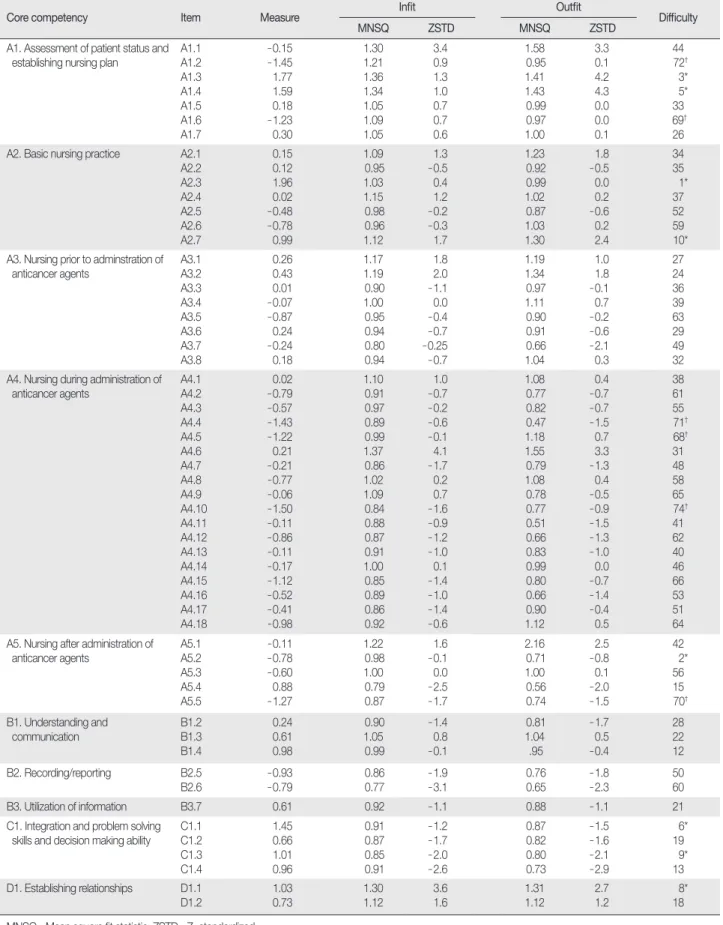
분석 결과 76문항 중 infit의 MNSQ 값이 1.5 이상이면서 ZSTD의 절대값이 2보다 큰 부적합 문항은 없었으며, infit의 MNSQ 평균값 은 1.00, outfit의 MNSQ 평균값은 0.97이였다(Table 3).
2) 문항 난이도
문항 난이도는 문항과 피험자의 측정치 분포도(item person map) 를 통해 각 문항의 측정치가 클수록(분포도에서 위 방향일수록) 어 려운 문항으로, 측정치가 작을수록(분포도에서 아래 방향일수록) 쉬운 문항으로 판단한다. 분석 결과, 본 도구는 난이도가 낮은 문항 Table 1. Item for Evaluating Core Competencies in Nursing Cancer Patients on Chemotherapy (Continued)
Core competency No. Item
C. Critical thinking skills C1. Integration and problem solving skills, decision making ability
1 2 3 4
Provide selected explanation about patient's past, present, and potential health issues.
Determine definite nursing priorities according to circumstances.
Identify the causes of any problem and seek solutions based on human and material resources that are currently available.
Evaluate the results of nursing care, efficiency, and responses from patient, family, and custodians. Apply the results in nursing practice.
D. Interpersonal skills D1.Establishing relationships 1
2
Respect the culture, race, religion and social background of patient, family, caregivers, and healthcare team. Provide nursing care without discrimination.
Establish mutual relationships with patient, family members, caregivers, and healthcare team, and seek consultation and cooperation when necessary.
E. Teaching skills E1. Provision of teaching and information 1
2 Assess the needs of patient, family members, and caregivers to provide adequate instructions and information.
Offer education and training about nursing practices through mentoring programs.
F. Management skills F1. Environmental and safety management 1
2 3
Create a pleasant and safe environment when providing treatment.
Practice nursing unit safety management according to policy.
Explain general guidelines about safe management of anticancer agents and provide nursing care according to policy.
F2. Infection
management 1
2 Thoroughly wash hands before and after physical contact with patient and maintain hygiene.
Prevent infection in nursing unit. When infection occurs, respond immediately according to procedure.
F3. Equipment management
1 2
Maintain and utilize various documents related to chemotherapy.
Regularly maintain and repair equipment and other items in nursing unit.
F4. Admission and discharge management
1 2
Perform nursing tasks necessary for admission, discharge, and transfer of patients.
Provide patient with information necessary for post-discharge management.
F5. Maintenance of nursing quality
1 2
Identify frequent errors in nursing practice and problems that occur repeatedly in clinical environment and seek improvement measures.
Participate in studies to evaluate nursing service, development and quality improvement (QI) of nursing practice, and standardization of nursing care.
G. Leadership skills G1. Qualification and task execution skills as a professional
1 2 3 4
Perform nursing practice according to related laws, nursing standards, and ethical standards.
Make decisions by respecting the rights of the patient and seek cooperation from the Ethics Committee and the Ministry of Justice.
Understand nurse's roles within the health service system and provide nursing care with a sense of responsibility and initiative.
Report your mistakes and take adequate measures to protect the patient when patient's safety is at risk due to inappropriate actions and treatments by a healthcare provider.
H. Knowledge integration skills H1. Provision of
evidence-based nursing care
1 2
Acquire knowledge regarding causes, symptoms, risk factors, treatments, pathogenesis, prognosis, prevention, early detection, and after-care associated with cancer and apply the knowledge in providing nursing care.
Participate in academic events, training sessions, life-long educational programs, and research activities related to cancer patients to understand the latest trends in nursing and apply acquired knowledge and information in clinical nursing practice.
부터 높은 문항까지 고루 분포되어 있으나 연구 대상자의 능력수준 보다 문항의 난이도가 전반적으로 낮게 분포되어 있었다(Figure 2).
Table 3에 정리한 문항난이도는 숫자가 작을수록 난이도가 높음을, 숫자가 클수록 난이도가 낮음을 의미하며, 간호사정 및 중재기술 을 다룬 A영역의 A1.3문항과 A1.4문항을 제외한 직접간호수행 영역 의 난이도가 전반적으로 낮은 편으로 나타났다.
3) 평정척도의 적합성 분석
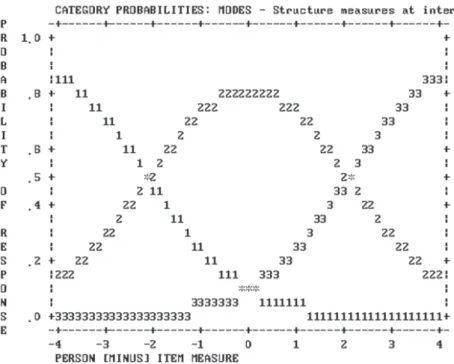
응답범주 확률곡선(probability curves)은 척도간 교차점이 일정 하며 각 범주의 영역이 다른 범주와 완전히 구별될수록 양호함을 의미한다. 분석 결과 76개 문항 중 6개 문항(A1.2, A2.3, A2.4, A4.11, A5.1, A5.4)의 응답범주가 2점 또는 3점인 이분 문항으로 나타났으 며, 이분 문항의 경우 척도간의 교차점이 존재하지 않아 척도의 적 절성을 평가할 수 없었다. 그 외 나머지 70개 문항은 응답범주가 1점, 2점, 3점인 다분 문항으로 나타났으며, 각 영역이 다른 범주와 완전 하게 구별되어 있고 척도간의 교차점이 대체로 일정한 간격을 이루
고 있어 본 도구의 척도로 3점 평정척도가 적합한 것으로 나타났다 (Figure 3).
3. 구성타당도 검증
1) 요인분석
Rasch 분석 결과 부적합 문항이 발견되지 않아 총 76개의 문항을 대상으로 요인분석을 실시하였다. 요인분석에서 사용되는 Kaiser- Meyer-Olkin (KMO) 값과 Bartlett의 구형성 검정치는 요인분석의 적합성을 나타내는 지표이다. KMO값은 보통 .70 이상일 때 양호하 다고 판단하며, Bartlett의 구형성 검정치는 상관관계행렬이 단위행 렬이란 귀무가설을 검정하기 위한 것이다. 분석 결과, KMO값은 .93 이었고, Bartlett의 구형성 검정치 χ2 값은 13425.27 (p<.010)로 나타나 본 연구의 표본크기는 요인분석의 조건을 충족하였다.
탐색적 요인분석 결과 총 17개의 요인이 추출되었고, 스크리도표 Table 2. General Characteristics of Participants ( N=349)
Characteristics Categories n (%)
Age (year) <25
25-30 31-35
>35
82 (23.5) 157 (45.0) 59 (16.9) 51 (14.6) Education level College graduate
University graduate Master degree
171 (49.0) 142 (40.7) 36 (10.3)
Position Nurse
Charge nurse Head nurse
Oncology advanced practice nurse
301 (86.3) 29 (8.3) 13 (3.7) 6 (1.7)
Work unit Hemato-oncology ward
Internal medicine ward Surgical ward
Injection room (chemotherapy) Others
144 (41.3) 50 (14.3) 94 (26.9) 21 (6.0) 40 (11.5) Clinical nursing career <1 yr
≥1- <5 yr
≥5- <10 yr
≥10 yr
34 (9.7) 144 (41.3)
92 (26.4) 79 (22.6) Cancer patient nursing
career
<1 yr
≥1- <5 yr
≥5- <10 yr
44 (12.6) 178 (51.0) 95 (27.2) Professional qualifications >10 yr
Yes No
32 (9.2) 53 (15.2) 296 (84.8) Certificated for relevant
cancer patient care Yes
No 234 (67.0)
115 (33.0) Improving nursing practice
and standardizing nursing service
Very helpful Helpful Not sure
153 (43.8) 187 (53.6) 9 (2.6)
Figure 2. Item person map of evaluating core competencies for nurs- ing cancer patients on chemotherapy ( N=307).
Table 3. The Result of Item Difficulty ( N=307)
Core competency Item Measure Infit Outfit
Difficulty
MNSQ ZSTD MNSQ ZSTD
A1. Assessment of patient status and establishing nursing plan A1.1
A1.2 A1.3 A1.4 A1.5 A1.6 A1.7
-0.15 -1.45 1.77 1.59 0.18 -1.23 0.30
1.30 1.21 1.36 1.34 1.05 1.09 1.05
3.4 0.9 1.3 1.0 0.7 0.7 0.6
1.58 0.95 1.41 1.43 0.99 0.97 1.00
3.3 0.1 4.2 4.3 0.0 0.0 0.1
44 72†
3*
5*
33 69†
26 A2. Basic nursing practice A2.1
A2.2 A2.3 A2.4 A2.5 A2.6 A2.7
0.15 0.12 1.96 0.02 -0.48 -0.78 0.99
1.09 0.95 1.03 1.15 0.98 0.96 1.12
1.3 -0.5 0.4 1.2 -0.2 -0.3 1.7
1.23 0.92 0.99 1.02 0.87 1.03 1.30
1.8 -0.5 0.0 0.2 -0.6 0.2 2.4
34 35 1*
37 52 59 10*
A3. Nursing prior to adminstration of anticancer agents
A3.1 A3.2 A3.3 A3.4 A3.5 A3.6 A3.7 A3.8
0.26 0.43 0.01 -0.07 -0.87 0.24 -0.24 0.18
1.17 1.19 0.90 1.00 0.95 0.94 0.80 0.94
1.8 2.0 -1.1 0.0 -0.4 -0.7 -0.25 -0.7
1.19 1.34 0.97 1.11 0.90 0.91 0.66 1.04
1.0 1.8 -0.1 0.7 -0.2 -0.6 -2.1 0.3
27 24 36 39 63 29 49 32 A4. Nursing during administration of
anticancer agents
A4.1 A4.2 A4.3 A4.4 A4.5 A4.6 A4.7 A4.8 A4.9 A4.10 A4.11 A4.12 A4.13 A4.14 A4.15 A4.16 A4.17 A4.18
0.02 -0.79 -0.57 -1.43 -1.22 0.21 -0.21 -0.77 -0.06 -1.50 -0.11 -0.86 -0.11 -0.17 -1.12 -0.52 -0.41 -0.98
1.10 0.91 0.97 0.89 0.99 1.37 0.86 1.02 1.09 0.84 0.88 0.87 0.91 1.00 0.85 0.89 0.86 0.92
1.0 -0.7 -0.2 -0.6 -0.1 4.1 -1.7 0.2 0.7 -1.6 -0.9 -1.2 -1.0 0.1 -1.4 -1.0 -1.4 -0.6
1.08 0.77 0.82 0.47 1.18 1.55 0.79 1.08 0.78 0.77 0.51 0.66 0.83 0.99 0.80 0.66 0.90 1.12
0.4 -0.7 -0.7 -1.5 0.7 3.3 -1.3 0.4 -0.5 -0.9 -1.5 -1.3 -1.0 0.0 -0.7 -1.4 -0.4 0.5
38 61 55 71† 68† 31 48 58 65 74†
41 62 40 46 66 53 51 64 A5. Nursing after administration of
anticancer agents A5.1
A5.2 A5.3 A5.4 A5.5
-0.11 -0.78 -0.60 0.88 -1.27
1.22 0.98 1.00 0.79 0.87
1.6 -0.1 0.0 -2.5 -1.7
2.16 0.71 1.00 0.56 0.74
2.5 -0.8 0.1 -2.0 -1.5
42 2*
56 15 70† B1. Understanding and
communication B1.2
B1.3 B1.4
0.24 0.61 0.98
0.90 1.05 0.99
-1.4 0.8 -0.1
0.81 1.04 .95
-1.7 0.5 -0.4
28 22 12 B2. Recording/reporting B2.5
B2.6
-0.93 -0.79
0.86 0.77
-1.9 -3.1
0.76 0.65
-1.8 -2.3
50 60
B3. Utilization of information B3.7 0.61 0.92 -1.1 0.88 -1.1 21
C1. Integration and problem solving skills and decision making ability
C1.1 C1.2 C1.3 C1.4
1.45 0.66 1.01 0.96
0.91 0.87 0.85 0.91
-1.2 -1.7 -2.0 -2.6
0.87 0.82 0.80 0.73
-1.5 -1.6 -2.1 -2.9
6*
19 9*
13 D1. Establishing relationships D1.1
D1.2 1.03
0.73 1.30
1.12 3.6
1.6 1.31
1.12 2.7
1.2 8*
18 MNSQ=Mean square fit statistic; ZSTD=Z-standardized.
*Most difficult 10 items; †Least difficult 10 items.
Table 3. The Result of Item Difficulty (Continued) ( N=307)
Core competency Item Measure Infit Outfit Difficulty
MNSQ ZSTD MNSQ ZSTD
E1. provision of teaching and information
E1.1 E1.1
0.66 1.64
0.94 1.20
-0.8 2.4
0.97 1.20
-0.2 2.1
19 4*
F1. Environmental and safety management
F1.1 F1.2 F1.3
0.96 -0.54 -0.15
1.10 1.02 0.92
1.3 0.3 -0.9
1.06 1.02 1.18
0.6 0.2 1.2
14 54 45 F2. Infection management F2.1
F2.2
-1.55 -1.47
0.88 0.86
-1.1 -1.5
0.78 0.77
-0.8 -0.9
75† 73† F3. Equipment management F3.1
F3.2
-0.20 0.24
0.95 0.91
-0.6 -1.1
0.90 0.82
-0.6 -1.3
47 30 F4. Admission and discharge
management
F4.1 F4.2
-1.13 -0.66
0.88 0.85
-1.1 -1.4
0.64 0.71
-1.4 -1.1
67† 57 F5. Maintenance of nursing quality F5.1
F5.2
0.79 1.82
1.10 1.13
1.3 1.7
1.09 1.12
0.9 1.4
17 76† G1. Qualification and task execution
skills as a professional
G1.1 G1.2 G1.3 G1.4
0.55 0.98 0.87 -0.14
1.02 1.05 0.96 0.86
0.3 0.6 -0.4 -2.0
1.02 1.03 0.91 0.74
0.2 0.3 -0.8 -2.2
23 11 16 43 H1. Provision of evidence
-based nursing care
H1.1 H1.2
0.33 1.40
0.92 1.04
-1.1 0.5
0.87 1.05
-1.2 0.6
25 7*
M±SD 0.00±0.90 1.00±0.14 -0.1±1.6 0.97±0.28 -0.1±1.5
MNSQ=Mean square fit statistic; ZSTD=Z-standardized.
*Most difficult 10 items; †Least difficult 10 items.
Figure 3. Provability curves of evaluating core competencies for nursing cancer patients on chemotherapy.
상 고유값이 1.0보다 큰 요인이 17개로 정도로 나타났다. 17개 요인 의 설명 변량은 66.3%로 요인부하량(공통성)이 .30 미만인 문항은 없었으며, 요인 1(항암제 투여 시 간호수행 영역)은 전체 변량의 32.29%를 설명하여 본 도구의 가장 중요한 요인으로 나타났다. 추출 된 요인은 대부분 측정도구에서 설정한 세부 영역에 따라 분류되었 으나 기존 18개 영역 중 자체 문항이 3개 이하인 영역의 일부 문항은 기존 요인이 아닌 다른 요인으로 분류되었으며, E영역인 교육기술과 H영역인 지식통합기술은 1개의 요인으로 분석되었다.
본 도구의 핵심요소인 A영역은 전체문항의 50% 이상으로, 다른 영역에 비해 구체적 수행절차를 다루고 있어 요인분석 시 1개의 요 인으로 추출되지 않을 수 있어(Kang et al, 2008) 확인적 요인분석 대 상에서 제외하였다. 7개 영역의 31개 문항을 대상으로 확인적 요인 분석을 실시한 결과 7개의 요인이 추출되었으며 총 설명 변량은 66.5%로 나타났다. 요인부하량이 .30 미만인 문항은 없었으며, 추출 된 요인은 대부분 기존의 7개 핵심역량으로 분류되었고, 다른 영역 에 비해 문항수가 많은 F영역(관리기술)은 2개의 요인으로, E영역 (교육기술)과 H영역(지식통합기술)은 1개의 요인으로 분석되었다.
2) 요인 명명 및 구성타당도 결과
Lenburg의 8가지 간호핵심역량(Lenburg, 1999; Lenburg et al., 2009) 을 기준으로 각 요인마다 가장 크게 부하된 문항과 내용을 토대로 8가지 간호핵심역량과 그에 따른 18개의 세부영역으로 요인을 명명 하였다.
4. 신뢰도 검증
전체 도구의 Cronbach's α=.97로 매우 높았다. 8가지 간호핵심역 량 중 요인 5(교육기술)의 Cronbach's α=.71이었으며, 이를 제외한 7 개 요인의 Cronbach's α가 .80 이상으로 높게 나타났다. 또한 Rasch 분 석을 통한 분리신뢰도 검증 결과, 연구 대상자와 문항에 대한 분리 신뢰도는 .95 이상으로 매우 우수한 수준이었다(Bond & Fox, 2007).
논 의
본 연구는 우리나라 임상간호실무에 적용 가능한 항암화학요법 을 받는 암환자 간호핵심역량 측정도구를 개발한 연구이다. 포커스 그룹 면담 및 전문가 내용타당도 검증 과정을 통해 개발된 본 도구 는 Lenburg의 8가지 간호핵심역량에 따른 18개의 세부 영역을 포함 한 총 76문항으로 구성되었다. 문항적합도 검증 결과 76개 문항 모 두 양호하였고, 요인분석 과정을 거쳐 18개 세부 영역을 포함한 총 76문항의 측정도구를 최종 완성하였다.
기존 연구에서 공통적으로 제시하는 간호핵심역량의 개념은 주
로 의사소통능력, 비판적 사고능력, 교육 및 관리기술, 지도력, 법적·
윤리적 실무능력, 협동, 전문직 발전, 간호과정 적용 등(Choi & Eun, 2006; Kang et al., 2008; Lenburg, 1999)으로, 이는 본 연구에서 도출된 8가지 간호핵심역량이 기존 연구와 맥락을 같이 하고 있음을 시사 한다. 또한 본 도구는 한국간호평가원이 발표한 6가지 핵심간호능 력(KABON, 2011)을 모두 포함하고 있어 본 도구가 우리나라 임상간 호 실정에 맞는 간호핵심능력과 부합됨을 보여주었다.
예비문항의 내용타당도 검증을 실시한 결과 총 113 문항의 CVI 는 .80 이상으로 그 값이 매우 높게 나타나 예비문항이 본 연구자가 측정 하고자 하는 내용을 충분히 반영하고 있음을 확인할 수 있었 다. 또한 예비조사를 통해 부적합문항을 선정하여 도구를 수정·보 완한 결과 본 조사에 사용된 총 76개 문항의 적합도가 모두 양호하 여 부적합 문항이 발견되지 않는 완성도 높은 도구를 개발 할 수 있 었다.
본 연구는 infit의 MNSQ 값이 1.5 이상이면서 ZSTD의 절대값이 2보다 큰 경우 부적합 문항으로 판단하였는데, 이는 측정도구의 문 항적합도를 분석한 Lee, Hong과 Shin (2007)의 연구와 Park과 Park (2008)의 연구와 동일한 기준이다. 반면, Kim, Park과 Lee (2011)의 연 구에서는 infit의 MNSQ 값이 0.6 미만이거나 1.4 이상이면서 ZSTD 의 절대값이 2보다 큰 경우 부적합 문항으로 선정해 본 연구와는 다른 기준을 적용하였다. 일반적으로 infit의 MNSQ 값이 0.6 미만 인 문항은 피험자의 반응이 이상하리만큼 Rasch 모형의 기대에 부 합되는 것을 의미한다. 문항적합도 지수를 절대적 기준으로 적용하 여 부적합 문항을 선정하는 경우 필수 문항이 누락되거나 측정하 고자 하는 속성을 제대로 측정하지 못해 도구의 완성도가 낮아질 수 있으므로, 도구의 목적과 내용에 따라 부적합 문항 선정 기준과 결과 해석에 신중을 기해야 한다.
문항난이도를 분석한 결과, 대상자의 능력치보다 도구의 문항난 이도가 전반적으로 낮은 것으로 나타났다. 일반적으로 문항난이도 와 개인의 능력범위가 일치할 때 도구의 문항이 개인의 능력정도를 구분하기에 적합한 것으로 해석한다(Bond & Fox, 2007; Chi & Chae, 2000). 그러나 본 도구가 의사, 간호사 등 보건의료인의 자격을 부여 하는 고위험도 시험과 달리 임상간호사로서 요구되는 핵심역량을 평가한다는 점에서 반드시 대상자 능력수준의 모든 범위를 포함해 야 하는 것은 아니다. 따라서 본 결과는 연구 대상자가 항암화학요 법을 받는 암환자를 간호하기 위한 일정수준 이상의 핵심역량을 모 두 함양하고 있으나 다만 그 역량의 수준이 다르다고 해석할 수 있 으며, 본 조사 결과 1점(매우 못함)에 해당되는 응답 범주가 나타나 지 않았다는 사실이 이를 뒷받침해 준다.
Rasch 모형을 적용한 분석 결과는 본 도구가 높은 신뢰도와 변별 력을 지닌 도구임을 지지해 주었다. 요인분석 결과 일부 영역은 기
존의 세부영역과 달리 요인이 추출되었으나 도구개발 당시 개념적 기틀로 삼았던 Lenburg의 8가지 핵심역량(Lenburg 1999; Lenburg et al., 2009)과 그에 따른 18개의 세부 영역 그대로 요인을 명명하였다.
그 이유는 간호수행 특성 상 핵심역량별 세부 영역이 다르다 하더라 도 동일한 맥락의 간호수행, 예를 들면 손 씻기나 항암제 안전관리 지침 준수에 관한 내용 등은 항암화학요법을 받는 암환자 간호 전 반에 거쳐 이루어지는 요소이기 때문에, 1개의 동일 요인으로 명명 하기보다 수행과정 상 다른 세부 영역으로 분류될 수 있다고 판단 하였기 때문이다. 또한 1개의 요인으로 추출된 E영역(교육기술)과 H 영역(지식통합기술)의 경우 문항수가 2개 이하로 적고, 정보 및 교육 제공의 수행이 지식통합을 전제로 하기 때문에 비슷한 속성으로 분류된 것으로 판단하였다. 그러나 포커스 그룹 패널과의 논의를 통해 핵심간호역량의 개념에 따라 이 두 가지 영역의 실무기술은 각 각의 요소로 정의하는 것이 더 적합하다고 판단하였다. 즉, 동일한 특성의 수행일지라도 영역별로 반드시 요구되는 항목이 존재하며 문항수에 따라 요인추출에 영향을 받으므로 동일요인으로 추출되 더라도 평가 영역에 준하여 명명하는 것이 바람직하며, 간호역량평 가 도구를 개발한 Kang 등(2008)의 연구에서도 요인분석 결과 전체 맥락과의 적합성을 검토하여 요인을 명명한 것을 알 수 있다.
연구 결과 환자 요구에 맞는 간호제공, 신체사정, 자료수집, 의사 소통기술, 지식통합기술 등의 영역이 수행하기 어려운 것으로 나타 났다. 이러한 기술은 단지 임상경험의 누적에 비례하여 얻을 수 없 으며, 장기간의 투병과 항암화학요법의 부작용을 경험하는 암환자 의 경우 신체적 변화와 함께 우울, 스트레스 등의 정서적 변화를 경 험하기 때문에 복잡한 간호를 요구할 수 있다(Kwak et al., 2010). 특 히 신체사정과 건강력 조사를 통한 자료 수집은 상급 간호 실무의 기본요소로 매우 복잡하고 어려운 수행이다(Shin, Kim, & Kang, 2009). 따라서 간호사는 다양한 임상경험을 바탕으로 간호학적 지 식과 기술을 습득하여 체계적으로 이해함은 물론, 효과적인 의사 소통기술을 활용하여 보다 친밀한 환자-간호사 관계를 형성해야 한다. 반면 신체사정 및 자료 수집을 제외한 기본간호수행과 항암 제 투약에 관련된 직접간호수행은 비교적 쉬운 것으로 나타나 최근 기본간호 및 실습교육을 강조한 교육패러다임이 임상현장에 반영 되고 있으며, 암환자 관련 분야 간호사의 기본요건이 어느 정도 충 족되고 있음을 확인하였다.
본 연구는 항암화학요법을 받는 암환자 간호핵심역량 측정도구 를 개발하기 위해 국내 처음으로 전국 13개 종합병원의 다양한 경 력을 가진 349명의 간호사를 대상으로 진행하였다. 이러한 시도는 단지 미국 협회에서 권고하는 실무능력이 아닌 우리나라 임상간호 현장에 맞는 간호수행능력을 파악하고 향상시키기 위한 현실적인 자료를 제공했다는 점에서 큰 의의가 있다. 따라서 향후 본 측정도
구를 활용하여 해당 영역의 간호수행 수준을 좀 더 객관적으로 평 가하고 분석할 수 있을 것으로 사료된다. 또한 Rasch 모형을 적용한 분석을 실시하여 측정도구의 타당도와 신뢰도를 입증했다는 점에 서 기존의 간호핵심역량 도구개발에 관한 연구와는 차별화된 의미 를 제공하였다.
다만, 본 연구는 선행 연구의 부족으로 연구 결과를 비교할 수 없 다는 한계가 있다. 향후 항암화학요법을 받는 암환자 간호를 담당 하는 많은 수의 간호사를 대상으로 반복 연구를 실시하여 개발된 도구의 개념과 양호도를 지속적으로 평가해야 한다. 또한 관련 분 야의 간호핵심역량을 강화하고 향상시키기 위해 간호협회나 기구 차원에서 구체적인 수행을 포함한 간호실무지침을 개발하여 암환 자 간호의 질 향상과 간호실무 표준화에 힘써야 할 것이다. 더불어 역량기반 교육과정 체계를 구축하여 실제 임상현장을 기반으로 한 실습위주의 교육 및 훈련 프로그램을 제공하고, 관련 분야의 임상 경험과 교육전략을 공유하여 전문직 간호사로서 발전하기 위한 체 계적 활동이 활발히 이루어지기를 기대한다.
결 론
본 연구에서는 Lenburg의 8가지 간호핵심역량을 토대로 우리나 라 임상간호에 적용 가능한 항암화학요법을 받는 암환자 간호핵심 역량 측정도구를 개발하였다. 76개 문항으로 구성된 측정도구는 구 체적인 간호수행 기준을 포함하고 있으며, 부적합 문항 없이 신뢰도 와 타당도가 매우 우수함을 확인할 수 있었다. 본 연구의 결과는 항 암화학요법을 받는 암환자 간호업무 표준화에 기초자료를 제공하 여 관련 분야의 교육 및 평가에 활용될 수 있을 것이며, 궁극적으로 암환자 간호의 질 향상을 도모할 수 있을 것이다. 특히 Rasch 모형을 적용하여 측정도구의 적합도 검증을 시도한 점은 도구개발 및 타당 화 과정에 대한 경험적 논의를 제공하여 향후 연구에 도움을 줄 수 있을 것이다.
REFERENCES
Azzoli, C. G., Temin, S., Aliff, T., Baker, S. Jr., Brahmer, J., Johnson, D. H., et al. (2011). 2011 focused update of 2009 American Society of Clinical Oncology Clinical Practice Guideline update on chemotherapy for stage IV non-small-cell lung cancer. Journal of Clinical Oncology, 29, 3825-3831. http://dx.doi.org/10.1200/JCO.2010.34.2774
Berterö, C., & Chamberlain Wilmoth, M. (2007). Breast cancer diagnosis and its treatment affecting the self: A meta-synthesis. Cancer Nursing, 30, 194-202. http://dx.doi.org/10.1097/01.NCC.0000270707.80037.4c Bond, T. G., & Fox, C. M. (2007). Applying the Rasch model: Fundamental
measurement in the human science (2nd ed.). New Jersey, NJ: Lawrance Erlbaum Associates Publisher London.
Chi, E. L., & Chae, S. H. (2000). Theory and practice of Rasch model (1st ed.).
Gyeonggi-do: Kyoyook-kwahaksa.
Choi, J. S., & Eun, Y. (2006). A study on the clinical competence according to clinical ladder of operating room nurses. Journal of Korean Academic Society of Nursing Education, 12, 60-69.
da Costa Vargens, O. M., & BerterÖ, C. M. (2007). Living with breast can- cer: Its effect on the life situation and the close relationship of women in Brazil. Cancer Nursing, 30, 471-478. http://dx.doi.org/10.1097/01.
NCC.0000300157.83144.fb
Ha, N. S., & Choi, J. (2010). An analysis of nursing competency affecting on job satisfaction and nursing performance among clinical nurses. Jour- nal of Korean Nursing Administration Academic Society, 16, 286-294.
Hall, L. W., Moore, S. M., & Barnsteiner, J. H. (2008). Quality and nursing:
Moving from a concept to core competency. Urologic Nursing, 28, 417- 425.
Kang, Y. S., Lee, S. J., Kim, I. J., & Ahn, K. H. (2008). A measurement scale development of nursing competence for nurses working in general wards. Journal of Korean Nursing Administration Academic Society, 14, 219-228.
Kim, G. M., Park, S. Y., & Lee, C. H. (2011). A Rasch analysis of the Korean version of Oswestry Disability Questionnaire according to general characteristics of patients with low back pain. Journal of the Korean Academy of University Trained Physical Therapists, 18(2), 35-42.
Kim, M. Y., & Park, S. A. (2007). An methodology research of performance appraisal tool of oncology advanced practice nurse. Journal of Korean Nursing Administration Academic Society, 13, 17-23.
Kim, R., Sung, D. K., Lee, H. B., Song, K. S., Jo, T. K., & Lee, S. C. (2005).
Comprehension and utilize of statistic analysis. Daegu: Daemyung Press.
Korean Accreditation Board of Nursing. (2011). Nursing education core competency assessment. Seoul: Author.
Kwak, M. K., Kim, E. J., Lee, E. R., Kwon, I. G., & Hwang, M. S. (2010).
Characteristics and quality of life in patients with chemotherapy-in- duced peripheral neuropathy. Journal of Korean Oncology Nursing, 10, 231-239. http://dx.doi.org/10.5388/jkon.2010.10.2.231
Lee, I. S., Hong, S. H., & Shin, E. K. (2007). Rasch rating scale modeling of the disability identity scale. Korean Journal of Social Welfare, 59(4), 273-296.
Lenburg, C. B. (1999). The framework, concepts and methods of the com- petency outcomes and performance assessment (COPA) model. On- line Journal of Issues in Nursing, 4, Manuscript 2.
Lenburg, C. B., Klein, C., Abdur-Rahman, V., Spencer, T., & Boyer, S.
(2009). The COPA model: A comprehensive framework designed to promote quality care and competence for patient safety. Nursing Edu- cation Perspectives, 30, 312-317.
Lynn, M. R. (1986). Determination and quantification of content validity.
Nursing Research, 35, 382-385.
National Cancer Center, & Ministry of Health & Welfare. (2011). Cancer facts & figures 2011. Gyeonggi-do: Author.
Park, E. Y., & Park, S. Y. (2008). The analysis of the child-rearing attitude test appropriateness by Rasch rating scale modeling. Korean Journal of Physical and Multiple Disabilities, 51(4), 117-136.
Peppercorn, J. M., Smith, T. J., Helft, P. R., Debono, D.J., Berry, S. R., Wollins, D. S., et al. (2011). American Society of Clinical Oncology statement:
Toward individualized care for patients with advanced cancer. Journal of Clinical Oncology, 29, 755-760. http://dx.doi.org/10.1200/
JCO.2010.33.1744
Scott Tilley, D. D. (2008). Competency in nursing: A concept analysis. The Journal of Continuing Education in Nursing, 39, 58-64. http://dx.doi.
org/10.3928/00220124-20080201-12
Shin, H. S., Kim, B. J., & Kang, H. S. (2009). Use of physical assessment skills and education needs of advanced practice nurses and nurse specialists.
Journal of Korean Academy of Nursing, 39, 709-719. http://dx.doi.org/
10.4040/jkan.2009.39.5.709
Webb, P. M., Cummings, M. C., Bain, C. J., & Furnival, C. M. (2004). Changes in survival after breast cancer: Improvements in diagnosis or treat- ment? The Breast, 13, 7-14. http://dx.doi.org/10.1016/S0960-9776(03) 00129-2