INTRODUCTION
Korea reached an aging society by having 7.2% of its population aged 65 and over in 2000 and proceeds to an aged society (Ministry of Health and Welfare, 2001).
This increase in the proportion of elderly persons implies increasing prevalence of chronic diseases and health care needs, including dementia. In 2005 the estimated rate of dementia among the elderly was 8.3%; this figure is ex- pected to reach 9% by 2020 (Byun, 1997), when Korea
turns into an aged society. Accordingly, the need for health care services for elders with dementia will require health care professionals who are willing to work with elders to provide quality nursing services.
Attitudes were reported to affect preference in work- ing gerontology and working with older patients among senior nursing students (Gomez, Young, & Gomez, 1991). In an earlier study in Korea, nursing students least preferred caring for the elderly or working in a nursing home (Kim, 1981). Nurses’ decreased accep- tance of the stereotype toward old people was related to
Effects of Gerontological Nursing Practicum on Attitudes toward Elders with
Dementia and General Elders among Korean Nursing Students
Jung Hee Kim, RN, PhD1
Purpose. This study investigated changes in attitudes toward elders in general and elders with dementia after students finished a gerontological nursing practicum.
Methods. Questionnaires developed for Asian cultures were administered pre practicum, immediately post practicum, and at 8-months follow up to 31 senior students in a baccalaureate nursing program. The 1-week practicum occurred at two adult day care centers: a center for elders with dementia and a center for elders with stroke. Repeated measures ANOVA and Bonferroni correction procedures were used to analyze data.
Results. Students’ evaluation of elder vitality and flexibility increased significantly at post practicum, however this increase was not sustained at follow up. Score of generosity of elders, the only positively evaluated dimension for elders in general, improved partly at post practicum. Students evaluated flexibility and gen- erosity of elders with dementia more negatively than general elders. All of the decreased attitudes at follow up were not significantly different from those at pre practicum.
Conclusions. Students had more negative attitudes toward elders with dementia. Attitudes of students in direct contact with elders with dementia were improved through the practicum regarding generosity and flexibili- ty. However the sustainability of the immediate effect was not observed at follow up.
Key Words : Attitude, Aged, Dementia, Nursing students, Nursing education
1. Associate Professor, Dept. of Nursing, College of Medicine, Inha University This work was supported by INHA University Research Grant.
Corresponding author: Jung Hee Kim, RN, PhD, Department of Nursing, College of Medicine, Inha University 253, Yonghyun-Dong, Nam-Gu, Incheon 402-751, Korea.
Tel: 82-32-860-8204 Fax: 82-32-860-8774 E-mail: [email protected] Received March 2, 2006 ; Accepted June 9, 2006
their positive interaction with old people in a long-term care facility (Hatton, 1977). Nursing staff interacted sig- nificantly less with confused patients than lucid patients on a geriatric ward (Armstrong-Esther, 1986).
Particularly those studies of nursing personnel caring for elderly people with dementia report less job satisfaction, greater burnout, reduced empathy associated with their negative attitudes toward those elderly (Brodaty, Draper,
& Low, 2003; strom, Nilsson, Norberg, Sandman &
Winblad, 1991). Hence, negative attitudes can be a sig- nificant barrier to bring future nurses into direct nursing care for elders with dementia, to provide quality nursing care to them, to continue professional development in the same area for an extended period of time.
Researchers have given little attention to elders with dementia when examining the attitudes of service providers. In past decades, researchers have studied the effects of nursing education on attitudes of students to- ward elders in general. Few empirical studies were found on attitudes toward elders with dementia. Furthermore, most studies have focused on the immediate effects of education, and have excluded the long-term effects of education (Kong, 1999; Hartly, Bentz, & Ellis, 1995;
Sheffler, 1995; Eddy, 1986; Langland et al., 1986;
Hannon, 1980). Therefore, it is unknown whether atti- tudes toward elders with dementia were changed after education, if at all, and if that change could be sustained after a certain period of time.
The present study investigated immediate and long- term changes in attitudes toward general elders and el- ders with dementia after students finished a clinical practicum in gerontology. Specifically, it was hypothe- sized that, before the practicum, the attitudes of nursing students toward elders with dementia would be less fa- vorable than their attitudes toward elders in general and that the attitudes of nursing students in direct contact with elders with dementia would be improved after the clinical practicum.
METHODS
Sample
The present study was initiated in a Bachelor’s of Science in Nursing program in a metropolitan city of Korea. Senior students were required to take a practicum in gerontological nursing which consisted of 1 credit (48 hours), for 1 week (Monday through Friday).
Sessions of the practicum were conducted between
March and April, 2000. In the junior year of university, students took a 2 credit lecture course of gerontological nursing in addition to such courses as adult health nurs- ing, psychiatric nursing, community health nursing. The contents of the gerontological nursing course were un- derstanding of Korean aging society, characteristics of el- ders, aging theories, health promotion of older adults, health education, social welfare system, and caring for elders with dementia, depression, and incontinence.
Thirty-eight students participated in the practicum.
Students’ age ranged between 21 and 24 years; they were all females except for one male.
Procedure
Students were divided into groups based upon univer- sity identification numbers, which are determined by Korean alphabetical order from students’ names. Each group consisted of 3 4 participants and assigned blindly to a practicum conducted at one of two adult day care centers: a center for elders with dementia (Center A) and a center for elders with stroke (Center B). In Center A there were 13 elders, (women n = 12, men n = 1), while Center B had 18 elders (women n = 12, men n = 6). No medical treatment was provided in the Centers;
services consisted of administering medication, health examinations, exercise, physical therapy, and various ac- tivity programs including art therapy, horticultural thera- py, reminiscence therapy.
The contents of the practicum included a case study, environmental evaluation, examination of the roles of a nurse, application of relevant law. In particular, each team planned and operated its own program for promot- ing the health status of elderly clients in each Center.
One nurse at each Center worked with students during the practicum. The two nurses maintained a strong trust- ing relationship with their elderly clients and committed as field nurses for the practicum. In addition, a professor, the present author, visited each Center mid-week and held discussion sessions with student groups from both Centers on the last day of each practicum.
Instruments
The short questionnaire used in this study included items measuring attitudes toward elders in general, fol- lowed by the same set of items measuring attitudes to- ward elders with dementia. In addition, the first survey included questions regarding students’ experiences living with older adults and interest in older adults.
Attitudes toward elders were measured using an in- strument developed specifically for Asian cultures by Takeda and colleagues (1991). The instrument, which employs 50 pairs of adjectives, was used in a study by Kim and colleagues (2004) to examine the attitudes of 366 Korean nursing students. Kim et al. (2004) reported 3 underlying factors consisting of 37 items; 18 items for vitality, 14 items for generosity, and 5 items for flexibili- ty. The present study adopted those 37 items represent- ing three dimensions. The items for the vitality dimen- sion were active/passive, dark/light, dynamic/static, neg- ative/positive, slow/quick, introverted/extroverted, pro- ductive/unproductive, weak/strong, conspicuous/incon- spicuous, isolated/connected, dependent/independent, busy/idle, big/small, sturdy/fragile, happy/unhappy, gray/rosy, capable/incapable, and attractive/unattractive.
The 14 items representing the generosity dimension were cold/warm, narrow/wide, greedy/unselfish, clever/stupid, gentle/severe, cooperative/rebellious, vul- gar/elegant, splendid/shabby, distant/close, unstable/sta- ble, satisfied/dissatisfied, neat/sloppy, hard/soft, and opti- mistic/pessimistic. The flexibility dimension was mea- sured with 5 items such as stubborn/docile, progressive/
conservative, objective/subjective, open/closed, and emotional/rational.
Cronbach’s alpha coefficients were .88, .86, and .67 for the vitality, generosity, and flexibility dimensions re- spectively (Kim et al., 2004). In the present study, alpha coefficients were .77, .81, .70 respectively for elders in general while alpha coefficients toward elders with de- mentia were .73, .77, and .81 respectively.
In obtaining the data, the pairs of adjectives were rated using a seven-point semantic differential scale ranging from 1 to 7, with 4 being neutral. A favorable or an un- favorable attitude is revealed when the score falls more toward an either end, while intensity is shown by how far out from the neutral point the score lies, which makes it possible to examine both the direction and the intensity of attitudes (Osgood, Suci, & Tannenbaum, 1957). The possible range of the mean scores for each dimension is 1 to 7, where scores higher than 4.0 indi- cate positive evaluation.
Data collection
Students completed self-administered questionnaires at pre practicum, post practicum and at an 8-month fol- low up. Participants were assured that their responses would be anonymous and used for research purposes
only. Students agreed to answer the questions by re- sponding to the questionnaires. Pre practicum question- naires were administered right before beginning the practicum on the first day at Centers. Post practicum questionnaires were administered before the discussion sessions after the 5-day field practicum while follow-up questionnaires were administered approximately 8 months later when students had finished the entire cur- riculum required for graduation.
Thirty-eight students responded to the pre and post practicum questionnaires. However, at follow up seven students were missing due to their responses with no identification numbers. Therefore, this study includes da- ta from the 31 students who completed all three ques- tionnaires.
Table 1 shows comparisons between students who completed all three questionnaires and those who did not. Those who did not complete the questionnaires did not differ from the other students in terms of practicum sites, experience living with elders, communication with elders, and interest in elders or issues related to elders.
Except for practicum site, these characteristics were re- ported to have a significant relationship with attitudes toward older adults among Korean nursing students in a former study (Kim, Son, & Algase, 2004). The attitudes toward elders did not differ significantly between the two groups except for vitality of elders with dementia:
the dropouts had somewhat less negative attitude than the completers.
Data analysis
Data were analyzed using SAS 8.2. The thirty seven items presented above were used to calculate three fac- tor mean scores. Some items were reversed to represent consistently more positive attitudes with higher mean scores. There was one missing item from the generosity dimension in both the pre practicum and the follow up data sets. Accordingly, mean scores were calculated us- ing the complete items only, which resulted in imputing the missing values with complete responses.
A test of repeated measures ANOVA was used to ex- amine the effects of the practicum on each dimension of attitude. Bonferroni correction procedures were adopted for multiple comparisons. In terms of testing the interac- tion effect of site, elder type and measurement time, the adjusted significance level was calculated by dividing the alpha level of .05 by 18, since the present study focused on 18 comparisons. The significance level of the effect of
time was calculated by dividing .05 by 3.
RESULTS
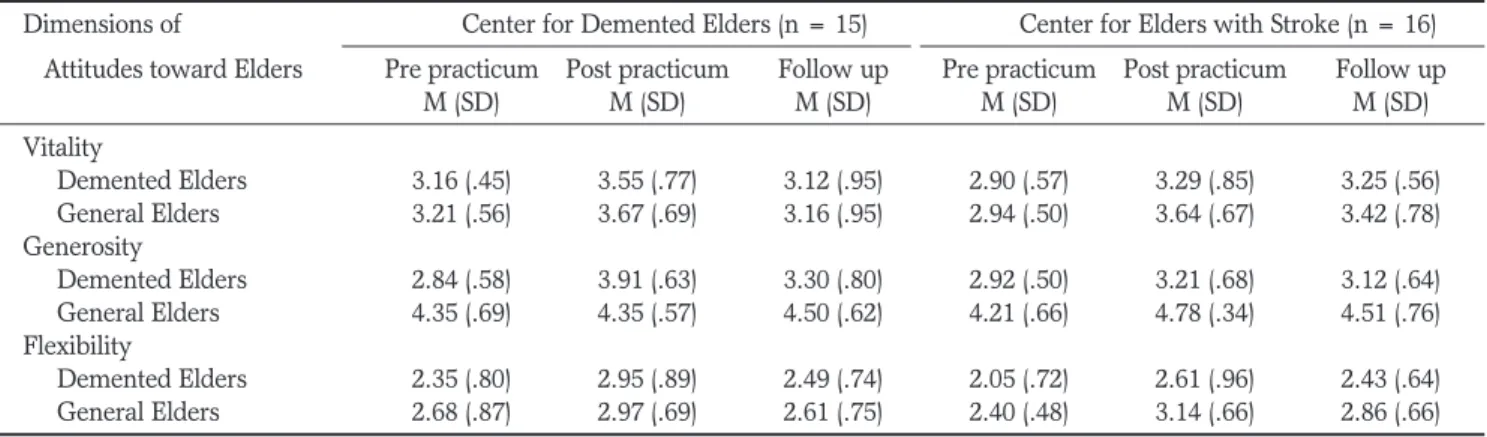
Table 2 shows the mean scores of each attitudinal di- mension at the three data collection points. The mean scores of the vitality dimension at pre practicum ranged from 2.9 toward elders with dementia among students at Center B to 3.21 toward general elders among students
at Center A, indicating a negative evaluation. All mean scores increased at post practicum, however, the scores decreased at follow up in both Centers. The mean scores in both sites were lower toward elders with dementia than toward general elders at all 3 time points, indicating a more negative evaluation given to elders with demen- tia than to general elders.
Analyses of the effects using repeated measures ANO- VA appear in Table 3. According to statistical tests, only
Table 2. Means and Standard Deviations of Attitude Dimensions over Time
Dimensions of Center for Demented Elders (n = 15) Center for Elders with Stroke (n = 16) Attitudes toward Elders Pre practicum Post practicum Follow up Pre practicum Post practicum Follow up
M (SD) M (SD) M (SD) M (SD) M (SD) M (SD)
Vitality
Demented Elders 3.16 (.45) 3.55 (.77) 3.12 (.95) 2.90 (.57) 3.29 (.85) 3.25 (.56)
General Elders 3.21 (.56) 3.67 (.69) 3.16 (.95) 2.94 (.50) 3.64 (.67) 3.42 (.78)
Generosity
Demented Elders 2.84 (.58) 3.91 (.63) 3.30 (.80) 2.92 (.50) 3.21 (.68) 3.12 (.64)
General Elders 4.35 (.69) 4.35 (.57) 4.50 (.62) 4.21 (.66) 4.78 (.34) 4.51 (.76)
Flexibility
Demented Elders 2.35 (.80) 2.95 (.89) 2.49 (.74) 2.05 (.72) 2.61 (.96) 2.43 (.64)
General Elders 2.68 (.87) 2.97 (.69) 2.61 (.75) 2.40 (.48) 3.14 (.66) 2.86 (.66)
Table 1.Comparison of Completers and Dropouts
Variable Completers (n = 31) Dropouts (n = 7) Statistical Test
N % N % Fisher’s exact test p value
Practicum center
for demented elders 15 (48.39) 4 (57.14) .999
for elders with stroke 16 (51.61) 3 (42.86)
Living experience with elders
1) yes (present) 05 (16.13) 1 (14.29) .999
1) yes (past only) 11 (35.48) 2 (28.57)
2) no 15 (48.39) 4 (57.14)
Communication with elders
1) Frequent 02 ( 6.45) 1 (14.29) .999
1) Occasional 11 (35.48) 2 (28.57)
2) Rare 14 (45.16) 4 (57.14)
2) Never 04 (12.90)
Interest in elders/issues
1) Very much 01 ( 3.23) .687
1) Moderate 13 (41.94) 4 (57.14)
2) Little 09 (29.03) 2 (28.57)
2) Very little 08 (25.81) 1 (14.29)
Attitude scores at Pre practicum Mean SD Mean SD t p value
Demented elders
Vitality 3.03 (.52) 3.62 (.60) 2.63 .013
Generosity 2.88 (.53) 3.23 (.32) 1.67 .104
Flexibility 2.19 (.76) 2.37 (.85) 0 .55 .588
General elders
Vitality 3.07 (.54) 3.21 (.58) 0 .60 .556
Generosity 4.27 (.67) 4.72 (.38) 1.71 .095
Flexibility 2.54 (.70) 3.06 (.85) 1.71 .095
divided into 2 groups for Fisher’s exact test.
the time effect on vitality was significant (F = 12.04, p <
.000). While the students’ evaluation of vitality at post practicum increased significantly (p < .000), this increase was not sustained at follow up (p < .004). The decreased mean scores for all four measures at follow up were not significantly different from those scores measured at pre practicum.
Mean scores for the dimension of generosity toward general elders were greater than 4.0 at all three time points in both Centers, indicating a positive evaluation.
In contrast, a negative evaluation was made toward el- ders with dementia in both Centers at all three time points. With the exception of mean scores toward gener- al elders in Center A, all mean scores for the generosity dimension increased at post practicum and decreased at follow up.
Regarding statistical tests, the interaction effect of practicum site, elder type and measurement time was significant (F = 10.11, p < .000). Results show that stu- dents at both Centers evaluated the generosity of elders with dementia significantly differently from general el- ders at both pre practicum (p < .000) and follow up (p <
.000), in that elders with dementia were evaluated nega- tively, whereas general elders received a positive evalua- tion. At post practicum, only students at Center B made significantly different evaluations between the two types of elders (p < .000). The increased mean scores of gen- erosity at post practicum were significant toward elders with dementia at Center A (p < .000) and toward gener- al elders at Center B (p = .002). As a result, the signifi- cant difference of the mean scores of generosity toward elders with dementia and toward general elders ob- served at pre practicum disappeared at post practicum in Center A. In addition, the increased mean score toward elders with dementia at Center A significantly decreased at follow up (p = .002), resulting in no significant differ- ence in mean scores between pre practicum and follow
up.
In terms of flexibility, mean scores toward both general elders and elders with dementia were all below the neu- tral point of 4.0 at all time points, indicating a negative evaluation. With the exception of mean scores at post practicum for Center A, students evaluated the flexibili- ty dimension of elders with dementia more negatively than general elders. Mean scores of flexibility toward el- ders with dementia and toward general elders at post practicum for Center A were almost the same. All the mean scores for flexibility increased at post practicum and decreased at follow up.
Statistical tests for flexibility revealed significant ef- fects for elder type (F = 9.15, p = .005) and measure- ment time (F = 10.85, p < .000). Students evaluated el- ders with dementia more negatively than general elders regarding flexibility (p = .005). The mean scores of flexi- bility were significantly increased at post practicum (p <
.000), whereas mean scores showed a significant de- crease at follow up (p = .009) with no significant differ- ence between scores obtained at pre practicum and fol- low up.
DISCUSSION
In this study, different effects of the practicum across the three dimensions of attitudes indicate that student attitudes toward older adults are a multi-dimensional concept. This is consistent with the work of Hicks, Rogers, and Shemberg (1976) and has been reported in previous studies (Takeda et al., 1991; Kim et al., 2004).
The multi-dimensional construct of attitudes toward el- ders supports separate analysis of each dimension adopt- ed in the present study.
Prior to the practicum, attitudinal dimension scores to- ward general elders were negative for vitality and flexi- bility and positive for generosity. The flexibility dimen- Table 3. Effects of Practicum on Attitude Dimensions
Effects Vitality Generosity Flexibility
F p value F p value F p value
Elder 02.09 .159 163.66 0.000* 09.15 0.005*
Time 12.04 0.000* 010.89 0.000* 10.85 0.000*
Site 00.14 .711 000.35 .560 00.24 .624
Elder * Time 00.96 .413 003.41 0.040* 00.13 .882
Site * Elder 00.45 .507 003.54 .070 01.97 .171
Site * Time 02.86 .065 000.14 .867 01.29 .284
Site * Elder * Time 00.34 .712 010.11 0.000* 01.34 .269
* p < .05
sion was evaluated more negatively than the vitality di- mension. These findings were similar to a study using a national sample of Korean nursing students (Kim, et al., 2004). Although the clinical practicum improved stu- dents’ attitudes toward older adults’ vitality and flexibili- ty, it did not change the negative attitudes into positive ones.
Nursing students in the present study held more nega- tive attitudes toward elders with dementia than toward general elders. This finding is consistent with an empiri- cal study reported by Kahana et al. (1996). In addition, a methodological explanation might be made for this finding. Student evaluations of elders with dementia were made after evaluations of general elders at all three measurement points. This may have indirectly led to comparative judgments between general elders and those with dementia by making “dementia” as a salient attribute. Likewise, Wingard, Heath and Himelstein (1982) reported more extreme negative attitudes among adults who made comparative judgments of older people relative to young people.
Consistent with prior studies examining effects of clin- ical experiences with ill older adults (Greenhill & Baker, 1986; Hartly, Bentz, & Ellis, 1995; Sheffler, 1995), the effect of the practicum in this study on student attitudes toward elders was positive immediately following the practicum. However, the improved attitudes were not sustained through the follow up, which may be attrib- uted to the short period of the practicum. The clinical practicum in the present study provided only a short, one week period of full-time practice. Within this period of time, the observation of positive effects on attitudes was encouraging. However, the positive effect of an in- tensified experience of direct contact with elders could not change students’ negative attitudes toward elders in general and elders with dementia into positive ones in terms of vitality and flexibility, and toward elders with dementia in the generosity dimension.
The generosity dimension was the only one revealing the interaction effect of practicum site, elder type and measurement time. While the generosity dimension was shown to be positive toward general elders, attitudes to- ward elders with dementia were still negative. This find- ing highlights the negative attitudes of nursing students attached to dementia. This negativity can be explained by Jolley and Benbow (2000). These authors reported fear attached to Alzheimer’s disease by displaying the most debilitating, demeaning and despairing features of
dementia. The situation of cognitively impaired older adults with Alzheimer’s disease has been viewed as hav- ing “triple jeopardy” when compared to the double stig- ma attached to being old and having mental illness (Benbow & Reynolds, 2000). An empirical study report- ed the influence of negative portrayal of older adults in newspaper advertisements on people’s perceptions of older adults (Kim & Won, 1999). Prior to their direct contact with elders with dementia, students in the pre- sent study may have been exposed to fictionalized dramatizations of typical symptoms of dementia in the mass media. This may have contributed to more negative attitudes toward elders with dementia than toward gen- eral elders. It is a greater challenge for nursing educators to change the attitudes of students toward elders with dementia than to change those toward elders in general.
Since students were identified with university identifi- cation numbers and the practicum was a part of their formal curriculum, there might be the possibility of re- sponse bias. However this possibility seems to be unlike- ly. Students were assured of using their responses for re- search purpose only. Attitudes measured at pre practicum were very similar to those of a national sam- ple of nursing students (Kim et al., 2004). Follow-up measures, which were obtained a semester after finaliz- ing grades of the practicum, were not significantly differ- ent from measures at pre practicum. In addition, positive changes observed at post practicum can be supported by positive comments, feelings, self-reported changes of perceptions of elders, which were presented in open dis- cussions with students at a final session of the practicum.
Because the positive effects of the practicum in this study were shown to be short-term, it would seem logi- cal to suggest that strategies to boost students’ changed attitudes should be set in place after the practicum.
However, formation of long-lasting attitudes involves a great deal of effort. Seefeldt, Jantz, Galper, and Serock (1977) mentioned that educating children to develop positive attitudes toward older adults is a life long process. Therefore, our own efforts in nursing curricula might not be enough to create positive attitudes toward elders among nurse graduates. Instead, societal efforts may be needed to influence attitudes from childhood. In the meantime, nursing educators should give continuous attention to this aspect of nursing care and attitudes throughout the entire curriculum from entrance until graduation.
The present study revealed a possibility of changing
students’ attitudes toward elders with dementia. In terms of educational strategies, facilitating positive interactions between nursing students and elders with dementia un- der well supervised circumstances is suggested. Further research is needed to focus on longitudinal studies of students’ attitudes toward different types of elders. In addition, elements to improve attitudes toward elders that can be incorporated into the entire nursing curricu- lum need to be devised. Educational strategies need to be developed to reveal stronger effects to form positive attitudes in dealing with older adults.
References
Armstrong-Esther, C.A. (1986). The influence of elderly patients’
mental impairment on nurse-patient interaction. J Adv Nurs, 11, 379-387.
strom, S., Nilsson, M, Norberg, A., Sandman, P., & Winblad, B.
(1991). Staff burnout in dementia care-relations to empathy and attitudes. Int J Nurs Stud, 28(1), 65-75.
Benbow, S.M., & Reynolds, D. (2000). Challenging the stigma of Alzheimer’s disease. Hosp Med, 61(3), 174-177.
Brodaty, H., & Draper, B., & Low, L. (2003). Nursing home staff at- titudes towards residents with dementia: Strain and satisfaction with work. J Adv Nurs, 44(6), 583-590.
Byun, Y.C., Han, Y.J., Lee, S.H., Park, C.H., Woo, J.I., & Lee, J.H.
(1997). Study of developing mapping for dementia care. KI- HASA.
Eddy, D.M. (1986). Before and after attitudes toward aging in a BSN program. J Gerontol Nurs, 12(5), 31-34.
Gomez, G.E., Young, E.A., & Gomez, E.A. (1991). Attitude toward the elderly, fear of death, and work preference of baccalaure- ate nursing students. Gerontol Geriatr Educ, 11(4), 45-56.
Greenhill, E.D., & Baker, M.F. (1986). The effects of a well older adult clinical experience on students’ knowledge and attitudes.
J Nur Educ, 25(4), 145-147.
Hannon, J. (1980). Effect of a course on aging in a graduate nursing curriculum: A small descriptive study. J Gerontol Nurs, 6(10), 604-615.
Hartley, C.L., Bentz, P.M., & Ellis, J.R. (1995). The effect of early nursing home placement on student attitudes toward the elder- ly. J Nur Educ, 34(3), 128-130.
Hatton, J. (1977). Nurse’s attitude toward the aged: Relationship to nursing care. J Gerontol Nurs, 3(3), 21-26.
Hicks, D.A., Rogers, J., & Shemberg, K. (1976). “Attitudes” toward
the elderly: A comparison of measures. Exp Aging Res, 2(2), 119-124.
Jolley, D.J., & Benbow, S.M. (2000). VI. Stigma and Alzheimer’s disease: causes, consequences and a constructive approach. Int J Clin Pract, 54(2), 117-119.
Kahana, E., Kinney, J.M., Kercher, K., Kahana, B., Tinsley, V.V., King, C., Stuckey, J.C., & Ishler, K.J. (1996). Predictors of atti- tudes toward three target groups of elderly persons: The well, the physically ill, and patients with Alzheimer’s disease. J Aging Health, 8(1), 27-53.
Kim, E.I. (1981). Study of attitudes toward the elderly among nurs- ing students. Master’s thesis, Ewha Womans University, Seoul.
Kim, J.H., Son, G., & Algase, D. (2004). Attitudes toward the elder- ly among nursing students in Korea. J Korean Acad Nur, 34(8), 1499-1508.
Kim, M.H., & Won, Y.H. (1999). Analysis on image of the elderly in Newspaper advertisements: the establishments for new image of the elderly. J Korea Gerontological Society, 19(2), 193-214.
Kong, E.S. (1999). The effects of gerontological nursing education on the attitudes toward the elderly: Focused on 3-year nursing college students. J Margaret Pritchard College of Nursing, 12(2), 7-16.
Langland, R.M., Raithel, J.A., Benjamin, G., Benson, R., & Crim, B.
& Kunz, C. (1986). Change in basic nursing students’ attitudes toward the elderly after a nursing home experience. J Nur Educ, 25(1), 31-33.
Ministry of Health and Welfare (2001). Annual statistical reports of health and welfare. Korea.
Osgood, C.E., Suci, G.J., & Tannenbaum, P.H. (1957). The mea- surement of meaning. University of Illinois Press.
Seefeldt, C., Jantz, R.K., Galper, A., & Serock, K. (1977).
Children’s attitudes toward the elderly: Educational implica- tions. Educ Gerontol, 2, 301-310.
Sheffler, S.J. (1995). Do clinical experiences affect nursing students’
attitudes toward the elderly? J Nur Educ, 34(7), 312-316.
Takeda, K., Hosoe, Y., Sodei, T., Cheng, S., & Sue, P.S. (1991). The attitude and the sense of responsibility of university students toward the aged: cross cultural study in Japan, Taiwan and Korea (Part 3). Journal of Home Economics of Japan, 42(5), 405-413.
Wilson, R.W., & Patterson, M.A. (1988). Perceptions of stress among nursing personnel on dementia units. The American Journal of Alzheimer’s Care and Related Disorders &
Research, 3(4), 34-39.
Wingard, J.A., Heath, R., & Himelstein, S.A. (1982). The effects of contextual variations on attitudes toward the elderly. J Gerontol, 37(4), 475-482.