1. INTRODUCTION
Humidity sensors are used to measure and control humidity in many areas. Capacitive detection method is a widely used technique to measure relative humidity(RH) [1-8]. Generally, capacitive humidity sensors are comprised of a pair of electrodes and a humidity-sensitive insulating layer, made from materials such as polymer[9- 12], metal oxide[13, 14], and semiconductors[15, 16]. The large dielectric constant of water, compared to those of many insulators, causes a detectable change in capacitance upon water absorption by the insulator.
There is a large need for monitoring the relative humidity over a meso-scale surface (about 50 cm
2- 100 cm
2) in many areas of industrial manufacturing, small-volume environmental control, and agricultural soil monitoring[17- 21]. It is considered that capacitive sensors offer potential advantages for this application including simple device structure and compatibility with array implementation.
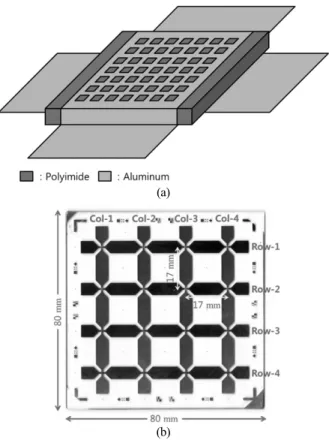
In this research, a capacitive humidity sensor structure
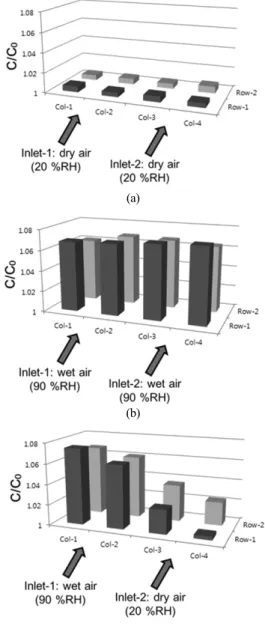
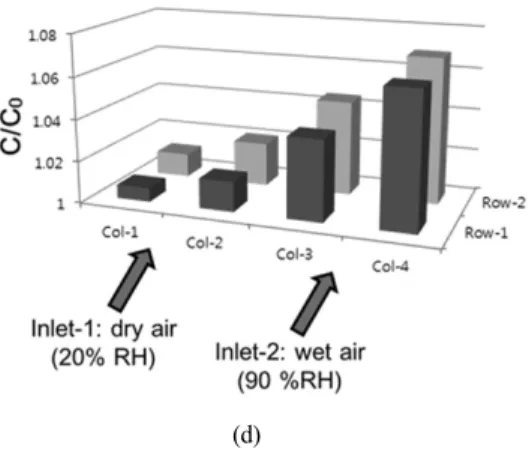
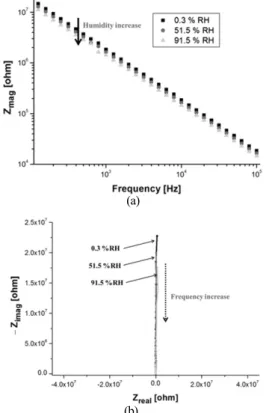
was demonstrated with a simple fabrication process for a potential application in a two-dimensional array implementation. Polyimide was used as the humidity- sensitive insulating layer because the change of its dielectric constant is linearly proportional to the amount of water absorbed[22]. Also, it has high inertness to many interfering chemicals. To verify the sensor operation, we measured capacitance changes due to humidity variations and frequency characteristics of the fabricated sensors.
2. SENSING PRINCIPLE
The dielectric constant of a majority of polymers is generally less than 10 at room temperature. That of water is about 80[23, 24], and as such causes a large change in capacitance upon absorption by a polymer. Looyenga’s equation for the dielectric constant of a water-absorbing polymer is given by[24, 25]:
where γis the volume of water in the film, and ε
Pand ε
H2Oare the dielectric constants of the polymer and the water, respectively. Equation (1) assumes that the water vapor absorbed by the polymer can be considered as finely
1
School of Electronics Engineering, Kyungpook National University, Korea
2
Department of Sensor and Display Engineering, Kyungpook National University, Korea
3
Department of Electrical & Computer Engineering and Department of Biological Sciences, Missouri University of Science and Technology, USA
+