INTRODUCTION
Advances in medicine have increased the use of mechani- cal ventilation in intensive care units (ICUs). Lung-protec- tive ventilation has been credited with the recent decline in mortality from acute lung injury/acute respiratory distress syndrome (ALI/ARDS) (1-3).
Although some information exists on mechanical ventila- tion and related issues, limited data are available from Asian countries (4-6). The prevalence of specific diseases varies from country to country; for example, the prevalence of tubercu- losis is higher in Asian countries. Because of these differences, the initiation of mechanical ventilation can vary from coun- try to country.
Epidemiologic and environmental factors in the ICU are important to critical care because they can affect care and mortality. For example, the association between hospital vol-
ume and patient outcome has been clearly established for some medical and surgical units (7, 8). In addition, the avail- ability of intensivists in the ICU can reduce mortality and improve patient outcome (9-12).
The aim of this study was to evaluate the indications for mechanical ventilation in the ICU, the characteristics of patients receiving mechanical ventilation, and the use of available ventilator modes, airway management, and wean- ing methods. The second aim of this study was to conduct a survey of ICU staff to determine the characteristics of ICUs.
MATERIALS AND METHODS
A prospective multicenter study was conducted in Korea on March 25, 2003. The study was performed at 11:00 a.m.
and involved 35 ICUs, including 18 medical ICUs, 8 medi-
948
Sang-Bum Hong, Bum Jin Oh*, Young Sam Kim�, Eun Hae Kang�, Chang Ho Kim�, Yong Bum Park‖, Min Soo Han¶, Cheungsoo Shin**, and for the Korean study group on respiratory failure (KOSREF)
Division of Pulmonary and Critical Care Medicine, Department of Emergency Medicine*, University of Ulsan, Asan Medical Center, Seoul; Department of Internal Medicine, Yonsei University College of Medicine�, Seoul; Division of Respiratory and Critical Care Medicine, Department of Medicine, Korea University College of Medicine�, Seoul; Department of Internal Medicine, Kyungpook National University�, Daegu; Department of Internal Medicine, Kangdong Hallym University Sacred Heart Hospital‖, Seoul;
Department of Internal Medicine, Eulji University Hospital¶, Daejon; Department of Anesthesiology Yonsei University College of Medicine, Yondong Severance Hospital**, Seoul, Korea
Address for correspondence Sang-Bum Hong, M.D.
Division of Pulmonary and Critical Care Medicine, Department of Internal Medicine, University of Ulsan College of Medicine, Asan Medical Center, 388-1 Pungnap-dong, Songpa-gu, Seoul 138-600, Korea Tel : +82.2-3010-3893, Fax : +82.2-3010-6968 E-mail : [email protected]
DOI: 10.3346/jkms.2008.23.6.948
Characteristics of Mechanical Ventilation Employed in Intensive Care Units: A Multicenter Survey of Hospitals
A 1D point-prevalence study was performed to describe the characteristics of con- ventional mechanical ventilation in intensive care units (ICUs). In addition, a survey was conducted to determine the characteristics of ICUs. A prospective, multicenter study was performed in ICUs at 24 university hospitals. The study population con- sisted of 223 patients who were receiving mechanical ventilation or had been weaned off mechanical ventilation within the past 24 hr. Common indications for the initia- tion of mechanical ventilation included acute respiratory failure (66%), acute exac- erbation of chronic respiratory failure (15%) (including tuberculosis-destroyed lung [5%]), coma (13%), and neuromuscular disorders (6%). Mechanical ventilation was delivered via an endotracheal tube in 68% of the patients, tracheostomy in 28% and facial mask with noninvasive ventilation (NIV) in 4%. NIV was used in 2 centers. In patients who had undergone tracheostomy, the procedure had been performed 16.9±±8.1 days after intubation. Intensivists treated 29% of the patients. A need for additional educational programs regarding clinical practice in the ICU was expressed by 62% of the staff and 42% of the nurses. Tuberculosis-destroyed lung is a com- mon indication for mechanical ventilation in acute exacerbation of chronic respira- tory failure, and noninvasive ventilation was used in a limited number of ICUs.
Key Words : Respiration, Artificial; Intensive Care Units; Respiratory Insufficiency; Tuberculosis-Destroyed Lung
Received : 6 September 2007 Accepted : 19 February 2008
cosurgical ICUs, 4 surgical ICUs, 3 coronary care units, and 2 neurological ICUs. A private KOrean Study group on REspiratory Failure (KOSREF), consisting of ICU doctors, participated in the study. Most members of KOSREF worked in the pulmonary or anesthesia departments of tertiary or university-affiliated hospitals. Those who were interested in studying and researching critical care participated of their own accord. Pediatric ICUs and postoperative recovery areas were excluded. The study was approved by each hospital’s institutional review board.
Data collection
The study was confined to patients who were receiving mechanical ventilation, undergoing a spontaneous breath- ing trial, or who had been extubated within the 24 hr prior to 11:00 a.m. on the study date. Information on each hospi- tal, each ICU, and the patients receiving ventilator support or weaning were collected on data sheets. Data sheets and physician questionnaires were mailed to KOSREF members before the study date.
Demographic data
The data collector recorded each patient’s sex, age, pre- dicted body weight (PBD), date of admission to the ICU, APACHE II score at the time of admission, date of mechan- ical ventilation initiation, and mode of airway access. If a patient had undergone a tracheostomy, the date of the pro- cedure was noted.
Ventilator data
Indications for the initiation of mechanical ventilation were selected from the following predefined categories, as derived from the literature (4, 6, 13): 1) Acute exacerbation of chronic respiratory failure (CRF) referred to obstructive or restrictive lung disease requiring mechanical ventilation because of infection, bronchospasm, heart failure, or an acute episode. Tuberculosis-destroyed lung (TDL) referred to des- troyed lung parenchyma using pulmonary radiology and a history of present or past tuberculosis (13). 2) The term ‘coma’
was used in reference to patients who required mechanical ventilation owing to the loss of consciousness, secondary to organic or metabolic conditions. 3) Neuromuscular disease was used in reference to patients who required mechanical ventilation owing to impairment of the peripheral nerves, myoneural junction or muscle mass. 4) Acute respiratory failure was used in reference to patients without preexisting obstructive or restrictive lung disease who required mechan- ical ventilation because of respiratory failure. If a patient had multiple indications for mechanical ventilation, the attend- ing staff indicated the dominant reason.
Patients with acute respiratory failure (ARF) were subdi- vided into groups, according to ARDS (1), postoperative state, acute pulmonary edema/congestive heart failure, aspi-
ration, pneumonia, sepsis/septic shock (14), and trauma (4).
The data collector recorded the mechanical ventilation mode and settings at the time of the study. Weaning was defined on the basis of the attending staff’s judgment and the method of weaning was recorded.
Physician questionnaire on ICU status
We developed a questionnaire to determine if ICUs are equipped with enough staff and medical instruments to prop- erly care for patients. On the day of the study, each partic- ipating staff member in the ICU completed the question- naire. The survey provided information about the ICU and the hospital, including the number of beds, the number of patients currently in the ICU, the number of patients receiv- ing mechanical ventilation at the time, and the respective ratios of patients to staff, residents, and nurses. The survey also determined, the approximate number of patients of the department each participant worked in that the staff, resi- dents, and nurses were caring for at the time of the study, whether an intensivist was included among the ICU staff, whether the participant thought the numbers of doctors and nurses were sufficient to care for the patients in the ICU, whether the participant thought ICR doctors and nurses needed additional educational programs on clinical practice, whether the participant had ever encountered a shortage of mechanical ventilators and patient monitors, whether the participant thought the medical instruments in the ICU were outdated, whether the ICU possessed an arterial blood gas analysis (ABG) machine, whether the ICU staff could check portable chest radiography within 10 min, and whether the surgeons cooperate immediately when they are asked to per- form a tracheostomy or a tube thoracostomy.
Statistical analyses
Results were expressed as means±standard deviations.
Statistical analyses were performed using SPSS 12.0 (SPSS Inc., Chicago, IL, U.S.A.). One-way analysis of variance (AN- OVA) tests and post hoc multiple comparisons using Tukey’s method were used to measure differences among the cate- gories for initiation of mechanical ventilation. Differences were considered significant if the p value was less than 0.05.
RESULTS Demographic data
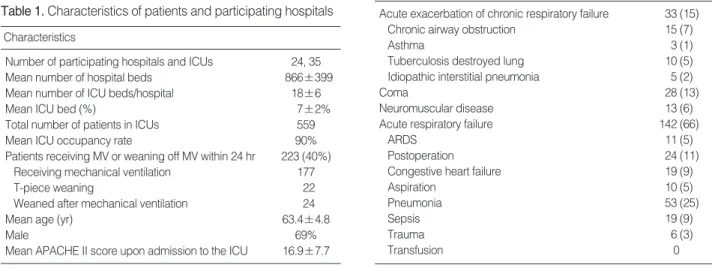
The study comprised 619 ICU beds, which were occupied by 559 patients at the time of the study. This study includ- ed 223 patients (40%) who were receiving (177 patients) or had been weaned off (T-piece trial 22 patients, extubated 24 patients) mechanical ventilation at the time of the study.
Characteristics of the patients and participating hospitals
are summarized in Table 1.
Among 216 patients studied, 66% received mechanical ventilation because of acute respiratory failure. These data did not include the seven patients who cited more than one reason for mechanical ventilation. Pneumonia was the most common indication of mechanical ventilation. An acute exac- erbation of chronic respiratory failure was the precipitating cause of mechanical ventilation in 33 (15%) patients. COPD and TDL accounted for 7% and 5% of acute exacerbation of chronic respiratory failure, respectively (Table 2). In patients with CRF, age and APACHE II score were older and higher than those in patients with comas (Table 3).
Artificial airway
Delivery of mechanical ventilation was performed using an endotracheal tube in 68% of patients, a tracheostomy in 28%, and a facial/nasal mask with noninvasive ventilation (NIV) in 4%. NIV was used in two centers. In patients receiv- ing mechanical ventilation through endotracheal tubes, 128 (98%) were passed through the mouth and two (2%) through the nose. In patients who had undergone tracheostomy, the procedure had been performed an average of 16.9±8.1 days
after intubation. The time between intubation and tracheosto- my did not vary based on the underlying condition (Table 3).
Ventilator modes and settings
In patients receiving mechanical ventilation, 51 (29%) received volume control ventilation (VCV) and 33 (19%) received pressure control ventilation (PCV). In 26 (15%), 33 (19%), and 25 (14%) patients, synchronized intermit- tent mandatory ventilation (SIMV), pressure support (PSV), or a combination of the two procedures were used, respec- tively. Nine patients (5%) received mechanical ventilation via other modes.
In patients receiving mechanical ventilation, the tidal volume was set to 8.1±2.1 mL/kg of the predicted body weight (PBW). Tidal volume varied according to underly- ing conditions (Table 3). The mean body weight was 58.6
±9.6 kg. The mean positive end-expiratory pressure (PEEP) was 5.0±3.8 cm H2O and was employed in 78.6% of the ventilated patients. In those patients, a PEEP of 1-5 cm H2O
ICUs, intensive care units; MV, mechanical ventilation.
Number of participating hospitals and ICUs 24, 35
Mean number of hospital beds 866±399
Mean number of ICU beds/hospital 18±6
Mean ICU bed (%) 7±2%
Total number of patients in ICUs 559
Mean ICU occupancy rate 90%
Patients receiving MV or weaning off MV within 24 hr 223 (40%)
Receiving mechanical ventilation 177
T-piece weaning 22
Weaned after mechanical ventilation 24
Mean age (yr) 63.4±4.8
Male 69%
Mean APACHE II score upon admission to the ICU 16.9±7.7 Table 1. Characteristics of patients and participating hospitals
Table 2. Indications for mechanical ventilation in the ICU
ICUs, intensive care units; ARDS, acute respiratory distress syndrome.
Reason for MV CRF Coma Neuromuscular ARF p value
Age (yr) 67.7±11.5� 55.3±15.9 57.8±14.9 64.5±14.9 0.003
APACHE II 14.3±6.5� 20.3±7.5 14.6±6.7 17.2±7.9 0.009
Days from intubation* 19.5±11.1 15.5±8.8 19.6±5.1 15.8±6.9 0.510
Tidal volume, mL/kg PBW 7.5±1.5� 8.9±2.4 8.8±2.6 7.9±2.1 0.045
Respiratory rate 22±8 16±6 18±7 19±7 0.124
Peak airway pressure (cmH2O) 24±11 19±7 21±3 25±13 0.278
PEEP (cmH2O) 3.0±3.4� 4.6±5.1 5.0±5.2 6.4±5.0 0.047
Table 3. Characteristics of patients and ventilator settings, according to the indication for mechanical ventilation
Data are expressed in mean±standard deviation.
*, Days from intubation to tracheostomy; �, p<0.05 compared with the coma group; �, p<0.05 compared with the ARF group.
MV, mechanical ventilation; CRF, acute exacerbation of chronic respiratory failure; ARF, acute respiratory failure; PBW, predicted body weight; PEEP, positive end-expiratory pressure.
Acute exacerbation of chronic respiratory failure 33 (15)
Chronic airway obstruction 15 (7)
Asthma 3 (1)
Tuberculosis destroyed lung 10 (5)
Idiopathic interstitial pneumonia 5 (2)
Coma 28 (13)
Neuromuscular disease 13 (6)
Acute respiratory failure 142 (66)
ARDS 11 (5)
Postoperation 24 (11)
Congestive heart failure 19 (9)
Aspiration 10 (5)
Pneumonia 53 (25)
Sepsis 19 (9)
Trauma 6 (3)
Transfusion 0
Characteristics
Indications No. (%)
was used in 39.2% of patients, while a PEEP of 6-10 cm H2O was used in 28.9% of patients and a PEEP greater than 10 cm H2O was used in 10.4% of patients. PEEP was higher in patients with acute respiratory failure than in patients with acute exacerbations of chronic respiratory failure (Table 3).
In all, 99 of 223 patients (44%), including 24 patients who were extubated within 24 hr, were in a weaning phase at the time of the study. Among the 75 patients undergoing weaning, PSV was used in 31 patients (41%) and T-piece trial was used in 22 (29%). A combination of SIMV and PSV was used in 11 (15%) patients, while SIMV was used in 6 (8%) and continuous positive airway pressure (CPAP) was used in 5 (7%).
ICU characteristics
The survey response rate was 100%. The mean number of beds in the 24 participating hospitals was 866±399. The percentage of beds devoted to the ICU was 7±2%. The patient to staff ratio was 16.0±8.3, the patient to nurse ratio was 2.4±0.4, and the patient to resident ratio was 11.1± 6.4. Most of the staff (79%) stated that the number of doc- tors working in the ICU was insufficient. Of the survey par- ticipants, 29% worked full-time in the ICU. A third of the ICU staff (32%) worked in the Department of Pulmonolo- gy, 18% worked in the Department of Anesthesiology and 50% worked in other departments.
Most of the staff (62%) and 42% of the nurses stated that they needed additional training in regard to clinical practice in the ICU. Most of the staff (83%) stated that there was a sufficient number of mechanical ventilators, and 79% of the staff felt that there was a sufficient number of patient moni- tors in the ICU. Seventy five percent of the staff stated that the medical instruments in the ICU were not out of date. An ABG machine was present in 33% of the ICUs. Fewer than half (42%) of the staff stated that they could check portable chest radiography within 10 min. Likewise, fewer than half (46%) felt that the ICU surgeons cooperated immediately when they were asked to do tracheostomy or a tube thora- costomy.
DISCUSSION
In this 1-D point-prevalence multicenter study of ICUs, pneumonia was the most common indication of mechanical ventilation, and COPD and TDL were common causes of acute exacerbation of chronic respiratory failure. Nasotra- cheal intubation and NIV were seldom used and tracheosto- my after intubation was often performed late period. In addi- tion, the survey suggested that additional personnel and training programs are needed to supplement the knowledge of ICU caregivers.
Characteristics of patients receiving mechanical ventilation
Among the patients with acute respiratory failure, the pro- portion of ARDS was similar in comparison to other reports (15, 16). However, pneumonia accounted for 37% of the ventilated patients in this study. This is high proportion of patients, compared with 13% of pneumonia cases reported in the U.S.A. and 18% reported in Spain (4). It is possible that heavy consumption of cigarettes and alcohol in Korea contributes to the high occurrence of pneumonia. However, this study did not examine patient histories for evidence of alcohol and tobacco use. Among the subgroups of acute exac- erbations of chronic respiratory failure, it is noteworthy that TDL was one of the common reasons for receiving mechani- cal ventilation. The prevalence of tuberculosis in Korea is 0.5%, which is higher than the prevalence in Westernized countries, while the mortality from tuberculosis is 6.6 peo- ple per 100,000. Therefore, TDL should be considered an important reason for mechanical ventilation in patients with CRF in an area with a high prevalence of tuberculosis.
Airway
Previous studies have found that the incidence of tracheosto- my varies according to patients’ underlying medical condi- tions (4-6). The results of our study do not support this obser- vation. While underlying conditions or APACHE scores were similar to previous reports (4), the mean time before tracheostomy (16.9 days) was longer than that observed in North America (12 days) and Spain (11 days) (17). Further- more, nasotracheal intubation was used in only 1% of cases, whereas this procedure is used in 5% of cases in North Amer- ica and in 16% of cases in Portugal (4). We hypothesize that cultural differences could contribute to the delay in tracheo- stomies in Korea, which would explain why no differences were observed in the incidence of tracheostomies relative to the underlying medical conditions. Further studies of airway management and outcomes in Korean ICUs are needed.
Only two centers (4% of the mechanical ventilation mode) used NIV in this study, possibly because NIV requires trained physicians, nurses, respiratory therapists, and specific equip- ment. Utilization of NIV varied among hospitals, suggest- ing that more education on the utility and methodology of NIV is needed (18).
Ventilator settings
Although the results of this study showed that VCV was the most commonly used mode in the ICU, the use of pres- sure modes (PCV or PSV) was similar to the use of volume modes (VCV or SIMV). Ventilator modes were applied dif- ferently by each center (data not shown) and the use of sev- eral new ventilator modes seems limited. Future studies should follow up on these results.
The tidal volume in the ventilated patients was 8.1±2.1 mL/kg of PBW. Baseline characteristics appeared to vary according to disease groups, and ICU doctors applied differ- ent tidal volumes and PEEP according to disease groups.
This suggests that physicians are aware of ventilator-induced lung injury and are making an effort to adjust the PEEP levels depending on the cause of respiratory failure.
Survey
In terms of manpower, there were both quantitative and qualitative problems involved in caring for ICU patients.
Previous studies have shown that the presence of intensivists reduces mortality and improves outcome in ICUs (9-12).
However, only 29% of patients in this study were treated by intensivists. About half of the ICU caregivers desired fur- ther training in regard to caring for ICU patients. The study also detected qualitative problems, such as a lack of cooper- ation from surgeons, limited access to portable chest radiog- raphy machines, and limited access to ABG machines in the ICU. However, the availability of instruments such as ven- tilators and monitors did not appear to interfere with the ability of ICU staff to care for patients.
A potential limitation of this study was that the ICUs were not selected randomly. Identification of the ICUs and their voluntary participation may have introduced a selec- tion bias, as it cannot be assumed that the participating ICUs are entirely representative of Korean medical centers. How- ever, our study included large, university-affiliated hospitals from different provinces in an attempt to obtain an accurate representation. Furthermore, because only a few SICU were examined, postoperative patients made up 11% of the total study population. The questions in this survey were gener- al, so further research is needed to address specific questions and thereby improve the quality of critical care. Finally, the authors were unable to visit each medical center and relied upon the ICU staff members to provide accurate feedback.
In conclusion, the results of this study suggest that TDL is a common indication for mechanical ventilation in acute exacerbation of chronic respiratory failure, that further stud- ies are needed to address current problems in airway man- agement, and that ICU doctors and nurses desire more staff and additional training in the field of critical care medicine.
Competing interests
The authors have no conflicts of interests regarding this publication.
ACKNOWLEDGMENTS
Participants are listed. Hyuk Pyo Lee (Sanggye Paik Hos- pital); Young-Joo Lee (Ajou University Hospital); Jung Bock
Hyun (Gangneung Asan Hospital); Lim Sung Chul (Chon- nam National University Hospital); Ahn Jong-Joon (Ulsan University Hospital); Jung Hyun Chang (Mokdong Hospi- tal); Jeong Woong Park (Gil Medical Center); Kang-Hyeon Choe (Chungbuk National University Hospital); Yun Seong Kim (Pusan National University Hospital); Shin OK Koh (Shinchon Severance Hospital); Jae Hwa Cho (Inha Univer- sity Hospital); Younsuck Koh, Chae-Man Lim (Asan Medi- cal Center); Jae Ho Lee (Bungdang Seoul National Univer- sity Hospital), Oh Jung Kwon (Samsung Medical Center);
Kwang Seok Eom, Myung-Goo Lee, Ki-Suck Jung (Hal- lym University Sacred Heart Hospital).
REFERENCES
1. Bernard GR, Artigas A, Brigham KL, Carlet J, Falke K, Hudson L, Lamy M, Legall JR, Morris A, Spragg R. The American-European Consensus Conference on ARDS. Definitions, mechanisms, relevant outcomes, and clinical trial coordination. Am J Respir Crit Care Med 1994; 149: 818-24.
2. Amato MB, Barbas CS, Medeiros DM, Magaldi RB, Schettino GP, Lorenzi-Filho G, Kairalla RA, Deheinzelin D, Munoz C, Oliveira R, Takagaki TY, Carvalho CR. Effect of a protective-ventilation strate- gy on mortality in the acute respiratory distress syndrome. N Engl J Med 1998; 338: 347-54.
3. The Acute Respiratory Distress Syndrome Network. Ventilation with lower tidal volumes as compared with traditional tidal volumes for acute lung injury and the acute respiratory distress syndrome. The Acute Respiratory Distress Syndrome Network. N Engl J Med 2000;
342: 1301-8.
4. Esteban A, Anzueto A, Alia I, Gordo F, Apezteguia C, Palizas F, Cide D, Goldwaser R, Soto L, Bugedo G, Rodrigo C, Pimentel J, Raimondi G, Tobin MJ. How is mechanical ventilation employed in the intensive care unit? An international utilization review. Am J Respir Crit Care Med 2000; 161: 1450-8.
5. Luhr OR, Antonsen K, Karlsson M, Aardal S, Thorsteinsson A, Frostell CG, Bonde J. Incidence and mortality after acute respirato- ry failure and acute respiratory distress syndrome in Sweden, Den- mark, and Iceland. The ARF Study Group. Am J Respir Crit Care Med 1999; 159: 1849-61.
6. Esteban A, Alia I, Ibanez J, Benito S, Tobin MJ. Modes of mechani- cal ventilation and weaning. A national survey of Spanish hospitals.
The Spanish Lung Failure Collaborative Group. Chest 1994; 106:
1188-93.
7. Halm EA, Lee C, Chassin MR. Is volume related to outcome in health care? A systematic review and methodologic critique of the litera- ture. Ann Intern Med 2002; 137: 511-20.
8. Kahn JM, Goss CH, Heagerty PJ, Kramer AA, O’Brien CR, Ruben- feld GD. Hospital volume and the outcomes of mechanical ventila- tion. N Engl J Med 2006; 355: 41-50.
9. Varelas PN, Conti MM, Spanaki MV, Potts E, Bradford D, Sunstrom C, Fedder W, Hacein Bey L, Jaradeh S, Gennarelli TA. The impact of a neurointensivist-led team on a semiclosed neurosciences inten-
sive care unit. Crit Care Med 2004; 32: 2191-8.
10. Pronovost PJ, Jenckes MW, Dorman T, Garrett E, Breslow MJ, Rosenfeld BA, Lipsett PA, Bass E. Organizational characteristics of intensive care units related to outcomes of abdominal aortic surgery.
JAMA 1999; 281: 1310-7.
11. Young MP, Birkmeyer JD. Potential reduction in mortality rates using an intensivist model to manage intensive care units. Eff Clin Pract 2000; 3: 284-9.
12. Pollack MM, Katz RW, Ruttimann UE, Getson PR. Improving the outcome and efficiency of intensive care: the impact of an intensivist.
Crit Care Med 1988; 16: 11-7.
13. Park JH, Na JO, Kim EK, Lim CM, Shim TS, Lee SD, Kim WS, Kim DS, Kim WD, Koh Y. The prognosis of respiratory failure in patients with tuberculosis destroyed lung. Int J Tuberc Lung Dis 2001; 5: 963-7.
14. Bone RC, Balk RA, Cerra FB, Dellinger RP, Fein AM, Knaus WA,
Schein RM, Sibbald WJ. Definitions for sepsis and organ failure and guidelines for the use of innovative therapies in sepsis. The ACCP/
SCCM Consensus Conference Committee. American College of Chest Physicians/Society of Critical Care Medicine. Chest 1992;
101: 1644-55.
15. Knaus WA, Sun X, Hakim RB, Wagner DP. Evaluation of defini- tions for adult respiratory distress syndrome. Am J Respir Crit Care Med 1994; 150: 311-7.
16. Ferring M, Vincent JL. Is outcome from ARDS related to the severi- ty of respiratory failure? Eur Respir J 1997; 10: 1297-300.
17. Griffiths J, Barber VS, Morgan L, Young JD. Systematic review and meta-analysis of studies of the timing of tracheostomy in adult patients undergoing artificial ventilation. BMJ 2005; 330: 1243.
18. Carlucci A, Richard JC, Wysocki M, Lepage E, Brochard L. Nonin- vasive versus conventional mechanical ventilation. An epidemiolog- ic survey. Am J Respir Crit Care Med 2001; 163: 874-80.