http://dx.doi.org/10.14316/pmp.2015.26.4.229
Received 20 October 2015, Revised 7 November 2015, Accepted 9 November 2015
Correspondence: Ji Hoon Choi ([email protected])
Tel: 82-51-990-6399, Fax: 82-51-793-0660
cc This is an Open-Access article distributed under the terms of the Creative Commons Attribution Non-Commercial License (http://creativecommons.org/licenses/by-nc/4.0) which permits unrestricted non-commercial use, distribution, and reproduction in any medium, provided the original work is properly cited.Response Evaluation after Stereotactic Ablative Radiotherapy for Lung Cancer
Ji Hoon Choi
Department of Radiation Oncology, Kosin University Gospel Hospital, Kosin University College of Medicine, Busan, Korea
We retrospectively reviewed lung cancer patients who were treated with stereotactic ablative radiotherapy (SABR).
We investigated the value of response evaluation after treatment by measuring the volume change of tumors on serial chest computed tomography (CT) examinations. The study included 11 consecutive patients with early-stage (T1-T2aN0M0) non-small cell lung cancer (NSCLC) who were treated with SABR. The median dose of SABR was 6,000 cGy (range 5,000∼6,400) in five fractions. Sequential follow-up was performed with chest CT scans. Median follow-up time was 28 months. Radiologic measurement was performed on 51 CT scans with a median of 3 CT scans per patient. The median time to partial response (T
PR) was 3 months and median time to complete remission (T
CR) was 5 months. Overall response rate was 90.9% (10/11). Five patients had complete remission, five had partial response, and one patient developed progressive disease without response.
On follow-up, three patients (27.2%) developed progressive disease after treatment. We evaluated the the response after SABR. Our data also showed the timing of response after SABR.
Key Words: Lung cancer, Stereotactic ablative radiotherapy, SABR, SBRT
Introduction
During the past decade, the standard therapy for operable, early-stage (T1-T2aN0M0), non-small cell lung cancer (NSCLC) has been lobectomy.
1)Conventionally fractionated radiotherapy for patients with early-stage NSCLC who are medically in- operable has traditionally been regarded as superior to no treatment but not able to achieve levels of local control (LC) or overall survival (OS) similar to those of surgical resection.
During the past decade, stereotactic ablative radiotherapy (SABR; also called stereotactic body radiotherapy) has become standard of care for patients with early-stage NSCLC who are clinically unable to tolerate a surgical procedure or refuse surgery. SABR has resulted in LC in excess of 90% for tu-
mors that are medically inoperable and operable tumors in clinical stage INSCLC
2-13)and overall survival after SABR was better than that achieved after conventional fractionated radio- therapy.
14)SABR delivers ablative doses of radiation (biologi- cally effective dose [BED] >100 Gy) to tumors in 1∼10 fractions with a high degree of accuracy. Accurate evaluation of tumor response after radiotherapy is essential to determine the efficacy of treatment. De Rose et al. analyzed a radio- logical response was defined according to RECIST criteria in non-small cell lung cancer oligometastatic patients who had undergone SABR for lung metastatic lesions. Local control was 92% of the treated lung lesions. Complete remission was 66% of cases and partial remission or persistent stable disease in 34% with assessment of radiological response.
15)We investigated the value of response evaluation after treat-
ment by measuring the size change of tumors on serial chest
CT examinations.
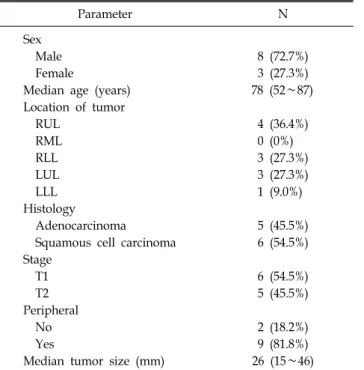
Table 1. Patient characteristics.
Parameter N
Sex
Male 8 (72.7%)
Female 3 (27.3%)
Median age (years) 78 (52∼87)
Location of tumor
RUL 4 (36.4%)
RML 0 (0%)
RLL 3 (27.3%)
LUL 3 (27.3%)
LLL 1 (9.0%)
Histology
Adenocarcinoma 5 (45.5%)
Squamous cell carcinoma 6 (54.5%) Stage
T1 6 (54.5%)
T2 5 (45.5%)
Peripheral
No 2 (18.2%)
Yes 9 (81.8%)
Median tumor size (mm) 26 (15∼46)
Table 2. Treatment characteristics.
Treatment characteristics Median Range
Prescription dose (Gy) 60 50∼64
Fractions 5 4∼5
BED dose (Gy
10) 132 100∼166.4
Materials and Methods
1. Patients
This retrospective study included 11 consecutive patients with early-stage (T1-T2aN0M0), non-small cell lung cancer (NSCLC) who were treated with stereotactic ablative radio- therapy (SABR) between January 2011 and March 2015.
Inclusion criteria were patients with pathologically proven ear- ly-stage (T1-T2aN0M0), non-small cell lung cancer (NSCLC) who were medically inoperable or who refused surgical re- section. For this study, we excluded patients with TNM stage other than T1-T2aN0M0 and those who had previously re- ceived other treatments of surgery or chemotherapy for the tumor. All of patients underwent a PET-CT scan with chest CT examination and MRI of brain prior to initiation of treat- ment. Post treatment follow-up consisted of contrast enhanced CT scans of the thorax at 1, 3 and 6 months post-SABR, fol- lowed by 6 months until 2 years after treatment and annually thereafter. The patients’ characteristics are listed in Table 1.
The most common primary tumour histology was squamous cell carcinoma (54.5%). Median tumor size was 26 mm (range:
15∼46).
2. Treatment
The patients underwent 4DCT scans for treatment planning.
The 4DCT images were obtained using a 4DCT scanner (Light Speed RT, General Electric Co., Waukesha, WI, USA) with RPM (Real-time Position Management
TM, Varian Medical Systems, Inc., Palo Alto, CA, USA) system. The 4DCT im- ages were sorted and reconstructed by an Advantage Worksta- tion (General Electric Co.). Phases were sorted into 0%∼90%
(all phases) from 4DCT images and reconstructed using the maximum intensity projection (MIP) method. Gross tumor vol- umes (GTVs) and internal target volume (ITV) around the GTV, accounting for tumor motion were manually delineated on each of the 10 phases of reconstructed CT image by a ra- diation oncologist using the treatment planning system (Eclipse 8.1, Varian Medical Systems, Inc.) with the lung CT window setting (WW; window width: 1600 HU, WL; window level:
−600 HU). All fractionation schemesBED of ≥100 Gy
10pre- scribed to the planning target volume (PTV). The median dose of SABR was 6,000 cGy (range 5,000∼6,400) in 5 fractions.
The SABR dose was prescribed to deliver 100% of the pre- scribed dose to >99% of the ITV and 95% of the prescribed dose to >99% of the PTV. The PTV consisted of the ITV plus a 5 mm margin uniformly. The treatment dose schedule is shown in Table 2.
Post-SABR follow-up consisted of contrast enhanced CT scans of the thorax and PET-CT. Sequential follow-up was performed in our institution. Time-to-event outcomes were analyzed.
3. Response criteria
For 2-dimensional (2D) measurement, the tumor mass in the
axial plane of the CT scan was measured at the longest
cross-sectional diameter and the longest diameter perpendicular
Table 3. Summary of response rates by measurement of tumor size.
CR N (%) PR N (%) PD N (%)
ALL 5 (45.5%) 5 (45.5%) 1 (9.0%)
T1 stage 2 (18.2%) 4 (36.4%)
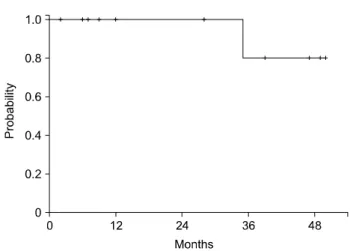
T2 stage 3 (27.4%) 1 (9.0%) 1 (9.0%) Fig. 1. Overall survival after SABR.
to it. Response criteria were defined as follows: complete re- sponse (CR), complete resolution; partial response (PR), de- crease of at least 30%; progressive disease (PD), increase of at least 20%; and stable disease (SD), neither PR nor PD.
Fisher’s exact test was performed to examine the influence of variables on response.
Results
1. Radiologic tumor size change
Over a median follow-up of 28 months (range, 2∼50 months), the 3-year overall survival rate of all 11 patients was 80.0% (Fig. 1). Radiologic measurement was performed on 51 CT scans (11 pre-radiotherapy and 40 post-SABR CT scans) with a median number of 3 CT scans per patient. For all 11 patients, the mean pre-RT maximum diameter of tumor was 29 mm. Detailed RT-related parameters are listed in Table 2.
The relative values of the maximum diameter of the tumor on follow-up CT scans with reference to pre-SABR values were obtained. The median time to partial response (T
PR) was 3 months and median time to complete remission (T
CR) was 5 months.
2. Response rates and patterns of failure
The response rates (RRs) are listed in Table 3. Overall RR measured by the 2D-method was 90.9% (10 of 11 patients).
Five patients had CR, five had PR, and one developed pro- gressive disease without response.
Three patients (27.2%) developed progressive disease after treatment. Among the three patients with progression, two (18.2%) had in-field failure with metastatic nodules and one (9.1%) had local failure with regional lymph node metastasis.
Patients with higher-stage disease tended to undergo recurrence more frequently with disease progression, but the difference was not statistically significant (p=0.490).
Discussion
Many studies have shown that stereotactic ablative radio- therapy (SABR) is effective for the treatment of early-stage non-small cell lung cancer and SABR has become the standard of care for medically inoperable NSCLC.
2-13)Chang et al. as- sessed overall survival for SABR versus surgery by pooling data from two independent, randomized, phase 3 trials of SABR in patients with operable stage I NSCLC. Overall sur- vival at 3 years was 95% in the SABR group compared with 79% in the surgery group (p=0.037). Recurrence-free survival at 3 years was 86% in the SABR group and 80% in the sur- gery group (p=0.54).
16)Heal et al. retrospectively analyzed the rates of tumor control and toxicity following SABR treatment with the Cyberknife system for primary early-stage NSCLC.
With a median follow-up of 27.5 months, 3-year local control rates were 84.33% and there was no grade 3 toxicity.
17)In our study, the median follow-up was 28 months (range, 2∼50 months), overall survival rate was 80.0%. T-stage did not show as an independent predictor of overall survival. After SABR, the initial response rate to treatment was 81.8%. Table 3 lists the response rates (RRs). The overall response rate was 90.9% and 5 of 11 (45.4%) patients had complete remission of the tumor.
The patients treated with SABR in our study experienced
few toxicities. One patient experienced a rib fracture (grade
≥3 toxicity) after SABR to a peripheral lung tumor within 1 cm of, but not abutting, the chest wall. Otherwise, all tox- icities were grade 2 or lower. Observed toxicities were primar- ily pneumonitis. There were no cases of esophagitis, spinal cord toxicity, or hemorrhage of mediastinum. Chaudhuri et al.
retrospectively analyzed outcomes in 68 patients with single lung tumors, 34 central and 34 peripheral tumors, who were treated with SABR consisting of 50 Gy in 4∼5 fractions. The authors reported their experience in treating patients with cen- tral and ultra-central lung tumors with SABR. Toxicity rates were low and tolerable in both groups. There were two cases of grade 3 toxicity with chest wall pain, and one case of grade 4 toxicity of pneumonitis. They suggested that SABR dosed at 50 Gy in 4∼5 fractions is safe and effective for treatment of early-stage non-small lung cancer, even for centrally located lung tumors.
18)Response evaluation of tumors is not easy because of the lack of distinct borders and irregular shape and growth patterns. There are some publications evaluating radiographic response using axial CT scan measurements. Shah et al. re- ported methodological issues in their publications comparing 2D and volume measurements for assessment of tumor re- sponse in adult high-grade gliomas.
19)Force et al. analyzed 25 patients with thymic cancer and evaluated tumor responses us- ing CT-based response evaluation criteria in solid tumors (RECIST), World Health Organization (WHO) criteria, modi- fied RECIST, and 3D volumetrics with computer-assisted software. The authors found that use of volumetrics showed 22% discordance compared to RECIST, 15% versus modified RECIST, and 22% versus WHO criteria.
20)Although they found a generally good correlation among modalities with some discordance, the primary purpose of their studies was to validate different measurement methods of assessing response, rather than to evaluate the efficacy of radiation therapy by as- sessing response.
In the current study we analyzed the timing of treatment response. The results of our study showed that the initial re- sponse became evident as early as 1 month after RT. The me- dian time to partial response (T
PR) was 3 months. Five of 11 patients had complete remission of tumor. The median and mean time to complete remission (T
CR) was 5 months and 6.4 months respectively. Two patients showed response at the time
of the first CT scan at 1 month after treatment. There was no correlation between T stage and tumor response. Eight of 11 patients showed a partial response at the time of the first CT scan after RT. Of these eight patients, four eventually showed complete remission of the tumor.
The median time to progression of disease was 10.5 months.
Three patients (27%) had local failure with metastatic nodules and one patient (9%) had local failure with regional lymph node metastasis. Only one patient showed a PD response at the initial CT scan. The mean number of CT scans performed after SABR was 3.6 and the median time of the first CT scan from the end of treatment was 1 month (range, 1∼6).
There are some limitations associated with the nature of this study, which was a single-institutional retrospective study with a small number of enrolled patients with SABR treatment.
Conclusion
The overall response rate after SABR was 90.9%. Our data suggest that some patients could have a response as early as 1 month after RT. In addition, we evaluated the timing of the response after SABR. Our results may help clinicians with treatment planning for patients with early-stage non-small cell lung cancer.
References
1. Shimkin MB, Connelly RR, Marcus SC, et al: Pneumo- nectomy and lobectomy in bronchogenic carcinoma. A compar- ison of end results of the Overholt and Ochsner clinics. J Thorac Cardiovasc Surg 44:503-19, 1962
2. Onishi H, Araki T, Shirato H, et al: Stereotactic hypofrac- tionated high-dose irradiation for stage I nonsmall cell lung car- cinoma: clinical outcomes in 245 subjects in a Japanese multi- institutional study. Cancer 101:1623-31, 2004
3. Lagerwaard FJ, Haasbeek CJ, Smit EF, et al: Outcomes of risk-adapted fractionated stereotactic radiotherapy for stage I non-small-cell lung cancer. Int J Radiat Oncol Biol Phys 70:685-92, 2008
4. Chang JY, Liu H, Balter P, et al: Clinical outcome and pre- dictors of survival and pneumonitis after stereotactic ablative ra- diotherapy for stage I non-small cell lung cancer. Radiat Oncol 7:152, 2012
5. Crabtree TD, Denlinger CE, Meyers BF, et al: Stereo- tactic body radiation therapy versus surgical resection for stage I non-small cell lung cancer. J Thorac Cardiovasc Surg 140:
377-86, 2010
초기 폐암의 정위방사선치료후 반응평가 분석