1. Introduction
With the development of the fourth industrial revolution, the use of AI intelligent robot has
become more and more universal, and the application of robot technology has also been expanded from industrial manufacturing to service industry. From manufacturing robots to
Research on Service Extensior of Restaurant Serving Robot
- Taking Haidilao Hot Pot Intelligent Restaurant in Beijing as an Example
Yuqi Zhao 1 , Young-Hwan Pan 2*
1
Master’s Course, Dept. of Experience Design, Techno Design, Kookmin University
2
Professor, Dept. of Experience Design, Techno Design, Kookmin University
레스토랑 서빙 로봇의 서비스 확장에 관한 연구
- 중국 베이징 하이디라오 스마트 레스토랑을 사례로 연구
조여기 1 , 반영환 2*
1
국민대학교 테크노디자인전문대학원 경험디자인학과 석사과정
2
국민대학교 테크노디자인전문대학원 경험디자인학과 교수
Abstract This study focuses on the analysis of the service process and interaction mode of the serving robot used in the restaurant, Through user research, shadowing research and indepth interviews with customers and catering service personnel, this paper analyzes the contact points between catering service machines, people and users, constructs user journey map to understand users' expectations. In addition to the delivery service that can be allocated to the machine and people, the blueprint construction of ordering, reception and table cleaning services can also included in the service process.
The final proposal is to improve the existing machine human interface and design a new service scheme.
Key Words : Smart restaurant, Serving robot, Service design, Robot interface, Service blueprint
요 약 본 연구는 식당에서 사용하는 외식서빙 로봇의 서비스 절차 및 인터랙션 방식에 중점을 두고 연구한다. 사용자 설문조사,사용자를 관찰하고 고객과 레스토랑 종업원의 인터뷰를 통한 레스토랑 서빙 로봇과 고객의 교류방식을 분석 하고 사용자 요구를 파악하기 위해 사용자 여정 지도를 구축한다. 또한 서비스 절차에서 배달 서비스 뿐만 아니라 주문 서비스, 접대 서비스 및 테이블 정리 등을 모두 서비스 로봇이 행하는 것을 의도한다.최종 제안 연구 목적은 기존의 서빙 로봇 GUI을 개선하고 새로운 서비스 청사진을 설계하는 것이다.
주제어 : 스마트 레스토랑, 서빙 로봇, 서비스디자인, 로봇 GUI, 서비스 청사진
*Corresponding Author : Young-Hwan Pan([email protected]) Received February 28, 2020
Accepted April 20, 2020
Revised March 31, 2020
Published April 28, 2020
home service robots, a variety of different types of robots have been able to replace some of the original non-standard tasks[1].
However ,to introduce service robots in service industry, we must be sure about the labor distributor between robots and humans; how will we design the human robot interactive interface for customer service or service personnel[2]?
There is a big difference between human robot interaction and traditional human machine interaction[3].
In the current industry, robots are able to replace humans in guiding, reception and delivery services.As a matter of fact, robots can be used in many aspects in the hot pot industry, such as washing vegetables, cutting vegetables, sorting dishes, serving, serving dishes and picking up hot pot seasoning, as well as automatically putting dishes into hot pot for customers[4]. With the gradual introduction of supportive policies for the robot industry, service robots have entered a high-speed development stage, and their market growth rate is far faster than other types of robots[5]. Due to the universality of the service industry, the division of labor and interaction between human and robot are different in a specific service industry. Decker et al.[6] pointed out that since the services provided by robots are diversified, it is difficult to standardize the services provided by robots. The service quality, the potential for standardization of working environment, the design of man-machine interface, and the educational background of manual service providers vary from service industry to service industry, and H.ttenrauch [7] also indicated that human–robot relationships must be understood in the context of use of robots, and based on empirical studies of humans and robots in real settings. They concluded that addressing only the primary user in service robotics is unsatisfactory, and that the focus should be on the setting, activities and social interactions of the group of people where
the robot is to be used. Pellerin [8] proposed that the technical and social evaluation of introducing robots in the service industry should not just derive from the seniors’ perspective, but also the opinions of the entire business team.
Therefore, this study will focus on the contact point between customers and service personnel and catering robot in the process of dining, and improve the existing service system, so that people can use the catering intelligent robot, reduce the labor cost and achieve the purpose of sustainable productio.
The research method and scope of this thesis are consistent with that described in the next section. Using the methodology of service design, firstly, through consulting the relevant literature, examples and corresponding books to understand the work principles of AI robots, catering service system and current catering service status. Secondly , to visit restaurants that use robots in China and Korea, and analyze their service modes. Meanwhile, to conduct in depth interview, shadow survey and satisfaction review on service personnel and customers, so as to analyze the contact points ofusers and robots,byconstructing the user journey map and extracting current pain points from user use scenes, to put forward the improved plans and future research direction.
2. Background of intelligent robots
2.1 The development status of service robots
The service robot refers to semi automatic or
completely automatic robots that can complete
the work of humans. The service robot is divided
into two types, one is the service robot applied
in the professional field[9]; the other is the robot
specialized in family and personal service, which
is widely used in security, management and other
fields. The catering robot belongs to the service
type robot applied in the special field[10].
The fully autonomous commercial service robots used in the Haidilao Hot Pot Intelligent Restaurant in Beijing, China are equipped with fully autonomous positioning and navigation system, which can realize high-precision indoor navigation through multi-sensor information fusion such as laser radar, depth vision, and machine vision, and can enable the robots to move freely and stably in complex indoor spaces for a long time. In addition, equipped with a powerful intelligent speech recognition system and an infrared physical sensing system, [11]. The hardware devices are shown in table 1.
Product Dimensions 1200*500mm
Net Weight 50kg
Battery Capacity DC 48v 12Ah
Rated Power 500W
Single Pallet Load 10kg Standby Current <0.5A
Stand-by Time >48h
Service Life 50000h
Charge Mode Automatic / Manual Cargo Capacity 40cm*25cm*40cm Maximum walking speed 1m/s
Charging Duration 4h
Table 1. Fully autonomous commercial service robot product hardware parameters
The most famous engines equipped in Ai products on the market are the TensorFlow engine developed by Google and the Microsoft Azure engine developed by Microsoft. As a kind of artificial intelligence, machine learning can enable software to explain or predict the future situation based on a large amount of data.
"TensorFlow" is an internal machine learning system that has been adopted by Google for many years. Nowadays, Google starts to make this system an open-source system, and make the parameters of this system open to industry engineers, scholars, and technicians with a lot of programming capabilities[12]. On the other hand,
Microsoft has demonstrated that Azure can provide the most advanced machine learning capabilities. With Azure machine learning, Azure Databricks and ONNX can quickly and easily construct, train and deploy your machine learning model[13].
The emergence and development of service robots are closely related to machinery, medicine, materials, biology and other disciplines.
Therefore, only after the rapid development of relevant disciplines and technologies, can service robots achieve further development. On the other hand, the development direction of service robot technology is intelligence. In the future, the sensor technology, intelligent cognition and sensing technology, new materials, and complex power control technologies service robots will be widely used in service robots. With the continuous development of sensor technology, the accuracy of the intelligent algorithm, the core of intelligence, will be higher and higher, which not only can process sensor information at high speed, but also can improve the intelligence level of intelligent robots[14].
2.2 situation of robot catering industry With the development of robot technology, more and more robot service industries enter the public's vision. With the rise of labor price in China, the overall profit of catering industry is declining. Now more and more catering industry is trying to control costs and improve profits.
Therefore, it has become a trend to introduce service robots into the catering industry to replace "things that people can't do" with "things that people don't want to do"[15].
At present, a number of restaurants all over
the world are providing services through
restaurant service robots. In this study, two
restaurants in South Korea and three restaurants
in China were interviewed, and it is found that
the use of these robots are far from satisfactory
because these robots can only provide simple services such as delivering food. Chien-Jung Lai pointed out in his paper that the current artificial intelligence development can enable restaurant service robots to provide the following services in a short time including front desk reception, customer reception, menu introduction, and performance for entertainment. In the medium term, the restaurant service robots can bring portable electronic equipment to place orders for customers and in the long term, the restaurant service robots can realize more humanized and intelligent functions. It is also pointed out that the service robots won’t completely replace waiters within a certain period of time and the use of service robots does not necessarily mean that more and more manual and cognitive tasks will be replaced by robots. It is an important topic to think about how to make human and service robots work together in the future[13].
3. Service Design
3.1 In-depth interview
This study aims to analyze customers' contact points with robots throughout the meal, so as to put forward proposals that help to improve users’
satisfaction. The investigation process mainly focus on the problems that affect customers’
dining experience throughout the meal. From November 13, 2019 to November 20, 2019, there are 30 persons that have been interviewed in total, including 10 waiters, 17 customers and 3 related experts. Each one of them received an interview for 20 to 30 minutes respectively.
During the investigation, the main investigation items were the customers' experience of the existing service of the restaurant service robot during the dining process of the restaurant. I hope what service the service robot can provide
in the future and the operation experience of the service staff. In addition, a total of 111 questionnaires related to satisfaction survey of restaurant robots were released through WJX.CN.
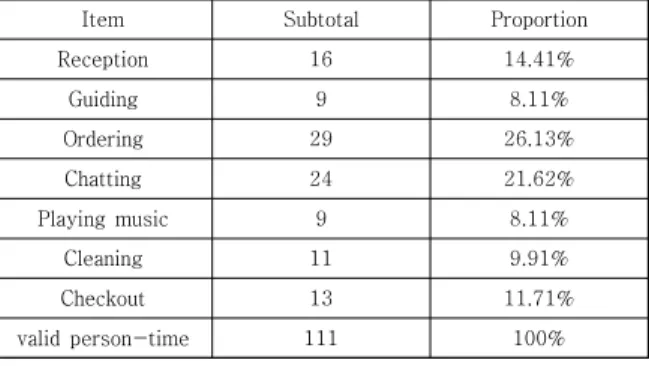
According to the results of user satisfaction questionnaires, 69 people (62%) chose the options of general or dissatisfied when comparing the service quality of restaurant service robots with that of manual service, while 31 people (38%) chose satisfied. In addition to the food delivery service, customers also expect restaurant service robots to provide other service items, which are shown in the table 2 below:
Item Subtotal Proportion
Reception 16 14.41%
Guiding 9 8.11%
Ordering 29 26.13%
Chatting 24 21.62%
Playing music 9 8.11%
Cleaning 11 9.91%
Checkout 13 11.71%
valid person-time 111 100%
Table 2. Findings of services customers want from robots
After the question nairesurvey and userinterviews are combined, the results are as follows:1) catering service personnel generally believe that the service provided by the robot is not intelligent enough,.the environment adaptability of the robot is poor. In a quiet laboratory environment, they can only complete simple delivery service. In noisy restaurants, due to the loud noise, or the touching of customers out of curiosity, its functions shall be affected; 2) Due to the structure of the robot, it is impossible to remind the customer of the arrival of dishes through the body in the delivery service.
Moreover, in service, the customer needs to take out the dishes manually and put them on the table. If the robot were to have the action of
"delivering dishes", it will remind the customer
very well. 3) If the robot breaksdown,it will cost a relatively high maintenance price. In the overall maintenance, it needs manual operation.
4) The service personnel generally think that it is more labor-intensive to recycle the plates after the customers have finished eating. If the robot can realize this function, the labor cost will be greatly reduced. 5)It is found through investigations that younger generation aged from 20 to 30 prefer the service provided by robots.
Compared with the elderly, young people are relatively prone to contacting and accepting new things more quickly, and enjoy the satisfaction brought by new products. However, the elderly aged from 40 to 50 are more inclined to manual service, because they pay more attention to life quality and service quality and there will be more special cases. Compared with the service that robots can provide currently, waiters can randomly respond to a variety of situations, therefore, manual service can provide more satisfactory service.
3.2 User behavior export
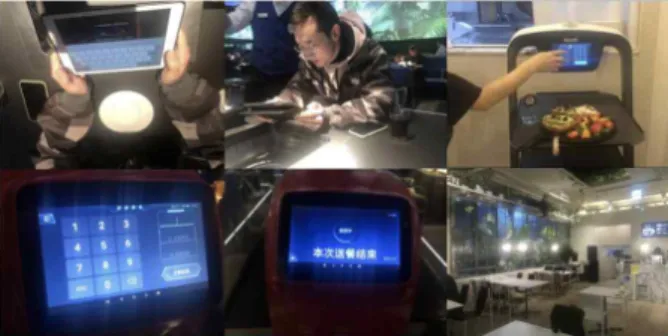
This study takes Haidilao Hot Pot Intelligent Restaurant in Beijing, as the research site to clarify the contact points between the restaurant robot and the user through shadow research. The details are as follows: customers first make reservations through Haidilao WeChat Official Account and then come to the restaurant to take their number on the ticket vending machine and wait in the waiting area of the restaurant. When it’s their turn to enter the restaurant, service personnel will guide the customers to find their own seat, then ordering food can be completed through iPad provided for every table. After waiting for about 15 minutes, the waiter will place ordered food on the robot, and input the corresponding table number, then the robot automatically search for the customer table and prompt customers to take out their own food and place it on the table. After customer click
"confirm" button on the screen of the robot, the robot will automatically return to its original position and the customers begin to have meal.
After customers finished the meal, they can ask waiter to come by clicking desk bell and make electronic payment through Alipay, and then the meal was over. Fig. 1 shows the survey process data.
Fig. 1. User behavior survey data.
3.3 User journey map export
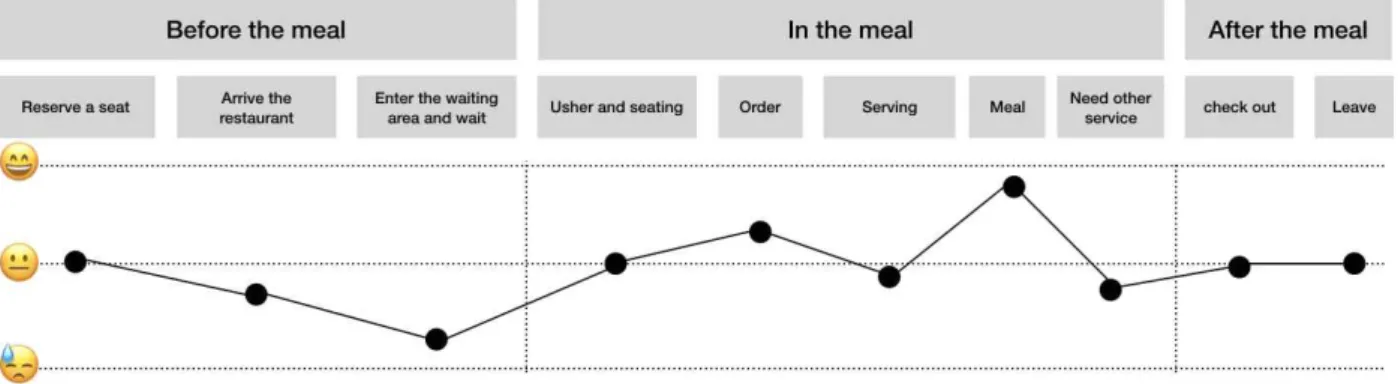
Through the visit survey and shadow survey, we have determined the behavior mode of service personnel and customers in the restaurant, and sorted out the user journey map.
For details, please refer to Fig. 2.
User journey map are divided into three stages: before, during and after the meal.
Through the user journey map, we can find that if you are in the peak period of the meal before the meal, even if you have made an appointment, the wait time is long, the customer's satisfaction will be reduced, and the conflicts of most restaurants will be created in this period of time.
Then ,when waiters take the customer to the corresponding seat, which will also cost a part of the waiter's energy and time, If the serving robot can lead customers to the table in this period, it will greatly reduce the labor force of the waiter, improve the working efficiency and reduce the conflicts.
During the meal, the customer thinks that the
problem of robot delivery is that when it moves
to the dining table, it can only remind the
customer by voice instead of body. In the noisy environment, the customer may not notice, and when serving, the customer needs to manually take out the dishes. If the robot were to have the action similar to "delivering dishes", it will give a
good prompt to the customer. In addition, in the process of dining, customers are likely to need other services again, which requires the service of humans. Sometimes customers are likely to carry out some very simple inquiries. In this case, Fig. 2. Serving robot User Journey Map
Fig. 3. Service blueprint for the robot restaurant mode improvement proposal.
the efficiency rate of the waiter will be reduced.
If the delivery robot can replace people to answer some simple questions, it will greatly increase the service efficiency of the whole restaurant.
After the meal, customers generally use bank cards or electronic banks to pay online. The period from customers leave the table to the time new customers come to the table is when the waiter cleans the table, which will cost a lot of time and energies. If this time can be relatively reduced, the waiting time of the next batch of customers will also be shorter, which will reduce the labor cost and improve the work efficiency.
4. Service proposal
The proposal in this study takes the keenon robot used in Haidilao Hot Pot Intelligent Restaurant in Beijing, as an example. Throughout the whole meal, guest reception, food delivery, voice self-service and partial functions of cleaning provided by waiters before will be replaced by restaurant robots. Fig. 3 is a service blueprint for the robot restaurant mode improvement proposal.
In the new proposal, it is hoped that the restaurant service robot will add the function of receiving customer,self-service voice function and cleaning function based on existing technology.
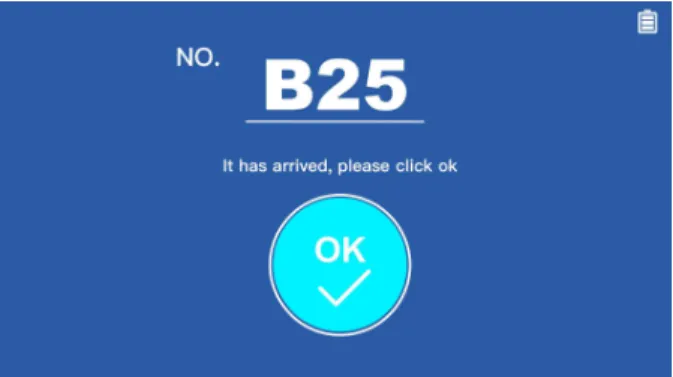
4.1 Robot receiving customer function In the proposal, the task of leading the customer to find the corresponding table. The waiter clicks the "lead" option in the main menu, inputs the corresponding table number, and the screen will continue to display the table number in the moving process of the robot. When the customer arrives ,he can click the "OK" button on the screen, and the robot will return to the fron desk for standby.
Fig. 4. UI design of robot receiving customers starting interface
Fig. 5. UI design of robot arriving at the assigned posts
4.2 Robot voice self service function In the dining process, customers will put forward some other service requirements.in the proposal, robot voice self service can replace the waiter to answer simple questions. When the customer needs to press the bell at the dining table, the robot will automatically move to the dining table, and the interaction interface will be automatically converted as shown in Fig. 6.
According to the questions frequently asked by customers in user survey, Table 3 has been sorted out.
Fig. 6. UI design of robot voice self service
1.What is the wifi password ? 2.May I see the menu?
3.Is there any promotion?
4.Can I have the tissue?
5..where is the washroom?
Table 3. Questions frequently asked by customers
However, in the current noisy environment, it will seriously affect the performance of the robot's voice recognition function, and the adaptability is poor. Therefore, this study will formulate some research directions.
4.3 Robot cleaning function
In this proposal, we hope that the robot can provide the function of recycling the garbage from the dinner plate and self delivery. After the customer has finished eating, he / she presses the bell beside the dining table to call the robot.
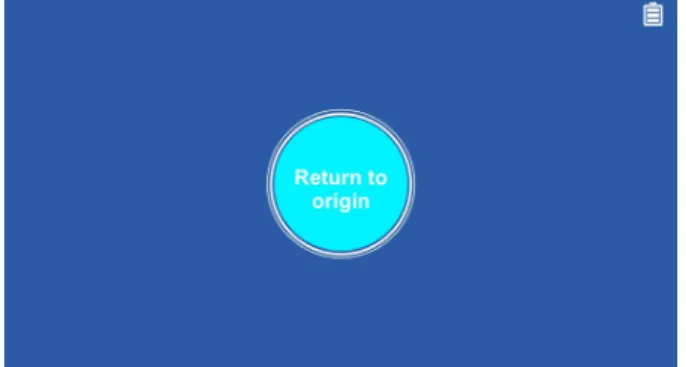
The waiter enters the designated dining table number at the starting interface of the cleaning function. After the robot reaches the designated dining table, the customer takes the initiative to place the plates, containers, tableware etc. in front of the robot, and then click "return to origin" button, the robot will automatically return to the origin, and the waiter will clean the dining table.
Fig. 7. UI design of robot cleaning starting interface
Fig. 8. UI design of robot cleaning end interface
5. Conclusion
Based on the user behavior research and user journey map in the service design methodology, this study aims to explore the services of delivery service robot, including meal delivery service, other service contacts and solutions in the whole process. The research results of this study are as follows: first of all, through user visit, user behavior survey and user journey map, it can be concluded that in the current robot restaurant environment, the reception of customers, simple voice Q & A and cleaning work can be replaced by the delivery robot, and the corresponding robot functional interaction prototype interface is made. Only after realizing comprehensive service and intelligence, can the marketization development of service robots be accelerated.
To realize marketization, the service robot
industry should not only formulate and
implement industry norms and standards, but
also win public recognition and acceptance.It is
expected that experiments of a certain scale can
be carried out in the future for the proposal put
forward in this paper, and the proposal content
can be made into a questionnaire to collect
customers’ feedback and advice at a specific
intelligent restaurant as the experiment site, in
addition, the work efficiency of waiters and the
data of sales revenue can be assessed, based on
which further study can be carried out.
REFERENCES
[1] Huangxiang Chen,(2012),The past, present and future of robots.
[2] Habel, C. (2009). Mensch-Roboter-Interaktion.
Seminar, Sommerse mester 2009.
[3] Chien-Jung Lai & Ching-Pei Tsai. (2018). Design of Introducing Service Robot into Catering Services.
Proceedings of the 2018 International Conference on Service Robotics Technologies, 2018(3), 62-66.
DOI : 10.1145/3208833.3208837
[4] Wei Xu. (2016). The Exploration of Robot Used in Hot Pot. Techniques of Automation and Applications, 35(12), 141-144.
DOI : 10.3969/j.issn.1003-7241.2016.12.037
[5] Xiaoqin Song. (2019). Robots in the age of artificial int elligence. China New Time, 2019(5), 28-32.
DOI : 10.3969/j.issn.1671-8399.2019.05.006
[6] Decker, M.,Fischer, M.. & Ott, I. (2017). Service robotics and human labor: a first technology assessment of substitution and cooperation, Robotics and Autonomous Systems, 87, 348-354.
[7] Severinson-Eklundh, K., Green, A. & Hü ttenrauch, H.
(2003). Social and collaborative aspects of intera ction with a service robot, Robotics and Autonomous Systems, 42, 223-234.
[8] Pellerin, C. (1993). Service robots: clean up in the 1990s, The Industrial Robot, 20(15), 18-21.
[9] Junqi Ma. (1997). SERVICE ROBOT.JOURNAL OF KUNMING UNIVERSITY OF SCIENCE AND TECHNOLOGY, 34-38.
[10] Guang Mingxiong,Tao Zhao,Jianwei Gong & Junyao Gao. (2007). Development Status and Several Problems of Service Robots.MACHINE TOOL & HYDRAULICS, 35(3), 212-215,220.
DOI :10.3969/j.issn.1001-3881.2007.03.075 [11] Keenon. homepage. [Online].
http://www.keenonrobot.com/
[12] Tensorflow Chinese community. [Online].
http://www.tensorfly.cn/tfdoc/tutorials/overview.html [13] Microsoft azure. homepage. [Online].
https://azure.microsoft.com/zh-cn/overview/
[14] Shixuan Liu.(2018).The application and development prospect of service robot in the future.The road to success,2018(3):24-25
DOI :10.3969/j.issn.1008-3561.2018.03.022
[15] ZhouzhouLu. (2015). Application Analysis of Restaurant Service Robot. Technology Wind, 2015(15), 122-123.
DOI : 10.19392/j.cnki.1671-7341.2015.15.102
조 여 기(Zhao Yuqi) [학생회원]
· 2018년 ~ 현재 : 국민대학교테크노 디자인전문대학원경험디자인학과 석사과정
· 관심분야 : 사용자경험, 인터랙션디자 인
· E-Mai l: [email protected]
반 영 환(Young-Hwan Pan) [정회원]