Journal of the Korea Institute for Structural Maintenance and Inspection Vol. 17, No. 4, July 2013, pp.112-118
http://dx.doi.org/10.11112/jksmi.2013.17.4.112
pISSN 2234-6937 eISSN 2287-6979
지진 구조 손상도 예측을 위한 지반 운동 수정법 평가
Evaluation of Ground Motion Modification Methodologies for Seismic Structural Damage
허 영 애1)*
YeongAe Heo
Abstract
The selection of appropriate ground motions and reasonable modification are becoming increasingly critical in reliable prediction on seismic performance of structures. A widely used amplitude scaling approach is not sufficient for robust structural evaluation considering a site specific seismic hazard because only one spectral value is matched to the design spectrum typically at the structural fundamental period. Hence alternative approaches for ground motion selection and modifications have been suggested.
However, there is no means to evaluate such methodologies yet. In this study, it is focused to describe the main questions resided in the amplitude scaling approach and to propose a regression model for structural damage as point of comparison. Spectrum compatible approach whose resulting spectrum matches the design spectrum at the entire range of the structural period is considered as alternative to be compared to the amplitude scaling approach. The design spectrum is generated according to ASCE7-05.
Keywords : Seismic structural response, Ground motion modification, Amplitude scaling, Spectrum compatible, Spectrum matching, Regression model
1) 정회원, 삼성중공업 조선해양연구소 책임연구원, 교신저자 * Corresponding author : [email protected]
• 본 논문에 대한 토의를 2013년 8월 31일까지 학회로 보내주시면 2013년 9월호에 토론결과를 게재하겠습니다.
Copyright Ⓒ 2012 by The Korea Institute for Structural Maintenance and Inspection. This is an Open Access article distributed under the terms of the Creative Commons Attribution Non-Commercial License (http://creativecommons.org/licenses/by-nc/3.0)which permits unrestricted non-commercial use, distribution, and reproduction in any medium, provided the original
1. Introduction
It would be very important to apply a recorded ground motion from a previous event that has same site condition, earthquake characteristics (such as distance, magnitude, fault type, directivity, and etc.) for reasonable seismic design and evaluation because structural response is very sensitive to the choice of ground motions especially in nonlinear dynamic analysis for offshore structures vulnerable to seismic hazard (Kim, 2012; Jun et al., 2006). It would be extremely rare, however, to find such a ground motion record. Hence, it is common practice to select empirical recorded motions from other locations with similar site and hazard characteristics, which results in the necessity of modifying ground motions so that the demands imposed by
the selected records are within the expected range of force demands dictated by the site-specific design spectrum. Two of the main approaches to ground motion modification are intensity based scaling and spectrum matching. The former involves magnitude scaling of acceleration time series at a spectral period, and the latter involves modifying the spectral content of the time series for the entire range of spectral periods in the design spectrum.
The main issues that need to be considered in choosing either of the ground motion modification methods are:
1) For the amplitude scaling approach
∙ What intensity measure should form the basis of the selections?
∙ Whether the average or the maximum response should be considered in performance assessment,
i.e. are those values reliable?
2) For spectrum matching / spectrum compatible approach
∙ Is it too conservative to match the design spectrum which is an envelope of multiple earthquakes?
∙ Does the modification of the frequency content distort the non-stationary characteristics of the time series?
∙ Is it unrealistic to smoothen out all the peaks and troughs and thereby alter the structural response in uncertain ways?
In this paper it is focused on evaluating both methods against the so-called “true” solution assuming that a predictive regression model utilizing high-end numerical simulations and considering a large volume of earthquake recordings enables the generation of a model that likely produces the best possible prediction (Watson-Lamprey, 2007; Heo, 2009). Further details about the necessary information such as a sample structural model, selected ground motions, the proposed damage model, intensity scaling and spectrum compatible methodologies, and etc.
are well described in Heo (2009).
2. Evaluation Framework
The proposed evaluation framework consists in the development of statistical prediction models (or regression model) based on the analysis of large data sets that consist either of existing empirical data (such as ground motion parameters from recorded motions) or simulated data from detailed numerical procedures (such as nonlinear structural simulations). The purpose of a regression model for structural response is two-fold: first, it provides a simple means to predict a reliable probabilistic structural response quantity with considerable reduction in computational effort;
and secondly it offers a means to compare different approaches in seismic structural analysis and resolve existing controversy on ground modification and selection.
2.1 Regression Model for Structural Response
The typical procedure for developing a regression model of a sample model response parameter, Y, in terms a set of predictive parameters, Xi, consists of the following steps.
An expression of the following form can be generated from available data:
ln ln ⋯ ln (1)
In the above expression, n predictive parameters are selected. The constants are determined by data analysis.
The importance of the selected variables can be established by examining the magnitude of the constants and the standard deviation of the residuals and the correlation among the predictive parameters. The correlation can be determined by examining the following parameter:
ln ln
ln
(2)
This is a residual normalized by the standard deviation of the residual. The residual of the model Y is determined from:
ln ln ln (3)
Once it is confirmed that a correlation exists between some of the predictive parameters, these variables should be linked by correlation functions. For example, if εlnX1, εlnX2
and εlnX3 are correlated, then the following correlation functions can be developed:
ln ln (4)
ln ′ ′ln ′ln (5)
Note that in the above expressions, each of the predictive parameters can be formulated as a separate set of regression models. This is a general process to establish a regression model; hence, it can be applied to the
development of regression models for both the structural response in terms of ground motion parameters and ground motion parameters in terms of earthquake parameters. For example, to generate a regression model of a structural response measure in terms of ground motion parameters, the Damage Index (DI) calculated from an existing damage model (Heo 2009) represents Y and spectral acceleration amplitudes at critical periods (such as SaT1
and SaT2) represent the predictive parameters.
2.2 Regression Model for Ground Motion Parameter
Ideally, the objective of the probabilistic assessment is to establish the probability of exceeding a certain damage threshold given an earthquake scenario. To accomplish this, it is also essential to develop a ground motion prediction model in terms of earthquake parameters (such as moment magnitude, M, of the earthquake and closet distance to the rupture zone, R)
ln ln ln (6)
In the above example, only a single ground motion parameter and two earthquake parameters are considered.
Additional forms of the above model are obviously possible and the choice of parameters depends on numerous factors. The development of a ground motion prediction model based on earthquake site and source characteristics is beyond the scope of the present study because a large body of literature currently exists on this topic in the field of seismology. In the present study, spectral magnitudes are generated using provisions in ASCE 7-05.
2.3 Probability Density and Fragility Curve of the Response
Finally, the probability that a set of ground motions causes a selected damage index to be exceeded for a given earthquake scenario is computed by integrating the probability distribution of the structural response measure (DI) over the truncated area from ε’δlnDI (the value of the normalized residual corresponding to a specified damage
state, di) to infinity:
′ln
∞
ln
ln (7)
ln
lnln (8)
expln exp
ln
ln (9)
In the above equations,
ln is the normal distribution function of the normalized residuals with the mean,
ln, and standard deviation, ln, of the computed damage indices. The cumulative probability density distribution represented by Eq. (7) is referred to as a fragility function.
2.4 Probabilistic Performance Evaluation
The procedure described in Section 2.1 through 2.3 is applied to develop predictive models of the response of a 12-story with 5-bay RC building designed to modern seismic provisions. The true response model is generated through a complete set of 200 nonlinear time-history simulations of the building. The following ground motion parameters are considered: spectral acceleration at the fundamental period, SaT1, the spectral acceleration at the second mode period, SaT2, the spectral acceleration at the third mode period, SaT3. Higher mode ground motion parameters can be a reliable parameter in case that ground motions push the system well into the inelastic response region. The following combination of ground motion parameters were considered in generating the regression model:
ln ln ln ln (10)
Results of the data analysis using the proposed structural damage in Heo (2009) are presented in Table 1.
Fig. 1 shows the representative structural damage residuals for the 200 simulations as a function of various ground motion parameters, which indicates that the prediction is
Table 1 Regression coefficient for the response model using damage indices reinforced concrete frame
ln ln
0.1609 0.3979 -0.4980 0.3464 0.1147 0.2577
(a) for the spectral acceleration at the first mode period
(b) for the spectral acceleration at the second mode period Fig. 1 Structural damage residuals versus spectral accelerations
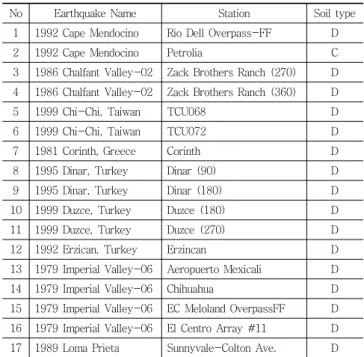
Table 2 Seventeen (17) ground motion details
No Earthquake Name Station Soil type
1 1992 Cape Mendocino Rio Dell Overpass-FF D
2 1992 Cape Mendocino Petrolia C
3 1986 Chalfant Valley-02 Zack Brothers Ranch (270) D 4 1986 Chalfant Valley-02 Zack Brothers Ranch (360) D
5 1999 Chi-Chi, Taiwan TCU068 D
6 1999 Chi-Chi, Taiwan TCU072 D
7 1981 Corinth, Greece Corinth D
8 1995 Dinar, Turkey Dinar (90) D
9 1995 Dinar, Turkey Dinar (180) D
10 1999 Duzce, Turkey Duzce (180) D
11 1999 Duzce, Turkey Duzce (270) D
12 1992 Erzican, Turkey Erzincan D
13 1979 Imperial Valley-06 Aeropuerto Mexicali D 14 1979 Imperial Valley-06 Chihuahua D 15 1979 Imperial Valley-06 EC Meloland OverpassFF D 16 1979 Imperial Valley-06 El Centro Array #11 D 17 1989 Loma Prieta Sunnyvale-Colton Ave. D
Table 3 The peak ground accelerations (PGA) and the spectral accelerations at the fundamental period (SaT1) of the 17 ground motions
No 1 2 3 4 5 6
PGA 0.386 0.597 0.447 0.400 0.464 0.402 SaT1 0.128 0.129 0.135 0.102 0.520 0.268
No 7 8 9 10 11 12
PGA 0.241 0.352 0.283 0.349 0.536 0.498 SaT1 0.093 0.358 0.202 0.216 0.421 0.360
No 13 14 15 16 17
PGA 0.333 0.273 0.296 0.364 0.208
SaT1 0.226 0.104 0.507 0.220 0.155
Table 4 Record sets for scaling approach
set1 set2 set3
No SF No SF No SF
1 2.49 1 2.49 16 0.61
2 2.47 2 2.47 77 0.89
3 2.36 3 2.36 78 1.58
4 3.12 5 0.61 82 0.76
6 1.19 10 1.47 86 0.88
7 3.42 11 0.76 91 1.41
17 2.05 17 2.05 98 0.63
quite reasonable within about 16% of the standard deviation.
Recall from Eq. (3) that the residual is the difference between the natural logarithm of the model prediction and the actual simulated value from the numerical simulations.
Among 200 ground motions and the corresponding structural responses, seventeen (17) ground motions and the structural responses are randomly selected to evaluate two of ground motion modification methodologies. The details of the selected ground motions are listed in Table 2 and Table 3.
For intensity scaling approach, three sets of seven ground motions are selected from a bin consisting of the
17 randomly selected ground motions. The seven ground motions contained in these ground motion sets and each scale factor(SF) are tabulated in Table 4.
(a) set 1 (b) set 2
(c) set 3 (d) 17 spectral matched records
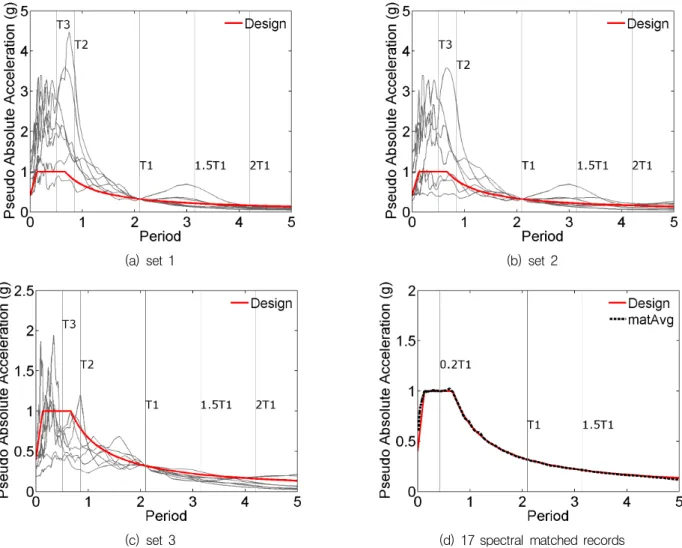
Fig. 2 Spectra of scaled record (Notation: Design: ASCE 7-05 design spectra; matAvg: average of spectrum-matched records)
The acceleration spectra of these ground motions are scaled to the design spectrum at the fundamental period.
The scaled spectra for each set are plotted in Fig. 2(a)~(c) respectively. The design spectrum drawn from ASCE7-05 is also presented in each figures with red solid line. Also spectral matched ground motions are created for all 17 ground motions (Fig. 2(d)). For these scaled and spectral matched ground motions, nonlinear transient structural analyses were carried out in order to generate structural performance indices such as material based damage, inter-story drift ratio, plastic rotation, and etc.
The probability distributions of structural performance for the scaled and spectrum-matched ground motions are compared to the one for 200 unscaled ground motions.
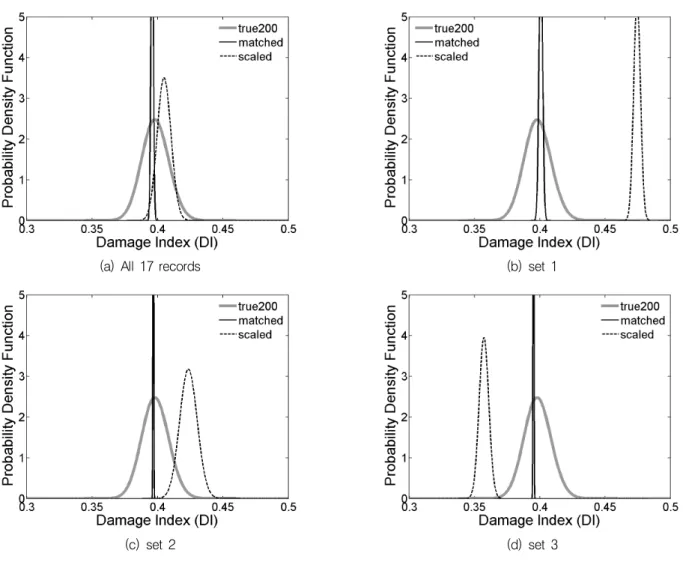
This probability distribution for 200 unscaled ground motion can play a role of “true” solution and it is shown
in Fig. 3 with bold solid line. Also, regular solid line and dotted line display the probability distribution of structural performance for spectrum-matched and scaled ground motions respectively. In Fig. 3(a), the probability distributions are plotted using all 17 ground motions for both approaches while only 7 ground motions are used as listed in Table 4 for Fig. 3(b)~(d). The results of the comparison clearly indicate that the spectrum-matched records consistently provide mean estimates of damage that are close to the
“true” model and generally have the least dispersion compared to the other ground motion sets. The three sets of scaled motions provide different estimates of mean damage with Set 1 in Fig. 3(b) providing estimates that are further from the true model. This suggests that using scaled records require a process of careful record selection so that the mean estimates are reliable.
(a) All 17 records (b) set 1
(c) set 2 (d) set 3
Fig. 3 Probability distribution of damage index
3. Conclusions
A probabilistic framework is used to assess the suitability of two ground motion modification methods. 200 nonlinear transient structural analyses are carried out for a 12-story with 5-bay RC building designed to modern seismic provisions using OpenSEES (2012). It was demonstrated that the mean estimates of structural damage using a limited subset of spectrum-matched records are statistically more consistent than similar estimates using the same set of scaled records. Therefore, significantly more effort should go into selecting appropriate records when using a scaling approach. Consequently, spectrum compatible approach provides more reliable prediction of seismic performance for RC buildings with much less computational cost than other existing methodologies to select and modify ground
motions. Further research should explore the effect of different structural types on seismic performance evaluation.
References
1. ACI, ACI 318-09: Building Code Requirements for Structural Concrete, Farmington Hills, MI: American Concrete Institute, 2009.
2. ASCE, ASCE/SEI 7-05: Minimum Design Loads for Buildings and Other Structures, Reston, VA: American Society of Civil Engineers, 2005.
3. Heo, Y. A., Framework for Damage-Based Probabilistic Seismic Performance Evaluation of Reinforced Concrete Frames, Published Ph.D. diss., Davis, CA: University of California at Davis, Department of Civil and Environmental Engineering, 2009, p.197.
4. Jun, D. H., Kang, P. D. and Kim, J. U., Nonlinear Response Spectra of Artificial Earthquake Waves Compatible with Design Spectrum, Journal of Earthquake Engineering Society of Korea, Vol. 10, No. 5, 2006, pp.63-71 (in Korean).
요 지
성능기반 내진설계 및 평가의 정밀도 향상에 있어서 적절한 지반운동 데이터 선정과 이를 합리적으로 수정하는 것에 대한 중요성이 부 각되고 있다. 지반운동 데이터를 수정하는 방법으로 단일 진폭수정법 (Amplitude scaling)이 널리 사용되고 있으나, 단일 진폭수정법에서 는 단 하나의 주기, 특히 구조물의 고유주기에서만 그 응답스펙트럼 값이 설계스펙트럼의 값과 일치하도록 수정되므로 특정 지역의 지진 재해도에 대해 일관성 있는 구조 해석 결과를 기대하기 어렵다. 따라서 이에 대해 여러 가지 대안 수정법들이 제시되고 있으나 이들의 타당 성을 평가할 수 있는 방안이 마련되어 있지 않다. 본 논문에서는 단일 진폭수정법의 문제점을 설명하고, 대안 수정법과 비교 평가하기 위한 구조 응답에 대한 회귀 모델을 제시하는데 목표를 두었다. 대안 수정법으로써 전체 주기 범위에서 지반운동의 응답스펙트럼이 설계스펙트 럼의 값과 일치하도록 수정하는 다중 스펙트럼 수정법을 고려하였다. 설계스펙트럼은 ASCE7-05에 따라 구하였다.
핵심 용어 : 지진 구조 응답, 지반운동 수정, 단일 진폭수정법, 다중 스펙트럼 수정법, 회귀 모델 5. Kim, T. W., Seismic Performance Evaluation of Steel
Moment Frames in Korea Using Nonlinear Dynamic Analysis, Journal of Earthquake Engineering Society of Korea, Vol.
16, No. 4, 2012, pp.1-8 (in Korean).
6. OpenSEES, Open source finite element platform for earthquake engineering simulations, Berkeley, CA: Pacific Earthquake Engineering Center, University of California at Berkeley.
Available at: http://opensees.berkeley.edu, 2012.
7. Watson-Lamprey, J. A., Selection and Scaling of Ground
Motion Time Series, Published Ph.D. diss., Berkeley, CA:
University of California at Berkeley, 2007, p.241.
Received : 05/20/2013 Revised : 06/11/2013 Accepted : 06/14/2013