http://dx.doi.org/10.6111/JKCGCT.2012.22.1.029
Importance of convection during physical vapor transport of Hg
2Cl
2in the presence of Kr under environments of high gravitational accelerations
Geug-Tae Kim†
Department of Nano-Bio Chemical Engineering, Hannam University, Taejon 305-811, Korea (Received December 8, 2011)
(Revised December 23, 2011) (Accepted January 6, 2012)
Abstract Special attention in the role of convection in vapor crystal growth has been paid since some single crystals under high gravity acceleration of 10g0 appear considerably larger than those under normal gravity acceleration (1g0). With increasing the gravity acceleration from 1g0 up to 10g0, the total molar flux for ∆T = 30 K increases by a factor of 4, while for ∆T = 90, by a factor of 3. The maximum molar fluxes for three different gravity levels of 1g0, 4g0 and 10g0, appear approximately in the neighborhood of y = 0.5 cm, and the molar fluxes show asymmetrical patterns, which indicate the occurrence of either one single or more than one convective cell. As the gravitational level is enhanced form 1g0 up to 10g0, the intensity of convection is increased significantly through the maximum molar fluxes for ∆T = 30 K and 90 K. At 10g0, the maximum total molar flux is nearly invariant for for ∆T = 30 K and 90 K. The total molar flux increases with increasing the gravity acceleration, for 1g0≤ gy≤ 10g0, and decreases with increasing the partial pressure of component B, a noble gas called as Kr (Krypton), PB. The |U|max is directly proportional to the gravity acceleration for 20 Torr PB≤ 300 Torr.
As the partial pressure of PB (Torr) decreases from 300 Torr to 20 Torr, the slopes of the |U|maxs versus the gravity accelerations increase from 0.29 sec to 0.54 sec, i.e. by a factor of 2. The total molar flux of Hg2Cl2 is first order exponentially decayed with increasing the partial pressure of component B, PB (Torr) from 20 Torr up to 300 Torr.
Key words Mercurous chloride, Convection, Krypton, Gravity, Physical vapor transport
1. Introduction
Physical vapor transport (PVT) has become an impor- tant crystal growth process for a variety of acousto-optic materials. Of particular importance is the use of PVT for materials processing experiments in high gravity environments, which would provide a better and thor- ough understanding of transport phenomena occurring in the vapor phase and crystal growth phenomena. Until now many theoretical studies and quantitative experi- ments on transport phenomena in PVT have been exten- sively investigated. Most important theoretical works were achieved by Rosenberger et al. [1-6] and, recently extended for transition to chaos flow fields in specialty materials of mercurous chloride in applications of micro- gravity experiments by Duval [7-12]. They have addressed the underlying phenomena in the PVT processes on the relative importance and influencing parameters of diffu- sion-advection, thermal and/or solutal convection on mass transport. Our recent studies [13-17] are for PVT processes of specialty materials such as mercurous
halides under normal and microgravity environments to investigate the role of convection on the mass transport rate and its transition from diffusion-dominated to circu- latory convection-dominated regimes in relation to total pressure, temperatures of source and crystal ends, aspect ratio (transport length-to-width), wall temperature pro- files, molecular weights.
It is the purpose of this paper to study the transport phenomena covering the various gravity accelerations in the PVT processes of Hg2Cl2 crystal growth system. For this theoretical analysis of the PVT processes, a two- dimensional model is in horizontally oriented, cylindri- cal, closed ampoules in a two-zone furnace system. The effects of high gravity accelerations on solutally and/or thermally buoyancy-driven convection will be considered at this point, primarily for a mixture of Hg2Cl2 vapor and impurity of Krypton (Kr) under high gravity conditions.
2. The Model
Mercurous chloride (Hg2Cl2) materials are important for applications in acousto-optic and opto-electronic devices such as Bragg cells, X-ray detectors operating at ambient temperature [11]. The equimolar Hg2Cl2 com-
†Corresponding author
†Tel: +82-42-629-8837
†Fax: +82-42-629-8835
†E-mail: [email protected]
pound decomposes to two liquids at a temperature near 525oC where the vapor pressure is above 20 atm [18].
Because of this decomposition and high vapor pressure, Hg2Cl2 cannot be solidified as a single crystal directly from the stoichiometric melt. However, very similar to the mercurous bromide, mercurous chloride exhibits suf- ficiently high vapor pressure at low temperatures so that these crystals are usually grown by the physical vapor transport (PVT) in closed silica glass ampoules.
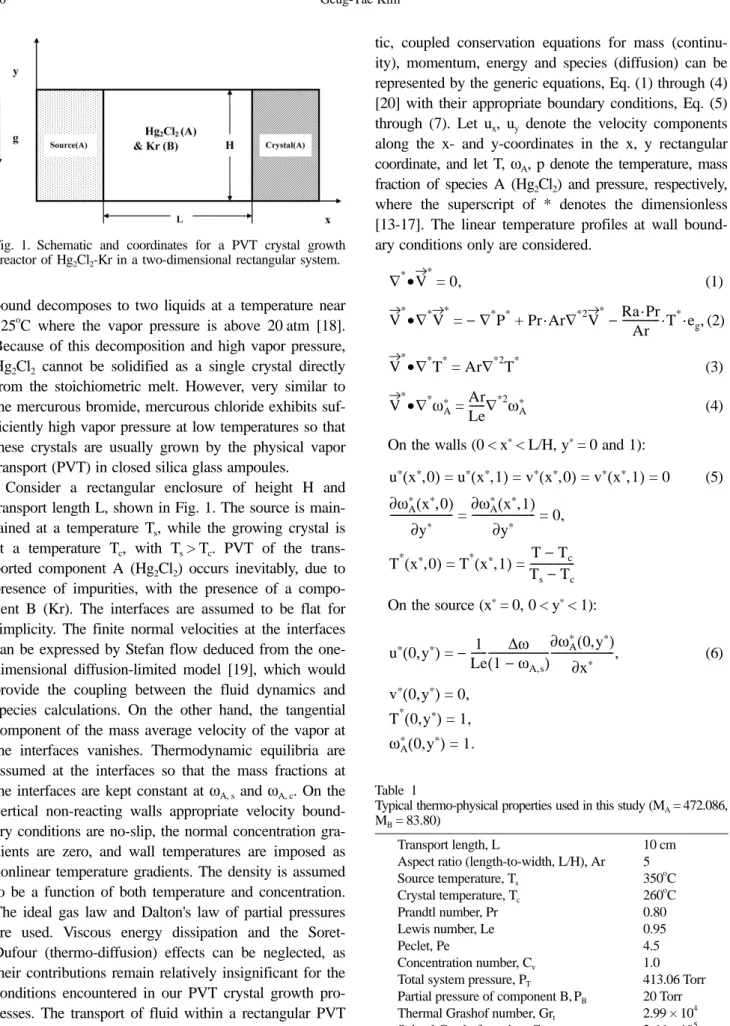
Consider a rectangular enclosure of height H and transport length L, shown in Fig. 1. The source is main- tained at a temperature Ts, while the growing crystal is at a temperature Tc, with Ts> Tc. PVT of the trans- ported component A (Hg2Cl2) occurs inevitably, due to presence of impurities, with the presence of a compo- nent B (Kr). The interfaces are assumed to be flat for simplicity. The finite normal velocities at the interfaces can be expressed by Stefan flow deduced from the one- dimensional diffusion-limited model [19], which would provide the coupling between the fluid dynamics and species calculations. On the other hand, the tangential component of the mass average velocity of the vapor at the interfaces vanishes. Thermodynamic equilibria are assumed at the interfaces so that the mass fractions at the interfaces are kept constant at ωA, s and ωA, c. On the vertical non-reacting walls appropriate velocity bound- ary conditions are no-slip, the normal concentration gra- dients are zero, and wall temperatures are imposed as nonlinear temperature gradients. The density is assumed to be a function of both temperature and concentration.
The ideal gas law and Dalton's law of partial pressures are used. Viscous energy dissipation and the Soret- Dufour (thermo-diffusion) effects can be neglected, as their contributions remain relatively insignificant for the conditions encountered in our PVT crystal growth pro- cesses. The transport of fluid within a rectangular PVT crystal growth reactor is governed by a system of ellip-
tic, coupled conservation equations for mass (continu- ity), momentum, energy and species (diffusion) can be represented by the generic equations, Eq. (1) through (4) [20] with their appropriate boundary conditions, Eq. (5) through (7). Let ux, uy denote the velocity components along the x- and y-coordinates in the x, y rectangular coordinate, and let T, ωA, p denote the temperature, mass fraction of species A (Hg2Cl2) and pressure, respectively, where the superscript of * denotes the dimensionless [13-17]. The linear temperature profiles at wall bound- ary conditions only are considered.
(1) (2)
(3) (4) On the walls (0 < x*< L/H, y*= 0 and 1):
(5)
On the source (x*= 0, 0 < y*< 1):
(6)
∇*•V* = 0,
V* ∇*V* = − ∇*P* + Pr Ar∇*2V* − Ra Pr⋅ --- TAr ⋅ ⋅* eg,
⋅
•
V*•∇*T* = Ar∇*2T* V* ∇*ωA* = Ar
Le---∇*2ωA*
•
u*(x*,0) = u*(x*,1) = v*(x*,0) = v*(x*,1) = 0
∂ωA*(x*,0)
∂y*
--- = ∂ωA*(x*,1)
∂y*
--- = 0,
T*(x*,0) = T*(x*,1) = T − Tc
Ts − Tc
---
u*(0 y, *) = − 1 Le--- ∆ω
1 − ωA s,
( )
---∂ωA*(0 y, *)
∂x* ---, v*(0 y, *) = 0,
T*(0 y, *) = 1, ωA*(0 y, *) = 1.
Fig. 1. Schematic and coordinates for a PVT crystal growth reactor of Hg2Cl2-Kr in a two-dimensional rectangular system.
Table 1
Typical thermo-physical properties used in this study (MA= 472.086, MB= 83.80)
Transport length, L 10 cm
Aspect ratio (length-to-width, L/H), Ar 5
Source temperature, Ts 350oC
Crystal temperature, Tc 260oC
Prandtl number, Pr 0.80
Lewis number, Le 0.95
Peclet, Pe 4.5
Concentration number, Cv 1.0
Total system pressure, PT 413.06 Torr Partial pressure of component B,PB 20 Torr Thermal Grashof number, Grt 2.99 × 10⁴ Solutal Grashof number, Grs 2.66 × 10⁵
On the crystal (x*= L/H, 0 < y*< 1):
(7)
3. Results and Discussion
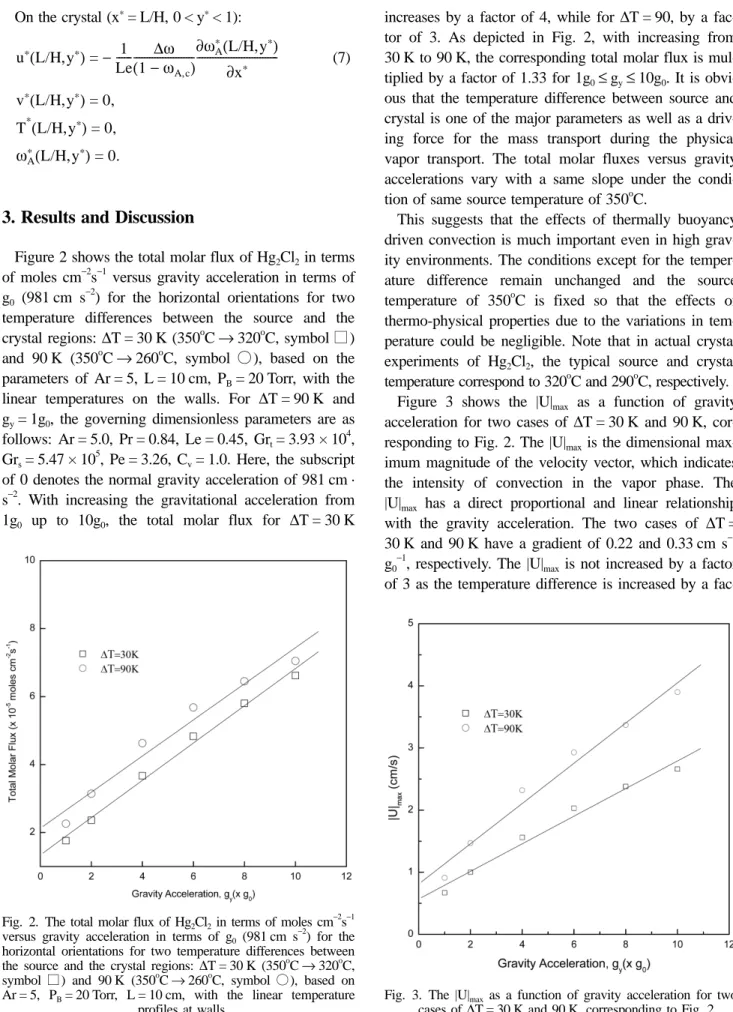
Figure 2 shows the total molar flux of Hg2Cl2 in terms of moles cm−2s−1 versus gravity acceleration in terms of g0 (981 cm s−2) for the horizontal orientations for two temperature differences between the source and the crystal regions: ∆T = 30 K (350oC→ 320oC, symbol □) and 90 K (350oC→ 260oC, symbol ○), based on the parameters of Ar = 5, L = 10 cm, PB= 20 Torr, with the linear temperatures on the walls. For ∆T = 90 K and gy= 1g0, the governing dimensionless parameters are as follows: Ar = 5.0, Pr = 0.84, Le = 0.45, Grt= 3.93 × 10⁴, Grs= 5.47 × 10⁵, Pe = 3.26, Cv= 1.0. Here, the subscript of 0 denotes the normal gravity acceleration of 981 cm · s−2. With increasing the gravitational acceleration from 1g0 up to 10g0, the total molar flux for ∆T = 30 K
increases by a factor of 4, while for ∆T = 90, by a fac- tor of 3. As depicted in Fig. 2, with increasing from 30 K to 90 K, the corresponding total molar flux is mul- tiplied by a factor of 1.33 for 1g0≤ gy≤ 10g0. It is obvi- ous that the temperature difference between source and crystal is one of the major parameters as well as a driv- ing force for the mass transport during the physical vapor transport. The total molar fluxes versus gravity accelerations vary with a same slope under the condi- tion of same source temperature of 350oC.
This suggests that the effects of thermally buoyancy driven convection is much important even in high grav- ity environments. The conditions except for the temper- ature difference remain unchanged and the source temperature of 350oC is fixed so that the effects of thermo-physical properties due to the variations in tem- perature could be negligible. Note that in actual crystal experiments of Hg2Cl2, the typical source and crystal temperature correspond to 320oC and 290oC, respectively.
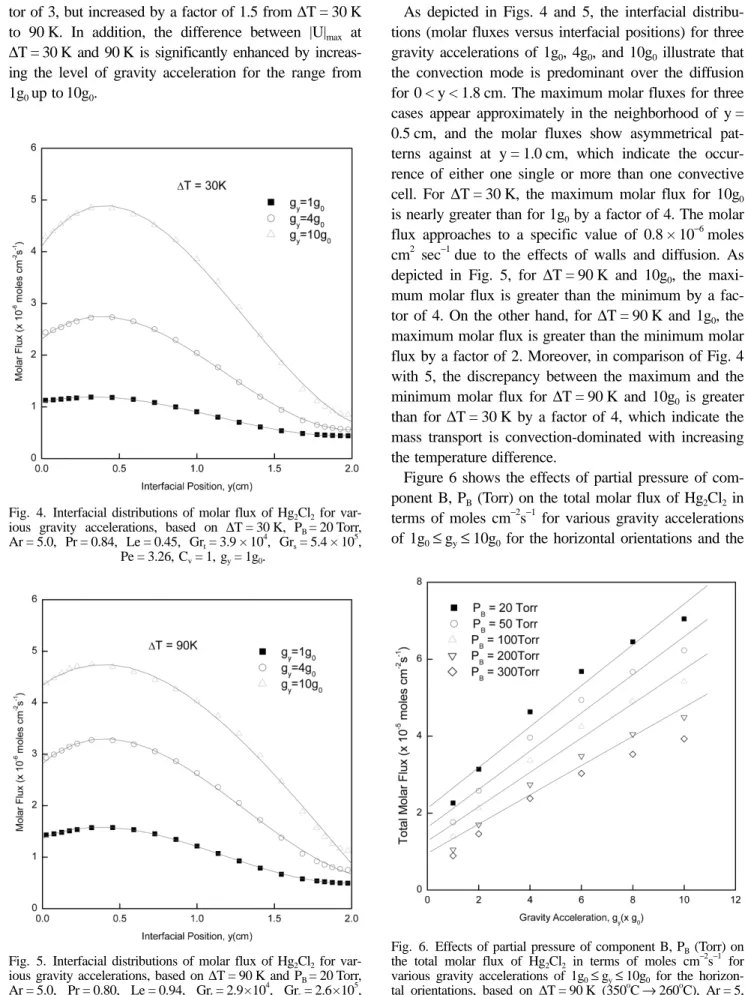
Figure 3 shows the |U|max as a function of gravity acceleration for two cases of ∆T = 30 K and 90 K, cor- responding to Fig. 2. The |U|max is the dimensional max- imum magnitude of the velocity vector, which indicates the intensity of convection in the vapor phase. The
|U|max has a direct proportional and linear relationship with the gravity acceleration. The two cases of ∆T = 30 K and 90 K have a gradient of 0.22 and 0.33 cm s−1 g0−1, respectively. The |U|max is not increased by a factor of 3 as the temperature difference is increased by a fac- u*(L/H y, *) = − 1
Le--- ∆ω 1 − ωA c,
( )
---∂ωA*(L/H y, *)
∂x* --- v*(L/H y, *) = 0,
T*(L/H y, *) = 0, ωA*(L/H y, *) = 0.
Fig. 2. The total molar flux of Hg2Cl2 in terms of moles cm−2s−1 versus gravity acceleration in terms of g0 (981 cm s−2) for the horizontal orientations for two temperature differences between the source and the crystal regions: ∆T = 30 K (350oC→ 320oC, symbol □) and 90 K (350oC→ 260oC, symbol ○), based on Ar = 5, PB= 20 Torr, L = 10 cm, with the linear temperature
profiles at walls.
Fig. 3. The |U|max as a function of gravity acceleration for two cases of ∆T = 30 K and 90 K, corresponding to Fig. 2.
tor of 3, but increased by a factor of 1.5 from ∆T = 30 K to 90 K. In addition, the difference between |U|max at
∆T = 30 K and 90 K is significantly enhanced by increas- ing the level of gravity acceleration for the range from 1g0 up to10g0.
As depicted in Figs. 4 and 5, the interfacial distribu- tions (molar fluxes versus interfacial positions) for three gravity accelerations of 1g0, 4g0, and 10g0 illustrate that the convection mode is predominant over the diffusion for 0 < y < 1.8 cm. The maximum molar fluxes for three cases appear approximately in the neighborhood of y = 0.5 cm, and the molar fluxes show asymmetrical pat- terns against at y = 1.0 cm, which indicate the occur- rence of either one single or more than one convective cell. For ∆T = 30 K, the maximum molar flux for 10g0
is nearly greater than for 1g0 by a factor of 4. The molar flux approaches to a specific value of 0.8 × 10⁻⁶moles cm2 sec−1 due to the effects of walls and diffusion. As depicted in Fig. 5, for ∆T = 90 K and 10g0, the maxi- mum molar flux is greater than the minimum by a fac- tor of 4. On the other hand, for ∆T = 90 K and 1g0, the maximum molar flux is greater than the minimum molar flux by a factor of 2. Moreover, in comparison of Fig. 4 with 5, the discrepancy between the maximum and the minimum molar flux for ∆T = 90 K and 10g0 is greater than for ∆T = 30 K by a factor of 4, which indicate the mass transport is convection-dominated with increasing the temperature difference.
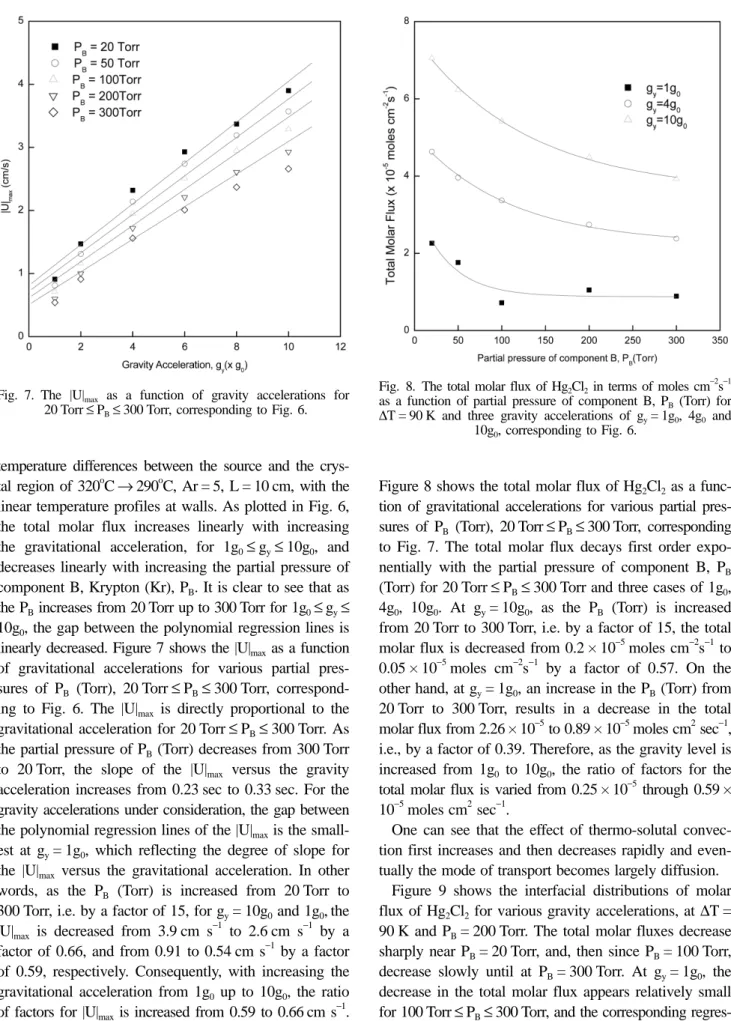
Figure 6 shows the effects of partial pressure of com- ponent B, PB (Torr) on the total molar flux of Hg2Cl2 in terms of moles cm−2s−1 for various gravity accelerations of 1g0≤ gy≤ 10g0 for the horizontal orientations and the
Fig. 5. Interfacial distributions of molar flux of Hg2Cl2 for var- ious gravity accelerations, based on ∆T = 90 K and PB= 20 Torr, Ar = 5.0, Pr = 0.80, Le = 0.94, Grt= 2.9×10⁴, Grs= 2.6×10⁵,
Pe = 4.5, Cv= 1.0, gy= 1g0.
Fig. 6. Effects of partial pressure of component B, PB (Torr) on the total molar flux of Hg2Cl2 in terms of moles cm−2s−1 for various gravity accelerations of 1g0≤ gy≤ 10g0 for the horizon- tal orientations, based on ∆T = 90 K (350oC→ 260oC), Ar = 5,
L = 10 cm, with the linear temperature profiles at walls.
Fig. 4. Interfacial distributions of molar flux of Hg2Cl2 for var- ious gravity accelerations, based on ∆T = 30 K, PB= 20 Torr, Ar = 5.0, Pr = 0.84, Le = 0.45, Grt= 3.9 × 10⁴, Grs= 5.4 × 10⁵,
Pe = 3.26, Cv= 1, gy= 1g0.
temperature differences between the source and the crys- tal region of 320oC→ 290oC, Ar = 5, L = 10 cm, with the linear temperature profiles at walls. As plotted in Fig. 6, the total molar flux increases linearly with increasing the gravitational acceleration, for 1g0≤ gy≤ 10g0, and decreases linearly with increasing the partial pressure of component B, Krypton (Kr), PB. It is clear to see that as the PB increases from 20 Torr up to 300 Torr for 1g0≤ gy≤ 10g0, the gap between the polynomial regression lines is linearly decreased. Figure 7 shows the |U|max as a function of gravitational accelerations for various partial pres- sures of PB (Torr), 20 Torr≤ PB≤ 300 Torr, correspond- ing to Fig. 6. The |U|max is directly proportional to the gravitational acceleration for 20 Torr≤ PB≤ 300 Torr. As the partial pressure of PB (Torr) decreases from 300 Torr to 20 Torr, the slope of the |U|max versus the gravity acceleration increases from 0.23 sec to 0.33 sec. For the gravity accelerations under consideration, the gap between the polynomial regression lines of the |U|max is the small- est at gy= 1g0, which reflecting the degree of slope for the |U|max versus the gravitational acceleration. In other words, as the PB (Torr) is increased from 20 Torr to 300 Torr, i.e. by a factor of 15, for gy= 10g0 and 1g0,the
|U|max is decreased from 3.9 cm s−1 to 2.6 cm s−1 by a factor of 0.66, and from 0.91 to 0.54 cm s−1 by a factor of 0.59, respectively. Consequently, with increasing the gravitational acceleration from 1g0 up to 10g0, the ratio of factors for |U|max is increased from 0.59 to 0.66 cm s−1.
Figure 8 shows the total molar flux of Hg2Cl2 as a func- tion of gravitational accelerations for various partial pres- sures of PB (Torr), 20 Torr≤ PB≤ 300 Torr, corresponding to Fig. 7. The total molar flux decays first order expo- nentially with the partial pressure of component B, PB (Torr) for 20 Torr≤ PB≤ 300 Torr and three cases of 1g0, 4g0, 10g0. At gy= 10g0, as the PB (Torr) is increased from 20 Torr to 300 Torr, i.e. by a factor of 15, the total molar flux is decreased from 0.2 × 10⁻⁵moles cm−2s−1 to 0.05 × 10⁻⁵moles cm−2s−1 by a factor of 0.57. On the other hand, at gy= 1g0, an increase in the PB (Torr) from 20 Torr to 300 Torr, results in a decrease in the total molar flux from 2.26 × 10⁻⁵ to 0.89 × 10⁻⁵moles cm2 sec−1, i.e., by a factor of 0.39. Therefore, as the gravity level is increased from 1g0 to 10g0, the ratio of factors for the total molar flux is varied from 0.25 × 10⁻⁵ through 0.59 × 10⁻⁵moles cm2 sec−1.
One can see that the effect of thermo-solutal convec- tion first increases and then decreases rapidly and even- tually the mode of transport becomes largely diffusion.
Figure 9 shows the interfacial distributions of molar flux of Hg2Cl2 for various gravity accelerations, at ∆T = 90 K and PB= 200 Torr. The total molar fluxes decrease sharply near PB= 20 Torr, and, then since PB= 100 Torr, decrease slowly until at PB= 300 Torr. At gy= 1g0, the decrease in the total molar flux appears relatively small for 100 Torr≤ PB≤ 300 Torr, and the corresponding regres- Fig. 8. The total molar flux of Hg2Cl2 in terms of moles cm−2s−1 as a function of partial pressure of component B, PB (Torr) for
∆T = 90 K and three gravity accelerations of gy= 1g0, 4g0 and 10g0, corresponding to Fig. 6.
Fig. 7. The |U|max as a function of gravity accelerations for 20 Torr≤ PB≤ 300 Torr, corresponding to Fig. 6.
sion profile is nearly flat. For the case of gy= 1g0, PB= 20 Torr and ∆T = 90 K in Fig. 5, the operation parame- ters are as follows: Ar = 5.0, Pr = 0.8, Le = 0.94, Grt= 2.9 × 10⁴, Grs= 2.6 × 10⁵, Pe = 4.5, Cv= 1.0. As shown in Fig. 9, like the cases of PB= 20 Torr, i.e., as shown in Fig. 5, the maximum molar flux for three gravitational accelerations appear at the neighborhood of y = 0.5 cm, and the molar fluxes versus the interfacial positions show asymmetrical against the position of y = 1.0 cm.
The molar fluxes for three different gravities of 1, 4, and 10g0 converge at the neighborhood of 0.4, while for the cases of PB= 20 Torr, the molar fluxes approach the value of 0.8 × 10⁻⁶moles cm2 sec−1 near y = 2.0 cm.
This result indicates that the convection for PB= 20 Torr are likely to be more predominant near y = 2.0 cm than for PB= 200 Torr. In comparison of Figs. 5 and 9, an increase in the partial pressure of component B, PB from 20 to 200 Torr suppresses the convective effects. The maximum molar flux for PB= 20 Torr and 10g0 is greater than for PB= 200 by a factor of 1.39. In addition, for PB= 200 Torr and 10g0 in Fig. 9, the maximum molar fluxes is greater than the minimum molar fluxes by a factor of 5.5. The difference between the maximum and the minimum molar flux for PB= 20 Torr and 10g0 is greater than for PB= 200 Torr by a factor of 1.4, which implies the mass transport by the diffusion is strong to enough to cause more significant nonuniformities with increasing the partial pressure of component B, PB.
4. Conclusions
The convection in crystal growth of Hg2Cl2-Kr during the physical vapor transport under environments of high gravitational accelerations is strong enough to cause the nonouniformites in front of the crystal region. The levels of gravitational acceleration more than 1g0 are appropri- ate to ensure the mass transport by the means of diffu- sive-convection. For both ∆T = 30 K and 90 K, the total molar flux increases by a factor of 3.5 with increasing the gravitational acceleration from 1g0 up to 10g0. The maximum molar fluxes for 1g0, 4g0 and 10g0 appear approximately in the neighborhood of y = 0.5 cm, and the molar flux shows asymmetrical patterns, which indi- cate the occurrence of either one single or more than one convective cell inside the enclosure. For PB= 20 Tor and ∆T = 30 K, the maximum molar flux for 10g0 is nearly greater than that for 1g0 by a factor of 4.0. The total molar flux increases with increasing the gravity acceleration, for 1g0≤ gy≤ 10g0, and decreases with increasing the partial pressure of component B, Kryp- ton (Kr), PB, for 20 Torr≤ PB≤ 300 Torr. Also, the |U|max
is directly and linearly proportional to the gravity accel- eration for 20 Torr≤ PB≤ 300 Torr. The total molar flux of Hg2Cl2 is first order exponentially decayed with increas- ing the partial pressure of component B, PB (Torr) from 20 Torr up to 300 Torr.
Acknowledgments
This work was financially supported by the Hannam University under Grant No. 2011A234 (April 1, 2011 through Feburary 29, 2012).
References
[ 1 ] D.W. Greenwell, B.L. Markham and F. Rosenberger,
“Numerical modeling of diffusive physical vapor trans- port in cylindrical ampoules”, J. Crystal Growth 51 (1981) 413.
[ 2 ] B.L. Markham, D.W. Greenwell and F. Rosenberger,
“Numerical modeling of diffusive-convective physical vapor transport in cylindrical vertical ampoules”, J.
Crystal Growth 51 (1981) 426.
[ 3 ] B.S. Jhaveri and F. Rosenberger, “Expansive convec- tion in vapor transport across horizontal enclosures”, J.
Crystal Growth 57 (1982) 57.
[ 4 ] B.L. Markham and F. Rosenberger, “Diffusive-convec- tive vapor transport across horizontal and inclined rect- angular enclosures”, J. Crystal Growth 67 (1984) 241.
Fig. 9. Interfacial distributions of molar flux of Hg2Cl2 for var- ious gravity accelerations, based on ∆T = 90 K and PB= 200 Torr, Ar = 5.0, Pr = 0.74, Le = 0.59, Grt= 1.4×10³, Grs= 1.1 × 10⁵,
Pe = 0.8, Cv= 1.8, gy= 1g0.
[ 5 ] A. Nadarajah, F. Rosenberger and J. Alexander, “Effects of buoyancy-driven flow and thermal boundary condi- tions on physical vapor transport”, J. Crystal Growth 118 (1992) 49.
[ 6 ] F. Rosenberger, J. Ouazzani, I. Viohl and N. Buchan,
“Physical vapor transport revised”, J. Crystal Growth 171 (1997) 270.
[ 7 ] H. Zhou, A. Zebib, S. Trivedi and W.M.B. Duval,
“Physical vapor transport of zinc-telluride by dissocia- tive sublimation”, J. Crystal Growth 167 (1996) 534.
[ 8 ] W.M.B. Duval, “Convection in the physical vapor trans- port process--I: Thermal convection”, J. Chem. Vapor Deposition 2 (1994a) 188.
[ 9 ] W.M.B. Duval, “Convection in the physical vapor trans- port process--II: Thermosolutal convection”, J. Chem.
Vapor Deposition 2 (1994b) 282.
[10] W.M.B. Duval, “Transition to chaos in the physical vapor transport process--I: fluid mechanics problem phenomena in microgravity”, Fluids Eng. Div. ASME 175 (1993) 51.
[11] W.M.B. Duval, N.E. Glicksman and B. Singh, “Physi- cal vapor transport of mercurous chloride crystals;
design of a microgravity experiment”, J. Crystal Growth 174 (1997) 120.
[12] P.A. Tebbe, S.K. Loyalka and W.M.B. Duval, “Finite element modeling of asymmetric and transient flow fields during physical vapor transport”, Finite Elements in Analysis and Design 40 (2004) 1499.
[13] G.T. Kim, W.M.B. Duval, N.B. Singh and M.E. Glicks- man “Thermal convective effects on physical vapor transport growth of mercurous chloride crystals (Hg2C12) for axisymmetric 2-D cylindrical enclosure”, Model- ling. Simul. Mater. Sci. Eng. 3 (1995) 331.
[14] G.T. Kim, W.M.B. Duval and M.E. Glicksman “Ther- mal convection in physical vapour transport of mercu- rous chloride (Hg2Cl2) for rectangular enclosures”, Modelling. Simul. Mater. Sci. Eng. 5 (1997) 289.
[15] G.T. Kim, W.M.B. Duval and M.E. Glicksman “Effects of asymmetric temperature profiles on thermal convec- tion during physical vapor transport of Hg2Cl2”, Chem.
Eng. Comm. 162 (1997) 45.
[16] G.-T. Kim and K.-H. Lee, “Parametric studies on con- vection during the physical vapor transport of mercu- rous chloride (Hg2Cl2)”, J. Korean Crystal Growth and Crystal Technology 14 (2004) 281.
[17] G.T. Kim, “Convective-diffusive transport in mercurous chloride (Hg2Cl2) crystal growth”, J. Ceramic Process- ing Research 6 (2005) 110.
[18] S.J. Yosim and S.W. Mayer, “The mercury-mercuric chloride system”, J. Phys. Chem. 60 (1960) 909.
[19] F. Rosenberger and G. Müller, “Interfacial transport in crystal growth, a parameter comparison of convective effects”, J. Crystal Growth 65 (1983) 91.
[20] S.V. Patankar, “Numerical heat transfer and fluid flow”, (Hemisphere Publishing Corp., Washington D.C., 1980).