surgical resection with adjuvant radiation therapy, but recur- rence is inevitable as with other malignant gliomas5,7,26).
AO/AOA is expected to show a high response rate to chemo- therapy among malignant gliomas, especially in subgroup with 1p-19q co-deletion. Reported results of PCV chemotherapy for newly diagnosed AO/AOA are fairly high, up to 75% although with significant occurrence of hematologic toxicity5,6,19). Thus, availability of salvage chemotherapy for recurrent AO/AOA has been limited by clinical parameters such as chemo-experience and old age, and reports of response rates are rare and vary by regimen in a range of 23-77%1,3,4,9-11,28,32).
Among those experiences, temozolomide (TMZ) is high- INTRODUCTION
Anaplastic oligodendroglioma (AO) is a relatively rare tumor comprising 5-25% of malignant gliomas and having a variable clinical course22,23). Appearance of a mixed astrocytic compo- nent on pathological examination confers a histologic diagnosis of anaplastic oligo-astrocytoma (AOA) but these two tumors have similar molecular profiles and are frequently categorized together in clinical treatment settings14,20,31).
Although recent clinical trial results found benefits from ad- juvant procarbazine, lomustine, and vincristine (PCV) chemo- therapy, standard therapy for newly diagnosed AO/AOA is still
Temozolomide Salvage Chemotherapy for Recurrent Anaplastic Oligodendroglioma and Oligo-Astrocytoma
Ho-Shin Gwak, M.D.,1 Gi Taek Yee, M.D.,1 Chul-Kee Park, M.D.,1 Jin Wook Kim, M.D.,1 Yong-Kil Hong, M.D.,1 Seok-Gu Kang, M.D.,1 Jeong Hoon Kim, M.D.,1 Ho Jun Seol, M.D.,1 Tae-Young Jung, M.D.,1 Jong Hee Chang, M.D.,1 Heon Yoo, M.D.,1 Jeong-Hyun Hwang, M.D.,1 Se-Hyuk Kim, M.D.,1 Bong Jin Park, M.D.,1 Sun-Chul Hwang, M.D.,1 Min Su Kim, M.D.,1 Seon-Hwan Kim, M.D.,1 Eun-Young Kim, M.D.,1 Ealmaan Kim, M.D.,1 Hae Yu Kim, M.D.,1 Young-Cho Ko, M.D.,1 Hwan Jung Yun, M.D.,1 Ji Hye Youn, R.N.,1 Juyoung Kim, M.D.,2 Byeongil Lee, M.D.,2 Seung Hoon Lee, M.D., Ph.D.1
Registration Group,1 Korean Society for Neuro-Oncology, Pharmaceutical Benefit Department, Health Insurance Review and Assessment Service,2 Korea
Objective : To evaluate the efficacy of temozolomide (TMZ) chemotherapy for recurrent anaplastic oligodendroglioma (AO) and anaplastic oligoas- trocytoma (AOA).
Methods : A multi-center retrospective trial enrolled seventy-two patients with histologically proven AO/AOA who underwent TMZ chemotherapy for their recurrent tumors from 2006 to 2010. TMZ was administered orally (150 to 200 mg/m2/day) for 5 days per 28 days until unacceptable toxicity occurred or tumor progression was observed.
Results : TMZ chemotherapy cycles administered was median 5.3 (range, 1-41). The objective response rate was 24% including 8 cases (11%) of complete response and another 23 patients (32%) were remained as stable disease. Severe side effects (≥grade 3) occurred only in 9 patients (13%). Progression-free survival (PFS) of all patients was a median 8.0 months (95% confidence interval, 6.0-10.0). The time to recurrence of a year or after was a favorable prognostic factor for PFS (p<0.05). Overall survival (OS) was apparently differed by the patient’s histology, as AOA pa- tients survived a median OS of 18.0 months while AO patients did not reach median OS at median follow-up of 11.5 months (range 2.7-65 months). Good performance status of Eastern Cooperative Oncology Group 0 and 1 showed prolonged OS (p<0.01).
Conclusion : For recurrent AO/AOA after surgery followed by radiation therapy, TMZ could be recommended as a salvage therapy at the estimated efficacy equal to procarbazine, lomustine, and vincristine (PCV) chemotherapy at first relapse. For patients previously treated with PCV, TMZ is a fa- vorable therapeutic option as 2nd line salvage chemotherapy with an acceptable toxicity rate.
Key Words : Anaplastic oligodendroglioma · Anaplastic oligoastrocytoma · Chemotherapy · Recurrence · Temozolomide.
Clinical Article
•Received : April 20, 2013 •Revised : August 22, 2013 •Accepted : September 30, 2013
•Address for reprints : Seung Hoon Lee, M.D., Ph.D.
Neuro-Oncology Clinic, National Cancer Center, 323 Ilsan-ro, Ilsandong-gu, Goyang 410-769, Korea Tel : +82-31-920-1503, Fax : +82-31-920-2798, E-mail : [email protected]
•This is an Open Access article distributed under the terms of the Creative Commons Attribution Non-Commercial License (http://creativecommons.org/licenses/by-nc/3.0) which permits unrestricted non-commercial use, distribution, and reproduction in any medium, provided the original work is properly cited.
toxicities. All the toxicities relevant to TMZ chemotherapy were recorded and evaluated in reference to Common Terminology Criteria for Adverse Effect (CTCAE, version 3.0). For patients who experienced equal or more than grade 2 toxicities at the 1st cycle, the dose was not elevated to the next level (i.e., 200 mg/m2/day). We did not reduce or modify the TMZ dose ex- cept the above grading and delayed the next cycle until patient completely recovered from the toxicities.
Response and evaluation
The tumor response was evaluated by MRI taken at 3 or 6 months after completion of 3 or 6 cycles of chemotherapy and at the time of suspicion of progression as compared to the base- line MRI, which was taken at the time of recurrence. Macdon- ald et al.15) for malignant glioma was adopted as the product of the maximal cross-sectional enhancing diameters are used to access tumor response. The PFS was defined as the time when the patients showed clinical deterioration with the evidence of radiological recurrence.
Statistical methods
The primary end point was the PFS, obtained by the Kaplan- Meier method (SPSS software version 12.0, SPSS Inc., Chicago, IL, USA). We also calculated the radiological response rate and OS as the secondary end point. For the analysis of factors af- fecting the PFS and OS, the Cox proportional hazard model was used to estimate the hazard ratio and corresponding 95%
confidence interval (CI) on univariable analysis. Multivariable analysis included all the variables considered in the univariable analysis, and forward variable selection with selection criteria of 0.05 was performed to determine the final model. Various factors related to radiological response were also verified by using Stu- dent’s t-test and chi-square or Fisher’s exact test as appropriate.
RESULTS
Patient characteristics
Seventy-two patients from 19 medical centers, who had his- tologically proven AO/AOA and underwent salvage TMZ che- motherapy for their recurrent tumors between June 2006 and April 2010, were collected for retrospective analysis. The clini- cal characteristics of the patients are summarized in Table 1.
Their mean age was 47.8 years (range, 11-76). The number of male patients was 40 and the female was 32. Most patients (86%) were ambulatory and capable of self-care and had ECOG perfor- mance score of 2 or less (29% with ECOG 0, 44% with ECOG 1 and 13% with ECOG 2). Only 10 patients (14%) had ECOG scores of 3. In fifty seven patients, AO/AOA was an initial diag- nosis of their tumor (de novo). At the time of diagnosis of WHO grade 3, 15 patients (21%) had a previous history WHO grade 2 gliomas. Median time to recurrence from the initial diagnosis of AO/AOA was 9.0 months (range, 1-123). Forty patients (56%) had received surgical resection followed by radiation therapy, lighted for salvage treatment as it possesses good bioavailability
although orally administered, and low cumulative toxicity such as myelosuppresion19). For recurrent malignant gliomas, TMZ chemotherapy showed improved progression-free survival (PFS) in patients with recurrent glioblastoma compared to PCV and revealed significant objective response rate of 35% in recurrent anaplastic astrocytoma and AOA at an acceptable, low rate of adverse events33,34).
However, a prospective clinical trial for evaluating the efficacy of TMZ salvage chemotherapy for this relatively rare AO/AOA has not been opened yet and several retrospective reports from single institutional experiences are not conclusive. Thus, our Ko- rean Society for Neuro-Oncology (KSNO) group cooperated with Korean Health Insurance Review and Assessment (HIRA) to perform a multi-center, retrospective study to evaluate the ef- ficacy and safety of TMZ salvage chemotherapy for recurrent AO/AOA.
MATERIALS AND METHODS Eligibility criteria
Patients with histologically proven WHO grade 3 AO/AOA, who underwent TMZ chemotherapy for their recurrent tumors treated at the medical centers having Institutional Review Board qualified for multi-disciplinary study, had been asked for selec- tive permission of HIRA for medical insurance coverage. The patients registered at HIRA database as who underwent TMZ salvage chemotherapy were considered to be enrolled in our study. Pathological diagnosis is confirmed by submission of the signed pathology report from each institution. After careful screening of case report form with pathology report of 95 pa- tients from 19 medical centers, 23 patients who were lost with- out follow-up images after TMZ chemotherapy, or no evidence of recurrence between the initial treatment and TMZ chemo- therapy, or whose recurrence was from WHO grade 2 tumors were eliminated from the study. All patients were screened to re- ceive TMZ chemotherapy about the following criteria : 1) surgi- cally proven histopathology for initial WHO grade 3 AO/AOA;
2) Eastern Cooperative Oncology Group (ECOG) performance status 3 or lower; 3) bone marrow function compatible to un- dergo chemotherapy on complete blood count (CBC) profile (hemoglobin over 10 g/dL, leukocyte over 4000/µL, platelet over 100000/µL); 4) normal hepatic and renal function.
Temozolomide chemotherapy protocol
TMZ was administered at 150 mg/m2/day for 5 days every 28 days for the first cycle, with doses increased to 200 mg/m2/day for 5 days every 28 days for subsequent cycles if no grade 3/4 toxicity was observed. Corticosteroids were not limited and ad- ministered at a dose determined by attending physician. Patients were allowed to continue on this regimen until unacceptable tox- icity or clinical/radiological disease progression. CBC and liver function test was done in the end of every cycle to monitor the
then chemotherapy with either PCV (70%) or other chemo- therapy (TMZ in 5 patients, avastin-irinotecan in 4 patients, ACNU-CDDP in 2 patents, and BCNU-CDDP in one patient).
Three patients, for whom conventional radiation therapy was performed at the time of low-grade diagnosis, underwent deb- ulking surgery and received PCV chemotherapy only without radiation therapy. These forty-three patients were defined to chemo-experienced group.
Other 26 patients received surgical resection and conventional radiation therapy without adjuvant chemotherapy. Another three patients receiving debulking surgery underwent stereotactic ra- diosurgery for their residual tumors. These 29 patients (40%) were chemo-naive before the enrollment to TMZ chemotherapy.
Response to temozolomide
A median of TMZ chemotherapy cycles administered was 5.3 (range, 1-41) and all the patients were evaluated to TMZ re- sponse as we excluded the patients without follow-up MR image (Table 2). There were 8 patients (11%) who achieved complete re- sponse and 9 patients (13%) who achieved partial response.
Thus, objective response rate of TMZ salvage chemotherapy was 24%. Another 23 patients (32%) remained in the range of stable disease and the tumors progressed in 32 patients (44%). Thus, tu- mor stabilization rate was 56% in the patients. The response rates according to the histologic subtype were summarized in Table 2.
The different histology of AO vs. AOA failed to show statistically significant difference in response rate although the response rate of 28% in AO patients was apparently higher than that of 14% in AOA patients. Gender, origin of tumor (de novo vs. secondary), previous chemotherapy experience, and other demographic vari- ables categorized (i.e., age of <40 vs. ≥40, ECOG of 0-1 vs. 2-3, and time to recurrence after the initial treatment for AO/AOA of
<1 year vs. ≥1 year) were evaluated for effect on the response rate.
Among tested variables, the origin of tumor (de novo vs. second- ary) was statistically significant as the secondary tumors showed a 53% response rate compared to the de novo tumors at 16%
(p<0.01).
Toxicities
All toxicities recorded were graded according to the CTCAE version 3.0 and listed in Table 3. Hematologic side effects were observed in 16 patents (22%) but severe side effects (grade 3 or 4) that caused delay of the next cycle occurred only in 6 patients (8%). Nausea and vomiting were recorded in 5 patients (7%) and one grade 4 nausea patient dropped out after one cycle by his wishes. Hepatotoxicity was only AST/ALT elevation (CT- CAE grade 1 or 2) without other hepatobiliary symptoms in five patients but a grade 3 elevation up to 200/713 IU/L in one pa- tient. All these abnormalities of hepatic enzymes returned to normal after either delay or termination of the TMZ therapy.
Progression-free survival and overall survival
Over the median image follow-up of 6.0 months (1 to 36
Table 1. Clinical characteristics of patients
Characteristics n
Histology (%)
AO 51 (71)
AOA 21 (29)
Mean age (range) 47.8 (11-76)
Gender (%)
Male 40 (56)
Female 32 (44)
ECOG scale (%)
0 21 (29)
1 32 (44)
2 9 (13)
3 10 (14)
Origin (%)
De novo 57 (79)
Secondary 15 (21)
Median time to recurrence (range) 9.0 months (1-123) Previous treatment (%)
Surgery+SRS 3 (4)
Surgery+chemotherapy 3 (4)
Surgery+radiation 26 (36)
Surgery+radiation+chemotherapy 40 (56) Median cycles of TMZ administered 5.3 (1-41) AO : anaplastic oligodendroglioma, AOA : anaplastic oligo-astrocytoma, SRS : stereotactic radiosurgery, TMZ : temozolomide, ECOG : Eastern Cooperative On- cology Group
Table 2. Response rate in patients with recurrent AO or AOA after sal- vage TMZ chemotherapy
Response AO (n=51) AOA (n=21) Total (n=72)
Complete response 7 (14%) 1 (4.8%) 8 (11%) Partial response 7 (14%) 2 (9.5%) 9 (13%)
Stable disease 17 (33%) 6 (29%) 23 (32%)
Progressive disease 20 (39%) 12 (57%) 32 (44%) AO : anaplastic oligodendroglioma, AOA : anaplastic oligo-astrocytoma
Table 3. Toxicities in patients with recurrent AO or AOA after salvage TMZ chemotherapy
Side effects AO (n=51) AOA (n=21) Total (n=73) Hematologic
Grade 1 or 2 7 3 10 (14%)
Grade 3 or 4 6 - 6 (8%)
Nausea/vomiting
Grade 1 or 2 2 1 3 (4%)
Grade 3 or 4* 2 2 (3%)
Hepatotoxicity
Grade 1 or 2 4 1 5 (7%)
Grade 3 or 4 - 1 1 (1%)
*One grade 4 nausea lead to discontinuation. AO : anaplastic oligodendroglioma, AOA : anaplastic oligo-astrocytoma, TMZ : temozolomide
variate analysis (p=0.004 and 0.006, respectively) (Fig. 2B).
‘Time-to-recurrence after the initial treatment for AO/AOA’ less than a year showed a tendency of negative influence on patients survival in univariate analysis (p=0.058) but failed to show sta- tistical significance in multivariate analysis (p=0.079).
DISCUSSION
Treatment options for recurrent AO/AOA
Early studies of PCV chemotherapy for newly diagnosed or re- current AO/AOA showed favorable response rate4,6,16,18). Based on those results, two phase 3 clinical trials (RTOG 9402 and EORTC 26951) of PCV adjuvant chemotherapy to surgery with radiation were launched5,27). Up-to-date reports of long-term fol- low up from both studies prove long-term OS benefit and in- creased long-term survival7,26). Thus, it can be expected for PCV chemotherapy to be adopted as one arm of standard therapy for AO/AOA. Hence, we need an effective salvage therapy for recur- rent AO/AOA other than PCV chemotherapy21,24,29). However, to date, non-alkylating chemotherapy tried for chemo-experienced AO/AOA is not satisfactory. Chamberlain and Johnston9), ana- lyzed data of bevacizumab for recurrent alkylator-refractory 1p19q co-deleted AO patients. Similar to other bevacizumab- based trials, initial response rate was fairly high (68%) but a me- months), 49 patients showed progression. PFS of all patients was
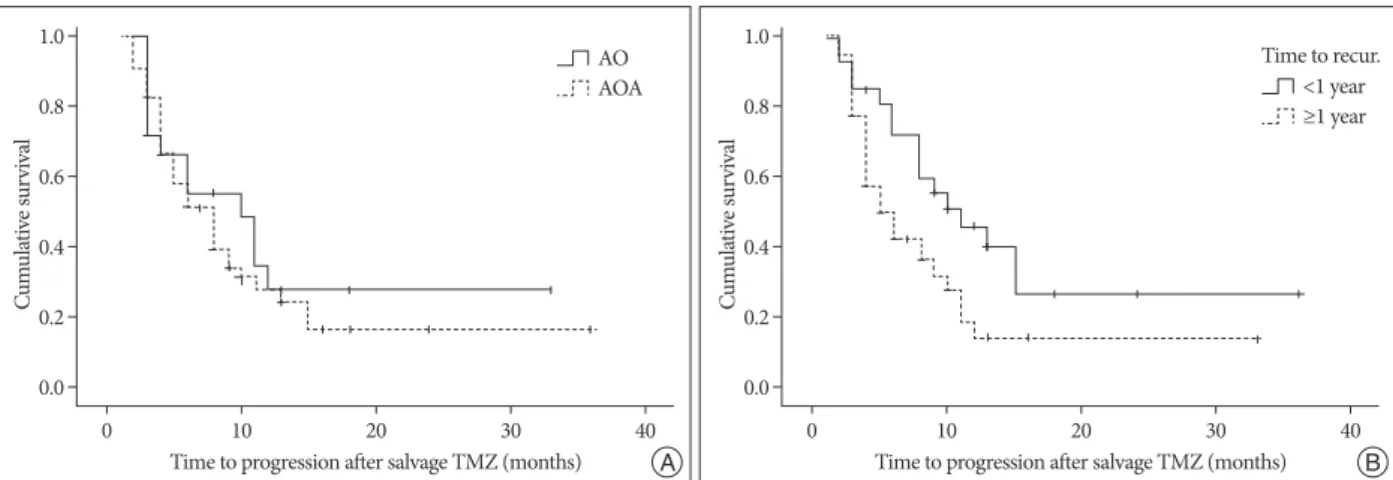
a median 8.0 months (95% CI, 6.0-10.0). Actuarial 6 months PFS rate was 52% and 1-year PFS 27%. Various clinical factors were evaluated to see if they can affect PFS (Table 4). By histol- ogy, AO patients showed a median PFS of 8.0 months while AOA patients had a median PFS of 10.0 months but this appar- ent difference did not reach the statistical significance (Fig. 1A).
Among tested clinical factors, only the time to recurrence had significant influence on PFS as the patients recurred within a year showed a median PFS of 5.0 months, which was signifi- cantly shorter than that of 11. 0 months in patients recurred at one year or after (p=0.04) (Fig. 1B) in univarable analysis but be- came insignificant in multivariable analysis (p=0.07).
Patients were followed for a median of 11.5 months (range, 2-66). As only 20 out of 72 patients died during the observation period, a median overall survival was not reached. The estimat- ed 1-year survival rate was 81% and 2-year 63%. Clinical factors were also tested to see if they significantly affect the OS (Table 5). AOA patients had a median OS of 18.0 months and 1-year OS rate of 76% while AO patients did not reach median OS and 1-year OS rate was 83% but this apparent difference did not show statistical significance (Fig. 2A). Among various clinical factors, ECOG status of completely ambulatory or better (0 and 1) signif- icantly prolonged patients survival in both univariate and multi-
Fig. 1. Kaplan-Meier progression-free survival in patients with recurrent AO or AOA after salvage TMZ chemotherapy (A) according to histopathology (AO vs. SOA, p>0.05) and (B) time to recurrence after the initial treatment for AO/AOA (<1 year vs. ≥1 year, p=0.04). AO : anaplastic oligodendroglio- ma, AOA : anaplastic oligo-astrocytoma, TMZ : temozolomide.
Cumulative survival Cumulative survival
Time to progression after salvage TMZ (months) Time to progression after salvage TMZ (months)
0 10 20 30 40 0 10 20 30 40
0.0 0.0
0.2 0.2
0.4 0.4
0.6 0.6
0.8 0.8
1.0 1.0
Table 4. Cox-proportional hazard model analysis of factors affecting patient’s progression-free survival after TMZ salvage chemotherapy
Factors Univariable analysis Multivariable analysis
p value Hazard ratio 95% CI p value Hazard ratio 95% CI
Histopathology (AO vs. AOA) 0.52 1.23 0.65-2.33 0.35 1.38 0.70-2.71
Age (<40 vs. ≥40) 0.16 1.56 0.84-2.91 0.56 1.23 0.61-2.49
Gender (male vs. female) 0.27 1.37 0.78-2.41 0.17 1.49 0.84-2.66
ECOG (0-1 vs. 2-3) 0.97 1.01 0.52-1.99 0.88 1.06 0.52-2.13
Origin (de novo vs. secondary) 0.44 0.77 0.40-1.48 0.37 0.72 0.35-1.48
Time to recur (<1 year vs. ≥1 year) 0.04 0.53 0.29-0.99 0.07 0.52 0.26-1.05
Previous chemotherapy (naïve vs. experienced) 0.93 1.03 0.57-1.84 0.62 1.18 0.61-2.24
CI : confidence interval, ECOG : Eastern Cooperative Oncology Group, TMZ : temozolomide, AO : anaplastic oligodendroglioma, AOA : anaplastic oligo-astrocytoma
AO
AOA Time to recur.
<1 year ≥1 year
B A
ported 6.4% of grade 3 or 4 thrombocytopenia and dose-reduc- tion was required only in 1.2% of total cycles. Two studies treat- ed chemo-naïve recurrent oligodendrial tumors with TMZ with standard 5 days schedule3,30). van den Bent et al.28,30) observed grade 3/4 hematotoxicity in 10 out of 38 patients (26%) and dose reduced and delayed in 11% and 15% of patients with oli- godendroglioma or oligoastrocytoma, respectively. Brandes et al.3) reported the occurrence of grade 3/4 hematotoxicity in 13%
of patients with AO/AOA and needed dose reduction and de- lays in 15% and 22% of patients, respectively. Although patients number was small (n=29), Yang et al.32) observed no significant toxicity with TMZ in Korean patients with malignant gliomas.
However, these occurrences of SAE from TMZ should be pre- sented with MGMT methylation status and need to be re-eval- uated in future prospective study13).
Response rate of TMZ in AO/AOA
The response rate of TMZ as 1st line salvage for (chemo-naïve) recurrent oligodendrial tumors was fairly high and similar to that of up-front or adjuvant TMZ therapy ranging 53-75%13,17,25). A prospective, phase 2 trial by van den Bent et al.30) revealed re- sponse rate of 53% including a half of CR among responders in patients with recurrent oligodendroglioma or oligoastrocyto- ma. Brandes et al.3) reported an overall response rate of 46% in- dian PFS was only 6.8 months. The efficacy of irinotecan (CPT-
11) for recurrent chemo-experienced (TMZ or BCNU) AO patients was evaluated in phase 2 prospective trial, but only mod- est effect was observed (28% of response rate, and median PFS of 4.5 months)8).
Safety of TMZ in AO/AOA
The virtues of TMZ for the treatment of malignant gliomas are good bioavailability in spite of per os administration, fairly high CNS penetration and most of all, good tolerance with a low rate of serious adverse events (SAE)14). Although TMZ itself is an alkylator carrying a high risk of cumulative hematotoxici- ty, the reported rate of SAE is fairly acceptable even in a salvage treatment setting1,2,10,12,17,25,34). In our study, only one patient dis- continued due to grade 4 nausea/vomiting and 6 patients (8%) delayed the next cycle for leucopenia/thrombocytopenia. Re- ported SAE rate of TMZ ranged 6-31% according to dose sched- ule or demographic factors1,2,12,13,17,25). Against the prejudication of more SAE in chemo-experienced patients than chemo-naïve patients, TMZ seemed to provoke equal or paradoxically less hematotoxicity in chemo-experienced settings compared with chemo-naïve one. Chinot et al.10) used the standard 5 days per 28 days schedule for recurrent PCV-experienced AO/AOA, but dose modification scheme down to 50% were applied. They re-
Table 5. Cox-proportional hazard model analysis of factors affecting patient’s overall survival after TMZ salvage chemotherapy
Factors Univariable analysis Multivariable analysis
p value Hazard ratio 95% CI p value Hazard ratio 95% CI
Histopathology (AO vs. AOA) 0.24 1.70 0.69-4.18 0.64 1.26 0.48-3.31
Age (<40 vs. ≥40) 0.75 0.85 0.31-2.34 0.84 0.89 0.27-2.88
Gender (male vs. female) 0.87 1.08 0.45-2.60 0.99 1.00 0.38-2.61
ECOG (0-1 vs. 2-3) 0.007 3.34 1.38-8.06 0.006 3.73 1.47-9.49
Origin (de novo vs. secondary) 0.41 1.86 0.43-8.09 0.34 2.14 0.45-10.24
Time to recur (<1 year vs. ≥1 year) 0.068 0.38 0.13-1.07 0.079 0.36 0.11-1.12
Previous chemotherapy (naive vs. experienced) 0.34 1.54 0.63-3.74 0.18 1.98 0.73-5.42
TMZ : temozolomide, CI : confidence interval, AO : anaplastic oligodendroglioma, AOA : anaplastic oligo-astrocytoma, ECOG : Eastern Cooperative Oncology Group
Fig. 2. Kaplan-Meier overall survival in patients with recurrent AO or AOA after salvage TMZ chemotherapy (A) according to histopathology (AO vs.
AOA, p>0.05) and (B) ECOG performance status (0-1 vs. 2-3, p=0.007). AO : anaplastic oligodendroglioma, AOA : anaplastic oligo-astrocytoma, TMZ : temozolomide.
Cumulative survival Cumulative survival
Overall survival after TMZ (months) Overall survival after TMZ (months)
0 10 20 30 40 50 60 70 0 10 20 30 40 50 60 70
0.0 0.0
0.2 0.2
0.4 0.4
0.6 0.6
0.8 0.8
1.0 1.0
AO AOA
ECOG 0-1 ECOG 2-3
B A
Cancer Control, Ministry for Health, Welfare and Family Affairs, Republic of Korea (1120320).
References
1. Balmaceda C, Peereboom D, Pannullo S, Cheung YK, Fisher PG, Alavi J, et al. : Multi-institutional phase II study of temozolomide administered twice daily in the treatment of recurrent high-grade gliomas. Cancer 112 : 1139-1146, 2008
2. Brada M, Hoang-Xuan K, Rampling R, Dietrich PY, Dirix LY, Macdon- ald D, et al. : Multicenter phase II trial of temozolomide in patients with glioblastoma multiforme at first relapse. Ann Oncol 12 : 259-266, 2001 3. Brandes AA, Tosoni A, Cavallo G, Reni M, Franceschi E, Bonaldi L, et
al. : Correlations between O6-methylguanine DNA methyltransferase promoter methylation status, 1p and 19q deletions, and response to te- mozolomide in anaplastic and recurrent oligodendroglioma : a prospec- tive GICNO study. J Clin Oncol 24 : 4746-4753, 2006
4. Brandes AA, Tosoni A, Vastola F, Pasetto LM, Coria B, Danieli D, et al. : Efficacy and feasibility of standard procarbazine, lomustine, and vin- cristine chemotherapy in anaplastic oligodendroglioma and oligoastro- cytoma recurrent after radiotherapy. A Phase II study. Cancer 101 : 2079-2085, 2004
5. Cairncross G, Berkey B, Shaw E, Jenkins R, Scheithauer B, Brachman D, et al. : Phase III trial of chemotherapy plus radiotherapy compared with radiotherapy alone for pure and mixed anaplastic oligodendroglioma : Intergroup Radiation Therapy Oncology Group Trial 9402. J Clin On- col 24 : 2707-2714, 2006
6. Cairncross G, Macdonald D, Ludwin S, Lee D, Cascino T, Buckner J, et al. : Chemotherapy for anaplastic oligodendroglioma. National Cancer Institute of Canada Clinical Trials Group. J Clin Oncol 12 : 2013-2021, 1994
7. Cairncross G, Wang M, Shaw E, Jenkins R, Brachman D, Buckner J, et al. : Phase III Trial of Chemoradiotherapy for Anaplastic Oligodendro- glioma : Long-Term Results of RTOG 9402. J Clin Oncol 31 : 337-343, 2013
8. Chamberlain MC, Glantz MJ : CPT-11 for recurrent temozolomide-re- fractory 1p19q co-deleted anaplastic oligodendroglioma. J Neurooncol 89 : 231-238, 2008
9. Chamberlain MC, Johnston S : Bevacizumab for recurrent alkylator-re- fractory anaplastic oligodendroglioma. Cancer 115 : 1734-1743, 2009 10. Chinot OL, Honore S, Dufour H, Barrie M, Figarella-Branger D, Mura-
cciole X, et al. : Safety and efficacy of temozolomide in patients with re- current anaplastic oligodendrogliomas after standard radiotherapy and chemotherapy. J Clin Oncol 19 : 2449-2455, 2001
11. Desjardins A, Quinn JA, Vredenburgh JJ, Sathornsumetee S, Friedman AH, Herndon JE, et al. : Phase II study of imatinib mesylate and hy- droxyurea for recurrent grade III malignant gliomas. J Neurooncol 83 : 53-60, 2007
12. Ducray F, del Rio MS, Carpentier C, Psimaras D, Idbaih A, Dehais C, et al. : Up-front temozolomide in elderly patients with anaplastic oligo- dendroglioma and oligoastrocytoma. J Neurooncol 101 : 457-462, 2010 13. Gan HK, Rosenthal MA, Dowling A, Kalnins R, Algar E, Wong N, et al. :
A phase II trial of primary temozolomide in patients with grade III oli- godendroglial brain tumors. Neuro Oncol 12 : 500-507, 2009
14. Gaya A, Rees J, Greenstein A, Stebbing J : The use of temozolomide in recurrent malignant gliomas. Cancer Treat Rev 28 : 115-120, 2002 15. Macdonald DR, Cascino TL, Schold SC Jr, Cairncross JG : Response
criteria for phase II studies of supratentorial malignant glioma. J Clin Oncol 8 : 1277-1280, 1990
16. Macdonald DR, Gaspar LE, Cairncross JG : Successful chemotherapy for newly diagnosed aggressive oligodendroglioma. Ann Neurol 27 : 573-574, 1990
cluding a higher response in AO histology than AOA (62% vs.
25%), and in 1p/19q loss (59% vs. 34%). In our study, second- ary AO/AOA showed a higher response rate than de novo AO/
AOA (53% vs. 16%, p<0.01). But histologic type (AO vs. AOA) showed no difference of radiological response. We have a provi- sion of gathering molecular profiles including 1p/19 co-dele- tion and MGMT methylation status of these ‘clinically validat- ed’ 72 recurrent AO/AOA patients as a second-term plan of the National R&D Program for Cancer Control, Ministry for Health, Welfare and Family Affairs, Republic of Korea.
The response rate of PCV as 1st line salvage chemotherapy for recurrent AO/AOA was 59% and the result was comparable to TMZ salvage therapy but incurred a high risk of persistent toxicity4). Although grade 3/4 hematotoxicity occurred only in 6.9% of total cycles given, sixteen of their 37 patients discontin- ued chemotherapy due to incomplete recovery within 2 weeks of treatment delay at a mean 3.5 cycles per patient.
Reports evaluating the efficacy of 2nd line TMZ salvage che- motherapy for AO/AOA are rare, but only one study is available.
Chinot et al.10) reported an objective response rate of 43.8% and median PFS of 6.7 months. The PFS was relatively short com- pared to the high response rate, but their response measure- ment was not a Mcdonald criteria but a volumetric analysis. In our study, chemo-naive patients showed apparently higher re- sponse rate (8 of 29 patients, 28%) than chemo-experienced pa- tients (9 of 43 patients, 21%), but the difference failed to reach statistical significance.
Based on these relatively high response rate with acceptable low incidence of SAE, TMZ has been adopted as up-front che- motherapy or adjuvant chemotherapy in AO/AOA and report- ed fairly good clinical results12,13,17,18,25). And also, our study group (KSNO) launched TMZ concomitant chemo-radiation in AO/AOA patients without 1p19q co-deletion in 2012 (KNOG-1201). However, introducing TMZ as CCRT and/or adjuvant setting in newly diagnosed AO/AOA has not been ac- cepted as a standard therapy, yet.
CONCLUSION
Although the response rate of 24% in our study is apparently lower than those from other studies of TMZ salvage therapy, both PFS and OS of our study are comparable with other TMZ salvage therapy and seem better than those studies using non- alkylating agents at a low rate of SAE. Thus, we recommend standard 5 days TMZ chemotherapy for recurrent AO/AOA at an equally expected efficacy to PCV chemotherapy as 1st line salvage therapy. For PCV experienced patients or patients at a risk of prolonged hematotoxicity, we expect TMZ salvage would be a choice with expectation of superior tolerability than other chemotherapy.
• Acknowledgements
This research was supported by a grant from the National R&D Program for
27. van den Bent MJ, Carpentier AF, Brandes AA, Sanson M, Taphoorn MJ, Bernsen HJ, et al. : Adjuvant procarbazine, lomustine, and vincristine improves progression-free survival but not overall survival in newly di- agnosed anaplastic oligodendrogliomas and oligoastrocytomas : a ran- domized European Organisation for Research and Treatment of Cancer phase III trial. J Clin Oncol 24 : 2715-2722, 2006
28. van den Bent MJ, Chinot O, Boogerd W, Bravo Marques J, Taphoorn MJ, Kros JM, et al. : Second-line chemotherapy with temozolomide in recurrent oligodendroglioma after PCV (procarbazine, lomustine and vincristine) chemotherapy : EORTC Brain Tumor Group phase II study 26972. Ann Oncol 14 : 599-602, 2003
29. van den Bent MJ, Kros JM, Heimans JJ, Pronk LC, van Groeningen CJ, Krouwer HG, et al. : Response rate and prognostic factors of recurrent oligodendroglioma treated with procarbazine, CCNU, and vincristine chemotherapy. Dutch Neuro-oncology Group. Neurology 51 : 1140- 1145, 1998
30. van den Bent MJ, Taphoorn MJ, Brandes AA, Menten J, Stupp R, Frenay M, et al. : Phase II study of first-line chemotherapy with temozolomide in recurrent oligodendroglial tumors : the European Organization for Research and Treatment of Cancer Brain Tumor Group Study 26971. J Clin Oncol 21 : 2525-2528, 2003
31. Yan H, Parsons DW, Jin G, McLendon R, Rasheed BA, Yuan W, et al. : IDH1 and IDH2 mutations in gliomas. N Engl J Med 360 : 765-773, 2009 32. Yang SH, Kim MK, Lee TK, Lee KS, Jeun SS, Park CK, et al. : Temozolo- mide chemotherapy in patients with recurrent malignant gliomas. J Ko- rean Med Sci 21 : 739-744, 2006
33. Yung WK, Albright RE, Olson J, Fredericks R, Fink K, Prados MD, et al. : A phase II study of temozolomide vs. procarbazine in patients with glio- blastoma multiforme at first relapse. Br J Cancer 83 : 588-593, 2000 34. Yung WK, Prados MD, Yaya-Tur R, Rosenfeld SS, Brada M, Friedman
HS, et al. : Multicenter phase II trial of temozolomide in patients with anaplastic astrocytoma or anaplastic oligoastrocytoma at first relapse.
Temodal Brain Tumor Group. J Clin Oncol 17 : 2762-2771, 1999 17. Mikkelsen T, Doyle T, Anderson J, Margolis J, Paleologos N, Gutierrez J,
et al. : Temozolomide single-agent chemotherapy for newly diagnosed anaplastic oligodendroglioma. J Neurooncol 92 : 57-63, 2009
18. Mohile NA, Forsyth P, Stewart D, Raizer JJ, Paleologos N, Kewalramani T, et al. : A phase II study of intensified chemotherapy alone as initial treatment for newly diagnosed anaplastic oligodendroglioma : an inter- im analysis. J Neurooncol 89 : 187-193, 2008
19. Newlands ES, Blackledge GR, Slack JA, Rustin GJ, Smith DB, Stuart NS, et al. : Phase I trial of temozolomide (CCRG 81045 : M&B 39831 : NSC 362856). Br J Cancer 65 : 287-291, 1992
20. Noushmehr H, Weisenberger DJ, Diefes K, Phillips HS, Pujara K, Ber- man BP, et al. : Identification of a CpG island methylator phenotype that defines a distinct subgroup of glioma. Cancer Cell 17 : 510-522, 2010 21. Peterson K, Paleologos N, Forsyth P, Macdonald DR, Cairncross JG :
Salvage chemotherapy for oligodendroglioma. J Neurosurg 85 : 597- 601, 1996
22. Pobereskin LH, Chadduck JB : Incidence of brain tumours in two Eng- lish counties : a population based study. J Neurol Neurosurg Psychiatry 69 : 464-471, 2000
23. Reifenberger G, Louis DN : Oligodendroglioma : toward molecular def- initions in diagnostic neuro-oncology. J Neuropathol Exp Neurol 62 : 111-126, 2003
24. Soffietti R, Ruda R, Bradac GB, Schiffer D : PCV chemotherapy for re- current oligodendrogliomas and oligoastrocytomas. Neurosurgery 43 : 1066-1073, 1998
25. Taliansky-Aronov A, Bokstein F, Lavon I, Siegal T : Temozolomide treat- ment for newly diagnosed anaplastic oligodendrogliomas : a clinical ef- ficacy trial. J Neurooncol 79 : 153-157, 2006
26. van den Bent MJ, Brandes AA, Taphoorn MJ, Kros JM, Kouwenhoven MC, Delattre JY, et al. : Adjuvant procarbazine, lomustine, and vincris- tine chemotherapy in newly diagnosed anaplastic oligodendroglioma : long-term follow-up of EORTC brain tumor group study 26951. J Clin Oncol 31 : 344-350, 2013