약학회지 제33권 제 3 호 161〜 166(1989) Yakhak Hoeji Vol. 33,No. 3
인삼의 dammarane 계 glycosides 분획물이 일차 배양한 계배의 근육세포에 미치는 영향
정 영 경• 박 미 정•송 진 호 • 김영중
(Received April 19,1989)
The Effect of Dammarane Glycosides of Panax ginseng on Primary Cultured Chicken Embryonic Muscle Cells
Young Kyeong Jung, Mi Jung Park, Jin Ho Song, and Young Choong Kim
College of Pharmacy, Seoul National University, Seoul, 151-742, Korea
Abstract— Effects of dammarane glycosides of Panax ginseng on primary cultured chicken embryonic skeletal muscle cells were studied by microscopic observation and determination of the activity of acetyl
cholinesterase. Muscle cells were prepared from the breast of 12-day-old chicken embryo and cultured with either a medium consisted of 87.5% Dulbecco’s Modified Eagle Medium (DMEM), 10% horse serum and 2.5% chicken embryonic extract or a medium consisted of 90% D M E M and 10% horse serum. It was observed that dammarane glycosides of Panax ginseng seemed to show the tendency to stimulate the growth and the differentiation of the muscle cells cultured with a medium consisted of 90% D M EM and 10% horse serum under microscopic observation. The activity of acetylcholinesterase in the muscle cells cultured with a medium consisted of 90% DMEM and 10% horse serum was increased by dammarane gly
cosides of Panax ginseng.
Keywordsd Dammarane glycosides of Panax chicken embryo, muscle cell culture-acetylcholines- terase
인삼은 생체내에서 여러 생리작용에 관여하여 다 양한 약리효과를 나타낸다고 수많은 학자들이 보고 하였다. 1-3^ 그러나 아직까지도 이를 뒷받침할만한 체계화된 정설을 찾지 못하고 있는데 이는 인삼의 효과가 비특이적이며,상당히 많은용량을 장기간에 걸쳐 투여하지 않으면 그 효과를 기대하기 힘들고, 또 인삼의 효과를 체계화하는데 적합한 방법을 찾기 가어렵기 때문이다. 이에 본연구에서는 인삼의 강 장 효과를 체계화하는데 적합한 방법을 찾기 위한 연구의 일환으로 비교적 짧은 시간내에 미량으로 세 포수준에서 그효과를 검색할 수 있는 일차세포 매 양법을 도입하여 우선 근육세포의 성장에 미치는 효 과를 알아보았다. 계배의 근육세포를 체외에서 매양 하면서 인산의 총 dammarane 계 glycosides 분획 물, panaxadiol 및 panaxatriol 계 glycosides 분 획물을 투여하여 그 효과를현미경으로 관찰하였다. 또한 근육세포의 성장과 분회식I 밀접한 관계륭 가지
고 있는 acetylcholinesterase 의 활성을 측정하여 인삼의 효과를 알아보았다. 41
실험방법
재료 및시약ᅳ본 실험에 사용한 인삼은 강화산 6 년근이며, 계배 (chicken embryo)는 일령 12일된 것을 유일농원(서울, 오류동)에서 구입하였다. 조 직 배양에 필요한 시약은 Grand Island Biological Company (미국) 제품을, 기타 시약은 Sigma Chemical Company (미국), K anto(일본) 및 Shiny (일본)의 특급시익을 사용하었다.
인삼 dammarane 계 glycosidcs 의 제조5.6)—인 삼 500g의 MeOH 추출물(1/X3회)을 감압농축한 후 농축물융 최소량의 물에 녹이고 ether로 세척하 여 유상물질을 제거하였다. 물충을 n-BuOH 로 추 출하여 총 dammarane 제 glycosides 분획물을 얻
161
162 정영경• 박미정 • 송 진 호■김영중
었으며, n-BuᄋH 층을 5% NaOH 로 처리한 후 n-BuOH 층을농축하여 panaxatriol 계 glycosi- des 분획물을 얻고 NaOH 층을 1N-HC1 로중화하
고 중화층을 다시 n-BuOH 로 추출 농축하여서
panaxadiol 계 glycosides 분획물을 얻었다. 계배 추출물.(chicken embryonic extract)의 제 조 일 령 이 12일된 계배를 적출하여 Hank's balanced salt solution (HBSS) 으로 세척한 후, 주사기를 이용하여 원심분리관속에 압출하고,등량 의 HBSS 로 희석하였다. 실온에서 30분간 방치한 후, 4X:에서 18,000rpm 으로 25분간 원심분리하여 서그 상등액을 취하여 사용하였다.
계배의 근육세포 배양8 일령이 12일된 계배의 가슴근육을 적출하여, 결합조직을 제거하고 0.2%
trypsin으로 조직을 연화시킨 후 세포상태로 분리
하였다. Fibroblast를 제거하기 위하여 lx 106 cells/m/ 농도의 세포를 이식시켜 37°C에서 45분간 공기 (95% )와 C02(5% )의 혼합기체를 공급하면서 배양하였다. 그 후 상등액만을 조심스럽게 취하여 약 5X 10s cells/m/ 농도의근육세포를 collagen 도 포 배양용기에 이식하여 배양하였다. 배양액은 Dulbecco's Modified Eagle Medium (DMEM) 87.5%, 말(horse) 혈청 10.0%, 계배 추출물 2.
5%, Penicillin 10,000IU/100m/, Streptomycin 10, 000//g/100m/ Amphotericin B500//g/100 m/ 으로 구성된 배양액과 이 배양액에서 세포성장 에 필수물질인 계배 추출물만을 제거한 배양액을 사 용하였다. 세포의 배양은 일정한 습도를 유지하는 37.C 배양기에서 공기 (95% )와 C02(5% )의 혼합기 체를 계속 공급시키면서 수행하였다.
인삼 dammarane 계 glycosides 분획물의 투 여一인삼 총 dammarane 계 glycosides, panax- diol 및 panaxatriol 계 glycosides 를 각각 증류수 에 용해시킨 후(lm g/m/) millipore membrane (0.22서m, Millex-GV, U.S.A.)를 사용하여 여과 멸균하였다.
단백질의 정량9>_배양한 세포의 단백질 함량은 Lowry 방법에 의하여 bovine serum albumin 을 표준품으로 하여 500nm 에서 홉광도를 측정하였 다.
Acetylcholinesterase의 정량101ᅳ배양한 세포
중에 존재하는 acetylcholinesterase 의 함량은 Ellman의 방법에 의하여 측정하였다. 인산 완충액 (0.1 M, pH 8.0) 2.6m/ 가 ■어있는 photocell 에 단백질 정량이 된 세포균질물 0.4 m/ 를 가하고 비 특이성 cholinesterase의 반응 억제제인 tetra- isopropylpyrophosphoramide 를 반응계의 최종 농도가 1X10--M 농도가 되도록 가하였다. 여기에 dithiobisnitrobenzoate 100///를 가하고 412 nm 에서 흡광도를 측정하여 흡광도가 안정화되었을 때 의 흡광도를 기준점으로 하고, 기질로서 acetylth- iocholine iodide 20 /// 를 가한 후 1분간의 홉광도 변화를 즉정하였다. Acetylcholinesterase 의특이 적효소활성은세포균질물의 단백질 lm g이 1분당 변 화 시 킨 、홉광도 변 화 량(ᅀA /분/ mg protein of tissue homogenate) 으로 나타내었다.
결과 및고찰
인삼이 근육세포의 성장발달에 어떻게 영향을 미 치는가를 밝히기 위하여 계배의 가슴근육으로부터 근육세포를 준비하여 정상상태와 비정상상태로 체외 에서 배양하면서 인삼의 성분 중에서 총 dammar- ane 계 glycosides 분획물, panaxadiol 및 panaxatriol 계 glycosides 분획물을 각각 첨가하 여그 효과를 현미경으로 관찰하였으며 또한 근육세 포의 성장, 분화에 밀접한 관계가 있는효소로 알려 진 acetylcholinesterase 의활성을 측정하였다.
인삼성분이 근육세포에 미치는 뚜렷한 효과를 알 아보기 위하여서는 정상상태에서 보다는 비정상상태 에서 우선 연구하는 것이 바람직하다고 생각되어 세 포분화와 성장에 필수물질이라 알려진 계배 추출물 을 함유하지 않고 DMEM 90%와 말 혈청 10% 만 으로 구성된 배양액으로 배양하여 근육세포의 성장 을 제한시키고, 총 dammarane 계 glycosides 분 획물의 양을 배양엑 l m/ 당 10새 에 서 70새까지 농도를 변화시키면서 현미경하에서 관찰하였다. 이 결과 인삼의 총 dammarane 계 glycosides 분획물 은 15 g/m / 에서 70 ᄍ g/m / 의 농도에서근육세포 의 성장을 촉진하는 것을관찰한 수 있었다. 따라서 본 실힘에서는 dammarane게 glycosides의 양을 배양액 lm/ 당 50//g씩 부여하고 그 효과-모 알아
인삼의dammarane 계 glycosides 분획물이 일차 배양한 계배의 근육세포에 미치는 영향 163
C D
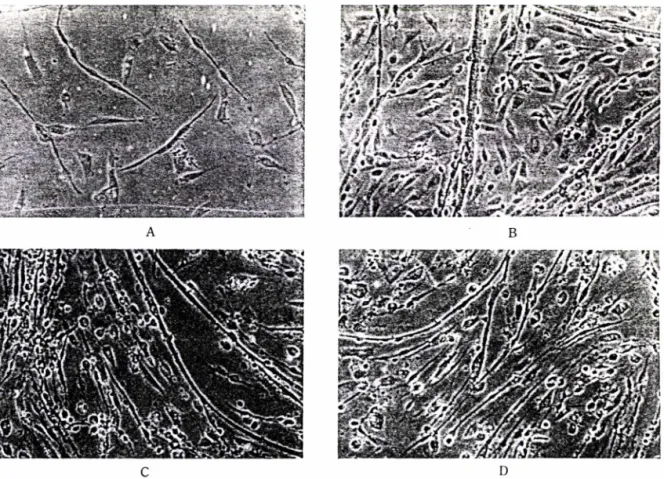
Fig. 1一 The effect of dammarane glycosides of Panax ginseng on the growth of chicken embryonic muscle cells with a medium consisted of 90% DM EM and 10% horse serum for 4 days ( x 200). A: Muscle cells cultured in the absence of dammarane glycosides of Panax ginseng. B: Muscle cells cultured in the presence of 50셔 g/m/
total dammarage glycosides. C: Muscle cells cultured in the presence of 50 fjg/m l panaxadiol glycosides. D:
Muscle cells cultured in the presence of 50 /ug/ml panaxatriol glycosides.
보았다 (Fig.l). Dammarane 계 glycosides 분획 물을첨가하지 않은경우에는근육세포가 myoblast 의 상태에서 성장이 멈추며 myotube 상태로는 거 의 발달하지 못하는 것4로 관찰되었으며 단위면적 에서 관찰되어지는 생존세포의 수도 현저히 감소하 였다. 그러나 dammarane 계 glycosides 분획물을 첨가한 경우에는 가늘고 짧긴하나 myotube 상태로 발달되었으며 단위면적에서 관찰되어지는 근육세포 의수도 dammarane 계 glycosides 분획물을 첨가 하지 않은 경우보다 더 많았다(Table I ). 따라서 dammarane 계 glycosides 분획물은 체외배양한 계배 근육세포의 생존기간 연장에 영향을 미칠 것이 라사료된다. 그러나,계배의 근육세포를 DMEM 87.5% ,말 혈청 10%, 계배 추출물 2.5% 로 구성 된 배양액으로 정상상태로 배양하였을 때는
dammarane 계 glycosides 분획물의 첨가와 관계 없이 모두 굵고 길게 잘발달된 myotube 로자라서 인삼성분에 의한 성장촉진효과를 볼 수 없었다 (Fig. 2).
현미경 관찰을 통해서 본근육세포의 성장에 대한 dammarane 계 glycosides 분획물의 효과는 세포 성장의 필수물질이라 알려진 계배 추출물에 비하면 그 정도가 훨씬 못 미치나, 계배 추출물을 함유하지 않는 배양액으로 배양한 근육세포의 성장 발달에 영 향을 미치며, 생존기간도 연장시키는 효과를 나타냄 을 관찰하였다.
이러한 현미경으로 관찰된 인삼의 dammarane 계 glycosides 분획물의 성장촉진효과를 뒷받침하 기위하여 근육세포 중에 존재하는 효소로서 근육세 포의 성장, 분화에 척도가 될 수 있는 acetyl-
Vol. 33, No. 3, 1989
164 정영경 • 박미정 •송 진 호• 김영중
Table I—The effect of dammarane glycosides of Panax ginseng on the number of chicken skeletal muscle cells cultured with a medium consisted of 90%
DMEM and 10% horse serum for 4 days.
Substance
Concentration of
dammarane glycosides Number of cells of Panax ginseng
(jjg/m l)
Control 0 2.3 ± 0.4
Total dammarane 10 22.5 ±2.1
glycosides 20 23.5 ± 1.4
30 23.3 ± 6.7
50 18.0 土 3.5
70 25.0 ± 0.7
100 23.3 ± 6.0
Panaxadiol 10 17.5 土 2.8
glycosides 20 13.8 ± 1.1
30 17.3 ±0.4
50 25.8 ± 4.6
70 20.0 ± 2.8
100 23.3 士 4.6
Panaxatri 이, 10 19.3 ± 0.4
glycosides 20 27.0 ±0.7
30 28.5 ±2.1
50 23.5 ± 2.8
70 22.5 ± 0.7
100 26.8 ± 0.4
Fig. 2— The effect of dammarane glycosides of Panax ^insrn^r on the growth of chicken cmbryonic muscle cells with a medium consisted of 87.5% DM EM , 10% horse serum and 2.5% chicken embryonic extract for 4 days ( x 200). A: Muscle cells cultured in the absciicc of damniarancc ^lycosidcs of Panax ^insruii. B: Musck* cdls cultured in the presence of 05/ig/m/ total dammarane glycosides. C: Musclc cells cultured in the prcsenco of SO izg/m/ panaxadiol glycosides. D: Muscle cells cultured in the prcscncc of pan.'ixatriol j^lycosidcs.
J. l^iann. Soc. Korn
인삼의dammarane 계 glycosides 분획물이 일차 배양한 계배의 근육세포에 미치는 영향 165_
Table II—The effect of dammarane glycosides of Panax
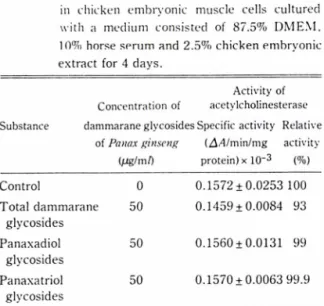
^insrn.i! on the activity of acetylcholinesterase in chicken embryonic muscle cells cultured with a medium consisted of 87.5% DMEM.
10% horse serum and 2.5% chicken embryonic extract for 4 days.
Substance
Activity of Concentration of acetylcholinesterase dammarane glycosides Specific activity Relative
of Panax ginseng (스/4/min/mg activity (/ig/m/) protein) x 10*3 (%)
Control 0 0.1572 ±0.0253 100
Total dammarane 50 0.1459 ±0.0084 93 glycosides
Panaxadiol 50 0.1560 ±0.0131 99
glycosides
Panaxatriol 50 0.1570 ±0.0063 99.9
glycosides
cholinesterase의 활성에 미치는 인삼 성분의 영향 을 알아보았다.
계배의 근육세포를 체외에서 DMEM 87.5%, 말 혈청 10% ,계배 추출물 2. 5%로 구성된 배양액으 로 4일간 배양한 후 acetylcholinesterase 의 활성 을 측정하였다(Table II). 이 경우 총 dammar
ane 계 glycosides 분획물을 물론 panaxadiol 및 panaxatri()l 계 glycosides 분획물 모두 acetyl
cholinesterase 의 활성에 별다른 영향을 미치지 않 았다.
그러나 계배의 근육세포를 똑같은 조건에서 계배 추출물을 함유하지 않는 배양액으로 배양하였을 때 는 실험에 사용한 모든 인삼의 dammarane 계 glycosides 분획물이 acetylcholinesterase 의 활성 을 증가시켰으며,특히 panaxadiol 계 glycosides 분획물은 약 50% 나증가시켰다(Table III).
이렇게 인삼의 dammarane 계 glycosides 분획 물이 그 활성을 촉진시키는 acetylcholinesterase 는근육세포의 분화와 성장에 밀접한 관계를 가지며 또한 특이한 형태의 근무력중의 경우 신경근 종관에 서이효소가 결핍되어 있는 것으로 보아 근육의 정 상적인 기능유지에도 관련성이 있을 것으로 사료된 다 m 본 연구결과 근육세포의 성장에 필요한 영양 분을 걸핍시켜 배양세포의 성장을 제한시컸을 애,
인삼의 dammarane 계 glycosides 분획물이
Table III一 The effect of dammarane glycosides of Panax on the activity of acctylcholinesterase in chicken embryonic muscle cells cultured with a medium consisted of 90% D M E M , and
10% horse serum for 4 days.
A c tiv ity o f C o n c e n tra tio n o f ace ty lc h o lin e ste ra se
S u b s ta n c e dammarane glycosides S p e c ific activity Relative of Panax ginseng (zl4/min/mg activity
Ctig/m/) protein) x 10*3 (%)
Control 0 0.0386 ± 0.0089
Total dammarane 50 0.0484 ±0.0045 glycosides
Panaxadiol 50 0.0592 ±0.0063
glycosides
Panaxatriol 50 0.0587 ±0.0033
glycosides
acetylcholinesterase 의 활성을 증가시킴과 동시에 큰육세포 성징을 족진,생손기간을 연장시키는 것으 로 보아 근육계통 질환의 예방이나 치료에 인삼의 dammarane 계 glycosides 분획물의 사용 가능성 을 부여한다 하겠다.
결 론
인삼의 총 dammarane 계 glycosides 분획물,
panaxadiol 및 panaxatriol 계 glycosides 분획물 은 모두 비정상상태로 유도배양한 계배의 근육세포 의 성장을 촉진시켰으며 근육세포 중에 존재하는 acetylcholinesterase 의 활성을 촉진시키는 경향을 나타냈다.
감사의 말씀
본 연구가 진행되게 지원해 준 한국과학재단에 깊 이감사하는 바이다.
문 헌
1) Takagi. K .t Saito, ii. and Nabala. II., Pharmacolo
gical studies of I^max ^inscn^ root, Ja/xtn. J. Pliur- macol. 22,245 (1972).
2) Kim, J.Y. and Staba, K.J.. Korean Ginseng Studies.
Vol. 3:1 No. 3. 1989
166 정 영 경•박 미 정•송 진 호 • 김영중
Ilwha Co. Ltd., Seoul Korea, p.l (1977).
3) Han, B.H. and Woo, L.H., ibid. p.22.
4) Schubert, D., Developmental Biology of Cultured Nerve, Muscle, and Glia, A Wiley-Interscience Pub
lication, New York, p.26 (1984).
5) Shibata, S., Tanaka, 0., Soda, M. and Tsushima, S., On Genuine Sapogenin of Ginseng, Tetrahedron Let
ters 12,795 (1963).
6) Shibata, S., Tanaka, 0., Soda, M. and Tsushima, S., Studies on the Constituents of Japanese and Chinese Crude Drugs XI, Chem. Pharm. Bull. 11, 759 (1963).
7) White, P.R., The Cultivation of Animal and Plant Cells, The Ronald Press Company, New York, p.66 (1963).
8) Yaffe, D., Retention of Differentiation Potentialities
during Prolonged Cultivation of Myogenic Cells, Proc. Natl. Acad. Sci. USA 61,477 (1968).
9) Lowry, O.H., Resebrough,N.J., Farr, A.L. and Rondall, R.J., Protein Measurement with the Folin- phenol Reagent, J. Biol. Chcm. 193,265 (1951).
10) Ellman, G.L., Courtney, K.D., Andre, J.V. and Fea- therstone, R.M., A New and Rapid Colorimetric De
termination of Acetylcholinesterase Activity, Bio- chem. Pharmacol. 7, 88 (1961).
11) Engel, A.G., Lambert, E.H. and Gomez, M.R., A New Myasthenic Syndrome with End-plate Acetyl
cholinesterase Deficiency, Small Nerve Terminals, and Reduced Acetylcholine Release, Ann. Neurol. 1, 4 (1977).
J. Pharm. Soc. Korea