돈분 액비 관비가 토마토의 수량 및 토양화학성에 미치는 영향
박진면·임태준·강석범·이인복1·강윤임2
농촌진흥청 국립원예특작과학원 원예특작환경과, 1농촌진흥청 국립원예특작과학원 기획조정과,
2농촌진흥청 국립원예특작과학원 시설원예시험장
Effect of Pig Slurry Fertigation on Soil Chemical Properties and Yield of Tomato (Lycopersicon esculentum Mill.)
Jin-Myeon Park, Tae-Jun Lim, Seok-Boem Kang, In-Bok Lee1, and Yun-Im Kang2
Horticultural & Herbal Crop Environment Division, National Institute of Horticultural & Herbal Science, Suwon 441-440, Korea
1Planning and Coordination Division, National Institute of Horticultural & Herbal Science, Suwon 440-706, Korea
2Protected Horticulture Research Station, National Institute of Horticultural & Herbal Science, Busan, 618-800, Korea
This study was conducted to evaluate fertigation effects of pig slurry (PS) and chemical fertilizer (CF) in tomato by analyzing the growth and yield, nutrient content and uptake, nutrient use efficiency, and soil characteristics in greenhouse cultivation. The treatments compared were; no-fertilizer, two different levels of PS (26 mg L-1 and 52 mg L-1), and a control treatment of chemical fertilizer. There was no significant difference in growth and yield between PS and CF treatments. however, yield reduction was observed in PS 26 mg L-1 treatment. The N-utilization efficiency in CF treatment was similar to that of PS 52 mg L-1 treatment.
Nutrient utilization efficiency decreased in order of potassium (K), nitrogen (N), phosphate (P) with 29.2~
43.3% in K, 15.8~36.7% in N, and 3.0~6.3% in P. In soil chemical characteristics, soil pH in PS treatment was higher than in CF treatment. In contrast, nitrate content in soil was higher in CF treatment than in PS treatment. The content of exchangeable K in soil was higher in PS and CF 52 mg L-1 treatments. There was no significant difference in exchangeable Ca and Mg among those treatments. Therefore, it can be concluded that chemical fertilizers can be substituted by PS based on soil chemical analysis in tomato fertigation culture.
Key words: Fertigation, Pig slurry, Tomato, Green house
접수 : 2010. 5. 24 수리 : 2010. 7. 9
*연락저자 : Phone: +82312906222 E-mail: [email protected]
서 언
우리나라에서 농축산부산물로 발생되는 유기자원은 볏 짚, 왕겨 및 가축 분뇨 등이 대부분으로 그 중 가축 분 뇨는 연간 5천만톤 (MAF, 2007)으로 돈분뇨가 가장 많 다. 돈분뇨는 다른 축산 분뇨와 달리 수분이 많아 액비 형태로 활용 방법을 찾지 않으면 근본적으로 해결이 곤 란하다. 가축 분뇨는 2012년부터 해양 투기가 금지되어 양돈 산업의 발전에 돈분뇨 처리가 걸림돌로 작용하고 있다. 가축 분뇨 액비는 벼농사에 사용되고 있으나 모내 기 전에 시용되어야 하는 등 특정 시기에 이용이 집중되 고 있어 분산 활용에 어려움을 겪고 있다. 작물 재배지
에서 가축 분뇨 액비 사용은 비료 절감과 화학비료 대 체 효과가 있으나 냄새, 양분함량 불균형, 취급 곤란 등 의 문제로 가축 분뇨 액비 시용 매뉴얼 (RDA, 2006)이 작성되었으나 원예작물에서 활용은 미미하다. 가축분 액 비의 농업적 이용은 양분 공급과 지력 유지뿐만 아니라 유기물질의 순환을 원활히 하는 측면에서도 중요하다 (Lee 등, 2003). 가축 분뇨 액비와 같은 유기 액비는 냄새가 없으며 균질성을 확보한다면 원예작물 재배지에서 화학 비료 대체 유기자원으로 활용이 가능하다. 돈분뇨는 우 분뇨에 비하여 질소함량이 높기 때문에 암모니아 가스 발생량이 높게 나타나며 (Bonmati and Flotats, 2003), 낮은 C/N율로 인하여 암모니아 가스의 발생이 많아서 호기성 미생물의 생장에 장애를 주게 된다. 따라서 발생 되는 질소성분을 제거하는 다양한 공법도 연구・개발되 었다 (Clifford et al., 1992; Liao et al., 1995). 최근 에 기존 퇴비화 시설을 활용하여 돈분뇨를 퇴비단 여과
Table 1. Physicochemical properties of the soil used in experiment.
Soil
texture pH Organic
matter NO3-N Available P2O5
Exchange cation
K Ca Mg
Sandy loam
g kg-1 --- mg kg-1 --- --- cmolc kg-1 ---
7.1 11.5 32.1 541 0.51 4.89 1.14
(SCB: Slurry Composting Biofiltration) 함으로써 냄 새가 줄어들고 농도가 낮은 비교적 균질한 저농도 액비의 생산기술을 확립하였다 (RDA, 2009a). SCB 액비는 질 소함량 대비 인산함량이 낮아 시설 하우스 시비에 적합하 며 관비에도 활용할 수 있다. 적당량의 가축분뇨 액비 시 용은 토양의 pH, 질소, 탄소 및 양이온 치환용량이 증가 된다고 하였으나 (Yadav et al., 2000), 과다 시용은 잉 여 양분이 물의 이동에 따라 수질을 오염시키기 때문에 적량 시용이 중요하다 (Murayama et al., 2000). 원예 작물에 대한 SCB 액비 시험은 노지 재배의 배추에서 기 비 기준 (Lim et al., 2009b)이 설정되고 수량과 생육 에 대한 SCB 액비 효과는 고추 (Lim et al., 2008)와 배추 (Lim et al., 2009a)에서 질소 화학비료와 대등한 효과가 있었다. 친환경 농산물을 생산하는데 시설 재배 에서 관비로 이용할 수 있는 양분은 제한적이며 충분하 지 못하나 돈분뇨 액비는 다량원소뿐만 아니라 미량원 소도 함유한 유기 액비로 활용 가능성이 높다. 따라서 시설 하우스 토마토 재배에서 비교적 균질하게 대량으 로 생산되는 돈분뇨 액비의 화학비료 질소 및 칼리의 대체 가능성을 검토하기 위하여 본 연구를 수행하였다.
재료 및 방법
시험 재료 시험 전 토양은 사양토이며 화학성은 pH가 7.1로 중성이고 유기물 함량이 11.5 g kg-1, 유효 인산 함량은 542 mg kg-1이며 유기물 함량은 낮은 조건 이다 (Table 1). 시험에 이용된 액비는 퇴비단 여과를 거 친 (SCB) 돈분뇨 액비로 화학성은 전질소 함량이 1.02 g L-1이며 칼리는 2.05 g L-1, 인산은 0.28 g L-1이었고 pH는 8.4였다. 시험에 이용된 토마토는 슈퍼도태랑 품종 이다.
처리 및 방법 시험처리는 무비와 질소 기준으로 돈분뇨 액비 2처리 (1/2수준: 26 mg L-1, 1수준: 52 mg L-1) 화학비료 1처리 (52 mg L-1)로 4처리를 두었다. 액 비의 처리 농도는 토마토 생육에 적합하도록 토양 중 질산태 질소함량이 50~100 mg kg-1을 유지할 수 있도 록 토양 검정 결과를 고려하여 질소 관비 농도를 조절 하였다. 화학비료 처리구의 칼리 관비는 염화칼륨으로 공
급하였다. 시험구 배치는 난괴법 3반복이며 처리당 면적 은 4.3 m2이다. 관비 방법은 토양수분 장력계를 이용하 였으며 관수점은 생육 초기에는 -20 kPa, 생육 후기에 는 -30 kPa에서 액비가 자동 공급되도록 하였다.
작물 재배, 생육조사 및 양분 이용률 토마토 돈 분뇨 액비 관비 시험은 국립원예특작과학원 탑동 시험포 장의 1-2W형 시설하우스에서 수행하였다. 재식 주수는 40×40 cm 2줄로 처리구당 20주를 재배하였다. 재배기 간은 이른 봄부터 여름까지 재배하는 반촉성 재배는 2008 년 3월 11일~8월 5일이었고 여름부터 초겨울까지 재배 하는 억제 재배는 2008년 8월 28~12월 9일이었다. 토 마토 하우스의 시설 관리 및 재배는 농촌진흥청 표준재 배법에 준하였다.
생육 조사 중 초장은 시험 종료시점에 10주를 측정하 여 평균하였고 잎 무게는 생체중을 측정한 후 건조기에 건조 후 건물량을 측정하였다. 수량은 과일이 익을 때마 다 수확하여 누적 계산하였다. 억제 재배 수량은 10 g 이상 모든 과일을 12월 9일에 한번에 수확하여 계산하 였다. 식물체 분석 시료 채취는 수확 후 각 처리구마다 2주를 취하여 잎, 줄기, 뿌리 및 과실로 분리하여 세척 후 70℃에 24시간 건조한 후 분석에 이용하였다. 토양 시료는 시험이 끝난 다음 정지 작업을 한 후 채취하여 음건 후 2 mm체로 쳐서 분석에 이용하였다. 처리별 양 분 이용률은 다음과 같이 계산하였다.
양분 이용률(%) = (처리구별 양분흡수량 - 무비구 양분 흡수량)/처리구 양분투입량 × 100
토양 및 식물체 분석 토양 및 식물체 분석은 토양 화학분석법 (RDA, 2000)의 토양 및 식물체 분석법에 준 하였다. 토양 pH는 토양과 물의 비율을 1:5로 하여 초자 전극법으로 측정하였다. 토양 유기물은 Tyurin 법, 유효 인산은 Lancaster 법, 치환성 칼륨, 칼슘, 마그네슘은 1N-CH3COONH4 (pH 7.0) 완충용액으로 침출하여 ICP -OES (MX2, GBC, Australia)를 사용하여 측정하였다.
질산태 질소는 2M-KCl로 침출한 시료 액에서 암모니아 를 제거한 후 켈달 분해 장치 (B-316, Buchi, Switz- erland)로 증류한 후 0.01 N 황산표준용액으로 적정하
Table 2. Effect of fertigation of chemical fertilizer and pig slurry on yield, shoot length, and weight of leaf and shoot of tomato in 2008.
Cropping
system Treatment Yield Plant height
Leaf Stem
Fresh weight
Dry weight
Fresh weight
Dry weight kg 10a-1 cm --- g plant-1 ---
Semi Non-fertilizer 9,563a‡ 154.8a 616.0b 68.8b 250.2b 36.3b
-forcing PS 1/2† 9,879a 164.4a 793.2ab 87.1ab 311.4a 44.2ab
culture PS 1 11,766a 173.0a 955.6a 103.3a 340.8a 47.7a
Chemical fertilizer 10,625a 163.0a 830.1ab 87.0ab 307.3a 45.7ab Non-fertilizer 5,434b 186.3b 473.3a 43.8a 218.0a 19.0a
Retarding PS 1/2 5,630b 193.0ab 485.8a 43.8a 221.8a 20.1a
culture PS 1 5,960ab 199.3a 587.0a 44.8a 222.0a 19.9a
Chemical fertilizer 6,450a 199.0a 509.5a 47.8a 257.0a 20.6a
†PS 1/2, 1: pig slurry N 26, 52 mg L-1. Chemical fertilizer: urea N 52 mg L-1.
‡Mean separation within columns by Duncan’s multiple range test at P = 0.05.
여 계산하였다. 식물체 무기성분 중 질소 측정은 식물체 시료 0.5 g을 황산염 혼합분말 (K2SO4와 CuSO4 = 9:1) 과 농황산을 넣고 분해한 후 켈달 분해 장치 (B-316, Buchi, Switzerland)로 증류한 후 황산표준용액으로 적 정 계산하였으며 인은 ammonium vanadate 법으로 비 색계 (UV/VIS spectrophotometer, Cintra 6 GBC, Aus- tralia)를 사용하여 정량하였고 칼륨, 칼슘 및 마그네슘 은 ICP-OES (MX2, GBC, Australia)로 측정하였다.
통계분석은 SAS 통계프로그램 (v. 4)을 이용하였다.
결과 및 고찰
돈분뇨 액비 및 화학비료 관비에 따른 토마토의 수량 과 생육은 Table 2와 같다. 토마토 수량은 반촉성 재배 에서 통계적인 유의성은 없으나 돈분뇨 액비 52 mg L-1 처리가 많은 경향을 보였고 억제재배는 화학비료 52 mg L-1 처리가 많았다. 돈분뇨 액비가 화학비료 처리에 비 하여 수량이 적었던 것은 돈분뇨 액비 52 mg L-1 처리 는 초기 생육이 좋아 도장하는 경향이 있었으며 이로 인 하여 착과량이 적었기 때문으로 판단되었다. 토마토 관 비 재배에서 토양 검정시비량의 80%를 관비를 했을 때 토마토 생육과 수량이 가장 좋다고 하였음 (Lee et al., 2007)을 볼 때, 본 연구의 돈분뇨 액비 100%는 생육 초기에 질소가 과다한 경향이었으며 50% 처리는 질소 시비량이 약간 부족한 것으로 판단되었다. 초장은 단수 를 제한하여 일정하게 재배하기 때문에 처리간에 차이 는 없었다. Lim et al. (2008)에 의하면 고추 재배에서 돈분뇨 액비를 50%만 시비하여도 125% 처리구와 초장
의 차이는 없다고 하여 본 연구결과와 같았다. 잎과 줄 기의 생체중과 건물중은 억제 재배에서 처리간에 차이 가 없으나 반촉성 재배에서 돈분뇨 액비 100% 처리가 가장 많은 경향을 보였다. RDA (2009b)에 의하면 돈분 뇨 액비와 화학비료 질소 관비 재배에서 시비량이 같으 면 오이의 수량과 생육량이 같다고 보고하여 본 연구결 과와 같은 경향이다. 결과적으로 돈분뇨 액비와 화학비 료는 동일한 농도로 관비 재배를 하면 토마토 수량 및 생육은 차이가 없을 것으로 판단되었다.
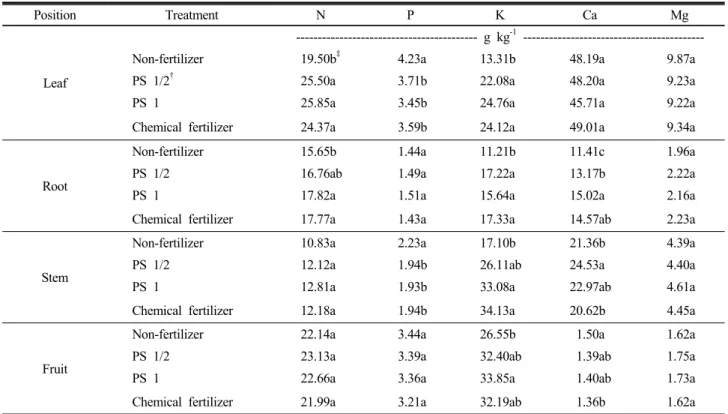
돈분뇨 액비 및 화학비료를 관비한 결과 토마토 잎, 뿌리, 줄기 및 과실의 무기성분 함량은 Table 3과 같 다. 잎의 무기성분 함량 중 질소와 칼륨은 비료 처리구 가 무비구에 비하여 모두 높았으며 비료 처리구간에는 차이가 없었다. Choi (2008)는 토마토 및 오이에서 화 학비료와 돈분뇨 액비 처리간에 잎의 무기성분 함량은 차이가 없다고 하여 본 연구와 일치하였다. 인 함량은 잎과 줄기에서 무비구가 가장 높았는데 이는 질소 시비 량이 적을 때 인의 흡수량이 증가하는 것으로 판단되며 돈분뇨 액비를 시용했을 때 양파 잎에서도 무비구가 인 산함량이 가장 높다는 보고 (Lee et al., 2006b)와 일 치하였다. 비료 처리 간에 잎의 질소 및 칼륨함량에 차 이가 없는 것은 돈분뇨 액비 26 mg L-1, 52 mg L-1 및 화학비료 52 mg L-1 처리구 모두 토마토가 자라는데 필 요한 질소와 칼륨이 공급되는 것으로 판단되었다. 마그 네슘함량은 처리간에 모든 부위에서 차이가 없으나 칼 슘함량은 줄기, 뿌리 및 과실에서 화학비료 처리구가 낮 았다. 이와 같은 결과는 칼슘 부족으로 발생하는 토마토 배꼽썩음과 발생이 돈분뇨 액비보다 화학비료 질소 과 용에서 더 많이 발생할 것으로 예상되었다. Hwang et
Table 3. Effect of fertigation of chemical fertilizer and pig slurry on the mineral content in leaf, root, stem, and fruit of tomato.
Position Treatment N P K Ca Mg
Leaf
--- g kg-1 ---
Non-fertilizer 19.50b‡ 4.23a 13.31b 48.19a 9.87a
PS 1/2† 25.50a 3.71b 22.08a 48.20a 9.23a
PS 1 25.85a 3.45b 24.76a 45.71a 9.22a
Chemical fertilizer 24.37a 3.59b 24.12a 49.01a 9.34a
Root
Non-fertilizer 15.65b 1.44a 11.21b 11.41c 1.96a
PS 1/2 16.76ab 1.49a 17.22a 13.17b 2.22a
PS 1 17.82a 1.51a 15.64a 15.02a 2.16a
Chemical fertilizer 17.77a 1.43a 17.33a 14.57ab 2.23a
Stem
Non-fertilizer 10.83a 2.23a 17.10b 21.36b 4.39a
PS 1/2 12.12a 1.94b 26.11ab 24.53a 4.40a
PS 1 12.81a 1.93b 33.08a 22.97ab 4.61a
Chemical fertilizer 12.18a 1.94b 34.13a 20.62b 4.45a
Fruit
Non-fertilizer 22.14a 3.44a 26.55b 1.50a 1.62a
PS 1/2 23.13a 3.39a 32.40ab 1.39ab 1.75a
PS 1 22.66a 3.36a 33.85a 1.40ab 1.73a
Chemical fertilizer 21.99a 3.21a 32.19ab 1.36b 1.62a
†PS 1/2, 1: pig slurry N 26, 52 mg L-1. Chemical fertilizer: urea N 52 mg L-1.
‡Mean separation within columns by Duncan’s multiple range test at P = 0.05.
al. (2004)에 의하면 돈분 일반 액비와 화학비료 시비 량이 같을 때 고추는 액비 처리에 의하여 인산과 칼륨은 증가하였으나 질소, 칼슘 및 마그네슘은 감소한다고 하 였고 배추는 처리간에 차이가 없다고 하여 작물에 따라 차이가 있음을 시사하였다.
돈분뇨 액비 및 화학비료를 관비한 결과 양분 흡수량 과 이용률은 Table 4와 같다. 질소 흡수량은 무비보다 돈분뇨 액비 26 mg L-1를 시비했을 때 ha당 22 kg, 돈 분뇨 액비 52 mg L-1를 시비했을 때 ha당 24 kg 더 흡수하여 시비량이 증가하여도 흡수량 증가는 미미하였 으며 화학비료 처리도 같은 경향으로 질소 시비량이 충 분함을 알 수 있었다. 토마토 재배에서 질소를 관비 했 을 때 토양 검정시비량 80%에서 수량이 많았고 생육이 가장 좋았다는 보고 (Lee et al., 2007)가 있어 질소 기준으로 액비를 시용할 때는 토양 검정시비량 100%보 다 시비량을 줄여 줄 필요가 있는 것으로 판단되었다.
양분 이용률은 질소는 16.0~36.7%, 인산은 3.0~6.3%, 칼륨은 29.2~43.3%로 칼륨, 질소, 인산 순으로 이용률 이 높아 양파 노지 재배시 돈분뇨 액비 시용 결과 (Lee et al., 2006a)와 같은 경향이다. 인산은 시비구에서 흡 수량 즉 양분 이용률이 낮기 때문에 흡수율을 높이는 방 법을 강구할 필요가 있다. Lee et al. (2006b)의 보고
에 의하면 녹비작물 후작으로 토마토 재배했을 때 양분 이용률은 질소 14.6~37.8%, 인산 16.7~56.0%, 칼리 23.6~46.5%로 돈분뇨 액비를 시용했을 때 보다 인산의 양분 이용률이 월등히 높아 돈분뇨 액비 및 화학비료 관비 재배에서 인산의 이용률을 높이기 위하여 녹비작물을 활용 할 필요가 있다고 판단되었다.
돈분뇨 액비 및 화학비료 관비 처리 후 토양 화학성 변화를 보면 Table 5와 같다. pH는 화학비료 처리구보 다 돈분뇨 액비 처리구가 높았는데 이는 돈분뇨 액비가 알칼리성이기 때문으로 판단되었다. 돈분뇨 액비를 시용 한 고추 (Kang et al., 2004)와 양파 (Lee et al., 2006a) 에서도 같은 경향이었다. 토마토를 재배한 후 토양 중 질산태 질소함량은 무비 재배에서는 28.8 mg kg-1로 낮 아졌으나 돈분뇨 액비 처리에서는 46.4~46.7 mg kg-1 로 증가하였고 화학비료 처리에서는 92.0 mg kg-1로 증 가하여 돈분뇨 액비 처리보다 화학비료 처리에서 질산태 질소 잔류량이 많았다. Hong (1998)은 토마토 질소 무비 재배 상한 기준을 토양 무기태질소 (NO3-N, NH4-N) 함 량이 220 mg kg-1이며, Kang and Hong (2004)에 의하 면 시설 토마토 재배에서 질산태 질소함량의 하한 기준 과 상한 기준은 각각 50, 280 mg kg-1이라 하여 92.0 mg kg-1는 토마토 재배에 높은 수치는 아니지만 장기재배에
Table 4. Nutrient input, uptake, and efficiency of retarding culture tomato cultivated in soil fertigated with chemical fertilizer and pig slurry.
Treatment Input Uptake Nutrient efficiency
N P K N P K N P K
kg ha-1 kg ha-1 --- % ---
Non-fertilizer 0 0 0 112 19 117 - - -
PS 1/2† 60 16 120 134 20 169 36.7 6.3 43.3
PS 1 120 33 240 136 20 187 20.0 3.0 29.2
Chemical fertilizer 119 33 238 131 21 196 16.0 6.1 33.2
†PS 1/2, 1: pig slurry N 26, 52 mg L-1. Chemical fertilizer: urea N 52 mg L-1.
Table 5. Effect of fertigation of chemical fertilizer and pig slurry on chemical properties in soil.
Treatment pH NO3-N Av. P2O5
Exchange cation
K Ca Mg
--- mg kg-1 --- --- cmol kg-1 ---
Non-fertilizer 7.1a‡ 28.8c 511a 0.18b 6.01a 1.75a
PS 1/2† 7.0ab 46.7b 630a 0.31b 6.30a 1.84a
PS 1 6.9b 46.4b 751a 0.55a 6.90a 1.98a
Chemical fertilizer 6.7c 92.0a 697a 0.50a 7.30a 2.31a
†PS 1/2, 1: pig slurry N 26, 52 mg L-1. Chemical fertilizer: urea N 52 mg L-1.
‡Mean separation within columns by Duncan’s multiple range test at P = 0.05.
의한 축적이 우려되는 것으로 판단되었다. 화학비료 처리 에서 토양 중 잔류 질산태 질소함량이 많은 것은 생육에 따른 양분 흡수량과 생육 후기로 갈수록 지온이 낮아져 암모니아태 함량이 높은 돈분뇨 액비보다는 요소태인 화 학비료 처리에서 이용량이 적어 잔류량이 많은 것으로 판단되었다. 치환성 칼륨은 무비가 낮고 돈분뇨 액비 및 화학비료 52 mg L-1 처리구가 높았지만 돈분뇨 액비와 화학비료는 처리간에 차이가 없었다. 이와 같은 결과를 종합해 볼 때 돈분뇨 액비는 토양 중 양분함량을 고려 하여 적정량을 시비한다면 토마토 관비재배에 화학비료 질소와 칼리를 대체하여 이용할 수 있는 유기 자원으로 판단되었다.
요 약
시설 하우스 토마토재배에서 돈분뇨 액비와 화학비료 의 관비 처리 효과를 알아보기 위하여 무비, 질소 기준 으로 돈분뇨 액비 26 mg L-1, 52 mg L-1 및 화학비료 52 mg L-1 4처리를 하여 토마토 수량, 생육, 무기성분 함량, 양분흡수량, 양분이용률 및 토양 화학성에 미치는 영향을 알아보았다. 돈분뇨 액비와 화학비료 관비 처리 는 수량과 생육에 차이가 없었으며 돈분뇨 액비 26 mg
L-1 처리에서 수량이 감소하는 경향을 보였다. 돈분뇨 액 비와 화학비료 처리에 비해 잎과 뿌리의 질소와 칼륨함 량은 무비에서 낮았으나 뿌리와 줄기의 인산함량은 무 비에서 높았다. 칼슘함량은 잎에서 처리간에 차이가 없 었으나 뿌리와 줄기는 돈분뇨 액비 52 mg L-1 처리가 높았고 과실내 칼슘함량은 화학비료 52 mg L-1 처리가 낮았다. 양분 이용률은 질소 15.8~36.7%, 인산은 3.0~
6.3%, 칼륨은 29.2~43.3%로 칼륨, 질소, 인산 순으로 낮았다. 토양 화학성 중 pH는 돈분뇨 액비 처리가 화학 비료 처리보다 높았고 질산태 질소함량은 화학비료 처 리가 돈분뇨 액비 처리보다 증가하였다. 치환성 칼륨함 량은 돈분뇨 액비와 화학비료 52 mg L-1 처리구가 높 았으며 칼슘과 마그네슘은 처리간에 차이가 없었다. 결 과적으로 토마토 관비 재배에서 토양 검정에 의한 돈분 뇨 액비 시용은 화학비료 질소와 칼리를 대체하여 이용 할 수 있을 것으로 판단되었다.
인 용 문 헌
Bonmati, A. and X. Flotats. 2003. Air stripping of ammo- nia from pig slurry characterization and feasibility as pre- or post-treatment to mesophilic anaerobic digestion.
Waste Management 23:261-272.
Choi, J.K. 2008. Effect of liquid pig manure on horti- cultural crop and soil environment. 2007 Annual Report on Natural Cycle Agricultural Research. RDA. Natural Recycle Agricultural Research Project Team. p. 95-103.
Clifford, WR., L.B. James, and H.D. Stensel. 1992. Design and retrofit of wastewater treatment plants for biological nutrient removal. Water Quality Management Library 5:1-23.
Hong, S.D. 1998. Fertilizer recommendation based on soil testing for tomato in plastic film house. J. Korea Soc.
Soil Sci. Fert. 31:350-358.
Hwang, S.W., J.K. Sung, B.K. Kang, C.S. Lee, S.G. Yun, T.W. Kim, and K.C. Eom. 2004. Polyamine biosynthesis in red pepper and chinese cabbage by the application of liquid pig manure. Korean J. Soil Sci. Fert. 37:171-176.
Kang, B.G., H.J. Kim, G.J. Lee, and S.G. Park. 2004.
Determination of the optimum application rate of pig slurry for red pepper cultivation. Korean J. Soil Sci. Fert.
37:388-395.
Kang, S.S. and S.D. Hong. 2004. Estimation of optimum application rate of nitrogen fertilizer based on soil nitrate contraction for tomato cultivation in plastic film house.
Korean J. Soil Sci. Fert. 37:74-82.
Lee, C.H., K.Y. Shin, J.T. Lee, G.J. Lee, and J.H. Ahn.
2003. Determination of nitrogen application level for Chinese cabbage with application of poultry manure com- post in highland. Korean J. Soil Sci. Fert. 36:280-289.
Lee, I.B., J.H. Lim, and J.M. Park. 2007. Effect of reduced nitrogen fertigation rates on growth and yield of tomato.
Kor. J. Environ. Agr. 26:306-312.
Lee, J.T., I.J. Ha, H.D. Kim, J.S. Moon, W.I. Kim, and W.D. Song. 2006a. Effect of liquid pig manure on growth, nutrient uptake of onion, and chemical properties in soil.
Kor. J. Hort. Sci. Technol. 24:148-156.
Lee, I.B., J.M. Park, J.H. Lim, and K.S. Hwang. 2006b.
Growth and yield response of the following tomato crop according to incorporation of green manure into soil.
Kor. J. Environ. Agr. 25:346-351.
Liao, P.H., A. Chen, and K.V. Lo. 1995. Removal of nitrogen from swine manure water by ammonia stripping.
Bioresource. Technol. 54:17-20.
Lim, T.J., I.B. Lee, S.B. Kang, J.M. Park, and S.D. Hong.
2009a. Effects of continual pre-plant application of pig slurry on soil mineral nutrients and yield of chinese cabbage. Kor. J. Environ. Agr. 28:227-232.
Lim, T.J., S.D. Hong, S.B. Kang, and J.M. Park. 2009b.
Evaluation of preplant optimum application rates of pig slurry composting biofiltration for chinese cabbage. Kor.
J. Hort. Sci. Technol. 27:572-577.
Lim, T.J., S.D. Hong, S.H. Kim, and J.M. Park. 2008.
Evaluation of yield and quality from red pepper for application rates of pig slurry composting biofiltration.
Kor. J. Environ. Agr. 27:171-177.
MAF. 2007. Statistical research annual report of agri- culture and forestry. Ministry of Agriculture and Forestry.
Seoul. Korea.
Murayama, S., N. Kibo, M. Komada, K. Baba, and A.
Tsumura. 2001. Water quality, particularly of trihalomethane formation potential of ground water of articultural area of humic volcanic ash soil on Shirash Plateau where livestock wastes have been applied as land management.
Soil Sci. Plant Nutr. 72:764-774.
Rural Development Adminstration (RDA). 2000. Methods of soil and plant analysis. National Institute of Agricul- tural Science and Technology, Suwon, Korea.
Rural Development Adminstration (RDA). 2006. Manual of appling liquid fertilizer with livestock manure. Na- tional Institute of Agricultural Science and Technology, Suwon, Korea.
Rural Development Adminstration (RDA). 2009a. Improve- ment of the swine slurry treatment and land application technology for recycling, p. 1-50., In: Kim, J.H., U.S.
Jeong, J.G. Choi, J.H. Gwak, G.H. Jeong, M.S. Jeong, M.S. Han, Y.S. Song, T.H. Yun., C. Kim. (eds.) Im- provement of the swine slurry treatment system by SCB process. 2009 Reort of National Joint Agricultural Re- search Project of RDA, Suwon, Korea.
Rural Development Adminstration (RDA). 2009b. Improve- ment of the swine slurry treatment and land application technology for recycling, p. 110-134. In: Park, J.M., Y.I.
Kang, I.B. Lee, T.J. Lim, J.K. Park, S.B. Kang. (eds.).
Development of cultivation technology for appliance in fruit tree and greenhouse vegetation of slurry composting biofilatration. 2009 Report of National Joint Agricultural Research Project of RDA, Suwon, Korea.
Yadav, R.L., B.S. Dwivede, K. Prasad, and P.S, Pandey.
2000. Yield trends and changes in soil organic-C and available NPK in a long-term rice-wheat system under integrated use of manure and fertilizers. Field Crop Res.
68:219-246.