• 검색 결과가 없습니다.

Effect of Slurry Composting and Bio-filtration (SCB) by Fertigation on Soil Chemical Properties and Growth of Red Pepper (Capsicum annuum L.)

N/A
N/A
Protected

Academic year: 2021

Share "Effect of Slurry Composting and Bio-filtration (SCB) by Fertigation on Soil Chemical Properties and Growth of Red Pepper (Capsicum annuum L.)"

Copied!
9
0
0

로드 중.... (전체 텍스트 보기)

전체 글

(1)

Effect of Slurry Composting and Bio-filtration (SCB) by Fertigation on Soil Chemical Properties and Growth of Red Pepper ( Capsicum annuum L.)

Jong-Eun Lee*, Yeo-Uk Yun, Jin-Il Lee, Moon-Tae Choi, Dong-Soek Lee

1

, and Yun-Gyu Nam Chungcheongnam-do Agricultural Research and Extension Services, Yaesan 32418, Korea

1

DAEJI Development Co., Ltd., Cheonan 31002, Korea

(Received: July 2 2015, Revised: October 14 2015, Accepted: October 20 2015)

The slurry composting and bio-filtration (SCB) liquid manure has some obvious advantages including a good source of N, P and K, local availability, effective microorganism and the ability to improve soil properties.

This study was conducted to evaluate the influence on the changes of soil chemical properties and yield of red pepper by fertigation cultivation with SCB application for 2 years. Red pepper was transplanted in early May in 2013 and 2014. The treatment with three replication was composed of 4 types as control (N 1.0), SCB 0.5N, SCB 1.0N, and SCB 2.0N standards of recommended nitrogen fertilizer (19 kg N 10a -1 ). The fertigation cultivation which was installed the surface drip irrigation system was splitted 10 times as 2.5 Mg 10a -1 nutritional solution included with chemical fertilizer and SCB every 10 days during the cultivation. The height and width of pepper plant were 7.0% and 5.8% higher in SCB 2.0N treatment than that in control. The yield of red pepper increased with the increasing of SCB application rates from SCB 0.5N to 2.0N. The yield of SCB 1.0N was much better 10% in average than that of control, and there was significant differences among all treatments. pH of control soil after final harvest decreased to 6.1, however pH of SCB treated soils increased from 6.7 to 7.1 depending on SCB application rates. The Exch.-K contents of SCB treated soils were increased 13.7 to 56.9% after final harvest compared with control by 0.51 cmol c kg -1 . Accordingly, these results showed that SCB 1.0N application rate as a recommended nitrogen level based on soil testing can be used as an alternative nitrogen management as well as plant nutrition for red pepper cultivation.

Key words: Red pepper, SCB, Nitrogen, Chemical properties, Fertigation

The effect of different SCB liquid fertilizer application rates on yield of red pepper in 2013 and 2014 (

Mean by Duncan`s multiple range test at p=0.05).

1)

*Corresponding author : Phone: +82416356103, Fax: +82416357923, E-mail: [email protected]

(2)

Introduction

우리나라 국민 식생활 변화에 따른 2013년 기준 국민 1인 당 육류 소비량은 42.7 kg으로 지난 20년과 비교하여 1.9배 증가하였고, 이와 더불어 국내 축산농가의 가축 사육두수도 증가하였다 (MAFRA, 2014). 이러한 이유로 최근 5년간 전 국 가축분뇨 발생량은 연평균 4천만 톤 이상을 기록하고 있 으며, 이중 돼지 분뇨가 38.2%를 차지하고 있다 (MAFRA, 2013). 또한, 시․도별 가축분뇨 발생량 점유율은 2012년 1월 에서 6월까지 충남이 17.8%로 가장 높았고, 경기 17.5%, 경 북 14.2%, 전남 12.6%를 차지하고 있다 (Regioninfo, 2012).

런던협약 이후 2012년부터 해양 투기가 전면 금지되면서 이 들 발생된 가축분뇨는 퇴․액비 자원화 88.7%, 개별농가 및 공공처리장 정화방류 9.1%, 자연 증발을 포함한 기타 2.2%

등으로 처리되고 있다 (MAFRA, 2013). 친환경농업 확대와 더불어 지속적인 퇴․액비 자원화를 위해 정부에서는 가축분 뇨 자원화율을 2019년까지 91.0%를 목표로 계획을 발표하 였으나 액비 자원화율은 7.7%로 퇴비화 81.0%에 비하여 현 저히 저조한 실정이다. 이는 액비 특성상 95% 이상 높은 함 수율과 불균일한 성분 및 악취 등에 따른 수요자의 기피현 상에 기인한다. 이러한 문제점들을 보완하여 개발된 가축분 뇨 액비화 기술이 퇴비단여과 (SCB: Slurry Composing &

Biofiltration) 액비이다. SCB 액비는 기존 퇴비화 시설의 바닥을 개조하여 퇴비화 효율증진 및 고품질 액비화 기능을 병합한 방법이다. 퇴비 발효 부숙과정과 생물학적 여과 침 출과정을 거쳐 생산된 SCB 액비는 냄새가 거의 없고 성상 이 균질하다. 또한 SCB 액비는 퇴비의 분해산물인 부식산 (humic acid)과 활성 유용미생물이 다량 함유된 고품질 액 비이며, 일반 돈분 액비와 달리 칼륨 함량 높고 인산 함량은 절반정도로 낮은 것이 특징이다 (RDA, 2007).

가축분뇨는 더 이상 폐기물이 아닌 자원의 개념으로서 완전한 의식 전환이 필요하다. 이러한 가축분뇨는 작물 생 육에 필수원소인 질소 (N), 인 (P), 칼륨 (K) 외에 다양한 영 양성분을 함유하고 있으며 (Schoenau and Assefa, 2004), 지력 유지 및 유기물질 순환을 원활하게 하는 측면에서도 매우 중요하다 (Lee et al., 2003; Paschold et al., 2008;

Theodora Matsi, 2012). 돈분 액비의 장기 연용은 토양 유 기물 함량 증가에 효과가 있을 뿐만 아니라 토양 미생물 효 소 활성 유도에 기여한다 (Adeli et al., 2008; King et al., 2015).

지난 10여년 전만해도 가축분뇨 액비의 처리 및 이용에 관한 연구는 대부분 벼와 노지 밭작물에 대한 밑거름 적정 시용량 및 수량성 조사였다 (Jeon et al., 2003; Kim et al., 1999; Lim et al., 2002; Park et al., 2001). 그러나 최근 연 구 동향은 친환경농법과 농업환경 부하 경감을 최소화한 SCB 액비 활용 연구가 중심을 이루고 있다. 고품질 유기 벼

생산과 토양 양분 집적평가 (Lee et al., 2011; Ryoo et al., 2012), 논 물관리를 통한 수계 부하 경감 (Kim et al., 2012), 간척지에서 녹비재배와 혼용한 옥수수, 교잡수수, 청보리 등 사료작물 적응성 연구 (Choi et al., 2011; Jo et al., 2010; Shin et al., 2014), 과원에서의 배와 복숭아에 대 한 수체 생장 및 시비 효율 등에 효과적임을 시사했다 (Lee et al., 2012; Lee et al., 2014; Park et al., 2012; Park et al., 2013). Ham et al. (2009)은 농업기술실용화재단과 공 동으로 골프코스관리를 위한 SCB 액비 활용이 잔디 생육에 효과적임을 보고하였다. 이후 개량된 SCB 저농도 액비 시 용이 한국잔디와 크리핑벤트그래스의 생육에 우수하였고, 토양 중 양분의 용탈을 감소시킨다 하였다 (Ham et al., 2011; Kang et al., 2010). 그리고 SCB 액비를 총각무와 옥 수수 (Kang et al., 2011), 고추 (Lim et al., 2008)와 배추 (Lim et al., 2009) 재배에서 정식 전 밑거름으로 이용하였 고, 시설재배로 오이 (Park et al., 2011)와 토마토 (Lee et al., 2008; Park et al., 2010) 관비재배 시 SCB 액비로 화학 비료 대체가 가능함을 보고하였다. 또한 시설하우스 조건에 서 저농도 돈분액비의 장기연용 (5년)이 토마토와 오이 수 량 저하 및 토양 인산 및 중금속 축적 우려가 없음을 밝혔다 (Seo et al., 2011). 이러한 SCB 액비 활용에 관한 연구가 수 없이 진행되었음에도 우리 앞에는 여전히 해결해야 할 과제 들이 산적해 있다. 현재 우리나라는 UN에서 물부족 국가로 지정하고 있다. 지구온난화에 따른 이상기후와 함께 농작물 에 필요한 충분한 물 공급이 어려워지고 있으며, 특히 우리 나라의 봄 가뭄은 매년 그 심각성을 더해가고 있다. 이에 대 해 SCB 액비는 농산물 생산 활동에 있어서 단지 작물 영양 원으로서의 기능 뿐만 아니라 물 대체 자원으로서 그 기능 을 더하고 있다. 따라서 본 연구는 지속가능한 작물 맞춤형 정밀농업으로 건전한 작물 생육 관리 및 수량 증대 그리고 토양 양분 집적 최소화를 위해 SCB 액비를 활용한 노지 고 추 관비재배 효과를 구명하고자 수행하였다.

Materials and Methods

시험재료 노지고추 SCB 액비 관비재배 시험은 예산통 인 충청남도농업기술원 시험포장에서 2년간 수행하였으며 토양 특성은 Table 1과 같다. 시험 전 토양은 노지고추를 재 배하기에 적합한 배수 양호한 양토였으며 적정한 수준의 화 학적 특성을 보였다. 또한 시험에 이용된 SCB 액비는 pH 9.2 정도의 알칼리였으며, 칼리함량 0.34%로 질소함량 (0.15%) 보다 약 2.3배 높았으며, 인산함량이 낮은 특징을 보였다 (Table 2).

시험처리 및 재배 노지고추 포장에서의 액비 관비재

배 처리 시험은 토양검정시비량으로 화학비료 관비재배구

(3)

Table 1. Physico-chemical properties of the soil used for the field experiment before treatment in 2013 and 2014.

Division pH EC OM Av. P

2

O

5

NO

3

-N Ex. cations Soil

texture

K

+

Ca

2+

Mg

2+

Na

+

1:5 dS m

-1

g kg

-1

--- mg kg

-1

--- --- cmol

c

kg

-1

---

2013 year 6.8 0.28 23 117 21 0.65 7.4 1.6 0.17 Loam

2014 year 6.3 0.35 24 143 23 0.71 6.9 1.8 0.18 Loam

Optimal ranges

6.0~6.5 <2 25~35 450~550 - 0.7~0.8 5.0~6.0 1.5~2.0 - SL

§

~CL

Optimal ranges of field cultivation

§

; SL: Sandy loam, CL: Clay loam

Table 2. Chemical properties of SCB liquid fertilizer applied to pepper cultivation.

pH T-N P

2

O

5

K

2

O CaO MgO Na

2

O Fe B Cu Zn

--- % --- --- mg L

-1

---

9.2 0.15 0.06 0.34 0.08 0.02 0.07 51 6 16 47

를 대조구로 하였고 (RDA, 2010), SCB 액비 처리구는 질소 시비량 기준 반량 (N 0.5), 적량 (N 1.0), 배량 (N 2.0) 3수 준으로 처리하였다. 화학비료 대조구 (N-P

2

O

5

-K

2

O=19.0- 11.2-14.9 kg 10

-1

)는 인산을 전량 밑거름으로 처리하였고, 질소와 칼리는 기비로 전체 시비량의 50%와 60%를 각각 처 리하였다. 그리고 남은 덧거름은 물 점적관주와 함께 정식 후 30일 간격으로 질소 3회와 칼리 2회를 처리하였다. SCB 액비 처리구는 정식 후 10일 간격으로 1회 관주량 2.5 ton 10a

-1

(SCB N 0.5: 액비 625 L+ 물 1,875 L; SCB N 1.0: 액 비 1,250 L + 물 1,250 L; SCB N 2.0: 액비 2,500 L + 물 0 L)을 기준으로 오전 10시에 약 30분간 10회 점적관주를 이용하여 처리하였다. SCB 액비 반량과 적량구에는 인산 부족으로 인한 결핍현상은 없을 것으로 판단하여 추가로 인 산을 시용하지 않았다. SCB 액비 점적관주 시 대조구에도 동일량의 물을 공급하였다. 2013년과 2014년 노지고추 관비 재배를 위한 품종은 ‘배로따’를 선택하였고 정식은 5월 1일 이었으며, 시험구 당 면적은 50 m

2

(5×10 m), 재식거리는 110×40 cm로 하여 난괴법 3반복으로 수행하였다.

생육조사 및 분석방법 고추 재배 및 작물 생육조사는

연구조사분석기준에 준하여 조사하였다 (RDA, 2012). 홍고 추 수량조사는 총 5회 수확하여 누적 계산하였다. 토양 시 료는 깊이 15 cm에서 3반복 2주 간격으로 채취하였으며, 2 mm 체를 통과한 풍건 시료 대한 토양 분석방법은 농촌진흥 청 토양화학분석법 (NIAST, 2010)에 준하여 분석하였다.

pH와 EC는 토양과 물의 비율을 1:5로 하여 초자전극법으로 측정하였고, 유기물은 Tyurin법, 유효인산은 Lancaster법, 치환성양이온은 1N NH

4

OAc (pH 7.0) 용액으로 침출하여 유도결합플라즈마원자발광분광법 (ICP, Varian ESP-730) 으로 분석하였다. 질산태 질소는 토양 5 g에 2 M KCl 25 ml 를 넣어 30분간 진탕하여 Whatman No. 2여과지로 여과한 후 침출액을 이용하여 켈달 (Foss, Kjeltec 8460) 자동분석

하였다.

통계분석 통계분석은 SAS 프로그램 (ver. 9.2, SAS, Cary, NC)을 이용하였으며, 고추 생육 및 수량 등은 분산분 석 (ANOVA)과 Duncan의 다중검정을 통해 각 처리간의 통 계적 유의성을 비교 검토하였다.

Results and Discussion

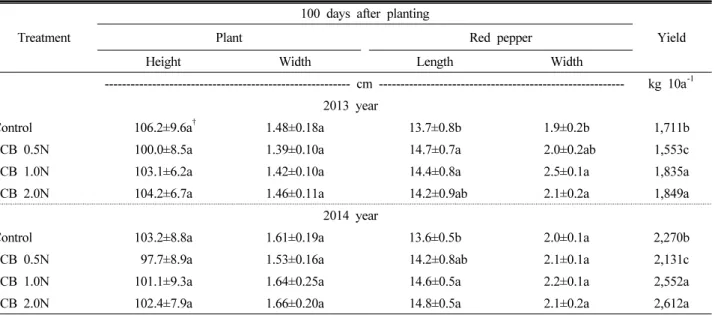
고추 생육 및 수량 2013-2014년간 노지고추 SCB 액

비 관비재배를 통한 생육과 수량 조사 결과는 Table 3과 같

다. 5월 1일 정식 후 약 100일째 최종 생육조사 결과에서 화

학비료구와 비교하여 SCB 0.5N 처리구에서 생육이 가장 저

조하였고, 액비 시용량이 많아질수록 초장과 경경이 증가하

였으나 모든 처리 간 고추의 초장과 경경에는 유의성을 없

는 것으로 나타났다. 돈분 액비를 고추 밑거름으로 시용한

연구 (Lim et al., 2008)와 토마토 관비재배 (Lee et al.,

2008; Seo et al., 2011) 그리고 배 (Park et al., 2012)와 복

숭아 (Park et al., 2013) 등 과수에서도 화학비료와 액비 처

리간 작물 생육에 차이가 발생하지 않는다는 보고와 동일하

였다. 홍고추의 과경과 과폭 조사에서는 화학비료구 대비

SCB 1.0N과 SCB 2.0N에서 크지는 않으나 유의한 차를 보

였다. Flores et al. (2007)은 질소 시비량을 0, 150, 300 kg

ha

-1

처리한 결과 고추의 평균 과중은 질소 시비량에 따른

차이가 없다고 하였다. 그리고 홍고추 수량조사는 7월 중순

부터 9월 상순까지 5회 수확하여 누적량으로 총량을 산정하

였으며, SCB 액비 시용량 증가에 따라 수량이 증가하였다

(Fig. 1). 특히, 화학비료구와 SCB 1.0N과 SCB 2.0N에서는

수량간의 통계적 유의성이 있는 것으로 나타났으며, 액비

적량구인 SCB 1.0N은 연차별 약 7%와 12%의 증수효과를 보

였다. 이러한 결과들로 화학비료와 동일한 질소 시용량을

기준으로 SCB 액비 적량 시용은 노지고추 관비재배 시 작

(4)

Table 3. Comparison of growth and yield of red pepper treated with chemical fertilizer vs. different SCB liquid fertilizer treatments.

Treatment

100 days after planting

Yield

Plant Red pepper

Height Width Length Width

--- cm --- kg 10a

-1

2013 year

Control 106.2±9.6a

1.48±0.18a 13.7±0.8b 1.9±0.2b 1,711b

SCB 0.5N 100.0±8.5a 1.39±0.10a 14.7±0.7a 2.0±0.2ab 1,553c

SCB 1.0N 103.1±6.2a 1.42±0.10a 14.4±0.8a 2.5±0.1a 1,835a

SCB 2.0N 104.2±6.7a 1.46±0.11a 14.2±0.9ab 2.1±0.2a 1,849a

2014 year

Control 103.2±8.8a 1.61±0.19a 13.6±0.5b 2.0±0.1a 2,270b

SCB 0.5N 97.7±8.9a 1.53±0.16a 14.2±0.8ab 2.1±0.1a 2,131c

SCB 1.0N 101.1±9.3a 1.64±0.25a 14.6±0.5a 2.2±0.1a 2,552a

SCB 2.0N 102.4±7.9a 1.66±0.20a 14.8±0.5a 2.1±0.2a 2,612a

Within-row means followed by the same letter are not significantly different at the 0.05 probability level through Duncan’s multiple range test (n=20).

Fig. 1. The effect of different SCB liquid fertilizer application rates on yield of red pepper in 2013 and 2014, respectively (

Mean by Duncan`s multiple range test at p=0.05).

물의 생육이 양호하며 수량 증수효과도 기대될 뿐만 아니라 화학비료 100% 대체자원으로서 가능할 것으로 판단되었다.

토양 화학성 노지고추 관비재배시 SCB 액비 시용수준 에 따른 2년차 최종 토양 화학성 변화는 Table 4와 같다. 이 들 토양 화학성 결과 중 pH, EC, 유효인산과 질산태 질소 및 교환성양이온함량 등은 SCB 액비 시용에 따른 토양 양 분 변화에 영향을 주었다.

토양 pH는 Table 1에서와 같이 2013년 시험 전 토양에서 6.8로 중성에 가까웠으나 Fig. 2에서 보는 바와 같이 1년차 시험재배 기간 중 모든 처리구에서 pH가 다소 낮아지는 경 향을 보였다. 재배 중 pH 변화는 화학비료구에서 가장 크게 감소하였으며, SCB 액비 처리구에서는 시용량이 많을수록 낮아지는 경향이 적었다. 2014년 동일 시험포장의 시험 전

토양 pH 6.3에서 시험 후 화학비료구는 6.1로 가장 낮아졌 으나 SCB 액비 처리구에서는 시용량이 증가할수록 pH가 6.7~7.1로 높아지는 경향을 보였다. SCB 액비를 포함한 가 축분뇨를 이용한 작물 재배시험 토양 pH는 시용량이 증가 할수록 높아졌다고 보고한 결과와 동일하였다 (Briceno et al., 2008; Ham et al., 2011; Lee et al., 2008; Kang et al., 2011; Park et al., 2012; Park et al., 2013; Seo et al., 2011). 이러한 결과는 칼리와 칼슘 등의 함량이 높고 pH 9.2 알칼리성 SCB 액비 특성 때문인 것으로 판단되며 SCB 액비 적량 시용을 초과할 경우 반드시 주의해야 할 것이다.

토양 전기전도도 (EC)는 Fig. 3과 같이 2년간의 재배 기 간 중 화학비료구와 SCB 2.0N에서 가장 높았다. 그리고 SCB 액비 적량 시용 이상일 경우 시험전 토양 EC보다 다소 높은 결과를 보였다. Kang et al. (2011)은 SCB 액비적량의 2배 처리는 토양 염류장해 우려가 있다고 하였다. 본 연구 에서도 SCB 액비적량을 시용한 시험 전․후 토양 EC에는 큰 차이가 없었으나 액비배량구에서는 화학비료구보다 높게 나타나 동일한 결과를 보였다. 다만 밑거름으로 시용한 기 존의 연구와는 달리 노지고추 재배기간 중 SCB 액비를 점 적관수로 10회 분시하였기 때문에 잔류하는 염류 함량이 낮 았던 것으로 판단된다.

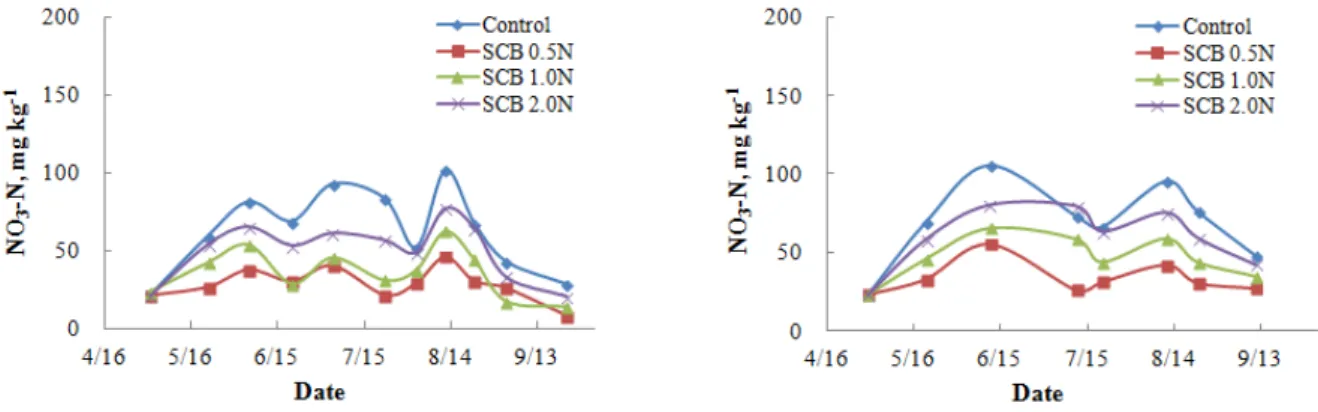
노지고추 관비재배 기간 중 토양 내 질산태 질소의 농도

변화는 2년간 유사한 경향의 결과를 보였다 (Fig. 4). 시험

전 토양 질산태 질소 함량은 약 20 mg kg

-1

정도였으나 재

배기간이 경과할수록 화학비료구에서 가장 높게 증가하는

경향을 보였으며, SCB 액비 시용량이 증가할수록 높아졌

다. 특히 화학비료구와 SCB 2.0N에서는 시험 전 질산태 질

(5)

Table 4. Physico-chemical properties of the soil used for the field experiment after final harvest in 2014.

Division pH EC OM Av. P

2

O

5

NO

3

-N Ex. cations

K

+

Ca

2+

Mg

2+

Na

+

1:5 dS m

-1

g kg

-1

--- mg kg

-1

--- --- cmol

c

kg

-1

---

Control 6.2 0.31 24 378 48 0.51 6.9 1.3 0.09

SCB 0.5N 6.7 0.26 24 332 27 0.58 6.9 1.4 0.10

SCB 1.0N 6.9 0.42 26 387 35 0.73 7.2 1.5 0.11

SCB 2.0N 7.1 0.55 28 442 42 0.80 7.5 1.7 0.13

Fig. 2. Changes of soil pH as affected by the application of SCB liquid fertilizer for red pepper in 2013 (left) and 2014 (right).

Fig. 3. Changes of electrical conductivity (EC) as affected by the application of SCB liquid fertilizer for red pepper in 2013 (left) and 2014 (right).

Fig. 4. Changes of nitrate N in topsoil as affected by the application of SCB liquid fertilizer for red pepper in 2013 (left) and 2014

(right).

(6)

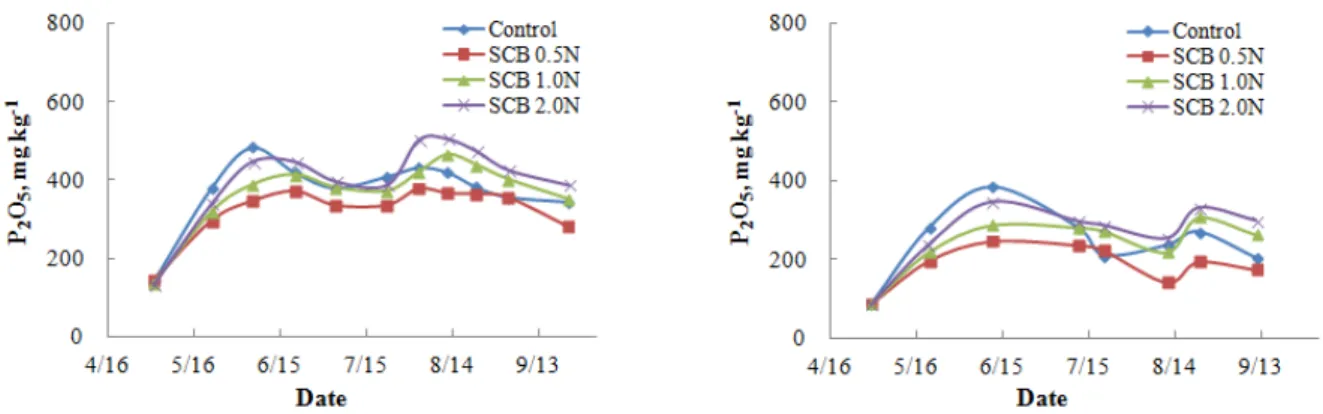
Fig. 5. Changes of avail. P

2

O

5

in topsoil as affected by the application of SCB liquid fertilizer for red pepper in 2013 (left) and 2014 (right).

Fig. 6. Changes of Exch. potassium as affected by the application of SCB liquid fertilizer for red pepper in 2013 (left) and 2014 (right).

소 함량보다 약 2배 정도 높은 결과를 보였다. 이러한 결과 는 시비량 증가로 인한 작물의 양분 흡수는 지속적으로 증 가되지 않으며 남겨진 양분은 토양에 잔류한다고 보고하였 다 (Lee et al., 2007; Lim et al., 2010). 또한 이들 질산태 질소의 변화 경향은 Fig. 3의 토양 EC 변화와 흡사한 경향 을 보였으며, 이는 토양 EC와 질산태질소 함량과는 밀접한 관계가 있기 때문이다 (Kang et al., 2011).

작물 영양원으로서 가축분뇨 액비의 과용과 연용에 있어 서 가장 큰 문제는 토양 내 인산집적으로 토양 입자와 강한 흡착력으로 인하여 불용태 인산이 되기 때문이다 (Smith et al., 2001; Soupir et al., 2006). 본 연구 기간 중 노지고추 SCB 액비 관비재배에서의 토양 내 유효인산 변화는 Fig. 5 와 같다. 토양 내 유효인산 함량은 모든 처리구에서 시험 전 값보다 시험 후에 증가하였다. 화학비료구와 SCB 액비 처 리구를 비교했을 때 과잉의 SCB 액비를 시용할 경우 토양 내 인산은 집적된다고 한 보고와 유사하였다 (Ham et al., 2011; Lee et al., 2008; Lee et al., 2011; Park et al., 2013; Ryoo et al., 2012). 그러나 재배 중 토양 내 인산 함 량은 화학비료구에 비하여 SCB 액비 처리구들의 인산 증가 는 그렇게 크지 않음을 알 수 있었다. 이는 높은 인산 함량 의 기존 돈분 액비와는 달리 SCB 액비에는 인산 함량이 질

소 함량의 1/3 수준인 0.06%라는 저농도로 함유하고 있으며 (Table 2), 관비재배 시 10회로 나눠 점적 관수하였기 때문 으로 판단된다. 또한 Lim et al. (2009)과 Seo et al. (2011) 도 가축분뇨 연용에 따른 토양 중 인산 함량 증가와 달리 SCB 액비 연용은 낮은 인산 함량으로 크게 증가하지 않는 다고 하였다.

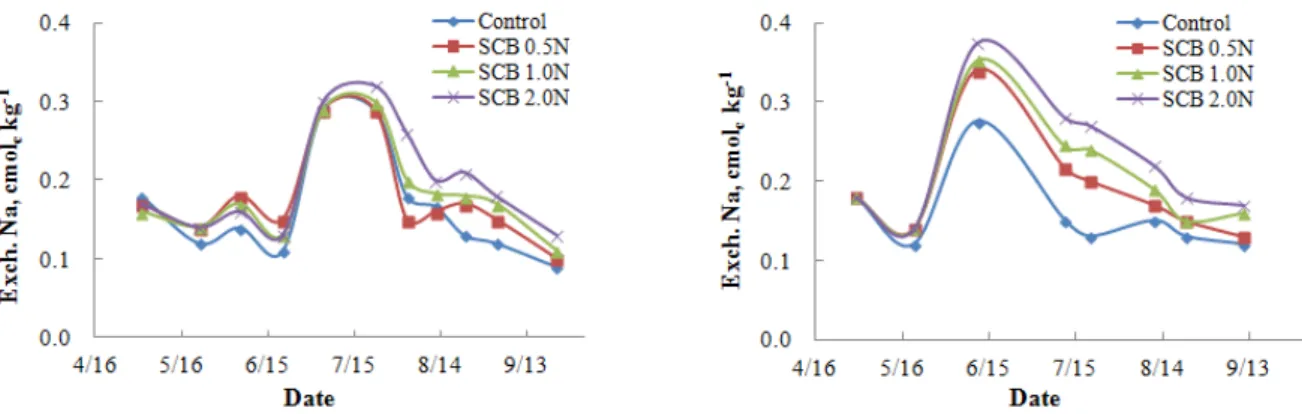
2년간의 관비재배 시험 후 고추밭 토양의 교환성양이온 함량은 Table 4에서 보는 바와 같으며, 이들 교환성양이온 함량 중 교환성 칼륨함량의 경시적 변화는 Fig. 6에 나타내 었다. SCB 액비의 K

2

O 함량은 0.34%로 질소 함량의 2배보 다 높았고, Na

2

O 함량은 0.07%였다. 이러한 SCB 액비 성분 특성상 교환성 칼륨은 매년 시험 전 토양보다 시험 후 토양 에서 다소 증가하는 경향을 보였다. 시험 후 화학비료구에 서 다소 감소한 결과와 비교할 때 질소 기준 SCB 0.5N, 1.0N, 2.0N으로 시용량이 증가할수록 교환성 칼륨함량은 0.58, 0.73, 0.80 cmol

c

kg

-1

로 증가하는 것을 알 수 있었다.

Kang et al. (2011)은 총각무와 옥수수 재배 시 밑거름으로

SCB 액비 처리 수준별로 교환성 칼륨함량이 높은 상태를

유지하며 토양 중에서 집적된다하였고, Seo et al. (2011)은

시설하우스 토마토와 오이 밑거름으로 질소기준 50%, 100%,

200% 시용구에서 각각 0.43, 0.70, 1.52 cmol

c

kg

-1

로 50%

(7)

Fig. 7. Changes of Exch. sodium as affected by the application of SCB liquid fertilizer for red pepper in 2013 (left) and 2014 (right).

시용구를 제외하고 유의성 있게 증가하였다고 보고하였다.

또한 토양 내 교환성 나트륨도 화학비료구보다 SCB 액비 처리량 증가에 따라 다소 증가하였다 (Fig. 7). 그러나 하절 기 강우에 영향으로 7월 하순을 중심으로 모든 처리구에서 크게 낮아졌으며, 9월 상순부터는 시험 전 교환성 나트륨 함량 정도의 수준으로 감소하였다. 그러나 Lee et al. (2014) 이 배 과원에서의 SCB 액비 장기 연용에 의한 교환성 칼륨 집적에 대한 연구 필요성을 언급했듯이 작물별 적정 시용량 설정을 위해서는 장기 연용에 따른 토양 화학성 변화에 대 한 추가 연구가 필요할 것으로 생각한다.

Conclusion

본 연구는 유기성자원인 퇴비단여과 (SCB) 액비를 이용 한 노지고추 관비재배 시 고추 생육과 수량성 검토를 통한 관비법 설정, 그리고 SCB 액비 시용수준에 따른 토양화학 성에 미치는 영향을 구명하고자 2년간 수행하였다. 고추 정 식일은 5월 1일로 동일하였고, 처리구는 화학비료구를 포함 하여 질소 19 kg 10a

-1

기준 SCB 액비 반량, 적량, 배량으로 4처리구 3반복으로 하였다. 점적호스를 이용한 관비방법은 정식 10일 후부터 1회 2.5 ton 10a

-1

로 10일 간격 총 10회로 분시하여 처리하였다. 고추 초장 및 경경은 화학비료 대비 SCB 액비 배량구에서 각각 평균 7.0%와 5.8% 컸고, 홍고추 수량은 화학비료 (2.27 Mg 10a

-1

) 대비 SCB 액비 적량 (2.55 Mg 10a

-1

) 처리에서 평균 약 10% 유의성 있는 증수효과를 보였다. 토양화학성에서 재배 후 토양 pH는 화학비료에서 는 감소하였으나 SCB 액비를 시용한 처리구는 시용량에 따 라 6.7~7.1로 증가하였다. 토양 내 교환성양이온 중 칼륨 함량은 화학비료 대비 SCB 액비 시용량이 증가할수록 13.

7~56.9% 증가하였다. 따라서 노지고추 관비재배에서 생육 과 수량 및 토양 염류집적 등의 양분균형을 고려한 SCB 액 비 적정량은 화학비료 질소 기준 액비적량을 시용할 것을 추천한다.

References

Adeli, A., C.H. Bolster, D.E. Rowe, M.R. Mclaughlin, and G.E. Brink. 2008. Effect of long-term swine effluent application on selected soil properties. Soil Sci. 173:223- 235.

Briceno, G., R. Demanent, M. de la Luz Mora, and G. Palma.

2008. Effect of liquid cow manure on Andisol properties and atrazine adsorption. J. Environ. Qual. 37:1519-1526.

Choi, K.C., M.W. Jung, N.C. Cho, and Y.C. Lim. 2011.

Effect of application of swine slurry on production of Sorghum×Sorghum hybrid and soil environment in reclaimed land. Korean J. Grassl. Forage Sci. 31:159-166.

Flores, P., I. Castellar, P. Hellin, J. Fenoll, and J. Navarro.

2007. Response of pepper plants to different rates of mineral fertilizers after soil biofumigation and solarization.

J. Plant Nutr. 30:367-379.

Ham, S.K., Y.S. Kim, T.S. Kim, K.S. Kim, and C.H. Park.

2009. The effect of SCB liquid fertilizer on growth of Creeping Bentgrass. Korean Turfgrass Sci. 23:91-100.

Ham, S.K., and Y.S. Kim. 2011. The effect of developed SCB liquid fertilizer on the growth of Creeping Bentgrass. Asian J. Turfgrass Sci. 25:100-105.

Ham, S.K., Y.S. Kim, and H.J. Lim. 2011. The effect of developed SCB liquid fertilizer on the growth of Kentucky Bluegrass. Asian J. Turfgrass Sci. 25:73-78.

Jeon, W.T., H.M. Park, C.Y. Park, K.D. Park, and U.G. Kang.

2003. Effect of liquid pig manure application on rice growth and environment of paddy soil. Korean J. Soil Sci.

Fert. 36:333-343.

Jo, N.C., J.S. Shin, S.H. Kim, S.H. Yoon, and K.C. Choi.

2010. Study on summer forage crop cultivation using SCB liquid fertilizer on reclaimed land. Korean J. Grassl. Forage Sci. 30:121-126.

Kang, B.K., H.H. Jung, and K.S. Kim. 2010. Effect of slurry composted and biofiltrated solution and and organic fertilizer on the growth of Zoysiagrass. Hort. Envi. Biotechmo. 51:

507-512.

(8)

Kang, H.J., S.H. Yang, and S.C. Lee. 2011. Effects of liquid pig manure on growth of potato, soil chemical properties and infiltration water quality. Korean J. Soil Sci. Fert.

44:1130-1136.

Kang, S.S., M.K. Kim, S.I. Kwon, M S. Kim, S.W. Yoon, S.G. Ha, and Y.H. Kim. 2011. The effect of application levels of slurry composting and bio-filtration liquid fertilizer on soil chemical properties and growth of reddish and corn.

Korean J. Soil Sci. Fert. 44:1306-1313.

Kim, M.K., S.I. Kwon, S.S. Kang, G.B. Jung, S.C. Hong, M.J. Chae, and K.H. So. 2012. Minimizing nutrient loading from SCB treated paddy rice fields through water management. Korean J. Soil Sci. Fert. 45:671-675.

Kim, W.B., Y.K. Kwon, S.W. Chang, and S.C. Lim. 1999.

Effect of livestock waste solution application on the growth of head lettuce under fertigation conditions. Korean J. Hort.

17:203.

King, T., J.J. Schoenau, and S.S. Malhi. 2015. Effect of application of liquid swine manure on soil organic carbon and enzyme activities in two contrasting Saskatchewan soils. Sustainable Agri. Research. 4:13-25.

Lee, C.S., K.Y. Shin, J.T. Lee, and G.J. Lee. 2003. Deter- mination of nitrogen application level for Chines cabbage with application of poultry manure compost in highland.

Korean J. Soil Sci. Fert. 36:280-289.

Lee, I.B., J.H. Lim, and J.M. Park. 2007. Effect of reduced nitrogen fertigation rates on growth and yield of tomato.

Korean J. Environ. Agric. 26:306-312.

Lee, J.E. 2008. The effect of application of pig liquid fertilizer on tomato fertigation in greenhouse. CNARES Report.

Lee, S.B., K.M. Cho, C.H. Yang, Y.J. Oh, T.I. Park, and K.J.

Kim. 2011. Effects of split application of SCB liquid fertilizer on rice yield and soil chemical property in Honam plain field. Korean J. Crop Sci. 56:140-145.

Lee, S.E., J.M. Park, and D.G. Choi. Effect of SCB liquid manure application in pear orchard managed by cover crop system on tree growth, potential nutrient recovery and soil physicochemical properties. Korean J. Soil Sci. Fert. 45:

779-786.

Lee, S.E., J.M. Park, Y.E. Lee, and D.G. Choi. 2014. Effect of cover crop species and liquid manure application rate on green manure production, leaf mineral content, fruit quality and soil chemical properties in pear orchard. Korean J. Soil Sci. Fert. 47:558-562.

Lim, D.K., W.K. Park, S.I. Kwon, J.J. Nam, and S.B. Lee.

2002. Application amount of anaerobic digestion waste water from methane fermentation of pig manure on rice.

Korean J. Environ. Agri. 21:248-254.

Lim, T.J., S.D. Hong, S.H. Kim, and J.M. Park. 2008. Evalua- tion of yield and quality from red pepper for application rates of pig slurry composting biofiltration. Korean J.

Environ. Agri. 27:171-177.

Lim, T.J., I.B. Lee, S.B. Kang. J.M. Park, and S.D. Hong.

2009. Effects of continual pre-plant application of pig slurry on soil mineral nutrients and yield of Chinese cabbage.

Korean J. Environ. Agri. 28:227-232.

Lim, T.J., I.B. Lee, S.B. Kang, J.M. Park, and S.D. Hong.

2010. Effects of fertigation with pig slurry on growth and yield of red pepper. Korean J. Environ. Agri. 29:227-231.

Lim, T.J., J.M. Park, J.S. Noh, S.E. Lee, and K.I. Kim. 2013.

Effect of slurry composting biofiltration (SCB) by subsurface drip fertigation on cucumber (Cucumis sativus L.) yield and soil nitrogen distribution in greenhouse. Korean J. Soil Sci.

Fert. 46:253-259.

MAFRA. 2013. Agriculture, Food and Rural Affairs Statistics Yearbook.

MAFRA. 2014. Agriculture, Food and Rural Affairs Statistics Yearbook.

Matsi, T. 2012. Liquid cattle manure application to soil and its effect on crop growth, yield, composition, and on soil properties, soil fertility improvement and integrated nutrient management. A Global Perspective. pp.97-118.

NIAST. 2010. Methods of soil chemical analysis. National Institute of Agricultural Science and Technology, RDA, Suwon, Korea.

Park, B.K., J.S. Lee, N.J. Cho, and K.Y. Jung. 2001. Effect of liquid pig manure on growth of rice and infiltration water quality. Korean J. Soil Sci. Fert. 34:153-157.

Park, J.M., T.J. Lim, S.B. Kang, I.B. Lee, and Y.I. Kang.

2010. Effect of pig slurry fertigation on soil chemical properties and yield of tomato (Lycopersicon esculentum Mill). Korean J. Soil Sci. Fert. 43:488-493.

Park, J.M., T.J. Lim, S.E. Lee, and I.B. Lee. 2011. Effect of pig slurry fertigation on soil chemical properties and growth and development of cucumber (Cucumis sativus L.). Korean J. Soil Sci. Fert. 44:194-199.

Park, J.M., T.J. Lim, and S.E. Lee. 2012. Effect of pig slurry application on the mineral content of leaf, fruit quality and soil chemical properties in pear orchard. Korean J. Soil Sci.

Fert. 45:209-214.

Park, J.M., S.E. Lee, T.J. Lim, and J.S. Noh. 2013. Effect of slurry composting biofiltration (SCB) liquid manure on shoot growth and fruit qualities of peach (Prunus persica L.) and soil chemcial properties in orchard. Korean J. Soil Sci. Fert. 46:530-535.

Park, J.T., and S.H. Kim. 2012. Study on the treatment per- formance of SCB-M with swine manure. J Biosystems Eng.

37:365-372.

Paschold, J.S., B.J. Wienhold, D.L. McCallister, and R.B.

Ferguson. 2008. Crop nitrogen and phosphorus utilization following application of slurry from swine fed traditional or low phytate corn diets. Agron. J. 100:997-1004.

RDA. 2007. Treatment and recycling of livestock manure.

Agricultural standard guide. Rural development administration,

(9)

Suwon, Korea.

RDA. 2010. Fertilizer recommendation for crops. Rural develop- ment administration, Suwon, Korea.

RDA. 2012. Standard of sampling and analysis for agri- cultural research. Rural development administration, Suwon, Korea.

Regioninfo. 2012. No.290.

Ryoo, J.W., C.H. Yoon, and T. Han. 2012. Effect of growth and yield with SCB leachate application rates in rice.

Korean J. Organic Agri. 20:631-642.

Schoenau, J.J., and B. Assefa. 2004. Land application and handling of manure, in M. Amarani (Ed.). Manure research findings and technologies. Alberta Agri. Food and Rural Development. Technical Press, Edmonton, Alberta, Canada.

pp.97-140.

Seo, Y.H., M.S. Ahn, A.S. Kang, and Y.S. Jung. 2011. Influ-

ence of continous application of low concentration swine slurry on soil properties and yield of tomato and cucumber in a greenhouse. Korean J. Soil Sci. Fert. 44:773-778.

Shin, P., and K.M. Cho, N.H. Back, C.H. Yang, and D.Y.

Chung. 2014. Effects of liquid pig manure application level on growth characteristics, yield, and feed value of whole crop Barley at reclaimed tidal land in Southwestern Korea.

Korean J. Soil Sci. Fert. 47:579-585.

Smith, K.A., D.R. Jackson, and P.J.A. Withers. 2001. Nutrient losses by surface run-off following the application of organic manures to arable land. Phosphorus. Environmental Pollution.

112:53-60.

Soupir, M.L., S. Mostaghimi, and E.R. Yagow. 2006. Nutrient transport from livestock manure applied to pastureland using phosphorus-based management strategies. J. Environ.

Qual. 35:1269-1278.

수치

Table 1. Physico-chemical properties of the soil used for the field experiment before treatment in 2013 and 2014.
Table 3. Comparison of growth and yield of red pepper treated with chemical fertilizer vs
Fig. 4. Changes of nitrate N in topsoil as affected by the application of SCB liquid fertilizer for red pepper in 2013 (left) and 2014  (right).
Fig. 5. Changes of avail. P 2 O 5  in topsoil as affected by the application of SCB liquid fertilizer for red pepper in 2013 (left) and  2014 (right).
+2

참조

관련 문서

Basic aspects of AUTOSAR architecture and methodology Safety mechanisms supported by AUTOSAR.. Technical safety concepts supported by AUTOSAR Relationship to ISO

GDP impact of COVID-19 spread, public health response, and economic policies. Virus spread and public

After first field tests, we expect electric passenger drones or eVTOL aircraft (short for electric vertical take-off and landing) to start providing commercial mobility

1 John Owen, Justification by Faith Alone, in The Works of John Owen, ed. John Bolt, trans. Scott Clark, &#34;Do This and Live: Christ's Active Obedience as the

Noorul Haq : Effect of friction welding parameters on mechanical and metallurgical properties of ferritic stainless steel, The international journal of

The dry matter yields per nitrogen kg were higher(p&lt;0.01) in chemical fertilizer, pig slurry single application and pig slurry plus chemical

HPLC profile of cell culture supernatant of Methylosinus JR31 (a), and effect of HPLC fractions on the growth of vitamin-requiring Methylomonas JR29...

Effect of planting date on growth and seed yield of Danfa black