서 론
점적관수는 토마토 재배를 위한 유용한 관수 방법이다 점. 적관수에 의한 물이용 효율은 지중점적관수 살수관수 혹은, , 이랑관수와 비교할 때 매우 효과적이다1-4). 점적관수는 토양 하층으로의 깊은 투수를 방지하고 근권 내에서의 정밀한 물, 관리를 가능하게 해준다 또한 점적시설에 의해 공급된 비료. 는 효과적으로 근권에 집중하게 함으로써 비료의 이용 효율 을 높인다 그 결과 토마토 주당 과실수와 과실중량 그리고. ,
수량은 증가하고 과실 배꼽썩음병의 발병율은 감소한다, 5-10). 따라서 점적관수를 이용한 관비재배는 시비작업의 생력화, 수량증대 및 품질향상을 기대할 수 있을 뿐만 아니라 연작장 해와 환경문제를 동시에 해결할 수 있는 새로운 작물 생산 시스템으로서 기대되고 있다11).
식물 양분 중 질소는 토양층 내에서의 용탈 암모니아 휘, 산 혹은 탈질을 통하여 작물의 이용율이 감소한다 일반적으, . 로 곡물 생산에 이용되는 질소 이용율은 대략적으로33%수 준이고 나머지, 67%는 다양한 경로를 통하여 손실되며 해마, 다 발생하는 질소 비료의 손실액은159억 달러에 이르는 것 으로 알려져 있다12).그 때문에 작물생산에 있어 적절한 양분 관리는 필수적이다 일시적인 과량의 관수보다는 적정량의. 잦은 관수가 작물에 의한 물의 이용효율을 높이 듯 적절한,
질소 관비량 절감이 토마토 생육 및 수량에 미치는 효과
이인복* ․ 임재현 ․ 박진면
농촌진흥청 원예연구소
년 월 일 접수 년 월 일 수리
(2007 12 14 , 2007 12 24 )
Effect of Reduced Nitrogen Fertigation Rates on Growth and Yield of Tomato
In Bog Lee, Jae Hyun Lim, and Jin Myeon Park (Dept. of Horticultural Environment, National Horticultural Research Institute, RDA, 540 Top-Dong, Suwon 441-440, Korea)
ABSTRACT: To investigate the effect of N fertigation on the growth, yield, and water and nitrogen use efficiencies during tomato cultivation, seedlings were transplanted in a sandy loam soil under plastic film house condition. 0, 88, 132, 176, 220 kg ha
-1N rates, which correspond to 0 (NF0), 40 (NF40), 60 (NF60), 80 (NF80), 100% (NF100) N level of soil test-based N fertilization, were injected weekly through drip irrigation system for 15 weeks in N fertigation system, and the control (conventional N treatment) was installed for comparison. Herein, nitrogen was applied by top-dressing with 60% as a basal and 40% as additional fertilizer. There was little different in stem diameter growth among N fertigation treatments, but plant height and dry matter increased with increasing N fertigation rates as well as in N conventional treatment. Tomato yield was increased with increasing the number of marketable fruits in N fertigation treatments, and the fruit yield was maximized in NF 80 treatment (176 kg ha
-1N supply or 96.6 mg L
-1N injection). Dry matter productivity and nitrogen uptake amount were significantly increased with increasing N fertigation rates. The ratio of fruits to the dry weight of whole plant was decreased with increasing N fertigation rates, but this ratio was 2.6~5.3% higher in N fertigation treatments than in the control. In addition, the ratios of nitrogen distributed toward fruits in N fertigation treatments were 3.7~21.7% higher than that of control. The apparent N recovery percentages showed significantly higher values as 71.8~
102.3% in N fertigation treatments, compared to 45% in N conventional treatment. Water use efficiency was significantly increased by fertigation system with the maximum 361 kg/ha cm
-1in NF 80, which is comparable to 324 kg/ha cm
-1of the conventional treatment. Conclusively, N fertigation system was effective on increasing tomato productivity and nutrient efficiency as well as 20% reduction of N fertilization level.
Key Words: Nitrogen fertigation, N recovery, Water use efficiency, Drip irrigation
306
*연락저자:
Tel: +82-31-290-6223 Fax: +82-31-290-6259 E-mail: [email protected]
비료의 분시는 기비와 추비 중심으로 재배하는 관행농법에 비해 비료의 이용율을 높임으로서 작물의 품질을 향상시키고 수량을 증가시킨다13). Locascio와 Smajstrala14)는 정식 전 전량 기비로 시용하는 것에 비해 재배기간 중 회에 걸쳐 분7 시하였을 경우 보다 높은 작물의 수량 확보가 가능하다고 하 였다 그러나. Cook과Sanders15)는 토마토에 대한 질소관비 의 시용빈도 증가로 과실의 수량은 증가하는 경향이었으나, 그 증수효과는 토양의 비옥도 상태에 따라 현저한 차이가 있 다고 주장하였다 그러한 사유로 보다 효율적인 시비관리를. 위해서는 작물마다 일률적으로 정해진 표준시비량 보다는 토 양양분함량을 고려한 토양검정시비량에 준하는 시비방법이 합리적인 것으로 판단된다35).그러나 작물생산을 위한 시비량 을 토양검정시비량에 준하여 시비한다할지라도 관비재배시, 양분 이용율이 상승한다는 점을 고려할 때 토양검정시비량, 에 상응하는 시비 전량을 관비하는 것은 비료 자원의 낭비를 초래할 것이다.
그러한 관점에서 본 연구는 토양검정시비량에 준하는 비 료량을 기준으로 그 처리량을 가감하여 점적관수로 관비 하 였을 경우 토마토의 생육과 수량 질소 및 물 이용효율에 미, 치는 영향을 기비와 추비에 의존하는 관행재배와 비교함으로 써 관비재배에 따른 질소 비료절감 효과를 조사하였으며 그, , 결과를 보고하자고 한다.
재료 및 방법
시험재료
실험에 사용된 토마토 품종은 모모타로‘ ’(Lycopersicon esculentum 이었으며 토마토 종자는 월) , 2 26일 파종하여 월4 일에 정식하였다 시험 토양은 원예연구소 탑동 포장에 소
15 .
재하는 하우스 조건의 사양토 점토( : 미사: 모래=11:14:75)로 서 화학적 특성은Table 1과 같다.
시험방법
토마토 육묘는 구당9 ㎡(1.5 m×6 m)의 면적에75 cm×
간격으로 두 줄 심기로 정식하였으며 시험구는 완전
45 cm ,
임의배치법에 따라 반복으로 처리하였다 시험처리는 무질3 . 소구 질소 관행시비구 질소관비처리구로 구분하였으며 질, , , 소 관비처리구는 각각 토양검정질소시비량의100%, 80%, 60%, 에 해당하는 질소시비량을 처리하였다 토양 를 고려
40% . EC
한 토양검정질소시비량은ha당220 kg 이었으며 인산과 칼, 리의 표준시비량은 각각ha당103 kg과122 kg를 처리하였 고(Table 2), 시험에 사용한 질소는 요소 인산은 용성인비, , 그리고 칼리는 염화칼리비료를 이용하였다 질소 관행구의. 경우 질소 시비는 기비와 추비의 비율을60:40의 비율로 분 시하였고 추비는 재배기간중 회에 걸쳐 분시하였다 질소관, 3 . 비처리구의 질소처리는 토양검정시비량의100%, 80%, 60%,
에 해당하는 질소시비량인 을 관수
40% 220, 176, 132, 88 kg 용액에 용해하여 각각113.6, 96.6, 79.4, 51.0 mg L-1의 농 도가 되도록 조절한 다음 주 간격으로1 15회에 걸쳐 점적관 수시 물과 동시에 공급하였다 인산은 토마토 정식 전에 모든. 처리구에서 전량 기비로 공급하였으며 칼리는 질소 관비시, 질소비료와 혼합하여 모든 처리구에서 동등하게 관비하였다. 재배기간 중 작물 관수를 위하여20 cm간격의 관수구가 있 는 점적호스를 정식한 토마토 옆에 설치하고 점적관수시스템 의 관비혼입기를 통하여 자동 공급하였으며 관수점은 텐시, 오메터를 이용하여 토양수분장력-20 kPa 수준에서 제어하 였다 시험기간 동안 공급된 질소량 및 관수량은. Table 2에 제시한 바와 같다.
생육조사 및 분석방법
토마토 초장 및 경경은 정식 후120일째에 조사하였으며, 경경은 토마토 줄기 하단부 첫째마디부분을 측정하였다 생, 육시기별 건물중 증가율은 정식 후 개월 간격으로 조사하였1
Table 1. Soil chemical properties before this experiment
pH(H2O, 1:5) EC
(dS m-1) OM
(g kg-1) Av. P2O5
(mg kg-1)
Ex. cation (cmol+ kg-1)
K Ca Mg
7.2 1.6 18.9 548 0.57 6.06 2.07
Table 2. Fertilization method, fertilizer application amount, and irrigation conditions used in this study
Treatment Fertilizationmethod N supply
(kg ha-1) Total irrigation
amount (mm) Irrigation frequency
(times) Irrigation interval
(day) N conc.
(mg L-1) NFa 0
NF 40 NF 60 NF 80 NF 100 Conventionalb
No nitrogen 40% N fertigation 60% N fertigation 80% N fertigation 100% N fertigation basal 60%:side40%
880 132176 220 220
303.5 345.6 332.5 364.8 387.5 325.5
2932 3534 35 31
3.53.3 3.03.1 3.0 3.2
51.0- 79.496.6 113.6
- a: nitrogen fertigation, b: nitrogen fertilizer was top-dressed.
으며 주당 건물중은 줄기 엽 과실 전체의 건물중으로 표시, , , 하였다(Table 3).상품과수 상품수량 및 상품율은 시판 가능, 한 정상과를 대상으로 조사하였으며 수량지수는 관행 질소 처, 리구를100으로 기준하여 각 처리구의 수량을 환산하였다 질. 소이용 특성 중 질소 투입량 및 흡수량은 각각 처리별 질소 공급량과 토마토에 의해 흡수된 질소 양분량을 고려하여 계산 하였으며 질소 회수율은, Crasswell과Godwin17)의 방법에 따라 처리구 질소흡수량 무질소구 질소흡수량 처리구의 질[( - )/
소공급량×100]으로 결정하였고 물 이용효율성은, Singandhupe 등18)의 방법에 따라 상품성 과실수량(kg ha-1)을 총관수량
으로 나눈 값으로 계산하였다
(cm) .
시험에 사용된 토양pH EC와 를 측정하기 위하여 토양과 증류수의 비를1:5로 혼합하여30분간 진탕후pH pH meter는
로 측정하였고
(ORION Model 720A) 19), EC는 전기전도도 측정기(YSI model 35)로 분석하였다20).토양 유기물은Walkley- Black법21)으로 분석하였고 토양입경은 토양비중계법, 22)으로 결정하였다 유효인산은. Bray No. 1법23), 그리고 치환성 양 이온함량은1M NH4OAc 침출법24)으로 침출한 후, K, Ca,
등의 원소를 로
Mg ICP-AES(GBC Integra XM2 model) 정량하였다 식물체중 질소함량은 황산분해후. Kjeldahl법으 로 결정하였다25).
결과 및 고찰
생육 및 수량
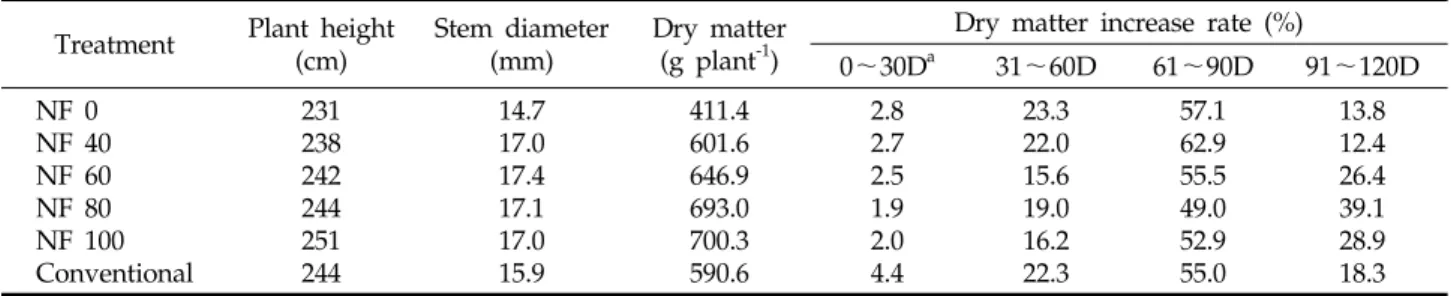
질소 관비량 증가에 따라 토마토의 초장과 건물중은 증가
하였으며 이러한 경향은 몇몇 연구자들, 26-28)에 의해 보고된 결과와 일치한다 반면에 토마토의 경경은 무질소 또는 질소. 관행처리구에 비해 질소관비처리구에서 증가하였으나 질소, 관비처리량 증가에도 불구하고 처리 간 경경에는 현저한 변 화가 없었다.
토마토 생육시기별 건물증가율은 모든 처리구에서 정식 후60 90~ 일 사이에 가장 높았으며(Table 2),건물중 증가는 정식56 105~ 일 사이에서는 일정한 증가율을 보인다29)고 보 고한 결과와 유사하였다 질소관행처리구에서는 정식 후. 90 일까지 전체 건물량의81.7%가 증가하였고91 120~ 일 사이 는18.3%의 증가를 보였으나 질소관비, 60%, 80%, 100%
처리구의 91 120~ 일 사이의 건물중은 각각26.4%, 39.1%, 증가하여 관비처리로 생육후기 생장이 지속되는 경향 28.9%
이었다(Table 3).
질소관비처리구의 토마토 수량은 질소처리량 증가로 높아 지는 경향이었다(Table 4). 이는 질소 관비처리구들에서 생 육 후기 지속적인 건물중 증가로(Table 3) 주당 상품과실수 가 증가하였기 때문으로 판단된다 그 결과 질소관비. 60%, 처리구의 토마토 과실 수량은 질소관행 대비 80%, 100%
가량 증가하였다 토마토 과실의 상품 역시 질소관행
9~33% .
처리에 비해 질소관비처리구에서 높았으며 질소 관비량이, 많을수록 상품율은 다소 증가하는 경향이었다 관비처리구중. 상품율이 높았던 질소관비 80%와100%처리구의 질소시비 량은 각각ha당176 kg과220 kg으로서 이러한 질소시비, 량 수준은Tei 등30)이 년에 걸쳐 조사한 결과 상품율이 가3 장 높았다고 보고한200 kg N ha-1 시비수준과 유사하다.
Table 3. Tomato plant growth characteristics at the different rate of N fertitigation system and conventional fertilization system
Treatment Plant height(cm) Stem diameter
(mm) Dry matter (g plant-1)
Dry matter increase rate (%)
0 30D~ a 31 60D~ 61 90D~ 91 120D~ NF 0NF 40
NF 60 NF 80 NF 100 Conventional
231238 242244 251 244
14.717.0 17.417.1 17.0 15.9
411.4 601.6 646.9 693.0 700.3 590.6
2.82.7 2.51.9 2.0 4.4
23.322.0 15.619.0 16.2 22.3
57.162.9 55.549.0 52.9 55.0
13.812.4 26.439.1 28.9 18.3 a: Days after transplanting.
Table 4. Tomato yield characteristics at the different rate of N fertitigation system and conventional fertilization system
Treatment No. of marketable fruit(No plant-1) Ave. fruit weight
(g fruit-1) Ratio of marketable fruit
(%) Marketable fruit
(Mg ha-1) Yield index NF 0NF 40
NF 60 NF 80 NF 100 Conventional
14.619.4 19.923.8 22.1 18.5
127.9 157.7 155.3 163.0 156.8 159.8
76.083.2 82.786.9 85.1 80.3
55.7 d 90.4 c 93.4 c 114.4 a 103.1 b 85.8 c
10565 109133 120 100
*DMRT 0.05.
질소 처리량 증가에 따른 과실 수량 증가 경향은Cook과 Sanders15)의 결과와 유사한 반면, Vavrina 등31)은 봄철과 가을철에 서로 다른 기온과 광환경으로 인해 봄철은 질소처 리량 증가로 상품수량은 증가하였으나 가을철에는 과실수량, 이 역으로 감소했음을 보고하였다 한편 최대수량을 보인 질. 소관비 80%수준 처리구의 관비농도는 97 mg L-1 이었다
이러한 질소관비농도 수준은
(Table 2). 200~400 mg L-1 범 위에서 토마토의 수량이 가장 높았다는 결과들26,27,32)과 비교 할 때 현저하게 낮은 질소 관비농도 수준이지만 모든 연구들, 이 그러한 결과와 일치하지는 않는 것으로 판단된다 즉. , Garton과Widders33)은 질소관비 97 mg L-1 수준에서 그, 리고 Vavrina 등31)은60 mg L-1 수준으로 공급하였을 때, 더 높은 질소 관비농도처리구보다 높은 수량을 관찰하였으며, Liptay와 Nicholls34)는 350 mg L-1 질소공급시 토마토의 생육이 부진하였음을 보고하였기 때문이다.
과실중량 비율 및 과실의 질소흡수 비율
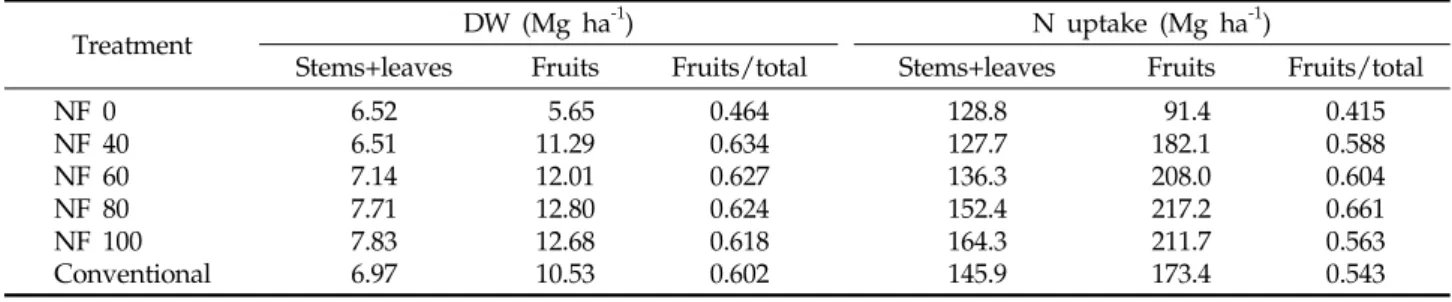
질소관비처리량 증가로 잎 줄기의 건물중과 과실의 건물+ 중들은 다소 증가하는 경향이었다(Table 5). 질소관비량 증 가에 따른 과실의 건물중 증가속도에 비해 줄기 엽의 건물중+ 증가율이 높아 질소관비량 증가에 따른 전체 건물중 대비 과, 실의 비율은 다소 감소하였다 그럼에도 불구하고 토마토 건. 물중에서 과실무게가 차지하는 비율은 질소관행시비의60.2%
에 비해 질소관비처리구들에서는 61.8 63.4%~ 의 비율로서 질소관비처리로 과중 비율은 상승하였다 한편. Tie 등30)의 보고에 따르면 토마토 과실은 정식후 약40일 경부터 동화산 물에 대한 주요 sink(저장고 역할을 하게 되며 그 시기를) , 전후하여 잎과 줄기로의 상대적인 동화산물 분배비율은 감소 한다고 하였다 또한 생육시기별 건물중 증가율을 고려할 때. 질소관비처리구들은 질소관행처리구에 비해 후기 생육을 지 속한다(Table 3). 결과적으로 관비처리에 따른 지속적인 후 기 생장 증가와 생육후기 과실의sink로서의 역할 증대로 인 해 질소관비처리구의 과중비율은 질소관행처리구에 비해 높 은 것으로 판단된다.
질소관비량 증가에 따라 일 줄기로의 질소분배량은 증가+ 하였던 반면 과실중 질소분배량은 질소관비, 40%에서 질소관 비80% 처리구까지 점진적으로 증가하다가 질소관비 100%
에서 다소 감소하는 경향이었다 그 결과 질소관비량 증가에. 따른 과실중 질소 분배비율은 차곡선2 (Y = 0.41 + 2.91x - 0.0000098x2, r2= 0.931**)의 반응을 보였다 그럼에도 불구. 하고 질소관비처리구의 전체 질소흡수량 대비 과실의 질소흡 수량 비율은56.3~66.1%범위로서 질소관행처리의54.3%에 비해 높은 질소분배율을 나타내었다 전체건물중 대비 과실. 의 건물중 비율과 전체 질소흡수량 대비 과실의 질소분배 비 율에 대한 이러한 결과들은 관행질소처리에 비해 질소관비처 리시 과실로의 질소분배 및 동화산물 전이가 효과적으로 진 행됨을 의미한다.
질소 및 물 이용율
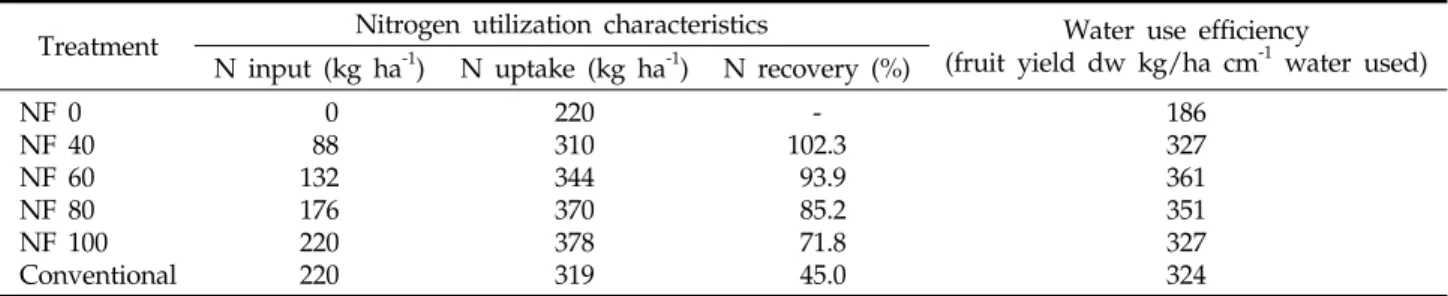
질소관비량(x)증가로 토마토에 의한 질소흡수량(y)은 유의 성있게 증가하였으나(y = 0.523x + 270, r2= 0.938**),질소이 용율은 역으로 감소하는 경향이었다(Table 6). 낮은 질소처리 구에서 보다 높은 질소이용율을 보이는 경향은Singandhupe 등18)의 결과와 유사하였으며 이는 제한된 토양 내 질소농도, 환경 하에서 작물에 대한 질소 요구도를 만족시키기 위하여 보다 활발하게 근권으로부터 무기질소를 흡수하기 때문이다. 질소관비처리량 증가에 따른 질소이용율 감소 경향에도 불구 하고 질소관비처리구들의 질소 이용율은, 71.8~102.3% 범위 로서 질소관행시비처리의 45%에 비교할 때 현저하게 높은 경향이었다 이는 관행시비의 경우 기비 및 소수의 추비에 의. 존함에 따라 작물의 생육단계에 맞춰 효율적으로 질소양분이 공급되지 못하기 때문이다.
질소처리별 총관수량(Table 2)과 토마토 건물중 수량(Table 으로부터 물의 이용효율성을 계산하였다
5) (Table 6). 질소관
행처리구의 물 이용효율성324 kg/ha cm-1에 비해 질소관비 처리구들의 물 이용효율성은327~361 kg/ha cm-1 범위로서 높은 경향이었다 특히 질소관비처리구 내에서도. 60%와 80%
처리구에서의 물 이용효율성이 각각361과351 kg/ha cm-1 로서 보다 효율적으로 물을 이용하는 것으로 나타났다 질소. 처리량과 물이용효율성 간의 관계를 살펴보면, y = 184 + 2.31x - 0.00076x2 (x = 질소처리량, y = 물이용효율, r2 = 0.959**) 2의 차곡선 반응을 보임으로서 질소처리량 증, 가에 따라 물이용효율성이 유의성 있게 증가한다는Singandhupe 등18)의 보고와는 다소 다른 양상을 보였다 그처럼 연구결과가 다른.
Table 5. Dry weight and N uptake of vegetative parts(stems and leaves) and fruits at the different rate of N fertitigation system and conventional fertilization system
Treatment DW (Mg ha-1) N uptake (Mg ha-1)
Stems+leaves Fruits Fruits/total Stems+leaves Fruits Fruits/total NF 0NF 40
NF 60 NF 80 NF 100 Conventional
6.526.51 7.147.71 7.83 6.97
11.295.65 12.01 12.80 12.68 10.53
0.464 0.634 0.627 0.624 0.618 0.602
128.8 127.7 136.3 152.4 164.3 145.9
182.191.4 208.0 217.2 211.7 173.4
0.415 0.588 0.604 0.661 0.563 0.543
것은 상호간 다른 연구 환경의 차이에서 기인하는 결과로 판 단된다 즉. , Singandhupe 등18)의 질소시용수준은0~120kg ha-1 범위로서 본 시험의 절반 수준이므로 상호간 비교가 곤 란한 점이 있어 보인다 한편 질소관비량에 따른 물 이용효율. 성은 다소 복잡한 상호관계를 가지는 것으로 생각된다 즉. , 질소관비량 증가로 인한 토마토의 생육 증가는 증산량 및 물 요구량을 증가 시키고 그러한 물요구량 증대는 관수량의 증, 가로 이어지기 때문이다 그러나 관수량 증가로 건물중은 증. 가하는 경향이었으나(y = 3.07x - 444.8, x = 관수량, y = 건물중, r2 = 0.740*), 관수량이 증가로 물이용효율성이 높아 지거나(y = -6604 + 38.8x - 0.054x2, x =관수량, y =물이 용효율, r2 = 0.888*), 질소시비량이 증가한다고 하여 물이용 효율이 증가하지는 않는 것으로 나타났다.
요 약
토마토의 생육 수량 물과 질소 이용율 등에 미치는 질소, , 관비 처리효과를 살펴보기 위하여 토양검정시비량의 0%, 에 해당하는 질소량은 회에 걸쳐 40%, 60%, 80%, 100% 15
토마토에 점적관비 하였으며 질소 점적관비 효과는 질소관, 행시비구 기비와 추비를( 60:40의 비율로 표층시비 와 비교하) 였다 질소관비량 증가로 토마토의 초장과 건물중은 증가하. 였으나 경경은 현저한 차이가 없었다 질소관비량 증가에 따, . 른 상품과실수 증가로 토마토수량은 증가하였다 질소관비처. 리구의 과실수량은 질소관비처리량에 따라9~33% 가량 증 가하였으며 토양검정시비량의, 80%(NF80처리구 에 해당하) 는176 kg ha-1의 질소 관비시(96.6 mg L-1)과실은 최대수 량을 보였다 질소관비량 증가로 토마토 부위별 건물중과 질.
소흡수량은 증가하였다 전체건물중 대비 과실 중량의 비율. 은 관행에 비해 질소관비처리구들에서2.6~5.3%증가하였고, 과실중 질소분배량은3.7~21.7%가량 증가하여 질소 관행처 리에 비해 질소 관비처리구에서 과실로의 질소분배 및 동화 산물 전이가 효과적으로 진행되는 것으로 판단되었다 한편. 질소 관비량 증가로 인한 질소흡수량은 증가하였으나 질소, 흡수율은 감소하는 경향이었다 그럼에도 불구하고 질소 관. 비처리구의 질소흡수율은 71.8~102.3% 범위로서 질소관행 처리구의45%와 비교할 때 현저하게 높았다 반면에 질소관. 비처리구의 물이용효율성은327~361 kg/ha cm-1로서 관행 질소 처리구의324 kg/ha cm-1보다 높았으며, NF80 처리 구의 경우361 kg/ha cm-1으로 가장 효율적으로 물을 이용 한 것으로 나타났다 결과적으로 과실의 상품수량 상품율. , , 물 이용효율성 등을 고려할 때 토양검정시비량의, 80%에 해 당하는 질소량을 관비시 토마토의 생육 및 수량 증가에 가장 효과적인 것으로 판단된다.
참고문헌
1. Clark, G.A., Stanley, C.D., Maynard, D.N., Hochmuth, G.J, Hanlon, E.A. and Hman, D.Z. (1991) Water and fertilizer management of micro-irrigated fresh market tomatoes, Trans. Amer. Soc. Agr. Eng. 34:
429-435.
2. Hochmuth, G.J. (1994) Current status of drip irrigation for vegetables in the southeastern and midAtlantic United States, HortTechnol. 4:390-393.
3. Locascio, S. J. (1989) Water quantity and time of
Table 6. Nitrogen and water utilization characteristics at the different rate of N fertitigation system and conventional fertilization system
Treatment Nitrogen utilization characteristics Water use efficiency
(fruit yield dw kg/ha cm-1 water used) N input (kg ha-1) N uptake (kg ha-1) N recovery (%)
NF 0NF 40 NF 60 NF 80 NF 100 Conventional
880 132176 220220
220310 344370 378319
102.3- 93.985.2 71.845.0
186327 361351 327324
Table 7. Soil chemical properties after the harvest of tomato
Treatment pH
(H2O, 1:5) EC
(dS m-1) OM
(g kg-1) Av. P2O5
(mg kg-1)
Ex. cations(cmol+ kg-1)
K Ca Mg
NF 0NF 40 NF 60 NF 80 NF 100 Conventional
6.86.9 6.86.9 6.7 6.8
0.690.86 1.301.39 1.43 1.55
16.018.1 16.517.5 17.0 15.2
525537 540564 546 552
0.220.29 0.330.45 0.36 0.30
6.266.12 6.466.70 6.52 6.39
2.452.24 2.442.56 2.50 2.62
N and K application for trickle-irrigated tomatoes, J. Amer. Soc. Hort. Sci. 114:265-268
4. Persaud, N., Locascio, S.J. and Geraldson, C.M.
(1976) Influence of fertilizer rate and placement and irrigation method on plant nutrition status, soil soluble salt and root distribution of mulched tomatoes, Soil crop Sci. Soc. Fla. Proc. 36:121-125.
5. Bhella, H.S. (1988) Tomato response to trickle irri- gation and black polyethylene mulch, J. Amer.
Soc. Hort. Sci. 113:543-546.
6. Giardini, L., Giovanardi, R. and Borin, M. (1988) Soil moisture influence on the productivity of industry tomato grown in lysimeters, Acta Hortic.
228:147-154.
7. Rubino, P and Tarantino, E. (1988) Influence of irrigation techniques on the behaviour of some pro- cessing tomato cultivars, Acta Hortic. 228:109-118.
8. Sanders, D.C., Howell, T.A., Hile, M.M.S., Hodges, L., Meek, D. and Phene, C.J. (1989) Yield and quality of processing tomatoes in response to irrigation rate and schedule, J. Amer. Soc. Hort. Sci. 114:
904-908.
9. Tan, C.S. and Dhanvantari, B.N. (1985) Effects on irrigation and plant population on yield, fruit speck and blossom-end rot of processing tomatoes, Can.
J. Plant Sci. 65:1011-1018.
10. Williams, J.W. and Sistrunk, W.A. (1979) Effects of cultivar, irrigation, ethephon, and harvest date on the yield of processing tomatoes, J. Amer. Soc. Hort.
Sci. 104:435-439.
11. Hartz K. and Hochmuth, G.J. (1996) Fertility manage- ment of drip irrigated vegetables, HortTechnol.
6:168-172
12. Raun, W.R. and Johnson, G.V. (1999) Review and interpretation: improving nitrogen use efficiency for cereal production, Agron. J. 91:357-362.
13. Miller, R.J., Rolstan, D.E., Rauschkolb, R.S. and Walfe, D.W. (1976) Drip irrigation of nitrogen is efficient, Calif. Agric. 30:16-18.
14. Locascio, S.J. and Smajstrala, A.G. (1995) Fertilizer timing and pan evaporation scheduling for drip irrigation method, In: Proceeding of the Fifth Inter- national Micro Irrigation Congress on Micro Irri- gation for a Changing World. Conserving Resources/
Preserving the Environment held at Hyatt Regency Orlando, Orlando, Florida, April 2-6, pp.175-180.
15. Cook, W.P. and Sanders, D.C. (1991) Nitrogen appli-
cation frequency for drip-irrigated tomatoes, HortSci.
26:250-252.
16. 농촌진흥청 농업과학기술원, (1999) 작물별 시비처방 기 준 상록사, , p.152.
17. Crasswell, E.T. and Godwin, D.C. (1984) The effi- ciency of nitrogen fertilizers applied to cereals in different climate, Adv. Plant Nutr. 1:1-55.
18. Singandhupe, R.B., Rao, G.G.S.N., Patil, N.G. and Brahmanand, P.S. (2003) Fertigation studies and irrigation scheduling in drip irrigation system in tomato crop, Europ. J Agron. 19:327.340.
19. Peech, M. (1965) Hydrogen ion activity, p. 914-926.
In: C. A. Black, D. D. Evans, L. E. Ensminger, J.
L. White, F. E. Clark and R. C. Dinauer(eds.) Me- thods of soil analysis: Parts 2. Chemical and micro- biological properties, No. 9 in the series of Agro- nomy, Am. Soc. of Agron, Inc. Publisher.
20. Bower, C. A. and Wilcox, L. V. (1965) Soluble salts, p. 933-951. In: C. A. Black, D. D. Evans, L.
E. Ensminger, J. L. White, F. E. Clark and R. C.
Dinauer(eds.) Methods of soil analysis: Parts 2.
Chemical and microbiological properties, No. 9 in the series of Agronomy, Am. Soc. of Agron, Inc.
Publisher.
21. Nelson, D. W. and Sommers, L. E. (1982) Total car- bon, organic carbon, and organic matter, p. 539-579.
In: A. L. Page, R. H. Miller, and D. R. Keeney(eds.) Methods of soil analysis: Parts 2. Chemical and microbiological properties, 2nd, No. 9 in the series of Agronomy, Am. Soc. of Agron, Inc., Soil Sci.
Soc. of America, Inc. Publisher.
22. Day, P. R. (1965) Particle fractionation and particle size analysis, p. 547-567. In: C. A. Black, D. D.
Evans, L. E. Ensminger, J. L. White, F. E. Clark and R. C. Dinauer(eds.) Methods of soil analysis:
Parts 1. Physical properties, No. 9 in the series of Agronomy, Am. Soc. of Agron, Inc. Publisher.
23. Bray, R. H and Kurtz, L. T. (1945) Determination of total, organic and available forms of phosphorus in soils, Soil Sci. 59:39-45.
24. Thomas, G. W. (1982) Exchangeable cations, p. 159- 165. In: A. L. Page, R. H. Miller, and D. R. Keeney (eds.) Methods of soil analysis: Parts 2. Chemical and microbiological properties, 2nd, No. 9 in the series of Agronomy, Am. Soc. of Agron, Inc., Soil Sci. Soc. of America, Inc. Publisher.
25. Bremner, J. M. (1965) Total nitrogen, p. 1149-1178.
In: C. A. Black, D. D. Evans, L. E. Ensminger, J.
L. White, F. E. Clark and R. C. Dinauer(eds.) Methods of soil analysis: Parts 2. Chemical and microbiological properties, No. 9 in the series of Agronomy, Am. Soc. of Agron, Inc. Publisher.
26. Masson, J., Tremblay, N. and Gosselin, A. (1991) Nitrogen fertilization and HPS supplemental lighting influence vegetable transplant production.Ⅰ. Trans- plant growth, J. Amer. Soc. Hort. Sci. 116:594-598.
27. Melton, R.R. and Dufault, R.J. (1991) Nitrogen, phosphorus, and potassium fertility regimes affect tomato transplant growth, HortSci. 26:141-142.
28. Widders, I.E. (1989) Pretransplant treatments of N and P influence growth and elemental accumula- tion in tomato seedlings, J. Amer. Soc. Hort. Sci.
114:416-420.
29. Marry C., Halbrooks, A. and Wilcox, G.E. (1980) Tomato plant development and elemental accumula- tion, J. Amer, Soc. Hort. Sci. 105:826-828
30. Tei, F., Benincasa, P. and Guiducci, M. (2002) Critical nitrogen concentration in processing tomato, Europ.
J. Agron. 18:45-55.
31. Vavrina, C.S., Hochmuth, G.J., Cornell, J.A. and Olson, S.M. (1998) Nitrogen fertilization of Florida- grown tomato transplants: Seasonal variation in green- house and field performance, HortSci. 33:251-254.
32. Weston, L.A. and Zandstra, B.H. (1989)Transplant age and N and P nutrition effects on growth and yield of tomatoes, HortSci. 24:88-90.
33. Garton, R.W. and Widders, I.E. (1990) Nitrogen and phosphorus preconditioning of small-plug seedlings influence processing tomato productivity, HortSci.
25:655-657.
34. Liptay, A. and Nicholls, S. (1993) Nitrogen supply during greenhouse transplant production affects sub- sequent tomato root growth in the field, J. Amer.
Soc. Hort. Sci. 118:339-342.