시설재배지 염류집적 토양에 대한 추비 저감 처리가 토마토 수량 및 양분함량에 미치는 영향
임정은ㆍ하상건ㆍ이예진ㆍ윤혜진ㆍ조민지ㆍ이덕배ㆍ성좌경*
국립농업과학원 토양비료과
Effects of reduced additional fertilizer on tomato yield and nutrient contents in salt accumulated soil
Jung-Eun Lim, Sang-Keun Ha, Ye-Jin Lee, Hye-Jin Yun, Min-Ji Cho, Deog-Bae Lee, Jwa-Kyung Sung*
Division of Soil & Fertilizer, National Academy of Agricultural Science, Wanju 565-851, Korea Received on 26 September 2015, revised on 21 October 2015, accepted on 26 October 2015
Abstract : This study was conducted to evaluate the effects of reduced nitrogen (N) and potassium (K) fertigation as additional fertilizer on tomato yield and nutrient contents in excessively nutrients-accumulated soil. Shoot and root dry weights (DW), dry matter rate for shoot, root and fruit and number of fruit in both AF50 and AF100 (50 and 100%
levels of additional fertilizer) treatments were increased in comparison with those in AF0 (0% level of additional fertilizer) treatment. In case of nutrient uptake by tomato, nitrogen, phosphorous (P) and potassium contents in all tomato parts (leaf, stem, root and fruit) in AF50 and AF100 treatment were lower than those in AF0 treatment. On the contrary, soluble sugar and starch contents in all tomato parts in AF50 and AF100 were higher than those in AF0 treatment. There were differences between AF0 and AF50 or AF100 in tomato growth, yield, nutrient level and contents of soluble sugar and starch. In contrast, the level and initiation point of fertigation did not significantly affect the parameters. Based on our results, the application of properly reduced level of additional fertilizer is possible to maintain the productivity of tomato and alleviate the nutrient accumulation in plastic film house soils.
Key words : Fertigation, Nutrient accumulation, Tomato
*Corresponding author: Tel: +82-63-238-2445
I. 서 론
식문화 및 농업기술의 발전과 함께 국내 시설재배지 면 적은 2014년 기준 93,511 ha로 전체 경지 면적(1,596,100 ha)의 약 5.9%를 차지하며 지속적인 증가추세를 보이고 있 다(KOSTAT, 2015). 그러나 시설재배지의 경우 작물생산 성 증대를 위한 화학비료 및 축분 퇴비 등의 농자재가 다량 투입되고 있으며 자연강우가 차단된 시설재배지의 특수조 건상 과도하게 투입된 농자재 성분이 작물의 흡수 이용 후 작토층에 잔류하게 되면서 토양 염류집적이 가속화되고 있 다(Kang et al., 2011; Kim et al., 2006).
과도한 농자재 투입으로 인한 토양의 염류집적은 작물 생육에 있어 수분장애, 양분흡수 장애, 영양장애, 품질저하 등의 원인이 되며(Kim et al., 2006), 환경적으로는 양분의 지하유출에 의한 오염문제를 야기할 수 있다. 간접적으로 는 작물 생육의 필수 요구량 이상으로 투입된 농자재의 구 입비용 발생 등 경제적 손실과도 연결된다.
시설재배지의 염류집적을 저감하기 위해 관수제염, 객 토, 심토반전, 표토제거, 토양 담수 및 배수, 고흡비작물 재배, 동전기법 등의 다양한 방법이 제안되었다(Jin et al., 2006; Kim, et al., 2006; Kim et al., 2012; Oh et al., 2010). 그러나 이는 사후 처리방법에 해당되며 근본적 원인 인 양분의 과다 투입문제를 해결할 수는 없다.
토마토 시설재배지에서는 관비(fertigation)의 형태로
화학비료를 지속적으로 투입하고 있으며, 관비가 양분 이 용효율이 높다는 점을 감안하면 관비에 의한 토양검정시비 처리는 작물 생산성 유지‧증진에 필요한 양분의 양 이상을 토양에 투입할 수 있어 양분의 집적, 비료자원의 낭비를 초래할 가능성이 있다(Lee et al., 2007).
이에 본 연구에서는 질소(N)와 칼륨(K)의 토양검정시비 량 중 추비를 0(무비), 50(감비), 100%(관행) 수준으로 관 비 처리하였을 때 토마토의 수량 및 양분함량에 미치는 영 향을 평가하여 시설재배지에서의 양분 투입 저감 방안을 모색하고자 하였다.
II. 재료 및 방법
1. 공시재료 및 처리방법
본 연구는 경기도 수원시 (구)국립농업과학원 내 유리온 실에서 실시하였다. 토마토(Lycopersicon esculentum L.) 종자(품종: 핑크탑, 농우바이오)를 펄라이트(pearlite)에 파종하여 발아시킨 후 생육이 균일한 토마토 유묘를 선별 하여 원예용 상토에 이식하고 3주간 성장시킨 후 온실 내 포트에 2014년 2월 20일에 정식하였다. 포트에 충진된 토 양은 충청남도 천안시 병천면 소재 오이 시설재배포장에서 채취한 표토로서 토성(soil texture)은 양토(loam soil)이 며 염류집적이 발생한 것으로 알려진 토양(pH: 6.2, EC:
10.3 dS/m, Avail. P
2O
5: 914 mg/kg)이다.
토양검정시비량에 해당하는 질소와 칼륨은 각각 22.7, 20.2 kg/10a였으며, 요소와 염화칼륨을 비료로 사용하였 다. 토양검정시비량에 대한 기비와 추비의 비율은 질소가 45:55, 칼륨은 65:35로 하였다. 기비는 정식 전 토양과 균 일하게 혼합하고 추비는 증류수에 녹여 생육기간에 관비 처리하였다. 정식 후에는 수확 시점까지 일반적인 시설재 배지 토마토 재배방법으로 관수를 실시하였다. 정식 후 2주 (2014년 3월 11일, 2WT), 6주(2014년 4월 3일, 6WT)부터 추비를 0(AF0), 50(AF50), 100%(AF100) 수준으로 수확시 까지 관비 처리하였다. 처리구는 온실 내 완전임의배치법 으로 3반복 시험하였다. 정식 90일 후에는 토마토 식물체 와 토양을 채취하여 분석시료로 사용하였다.
2. 토양 및 작물 분석 및 작물 조사
정식 90일 후 AF0, AF50, AF100 처리 토양은 풍건한 후 2 mm 이하로 체거름하여 화학성 분석을 실시하였다.
pH와 EC는 토양과 증류수 비율을 1:5로 측정하였으며, 유 기물과 총질소는 C/N analyzer (vario MAX CN, Elementar, Germany), 유효인산은 Lancaster법(NIAST, 2000)으로 분 석하였다. 치환성 양이온은 1 M-NH
4OAc (pH 7.0)으로 침출하여 유도결합 플라즈마 발광광도계(ICP-OES, GBC Integra XL Dual, Australia)로 측정하였다.
정식 90일 후 토마토의 잎, 줄기, 뿌리, 과실을 수확하여 생중량, 건중량을 측정하였다. 건조된 토마토 각 부위의 T-N 함량은 파쇄한 식물체 분말을 C/N analyzer로 분석 하였다. P
2O
5는 H
2O
2-H
2SO
4로 습식분해하여 Vanadate법 으로 정량하였으며, K
2O는 유도결합 플라즈마 발광광도계 로 측정하였다(NIAST, 2000).
토마토 부위별 수용성 당(soluble sugar)과 전분(starch) 함량 분석은 Yoshida 등(1976) 방법에 의거하여 실시하였 다. 수용성 당은 건조시료 0.2 g에 80% ethanol 10 mL를 가하여 80 - 85℃ 항온수조에서 30분간 방치한 후 원심분 리(10,000 rpm, 15분, 4 ℃)하여 상등액의 알코올 성분을 증발시 켜 25 mL로 표선한 용액을 분석에 사용하였다. 전분 은 수용성 당을 추출하고 남은 시료에 대해 9.3 N -HClO
4를 가하고 증류수 10 mL을 첨가한 후 원심분리하여 상등액 을 추출하였고, 잔류물에 4.6 N -HClO
4과 증류수를 가하고 원심분리하여 앞선 과정의 상등액과 혼합한 것을 분석에 사용하였다. 이 후 0.2% anthrone 시약과 반응시킨 후 분광 광도계(Spectrophotometer, U-3010 Hitachi, Japan) 630 nm에서 측정하였다. 표준물질은 glucose를 사용하여 상기 방법과 동일하게 조작한 후 검량선 작성에 사용하였다.
3. 통계처리
추비 0, 50, 100%의 관비 처리에 따른 토양 화학성, 토마
토의 생육 및 양분함량 변화를 비교평가하기 위하여 SAS
Ver 9.2(SAS Institute, 2008)를 이용한 ANOVA 검정을
실시하였다. ANO VA 검정은 각 처리구 내에서 3반복 시료
에 대한 분 석값을 산출한 후 처리구 간의 유의성(P<0.05)
을 검정하였다.
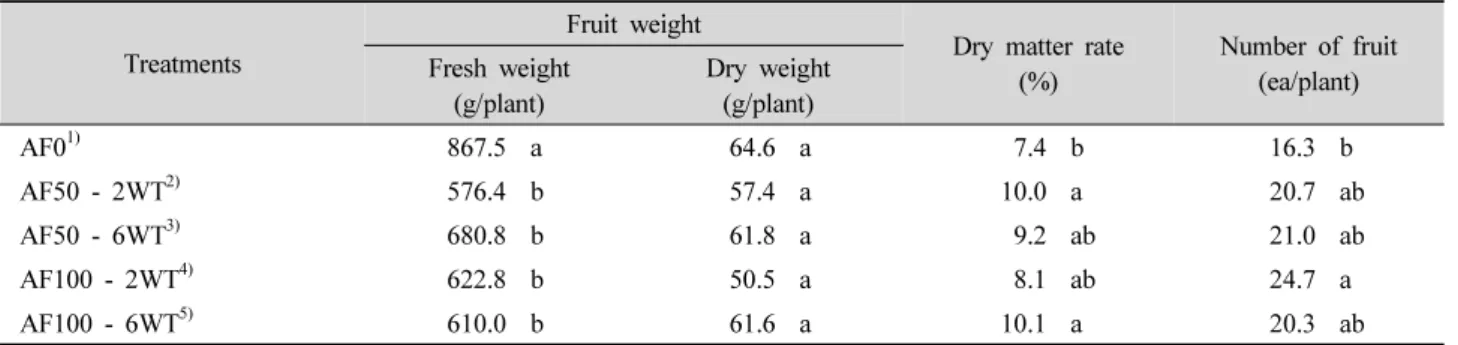
Table 1. Fresh weight, dry weight and dry matter rate for tomato parts (shoot and root) under different additional fertilizer levels after 90 days of transplanting. Same letters in the same column are not significantly different using Duncan’s multiple range test ( P<0.05 n=3).
Treatments Fresh weight (g/plant) Dry weight (g/plant) Dry matter rate (%)
Shoot Root Shoot Root Shoot Root
AF0
1)953.2 a 84.9 c 116.6 b 6.9 c 12.30 b 8.1 ab
AF50 - 2WT
2)958.0 a 148.9 a 148.5 a 11.4 a 15.49 a 7.7 b
AF50 - 6WT
3)948.5 a 109.9 b 144.9 a 9.7 b 15.30 a 8.9 a
AF100 - 2WT
4)989.9 a 150.4 a 149.0 a 11.4 a 15.06 a 7.6 b
AF100 - 6WT
5)932.5 a 121.8 b 139.5 a 10.0 ab 14.96 a 8.3 ab
1)
0% level of additional fertilizer treatment
2)
50% level of additional fertilizer treatment after 2 weeks of transplanting
3)
50% level of additional fertilizer treatment after 6 weeks of transplanting
4)
100% level of additional fertilizer treatment after 2 weeks of transplanting
5)
100% level of additional fertilizer treatment after 6 weeks of transplanting
Table 2. Fresh weight, dry weight, dry matter rate and number for tomato fruit (shoot and root) under different additional fertilizer levels after 90 days of transplanting. Same letters in the same column are not significantly different using Duncan’s multiple range test ( P<0.05 n=3).
Treatments
Fruit weight
Dry matter rate (%)
Number of fruit (ea/plant) Fresh weight
(g/plant)
Dry weight (g/plant)
AF0
1)867.5 a 64.6 a 7.4 b 16.3 b
AF50 - 2WT
2)576.4 b 57.4 a 10.0 a 20.7 ab
AF50 - 6WT
3)680.8 b 61.8 a 9.2 ab 21.0 ab
AF100 - 2WT
4)622.8 b 50.5 a 8.1 ab 24.7 a
AF100 - 6WT
5)610.0 b 61.6 a 10.1 a 20.3 ab
1)
0% level of additional fertilizer treatment
2)
50% level of additional fertilizer treatment after 2 weeks of transplanting
3)
50% level of additional fertilizer treatment after 6 weeks of transplanting
4)
100% level of additional fertilizer treatment after 2 weeks of transplanting
III. 결과 및 고찰
1. 토마토 수량 및 품질특성
토마토 지상부의 생중량은 AF0과 AF50, AF100 처리구 간 유의한 차이가 없었다(Ta ble 1). AF50 및 AF100 처리구 의 경우 지상부 생중량을 제외하고 지상부의 건중량(19.6 - 27.8% 증가)과 건물율(21.6 - 25.9% 증가), 지하부의 생중량(29.4 - 77.1% 증가)과 건중량(40.8 - 65.4% 증가) 및 건물율(1.5 - 9.1% 증가)은 AF0 처리구에 비해 유의한 수준으로 증가하였다. Lee 등(2007)은 질소 관비량 증가 (토양검정질소시비량의 40 - 100% 처리) 시 토마토의 건중
량이 증가한다고 보고하였으며, Lee 등(2006)은 표준시비 처리 및 질소공급능이 우수한 두과 녹비작물의 처리 시 무 비구에 비해 토마토 수량이 증가함을 보고하였는 데 본 연 구결과도 선행연구결과와 같이 질소 관비 처리에 의한 생 육 증대효과인 것으로 생각된다. 한편, 추비 처리 수준과 시점에 따른 차이는 나타나지 않았다.
착과된 토마토의 생중량은 시험구 중 AF0 처리구에서
가장 높은 수준(867.5 g/plant)이었다(Table 2). Rhee 등
(2002)은 NaCl 농도가 상승함에 따라 염 스트레스에 의한
수분흡수감소에 기인하여 토마토의 과실중량 등이 감소한
다고 하였다. 본 연구결과도 추비처리 후 토양 EC 증가
(Table 3)로 인한 염 스트레스가 토마토 과실중량의 감소에
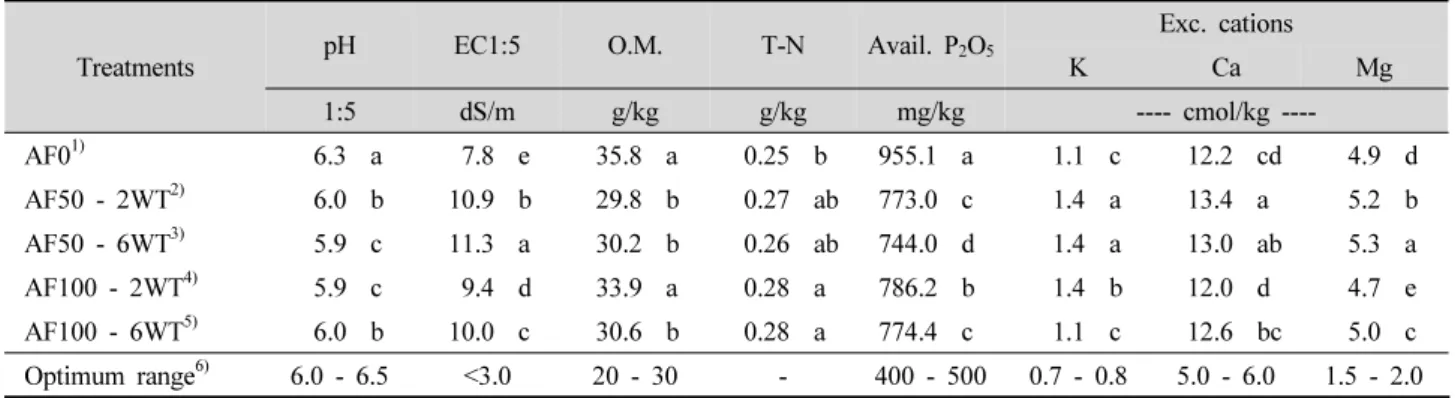
Table 3. Chemical properties in the soil treated with different additional fertilizer levels after 90 days of transplanting. Same letters in the same column are not significantly different using Duncan’s multiple range test ( P<0.05 n=3).
Treatments pH EC1:5 O.M. T-N Avail. P
2O
5Exc. cations
K Ca Mg
1:5 dS/m g/kg g/kg mg/kg ---- cmol/kg ----
AF0
1)6.3 a 7.8 e 35.8 a 0.25 b 955.1 a 1.1 c 12.2 cd 4.9 d
AF50 - 2WT
2)6.0 b 10.9 b 29.8 b 0.27 ab 773.0 c 1.4 a 13.4 a 5.2 b
AF50 - 6WT
3)5.9 c 11.3 a 30.2 b 0.26 ab 744.0 d 1.4 a 13.0 ab 5.3 a
AF100 - 2WT
4)5.9 c 9.4 d 33.9 a 0.28 a 786.2 b 1.4 b 12.0 d 4.7 e
AF100 - 6WT
5)6.0 b 10.0 c 30.6 b 0.28 a 774.4 c 1.1 c 12.6 bc 5.0 c
Optimum range
6)6.0 - 6.5 <3.0 20 - 30 - 400 - 500 0.7 - 0.8 5.0 - 6.0 1.5 - 2.0
1)
0% level of additional fertilizer treatment
2)
50% level of additional fertilizer treatment after 2 weeks of transplanting
3)
50% level of additional fertilizer treatment after 6 weeks of transplanting
4)
100% level of additional fertilizer treatment after 2 weeks of transplanting
5)
100% level of additional fertilizer treatment after 6 weeks of transplanting
6)
NAAS (2015)
Fig. 1. Soluble sugar content of tomato parts under different additional fertilizer levels after 90 days of transplanting. Same letters above bars in the same tomato part are not significantly different using Duncan’s multiple range test ( P<0.05 n=3).
영향을 준 것으로 생각된다. 건중량은 처리구 간 유의한 차이가 나지 않았으나 건물율의 경우 AF0 처리구에 비해 AF50 및 AF100 처리구(8.9 - 35.7% 증가)에서 유의한 수 준으로 증가한 것으로 나타났다. 특히 처리구별 착과수는 AF0 처리구(16.3 ea/plant)에 비해 AF50 및 AF100 처리 구(20.3 - 24.7 ea/plant)에서 24.5 - 51.0% 가량 증가하 였다. Lee 등(2007)은 질소 관비량 증가와 함께 토마토 수 량(착과수, 중량 등)이 증가하였으며 특히 검정시비량의 80% 수준의 관비 처리구에서 토마토가 최대 수량을 나타낸 다고 보고하였으며, Wang 등(2007)은 질소 수준별(0 - 36 mM) 관비 처리에 따른 방울토마토 과실 수량 보고에서 무 비구에 비해 적절히 높은 수준의 질소(4.5 - 9.0 mM) 처리 가 최대 과실 수량을 나타낸다고 하였는데 본 연구결과도 이와 유사하다. 한 편, 추비 처리 수준과 시점에 따른 토마 토 과실의 중량, 건물율, 착과수에서 유의한 차이는 없었다.
수 확 후 토마토 부위별 수용성 당 함량은 줄기(48.3 - 109.7 mg/g)>과실(36.3 - 92.7 mg/g)>잎(34.7 - 47.6 mg/g)>뿌리(14.8 - 34.0 mg/g) 순으로 나타났다(Fig.
1). 전체적으로 ‘AF100 - 2WT’를 제외한 AF50 및 AF100 처리구가 AF0 처리구에 비해 수용성 당 함량이 높았다.
AF50 및 AF100 처리구의 수용성 당 함량은 잎, 줄기, 뿌 리, 과실에서 AF0 처리구에 비해 각각 5.3 - 19.6%, 3.9 - 24.1%, 3.9 - 102.9%, 4.9 - 43.5% 높은 수준으로 나타 났다. Cuartero 등(1999)은 EC (2 - 9 dS/m) 상승 시에 토마토 내 당 함량이 높아진다고 하였으며, Wang 등(2007)
은 질소 농도별(0 - 36 mM) 관비 처리에 의한 방울토마토 내 수용성 당 함량 등에 관한 연구에서 질소처리농도 증가 시 과실 내 수용성 당 함량이 상승함을 보고하였다. Sainju 등(2003)과 Beckles 등(2012)은 토양의 칼륨 함량이 높을 수록 토마토의 당 함량이 상승한다고 하였다. 본 연구결과 또한 추비에 의한 EC 및 질소, 칼륨의 증가가 수용성 당 증가에 영향을 주었을 것으로 생각된다.
수확 후 토마토 부위별 전분 함량은 과실(54.8 - 211.0
mg/g)>줄기(44.5 - 63.3 mg/g)>잎(31.7 - 39.8 mg/
Fig. 2. Starch content of tomato parts under different additional fertilizer levels after 90 days of transplanting. Same letters above bars in the same tomato part are not significantly different using Duncan’s multiple range test ( P<0.05 n=3).
Fig. 3. Total nitrogen (T-N) content of tomato parts under different additional fertilizer levels after 90 days of transplanting. Same letters above bars in the same tomato part are not significantly different using Duncan’s multiple range test ( P<0.05 n=3).
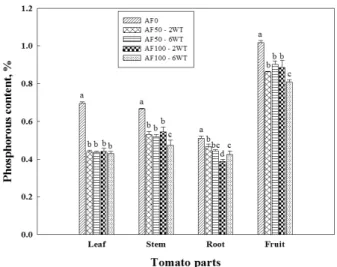
Fig. 4. Phosphorous (as P
2O
5) content of tomato parts under different additional fertilizer levels after 90 days of transplanting.
Same letters above bars in the same tomato part are not signi- ficantly different using Duncan’s multiple range test ( P<0.05 n=3).
g)>뿌리(21.4 - 35.5 mg/g) 순으로 나타났다(Fig. 2). 전 체적으로 AF50 및 AF100 처리구가 AF0 처리구에 비해 전 분 함량이 높았으며 모든 부위에서 관비 처리 수준과 시점 에 따른 차이는 미미하였다. AF50 및 AF100 처리구의 전 분 함량은 잎, 줄기, 뿌리, 과실에서 AF0 처리구에 비해 각각 17.2 - 25.4%, 7.3 - 11.4%, 44.7 - 65.8%, 94.9 - 285.0% 높은 수준으로 나타났다. 토양에서 질소함량이 높 은 경우 과도한 영양생장을 촉진함으로써 토마토 과실의 성 숙을 지연시키는 결과를 초래할 수 있으며(Sainju et al., 2003), 미성숙한 토마토 과실의 경우 높은 염류수준이 전분함량을 증대시킬 수 있다(Beckles et al., 2012). 본 연구 결과도 추비를 통한 질소의 비교적 높은 공급과 염류 도 상 승을 통한 토마토의 전분 증가효과로 생각된다.
2. 토마토의 양분흡수 특성
수 확 후 토마토 부위별 질소(T-N) 함량은 과실(N: 2.0 - 2.1%)>잎(N: 1.3 - 2.3%)>뿌리(N: 1.6 - 1.9%)>줄기 (N: 1.0 - 1.4%) 순으로 나타났다(Fig. 3). 잎의 경우 AF0 처리구(N: 2.3%)에서 가장 높은 질소함량을 나 타냈으며, 줄기의 경우 AF0 처리구(N: 1.0%)에 비해 AF50 및 AF100 처리구(N: 1.2 - 1.4%)에서 질소함량이 19.3 - 38.8% 가량 높 았다. 뿌리와 과실의 경우 전반적으로 AF0 처리구에 비 해 AF50 및 AF100 처리구에서 질소함량이 감소하였으나 유의한 수준은 아니었다. 추비 처리 수준과 시점에 따른
토마토 부위별 질소함량의 차이는 크지 않았다.
수 확 후 토마토 부위별 인(P
2O
5) 함량은 과실(P: 0.8 - 1.0
%)>줄기(P: 0.5 - 0.7%)>잎(P: 0.4 - 0.7%)>뿌리(P: 0.4
- 0.5%) 순으로 나타났다(Fig. 4). 모든 토마토 부위에서
인 함량은 AF0 처리구에서 가장 높은 수준이었으며, AF50
및 A F100 처리구의 경우 잎, 줄기, 뿌리, 과실에서 AF0
처리구에 비해 각각 평균 37.4, 22.6, 15.5, 15.0% 낮은
것으로 나 타났다. 추비 처리 수준과 시점에 따른 토마토
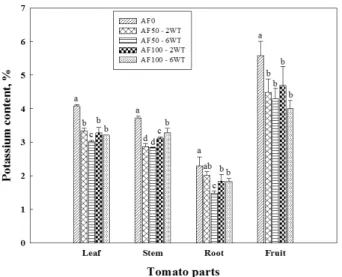
Fig. 5. Potassium (as K
2O) content of tomato parts under different additional fertilizer levels after 90 days of transplanting.
Same letters above bars in the same tomato part are not significantly different using Duncan’s multiple range test ( P<0.05 n=3).
타났다.
수 확 후 토마토 부위별 칼륨(K
2O) 함량은 과실(K: 4.0 - 5.6%)>잎(K: 3.0 - 4.1%)>줄기(K: 2.8 - 3.7%)>뿌리 (K: 1.5 - 2.3%) 순으로 나타났다(Fig. 5). 토마토 부위별 질소, 인 함량과 유사하게 칼륨 함량의 경우도 AF0 처리구 에서 가장 높은 수준이었으며, AF50 및 AF100 처리구의 경우 잎, 줄기, 뿌리, 과실에서 AF0 처리구에 비해 각각 평균 21.4, 18.5, 21.9, 21.7% 낮은 것으로 나타났다. 추비 처리 수준과 시점에 따른 토마토 부위별 칼륨 함량의 차이 는 미미하였다.
Rhee 등(2002)은 토마토 무기양분 흡수 연구에서 NaCl 처리 농도가 높아질수 록 토마토 내 N, P, K 함량이 낮아졌 으며, 이는 NaCl 처리 후 N, P 및 K의 작물 흡수에 대한 Cl과 Na의 길항작용에 의한 것임을 보고하였다. Rhee 등 (2007)은 토마토 무기성분 함량이 염류농도가 높을수록 Ca, Mg, K 함량이 감소함을 보고하였다. 본 연구결과도 AF0 처리구(EC: 7.8 dS/m)에 비해 AF50 및 AF100 처리 구(EC: 9.4 - 11.3 dS/m)에서의 상대적으로 높은 염류수 준으로 인한 양분 흡수 감소효과로 생각된다.
3. 토양 특성
토마토 수확 후 재배 토양의 화학성은 AF50 및 AF100 처리구에서 EC(9.4 - 11.3 dS/m), T-N(0.26 - 0.28
g/kg), 치환성 K(1.1 - 1.4 cmol/kg) 등이 AF0 처리구에 비해 증가하는 것으로 나타났다(Table 3). 이와 함께 모든 처리구에서 토마토 시설재배지 토양의 적정양분범위를 초 과하였다(NAAS, 2015). 특히 1:5 희석방법에 의한 EC 측 정 값이긴 하나 모든 처리구의 EC (7.8 - 11.3 dS/m)는 4 dS/m 이상으로 염류토양(saline soil)에 해당되었다( Brady and Weil, 2007). 전반적으로 추비 처리 수준과 시점에 따 른 토양 화학성의 유의한 차이는 나타나지 않았다.
IV. 결 론
우리나라 시설재배지의 경우 양분이 과다함에도 불구하 고 관행적으로 다량의 양분을 투입하고 있어 토양의 염류집 적이 우려되고 있다. 이에 본 연구에서는 시설재배지 염류 집적 토양에서 N, K 추비로써의 관비 처리량 저감이 토마토 의 생육‧수량 및 양분 흡수 등에 미치는 영향을 평가하였다.
AF50 및 AF100 처리구의 경우 토마토 지상부의 건중량 (19.6 - 27.8% 증가)과 건물율(21.6 - 25.9% 증가), 지하부 의 건중량(40. 8 - 65.4% 증가) 및 건물율(1.5 - 9.1% 증가), 토마토 과실의 건물율(8.9 - 35.7% 증가)과 착과수(24.5 - 51.0% 증가)는 AF0 처리구에 비해 증가하는 것으로 나타났 다. 그러나 추비 처리 수준과 시점에 따른 차이는 미미한 것으로 나 타났다. 토마토 부위별 흡수된 N-P-K 함량은 전 반적으로 AF0 처리구에 비해 AF50 및 AF100 처리구에서 감소하는 것으로 나타났으며, 토마토 부위별 수용성 당 및 전분 함량은 A F50 및 AF100 처리구가 AF0 처리구에 비해 높았다. 생육 결과와 마찬가지로 추비의 처리 수준과 시점 에 따른 차이는 없었다. 본 연구결과 시설재배지에서 추비 량의 적 절한 저감 처리를 통해 기존의 토마토 생산성은 유지 하면서 토양의 염류집적 완화가 가능할 것으로 판단된다.
또한 염류집적 시설재배지에서의 추비 처리의 경우 토양검 정결과와 작물 생육단계별 양분요구량의 상호 검토를 통해 적정수준의 양분을 공급하는 것이 필요한 것으로 판단된다.
그러나 작물별, 토양 특성 및 염류집적 유형별로 작물반 응이 상이하게 발현될 수 있으므로 향후 추비 저감 처리에 대한 추가적인 연구가 필요할 것으로 판단된다.
감사의 글
본 연구는 농촌진흥청 시험연구과제 “과제명: 시설재배
유형별 양수분 요구도 산정 및 생리대사물질 평가 (과제번 호: PJ010899)”의 연구비 지원을 통해 수행하였습니다.
참 고 문 헌