Kor. J. Hort. Sci. Technol. 31(1):128-132, 2013 DOI http://dx.doi.org/10.7235/hort.2013.12114
단단한 화경의 핑크색 절화용 거베라 신품종 ‘파티타임’ 육성
정용모1*ㆍ황주천1ㆍ진영돈1ㆍ이정수2ㆍ김수경1ㆍ노치웅3ㆍ이영병4ㆍ권오창4
1경상남도농업기술원 화훼연구소, 2농촌진흥청 국립원예특작과학원, 3경상남도농업기술원 연구개발국, 4동아대학교 생명자원과학대학
Breeding of a New Pink Gerbera hybrida ‘Party Time’ with Strong Peduncle for Cut Flower
Yong Mo Chung1*, Ju Chean Hwang1, Young Don Chin1, Jung Soo Lee2, Su Kyeong Kim1, Chi Woong Ro3, Young Byung Yi4, and Oh Chang Kwon4
1Flower Research Institute, Gyeongsangnam-do Agricultural Research & Extension Services, Changwon 641-920, Korea
2National Institute of Horticultural & Herbal Science, Rural Development Administration, Suwon 440-706, Korea
3Research and Development Bureau, Gyeongsangnam-do Agricultural Research & Extension Services,, Jinju 660-360, Korea
4Faculty of Life Science and Resources, Dong-A University, Busan 604-714, Korea
Abstract. A new pink gerbera (Gerbera hybrida Hort.) cultivar ‘Party Time’ was developed from a cross between ‘Hope’ and ‘Sunnyeo’, followed by seedling and line selections at the Flower Research Institute of Gyeongnam Agricultural Research and Extension Services (GARES) in 2007. Detailed characteristics of the new cultivar were evaluated from 2005 to 2007. ‘Party Time’ has semi-double type large flowers in a good harmony with pink (RHS, 65-C) ray floret and brown center. It has a good, stable flower shape and strong peduncles, and its vase life was 12.7 days. The average flower yield of ‘Party Time’ was about 47.3 stems per plant a year in greenhouse yield trails carried out 2005 to 2007. ‘Party Time’ (Grant No. 2691) was registered to the Korea Seed and Variety Service (KSVS) for commercialization in 2009.
Additional key words: crossing, selection, ray floret, vase life
*Corresponding author: [email protected]
※ Received 18 June 2012; Revised 15 October 2012; Accepted 24 October 2012.
서 언
거베라(Gerbera hybrida)의 2011년 국내 재배면적은 71.0ha, 생산액은 145억원으로 2010년에 비하여 재배면적은 2.6%
증가하였으나, 생산액은 오히려 5.8% 감소한 경향이었다.
국내 거베라의 재배면적은 1999년 89.4ha를 정점으로 그 이 후 현재까지 3-4년 주기로 70-80ha 정도로 증감을 되풀이하 고 있는 실정이다. 주 재배지역은 경남 김해와 밀양, 그리고 경북 봉화 등 3개 지역으로 각각 27.6ha, 7.2ha, 7.4ha로 전 체 재배면적의 59.9%를 차지하고 있다(MFAFF, 2012). 절 화용 거베라 화색의 선호도는 유럽은 오렌지색계가 선호도 가 가장 높으나 국내의 경우, 선명한 핑크색계가 가장 높으 며 그 다음 적색계, 황색계 순이다. 화형의 국내 선호도는 축하용 화환에 이용되고 있는 대륜계가 95% 이상 대부분을
차지하고 있는 실정이다. 이러한 선호도에 맞추어 핑크색 대륜계 품종 ‘Sugar Pink’(Chung et al., 2010), ‘Pink Giant’
(Chung et al., 2007a), 그리고 ‘Yeunhwa’(Park et al., 2007) 등 몇몇 국내 육성 품종들이 있지만, 이들 품종은 화경이 약 하거나 꽃의 크기가 적고, 외부설상화가 연약하여 기호도가 떨어지는 단점이 있다. 또한 같은 핑크색계 중에서도 색상 의 선명도에 따라 농가마다 선호하는 품종색상이 다양하여 품종선택에 아직은 제한적인 실정이다. 핑크색계 이외 적색 대륜계 품종 ‘Red Auction’(Chung et al., 2011)과 ‘Red Line’
(Park et al., 2009a), 황색 대륜계 품종 ‘Gold Eye’(Chung et al., 2007b), ‘Golden Time’(Chung et al., 2009), ‘Lovely Moon’(Park et al., 2009b), ‘Sunny Lemon’(Park et al., 2010), 그리고 ‘Sunmyo’(Park et al., 2011b), 백색 대륜계 품종
‘Whiteny’(Park et al., 2011a) 등 화색이 다양하고 선명한
Year 2001 - 2002 2003 - 2004 2005 - 2007
Parents plant characteristic
trials
‘Hope’
×
‘Sunnyeo’
‘GyeongnamG-29’ ‘Party Time’
‘03011-001’
:
‘03011-009’
:
‘03011-166’
Proc. Collection Artificial crossing,
selection and multiplication Characteristic trials, yield trial
Fig. 1. Breeding history of ‘Party Time’ that was crossed between ‘Hope’ and ‘Sunnyeo’ as parents in 2003 and selected from 2004 till 2007 after three years field trial.
다수성인 대륜계 품종들을 육성, 국립종자원에 품종보호등 록 후 농가에 보급되고 있다. 거베라 재배농가에서 품종을 선택할 때에는 소비자들의 화색에 대한 선호기간이 짧고 다 양한 화색을 요구하고 있어서 이들의 요구를 충족시킬 수 있는 품종들을 재배하기 위하여 매년 다양한 화색의 신품종 선택에 심혈을 기울이고 있는 실정이다. 또한 거베라의 품 종보호대상작물 지정(Choi, 2001, 2002)에 따른 로열티 지 불은 농가경영에 큰 부담이 되고 있다. 따라서 본 연구는 국 내 재배환경에 적합하고 국내 육성 핑크색계 품종의 단점을 보완할 수 있는 강건한 화경과 외부설상화가 단단하고 화색 이 선명한 핑크색의 대륜계 품종을 육성하여 외국 품종 재 배에 따른 로열티 지불에 대처하고 재배농가에 보다 많은 품종 선택의 기회를 제공하기 위하여 수행하였다.
육성경위
국내 재배 환경에 적합한 화색이 선명한 다수성 거베라 품종을 육성하기 위하여 유전자원의 수집은 2001년부터 재 배농가를 통하여 이루어졌다. 교배는 2003년 3월에 화경이 강건한 특성을 가진 자주색 대륜계의 ‘Hope’를 모본으로, 선명한 핑크색과 안정된 화형의 특성을 가진 대륜계
‘Sunnyeo’을 부본으로 인공교배를 실시하여 교배조합으로 부터 2,186개의 종자를 획득하였다. 교배 후 결실이 된 조합 은 채종 즉시 파종하였으며, 파종 1개월 후 발아된 1,660개 의 유묘는 본엽이 4-5매 전개되었을 때 화훼연구소 유리온 실 내의 선발 포장에 정식하였다. 그 중 화경이 강건하고 선 명한 핑크색의 다수성인 우수 개체 ‘03011-009’를 1차로 선 발, 생육 및 개화특성이 우수하여 ‘03011-009(경남G-29호)’
개체를 생장점 배양으로 개체증식 후 화훼연구소 유리온실 내의 특성검정 포장에 정식하여 2005년부터 2007년까지 3
회에 걸쳐 생육 및 수량특성 검정을 실시하였다. 품종육성 을 위한 특성조사는 화훼연구소 유리온실에서 농촌진흥청 농사시험연구조사 기준(RDA, 2003)과 작물별 신품종의 출 원 및 심사를 위한 특성조사기준(KSVS, 1997)에 따라 실시 하였다. 화색 등 식물체의 색상 표현은 영국왕립원예학회의 칼라차트(RHS, 2001)를 이용 비교 측정하였다. 특성검정을 실시한 결과 화색, 화형, 수확량 등 품질과 수량이 우수하다 고 판단되어 2007년 농작물 직무육성 신품종선정위원회의 심의를 거쳐 ‘Party Time’으로 명명하였다. 품종의 육성과 정은 Fig. 1과 같다.
주요특성
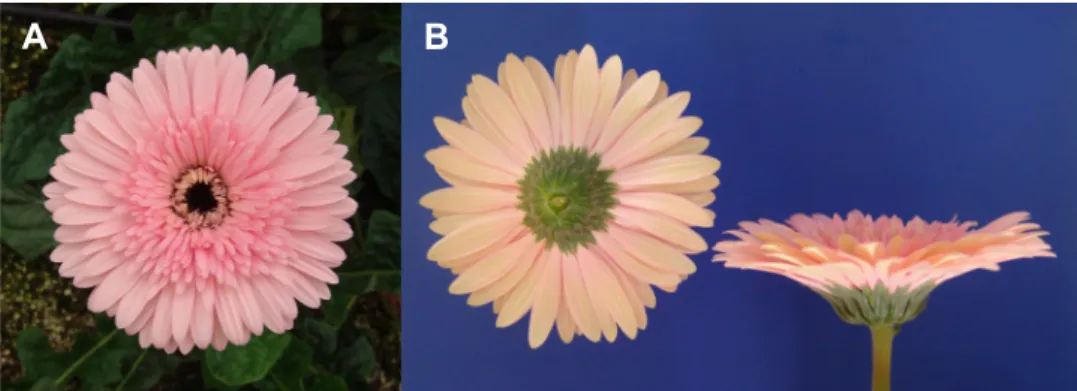
‘Party Time’은 화색이 선명한 핑크색(RHS, 65-C)으로 부본의 핑크색(RHS, 48-D)보다는 짙고 모본의 핑크색보다 는 옅은 핑크색(RHS, 75-A)이며, 화형은 모본과 동일한 반 겹꽃으로 갈색(RHS, 166-A) 의 화심을 가지는 절화용 대륜 화이다. 엽색은 전체가 모본(138-A)과 부본(137-A), 그리고 대조 품종(137-A)에 비하여 옅은 녹색(137-B)이며, 줄기색 은 모본(144-A)과 부본(145-B)보다는 옅으며, 대조 품종과 는 비슷한 녹색(144-B)이다(Table 1 and Fig. 2). 꽃 직경은 12.5cm 정도로 모본 12.1cm와 부본 10.5cm보다 더 크다.
화경의 평균 길이는 약 46.2cm 정도로 모본과 부본보다 짧 았으나, 대조 품종에 비하여 약간 길고 굵으며 단단한 경향 이었다(Table 2). 주당 연간 평균 절화수량은 3회에 걸친 수 량특성 조사 결과, 약 47.3본으로 모본 46.5본과 대조품종 46.2본보다는 다수성이나 부본 48.3본보다는 다소 떨어지는 경향이었고, 절화수명은 12.7일 정도로 모본 12.5일과 부본 11.3일 그리고 대조품종 11.7일보다 약 1일 정도 긴 편이다 (Table 3). 정식 후 첫 꽃 개화까지의 기간은 97.2일로 모본
Table 1. Inherent characteristics of gerbera ‘Party Time’.
Cultivar Color of
ray floret Flower type Color of
flower center Leaf color Peduncle color Hope
(Mother plant) Pink
(75-A) Semi-double Brown
(200-A) Green
(138-A) Green
(144-A) Sunnyeo
(Pollen parent) Pink
(48-D) Single Brown
(166-A) Green
(137-A) Green
(145-B)
Party Time Pink
(65-C)z Semi-double Brown
(166-A) Green
(137-B) Green
(144-B) Grandeur
(Reference)
Pink
(65-C) Semi-double Brown
(145-B)
Green (137-A)
Green (145-B)
zThe Royal Horticultural Society (RHS) color chart.
A B
Fig. 2. The flower color and shape of gerbera ‘Party Time’. A, front view; B, backward and side view.
Table 2. Ornamental characteristics of gerbera ‘Party Time’.
Cultivar Diameter
of flower (cm)
Diameter of flower center
(cm)
Length of peduncle
(cm)
Diameter of peduncle(cm)
Ray floret
(cm) Weight of
capitulum
Top Bottom Length Width (g)
Hope
(Mother plant) 12.1 ± 0.03z 2.0 ± 0.01 50.5 ± 0.35 0.6 ± 0.01 0.7 ± 0.01 5.0 ± 0.01 0.9 ± 0.01 16.8 ± 0.25 Sunnyeo
(Pollen parent) 10.5 ± 0.02 2.2 ± 0.01 49.3 ± 0.40 0.6 ± 0.01 0.7 ± 0.01 4.4 ± 0.01 1.1 ± 0.01 12.7 ± 0.20 Party Time 12.5 ± 0.03 2.1 ± 0.01 46.2 ± 0.38 0.6 ± 0.01 0.8 ± 0.01 4.8 ± 0.01 0.9 ± 0.01 17.5 ± 0.21 Grandeur
(Reference) 11.5 ± 0.03 1.9 ± 0.01 45.9 ± 0.42 0.5 ± 0.01 0.7 ± 0.01 5.2 ± 0.01 1.3 ± 0.01 13.7 ± 0.25
zValues are mean ± standard error (n = 30).
Table 3. Cultural characteristics of ‘Parte Time’.
Cultivar Days to first
flowering
No. of leaves at first flowering
Yieldz (cut flowers/plant)
Vase lifey (days) Hope
(Mother plant) 98.3 ± 0.25x 11.2 ± 0.15 46.5 ± 0.30 12.5 ± 0.25
Sunnyeo
(Pollen parent) 95.2 ± 0.23 10.7 ± 0.20 48.3 ± 0.32 11.3 ± 0.22
Party Time 97.2 ± 0.23 9.5 ± 0.19 47.3 ± 0.31 12.7 ± 0.23
Grandeur
(Reference) 102.4 ± 0.28 10.2 ± 0.21 46.2 ± 0.32 11.7 ± 0.28
zDate was collected 3 times during 2005-2007. First, May 20, 2005-May 19, 2006; Second, Sep. 26, 2005-Sep. 25, 2006; Third, Aug. 10, 2006-Aug. 9, 2007.
yVase life was measured at controlled room under the condition of minimum 20℃ temperature and almost 70% humidity on the 40cm peduncle length of cut flower.
xValues are mean ± standard error (n = 30).
A B
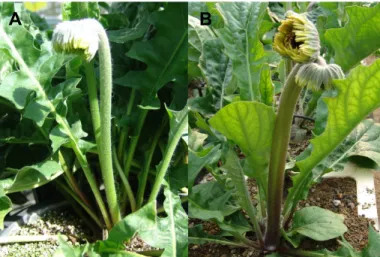
Fig. 3. The peduncle shape of gerbera ‘Party Time’. A, normal; B, double flower and fasciation.
A B C D
Fig. 4. The leaf shape of gerbera ‘Party Time’. A, ‘Hope’; B, ‘Sunnyeo’; C, ‘Party Time’; D, ‘Grandeur’.
98.3일과 부본 95.2일의 중간 정도이며 대조 품종 102.4일 에 비하여 짧고, 또한 첫 꽃 개화 시의 잎 수는 9.5매 정도로 모본 11.2매와 부본 10.7매 그리고 대조품종 10.2매보다 약 1매 정도 적어 조기수확이 가능한 품종이다(Table 3).
재배상 유의점
‘Party Time’의 동계재배 시 저온에 의하여 화경이 짧아 지는 경우가 있으므로 온실 내 가장자리보다는 가운데 이랑 으로 배치하는 것이 유리하며, 육묘기 영양과다로 개화초기 꽃대가 넓적하게 넓어지는 대화현상과 꽃봉오리가 두 개인 이중화 등 생리장해 현상이 나타날 수 있으므로 질소성분 영양관리에 주의하여야 한다(Fig. 3). 또한 다른 품종에 비 하여 잎의 결각이 얕고 적으며 엽병이 짧은 품종으로 적은 량의 잎으로도 생장점 주위에 수광량이 적어지기 쉬우므로 주당 25매 전후로 잎을 남기고 오래된 잎을 솎아 주어 생장 점 주위에 햇볕을 최대한 많이 받을 수 있도록 한다(Fig. 4).
유용성
2007년 12월 24일 종자산업법에 의거 ‘Party Time’ 품종 에 대하여 품종보호출원(품종보호 출원번호: 2007-487, 품 종명칭 등록번호: 거베라-738)하였고, 2007년에 재배심사를 실시하여 종자산업법 제55조에 의해 2009년 6월 10일 거베 라 신품종 ‘Party Time’으로 최종등록(품종보호 제2691호) 되었다. ‘Party Time’은 2009년 10월 통상실시권을 실시, 2012년 현재 재배를 희망하는 농가는 통상실시업체를 통하 여 종묘를 구입 재배할 수 있다.
초 록
경남농업기술원 화훼연구소에서 2000년부터 교배조합 육 성을 위하여 국내 재배농가로부터 유전자원을 수집한 후, 2003년 3월에 자주색 대륜계 ‘Hope’를 모본, 핑크색 대륜계 의 ‘Sunnyeo’을 부본으로 인공교배를 실시하여 계통 육성 후, 2004년부터 2007년까지 특성검정을 실시한 결과 화색,
화형, 수확량 등 품질과 수량이 우수하다고 판단되어 2007년 농작물 직무육성 신품종선정위원회의 심의를 거쳐 ‘Party Time’으로 명명 품종등록(품종보호 제2691호) 하였다. ‘Party Time’은 선명한 핑크색(RHS 65-C)과 갈색 화심(RHS 166-A) 과의 조화가 선명한 반겹꽃의 대륜화이다. 또한 화형이 안 정되고 화경이 강건하며 본당 수량은 연간 3회 검정 결과 평균 47.3개이며, 평균 절화수명은 12.7일이다.
추가 주요어: 교배, 선발, 설상화, 절화수명
인용 문헌
Choi, K.J. 2001. What is the international union for the protection of new varieties of plants? Kor. J. Breed. 33:248-253.
Choi, K.J. 2002. International union for the protection of new varieties of plants (UPOV) and its 1991 convention. Kor. J.
Hort. Sci. Technol. 20:151-159.
Chung, Y.M., B.J. Lee, J.C. Hwang, Y.D. Chin, S.K. Kim, C.W.
Ro, and O.C. Kwon. 2009. Breeding of a new yellow Gerbera hybrida ‘Golden Time’ with high yield for cut flower. Kor.
J. Breed. Sci. 41:595-598.
Chung, Y.M., J.C. Hwang, Y.D. Chin, S.K. Kim, C.W. Roh, Y.B.
Yi, and O.C. Kwon. 2010. A new gerbera ‘Sugar Pink’ with semi-double for cut flower. Kor. J. Hort. Sci. Technol. 28:
155-158.
Chung, Y.M., J.C. Hwang, Y.D. Chin, S.K. Kim, C.W. Roh, Y.B.
Yi, and O.C. Kwon. 2011. A new gerbera cultivar, ‘Red Auction’ with red color and semi-double for cut flower. Kor.
J. Hort. Sci. Technol. 29:77-80.
Chung, Y.M., Y.B. Yi, Y.C. Cho, and O.C. Kwon. 2007a. A new pink gerbera cut flower cultivar, ‘Pink Giant’ with high flower yielding. Kor. J. Breed. Sci. 39:88-89.
Chung, Y.M., Y.C. Cho, and O.C. Kwon. 2007b. A new yellow gerbera cut flower cultivar, ‘Gold Eye’ with strong peduncle and high flower yielding. Kor. J. Breed. Sci. 39:86-87.
Korea Seed and Variety Service (KSVS). 1997. The guide-lines of characteristics for application and registration of new varieties in flower. KSVS, Anyang, Korea.
Ministry of Food, Agriculture, Forestry and Fisheries (MFAFF).
2012. The current status of domestic flower cultivation in 2011.
MFAFF, Gacheon, Korea.
Park, S.K., J.H. Lim, H.K. Shin, M.S. Kim, H.Y. Joung, H.R.
Cho, and H.K. Rhee. 2009a. A new gerbera variety ‘Red Line’;
high yielding cultivar with red and semi-double for cut flower.
Kor. J. Breed. Sci. 41:591-594.
Park, S.K., J.H. Lim, H.K. Shin, M.S. Kim, H.Y. Joung, H.R.
Cho, and H.K. Rhee. 2009b. A new gerbera cultivar ‘Lovely Moon’; High-yielding cultivar with yellow and semi-double for cut-flower. Flower Res. J. 17:316-319.
Park, S.K., J.H. Lim, S.Y. Choi, H.K. Shin, and J.S Lee. 2010.
A new yellow and semi-double gerbera cultivar ‘Sunny Lemon’
with early flowering and high yielding. Kor. J. Breed. Sci.
42:703-706.
Park, S.K., J.H. Lim, S.Y. Choi, H.K. Shin, and Y.J. Huh. 2011a.
A new white and semi-double gerbera cultivar ‘Whiteny’ with strong floral stem for cut-flower. Kor. J. Breed. Sci. 43:572- 575.
Park, J.S., M.Y. Chung, and C.K. Kim. 2011b. Breeding of a new bright yellow gerbera ‘Sunmyo’ with high yield for cut flower. Kor. J. Hort. Sci. Technol. 29:156-159.
Park, J.S., S.W. Jang, H.S. Kim, H.H. Kang, C.K. Kim, and J.D.
Chung. 2007. Breeding of a bright pink gerbera ‘Yeunhwa’
for cut flower. Kor. J. Hort. Sci. Tech. 25:425-428.
Royal Horticultural Society (RHS). 2001. Royal horticultural society colour chart. RHS, London, UK.
Rural Development Administration (RDA). 2003. Manual for agricultural investigation. RDA, Suwon, Korea.