[논 문] 한국재료학회지 http://dx.doi.org/10.3740/MRSK.2016.26.5.246 Korean J. Mater. Res.
Vol. 26, No. 5 (2016)
246
용매열 합성법에 의한 니켈 분말 합성 및 특성
박찬·배동식
†
국립창원대학교 메카트로닉스대학 나노신소재공학부
Synthesis and Characterization of Nickel Powders by a Solvothermal Processing
Chan Park and Dong-Sik Bae †
Department of Advanced Materials Science and Engineering, Changwon National University, 20 Changwon-daero, Uichanggu, Changwon, Gyeonnam 51140, Republic of Korea
(Received January 30, 2016 : Revised March 27, 2016 : Accepted March 29, 2016)
Abstract
Nickel powders were prepared under solvothermal condition by precipitation from metal nitrates with aqueous ammonium hydroxide. The powders were obtained at in a temperature range of 190-250oC for 6h. The morphology and size of nickel powders were studied as a function of reaction temperature. The synthesis of nickel crystalline particles is possible under a solvothermal conditions in ethylene glycol solution. Characterization of the synthesized nickel powders were studied by XRD, SEM(FE-SEM) and TG/DSC. X-ray diffraction analysis of the synthesized powders indicated the formation of nickel structure after reaction. The average crystalline sizes of the synthesized nickel powders were in the range of 200-1000 nm; and the distribution of the powders was broad. The shape of the synthesized nickel particles was almost spherical. The morphology of synthesized nickel powders changed with reaction condition. It was possible to synthesize nickel powders directly in ethylene glycol without reducing agent.Key words
nickel, solvothermal processing, nano powders, spherical shape.1.
서 론Nano 크기의 Ni 분말은 일반적인 마이크로 이상 크 기의 분말보다 뛰어난 물리적, 화학적, 광학적 특성을 가 지며 높은 부가가치를 지니고 있다. Ni은 높은 산화저 항성, 높은 자성 및 전기전도도 가지고 있어서 부식에 저항성이 높은 고강도 합금인 스테인레스강의 주재료로 서 널리 사용되고 있고, 부식 및 마모 보완용 기능성 도 금, 동전, 첨단소재 등의 원료로 광범위하게 사용되고 있 다.
1)Ni 은 화학적 환원특성이 뛰어나 수소화 반응 촉매
2)로 사용되며 기계적 성질이 우수하여 금속구조물에 사 용되고,
3)전자기적 특성으로 무전해 도금, 자성체, 인광 체, 광화학, 압전체, 반도체, 전지분야 등으로 활용 폭이 확대되어지고 있다. 순수한 Ni의 제작방법으로는 아크 플
라즈마 방전법,
4)EWS(ehanol-water system),
5)화학적 환 원법,
6)수열합성법
7)등이 있다. 가장 많이 사용되는 아 크 플라즈마 방전 법은 대량으로 합성 가능하고 대량 생 산 공정이 실현 가능하나 초기 비용 및 유지비용이 비 싸며 지속적으로 고 순도의 비활성 기체를 흘려주어야 하고 형상 및 크기 제어가 어려운 단점이 있다. 반면, 화학적 환원법을 사용하면 미세한 분말을 얻을 수 있고 별도의 합성장비가 필요하지 않지만 실험 공정이 까다 롭고 주변의 온도 및 대기 조건에 민감하게 반응하는 단 점이 있다. 따라서 이러한 단점을 보완한 용매 열 합성 법으로 금속 분말을 제조하는 방법이 시도되고 있다. 용 매 열 합성법은 적절한 용매를 사용하며 적절한 온도와 압력 하에서 결정상의 분말을 직접 제조하는 방법이다. 단 순 조성의 물질을 합성 하는 기술로 신뢰도가 높고, 고
†
Corresponding author
E-Mail : [email protected], (D.-S. Bae, Changwon Nat'l Univ.)
© Materials Research Society of Korea, All rights reserved.
This is an Open-Access article distributed under the terms of the Creative Commons Attribution Non-Commercial License (http://creative-
commons.org/licenses/by-nc/3.0) which permits unrestricted non-commercial use, distribution, and reproduction in any medium, provided the
original work is properly cited.
용매열 합성법에 의한 니켈 분말 합성 및 특성 247
순도의 화학 양론적인 입자를 제조 가능하며 농도, 반
응시간, 반응온도, 전구물질, 촉매제 등의 종류에 따라 입 자의 형상과 크기를 조절이 용이하다고 알려져 있다.
8,9)용매 열 합성법은 전구체를 수산화물 형태로 침전시킨 후 세척하여 용매에 분산한 다음 적절한 온도와 압력을 가하여 합성하는 것이다. 이러한 공정으로 결정상을 가 지는 나노 크기 분말을 합성할 수 있고, 하소나 밀링 공 정이 필요하지 않은 장점이 있다.
10-12)본 연구에서는 금 속인 Ni을 합성하기 위하여 직접 환원 작용을 하는 에 틸렌글리콜(etylene glycol)을 선정하여 적절한 반응온도, 반응시간, 침전시의 pH 등을 변화하여 나노 크기의 구 형인 Ni입자를 제조하고자 하였다.
2.
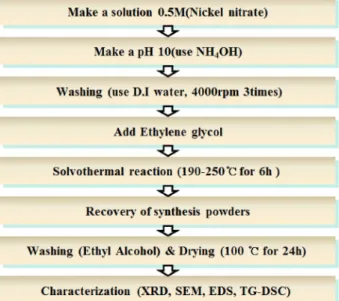
실험 및 방법구형 나노크기의 니켈을 합성하기 위한 시작 전구체로 는 Nickel(II) nitrate hexahydrate 96 % (deajung)을 사 용하였다. 합성에 사용된 용매는 Etylene glycol 99 % (daejung), 침전법에 사용된 촉매로는 Ammonium hydroxide (daejung), 합성 전후의 세척에는 2차 증류수와 Ethyl alcohol 99.9 %(samchun) 을 사용하였다. 반응을 위한 합 성장비는 Thermal reactor [UTO E.N, UTO system]을 사용하였다. 용매 열 합성법으로 구형 니켈을 합성하기 위한 실험 공정은 Fig. 1에 나타내었다. 먼저 0.5M의 Nickel nitrate solution 을 제작하고, NH
4OH 를 사용하여 pH 를 9-10으로 조절하여 침전물을 생성하였다. 침전물은 Ni(OH)
2로 녹색의 침전물을 얻을 수 있었다. pH를 11 이상으로 조절하게 되면 해리가 일어나 침전되는 양이
극히 감소되었다.
13)침전물에 2차 증류수를 혼합하고 뿌 연 혼탁액이 사라질 때 까지 원심 분리기를 사용하여 4000rpm, 10 분씩 3회 이상 세척하였다. 세척한 침전물 을 Etylene glycol와 혼합하여 30분간 mix 하고, 용매 열 합성장치를 사용하여 반응시켰다. 이때의 합성 조건은 반 응온도 190
oC 에서 250
oC 이며 승온 속도는 5
oC/min, 반 응 압력은 1-3.0 MPa 으로 유지하였다. 합성물을 회수하 고 Ethyl alcohol과 원심분리기를 사용하여 4000rpm, 10 분씩 5회 이상 세척한 후 100
oC 에서 24h 건조하여 Ni 분말 합성을 완료하였다. 니켈 분말의 특성평가는 XRD, SEM(SEM, JOEL, JP/JSM 5200), TG-DSC(SINCO TGA N-1000/1500) 를 사용하였다.
3.
고 찰반응 온도변수에 따른 합성된 분말의 결정상을 관찰하 기 위해여 X-선 회절 분석한 결과는 Fig. 2와 같다. 반 응온도가 190
oC 에서 6시간 유지한 경우 hexagonal 구 조의 Ni(OH)
2가 합성되었다. 반응온도가 200
oC 에서 220
o
C 영역에서는 Ni(OH)
2·0.75H
2O 의 결정구조와 일치하였 다. 반응온도가 230
oC 에서 6시간 유지한 경우의 합성된 분말은 결정상의 cubic 상의 Ni과 일부 Ni(OH)
2·0.75H
2O 이 혼재되어 있는 것을 알 수 있다. 반응온도가 235
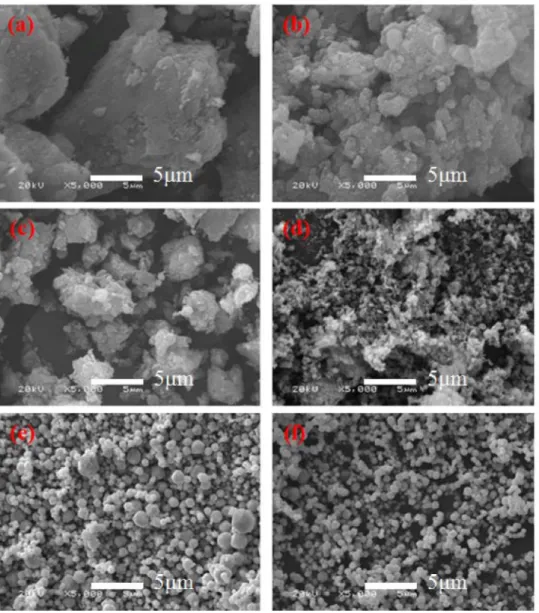
oC 이상인 경우는 cubic 상의 Ni 상이 나타났다. 반응온도 변화에 따른 합성된 분말의 미세구조를 살펴보기 위해 합성된 Ni 분말을 주사전자현미경(SEM)으로 관찰한 결 과는 Fig. 3과 같다. Fig. 3을 살펴보면 반응온도가 190
o
C 에서부터 220
oC 까지는 판상 형태이며, 크기는 불균일 하게 합성되었다. 반응온도가 230
oC 에서는 구형과 판상 이 혼합되어 있다. 반응온도가 235
oC 에서는 입자의 모
Fig. 2. X-ray diffraction patterns of synthesized nickel powders as a function of reaction temperature.
Fig. 1. Schematic diagram of synthesis of nickel powders by a
solvothermal processing.
248 박찬·배동식
양은 구형이고, 입자의 크기는 0.5~2.5 µm의 범위를 나 타내었다. 반응온도가 250
oC 에서 얻어진 입자의 모양은
거의 구형이며, 크기 분포가 균일하고 평균입자가 0.2 µm 이하의 Ni 입자가 합성되었다. Ni의 순도를 확인하기 위 Fig. 3. Microstructure of the synthesized nickel particles as a function of reaction temperature; (a) 190
oC, (b) 205
oC, (c) 220
oC, (d) 230
o
C, (e) 235
oC and (f) 250
oC.
Fig. 4. Particle size distribution of the synthesized nickel powders as a function of reaction temperature; (a) 235
oC and (b) 250
oC.
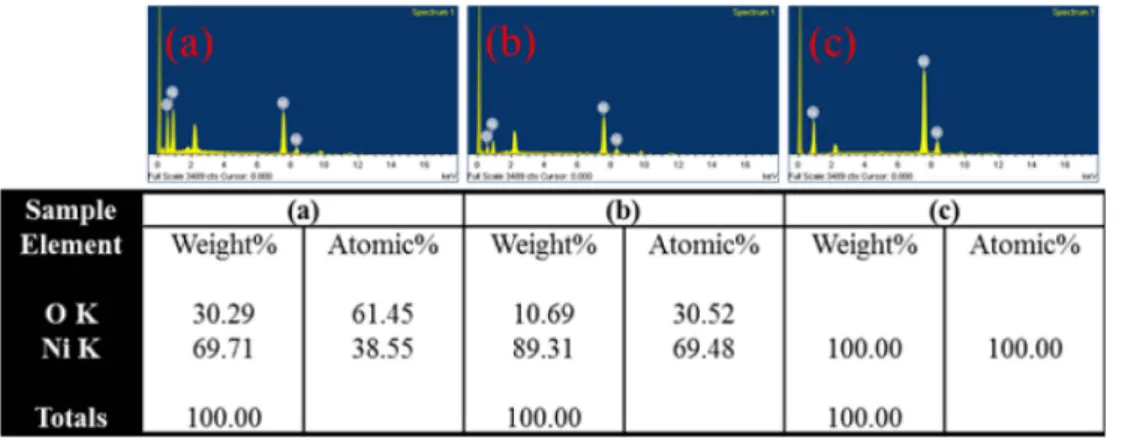
용매열 합성법에 의한 니켈 분말 합성 및 특성 249
하여 EDS를 측정한 결과는 Fig. 5와 같다. 합성에서 반 응온도가 증가할수록 합성된 분말의 산소 함량이 급격 하게 감소하는 것을 확인할 수 있었다. 반응온도가 250
o
C 에서는 순수한 Ni 만이 검출되었다.
4.
결 론Ni 전구체를 침전하여 ethylene glycol에 분산하여 반 응온도를 190
oC 에서 250
oC 까지 변화하면서 Ni 분말을 합성거동을 조사하였다. 순수한 Ni 분말은 반응온도가 235
oC 이상에서 6시간 반응시킨 경우에 합성되었다. 합 성된 분말의 크기는 반응온도가 250
oC 에서 구형이면서 입자의 크기 분포가 균일한 Ni 입자가 합성되었다. 이 때 입자의 평균 크기는 0.2 µm 내외로 균일하였고, EDS 분석결과 순수한 Ni이 합성되었다.
Acknowledgement
This study was financially supported by a Research Grant(ERC, 2011-0030058) from the National Research Foundation, Korea.
References
1. Bradley, Kevin. The 8th Annual China Nickel Conference, Shanghai. 2011.
2. Trimm, David L. Catal. Rev. 16, 155 (1977).
3. Hemker, K. J., and H. Last. Mater Sci Eng., 319, 882 (2001).
4. Wei, Zhiqiang, et al., Mater. Lett., 60, 766 (2006).
5. Zheng, Hua-gui, et al., Mater Res Bull., 36, 947 (2001).
6. Wang, Da-Peng, et al., J. Cryst. Growth, 310, 1195 (2008).
7. Yang, Li-Xia, et al., J. Solid State Chem., 180, 2095 (2007).
8. W. J. Dawson, Am. Ceram. Soc. Bull., 67, 1673 (1989).
9. S. Komarneni, E. Fregeau, E. Breval and R. Roy, J. Am.
Ceram. Soc., 71, C26 (1988).
10. S. B. Cho, S. Venigalla and J. H. Adair, J. Am. Ceram.
Soc., 79, 88 (1996).
11. M. Inoue, H. Taniono Y. Kondo and T. Inui, J. Am.
Ceram. Soc., 72, 352 (1989).
12. S. B. Cho and J. H. Adair, Sci. Tech. App., of Colloid.
Susp., edited by James H. Adair, Jon A. Casey, Clive A.
Randall (Sridhar Venigalla, 1995) p.139
13. XiangYi Denga, Zhong Chen., Mater. Lett., 58, 276 (2004).