INTRODUCTION
Algal blooms in eutrophic lakes are a nuisance for both recreational use and water supply.
Phosphorus and nitrogen are the primary factors controlling algal biomass in lakes. Phosphorus has a more crucial role compared to nitrogen in limiting algal growth in Korea, because natural background concentrations of nitrogen are rela- tively high and the N/P ratio is much higher than the Redfield ratio (Kim et al., 2001). There- fore, phosphorus reduction is a primary concern for the control of algal blooms.
Phosphorus control measures in lakes may be either preventive or curative; that is, source con-
trol in the watershed or suppressing algal utili- zation of phosphorus within the lake. Preventive measures of source control are known to be more effective and economical than curative measures dealing with phosphorus in lake water (Hender- son-Sellers and Markland, 1987). However, the control of nutrients in watersheds is not possible in many circumstances, especially when the ma- jor source of nutrients is non-point. Because nu- trient discharge from agricultural fields and urban areas occurs only after heavy rainfall and the amount of discharge water is enormous, it is not feasible to collect all the storm runoff and treat it. In such circumstances in-lake treat- ment is the only available method to abate eutro- phication symptoms.
─
─ 447 ──
The Application of Aluminum Coagulant for the Improvement of Water Quality in Three Recreational Ponds
Kim, Bomchul and Philgoo Kang
(Department of Environmental Science, Kangwon National University, Chunchon, 200-701 Korea)
Aluminum coagulant was applied to two eutrophic lakes (Lake Sukchon, in Seoul, and a pond on the campus of Kangwon National University), to precipitate suspended particles and phosphate from the water column. Aluminum sulfate (alum) was used for seven treatments and polyaluminum chloride (PAC) was used for one treatment. The effect of treatment varied depending on the dose of alumium coagulant. Particles and phosphate were completely precipitated from the water column with a dose of 10.0 mgAl/l. Partial removal was observed at doses of 3.3 and 1.8 mgAl/l, but not at 0.45 mgAl/l. Therefore, coagulant should be applied at a dose over the threshold in order to remove particles effectively, which seems to be between 1.8 and 10.0 mgAl/l. The length of treatment effect was determined by new inputs of nutrients and particles from external sources. Renewal of pond water by stream water caused recovery of algal growth in Lake Sukchon, and rainfall runoff and ground water pumping caused a return of turbid water in the campus pond.
During treatment there was no sign of decreasing pH, or harmful effects on fish or mussels. Aluminum coagulant may be an economically feasible alternative for water quality improvement when the external control of pollutant sources is difficult.
However, repeated application is required when there is a renewal of lake water or new input of nutrients.
Key words : aluminum coagulant, restoration, water quality, alum
* Corresponding Author: Tel: 033) 250-8572, Fax: 033) 251-3991, E-mail: [email protected]
Common methods of in-lake eutrophication control are phosphorus inactivation, artificial de- stratification, and biomanipulation. Among these methods, phosphorus inactivation is superior in regard to certainty of treatment effect, whereas artificial aeration and biomanipulation are not effective in many cases (Cooke et al., 1993).
The main purpose of aluminum treatment in lakes is to reduce phosphorus release from sedi- ments by covering the sediment surface with aluminum hydroxide floc (James et al., 1991).
Aluminum ion can form insoluble AlPO4 precipi- tate with orthophosphate which is stable even under anaerobic conditions. Phosphate released from the sediment is trapped by aluminum at the sediment surface, and internal loading of pho- sphorus can be reduced to nearly zero (Garrison and Knauner, 1984).
Another mechanism of water quality impro- vement is coagulation of suspended particles by aluminum hydroxide floc. Clay particles com- monly have negative charges on the surface and the electric repulsion prevents particles from ma- king large aggregates and settling to the bottom.
Aluminum cations can neutralize the negative charges on particle surfaces, enhancing aggrega- tion to form fast-settling large particles. Because aluminum ions have low solubility at neutral pH, hydoxide precipitate floc is formed. When the floc settles, suspended particles are concurrently coa- gulated and settled.
Among the various coagulants, aluminum sul- fate (alum) and polyaluminum chloride (PAC) are most commonly used for lake restoration pro- jects. Alum is known to be a good coagulant that is inexpensive and effective without causing harm to organisms if used carefully and according to directions. Alum had been used for the purifica- tion of water supply for decades. However, PAC has been in wide use for water purification re- cently because PAC produces less residual dis- solved aluminum in tap water.
In practical applications of aluminum coagu- lant in lakes the amount of coagulant required is a critical factor for treatment effectiveness and cost. Another point of concern is the duration of effectiveness. After settling the particulate mate- rials from the water column, algae can grow again if phosphorus is supplied from external sources or the sediment.
In this paper two case studies of aluminum treatment in lakes are described, and the effect of
water clarification and the duration of the treat- ment effect are evaluated. Factors governing the usefulness of aluminum treatment also are dis- cussed.
MATERIALS AND METHODS
Aluminum treatments were performed in December 1995 and March 1996 in two lakes:
Lake Sukchon in Seoul City and the campus pond at Kangwon National University. The basin of Lake Sukchon was formerly a part of the Han River channel. In the course of development along the river, the channel was straightened, and a separated curvature part remained as a lake for recreational use. The lake is separated from the streams, and there is no inflow water except ground water seepages. For this reason, water is artificially pumped into the lake from a nearby tributary stream in order to compensate water seepage. Ground water seepage into the lake also seems to supply water through the sandy bottom.
The downstream reach of the Han River receiv- es discharges from a densely populated water- shed, and the pumped water from the stream is rich in nutrients. Lake Sukchon has been suf- fering from eutrophication with dense algal blooms. Since an amusement park exists on the shore of Lake Sukchon, its aesthetics are very important. The aluminum treatment of this study was performed to improve aesthetic qua- lity of the lake.
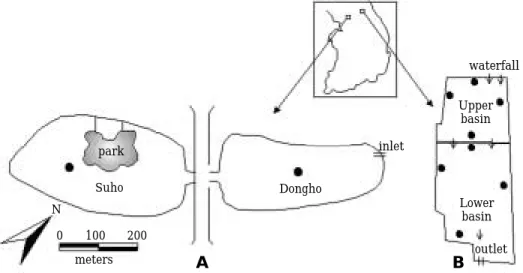
Lake Sukchon has two circular basins--the east basin (Dongho) and the west basin (Suho), which are connected with a narrow channel.
Even though aerators were installed and several diffusers were placed over the basin for the wa- ter quality improvement, algal blooms were not suppressed because of shallow depth. When alu- minum was applied to the lake, aerators were in full operation to aid mixing of coagulant. Aera- tion then was stopped to facilitate sedimentation of aluminum floc. The concentration of alumi- num in alum solution and PAC solution was 45 gAl/l and 24 gAl/l, respectively.
The campus pond in Kangwon University, nam- ed Yonjokji, is an artificial pond made for a small park area. It consists of two basins (upper and lower) separated by a barrier wall. Because it does not have an inflowing stream, ground water is pumped into the upper pond occasionally to sup-
plement evaporation and infiltration loss. High nutrient concentrations in the ground water cause year-round algal blooms. Aluminum treat- ments were performed three times by using alum --in November 1997, April 1998, and May 1998.
While applying alum solution, an outboard motor was operated to mix pond water and facilitate flocculation.
Samples for water quality analysis were taken with a Van Dorn sampler and stored in polye- thylene bottles. Temperature, pH, and dissolved oxygen (DO) were measured at 1m depth inter- vals in the lakes. Samples were filtered with GF/
C glass fiber filters, which were kept frozen until analysis of chlorophyll-a concentration. Chloro- phyll-a concentration was determined by a spectrophotometric method using acetone extrac- tion (Lorenzen, 1967). Total phosphorus concen- tration was determined by persulfate digestion followed by the ascorbic acid method for ortho- phosphate analysis. Trophic State Index (TSI) values were calculated according to Carlson (1977). Aluminum content of alum solution speci- fied by the manufacturer was 4.5% by weight, and that of PAC solution was 2.4%. Aluminum content of alum powder was 8.5% by weight.
RESULTS
Lake Sukchon
The water quality in the two basins of Lake
Sukchon did not differ, even though they are con- nected by a narrow channel (Fig. 1). Active aera- tion was thought to be the reason why lake wa- ter is well mixed. Stratification was not observed even in summer, and DO was saturated year- round (Fig. 2).
The N/P atomic ratios were in the range of 29 to 137, implying phosphorus should be limiting nutrient for algal growth. Lake Sukchon could be classified as a eutrophic lake with TSI (SD) of 56, TSI (TP) of 54, and TSI (Chl) of 57 (Forsberg and
Fig. 1. Map showing the study sites. Dark circles mean sampling stations. Arrows in panel B indicate the flow of water.
Pannel A: Lake Sukchon, Pannel B: campus pond.
Fig. 2. Depth-time isopleths of relative saturation of dis- solved oxygen concentrations (%) in Lake Sukchon (A: Dongho, B: Suho).
Suho park
Dongho
Upper basin
waterfall
inlet
meters
0 100 200
A B
outlet Lower
basin N
0 1 2 3 4 0 1 2 3 4 5
A
B
110
110 110
110 110
110
110 110 130 130
110 130
110 110 110 110
110
110 110
110
120 120
120
120130
120
120
120 130 120
130 130
130130
130 100
100
100 100
100 100 100
100 100
90
90 80
90
90
90 90
Oct. Nov. Dec. Jan. Feb. Mar. Apr. May Jun. Jul. Aug.
1995 1996
Depth(m)
Ryding, 1980) (Table 2). The close correspondence between TSI (TP) and TSI (Chl) further supports the view that P is limiting, and the close corres- pondence between TSI (Chl) and TSI (SD) indi- cates that algae are the main factor controlling light attenuation in this lake (Havens, 2000).
Table 1. Water volumes of study lakes and the amount of aluminum applied.
Lake Sukchon Campus pond Campus pond upper basin lower basin Water volume 508,000 m3 870 m3 1,980 m3 Maximum
depth 5.3 m 0.8 m 1.0 m
Treatment 1 Dec. 13, 1995 No application Nov. 19, 1997 alum 1.77 mgAl/l alum 10.0 mgAl/l
(total 20 m3)
Treatment 2 Mar. 27, 1996 Apr. 13, 1998 Apr. 13, 1998 PAC 0.45 mgAl/l 3.3 mg Al/l alum 3.3 mg Al/l
(total 10 m3)
Treatment 3 May 18, 1998 May 18, 1998 10 mg Al/l alum 10 mgAl/l
Table 2. Monthly average water quality parameters in Lake Sukchon. SD; Secchi disk depth (m), Temp; temperature (�C), DO; dissolved oxygen (mgO2/l), Tur; turbidity (NTU), TN; total nitrogen (mgN/l), TP; total phosphorus (µgP/l), DIP; dissolved inorganic phosphorus (µgP/l), COD; chemical oxygen demand (mgO2/l), Chl. a; chlorophyll a concentration (mg/m3), SS; suspended solid (mg/l), Alk; alkalinity (mgCaCO3/l), N/P; atomic TN/TP ratio.
1995 1996
Oct. Nov. Dec. 5 Dec.16 Dec.18 Jan. Feb. Mar. Apr. May Jun. Jul. Aug. Sep.
Dongho
SD 1.2 1.5 4.0 2.9 1.4 0.8 1.6 1.4 1.8 1.4 0.9
Temp 17.5 12.2 3.9 3.6 6.7 12.0 21.1 25.2 26.4 29.6 28.7
DO 9.6 9.7 13.9 13.5 14.2 14.2 11.7 10.7 10.6 8.4
pH 8.56 9.34 9.01 7.15 6.81 7.27 7.37 9.50 9.80 8.80 9.18 9.06 9.36 9.65
Tur. 6.4 5.5 1.6 1.3 0.9 1.4 1.1 1.8 2.4 2.2 3.8 3.2 5.0
TN 0.74 0.70 0.72 0.87 0.91 0.75 1.20 1.37 1.23 0.97 1.03 0.50 0.54 0.73
DIP 1.6 2.3 1.6 1.8 1.2 2.7 8.6 6.7 3.5 2.8 4.6 5.4 8.5 9.7
COD 9.3 8.5 6.0 5.7 5.8 3.9 3.6 6.4 7.8 7.5 8.1 5.2 5.7 5.9
SS 10.5 9.4 3.9 3.0 2.4 3.9 1.3 8.4 4.0 4.6 5.8 6.6 14.4
Alk. 33.1 39.9 35.5 36.1 36.5 39.4 39.8 41.8 43.0 40.4 40.4 23.6
N/P 50 56 71 130 137 90 122 97 89 86 109 38 45 42
Suho
SD 1.2 1.3 3.0 1.5 0.8 1.9 1.2 1.9 1.4 0.9
Temp 17.4 12.0 2.2 2.9 6.5 11.9 21.5 26.1 26.8 29.5 28.8
DO 9.0 9.3 15.4 14.5 13.1 14.3 12.2 8.8 9.0 7.7
pH 8.72 9.04 8.91 6.78 6.68 7.60 7.40 9.47 9.70 9.07 9.11 9.07 9.08 9.67
Tur. 6.1 5.7 1.8 1.1 1.0 0.8 0.8 1.7 2.2 1.9 5.2 3.4 4.4
TN 0.42 0.44 0.36 0.42 0.42 0.60 0.80 1.20 0.97 0.90 0.95 0.47 0.54 0.63
DIP 1.3 2.4 1.6 1.8 2.9 3.6 7.5 3.9 2.9 7.4 5.0 4.7 7.7
COD 7.0 8.2 7.7 6.1 6.7 3.5 3.3 6.1 8.0 7.9 8.0 5.3 6.7 6.6
SS 7.8 8.2 6.6 5.2 2.7 1.7 1.8 7.1 7.3 1.7 9.5 6.6 13.6
Alk. 38.4 37.4 34.9 36.2 37.1 39.2 40.3 42.5 44.1 41.6 42.1 22.6
N/P 29 35 18 51 57 91 137 95 86 86 63 41 30 40
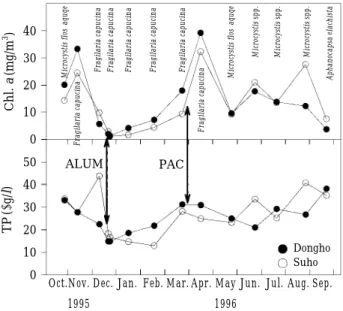
Fig. 3. Variation of total phosphorus (TP) and chlorophyll -a (Chl. a) concentration in two basins (Dongho and Suho) of Lake Sukchon. Italic names are dominant phytoplankton species in each sample. Arrows of ALUM and PAC indicate the time of treatments.
40 30 20 10 0
ALUM
Microcystis flos-aquqe Microcystis flos-aquqe Microcystis spp. Microcystis spp. Aphanocapsa elachista
Microcystis spp.
Fragilaria capucina Fragilaria capucina
Fragilaria capucina Fragilaria capucina Fragilaria capucina Fragilaria capucina Fragilaria capucina
PAC
Dongho Suho Oct.Nov. Dec. Jan. Feb. Mar. Apr. May Jun. Jul. Aug. Sep.
1995 1996
Chl. a(mg/m3 )TP(µg/l)
50 40 30 20 10 0
It is remarkable that nitrogen concentrations in Lake Sukchon are lower than in nearby stre- ams, the Han River and its tributaries. Because of low nitrogen concentrations, nitrate depletion occurred in summer when phytoplankton density was high. It seems that nitrogen limits algal growth in summer. The low nitrogen content in the lake water might be the effect of ground water seepage that has low nitrogen content; this requires further study.
The background pH was higher than 9, but it became lower than 7 with the application of alum in the first treatment. The pH increased again in March 1996 when inputs of water occu- rred from the tributary of the Han River (Sung- naechon). Even after the second treatment in spring when PAC was applied, pH remained over 9. Both inputs of the river water and the increase
of algal density seem to have contributed to the high pH in spring. From the lack of change in pH it can be concluded that the amount of alum and PAC applied in this study was within the pH buffering capacity of the lake (Table 2, Table 3).
In the first treatment when alum was applied at the dose of 1.77 mgAl/l, TP dropped from 22 to 15 mgP/m3 in the East Basin, and from 44 to 15 in the West Basin (Fig. 3). Chlorophyll-a con- centration also decreased, from 4.3 to 1.9 mg/m3 in the East Basin, and from 9.8 to 2.8 in the West Basin. Chlorophyll-a concentration in- creased again gradually, and it reached the level of pre-treatment after two months. During the treatment fish had normal swimming behavior and there was not any sign of harmful effects upon fish.
In the second treatment when PAC was appli- ed at a dose of 0.45 mgAl/l, TP and chlorophyll-a concentrations did not decrease. SS even increas- ed from 1.3 to 8.4 in the East Basin and from 1.8 to 7.1 in the West Basin. The reason why water quality was not improved is thought to be the insufficient PAC application, which was 1/4 of the first treatment. It is known that below a cri- tical concentration of coagulant suspended parti- cles are not effectively coagulated or settled. In the second treatment fine particles of aluminum hydroxide were observed in the water, causing
Table 4. Monthly average of water quality parameters in the campus pond.
1997 1998
Jun. Jul. Aug. 1-19 20-30Nov. Nov. Dec. Jan. Mar. 1-13 14-30 19-31 1-18Apr. Apr. May May Jun. Jul. Aug. Sep. Oct.
Upper basin
SD 0.6 0.6 0.7 0.9 1.0 0.9 0.7 0.8 0.8 0.8 2.1 0.8 0.7 0.6 0.8 0.6
Temp 27.2 27.3 29.2 8.1 7.8 6.6 3.9 12.7 18.9 22.8 24.6 25.7 25.8 26.0 25.6 21.5 16.4 pH 7.57 7.19 7.19 6.93 6.90 7.41 7.47 7.08 8.33 8.40 6.89 7.42 7.07 7.21 7.64 7.33
Tur. 3.4 3.3 4.3 4.5 11.9 4.4 5.5 4.6 2.4 3.8 6.5 9.5 4.5 5.4
TN 2.38 2.46 2.32 3.41 3.13 2.56 1.68 2.36 3.82 2.57 2.69 1.82 2.11 2.44 1.92 3.10 3.69 SS 19.6 17.6 16.6 8.2 12.1 7.5 3.8 9.1 8.8 10.0 10.0 4.8 9.0 18.9 17.3 14.5 15.6
Alk. 105 100 95 76.7 99.1 42.7
N/P 85 81 74 176 202 150 158 82 149 155 141 168 132 106 64 112 172
Lower basin
SD 0.6 0.6 0.7 1.1 2.5 0.8 0.7 0.6 0.7 0.8 1.3 0.8 0.6 0.6 0.7 0.6
Temp 27.4 27.7 28.6 5.9 6.5 6.2 4.1 11.7 18.1 22.0 24.4 25.4 26.1 25.9 25.4 22.2 17.0 pH 8.32 7.44 7.36 6.56 6.45 7.42 7.73 8.22 8.40 8.27 7.07 7.73 7.15 7.12 7.69 7.70
Tur. 5.0 2.0 4.2 3.6 9.5 9.7 6.2 5.4 3.7 4.3 8.0 10.1 7.5 8.4
TN 1.68 1.28 0.85 2.29 2.38 1.94 1.27 1.44 2.62 2.20 1.00 1.15 0.85 1.29 1.05 2.63 2.98 SS 25.6 31.4 10.8 10.6 2.7 4.3 5.3 8.5 11.8 13.6 10.5 7.1 7.5 18.2 20.8 24.5 22.1
Alk. 108 105 103 46.0 97.5 40.6
N/P 67 47 42 101 342 232 93 62 82 114 51 97 45 50 32 63 101
Table 3. Alum concentration (mgAl/l) consumed to pH 6.0 in Lake Sukchon (Sep. 1996).
Dongho Suho
Initial pH 9.6 9.6
Initial alkalinity (mgCaCO3/l) 23 22 Maximum alum dose (mgAl/l) estimated
according to Cooke et al. (1993) 5.0 5.0 Measured maximum alum dose (mgAl/l)
with pH over 6.0 6.4 6.8
high turbidity, because the PAC dose was below the threshold level for coagulation.
Campus pond
The campus pond also was eutrophic, with higher TSI values than in Lake Sukchon: TSI (SD) was 67, TSI (TP) was 63, and TSI (Chl) was 62. Again it is noteworthy that the values were quite similar. Because water in the Lower Basin was pumped to the Upper Basin occasionally, the water quality in two basins were similar (Table 4). The major cause of eutrophication in the pond was high nutrient concentrations in the pumped ground water. TP in the ground water was about 50 mgP/m3, and TN was about 4 mgN/l (Table 5).
The first treatment alum was applied at the dose of 10.0 mgAl/l, which was much higher than the doses to Lake Sukchon. The pond dose was determined from preliminary alkalinity tests to find the maximum possible dose of alum without lowering pH below 6.0. The maximum dose esti- mated from the alkalinity measurement and the empirical relationship of Cooke et al. (1993) was 13 mgAl/l. The measured maximum dose of alum
for the pond water was 11.0 mgAl/l. Therefore, the amount of alum applied in the first treat- ment was almost at the maximum level (Table 6).
The beneficial effects of alum in the first treat- ment were obvious. All phytoplankton and su- spended particles settled from the water column.
TP decreased by 88% and chlorophyll-a decreas-
Table 5. Water quality of the ground water that was sup- plied into the campus pond.
Aug. Sep. Oct.
Temp (�C) 15.5 14.9 14.6
pH 7.28 6.99 6.87
Turbidity (NTU) 0.3 0.4 0.3
TN (mgN/l) 3.58 3.97 3.96
TP (µg/l) 50.7 50.8 48.1
Table 6. Maximum alum dose with pH over 6.0 in the lower basin of the campus pond (Nov. 1997).
Initial pH 7.8
Initial alkalinity (mgCaCO3/l) 100 Maximum alum dose (mgAl/l) estimated
according to Cooke et al. (1993) 13 Measured maximum alum dose (mgAl/l) with
pH over 6.0 11.0
Table 7. The removal efficiency (%) of TP and Chl. a after 1 day of alum treatment in the campus pond.
Treatment 1 Treatment 2 Treatment 3 TP Chl. a TP Chl. a TP Chl. a Upper basin No application 32% 34% 71% 92%
Lower basin 88% 99% 58% 57% 72% 91%
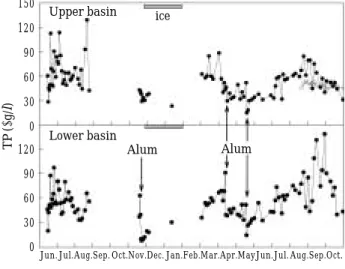
Fig. 4. Variation of total phosphorus concentration (TP) in the campus pond. The gray bar in each panel indicates ice-covered period. Dark circles are data of the lake, and open circles in the upper panel represent TP of ground water that was pumped into the pond.
Fig. 5. Variation of chlorophyll-a concentration (Chl. a) in the campus pond. The gray bar in each panel indicates ice-covered period. Arrows indicate time of three alum treatments.
150 120 90 60 30 0
Upper basin
Lower basin
ice
Alum
Jun.Jul.Aug.Sep. Oct.Nov.Dec. Jan.Feb.Mar.Apr.MayJun.Jul. Aug.Sep.Oct.
1997 1998
TP(µg/l) Alum
120 90 60 30 0
100 80 60 40 20 0 100 80 60 40 20 0 Chl. a(mg/m3 )
Upper basin
Lower basin
Alum
Alum ice
138.6
Jun.Jul.Aug.Sep. Oct.Nov.Dec. Jan.Feb.Mar.Apr.MayJun.Jul. Aug.Sep.Oct.
1997 1998
ed by 99% (Table 7, Figs. 4, 5). The pond water became so clear that the pond bottom and fish could be seen clearly. Because the maximum de- pth was only 1m, even mussels crawling on the sediment could be observed from the water sur- face. The water remained clear for three weeks, and then ice cover formed. During the treatment period there was no sign of harmful effects on fish or crawling mussels.
In the second treatment the alum dose was reduced to 3.3 mgAl/l (1/3 of the first treatment) in order to observe the effect of a lower dose.
Both the Upper Basin and the Lower Basin had a 40% reduction of TP and chlorophyll-a, which was a much lower removal efficiency than with the first treatment. The duration of effect also was shorter--one week after the treatment, there was a small rain and turbidity increased due to the input of turbid runoff from the sur- rounding land. Chlorophyll-a also increased after the rain.
In the third treatment of the campus pond alum was applied at the same dose as the first treatment (10 mgAl/l). The removal efficiency was better than the second treatment, with 70%
efficiency for TP, and 90% for chlorophyll-a.
However, the duration of beneficial effects was shorter than in the first treatment, possibly due to input of more ground water. Within one week of the treatment, TP and chlorophyll-a concen- trations returned to pre-treatment levels.
DISCUSSION
Aluminum coagulant has been used to block phosphorus release from lake sediment or to facilitate sedimentation of particles in lakes. The major purpose of alum treatment is to block pho- sphorus release from sediment in lakes where the proportion of internal loading is significant.
The maximum possible dose is of concern in lakes where sediment blocking is major target of alum treatment, and it is determined by pH, alkalinity, and stirring intensity (Cooke et al., 1993). In order to reduce application labor cost and increase the longevity of the treatment effect it would be economical to apply alum as much as possible at one time.
The purpose of treatment in this study was to precipitate suspended particles and phosphate.
Internal loading from sediment was not a signi-
ficant contribution compared with external in- puts. In such cases the minimum threshold dose is of concern. Of eight treatments in this study the treatment at the dose of 10.0 mgAl/l had the best effect, removing all particles from the water.
The treatment doses of 3.3 and 1.77 mgAl/l had partial effects, removing a substantial portion of phosphorus and particles. However, a dose of 0.45 mgAl/l had no significant benefits. It seems that application at the dose of more than the threshold level (possibly 5 mgAl/l) is required to remove over 80% of particles in eutrophic Korean lakes of this type.
Longevity of treatment effects seemed to be dependent on external nutrient loading. In the treatment of the campus pond, turbidity increas- ed just after a rain event. Pumping of ground water into the lake might have stimulated re- growth of algae. In winter, when there was no rain runoff or pumping, the treatment effect last- ed for a month. However, in spring the effect ended when there was a rain and ground water was pumped in. It seems that the effect of water clearing with coagulant is vulnerable to external loading, as reported in other studies (Connor and Martin, 1989). Even with small loadings the effect of treatment eventually ended. It can be said that preventing external loading sources is crucial to the longevity of coagulant treatment in these lakes.
Possible harmful effects of aluminum on aqua- tic animals were another concern. However, there was no sign of harmful effects on fish or mussels in this study, as in many other reports. Fish were seen swimming with normal behavior. In some reports a long term reduction of benthic animals was reported, however it is not clear whether that was due to harmful effects of alum or indi- rect effects of reduced plankton and food. The chronic effects of coagulant on lake ecosystems need to be studied further.
Aluminum coagulant seems to be a good treat- ment for water quality improvement in lakes, as long as external sources of nutrients and parti- cles are controlled. If treatments are required re- peatedly, it would lower the economic feasibility of coagulation treatment in lakes, especially in reservoirs. However, because its effect is clear and prompt, alum can be a feasible alternative for the improvement of lakes where source con- trol is not available.
REFERENCES
APHA, AWWA and WPCF. 1992. Standard methods for the examination of water and wastewater, 18th ed. APHA. N.Y.
Carlson, R.E. 1977. A trophic state index for lakes.
Limnol. Oceanogr. 22:361-369.
Connor, J.N. and M.R. Martin. 1989. An assessment of wetlands management and sediment phosph- orus inactivation. Kezar Lake, New Hampshire.
Water Res. Bull. 25:845-853.
Cooke, G.D., E.B. Welch, S.A. Peterson and P.R.
Newroth. 1993. Restoration and management of lakes and reservoirs, 2nd ed. LEWIS. pp.548.
Forsberg, C. and S.O. Ryding. 1980. Eutrophication parameters and trophic state indices in 30 Swed- ish waste-receiving lakes. Arch. Hydrobiol. 89:
189-207.
Garrison, P.J. and D.R. Knanuer. 1984. Long term evaluation of three alum treated lakes. In: Lake and Reservoir management. EPA/440/5/84-001,
pp. 513-517.
Havens, K.E. 2000. Using trophic state index (TSI) values to draw inferences regarding phytoplank- ton limiting factors and seston composition from routine water quality monitoring data. Korean Journal of Limnology 33:187-196.
Henderson-Sellers, B. and H.R. Markland. 1987.
Decaying lakes. John-Wiley and Sons. pp.254.
James, W.F., J.W. Barko and W.D. Taylor. 1991.
Effect of alum treatment on phosphorus dynamics in a north-temperate reservoir. Hydrobiologia 215:231-241.
Kim, Bomchul, Ju-Hyun Park, Gilson Hwang, Man- sig Jun, Kwangsoon Choi. 2001. Eutrophication of reservoirs in South Korea. Limnology. 2:223-229.
Lorenzen, C.J. 1967. Determination of chlorophyll and pheo-pigments. spectrophotometric equation.
Lim. Oceanogr. 12:343-346.
(Manuscript received 10 March 2003, Revision accepted 10 October 2003)
⁄ ¤
알루미늄 응집제를 사용한 호수수질 개선 사례 연구
김 범 철*∙강 필 구 (강원대학교 자연과학대학 환경학과)
부영양호의 수질정화를 위하여 알루미늄 응집제를 호수에 첨가하고 조류와 부유물의 침강제거효 과, 및 인의 감소효과를 측정하였다. 서울 석촌호와 강원대학교 구내 연못을 대상으로 8회에 걸쳐 첨가량을 달리하여 실시하였다. 7회의 처리에서는 황산알루미늄을 사용하였고 1회는 PAC를 사용 하였다. 부유물질의 침강제거효과는 첨가량에 따라 좌우되었다. 10.0 mgAl/l를 첨가한 경우에는 부 유물질, 조류, 인 등이 완전히 제거되었으나, 3.3 mgAl/l와 1.8 mgAl/l를 첨가한 경우에는 부분적인 제거 효과가 있었다. 그러나0.45 mgAl/l 로 첨가한 경우에는 거의 개선효과가 보이지 않았다. 알루 미늄 첨가가 부유물을 침전제거에 효과를 나타내기 위해서는 최소역치(약 5 mgAl/l) 이상을 투여하 여야 하는 것으로 결론지을 수 있다. 효과 지속시간은 외부로부터의 추가부하량 유입에 의해 좌우 되는 것으로 보인다. 석촌호에서는 인근 하천수의 펌핑에 의해 곧 다시 혼탁해 졌으며, 구내연못에 서는 강우후 주변의 토사가 유입되거나 지하수 펌핑으로 영양염류가 유입되면 곧 다시 조류가 번 성하고 혼탁해 졌다. 응집제 투여의 결과로pH가 지나치게 낮아지는 피해나 어패류에 대한 유해성 징후는 발견되지 않았다. 외부 오염원을 제거할 수 없는 호수에서는 응집제의 투여가 호수수질 개 선의 임시적 대안으로 활용될 수 있을 것으로 보인다.