• 검색 결과가 없습니다.

Preservice Biology Teachers' Learning to Teach Science through Science Methods Courses

N/A
N/A
Protected

Academic year: 2021

Share "Preservice Biology Teachers' Learning to Teach Science through Science Methods Courses"

Copied!
16
0
0

로드 중.... (전체 텍스트 보기)

전체 글

(1)

Preservice Biology Teachers' Learning to Teach Science through Science Methods Courses

Sun Young Kim*

Abstract: This study tracked the changes of preservice biology teachers' pedagogical knowledge along with science teaching efficacy throughout sequentially developed science methods course I and II over two consecutive semesters. Two courses, science methods course I and II, aimed these preservice teachers to discuss the notion of science teaching with teaching and learning theories, to learn science instructional models, to design lessons utilizing science instructional models, and to eventually implement microteaching. The preservice teachers were mainly engaged in cooperative instructional planning activities through science methods course I, and engaged in cooperative microteaching activities through the science methods course II. This study revealed that preservice teachers successfully developed pedagogical knowledge and science teaching efficacy after two science methods courses. The science methods course I where cooperative instructional planning activities occurred helped the preservice teachers to improve pedagogical knowledge but not science teaching efficacy. Based on their pedagogical knowledge development, then, these preservice teachers increased science teaching efficacy belief after completion of the science methods course II.

Key words: preservice biology teacher, science methods course, pedagogical knowledge, science teaching efficacy Chosun University

I. INTRODUCTION

Teacher preparation for preservice teachers may be the most influential stage to achieve effective science teaching practices (Hudson &

Ginns, 2007). Preservice teacher education is a pivotal role for changing practice towards the inclusion of science education reform (Brunkhorst et al., 1993). Anderson (1997) argues that science methods courses provided by teacher education programs play a role to connect theory and practice as well as bridge the gap between course work and student teaching.

Through science methods courses, preservice teachers are capable to address the subject matter perspective and integrate the various teaching and learning perspectives (Anderson, 1997). Science methods courses further help preservice teachers move into self-directed professional development (Anderson, 1997).

Even though the significance of preservice science teacher education has increased, science

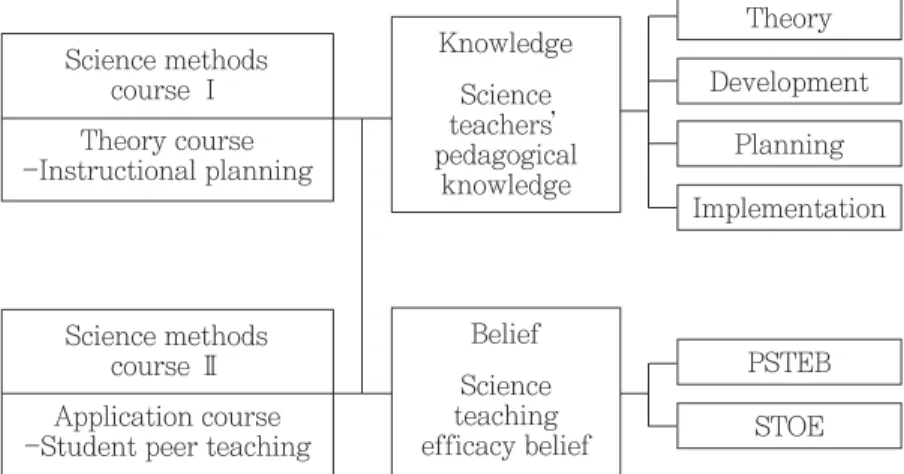
methods courses vary and different educators provide different syllabus. Smith and Gess- Newsome (2004) explored a sample of 50 elementary science methods course syllabi and qualitatively analyzed using the six teaching standards. They found that universal inclusion related to the standards did not exist. Many studies have further developed science methods courses and examined their effectiveness (e.g., Boone & Anderson, 1994; Ramaswany et al., 2001). Kim (2012) explored changes of preservice teachers’pedagogical knowledge and science teaching efficacy after the science methods course that provided students with opportunities of instructional planning based on teaching and learning theories. As shown in Figure 1, the current study added the teaching application course (named as science method course II) following the theory course (named as science methods course I) to Kim’ s (2012) study and examined preservice teachers’changes of both pedagogical knowledge and teaching efficacy.

*Corresponding author: Sun Young Kim ([email protected])

**Received on 25 July 2012, Accepted on 13 November 2012

***This work was supported by research funds from Chosun University, 2011.

(2)

Pedagogical knowledge and science teaching self-efficacy are predictors of future science teaching success of preservice teachers as well as fundamental indicators of how preservice science teachers develop reform-based science teaching agendas (Kim, 2012).

This study aimed to track changes of preservice science teachers’pedagogical knowledge and self-efficacy after sequentially developed science methods courses I and II over two consecutive semesters (Fig 1). Specifically, this study attempted to answer the following research questions: (1) How did preservice science teachers’pedagogical knowledge change over the duration of science methods course I and II? (2) How did preservice science teachers’

science teaching efficacy belief change throughout the science methods course I and II?

Ⅱ. THEORETICAL FRAMEWORK

Pedagogical knowledge

Teaching is a complex activity that requires many knowledge domains, such as subject matter knowledge, classroom management, students’preconceptions on specific content, teaching strategies, and so on. Pedagogical knowledge is defined by the knowledge of students, curriculum, planning instruction, and

evaluation (Jones & Vesilind, 1996). Morine- Dershimer and Kent (1999) identified pedagogical knowledge in relation to classroom organization and management, instructional models and strategies, and classroom communication and discourse. Carlsen (1999) identified general pedagogical knowledge as learners and learning, classroom management, general curriculum and instruction. Sulman (1986) proposed pedagogical content knowledge (PCK) defined as “the particular form of content knowledge that embodies the aspects of content most germane to its teachability”(p.9) by placing pedagogical knowledge into a context.

Many studies have made an effort to develop pedagogical knowledge in various ways. Some studies focused on the development of pedagogical content knowledge for a specific content area (e.g., van Driel et al, 2002). Hudson and Ginns (2007) examined the influence of a science pedagogy course (one semester duration) which includes lecture of constructivism, the social nature of learning, conceptual change, instructional designs and the workshops of the implementation of elementary science lessons.

The study result indicated that the course was effective in developing presevice elementary teachers’pedagogical knowledge.

Even though the role of preservice teacher education program has emphasized in science

Fig. 1 The schematic of current study Science methods

course Ⅰ Theory course -Instructional planning

Knowledge Science teachers’

pedagogical knowledge

Belief Science teaching efficacy belief

Theory Development

PSTEB STOE Planning Implementation

Science methods

course Ⅱ

Application course

-Student peer teaching

(3)

education, the literature review revealed that few studies have examined secondary preservice science teachers’growth of PK along with science teaching efficacy during their teacher education programs.

Science teaching efficacy

Teacher efficacy is an important factor in educational research (Lakshmanan et al., 2011).

Bandura (1997) defined perceived self-efficacy as

“belief in one’ s capabilities to organize and execute the courses of action required to produce given attainments” (p. 3). Similarly, teachers’self-efficacy refers to the beliefs of teachers that he or she has ability to bring about positive student change (Gibson & Dembo, 1984). Self-efficacy is comprised of two distinct constructs, efficacy expectations and outcome expectations (Bandura, 1977). In science teaching, efficacy expectation is defined as a teacher’ s belief regarding his or her own ability to teach science effectively, and outcome expectancy as a teacher’ s belief that student learning can be influenced by effective teaching (Enochos & Riggs, 1990; Ramey-Gassert &

Enochs, 1990, cited from Cannon & Scharmann, 1996).

Bandura (1997) suggested four strategies for developing self-efficacy: mastery experience, vicarious experience, social and verbal persuasion, and physical and emotional states.

The first strategy, mastery experience, describes that an increase in self-efficacy occurs when individuals master or achieve success at a certain task (Bandura, 1997). Mastery experience is the most powerful sources of information in the development of self-efficacy (Bandura, 1994). The second source, vicarious experience, is characterized that seeing people similar to oneself success by sustained effort increases observer’ s self-efficacy. Bandura (1994) argues that perceived similarity to the models strongly increases the impact of modeling on perceived self-efficacy. The third source, social persuasion

is described as positive reinforcement or expression of motivation and support increase of one’ s self-efficacy. The final source, somatic and emotional states mention that positive mood enhances perceived self-efficacy.

Science teaching efficacy beliefs are a consistent predictor of beginning teachers’

success or failure (Park, 2006; Scharmann &

Hampton, 1995). Likewise, Cantrell et al. (2003) maintain that a specific measure of science teaching efficacy beliefs may play a role as a predictor of future science teaching success of preservice teachers.

Ⅲ. METHODOLOGY

1. Participants and Description of Courses

A total of 42 preservice biology teachers (9 men, 33 women) with a mean age of 23 (ranging from 21-28) who were enrolled in a college of education participated in this study. They were all in a program for secondary biology science teachers and were in their third year of college.

All of the preservice teachers participated in this study were enrolled in the science methods course I and II over two consecutive semesters.

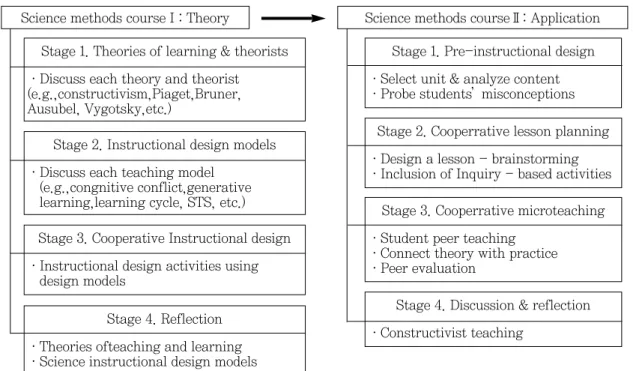
Students were enrolled in the science methods course I (theory course, three credit hours) during the autumn semester, and the science methods course II (application course, three credit hours) during the next calendar year of spring semester (Fig 2). The preservice teachers were mainly engaged in cooperative instructional design through science methods course I and in cooperative microteaching experiences through science methods course II. This study utilized cooperation as a pedagogical method since several studies have reported that science methods courses utilizing cooperative learning strategies that incorporate investigating and sharing ideas are beneficial for fostering effective science teaching (e.g., Cannon &

Scharmann, 1996; Watters & Ginns, 2000).

As shown in Figure 2, the science methods

(4)

course I is the theory course that aims for students to learn about theories of learning and science instructional design models, and to finally design lessons utilizing appropriate instructional models during one semester. The science methods course II is the application course that requires students to select a unit, design a lesson plan, do microteaching and reflect on their teaching with peers (Fig 2). The preservice teachers in this class participated as students or as teachers. That is, as teachers, two students grouped together and selected a unit for microteaching. They were asked to survey about students’misconceptions about the unit, design an inquiry-based lesson according to students’misconception on the unit, and had an experience of microteaching to their peers. As students, the preservice teachers usually work as a group to perform inquiry activities. After microteaching, the class discussed about content-specific concepts, teaching strategies, and appropriateness of activities adopted for a specific topic to improve their teaching in future.

Further, microteachings were videotaped so that

these students see their own teaching again and reflect on their teaching. Overall, students mainly had opportunities of cooperative instructional design through science methods course I and cooperative microteaching experiences through science methods course II.

Both courses utilized cooperation and reflection as a main teaching strategy to facilitate students’learning to teach science (Fig 2).

2. Data Collection and Data Analyses

Two instruments, pedagogical knowledge and science teaching efficacy belief instrument, were distributed before the science methods course I (pretest), right after the science methods course I (posttest I), as well as right after the science methods course II (posttest II).

Pedagogical Knowledge Instrument

This instrument developed by Hudson and Ginns (2007) was used to examine preservice teachers’ pedagogical knowledge. Four constructs were measured: (1) understanding the

Fig. 2 Main themes of science methods course I & II Stage 1. Theories of learning & theorists

·Discuss each theory and theorist (e.g.,constructivism,Piaget,Bruner, Ausubel, Vygotsky,etc.)

Stage 1. Pre-instructional design

·Select unit & analyze content

·Probe students’misconceptions Stage 2. Cooperrative lesson planning

·Design a lesson - brainstorming

·Inclusion of Inquiry - based activities

Stage 4. Discussion & reflection

·Constructivist teaching

Stage 3. Cooperrative microteaching

·Student peer teaching

·Connect theory with practice

·Peer evaluation Stage 2. Instructional design models

·Discuss each teaching model

(e.g.,congnitive conflict,generative learning,learning cycle, STS, etc.) Stage 3. Cooperative Instructional design

·Instructional design activities using design models

Stage 4. Reflection

·Theories ofteaching and learning

·Science instructional design models

Science methods courseⅠ: Theory Science methods courseⅡ: Application

(5)

theory for developing a science curriculum (construct: Theory); (2) understanding the development of students’concepts, abilities, skills, and attitudes (construct: Students’

Development); (3) understanding effective planning for science teaching and learning (construct: Planning); (4) implementing effective science teaching practices (construct:

Implementation). The Cronbach alpha values of four constructs, theory, students’development, planning and implementation, are respectively 0.76, 0.64, 0.64, and 0.83. The instrument is a five choice Likert-type scale with strongly disagree, disagree, uncertain, agree, and strongly agree as possible item responses. The descriptive statistics and the Repeated measures of ANOVA were implemented on each construct (Theory, Development, Planning, Implementation) to examine if there are changes in students’

scores of pedagogical knowledge after science methods course I and II.

Science Teaching Efficacy Belief Instrument (STEBI-B)

The Science Teaching Efficacy Belief Instrument developed by Enochs and Riggs (1990) was utilized to measure preservice teacher confidence in teaching science. The STEBI -B consists of two subscales, the 13-item Personal Science Teaching Efficacy Belief (PSTEB) Scale, which assesses the belief that one’ s own teaching ability can be developed, and the 10-item Science Teaching Outcome Expectancy (STOE) Scale, which assesses the belief that student learning can be influenced by effective teaching (Enochs &

Riggs, 1990). In this study, the Cronbach alpha

for Personal Science Teaching Efficacy Belief was .74 and Science Teaching Outcome Expectancy was .80. The descriptive statistics as well as the repeated measures of ANOVA were performed to investigate whether students change their scores of science teaching efficacy belief after science methods course I and II.

Ⅳ. RESULTS AND DISCUSSION

1. Pedagogical Knowledge

The pedagogical knowledge, consisting of four constructs, theory, development, planning, implementation, was measured before (pretest) and after the intervention (posttest I and posttest II). Table 1 and Figure 3 show the changes of scores of pedagogical knowledge after the science methods course I and II.

Table 1

Descriptive statistics of pedagogical knowledge

Theory(n=42) Development(n=42) Planning(n=42) Implementation(n=42)

M SD M SD M SD M SD

Pre 19.40 3.575 11.90 2.046 30.38 4.231 54.38 5.885

Post I 24.36 2.945 13.76 1.495 35.14 2.514 58.90 4.957

Post II 24.38 2.556 13.95 1.431 35.07 3.056 59.52 3.846

Fig. 3 The bar graph of the mean scores of the pretest, posttest I, and posttest II of pedagogical

knowledge

(6)

Theory for Developing Science Curriculum The construct ‘theory’includes seven indicators (e.g., articulate constructivist principles for teaching science; compare existing approaches for teaching science) that measure students’understanding of the theoretical underpinnings for developing science curriculum. The Repeated measures of ANOVA indicates that there is a significant effect of theory over time ( F[1, 41]=4300.917, p<.01)(Table 2). The pairwise comparison results (Table 3) indicate that the preservice teachers significantly increased the mean scores of

‘theory’construct in the posttest I compared to the pretest ( p<.01), while there is no change of the mean scores of the construct ‘theory’in the posttest II compared to the posttest I ( p>.05) .

The t-tests between the pretest and the posttest I, as well as between the posttest I and the posttest II were performed in order to examine which indicators’scores were improved after the science methods course I and II (Table 4). In the posttest I compared to the pretest, six indicators’scores among seven indicators significantly increased (p<.01) except the indicator ‘talking about science’ . Instructional planning activities required students to integrate the theories of science teaching and learning (Kemp et al., 1994), considering each indicator of theory, such as key components of science syllabus, a rationale for an effective science program, approaches for teaching science, and so on.

Notably, in the posttest II compared to the posttest I, students significantly increased their scores of the indicator ‘constructivist’as well as

‘talking about science’even though the total posttest II scores did not significantly increase.

Especially, the indicator ‘constructivist’scores significantly increased twice in both the posttest and the delayed posttest (Table 4). This result implicated that both science methods course I and II helped students gain insights of constructivism. The two courses provided in this study articulated the notion of constructivism through opportunities of collaboration and reflection. The instructor asked each group to brainstorm and reflect the aspects of

‘constructivist teaching approaches’in their lesson plans as well as in their microteaching.

After each microteaching, especially, the class discussion focused on better instructional strategies to become constructivist teaching.

Therefore, facilitating discussions and reflection on their lesson plans and microteaching helped these prospective science teachers understand the complexity of science teaching and gain insights of reform-based science teaching (Abell

& Bryan, 1997). Nilsson (2008) likewise emphasized the importance of team teaching for aiding preservice teachers to realize the complication of the classroom and careful reflection on their teaching.

Students’Development regarding to Concepts, Abilities, and Attitudes

The construct ‘development’measures understanding of concepts, abilities, skills, and attitudes, and consists of four indicators (e.g., discuss the development of students scientific reasoning abilities; discuss the development of students attitudes for learning secondary

Table 2

The Repeated-measures of ANOVA result of Theory Source Type III sum of

squares df Mean square F Sig.

Intercept 65008.286 1 65008.286 4300.917 .000**

Error

** p < .01

619.714 41 15.115

(7)

science; demonstrate an understanding of the development of students manipulative skills for investigating science; discuss the development of students science concepts). The mean scores of the construct ‘development’significantly changed over time (F[1,41]= 5280.220, p<.01) (Table 5). According to the Pairwise comparison results (Table 6), the preservice teachers significantly increased their scores of

‘development’in the posttest I compared to the pretest after science methods course I. However, the mean scores of posttest I and the mean

scores of posttest II were not significantly different, implicating that cooperative teaching experiences provided by the science methods course II did not help these teachers increase the mean scores of the construct ‘development’ . According to the Table 7, the mean scores of all the indicators of ‘development’(e.g., scientific reasoning, attitude, manipulative skills, science concepts) significantly increased after the science methods course I, while no significant increase after the science methods course II. The

‘scientific reasoning’indicator represented the Table 3

The Pairwise comparison result of Theory

Based on estimated marginal means

*The mean difference is significant at the .05 level a Adjustment for multiple comparisons: Bonferroni

*p < .05; **p < .01

(I) (J) Mean

Difference

(I-J) Std. Error Sig.

a

95% Confidence Interval for Difference

a

Lower

Bound Upper

Bound

Pre Post I - 4.952* .598 .000 -6.445 -3.460

Post II -4.976* .590 .000 -6.448 -3.504

Post I Pre 4.952* .598 .000 3.460 6.445

Post II -.024 .463 1.000 -1.179 1.132

Post II Pre 4.976* .590 .000 3.504 6.448

Post I .024 .463 1.000 -1.132 1.179

Table 4

The t-test results on the construct Theory

Indicator Pretest-Posttest I Posttest I-Posttest II

M SD t df p M SD t df p

Syllabus -.857 .872 -6.374 41 .000** .116 .731 1.044 42 .303

Rationale -.810 1.042 -5.037 41 .000** .256 1.049 1.600 42 .117

Theory -.905 .759 -7.725 41 .000** .140 .675 1.355 42 .183

Constructivist -.619 .962 -4.172 41 .000** -.419 .698 -3.932 42 .000**

Teaching Approaches -.786 .898 -5.670 41 .000** -.070 .799 -.573 42 .570

Viewpoints -.810 .943 -5.562 41 .000** .093 .781 .781 42 .439

Talking About Science -.167 .696 -1.553 41 .128 -.209 .638 -2.150 42 .037*

(8)

most score increase and ‘manipulative skills’

indicator next score increase in the posttest II.

Supovits and Turner (2000) pointed out the importance of inquiry, practice questioning, and experimentation. Within the science methods course I, inquiry activities adopted in each lesson plan apparently helped these preservice teachers develop understanding of scientific reasoning and manipulative skills. This study, on the other hand, revealed that microteaching experiences to peers through the science methods course II were not sufficient for these prospective teachers to further enhance their understanding of the development of students’scientific reasoning abilities, manipulative skills and attitudes. This study suggests that field experiences within real classrooms need to make inclusion of reflection on students’reasoning abilities, attitude toward

science, and development of manipulative skills.

Effective Planning for Science Teaching and Learning

The ‘planning’construct measures preservice teachers’understanding of effective planning for science teaching and learning, and consists of ten indicators (e.g., devise clear lesson structures; develop a scope and sequence for teaching secondary science; articulate the components of an effective secondary science program). The Repeated measures of ANOVA indicated that there was a statistically significant change of the mean scores of the construct ‘planning’among the pretest, posttest I, and posttest II ( F[1,41]= 9170.799, p<.01) (Table 8). The Pairwise comparison results (Table 9) represented that these preservice teachers

Table 5

The Repeated-measures of ANOVA result of Development

Table 6

The Pairwise comparison result of Development Source Type III sum of

squares df Mean square F Sig.

Intercept 21975.365 1 21975.365 5280.220 .000**

Error

**p < .01

Based on estimated marginal means

*The mean difference is significant at the .05 level a Adjustment for multiple comparisons: Bonferroni

170.635 41 4.162

(I) (J) Mean

Difference

(I-J) Std. Error Sig.

a

95% Confidence Interval for Difference

a

Lower

Bound Upper

Bound

Pre Post I -1.857* .357 .000 -2.748 -.967

Post II -2.048* .310 .000 -2.822 -1.273

Post I Pre 1.857* .357 .000 .967 2.748

Post II -.190 .290 1.000 -.914 .533

Post II Pre 2.048* .310 .000 1.273 2.822

Post I .190 .290 1.000 -.533 .914

(9)

significantly increased their scores of ‘planning’

construct after the science methods course I where students mainly experienced cooperative instructional design activities, while no statistical difference was found between the posttest I and posttest II, indicating that science methods course II did not dedicate to develop students’understanding of ‘planning’ . In the posttest I, all the indicators’scores except the indicator ‘integrate’significantly increased compared to the prettest. In the posttest II, on the other hand, the score of the indicator of

‘integrate’only significantly increased compared to the posttest I (Table 10).

Bellon et al. (1992) argued that planning is a cyclic process of preactive, active, and postactive. In this study, students had an opportunity of experiencing preactive and active stage. The science methods course I only provided the preservice teachers with the preactive stage of planning lessons along with science instructional models, reflecting the theories of science teaching and learning. In addition, the science methods course II provided

students with the active stage of implementing their lesson plan to peers. This study suggests that the inclusion of postactive stage that resolves problems of instructional planning and elaborates their plan help students further develop understanding of each indicator of planning (e.g., ‘devise clear lesson structures for teaching primary science’ , ‘develop a scope and sequence for teaching science’ , and ‘select appropriate activities and resources for teaching science’ ).

Implementing Science Teaching Practices

The construct ‘implementation’examines preservice teachers’understanding of implementing effective science teaching practices. In this construct, 16 indicators are included (e.g., provide a problem-based learning environment for teaching secondary science; implement appropriate secondary science teaching strategies). According to the Repeated measures of ANOVA results, a statistically significant difference was found among the pretest, posttest I, and posttest II (F[1,41]= 10074.356, p<.01) Table 7

The t-test results on the construct Development

Table 8

The Repeated-measures of ANOVA result of Planning

**p < .01

*p < .05; **p < .01

Indicator Pretest-Posttest I Posttest I-Posttest II

M SD t df p M SD t df p

Scientific Reasoning -.619 1.011 -3.968 41 .000** -.140 .774 -1.182 42 .244

Attitude -.357 1.008 -2.297 41 .027* -.140 .710 -1.289 42 .204

Manipulative Skills -.476 .890 -3.467 41 .001** .000 .787 .000 42 1.000 Science Concepts -.405 .885 -2.964 41 .005** .070 .704 .650 42 .519

Source Type III sum of

squares df Mean square F Sig.

Intercept 141671.627 1 141671.627 9170.799 .000**

Error 633.373 41 15.448

(10)

(Table 11). The pairwise comparison results (Table 12) revealed that the pretest scores and the posttest I scores were significantly different each other (p<.01), representing that students improved their scores of ‘implementation’after science methods course I. However, no score difference between the posttest I and the posttest II was found (p>.05), implicating that

these preservice teachers did not improve their understanding of implementation after science methods course II.

The t-test result (Table 13) indicated that in the posttest I, students significantly increased their scores on the nine indicators among sixteen compared to the pretest. On the other hand, the posttest II scores did not significantly change in

(I) (J)

Mean Difference

(I-J) Std. Error Sig.

a

95% Confidence Interval for Difference

a

Lower

Bound Upper

Bound

Pre Post I -4.762* .696 .000 -6.167 -3.357

Post II -4.690* .758 .000 -6.221 -3.160

Post I Pre 4.762* .696 .000 3.357 6.167

Post II .071 .485 .884 -.908 1.051

Post II Pre 4.690* .758 .000 3.160 6.221

Post I -.071 .485 .884 -1.051 .908

Indicator Pretest-Posttest I Posttest I-Posttest II

M SD t df p M SD t df p

Lesson Plans -.786 1.048 -4.857 41 .000** .070 .704 .650 42 .519 Scope and Sequence -.643 .850 -4.900 41 .000** .116 .793 .961 42 .342

Program -.738 .912 -5.244 41 .000** .116 .731 1.044 42 .303

Outcomes -.524 1.215 -2.795 41 .008** -.070 .828 -.553 42 .583

Affective Domain -.524 .833 -4.073 41 .000** -.070 .828 -.553 42 .583

Integrate -.143 .843 -1.098 41 .279 -.256 .693 -2.420 42 .020*

Independent Collaborate -.333 .874 -2.471 41 .018* .140 .743 1.232 42 .225 Appropriate Activity -.262 .665 -2.553 41 .014* .070 .552 .829 42 .412 Inclusivity -.357 1.078 -2.147 41 .038* -.093 .895 -.682 42 .499

Concept Map -.548 .705 -5.031 41 .000** .209 .888 1.546 42 .130

Table 9

The Pairwise comparison results of Planning

Based on estimated marginal means

*The mean difference is significant at the .05 level a Adjustment for multiple comparisons: Bonferroni

*p < .05; **p < .01 Table 10

The t-test results on the construct Planning

(11)

the all indicators of ‘implementation’(p>.05).

Notably, the scores of ‘appropriate secondary science teaching strategies’indicator most increased in the posttest I compared to the pretest. Even though students experienced cooperative microteaching in the science methods course II, no score improvement on the construct

‘implementation’in the posttest II compared to the posttest I (p>.05). This result implicated that microteaching experience was not sufficient to develop the notions of ‘implementation’ . The indicators, such as classroom management, learning environment, and questioning skills, should deal with real class settings. Student- teaching experiences targeting these indicators at school context will help these preservice teachers further develop the notion of ‘implementation’

(Weld & French, 2001).

2. Science Teaching Efficacy Belief

Along with pedagogical knowledge, perservice teachers’science teaching efficacy belief, consisting of PSTEB and STOE, was examined after the science methods course I and II. The preservice teachers’score changes of science teaching efficacy belief were demonstrated in the Table 14 and Figure 4.

Personal Science Teaching Efficacy Belief (PSTEB) Scale

The Repeated measures of ANOVA results indicated that preservice teachers significantly changed their PSTEB scores over time (F[1,41]=

6735.503, p<.01) (Table 15). The Pairwise comparison result indicates that there was no statistically significant change between the pre- PSTEB and post I-PSTEB scores (p>.05), while

Based on estimated marginal means

*The mean difference is significant at the .05 level a Adjustment for multiple comparisons: Bonferroni

Table 11

The Repeated-measures of ANOVA result of Implementation

**p < .01

(I) (J)

Mean Difference

(I-J) Std. Error Sig.

a

95% Confidence Interval for Difference

a

Lower

Bound Upper

Bound

Pre Post I -4.762* .696 .000 -6.167 -3.357

Post II -4.690* .758 .000 -6.221 -3.160

Post I Pre 4.762* .696 .000 3.357 6.167

Post II .071 .485 .884 -.908 1.051

Post II Pre 4.690* .758 .000 3.160 6.221

Post I -.071 .485 .884 -1.051 .908

Source Type III sum of

squares df Mean square F Sig.

Intercept 418083.841 1 418083.841 10074.356 .000**

Error 1701.492 41 41.500

Table 12

The Pairwise comparison results of Implementation

(12)

the statistically significant change was found between the post I-PSTEB and post II-PSTEB scores (p<.05), representing that students increased their PSTEB scores after science methods course II (Table 16).

Science Teaching Outcome Expectancy (STOE) Scale

According to the Table 17, the Repeated measures of ANOVA results represent that there is a statistically significant change of STOE scores over time ( F[1,42]= 4208.402, p<.01). The preservice teachers’post II-STOE scores significantly increased after the science method course II with cooperative microteaching experiences (p<.01) (Table 18). However, the Table 13

The t-test results on the construct Implementation

*p < .05; **p < .01

Indicator Pretest-Posttest I Posttest I-Posttest II

M SD t df p M SD t df p

Problem-Based Learning -.524 1.087 -3.122 41 .003** -.093 .718 -.850 42 .400 Strategies -.786 .842 -6.047 41 .000** -.093 .526 -1.159 42 .253 Classroom Management -.238 .932 -1.655 41 .105 -.163 .814 -1.311 42 .197 Learning Environment -.357 .821 -2.819 41 .007** -.023 .597 -.255 42 .800 Ethical Issues -.262 .701 -2.423 41 .020* .047 .486 .628 42 .533

Unit of work -.333 .846 -2.554 41 .014* .070 .737 .621 42 .538

Assessments -.286 .742 -2.496 41 .017* .093 .610 1.000 42 .323

Critical Reflection -.143 .566 -1.635 41 .110 -.116 .544 -1.402 42 .168 Questioning Skills -.405 .798 -3.287 41 .002** -.023 .707 -.216 42 .830

Evaluate -.405 .885 -2.964 41 .005** -.070 .669 -.684 42 .498

Teach in Other Cities -.095 .656 -.942 41 .352 .000 .655 .000 42 1.000 Hands-on Lessons -.214 .682 -2.036 41 .048* -.047 .785 -.388 42 .700 Content Knowledge -.143 .843 -1.098 41 .279 -.163 .871 -1.226 42 .227 Teaching Confidently -.167 .660 -1.638 41 .109 -.070 .704 -.650 42 .519 Positive Attitudes -.119 .670 -1.152 41 .256 -.023 .462 -.330 42 .743 Teach Other Countries -.048 1.011 -.305 41 .762 -.070 1.142 -.401 42 .691

Table 14

The descriptive statistics of PSTEB and STOE

PSTEB (n=42) STOE (n=42)

M SD M SD

Pre 44.93 4.338 34.86 3.475

Post I 46.12 4.014 34.86 3.440

Post II 47.73 3.225 37.33 4.040

(13)

science methods course I did not help these preserivce teachers increase the mean scores of STOE in the posttest I compared to the pretest (p>.05).

Overall, science teaching efficacy belief scores including both PSTEB and STOE measured by

STEBI-B were significantly increased after science method course II (mainly cooperative microteaching experiences), while no score differences were found before and after the science methods course I (where mainly occurs cooperative inquiry-based lesson plan activities along with science instructional models). These findings are consistent with studies that mastery experiences have the greatest impact on efficacy belief (Brand & Wilkins, 2007; Tschannen- Moran et al., 1998). In the science methods course II different from the science methods course I, students became a biology teacher and taught the class a specific biology topic assuming that their peers were students.

Bandura (1997) emphasized the importance of mastery experience in order to enhance science teaching efficacy. All of preservice teachers experienced the whole process of teaching, and Table 15

The Repeated-measures of ANOVA result of PSTEB Fig. 4 The bar graph of the mean scores of the pretest, posttest I, and the posttest II of PSTEB

and STOE

Source Type III sum of

squares df Mean square F Sig.

Intercept 265421.341 1 265421.341 6735.503 .000**

Error 1615.659 41 39.406

**p < .01 Table 16

The Pairwise comparison results of PSTEB

on estimated marginal means

*The mean difference is significant at the .05 level a Adjustment for multiple comparisons: Bonferroni

(I) (J)

Mean Difference

(I-J) Std. Error Sig.

a

95% Confidence Interval for Difference

a

Lower

Bound Upper

Bound

Pre Post I -4.762* .696 .000 -6.167 -3.357

Post II -4.690* .758 .000 -6.221 -3.160

Post I Pre 4.762* .696 .000 3.357 6.167

Post II .071 .485 .884 -.908 1.051

Post II Pre 4.690* .758 .000 3.160 6.221

Post I -.071 .485 .884 -1.051 .908

(14)

received reinforcement from the instructor and their peers. Therefore, these preservice teachers could reach some levels of mastery that result in significant increase of science teaching efficacy.

Along with mastery experience, students observed other groups’microteaching and thereby could be capable of self-percept that they master comparable activities, which were placed into vicarious experience (Bandura, 1997).

Especially, teaching experiences followed by reflection facilitate teachers’revisiting and reframing their teaching practices (Byran &

Abell, 1999) and thus increase these preservice teachers’science teaching self-efficacy.

V. CONCLUSION AND IMPLICATION

This study described the changes of preservice biology teachers’pedagogical knowledge and science teaching efficacy belief after two consecutive science methods courses. The science methods courses I is the theory course that incorporates learning educational theories and planning lessons along with science instructional models. The follow-up science methods course II is the application course where student peer teaching occurred.

Throughout the two courses, students learned how to plan and teach secondary science. This study revealed that the preservice teachers who completed two consecutive science methods courses significantly improved pedagogical knowledge as well as science teaching efficacy.

Both science methods courses facilitated Source Type III sum of

squares df Mean square F Sig.

Intercept 161402.860 1 161402.860 4208.402 .000**

Error 1610.806 42 38.353

**p < .01 Table 17

The Repeated-measures of ANOVA result of STOE

Table 18

The Pairwise comparison results of STOE

(I) (J)

Mean Difference

(I-J) Std. Error Sig.

a

95% Confidence Interval for Difference

a

Lower

Bound Upper

Bound

Pre Post I -.767 .918 .408 -2.620 1.085

Post II -3.209* .917 .001 -5.060 -1.358

Post I Pre .767 .918 .408 -1.085 2.620

Post II -2.442* .613 .000 -3.679 -1.205

Post II Pre 3.209* .917 .001 1.358 5.060

Post I 2.442* .613 .000 1.205 3.679

on estimated marginal means

*The mean difference is significant at the .05 level

a Adjustment for multiple comparisons: Bonferroni

(15)

students’active participation of cooperation and reflection on the processes of planning lessons and microteaching. Science methods courses utilizing cooperative learning strategies that incorporate investigating and sharing ideas are beneficial for enhancing science teaching efficacy belief and fostering effective science teaching. This study, likewise, implicated that cooperative lesson planning and cooperative teaching activities helped preservice teachers share their thought, extensively engaged in reflection in how to plan and teach science, and thereby increased pedagogical knowledge and self efficacy.

It is notable that the theory course dedicated to only improve pedagogical knowledge not science teaching efficacy belief, whereas the application course devoted to increase science teaching efficacy belief, not pedagogical knowledge. This study suggests that inclusion of connecting microteaching experiences with appropriate elements of pedagogical knowledge helps further growth of pedagogical knowledge as well as science teaching efficacy belief.

Gradual increase of both pedagogical knowledge and science teaching efficacy belief during the preservice teacher education dedicates to success of science education reform movement. Finally, the analyses and description of the ways about how these students’pedagogical knowledge and science teaching efficacy were evolved will provide tips for further program development such as a follow-up course of field experience to science teacher educators.

REFERENCES

Abell, S. J., & Bryan, L. A. (1997).

Reconceptualizing the elementary science methods course using a reflection orientation.

Journal of Science Teacher Education, 8(3), 153- 166.

Anderson, R. D. (1997). The science methods course in the context of the total teacher education experience. Journal of Science Teacher

Education, 8(4), 269-282.

Bandura, A. (1977). Self-efficacy: Toward a unifying theory of behavioral change.

Psychological Review, 84(2), 191-215.

Bandura, A. (1994). Self-efficacy. In V. S.

Ramachaudran (Ed.), Encyclopedia of human behavior (Vol. 4, pp.71-81). New York: Academic Press.

Bandura, A. (1997). Self-efficacy: The exercise of control. New York: Freeman.

Bellon, J. J., Bellon, E. C., & Blank, M. A.

(1992). Teaching from a research knowledge base: A development and renewal process. New York: Macmillan.

Boone, W. J., & Anderson, H. O. (1994).

Designing, evaluating and reacting to secondary science methods class. Journal of Science Teacher Education, 5(1), 15-22.

Brand, B. R., & Wilkins, J. L. M. (2007).

Using self-efficacy as a construct for evaluating science and mathematics methods courses.

Journal of Science Teacher Education, 18(2), 297-317.

Brunkhorst, H. K., Brunkhorst, B. J., Yager, R. E., Andrews, D. M., & Apple, M. A. (1993). The Salish consortium for the improvement of science teaching preparation and development.

Journal of Science Teacher Education, 4(2), 51- 53.

Bryan, L. A., & Abell, S. K. (1999).

Development of professional knowledge in learning to teach elementary science. Journal of Research in Science Teaching, 36(2), 121-139.

Cannon, J. R., & Scharmann, L. C. (1996).

Influence of a cooperative early field experience on preservice elementary teachers’science self- efficacy. Science Education, 80(4), 419-436.

Cantrell, P., Young, S., & Moore, A. (2003).

Factors affecting science teaching efficacy of preservice elementary teachers. Journal of Science Teacher Education, 14(3), 177-192.

Carlsen, W. S. (1999). Domains of teacher knowledge. In J. Gess-Newsome & N. C.

Lederman (Eds.), Examining pedagogical content

knowledge (pp. 133-144). Dordrecht: Kluwer.

(16)

Enochs, L. G., & Riggs, I. M. (1990). Further development of an elementary science teaching efficacy belief instrument: A preservice elementary scale. School Science & Mathematics, 90(8), 694-706.

Gibson, S., & Dembo, M. H. (1984). Teacher efficacy: A construct validation. Journal of Educational Psychology, 76(4), 569-582.

Hudson, P., & Ginns, I. (2007). Developing an instrument to examine preservice teachers’

pedagogical development. Journal of Science Teacher Education, 18(6), 885-899.

Jones, M. G., & Vesilind, E. M. (1996). Putting practice into theory: Changes in the organization of preservice teachers’pedagogical knowledge.

American Educational Research Journal, 33(1), 91-117.

Kemp, J. E., Morrison, G. R., & Ross, S. M.

(1994). Designing effective instruction. New York: Macmillan College Publishing Company.

Kim, S. Y. (2012). Changes of preservice biology teachers’pedagogical knowledge and science teaching efficacy belief through science pedagogy course. Journal of Korea

Association of Research in Science Education, 32(3), 467-476.

Morine-Dershimer, G., & Kent, T. (1999). The complex nature and sources of teachers’

pedagogical knowledge. In J. Gess-Newsome &

N. C. Lederman (Eds.), Examining pedagogical content knowledge (pp. 21-50). Dordrecht:

Kluwer.

Nilsson, P. (2008). Teaching for understanding:

The complex nature of pedagogical content knowledge in pre-service education.

International Journal of Science Education, 30(10), 1281-1299.

Park, S. H. (2006). Pedagogical content knowledge among science teachers based on teaching method, self-efficacy, and attitude on

science teaching. Journal of Korea Association of Research in Science Education, 26(1), 122-131.

Ramaswamy, S., Harris, I., & Tschirner, U.

(2001). Student peer teaching: An innovative approach to instruction in science and engineering education. Journal of Science Education and Technology, 10(2), 165-171.

Ramey-Gassert, L. & Enochs, L. (1990). Self- efficacy as a construct in science teaching improvement. Seminar presented at the Center for Science Education Seminar Series, Manhattan, KS.

Shulman, L. S. (1986). Those who understand:

Knowledge growth in teaching. Educational Researcher, 15(2), 4-14.

Smith, L. K., & Gess-Newsome, J. (2004).

Elementary science methods courses and the National Science Education Standards: Are we adequately preparing teachers? Journal of Science Teacher Education, 15(2), 91-110.

Supovitz, J. A., & Turner, H. M. (2000). The effects of professional development on science teaching practices and classroom culture.

Journal of Research in Science Teaching, 37(9), 963-980.

Van Driel, J. H., De Jong, O., & Verloop, N.

(2002). The development of preservice chemistry teachers’pedagogical content knowledge.

Science Education, 86(4), 572-590.

Watters, J. J., & Ginns, I. S. (2000).

Developing motivation to teach elementary science: Effect of collaborative and authentic learning practices in preservice education.

Journal of Science Teacher Education, 11(4), 310- 321.

Weld, J., & French, D. (2001). An undergraduate

science laboratory field experience for preservice

science teachers. Journal of Science Teacher

Education, 12(2), 133-142.

수치

Fig. 1  The schematic of current studyScience methods course ⅠTheory course-Instructional planningKnowledgeScience teachers’pedagogicalknowledgeBeliefScience teachingefficacy belief Theory DevelopmentPSTEBSTOEPlanning ImplementationScience methods course Ⅱ
Fig. 2  Main themes of science methods course I &amp; IIStage 1. Theories of learning &amp; theorists
Fig. 3  The bar graph of the mean scores of the pretest, posttest I, and posttest II of pedagogical

참조

관련 문서

In this study, using concept mapping of a variety of learning techniques in the area of science, especially biology, has a positive effect on learning

Situated learning in science education: socio‐scientific issues as contexts for practice?. What Major “Socio-Scientific Topics” Should the Science Curriculum

Keyword: HRD, the science policy, the educational policy, the Humanities, The Professional Graduate School for Education, the Presidential Committee for the

Physics, Biology, Chemistry, Geo-sciences, Space Science, Biochemistry, Biomedical, Biotechnology..

- Single crystals, Polycrystalline materials, Anisotropy, Noncrystalline solids?. Contents

announced that the Chatham Islands people (the Moriori) were now their slaves, and killed those who objected...

In BCC and HCP crystal structure, mechanical twinning occurs at low temperatures, and at high rates of loading (shock loading), conditions under which the slip

Adapted from Fig. Billmeyer, Jr., Textbook of Polymer Science, 3rd edition. Reprinted by permission of John Wiley &amp; Sons, Inc.).. Polymer