Journal of Internet Computing and Services(JICS) 2019. Apr.: 20(2): 21-27 21
Design and Implementation of Intelligent IP Switch with Packet FEC for Ensuring Reliability of ATSC 3.0 Broadcast Streams ☆
Song Yeon Lee1 Jong Ho Paik2* Hyun Seok Dan3
ABSTRACT
The terrestrial ATSC 3.0 broadcasting system, which is capable of converging broadcast and communication services, uses IP based technology for data transmission between broadcasting equipment. In addition, data transmission between broadcasting equipment uses IP-based technology like existing wired communication network, which has advantageous in terms of equipment construction and maintenance In case IP based data transmission technology is used, however, it may inevitably cause an error that a packet is lost during transmission depending on the network environments. In order to cope with a broadcasting accident caused by such a transmission error or a malfunction of a broadcasting apparatus, a broadcasting system is generally configured as a duplication, which can transmit a normal packet when various types of error may occur. By this reason, correction method of error packets and intelligent switching technology are essential. Therefore, in this paper, we propose a design and implementation of intelligent IP switch for Ensuring Reliability of ATSC 3.0 Broadcast Streams. The proposed intelligent IP consists of IP Stream Analysis Module, ALP Stream Analysis Module, STL Stream Analysis Module and SMPTE 2022-1 based FEC Encoding/Decoding Module.
☞ keyword : Intelligent IP Switch, ATSC 3.0 System, SMPTE 2022-1, IP Broadcasting System
1. Introduction
The terrestrial ATSC 3.0 broadcasting system is a next-generation broadcasting standard that efficiently combines IP-based communication techniques with features of broadcasting services which delivering high-quality data to a large number of users in real time to provide flexible service configuration and personalized services to viewers. By these reasons, the ATSC 3.0 broadcasting network should use IP based MMT (MPEG Media Transport) or ROUTE (Real Time Object Delivery over Unidirectional Transport) format in order to provide converged broadcasting services using the HTTP/TCP/IP protocol when transmitting the data through
1 Dept. of Computer, Seoul Women's University, Seoul, 01797, Korea.
2 Dept. of Software Convergence, Seoul Women's University, Seoul, 01797, Korea.
3 ATBIS Co., Ltd., Seoul, 08502, Korea.
* Corresponding author ([email protected])
[Received 31 December 2018, Reviewed 23 January 2019, Accepted 25 February 2019]
☆ A preliminary version of this paper was presented at APIC-IST 2018 and was selected as an outstanding paper.
☆ This work was supported by a special research grant from Seoul Women's University(2019).
network[1,2,3,4]. In case IP based data transmission technology is used, it may inevitably cause a packet loss during transmission depending on the network environment. In order to cope with a broadcasting accident caused by transmission error or a malfunction of a broadcasting apparatus, the Intelligent IP switch shall be required to accurately detect errors and switchover broadcast streams with recoverable IP packet when various types of errors occur.
In this paper, we propose a design and implementation method of an intelligent IP switch, which is suitable for broadcast stream and reliable in comparison with the simple IP Switch technology used in existing network environment.
The proposed Intelligent IP Switch consists of IP Stream Analysis Module, ALP Stream Analysis Module, STL Stream Analysis Module and SMPTE 2022-1 based FEC Encoding/Decoding Module. When the input stream is damaged, the seamless switching module performs a switching to a multiplexer that outputs a normal stream and can restore the stream transmitted through the gateway, thereby providing a normally restored stream output.
In this paper, related works concerned with the propsed intelligent IP switch for ATSC 3.0 broadcasting system are ISSN 1598-0170 (Print) / ISSN 2287-1136 (Online)
http://www.jics.or.kr Copyright ⓒ 2019 KSII
explained in Section 2. The design and implementaton method of intelligent IP switch with packet FEC is described in Section 3 and 4, respectively. To verifiy the validity of the propsoed intelligent IP switch, experimental conditions and results are suggested in Section 4. And finally this paper is concluded in Section 5.
2. Related Works
2.1 Characteristics of Terrestrial ATSC 3.0 Broadcasting System
ATSC 3.0 is a suite of voluntary technical Standards and Recommended Practices that is fundamentally different from predecessor ATSC systems. With higher capacity to deliver Ultra High-Definition services, robust reception on a wide range of devices, improved efficiency, IP transport, advanced emergency alerting, personalization features and interactive capability, the ATSC 3.0 Standard provides much more capability than previous generations of terrestrial broadcasting.
The ATSC 3.0 System is designed with a layered architecture due to the many advantages of such a system, particularly pertaining to upgradability and extensibility[5].
The ATSC 3.0 broadcasting system improves the frequency efficiency and stability of transmitting UHD broadcasting service which can be provided at any time, anywhere without changing the frequency, by changing the MFN (Multiple Frequency Network) transmission method applied to the ATSC 1.0 standard, which is a domestic broadcasting standard, to the single frequency network (SFN) transmission method. Fig. 1 shows the MFN structure of redundant ATSC 3.0 broadcasting system.
(Figure. 1) MFN Structure of redundant ATSC 3.0 broadcasting system
2.2 Layer Interfaces of ATSC 3.0 Broadcasting System
As the fisrt step of receiving ATSC 3.0 broadcasting signal, in general, a receiver should access to a low level signaling stream with pre-defined IP address and port number to receive Low Level Signaling (LLS) data. The receiver can obtain information for desired broadcasting signal through Service List Table (SLT) located in the received LLS data[5].
The ATSC 3.0 broadcasting system supports the interface between the IP layer and the physical layer through the ATSC Link-layer Protocol (ALP), which can support the convergence service of the broadcasting network and the communication network. It is required to process the STL (Studio to Transmitter Link) packet for stable transmission between the studio and the transmitter by receiving the ALP packet from the ATSC 3.0 gateway[6].
ALP is a protocol used in the link layer that serves as an interface for data transmission between the network layer and the physical layer, and ALP also provides data encapsulation, compression and signaling functions at the link layer. Fig. 2 shows the structure of ALP component and interface.
Through ALP, it is possible to encapsulate all types of packets mainly, ALP encapsulates IP packets, MPEG-2 TS packets, and link layer signaling packets. An encapsulated ALP packet enables a single processing on one packet format in the physical layer, regardless of the type of packet transmitted from the network layer. It also compresses the duplicated header information of the input data before proceeding encapsulation step for transmission efficiency.
(Figure. 2) Structure of ALP component and interface.
3. Design of Intelligent IP Switch with Packet FEC
A switch technology, which has been applied to ATSC 1.0 broadcasting system, is incompatible with ATSC 3.0 broadcasting system which supporting IP-based stream transmission against MPEG-2 TS-based technology. Since ATSC 3.0 introduces a single frequency network and uses an IP-based STL-TP transmission technology, an additional error correction function shall be required unlike the ATSC 1.0 broadcasting system [1].
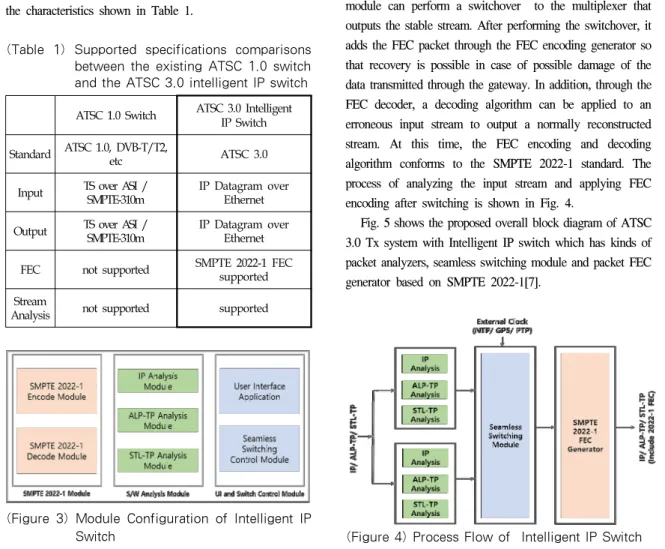
Table 1 shows the supported specifications comparisons between the existing ATSC 1.0 switch and the ATSC 3.0 intelligent IP switch designed in this paper. Fig. 3 shows the module configuration of the Intelligent IP Switch that reflects the characteristics shown in Table 1.
(Table 1) Supported specifications comparisons between the existing ATSC 1.0 switch and the ATSC 3.0 intelligent IP switch
ATSC 1.0 Switch ATSC 3.0 Intelligent IP Switch
Standard ATSC 1.0, DVB-T/T2,
etc ATSC 3.0
Input TS over ASI / SMPTE-310m
IP Datagram over Ethernet
Output TS over ASI / SMPTE-310m
IP Datagram over Ethernet
FEC not supported SMPTE 2022-1 FEC supported Stream
Analysis not supported supported
(Figure 3) Module Configuration of Intelligent IP Switch
In using Intelligent IP switch, the ALP (ATSC 3.0 Link-Layer Protocol) stream analysis module and the STL (Studio-to-Transmitter Link) stream analysis module are required to detect an error of a packet stream incoming through the network.
The IP stream analysis module can analyze and verify the SLT (Service List Table) data and the system time data, which are bootstrap information for describing information on the signaling transmission protocol. The ALP stream analysis module can analyze the ALP-TP, ALP packet, and IP packet.
The STL stream analysis module can analyze the preamble data, time management data, and baseband packet data. It is confirmed through the respective analysis modules that the stream input is normally performed.
If the input stream is corrupted, the seamless switching module can perform a switchover to the multiplexer that outputs the stable stream. After performing the switchover, it adds the FEC packet through the FEC encoding generator so that recovery is possible in case of possible damage of the data transmitted through the gateway. In addition, through the FEC decoder, a decoding algorithm can be applied to an erroneous input stream to output a normally reconstructed stream. At this time, the FEC encoding and decoding algorithm conforms to the SMPTE 2022-1 standard. The process of analyzing the input stream and applying FEC encoding after switching is shown in Fig. 4.
Fig. 5 shows the proposed overall block diagram of ATSC 3.0 Tx system with Intelligent IP switch which has kinds of packet analyzers, seamless switching module and packet FEC generator based on SMPTE 2022-1[7].
(Figure 4) Process Flow of Intelligent IP Switch
(Figure 5) Overall Block Diagram of ATSC 3.0 Tx System with Intelligent IP Switch
4. Implementation of Intelligent IP Switch with Packet FEC
SMPTE 2022-1 scheme has the advantage of burst error correction capacity in comparison with RFC2733[2]. For recovering the lost packet this standard operates XOR which has the ability to recover any one lost packet. Moreover, for the case of more than one packet has lost, two dimensional scheme can be used. Since two or more lost packets cannot be recovered with one dimensional scheme. Example of dual FEC mode structure is shown in Fig. 6 as below.
(Figure 6) Example of Dual FEC Mode Structure
To form two dimensional scheme, this standard designate L for the number of columns and D for the number of rows.
The flow of FEC Encoding algorithm is shown in Fig. 7.
First, depending on the conditions set by the user, generate a matrix structed by Row(L) and Column(D). Next,
after the data which will be sent is sorted in the form of FIFO, it has to be inserted in the FEC Matrix which is generated in the previous step. If FEC Matrix row field is filled completely, FEC encoder creates Row FEC Data by operating XOR . And the column FEC data also generated in the same way. In FEC data generating step, the additional FEC Header and the RTP Header of original stream has to be inserted before the FEC payload. These procedures should be performed before the data stream is emitted to the STL transmitter.
(Figure 7) Flowchart of FEC Encoding Procedure
Since the proposed FEC encoding algorithm applied two dimensional scheme, the first FEC stream has to be sent to port that is 2 greater than destination UDP number and the second FEC stream has to be sent to port that is 4 greater.
Before the data emitted to transmitter, it has to be decoded after transmitted through gateway in order to verify the integrity of the encoded data stream. The decoding algorithm’s flow shows in Fig. 8. Each Row(L) and Column(D) FEC data is received from the UDP port number which is 2 and 4 greater than input stream’s UDP port number. After receiving FEC data, by analyzing FEC Header extract Row(L) and Column(D) FEC data.
(Figure 8) Flowchart of FEC Decoding Procedure
With these extracted data, generate the appropriate structure of matrix and insert original stream and FEC data to it. If the matrix has loss data decode the FEC data and recover RTP Header with FEC Header. Next, by operating XOR of FEC payload data, recover the RTP payload of original stream and be emitted the recovered data to stream analyzer.
As described in Section 2 above, the ALP / IP packet can be extracted from the ATSC 3.0 STL-TP stream. The extracted main parameters are Preamble and Time &
Management. In addition, the validity of L1 signal can be analyzed through data analysis and also BBP (Base-Band Packet) can be extracted, whose the validity is analyzed. Fig.
9 shows UI screen shot of packet analyzer of the proposed intelligent IP switch.
(Figure. 9) UI Screen Shot of Packet Analyzer
To measure the delay time and the switching time, the network switch was installed to analyze the signal output from the DUT and the signal output from the gateway as shown in Fig. 10(a). The delay time test was proceed as follows. The signal generator make an event packet every 200 ms with the original video. The gateway could receive the original video and event packet from the transmission signal generator and outputs the same two videos. The one was transmitted to the DUT and the other was transmitted to the network switch at the same time. The DUT could receive the video from the Gateway and then transmit the one to the RF Out Exciter and the other to the Network Switch. The network switch could receive each video from the gateway and the DUT, respectively. And then two video could be sent to the packet analyzer which can compare the differences of arrival time of the two video packets.
(a) (b)
(Figure. 10) (a) Experimental Configuration and (b) Main UI of the Proposed Intelligent IP Switch
For the switching time test, an event packet at the moment the DUT changes the image source from Primary to Secondary could be generated. The switching time could be measured by adding the time of arrival of the first packet to Secondary after the occurrence of the corresponding event.
The delay average time and the switching average time were measured at 1.37ms and 823.8ms, respectively, by repeating 10 times under the conditions described above.
The main UI supporting the user condition setting of the proposed Intelligent IP Switch is shown in Fig. 10(b). As shown in Fig. 10(b), the switch condition can be set on the main UI screen and the status of input stream and output stream can be monitored as well.
5. Conclusions
In this paper, we proposed the design and implementation method of an intelligent IP switch, which is suitable for broadcast stream and reliable in comparison with the simple IP Switch technology used in existing network environment.
The proposed Intelligent IP Switch consists of IP Stream Analysis Module, ALP Stream Analysis Module, STL Stream Analysis Module and SMPTE 2022-1 based FEC Encoding/Decoding Module. When the input stream is damaged, the seamless switching module performs a switching to a multiplexer that outputs a normal stream and can restore the stream transmitted through the gateway, thereby providing a normally restored stream output.
The proposed intelligent IP switch is expected to be applicable to the areas that require redundancy between broadcasting
systems and transmission signal duplication as well.
Reference service
[1] HyeonGu Yang, YoungSeon Ryu, YoungKwon Lim and SeongHui Hwang, "A service and transmission technology of Advanced Americas Broadcasting Standards, ATSC 3.0," Broadcasting and Media Magazine, Vol. 20, No. 4, pp. 46~57, 2015. http://www.kibme.org/
[2] MinSeong Gwak, “Introduction of ATSC 3.0 based ROUTE/DASH for UHDTV and IP Hybrid broadcasting service.”, The Journal of The Korean Institute of Communication Sciences, Vol. 33, No. 7, pp. 25~31, 2016. http://www.kibme.org/
[3] Yejin Sohn, Minju Cho, Minjae Seo, Jongho Paik. A Synchronization Scheme for Hierarchical Video Streams over Heterogeneous Networks. KSII Transactions on Internet and Information Systems(TIIS), 9(8), 3121-3135, 2015. http://dx.doi.org/10.3837/tiis.2015.08.022 [4] MinKyu Park and Yong Han Kim, 2016, "An Overhead
Comparison of MMT and MPEG-2 TS in Broadcast Services," JOURNAL OF BROADCAST ENGINEERING, Vol. 21, No. 3, pp. 436~449.
https://doi.org/10.5909/JBE.2016.21.3.436
[5] Jeonho Kang, Dongjin Kang and Kyuheon Kim, "Method of DASH segments into a MMTP stream for switching contents under a hybrid broadcasting environment," KSII Transactions on Internet and Information Systems, vol.
11, no. 12, pp. 5981-5997, 2017.
https://doi.org/10.3837/tiis.2017.12.016
◐ 저 자 소 개 ◑
이 송 연(Song Yeon Lee)
2017년 서울여자대학교 멀티미디어학과(공학사) 2019년 서울여자대학교 일반대학원 컴퓨터학과(공학석사) 2019년~현재 서울여자대학교 대학원 컴퓨터학과 박사과정
관심분야 : 차세대 방송통신 시스템, 차세대 영상시스템, IoT/IoMT, etc.
E-mail : [email protected]
백 종 호(Jong Ho Paik) 1994년 중앙대학교 전기공학과(공학사) 1997년 중앙대학교 대학원 전기공학과(공학석사)
1997년~2011년 전자부품연구원 모바일단말연구센터 센터장 2007년 중앙대학교 대학원 전자전기공학부(공학박사) 2011년~현재 서울여자대학교 소프트웨어융합학과 부교수
관심분야 : 차세대 방송통신시스템, 차세대 영상시스템, IoT/IoMT, etc.
E-mail : [email protected]
단 현 석(Hyun Suk Dan) 2005년 동국대학교 컴퓨터공학과(공학사) 2015년~현재 (주)ATBIS 연구소장
관심분야 : 디지털방송, 멀티미디어 통신, 방송 통신 융합, Hybrid 방송 서비스, etc.
E-mail : [email protected]
[6] “ATSC Standard: Link-Layer Protocol (A/330)", ATSC, 2016. https://www.atsc.org/
[7] ST 2022-1:2007, “Forward Error Correction for Real-Time Video/Audio Transport Over IP Networks”, 2007.
https://www.smpte.org/