pISSN 1598-2033 eISSN 2233-5706 J. Korea Inst. Build. Const., Vol. 15, No. 6
http://dx.doi.org/10.5345/JKIBC.2015.15.6.641
www.jkibc.org
Causes of Schedule Delays in Building Construction Projects in Vanuatu
Kim, Dae Young
1*Chi, Seokho
21)Department of Architectural Engineering, Dong-Eui University, Jin-Gu, Busan, 176, Korea
1Department of Civil and Environmental Engineering, Seoul National University, Gwanak-Gu, Seoul,
151-144, Korea
2Abstract
With its recent tourism boom, Vanuatu, a small country in the South Pacific, is experiencing an increasing demand for construction. However, it has been struggling with persistent schedule delays in their construction projects due to a variety of reasons. In an attempt to respond to this situation, this paper aims to identify the major causes of schedule delays in building construction in Pacific island countries, with a focus on Vanuatu. To collect data on the factors affecting schedule delays, face-to-face interviews were conducted. Based on these, seven major causes of schedule delays, as selected by the majority of the participants, were identified and discussed to provide perceptive insights for future improvement opportunities. This paper attempts to help contractors with limited resources better understand the major causes of schedule delay in Vanuatu and achieve better performance in building projects.
Keywords : schedule delays, small building projects, schedule performance, republic of vanuatu
1. Introduction
A schedule delay is one of the most common and recurring problems in construction projects[1,2].
Although schedule delays vary considerably from project to project, the delays are more common and severe in developing counties due to their limited resources and lack of project management skills[3,4,5,6].
Significantly, many construction projects in developing countries are performed by small, local construction companies that rely more on workers’ skills rather than project management, causing a higher risk of project delay. As such, it is important to understand the critical risk factors causing project delays, and seek improvement opportunities for the construction
Received : May 7, 2014
Revision received : June 26, 2014 Accepted : October 28, 2015
* Corresponding author: Kim, Dae Young
[Tel: 82-51-890-2817, E-mail: [email protected]]
ⓒ2015 The Korea Institute of Building Construction, All rights reserved.
industry in developing countries[7,8,9].
The Republic of Vanuatu is a small developing country in the South Pacific, roughly 1,750 kilometres east of Australia and 800 kilometers west of the Fiji Islands.
Its 83 islands cover an area of 12,190 sq. kilometers.
Port Vila is the largest city in Vanuatu, with a population of just over 44,000. The recent growth of tourism has created a need for traveler-related buildings and infrastructures that directly affect the competitiveness of Vanuatu’s tourist attractions in the international marketplace. This building boom has increased the demand for suppliers, contractors, services, and other construction-related supports.
However, this small country has regional
characteristics typical of other South Pacific islands,
and limited transportation infrastructure and resources
for construction environments. As a result, schedule
delays have frequently occurred and hampered project
success in building construction. Therefore, the
objectives of this study were (1) to identify specific
factors that contribute to schedule delays in Vanuatu’s
construction projects; (2) to determine the major causes of delays in Vanuatu that may be characteristic of South Pacific countries by assessing these factors based on the opinions of three different groups (owners, contractors, and consultants) and comparing them with the factors identified from other developing countries;
and (3) to suggest potential strategies to mitigate the major causes in schedule delays. The findings of the paper could help contractors with limited resources to better understand the major causes of schedule delay in Vanuatu and achieve better performance in building projects.
2. Previous studies
According to a study conducted by Ogunlana et al.[10], most schedule delays in developing economies arise from a combination of three factors: (1) inadequacies in industry infrastructure, (2) problems caused by clients and consultants, and (3) incompetence of contractors. Many other studies have also recognized these schedule problems and highlighted specific causes of schedule delays that are more critical in various developing countries, particularly in Africa, the Middle East, and Asia. This section will discuss such delay factors country by country.
2.1 Causes of schedule delays in african countries Mansfield et al.[11] identified the seven most significant factors responsible for schedule delays in Nigerian construction projects from a survey of 37 selected owners, contractors, and public clients. These seven factors included poor contract management, financing and payment of completed works, changes in site conditions, shortages of materials, the need to import materials and plant items, design changes, and subcontractors and nominated suppliers. Similarly, Apolot et al.[12] explored schedule delays in Uganda’s public sector projects, attributing delay to scope change, delayed payments, poor monitoring and
control, high cost of capital, and political instability.
Kaliba et al.[13] surveyed the causes of schedule delays in Zambia’s road construction projects. The survey revealed that the most important factors are delays in payment, financial process, financial difficulties, contract modification, economic problems, material procurement, and changes in drawings. As well, Frimpong et al.[14] conducted a study to identify and evaluate the significant factors contributing to schedule delays in Ghana’s groundwater projects. Their study indicated that delays occur primarily due to monthly payment difficulties, poor contract management, material procurement problems, inflation, and contractors’ financial difficulties. Lastly, Fugar and Agyakwah-Baah[15] focused on Ghana’s building projects and attributed the delays to underestimation of project cost and complexity, payment delay, difficulty in accessing bank credit, and poor supervision.
2.2 Causes of schedule delays in middle eastern countries
Several other studies have also examined construction projects in Middle Eastern countries.
Faridi and El-Sayegh[16] analyzed the causes of delays
in the United Arab Emirates (UAE) construction
industry. They identified the top 10 most significant
causes of construction delays, including slow approval
of drawings, inadequate early planning, slowness of
the owners’ decision-making process, and shortage of
manpower. To compare these to other Middle Eastern
countries such as the Kingdom of Saudi Arabia (KSA)
and Lebanon, they also conducted a comparative study
and concluded that the causes of delays for the UAE
construction industry differ significantly from the
causes of delays for Saudi Arabia and Lebanon. In
addition, a study of schedule delays was conducted that
focused on Libyan construction projects[17], which
noted improper planning, lack of effective
communication, design errors, shortage of supply, slow
decision making, and financial issues. A more extensive
No. Delays Factors
African Countries Middle Eastern Countries Asian Countries
Nigeria Uganda Zambia Ghana Ghana KSA KSA Kuwait UAE Libya Egypt Thailand Malaysia Malaysia Indonesia Vietnam
1 Approval of drawings v v v
2 Poordesign v v v
3 Change orders v v v v v v v
4 Delayed payments by contractor v v v v v v
5 Delayed payments by owner v v v v v v
6 Financial constraints v v v v v v v v v v
7 Poor contract management v v v v
8 Improper planning v v v v v v
9 Lackofowner'sexperience v
10 Lack of contractor's experience v v
11 Slow decision-making process v v v v v
12 Lack of effective communication v
13 Problems with subcontractors v v v
14 Poor site management v v v v v v
15 Poorsiteconditions v v
16 High cost of capital v
17 Excessive bureaucracy v v
18 Inflation v
19 Political instability v
20 Shortage of equipment v
21 Poor productivity v v
22 Slow delivery of materials v v v v v v
23 Shortage of materials v v v v v v
24 Shortage of skilled labor v v v
Table 1. Summary of causes of delays identifiedin previous studies
study was also carried out by Al-Khalil and Al-Ghafly[3] to assess 60 causes of delays in public utility projects in KSA using a questionnaire to survey three groups, including contractors, consultants, and owners. They found that the most significant factors underlying delays were cash flow problems, contractors’ financial difficulties, difficulties in obtaining permits, and the requirement of selecting the lowest bidder without regard to qualifications.
In addition, Koushki et al.[18] investigated the main
reasons for schedule delay in Kuwait’s private
residential projects with a large number of survey
participants (n=450). In their study, they highlighted
three main causes of schedule delays, including changed
orders, financial constraints, and the owner’s lack of
experience. To overcome those delays in private
residential projects, their recommendations included
maintaining adequate funds throughout, ensuring
sufficient time and money at the design phase, and hiring competent consultants and contractors to complete the work. Other studies of construction schedule delays were found for KSA, and Egypt. Some of the main factors creating schedule delays in these countries included design change, financial constraints, lack of payment by owner, slow delivery of material, weather, and site conditions[7,19].
2.3 Causes of schedule delays in asian countries Sambasivan and Soon[5] conducted a study on construction delays in Malaysia’s construction industry and identified the 10 most important causes. Some of the factors highlighted included improper planning by the contractor, poor site management, inadequate contractor experience, inadequate client’s finance and payments, and problems with subcontractors. For Vietnam’s large construction projects, Le-Hoai et al.[4]
addressed similar key issues, which included poor site management and supervision, poor project management assistance, financial difficulties of owner and contractor, and design changes. Moreover, Ahsan and Gunawan[2]
emphasized that international development projects faced delays primarily because of the lengthy contract and procurement periods, civil works and land acquisition, consultant recruitment, natural calamities, and government procedures.
In contrast, Long et al.[20]’s investigation of delays in Thailand revealed that the three main causes are material procurement problems, excessive delays in receiving information, and poor contractor management.
Alaghbari et al.[2] carried out a questionnaire survey on Malaysia building construction projects. The major factors they listed in schedule delays included financial difficulties, delayed supervision and decision-making process, and lack of materials. Similarly, Kaming et al.[21] also made an effort to investigate the causes of schedule delays in Indonesian building projects, attributing them primarily to design change, poor labor productivity, and inadequate planning.
2.4 Literature review summary and need for the study The literature review investigated numerous causes of schedule delays in different projects and countries.
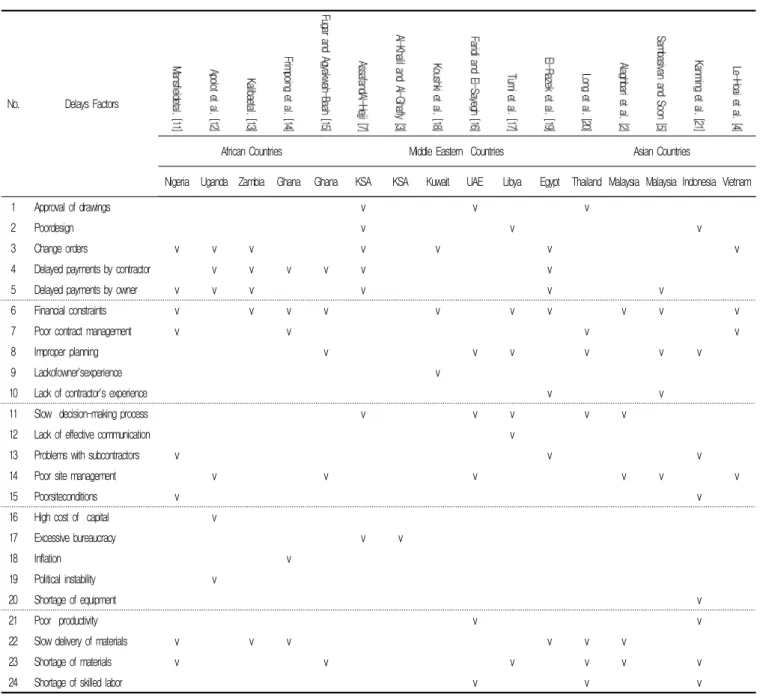
Based on the previous studies, the authors assessed the major causes of construction delays that commonly occurred in developing countries. Table 1 summarizes the major causes of delays in various developing countries. However, these studies focused mainly on public infrastructure projects or medium to large size building projects, but do not address small construction projects in the least developed countries like the Republic of Vanuatu[18]. In recent years, the construction industry in Vanuatu (particularly in Port Vila, the capital of Vanuatu) has seen relatively rapid growth with the influx of tourism. Like other developing countries, however, building construction in Vanuatu faces many challenges, one of which is schedule delays.
The literature review identified that there is currently a distinct lack of studies that have investigated delay factors in South Pacific Island countries in general, and in the Republic of Vanuatu in particular. The study presented in this paper focuses on schedule delay in small building construction. Its findings can enable building professionals to better understand major causes of schedule delays in Vanuatu’s small building construction. By extension, they will also help small-sized building contractors with limited resources to take appropriate steps to avoid delays and ultimately achieve better schedule performance.
3. Research methods
Face-to-face interviews were conducted to identify the major causes of delay in Vanuatu’s small building projects, and to investigate Vanuatu’s similarities and differences compared to other developing countries summarized in Table 1. An interview questionnaire was developed based on the findings of the literature review.
The questionnaire was composed of two main sections.
Section A of the questionnaire covered schedule delay
Issues No. Schedule Delay Factors
Response
Issues No. Schedule Delay Factors
Response
RII Rank RII Rank
1 Bad weather 0.54 6 39 Common ownership 0.67 1
2 Water and electricity Services 0.25 29 40 Low productivity 0.63 2
3 Poor safety 0.25 29 41 Skilled Labour shortage 0.5 7
4 Local regulation/public holidays 0.21 34 42 Loss of knowledge & skilled workers 0.33 21
5 Lack of storage facility 0.21 34 43 Low discipline 0.29 23
6 Mistakes/rework/additional work 0.08 57 44 Overworking Labour 0.25 29
7 Poor access 0.04 64 45 Transportation of labor to and from work 0.21 34
8 Equipment shortage 0.42 9 46 Community Involvement 0.13 52
9 Equipment damage/repair 0.42 9 47 Material shortage 0.63 2
10 Insufficient equipment/stock 0.42 9 48 Slow delivery of material 0.58 5
11 Slow delivery of equipment 0.38 17 49 Material change 0.46 8
12 Unskilled operator 0.29 23 50 Poor quality of material 0.42 9
13 Equipment out dated 0.25 29 51 Material damage 0.38 17
14 Low quality of equipment 0.13 52 52 Site material management 0.17 47
15 slow Engineering checks 0.38 17 53 Inflation 0.17 47
16 Owner interference 0.25 29 54 Design changes before construction 0.42 9
17 Insufficient experience 0.21 34 55 Design changes during construction 0.42 9
18 Slow contractor payment 0.21 34 56 Design errors (Poor visibility studies) 0.42 9
19 Improper work planning 0.21 34 57 Poor communication contractor-owner 0.38 17
20 Poor work quality 0.21 34 58 Poor communication contract org. 0.21 34
21 Poor supervision 0.21 34 59 delivery of information 0.21 34
22 Government taxes 0.21 34 60 Approval by authorities 0.13 52
23 Inappropriate work method 0.17 47 61 Scope changes before construction 0.08 57
24 Conflict of labour & management 0.17 47 62 Scope changes during construction 0.08 57
25 Telecom breakdown 0.13 52 63 Design conflict by consulting firms 0.04 64
26 Poor site layout 0.04 64 64 Lack of office equipment 0.04 64
27 Change of construction management 0.04 64 65 Land Processes 0.63 2
28 Untimely responding to queries 0.04 64 66 Land Disputes 0.42 9
29 SlowProcessesofcontractspayments 0.33 21 67 Authorisation by Authorities 0.29 23
30 Process of loans and additional loans 0.29 23 68 Family Disputes (owners) 0.29 23
31 Cash flow of GC conflict with owner 0.29 23 69 Political effects 0.21 34
32 Process of claims 0.21 34 70 Environmental processes 0.17 47
33 Government funding processes 0.08 57 71 Religious Effect 0.13 52
34 Insurance 0.04 64 72 Accidents 0.08 57
35 Companybankrupt 0.04 64 73 Economic effects 0.08 57
36 Tender process 0.04 64 74 Corruption 0.08 57
37 Aid funding factors 0.04 64 75 Civil Commotions 0.04 64
38 Misappropriation of funds 0.04 64 76 Procurer effects (inaccurate cost estimates) 0.04 64
Table 2. List of factors affecting schedule delays in Vanuatu
issues in small building construction, which were grouped into eight categories: (1) labor, (2) equipment, (3) information, (4) material, (5) site characteristics, (6) managerial, (7) financial, and (8) other issues.
Section B included open-ended questions about
potential strategies for preventing schedule delay to elicit the interviewees’ observations and experience regarding local schedule performance.
A total of 24 professionals in Vanuatu’s capital, Port
Vila ― where most of the construction projects in
Vanuatu are concentrated ― participated in the interviews. The participants, who are actively involved in the construction industry with a minimum experience of 5 years, consisted of 7 owners, 8 contractors, and 9 consultants. Based on the interview questionnaire, the interviewees were asked to offer their opinions on a variety of factors in the given categories affecting the schedule delays of small building construction projects in Vanuatu. Then, the interviewees were also asked to provide any perceptive insights they could regarding opportunities for mitigating schedule delays.
The interview responses were collected and analyzed for comparison with the findings from the literature review.
4. Data analysis and discussion of results
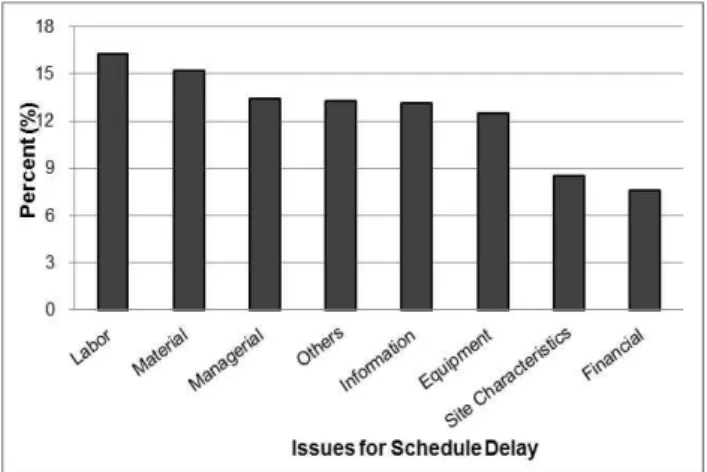
The responses to the interviews identified 76 delay factors. These factors were broken down into 8 issues based on the literature review and expert opinions. As in many other countries, the labor issue (16.3%) was the most critical concern in Vanuatu’s construction projects, followed by material issues at 15.2%.
Construction equipment, information, and management issues were also considered to contribute to schedule delays, at 12.5%, 13.1%, and 13.4%, respectively. Site characteristics amounted to just 8.5% of the total, with financial issues another 7.6%. The other 13.3%
consisted of land processes and political issues. Figure 1 illustrates these findings.
The ranking of the relative importance of the factors that lead to schedule delays was determined by the percentage value of the responses. Moreover, if a factor was selected by the majority of the participants as a significant cause of schedule delay, that factor was classified and considered a major cause. These major causes, which represent the more common and critical factors in construction schedule delay, were further used and discussed for future improvement opportunities.
Table 2 summarizes the percentages given to the different delay factors and their corresponding rankings.
Figure 1. Major issues for schedule delays in building projects
5. Major causes of schedule delay and potential strategies for schedule success.
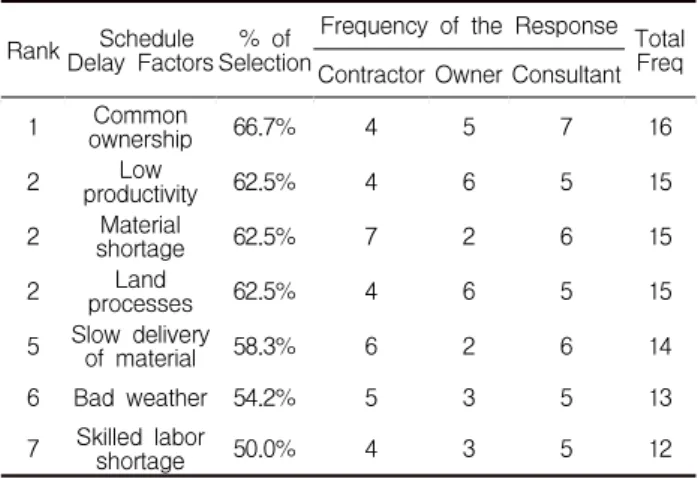
Based on the results from the interviews, seven major causes of schedule delay affecting small building construction projects in Vanuatu were identified. Table 3 shows the major causes that frequently lead to schedule delay in building construction in Vanuatu.
Common ownership was found to be the most common cause of schedule delay at 67% of responses, followed by land processes, material shortage, and low productivity at 63%. Slow delivery of material was ranked fifth at 58%, while bad weather was ranked as the sixth major cause of schedule delays at 54%. Skilled labor shortage was the least among them, identified in 50% of the responses.
In addition, the interviewees also provided several
suggestions for mitigating the risks that arise from
the schedule delay factors. Table 4 summarizes
potential strategies for reducing the risks of schedule
delays. The findings from the results of the interviews
are discussed below.
Rank Factors Risks Possible Solutions
1 Common ownership
•Massabsenteeism
•Frequentleaves
•Hirelessworkersfromthesameisland
•Hirenotmorethanoneworkerofafamilyorclan
•Understandandsupportforthefeelingsoftheworkers
2 Low productivity •Lossofmotivation
•Poormotivation
•Closemonitoring
•Improvelaborconditions
•Encourageandmotivateworkers 2 Material shortage • lack of natural construction resources •Orderinadvance
•Sparematerialsinstock
2 Land processes •Slowprocessofapplication
•Localpoliticsandgovernmentalandenvironmentalissues
•Prepareapplicationsinadvance
5 Slow delivery of material
•Geographicalcharacteristics
•Poortransportationinfrastructure
•Fewlogisticcompanies
•Orderinadvance
6 Bad weather •Variousnaturalhazards
•Longrainyseason
•Makeallowanceinscheduleandcostestimates
•Usenon-workingdaystomakeuplostdays
•ForceMajeureclause
7 Skilled labour shortage •Lackofmanagerialskills
•Lackofadvancedtechnicaltradeskills
•Jobsitetraining
•Vocationalschool
•Industrialattachments
Table 4. Potential strategies for reducing risks for schedule delays
Rank ScheduleDelay Factors % of
SelectionFrequency of the Response Total Contractor Owner Consultant Freq
1 Common
ownership 66.7% 4 5 7 16
2 Low
productivity 62.5% 4 6 5 15
2 Material
shortage 62.5% 7 2 6 15
2 Land
processes 62.5% 4 6 5 15
5 Slow delivery
of material 58.3% 6 2 6 14
6 Bad weather 54.2% 5 3 5 13
7 Skilled labor
shortage 50.0% 4 3 5 12
Table 3. Major causes of schedule delays in construction projects of vanuatu
5.1 Common ownership
Common ownership is clearly one of the most frequent factors affecting schedule delay in Vanuatu.
The majority of the interviewees were concerned with strong family/community relationships. Unlike other countries, most of the people are focused on traditional village life and are often obliged to participate in many
village ceremonies, such as marriages, funerals, or other relevant religious events. Due to these various types of village events, many employees tend to take frequent leaves, preventing them from performing one or more of the essential functions of their jobs.
Moreover, if employees come from the same family, clan, or island, a large number of employees will be on vacation at the same time. As such, this leave abuse may prevent the normal implementation of construction projects and represents a primary obstacle to schedule performance in Pacific Island countries, particularly those in which the economy is based mostly on tourism, such as Vanuatu and Fiji.
To mitigate mass absenteeism, the contractors can
make it a policy to avoid hiring a large number of
workers from the same community or clan. However,
it is strongly recommended to understand and support
the feelings of the workers, rather than discriminate
against them.
5.2 Land processes
In Vanuatu, protracted land acquisition frequently causes schedule delays in small building construction projects. Most interviewees expressed that the land acquisition processes are extremely slow and often take a long time due to local politics and governmental and environmental issues mainly arising in developing rural areas. To develop a registered property―and reduce unnecessary costs and time―the land-related formalities should be properly processed to ensure that all the legal hurdles are cleared before construction work commences. However, many interviewees highlighted the fact that obtaining an approval takes significant time; some stated that applications may sit without approval for as long as twelve months.
Moreover, land disputes are becoming more common, and therefore are seen as a major cause of schedule delay, particularly in rural developments. However, little can be done by contractors to resolve the issue, except to prepare applications in advance.
5.3 Shortage and slow delivery of materials
Due to a lack of natural construction resources, most construction materials are either transported from other islands or imported from other South Pacific regions.
Vanuatu is made up of small islands scattered throughout the archipelago. As such, most of the supplies are carried by ships. Vanuatu’s poor transportation infrastructure hampers the efficiency of logistics operations. Each island has only one small port or wharf that is capable of handling small cargo ships and boats. In addition, the few logistic companies have a very tight schedule to deliver materials, and as a result, materials ordered are rarely delivered on time. For this reason, many contractors are concerned about slow material procurement, which is clearly one of the biggest challenges for successful schedule management in construction projects. Therefore, it is recommended that contractors order materials in advance and maintain a stock of spare materials to prevent schedule delay.
5.4 Bad weather
Vanuatu is one of the countries that is most susceptible to a variety of natural hazards such as cyclones, earthquakes, and tsunamis. According to Mckenzie et al.[22], the country experiences an average of 2.6 cyclones per year, which cause massive damage to the entire country, and it is also prone to earthquakes and tsunamis. To make matters worse, it has a long rainy season with an average rainfall of 2,369 millimeters per year. These heavy rains subsequently cause secondary damage due to the resulting floods.
This vulnerability to natural hazards severely hinders the normal implementation of construction projects. As discussed above, inclement weather conditions are obviously one of the major factors that have a serious negative impact on schedule performance. Therefore, contractors are suggested to make allowances in schedule and cost estimates. Also, lost days from adverse weather can be made up by using additional non-working days. In addition, this issue can be overcome by proper economic investment and the Force Majeure clause.
5.5 Skilled labor shortage
Like most of the Pacific Island Countries (PICs), Vanuatu is also suffering from a shortage of skilled labor, particularly in terms of managerial skills and advanced technical trade skills (e.g., electrical, mechanical, plumbing, and building construction).
Although the country has a few vocational institutes, little training is available for some of the construction trades such as plumbing, painting, and tiling. These skills are occasionally fulfilled by expatriate workers;
nevertheless, the industry is still struggling with a
skilled labor shortage. Moreover, the increased
innovation and modern technology found in today’s
construction industry exacerbates this issue. As a
result, less experienced workers have very little
confidence in themselves and are hesitant when their
supervisor is not around. For this reason, the
No.
This Study Previous Studies
Republic of Vanuatu
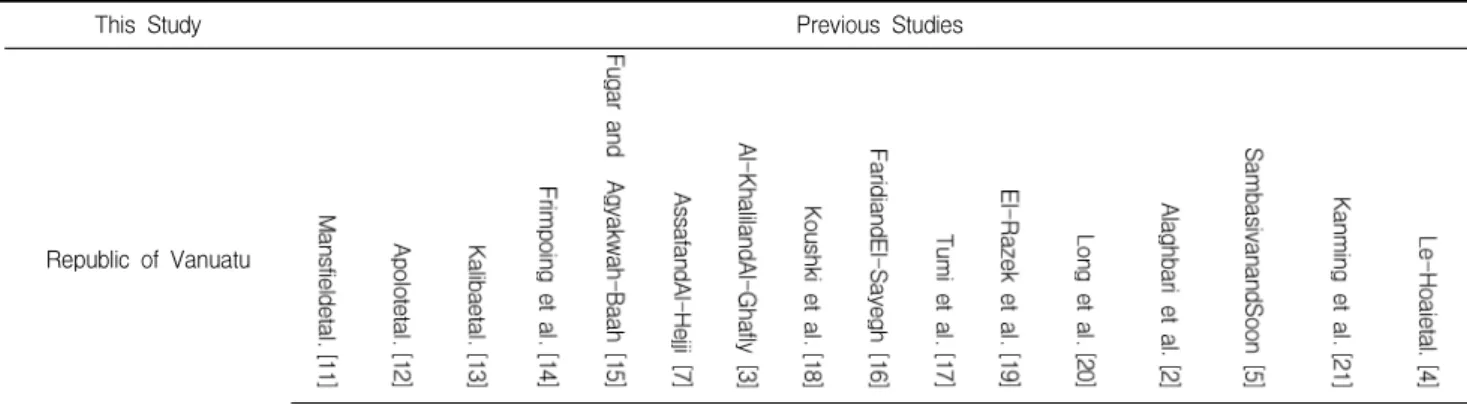
Nigeria Uganda Zambia Ghana Ghana KSA KSA Kuwait UAE Libya Egypt Thailand Malaysia Malaysia Indonesia Vietnam Pacific Island Country African Countries Middle Eastern Countries Asian Countries
1 Common ownership
2 Poor productivity v v
3 Material shortage v v v v v v
4 Landprocesses
5 Slow delivery of materials v v v v v v
6 Bad weather
7 Skilled labor shortage