플라스틱 광섬유를 사용한 통신망에서 OCDMA의 성능 분석
張克*ㆍ서희종
Performance Analysis of OCDMA on Plastic Optical Fiber Access Network
Ke Zhang*ㆍHee-Jong Suh 요 약
본 논문은 플라스틱 광섬유(POF)를 연결한 네트워크에서 광 부호분할다중접근(OCDMA)기술의 성능을 분 석한다. 최근에 POF는 무게가 가볍고, 중심선의 직경이 크며, 유연하고, 쉽게 설치할 수 있는 특성이 있기 때 문에 POF를 이용한 광전송은 커다란 주목을 받고 있다. 특히 POF의 광대역(broad band) 특성은 OCDMA기 술에 기초한 네트워크 연결 전송매체로서 각광을 받고 있다. 일반적인 OCDMA 시스템은 전송로의 수량이 BER특성에 의해서 단지 제한된 단위만을 동시에 연결하고 전송할 수 있다. 이러한 문제를 해결하기 위하여 본 논문에서는 새로운 다우선 예약프로토콜을 제안하였다. 이 프로토콜과 분산 조정 알고리듬을 이용하여, 통 신로 내부와 목표지로 가는 정보의 충돌을 피할 수 있다. 이 프로토콜은 시간지연이 서로 다른 다매체정보의 전송을 효과적으로 지원할 수 있다. 데이터 분석과 모의실험을 실행하여, 여러 시스템 매개변수에 의존하는 네 트워크 출력과 평균지연을 조사했다. 그 결과, OCDMA기술에 근거한 POF를 네트워크를 사용하는 다우선 예 약 프로토콜이 효율적이라는 것을 확인할 수 있었다.
ABSTRACT
In this paper, the performance of the optical code-division multiple access (OCDMA) technology on a plastic optical fiber (POF) access network, which had received much attention due to its low weight, large core diameter, flexibility, easy installation, and especially its high bandwidth, is analyzed.
Recently, POF was a very attractive candidate for transmission media in an access network based on OCDMA technology. But the conventional OCDMA system only allows finite units to transmit and access simultaneously according to the number of channels which are restricted by BER, and so, in this paper, to resolve this problem a novel multi-priority reservation protocol is also proposed. By using this reservation scheme and a distributed arbitration algorithm, channel collision and destination conflict could be avoided. And this protocol can efficiently support the transmission of multimedia messages that require the different time-delay. The network throughput and average delay using various system parameters have been investigated by numerical analysis and simulation experiments. These results shows that the multi-priority reservation protocol in this POF access network based on OCDMA technology is valid and efficient.
키워드
Plastic Optical Fiber, OCDMA, Access Network, Control Protocol 플라스틱 광섬유, OCDMA, 접근 네트워크, 제어 프로토콜
* 북경석유화공학원 교수
교신저자 : 전남대 전자통신공학과 ㆍ접 수 일 : 2016. 10. 05 ㆍ수정완료일 : 2016. 11. 13 ㆍ게재확정일 : 2016. 11. 24
ㆍReceived : Oct. 05, 2016, Revised : Nov. 13, 2016, Accepted : Nov. 24, 2016 ㆍCorresponding Author : Heejong Suh
Dept. of Electronic Comm. Eng., Chonnam Nat’l University, Email : [email protected]
http://dx.doi.org/10.13067/JKIECS.2016.11.11.1083
Ⅰ. INTRODUCTION
In the optical communication systems, the information of binary data are two optical power levels, and in the standard non-return-to-zero (NRZ) format, optical power remains constant unless adjacent bits have different values. At the receiver, a photodetector's output is sampled and re-clocked. Link bandwidth is often provisioned among many users using low-bandwidth via time-division multiplexing(: TDM), in which users are assigned distinct repetitive time slots for transmission. Although today's 40 Gbit/s optical bit rates seem remarkable, there are barriers to increase optical-bit rates, which are the limitations of optical and electronic devices, as well as signal distortion during transport. And wavelength-division multiplexing(: WDM) has been introduced to utilize the bandwidth of optical fiber widely in the face of limited serial bit rates. The performance in today's WDM links is 10T bit/s, which is indeed impressive from the standpoint of aggregate single-fiber throughput[1]. But WDM access requires the precise wavelength control of laser diodes and a wavelength multiplexer or demultiplexer, which can be sensitive to a temperature change. On the other hand, the role of optics in the communication system is limited to purely passive transmission of data from one electronic network unit to another. Code-division multiplexing(: CDM) is achieved by assigning different, minimally interfering code sequences to different user pairs. In this system, network units communicate by imprinting their message bits upon their own unique code, asynchronously over a common channel. A matched filter at the receiver ensures that data are detected only when they are imprinted on the proper code sequence. This approach to multi-access allows transmission without delay and handles multi-access interference as an integral part of the scheme. So CDMA is
very suitable for multimedia access network, especially to real-time users.
Access network plays a very important role in the telecommunication network, as the great growing of the multimedia communication, there can be a bottleneck. Optical access network, especially POF access network, can cost-effectively resolve this bottleneck problem. In comparison with coaxial cable or twisted pair, the plastic optical fiber has the well-known advantages such as immunity to electromagnetic interference, transmission reliability and low weight. And in comparison with silica optical fiber, the large core diameter of POF makes handling easy. It enables the use of inexpensive injection molding polymer connectors, of low connection cost. Furthermore, POF can offer high bandwidth[2-3]. As we known, the differential mode attenuation or mode coupling of POF makes the bandwidth much greater than that which would be expected from their index profiles. In CDMA system, it must be afforded that the bandwidth of the system is larger than that of the signal being transmitted. So POF access network combined with CDMA gives us an effective solution to FTTO(: Fiber to the Office) or FTTH(: Fiber to the Home).
In this POF access network, each optical network unit is equipped with a fixed optical encoder and decoder, both of which are tuned to the control channel. Each optical network unit also has a tunable optical encoder and decoder that can operate at any one of data channels independently.
Priority control is very important in future communication networks because emerging new services require various qualities of services(: QoS) as well as high bandwidth. For example, real time traffic such as voice, video, and control message, has more strict time constraints than non-real time traffic. Real time traffic has to be serviced before non-real time traffic. Among the real time traffic, compressed video traffic is more delay sensitive
than uncompressed video and voice traffic[4].
Several protocols have been proposed in optical communication networks. But, no scheme that considers the priority of traffic has so far been studied. In this paper we analyze the performance of the optical code-division multiple access (:
OCDMA) technology on a POF access network.
The proposed protocols easily accommodate multipriority traffic. The multipriority reservation protocol has the following properties. First, it has a priority control scheme that easily accommodates multipriority traffic for multimedia information.
Second, it can be employed in the network with limited channel. i.e. the number of stations in the system is not restricted by the number of data channels. The performance of the proposed multipriority control protocol using various system parameters has been investigated by numerical analysis and simulation experiments.
The rest of this paper is organized as follows. In Section 2, we present the physical topology of OCDMA access network. In Section 3, the multipriority reservation control protocol and its performance analysis are presented. In Section 4, the numerical results and summary are presented.
We conclude in Section 5.
Ⅱ. THE PHYSICAL TOPOLOGY OF OCDMA ACCESS NETWORK
Optical access network is comprised of the optical line terminal(: OLT), optical distribute network(:ODN) and optical network unit(: ONU).
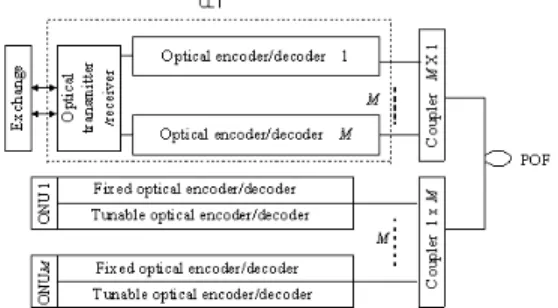
Double star physical topology of OCDMA access network is showed in Fig.1.
In this access network each ONU not only can make information exchange with any one at any time but also exchange with more than one at the same time. To reach this aim, each ONU is equipped with a fixed optical encoder and a fixed
optical decoder, both of which are tuned to the control channel. Each ONU also has a tunable optical encoder and a tunable optical decoder that can operate at any one of data channels independently. A multipriority reservation control protocol(will be showed in Section 3) that can efficiently support real-time multimedia communication is presented for the encoders and decoders to coordinate message transmission.
The key for realizing OCDMA is the design of the optical codes and the realization of all optical encoder/decoder. A planar holographic optical processor that is a low-cost fabrication and that is spatial domain encoding and decoding.
Fig. 1 The physical topology of OCDMA access network.
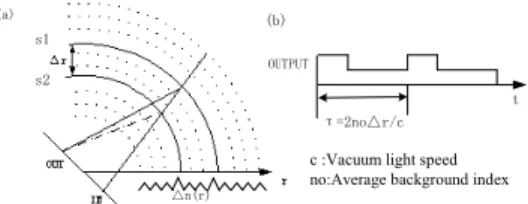
The modulating signal for each ONU can take on any form (digital or analog), any rate, and any shape. This is very suitable for multimedia environments[5-6]. The planar holographic optical processor(: HOP) consisting of a two-port(, ) is shown in Fig.2. An impulsive signal entering the input port and interacting with the index grating at position r produces an output signal shown in Fig.2 (b). Control of the spacing and amplitude of index n(r) variations provides the required temporal response. For example, the delay of ⋅ ( is the width of an optical pulse, =0,1,2,...n) time can be obtained by modified index. Therefore we can construct the tunable or fixed encoder/decoder by HOP. ( All-optical tunable encoder designed in [7].)
It comprises a × ( is code weight) optical power splitter, tunable optical delay processors constructed, an × optical power combiner and a delay controller. Tunable optical delay processors, comprising [log]+1 stages of 2× 2 optical switches which are set either in the cross state or in the bar state, were shown in Fig. 3. For example, the pulse delayed of can be obtained.
(a) s1 s2
△n(r)
τ=2no△r/c OUTPUT (b)
t
c :Vacuum light speed no:Average background index
Fig. 2 (a) Schematic of planar HOP consisting of 2D optical waveguide with a pattern of equal-index
contours shown by circular arcs.
(b) Impulse temporal response of the HOP with the refractive index structure shown at the bottom of (a).
Fig. 3 Block diagram of tunable optical delay
processor with 3 stages.
The wavelength of POF suitable for low-loss transmission is about 650 nm~1300nm. Laser diode (LD), vertical-cavity surface-emitting laser (VCSEL) at this wavelength range is used as the light source. VCSEL are attractive because they have the potential to be cheaper to fabricate and test than conventional laser diodes, emit a high-quality circular beam that is ideal for launching into optical fibers, and consume little power. Si, GaInAsP, Ge-PIN photodiode or APD can be employed as detectors in this access network.
Ⅲ. MULTIPRIORITY RESERVATION CONTROL PROTOCOL
AND PERFORMANCE ANALYSIS
OCDMA is a spread spectrum scheme. Data from multiple ONUs are encoded differentially, multiplexed on a single transmission medium, demultiplexed, and passed through code-specific detection. Discrimination of unwanted signals is achieved by means of assigning minimally interfering codes to each ONU. So, the number of the code sequence restricts the number of ONU in the access network. To resolve this problem a novel control protocol is presented for this plastic optical fiber access network. The protocol can efficiently support the transmission of multimedia communication in real time.
3.1 Control protocol
We assume that this plastic optical fiber access network, as shown in Fig.4, possesses ( ) codewords and ONUs (), where each codeword operating with a different channel from the set{, , ,⋯}. is used as a control channel for coordination of access among ONUs.
, ,⋯ and are used as data channels for actual messages. All channels are slotted with the size of the transmission time of a fixed-length data packet. One slot of the control channel is divided into L and the length of a control minislot equals the control packet transmission time. The control packet gives the information of the destination address and the priority of the data packet. The protocol operation is divided into two parts:
reservation and data transmission. When a station has a packet to send, it performs a reservation procedure first by sending a control packet on the control channel and then transmits the data packet on the data channel.
Fig. 4 Structure of control and data channels.
We assume that the propagation delay from a station to the star coupler is zero. Therefore, if a station transmits a control packet in the th slot, it can obtain the result of the reservation at the end of the th slot, and if the reservation is successful, the station transmits the data packet in the ( )th slot.
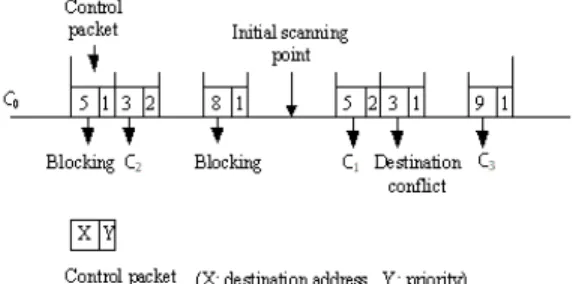
In this protocol, the control slot has M minislots, where M represents the number of stations. Since each station has its corresponding control minislot, no collision occurs on the control slot. Due to the limited number of channels and destination conflict, however, arbitration for selecting successful control packets is still needed. The algorithm of selecting successful control packets is as follows. Among the uncollided control packets, the successful ones are selected sequentially from the highest priority packets to the lowest priority ones. The scanning of the control slot never starts from the fixed point so that any one station never becomes more advantageous than the others. The scanning point can be obtained by the following rule. For each control slot, every station randomly selects an initial scanning point among the M control minislots. Each station has the same random number generator with the same seed.
Consequently, they obtain the same initial scanning point for each control slot. Each station scans from the initial scanning point to the th control minislot and wraparound. If a control packet has the same destination address as the previously selected control packet, it is discarded to prevent
destination conflict. The algorithm is completed when no more control packets are left or the number of selected control packets reaches the number of data channels. Stations whose control packets are successful choose data channels sequentially from channel 1 through N in the order of their selection, and transmit data packets on the next slot. Fig. 5 shows an example of the reservation algorithm of the slotted TDM-based protocol. In that figure, priority 2 is higher than priority 1 and the "Blocking"control packet is the packet that fails due to the lack of available data channels. If the control packet is not successful, the station has to restart the reservation procedure on the next slot.
Fig. 5 Example of the reservation algorithm (M=10, N=3, L=10, two priority traffics)
3.2 Performance analysis
In the performance analysis of this plastic optical fiber access network we make the following assumptions:
(1) The network can support kinds of priority traffic, where 1-priority is the lowest priority; is the number of the station that generate p-priority traffic, and
;
(2) Each station belongs to either one of two states: empty or backlogged state. The empty station of priority can generate a new packet with probability at the beginning of a slot and a control packet is transmitted immediately. The
backlogged station cannot generate a new packet but retransmits its old packet with probability 1.
The new packet selects its destination address among ( ) stations with equal probability, and any backlogged station reselects the destination address of its packet.
(3) The tuning times of the tunable optical encoder/decoder are assumed to be zero.
With the assumptions stated above, we can construct a Markov chain by defining ⋯ as the state where there are ii⋯ im packets whose priorities are ⋯ -priority respectively in the network at the state transition probability from the state ⋯ to ⋯ during a slot time. We also define ⋯ as the steady state probability of the state ⋯
, the ⋯ can be obtained by solving the following linear equation:
∏ ∏⋅
⋯
⋯ (1)
where
∏△⋯ , △⋯ ⋯ .
To compute ⋯ ⋯ , we define several probabilities. Let be the probability that new p-priority packets are generated at the beginning of a slot, given that there are p-priority packets in the network at the end of the previous slot. Then is given by
⋅σ⋅ σ (2)
where
. Let represent
the probability that ( ) channels are reserved by the uncollided control packets without destination conflict, given that channels are already reserved by the higher priority packets. To
obtain , we define as being the probability of finding exactly stations to which there are no packets destined among packets, given that there are stations in the system and different destinations are already reserved by the higher priority packets. can be calculated using the inclusion-exclusion principle[8] and is given by
(3)
where
represents the probability that there is no packet destined to specific stations among packets, given that there are M stations.
is then given by
ψ
ψ (4)
Now ⋯ ⋯ can be obtained by the following equation:
⋯ ⋯
max min
max min
⋯
max min
⋯ ⋯ ×
(5)
× ×
⋯×
where ⋯ ⋯ is the probability that {⋯ } control packets are successful given that {⋯ } control packets are transmitted in a slot.
Since there is no collision in the TDM scheme, the effect of destination conflict and insufficiency of
data channels has only to be considered in the computation of ⋯ ⋯ .
⋯ ⋯ can be obtained by the following equation:
⋯ ⋯
×
(6)
Now we calculate the performance of the system.
The system throughput of the priority p is given by:
⋯
min
min
⋯
min
×⋯ ⋯ ×
⋯ (7)
where ⋯ . and the system throughput is
(8)
The average delay is defined from the arrival instant of a packet at a station to the instant that the packet successfully leaves the station. The average delay of the priority p packet can be written by
σ
(9)
⋯ .
Ⅳ. NUMERICAL RESULTS
For the multipriority reservation control protocol of the plastic optical fiber access network, a large number of simulation experiments have been accomplished using various system parameters.
Now a part of typical results are given below.
0.5 0.0
0.0 1.0 2.0 3.0
1.0 Low priority High priority
Throughput
σ1 1 . 2=0 σ
2 . 2=0 σ 2
. 2=0 σ
1 . 2=0 σ
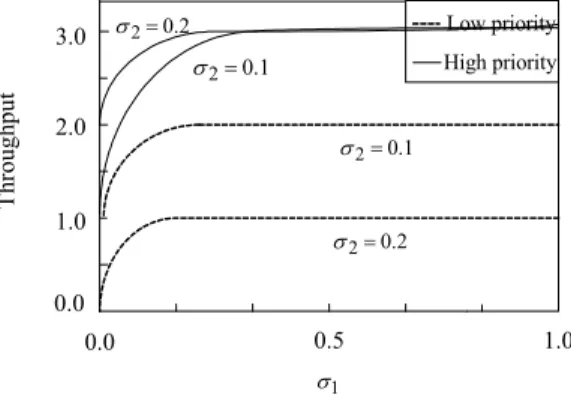
Fig. 6 Network throughput versus input load with two priority traffics
(=10, =10, N=3, L=20).
0.5 1.0
0.0 1 5 9 11
7
3
1.5 Low priority High priority
Throughput (S1)
Delay
Fig .7 Comparison of the delay characteristics of the two priority traffics
( =10,=10, =3, =20,σ
2=0.2).
Fig. 6 shows the throughput characteristics as the arrival rate of the low-priority packet (σ) increases and the high-priority packet (σ) is fixed.
The maximum total throughputs are 3, and the maximum total throughput of the protocol is always
if the effect of destination conflict is negligible (i.e., is greater than ). The throughput of the high-priority traffic does not change, though the input load of the low-priority traffic varies. The throughput of the high-priority traffic only depends on its own input load.
Fig. 7 shows the delay characteristics as the throughput of the low-priority traffic increases. For each curve, σ
2 is fixed and σ
1 varies from 0.01 to 1. The protocol has an optimal priority control that is the higher-priority packet in the system is always transmitted prior to the lower-priority packet and the lower-priority traffic does not affect the performance of the higher-priority traffic.
Ⅴ. CONCLUSION
We can confirm that POF is a very attractive candidate for transmission media in access network based on OCDMA technology. OCDMA scheme is employed not only to efficiently exploit the huge bandwidth of POF but also to simplify the control logic. With OCDMA scheme, users can access simultaneously the channel with zero waiting time and without the synchronization of network, so it can efficiently support real-time multimedia communication. POF access network combined with CDMA gives us an effective solution to FTTO or FTTH.
The proposed multipriority control protocol, in this paper, resolves the problem that OCDMA system only allows finite units to transmit and access simultaneously according to the number of channels which are restricted by BER. The number of data channels does not restrict the number of units in the network and real time traffic is always serviced before non-real time traffic. The performance of the proposed multipriority control protocol using various system parameters has been investigated by numerical analysis and simulation
experiments. We known that the control protocol is valid and efficient.
Encoder/decoder in this plastic optical fiber access network can be constructed by HOP which is created by stamping. Replication or lithographic production provides a pathway to low-cost fabrication. Planar holographic methods provide for powerful and uniquely "optical" circuits.
References
[1] T. Mossberg, and G. Zhang,M. Raymer, "Optical code-division multiplexing," Optics & Photonics News, vol. 12, no. 3, 2001, pp. 50-54.
[2] W. Li, H. Yin, and S. Yang,, "2.5Gbit/s transmission over 200m PMMA graded index polymer optical fiber using a 645nm narrow spectrum laser and a silicon APD," Microwave and Optical Technology Letters, vol. 20, no. 3, 1999, pp.
163~166.
[3] G. Giaretta and G. Zhang, "High-speed (11Gbit/s) data transmission using perfluorinated graded-index polymer optical fibers for short interconnects (<100m)," IEEE Photonics Technol.
Lett., vol. 12, no. 3, 2000, pp. 347-349.
[4] D. Behmann and M. Galmpny, "High speed transport systems for multimedia applications,"
IFIP'89 (Zurich, Switzerland), May 1989, pp.
303-321.
[5] A. Jawad and G. Eung, "Holographic CDMA,"
IEEE Transactions on Communications, vol.43, no.
9, 1995, pp. 2434-2438.
[6] T. W. Mossberg, "Planar holographic optical processors," Opt. Lett., vol.26, no.7, 2001, pp.
414-416.
[7] H. Yin, S. Yang, and G. Zhang, "Synchronous optical code and its all-optical tunable encoder/decoder for synchronous optical code-division multiple access communication system," Acta Photonica Sinica, vol. 28, no. 7, 1999, pp. 607-612.
[8] W. Feller, "An introduction to probability theory and its applications," 3rd ed., vol.1, John Wiley and Sons, New York, 1968.
[9] Yanji and H. Suh, "A Comparison of Raptor Code
Using LDGM and LDPC Code," J. of the Korea Institute of Electronic Communication Sciences, vol. 8, no.1, 2013, pp. 65-70.
[10] S. Chen and H. Suh, "An Effective Decoding Algorithm of LDPC Codes with Lowering Error Floors," J. of the Korea Institute of Electronic Communication Sciences, vol. 9, no. 10, 2014, pp.
1111-1116.
[11] H. Chen and H. Suh, "An Improved Bellman-Ford Algorithm based on SPFA," J. of the Korea Institute of Electronic Communication Sciences, vol.7, no. 4, 2012, pp.721-726.
저자 소개
장극(Ke Zhang) 1984년 Beijing NormalUniversity (공 학사)
2004년 여수대학교 대학원 전자통 신공학과 졸업(공학석사)
2006년 전남대학교 대학원 전자통신공학과 박사입학 1993년 ∼현재 북경석유화공학원 교수
※ 관심분야 : 데이터통신시스템, 컴퓨터통신
서희종(Hee-Jong Suh) 1975년 한국항공대학 항공통신공학 과 졸업(공학사)
1996년 중앙대학교 대학원 전자공 학과 졸업(공학박사)
2006년 ∼현재 전남대학교 전자통신공학과 교수
※ 관심분야 : 네트워크, 그래프이론