A Study on Educational Assortative Marriage
Moonju Seong
Dept. of Social Welfare, Namseoul Univerisity
교육수준별 결혼유형에 대한 고찰
성문주
남서울대학교 사회복지학과
Abstract This paper examines the relationship between education and marriage in South Korea, based on a 2 percent data of the 2000 census. The result found strong educational homogamy and wife-hypergamy over the five age cohort, 21-30, 31-40, 41-50, 51-60, and 61-70. For the primary, junior secondary, upper secondary and tertiary educational levels, the chance of marrying within the same educational level was stronger for primary and tertiary education. In terms of trends, the educational homogamy increased across the four cohorts. We note that while upward marriage was stronger for women (hypergamy), it decreased over time.
Key Words : Educational assortative marriage, Homogamy, Wife-hypergamy
요 약 본 연구는 2000년 국민주택총조사 자료(2% 샘플)를 사용하여 기혼 응답자 중 본인과 배우자의 학력 결합유 형에 대해 살펴보았다 . 21-70세 응답자를 10년 단위로 5개 연령대별 결혼유형을 분석한 결과는 전체 결혼에서 동일 한 학력을 가진 배우자와 결혼하는 동질혼이 65%, 자신보다 고학력인 남성과 결혼하는 여성 상승혼이 30%로 이 두 유형이 전체 결혼유형의 90%를 설명하는 것으로 나타났다. 교육동질혼 경향은 모든 연령대에서 강하게 나타났으며, 교육 수준을 초등학교 , 중학교, 고등학교, 대학 이상(전문대 포함)으로 구분하여 동질혼을 비교했을 때, 초등학교와 대학 이상 그룹에서 동질혼의 비율이 매우 높았다 . 이러한 동질혼 경향은 젊은 세대로 갈수록 증가하였다. 그러나 여성의 상승혼은 젊은 연령대로 갈수록 감소함을 알 수 있었다 .
주제어 : 교육동질혼 , 상승혼, 하강혼, 교육, 결혼
* 본 논문은 박사학위 논문의 일부를 수정 보완한 것입니다. This paper is derived from a part of Ph.D. Thesis(2008).
본 연구는 2013년 남서울대학교 학술 연구비지원에 의해 수행되었음.
Received 25 October 2013, Revised 3 December 2013 Accepted 20 March 2014
Corresponding Author: Moonju Seong(Namseoul University) Email: [email protected]
Ⓒ The Society of Digital Policy & Management. All rights reserved. This is an open-access article distributed under the terms of the Creative Commons Attribution Non-Commercial License (http://creativecommons.otg/licenses/by-nc/3.0), which permits unrestricted non-commercial use, distribution, and reproduction in any medium, provided the original work is properly cited.
ISSN: 1738-1916
1. Introduction
Recent studies examining educational assortative marriage have observed a common pattern of educational similarities in most industrialized
countries, i.e. individuals tend to marry those with a similar level of education[1][2][3]. It is because education directly and indirectly implies occupation, income, family background and culture.
Like other countries, education is one of the most
important criteria in partner selections in South Korea (hereafter Korea). A number of studies on Korea document the existence of a strong educational homogamy[4][5]. Based on previous literatures, this paper aims to describe general marriage patterns related with educational levels for the late-half of 20 th century.
For purposes of clarification, this paper employs the following definitions: assortative marriage indicates that people tend to have non-random marriage with individuals who are similar to themselves. Assortative marriage is classified into homogamy and hypergamy.
Homogamy in marriage refers to the pattern of marrying an individual with the same attributes as oneself (e.g., educational homogamy or ethnic homogamy), and hypergamy in marriage refers to upward marriage in the given aspect, such as educational qualifications and socioeconomic status.
For example, wife-hypergamy in educational marriage indicates that women marry partners with higher education than themselves.
2. Previous studies and background
2.1 Previous studies
In the context of Korean research, several empirical studies have documented the significant impact of education on Korea’s marriage market[6]. The country’s marriage pattern in the second half of the 20th century is characterized by a strong educational homogamy and a pattern of women’s marrying up[5][7]. Chang observed a similar pattern of educational assortative marriage by using 2,392 couples aged 25 to 64 taken from the 1990 and 1995 cross-sectional data sets of the Social Inequality Survey conducted by the Social Science Association in Korea[7]. Park and Smits confirmed the presence of strong educational homogamy and wife-hypergamy during the 1930s-1990s[5].
Regarding trends observed, Park noted increasing
educational homogamy[8], whereas Chang showed no constant trends[7]. In relation to the wife-hypergamy, an increase in the wife-hypergamy effect for the 1960s-1980s marriage cohort was observed[9] whereas no systematic trend for the 1950s-1990s marriage cohort was reported[7]. The different time spans may account for the inconsistent results. However, Park and Smits[5] found an increasing trend of educational homogamy, particularly among tertiary education for the 1930s-1990s. Hence, although it is certain that educational homogamy and hypergamy are predominant marriage patterns in Korea, it has not been established whether educational homogamy and hypergamy have persisted or increased/decreased over time.
2.2 Background
This section presents structural details, such as the mean age and educational attainment among Korea's marriageable population. To begin, Figure 1 reports the mean ages of first marriage. In general, the mean age for both genders increased slowly from 1960 to 2005, and the mean age for men was consistently higher. In 1960 the average marriage age is 25 years for men and 22 years for women, but in 1980, the same figures increased slightly, i.e. by 2 years for men and 3 years for women. In 2005 the data indicate even later ages, i.e. 31 years for men and 28 years for women.
[Fig. 1] Mean Ages of First Marriage, 1960-2005 Source: [10][11][12]
Next Figure 2 presents the trends of educational
attainment of men and women in the common marriageable age, 20 to 29.
Among those aged 20-29, the obtained schooling years are 4.0 and 1.7 years for men and women respectively in 1945, but the gap decreased constantly, reaching parity in 1995 (12.7 years for both genders).
Impressively, the 2000 figure shows that women received slightly higher education (0.2 years) than men.
[Fig. 2] Mean Schooling Years of Population Ages 20-29 Years, 1945-2000
Source: [11][12]
If a first marriage rate is low or a divorce rate is high, the results of analyzing educational assortative marriage may be constrained. Hence, it is useful to examine family trends, i.e. marriage and divorce rates.
5.9 9.0
8.0 9.2
8.7
7.0 6.4
0.3 0.3
1.0 1.5
2.5 2.9
0.5 0.0
2.0 4.0 6.0 8.0 10.0
1955 1965 1975 1985 1995 2000 2004
(%)
Marriage rate Divorce rate
[Fig. 3] Crude Rates of Marriage and Divorce, 1955-2004
Source: [13][14]
In Figure 3, the marriage/divorce rates from 1955-2004 are conventionally calculated as the annual
number of marriages/divorces per 1,000 persons. The marriage rate of 5.9 in 1955 rose to 9.0 by 1965. From 1965 to 1995, the marriage rate remained constant at more or less 9 percent, only to decline gradually to 6.4 in 2004. In contrast, the divorce rate gradually rose from 0.3 to 0.5 between 1955 and 1975, and then increased to 2.9 in 2004. The marriage and divorce rates imply relatively stable marriage formation for the six decades.
In summary, Korean men were more highly educated until women finally caught up in 1990s. In terms of educational levels among marriageable ages, until 2005 the number of tertiary educated men was still larger than for tertiary educated women. We note that a relatively large percentage of tertiary educated men would have married down due to the shortage of female graduates, and that this situation may affect the marriage choice for both sexes with less than tertiary education. Based on these aggregate figures, we assume that with a strong educational homogamy, wife-hypergamy is also one of the predominant marriage patterns prior to the 1990s, but there is no solid empirical evidence, this cannot be assumed. The following sections discuss the applicability of this assumption.
3. Data and Methods
We use a 2 percent sample of the population and housing census surveyed in 2000. The census was conducted on every household in the country and includes information of all persons living in the household. For this study, we selected married respondents and wife’s age is between 21 and 70.
Thus, we finally used 197,057 couples. As this paper
focuses on absolute marriage patterns, we use
cross-tabulations for the frequencies of educational
levels and homogamy and hypergamy marriage
patterns.
4. Results
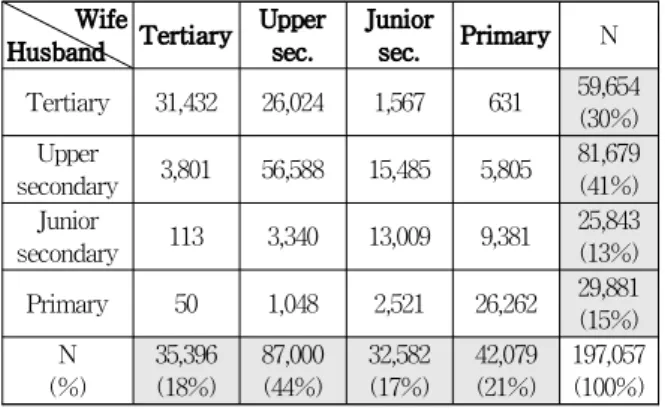
Table 1 shows the total number of couples at each educational level including the proportion of educational levels between men and women and the pattern of educational matching.
<Table 1> Educational Qualification Marriage Matching, 1960s-1990s (unit: couples) Wife
Husband Tertiary Upper sec.
Junior
sec. Primary N Tertiary 31,432 26,024 1,567 631 59,654
(30%) Upper
secondary 3,801 56,588 15,485 5,805 81,679 (41%) Junior
secondary 113 3,340 13,009 9,381 25,843 (13%) Primary 50 1,048 2,521 26,262 29,881 (15%) N
(%)
35,396 (18%)
87,000 (44%)
32,582 (17%)
42,079 (21%)
197,057 (100%) Source: Data taken from the 2 percent of 2000
census; [19]
<Table 2> Inflow and Outflow of Educational Marriage Matching (in percentage) Wife
Husband Tertiary Upper sec. Junior
sec. Primary Total (N)
Tertiary 53.7 43.6 2.6 1.1 100.0
(59,654) Upper
secondary 4.7 69.3 19.0 7.1 100.0
(81,679) Junior
secondary 0.4 12.9 50.3 36.3 100.0
(25,843)
Primary 0.2 3.5 8.4 87.9 100.0
(29,881)
Tertiary 88.8 29.9 4.8 1.5
Upper
secondary 10.7 65.0 47.5 13.8
Junior
secondary 0.3 3.8 39.9 22.3
Primary 0.1 1.2 7.7 62.4
Total 100.0 100.0 100.0 100.0
(N) (35,396) (87,000) (32,582) (42,079) 197,057 Source: [19]
30% of husbands have tertiary education and 41%
have upper secondary education. Among wives, the proportion of obtaining tertiary education is 18% and
the upper secondary is 44%. The number of couples with same level of education is the largest (the main-diagonal cells) at 65%, and the number of couples with one different level is 31%.
Table 2 defines educational marriage in terms of the proportion of the destination from husbands’ education to wives’ (the first panel) and the destination from wives’ education to husbands’ (the second panel). For husbands, the most frequent pattern is to marry women with the same level of education, followed by marrying women whose education is one level lower.
For example, 87.9% of men with primary education and 69.3% of upper secondary educated men have wives with the same level of education as themselves, and the homogamy rate is slightly lower for those with tertiary education (53.7%) and junior secondary education (50.3%). In terms of upward marriage, women are more likely to marry men with higher education than themselves, i.e. 47.5% of women with junior secondary education marry men with upper secondary education, and 29.9% of women with upper secondary education marry men with tertiary education. Wife-hypergamy is more likely to occur when the man is one level higher. For example, only 4.8% of women with junior secondary marry men with tertiary education and 1.5% of women with primary education marry men with tertiary education. From the male point of view, a relatively large number of tertiary educated men marry women with upper secondary education (43.6%), and 36.3% of men with junior secondary education marry women with less education. At the same time, the level of women marrying down is relatively low. Table 3 illustrates the proportion of homogamy and wife-hypergamy and the other patterns. For all respondents, homogamy marriage predominates, followed by wife-hypergamy marriage, i.e. 65% of all educational marriage is homogamy and 30% is wife-hypergmay. In terms of the cohort change, two interesting trends were found:
homogamy marriage increased over time and the level
of wife-hypergamy decreased. The level of homogamy marriage continuously increased from 62% to 74%
across the 61-70 age cohort to the 21-30 age cohort, and the degree of wife-hypergamy decreased from 42% in the 61-70 age cohort to 18% in the 21-30 age cohort.
<Table 3> Proportion of the Type of Educational Marriage across Age Cohorts, 2000
In percentages (%)
All 61-70 51-60 41-50 31-40 21-30
Homogamy 65 62 55 60 69 74
Wife-
hypergamy 30 37 42 35 24 18
Others 6 1 3 5 7 8