로스팅 조건에 따른 엘살바도르산 Coffea arabica cv.
Bourbon 커피의 항산화 활성
⁃ 연구노트 ⁃
송가영1*․김은경2*․김나연1,3․김요섭1,3․이승협1,3․김인용1․하정헌1,3․김기영2․정윤화1,3
1단국대학교 천연물식의약소재산업화연구센터
2경기대학교 관광전문대학원 외식산업경영학과
3단국대학교 식품영양학과
Antioxidant Activities of El Salvadoran Coffea arabica cv. Bourbon Coffee Extracts with Different Roasting Conditions
Ka-Young Song1*, Eunkyung Kim2*, Nayeon Kim1,3, Yosub Kim1,3, Seunghyup Lee1,3, Inyong Kim1, Jung Hun Ha1,3, Ki-Young Kim2, and Yoonhwa Jeong1,3
1Research Center for Industrialization of Natural Neutralization and
3Department of Food Science and Nutrition, Dankook University
2Department of Food Service Industry Management, Graduate School of Tourism Business Management, Kyonggi University
ABSTRACT This study investigated the effect of roasting on the antioxidant activities of the El Salvadoran Coffea arabica cv. Bourbon coffee extracts (E: espresso, D: drip) with different roasting degrees (1: Light medium, 2: Medium, 3: Moderately dark, 4: Very dark). The total polyphenol contents in espresso and drip coffee were the highest at Light medium (E1, D1), and they were the lowest at Very dark (E4, D4). The total flavonoid contents in espresso and drip coffee were the highest at Light medium (E1, D1), and decreased as the roasting degree increased. The Trolox equivalent antioxidant capacity (TEAC) in espresso and drip coffee was not significantly different among coffee extracts with different degrees of roasting. The 1,1-diphenyl-2-picrylhydrazyl radical scavenging capacity in espresso coffee and drip coffee was the lowest at Very dark (E4, D4). The ferric reducing antioxidant power (FRAP) in espresso and drip coffee was the highest at Light medium (E1, D1), and decreased as the roasting degree increased. The TEAC in drip coffee was highly correlated with the contents of total polyphenol and total flavonoids. There was a high positive correlation between TEAC, and the total contents of polyphenols and flavonoids with different roasting degrees in drip coffee. The FRAP was highly correlated with the contents of total polyphenol and total flavonoids in espresso and drip coffee. These results suggest that roasting degrees affect the contents of total polyphenol and flavonoids and the antioxidant activities of coffee extracts.
Key words: Coffea arabica cv. Bourbon, coffee, roasting, antioxidant activities
Received 2 October 2019; Accepted 28 October 2019 Corresponding author: Yoonhwa Jeong, Department of Food Sci- ence and Nutrition, Dankook University, Cheonan, Chungnam 31116, Korea
E-mail: [email protected], Phone: +82-41-550-3477
*These authors contributed equally to this work.
Author information: Ka-Young Song (Professor), Eunkyung Kim (Graduate student), Nayeon Kim (Graduate student), Yosub Kim (Graduate student), Seunghyup Lee (Graduate student), Inyong Kim (Professor), Jung Hun Ha (Professor), Ki-Young Kim (Professor), Yoonhwa Jeong (Professor)
서 론
커피는 세계적으로 가장 많이 소비되는 음료 중 하나이 다. 커피에는 카페인, 페놀화합물, 하이드록시남산 및 Mail- lard 반응의 생성물인 멜라노이딘 등의 항산화 물질이 많고,
커피를 통해 다량의 항산화 물질을 섭취할 수 있다(Svilaas 등, 2004). 커피는 로스팅, 추출방법, 원산지, 품종 등에 따 른 항산화 활성 차이가 있다(Lopez-Galilea 등, 2007).
로스팅은 커피의 성분에 영향을 미치며, 크게 두 단계로 진행된다. 첫 번째 단계에서는 160°C 이하에서 주로 건조가 일어나고, 두 번째 단계에서는 190°C 이상에서 pyrolytic 반응이 시작되어 oxidation, reduction, hydrolysis, poly- merisation, decarboxylation 등 많은 화학반응이 일어난 다(Votavova 등, 2009). 이러한 과정을 통해 커피 원두는 향, 색, pH, 구성성분, 부피 등이 변화를 하게 된다(Hernan- dez 등, 2007). 주요 변화로는 트리고넬린, 클로로겐산, 멜 라노이딘이 형성되고, 단백질, 아미노산, 아라비노갈락탄, 당이 감소하게 된다(Parliment, 2000). 이와 같은 반응은
Table 1. Roasting conditions for the four roasting profiles
Sample Starting temperature (°C) Final temperature (°C) Total roasting time (min) Agtron Light medium
Medium Moderately dark Very dark
170 170 170 170
191 200 210 230
8:51 9:35 10:61 15:85
66.60±0.60 55.20±0.60 46.20±0.30 27.80±0.50 커피의 품질특성 및 소비자 기호도에 영향을 준다.
카페인 및 클로로겐산 등 커피의 생리활성 물질이 건강에 도움을 준다는 연구 결과가 발표됨에 따라 커피에 대한 관심 은 계속해서 증가하고 있다. 커피의 섭취는 항당뇨 및 항암 등에 효과가 있으며(Vitaglione 등, 2012), 심혈관질환, 알 츠하이머, 파킨슨, 간경화 등의 여러 질병에 효과가 있다고 보고되었다(Higdon과 Frei, 2006). 이러한 효과는 폴리페 놀에 의한 것으로 특히 클로로겐산은 강한 항산화 활성을 가지고 있다(Fujioka와 Shibamoto, 2006).
커피의 항산화 활성 관련 연구로는 건조방법에 따른 커피 원두의 페놀화합물, 항산화 활성(Cheng 등, 2019), 커피 로 스팅에 따른 영양학적, 화학적, 항산화 특성(Costa 등, 2018), 커피 silverskin 멜라노이딘 성분의 생리활성(Tores de la Cruz 등, 2019), 로스팅 정도에 따른 로부스타 커피의 생리 활성 물질 함량 및 항산화 활성(Herawati 등, 2019), 고체 발효 커피의 항산화 효과(Kwak 등, 2018), 배전 강도와 추 출시간에 따른 커피 추출물의 항산화 활성(Jo 등, 2016), 추출시간 및 방법에 따른 커피 항산화 성분의 추출(Ludwig 등, 2012) 등이 있다.
본 연구에서는 엘살바도르산 Coffea arabica cv. Bour- bon 생두를 4가지 조건에서 로스팅한 후 에스프레소와 드립 커피로 추출하여 항산화 활성에 대해 조사하였다.
재료 및 방법
재료
생두는 Arabica종 Coffea arabica cv. Bourbon(El Sal- vador, SHG, Natural)으로 2017년 6월에서 2018년 3월까 지 수확된 것을 모이커피컴퍼니(Moi Coffee Company, Yongin, Korea)에서 제공받아 사용하였다.
로스팅
로스팅은 Aillio Bullet R1 Roaster(Aillio, Taipei, Tai- wan)로 170°C 예열 후 생두를 투입하였다. CM-100(Light- tells Corp., Ltd., Hsinchu County, Taiwan)으로 Agtron 값(The Specialty Coffee Association, SCA)을 설정하여 Light medium 로스팅은 Agtron 70.17~60.36, Medium 로 스팅은 Agtron 60.07~50.00, Moderately dark 로스팅은 Agtron 49.75~45.18, Very dark 로스팅은 Agtron 30.07
~20.50 범위의 4단계로 로스팅하였다(Table 1). 원두는 -18°C에서 냉동 보관 후 사용하였다.
에스프레소 추출
에스프레소 커피는 45 mesh로 분쇄한(Yang-Chia Ma- chine Works Co., Ltd., Taipei, Taiwan) 원두 가루를 반자 동 에스프레소 머신(E98 President A2, Faema, Milano, Italy)을 이용하여 추출하였다. 에스프레소 추출액은 Light medium(E1), Medium(E2), Moderately dark(E3) 및 Very dark(E4)의 4가지 시료로 원두 분말 7 g을 30 mL까지 추출 하였다.
드립 추출
드립 커피는 분쇄기(Fujikouki Co., Ltd., Osaka, Japan) 를 이용하여 25 mesh로 분쇄 후 원두 가루를 클레버 드리퍼 (Mr. Clever, E.K, INT’L Co., Ltd., Taipei, Taiwan)를 이 용해 추출하였다. 드립 추출액은 Light medium(D1), Me- dium(D2), Moderately dark(D3) 및 Very dark(D4)의 4가 지 시료로 원두 분말 15 g당 260 g(~210 mL)까지 추출하 였다.
시료 제조
시료는 Advantec No. 2 filter paper(Toyo Roshi Kaisha, Ltd., Tokyo, Japan)를 이용해 여과 후 사용하였다.
총 폴리페놀 함량 측정
총 폴리페놀 함량은 Singleton과 Rossi(1965)의 방법을 응용하여 측정하였다. 에스프레소 커피는 20배, 드립 커피 는 5배 희석하여 시료로 사용하였다. 시료 100 µL에 0.9 N Folin & Ciocalteu’s phenol reagent(Sigma-Aldrich Co., St. Louis, MO, USA) 200 µL, sodium carbonate (Showa Chemical Industry, Tokyo, Japan) 800 µL를 가 하고 30분 동안 암실에서 반응시킨 후 microplate reader (Spectramax M2E, Thermo Fisher Scientific, Waltham, MA, USA)를 이용하여 765 nm에서 흡광도를 측정하였다.
Gallic acid(Sigma-Aldrich Co.)를 표준물질로 사용하여 표준곡선을 작성하고, 총 폴리페놀 함량을 μg GAE(gallic acid equivalent)/mL로 나타내었다.
총 플라보노이드 함량 측정
총 플라보노이드 함량은 Chang 등(2002)의 방법을 응용 하여 측정하였다. 시료 300 µL에 에탄올(Junsei Chemical Co., Tokyo, Japan) 900 µL, 증류수 1,700 µL, 10% alumi- num chloride(Sigma-Aldrich Co.) 60 µL, 1.0 M potas- sium acetate(Sigma-Aldrich Co.) 60 µL를 가하고, 암실에
서 30분간 반응시킨 후 microplate reader를 이용하여 415 nm에서 흡광도를 측정하였다. Quercetin(Sigma-Aldrich Co.)을 표준물질로 사용하여 표준곡선을 작성하고, 총 플라 보노이드 함량을 μg QE(quercetin equivalent)/mL로 나타 내었다.
Trolox equivalent antioxidant capacity (TEAC) 측정 TEAC는 Re 등(1999)의 방법을 응용하여 측정하였다.
에스프레소 커피는 50배, 드립 커피는 10배 희석하여 시료 로 사용하였다. 시료 5 µL에 ABTS reagent(Sigma-Al- drich Co.) 150 µL를 가하고, microplate reader를 이용하 여 734 nm에서 흡광도를 측정하였다. Trolox(Sigma-Al- drich Co.)를 표준물질로 사용하여 표준곡선을 작성하고, TEAC를 mg TE(Trolox equivalent)/mL로 나타내었다.
DPPH 라디칼 소거 활성 측정
DPPH(1,1-diphenyl-2-picrylhydrazyl) 라디칼 소거 활 성은 Blois(1958)의 방법을 응용하여 측정하였다. 에스프레 소 커피는 100배, 드립 커피는 20배로 희석하여 시료로 사 용하였다. 시료 40 µL에 0.45 mM DPPH reagent(Sigma -Aldrich Co.) 160 µL를 가하고, 암실에서 30분간 반응시 킨 후 microplate reader를 이용하여 517 nm에서 흡광도 를 측정하였다. Ascorbic acid(Sigma-Aldrich Co.)를 표준 물질로 사용하여 표준곡선을 작성하고, DPPH 라디칼 소거 활성을 mg AE(ascorbic acid equivalent)/mL로 나타내었 다.
Ferric reducing antioxidant power (FRAP) 측정 FRAP는 Benzie와 Stain(1996)의 방법을 응용하여 측정 하였다. 에스프레소 커피는 100배, 드립 커피는 20배로 희 석하여 시료로 사용하였다. 시료 5 µL와 cocktail solution (300 mM sodium acetate : 10 mM TPTZ : 20 mM FeCl3・ 6H2O=10:1:1) 145 µL를 섞어 암실에서 15분간 반응시킨 후에, microplate reader를 이용하여 593 nm에서 흡광도 를 측정하였다. FeSO4(Sigma-Aldrich Co.)를 표준물질로 사용하여 표준곡선을 작성하고, FRAP를 μmol FeSO4/mL 로 나타내었다.
통계처리
통계분석은 SPSS 통계프로그램의 one-way ANOVA (Statistical Package for the Social Science, Ver. 25.0, SPSS Inc., Chicago, IL, USA)를 이용하여 Duncan’s mul- tiple range test로 P<0.05 유의수준에서 분석하였다.
결과 및 고찰
총 폴리페놀 함량
로스팅 정도에 따른 총 폴리페놀 함량은 Table 2와 같다.
에스프레소 커피에서는 E1(6,076.25 μg GAE/mL)> E2 (5,707.35 μg GAE/mL)> E3(5,287.89 μg GAE/mL)> E4 (4,723.15 μg GAE/mL)의 순으로, Light medium(E1)에서 총 폴리페놀 함량이 가장 높았고, Very dark(E4)에서 가장 낮았다. 드립 커피에서는 D1(1,236.78 μg GAE/mL)> D2 (1,175.50 μg GAE/mL)> D3(1,009.90 μg GAE/mL)> D4 (918.71 μg GAE/mL)의 순으로 Light medium(D1)에서 총 폴리페놀 함량이 가장 높았고, Very dark(D4)에서 가장 낮 았다. Herawati 등(2019)의 연구에서 총 폴리페놀 함량은 early yellow 14.39 g GAE/100 g, 생두 14.31 g GAE/100 g, brown 13.38 g GAE/100 g의 순이었으며, yellow 로스 팅에서 가장 높았다. Farah와 Donangelo(2006)의 연구에 서 생두의 총 페놀화합물이 로스팅이 강해짐에 따라 다소 증가하다가 최종적으로는 감소하였으며, 이는 본 연구 결과 와 유사하였다. Maillard 반응은 항산화 물질의 화합물 형성 을 유도하여 커피 원두의 페놀화합물 함량을 증가시키며, 이후에는 감소하게 된다(Tomaino 등, 2005).
총 플라보노이드 함량
로스팅 정도에 따른 총 플라보노이드 함량은 Table 2와 같다. 에스프레소 커피에서 E1(667.58 μg QE/mL)> E2 (584.75 μg QE/mL)> E3(507.21 μg QE/mL)> E4(329.44 μg QE/mL)의 순으로 Light medium(E1)에서 총 플라보노 이드 함량이 가장 높았고, Very dark(E4)에서 가장 낮았다.
드립 커피에서는 D1(110.19 μg QE/mL)> D2(105.95 μg QE/mL)> D3(71.99 μg QE/mL> D4(52.77 μg QE/mL)의 순으로 Light medium(D1)에서 가장 높았고 Very dark (D4)에서 가장 낮아 에스프레소 커피 결과와 유사하였다.
Cho 등(2014)의 연구에서도 light 로스팅에서 24.79 mg CE/
g으로 총 플라보노이드 함량이 가장 높았으며, 이후 감소하 여 medium 로스팅에서 15.40 CE/g, dark 로스팅에서 9.30 CE/g으로 감소하였다. Król 등(2019)의 연구에서 저장 원 두의 로스팅 단계별 총 플라보노이드 함량은 light(1.00 mg/
g), medium(0.81 mg/g), dark(0.61 mg/g) 순으로 로스팅 강도가 증가함에 따라 총 폴리페놀 함량이 유의적으로 감소 하였다.
Trolox equivalent antioxidant capacity (TEAC) 로스팅 정도에 따른 커피의 TEAC는 Table 3과 같다. 에 스프레소 커피에서 TEAC는 E3(75.76 mg TE/mL)> E2 (75.23 mg TE/mL)> E4(74.29 mg TE/mL)> E1(73.66 mg TE/mL)의 순이었으며, 시료 간에 유의적인 차이가 없었 다. 드립 커피에서는 TEAC가 D2(16.41 mg TE/mL)> D1 (15.69 mg TE/mL)> D3(14.38 mg TE/mL)> D4(13.78 mg TE/mL)의 순이었으며, 시료 간에 유의적인 차이가 없었다.
Gómez-Ruiz 등(2008)의 연구에서 커피 추출물의 TEAC는 생두에서 로스팅이 강해질수록 감소하여 light coffee 추출 물에서 6.31 µM로 가장 높았고, dark coffee 추출물에서
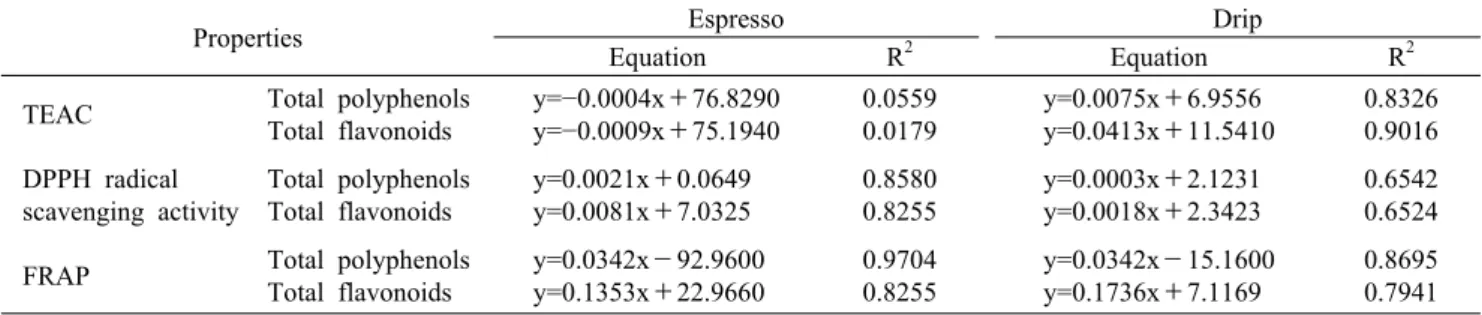
Table 4. Correlation of TEAC, DPPH radical scavenging activity, and FRAP with total polyphenols and total flavonoids of Coffea arabica cv. Bourbon coffee extracts from El Salvador with roasting degrees by two extraction methods
Properties Espresso Drip
Equation R2 Equation R2
TEAC Total polyphenols Total flavonoids
y=−0.0004x+76.8290 y=−0.0009x+75.1940
0.0559 0.0179
y=0.0075x+6.9556 y=0.0413x+11.5410
0.8326 0.9016 DPPH radical
scavenging activity
Total polyphenols Total flavonoids
y=0.0021x+0.0649 y=0.0081x+7.0325
0.8580 0.8255
y=0.0003x+2.1231 y=0.0018x+2.3423
0.6542 0.6524 FRAP Total polyphenols
Total flavonoids
y=0.0342x-92.9600 y=0.1353x+22.9660
0.9704 0.8255
y=0.0342x-15.1600 y=0.1736x+7.1169
0.8695 0.7941
5.92 µM로 가장 낮았다. 반면 Vignoli 등(2011)의 연구에서 는 light 로스팅에서 18.77 g Trolox/100 g, medium 로스 팅에서 21.03 g Trolox/100 g, dark 로스팅에서 23.78 g Trolox/100 g으로 로스팅이 강해질수록 활성이 증가하였다.
드립 커피에서 로스팅 조건에 따른 폴리페놀 함량과 TEAC 와의 상관관계는 y=0.0075x+6.9556; R2=0.8326이었으 며, 총 플라보노이드 함량과 TEAC와의 상관관계는 y=
0.0413x+11.541; R2=0.9016으로 모두 높았다.
DPPH 라디칼 소거 활성
로스팅 정도에 따른 DPPH 라디칼 소거 활성은 Table 3과 같다. 에스프레소 커피에서 DPPH 라디칼 소거 활성은 E2(12.50 mg AE/mL)> E1(12.22 mg AE/mL)> E3(10.60 mg AE/mL)> E4(9.80 mg AE/mL)의 순이었고, 드립 커피 에서는 DPPH 라디칼 소거 활성은 D1(2.55 mg AE/mL)>
D3(2.52 mg AE/mL)> D2(2.51 mg AE/mL)> D4(2.41 mg AE/mL)의 순이었으며, Very dark에서 유의적으로 가장 감 소했다. Vignoli 등(2011)의 연구에서 DPPH IC50이 light 로스팅 단계에서 16.11 μg/mL, dark 로스팅 단계에서 20.23 μg/mL로 보고되었으며, Herawati 등(2019)의 연구에서는 DPPH IC50이 very light 단계에서 2.85 μg/mL로 가장 낮았 고, dark 단계에서 5.12 μg/mL로 가장 높았다. 로스팅 조건 에 따른 총 폴리페놀 함량과 DPPH 라디칼 소거 활성의 상관 관계는 에스프레소 커피(y=0.0021x+0.0649; R2=0.8580) 와 드립 커피(y=0.0003x+2.1231; R2=0.6542)에서 모 두 양의 상관관계가 나타났으며, 로스팅 조건에 따른 총 플 라보노이드 함량과 DPPH 라디칼 소거 활성의 상관관계 또 한 에스프레소 커피(y=0.0081x+7.0325; R2=0.8255)와 드립 커피(y=0.0018x+2.3423; R2=0.6524)에서 양의 상관관계가 나타났다(Table 4).
Ferric reducing antioxidant power (FRAP)
로스팅 정도에 따른 FRAP는 Table 3과 같다. 에스프레 소 커피에서 FRAP는 E1(113.69 μmol FeSO4/mL)> E2 (106.67 μmol FeSO4/mL)> E3(84.19 mM μmol FeSO4/ mL)> E4(69.91 μmol FeSO4/mL)의 순으로 Light me- dium(E1)에서 가장 높았고, Very dark(E4)에서 가장 낮았
다. 드립 커피에서는 D1(28.99 μmol FeSO4/mL)> D2 (22.35 μmol FeSO4/mL)> D3(20.16 μmol FeSO4/mL)>
D4(16.15 μmol FeSO4/mL)의 순으로 Light medium(D1) 에서 FRAP가 가장 높았고, Very dark(D4)에서 가장 낮았 다. Herawati 등(2019)의 연구에서는 로스팅 정도에 따른 커피의 FRAP가 light, medium, dark 로스팅에서 각각 29.14, 28.38, 27.21 g TEAC/100 g으로 로스팅 정도가 강해질수록 FRAP가 감소하는 경향을 보였다. 로스팅 조건 에 따른 총 폴리페놀 함량과 FRAP의 상관관계는 에스프레 소 커피(y=0.0342x-92.96; R2=0.9704)와 드립 커피(y
=0.0342x-15.16; R2=0.8695)에서 모두 양의 상관관계 가 있었으며, 로스팅 조건에 따른 총 플라보노이드 함량과 FRAP의 상관관계 또한 에스프레소 커피(y=0.1353x+
22.966; R2=0.8255)와 드립 커피(y=0.1736x+7.1169;
R2=0.7941)에서 양의 상관관계가 있었다(Table 4).
요 약
본 연구에서는 엘살바도르산 Coffea arabica cv. Bourbon 생두를 4가지의 로스팅 조건으로 커피 원두를 제조하고, 에 스프레소 및 드립 커피를 추출하여 총 폴리페놀 함량, 총 플라보노이드 함량, TEAC, DPPH 라디칼 소거 활성 및 FRAP 등의 항산화 활성을 조사하였다. 총 폴리페놀 함량은 에스프레소 및 드립 커피 모두 Light medium(E1, D1)에서 가장 높았으며, Very dark(E4, D4)에서는 낮았다. 총 플라 보노이드 함량 역시 에스프레소 및 드립 커피 모두 Light medium(E1, D1)에서 가장 높았으며, 로스팅이 강해질수록 감소하였다. TEAC는 에스프레소와 드립 커피에서 시료 간 에 유의적인 차이가 없었다. DPPH 라디칼 소거 활성은 에스 프레소 커피와 드립 커피 모두 Very dark(D4, E4)에서 가장 낮았다. FRAP는 에스프레소 커피와 드립 커피 모두 Light medium(E1, D1)에서 가장 높았고 로스팅이 강해질수록 감 소하는 경향이 있었다. 드립 커피에서 로스팅에 따른 총 폴 리페놀 및 총 플라보노이드 함량과 TEAC, DPPH 라디칼 소거 활성 및 FRAP의 상관관계는 높게 나타났다. 원두의 로스팅 강도는 커피의 총 폴리페놀과 총 플라보노이드 함량 과 항산화 활성에 영향을 준다고 생각된다.
감사의 글
본 연구는 농림축산식품부 농림축산식품연구센터 지원사업 (과제번호 714001-07-5-SB110)에 의해 수행되었으며 이 에 감사드립니다.
REFERENCES
Benzie IF, Strain JJ. The ferric reducing ability of plasma (FRAP) as a measure of “antioxidant power”: the FRAP assay. Anal Biochem. 1996. 239:70-76.
Blois MS. Antioxidant determinations by the use of a stable free radical. Nature. 1958. 181:1199-1200.
Chang CC, Yang MH, Wen HM, Chern JC. Estimation of total flavonoid content in propolis by two complementary colori- metric methods. J Food Drug Anal. 2002. 10:178-182.
Cheng K, Dong W, Long Y, Zhao J, Hu R, Zhang Y, et al.
Evaluation of the impact of different drying methods on the phenolic compounds, antioxidant activity, and in vitro diges- tion of green coffee beans. Food Sci Nutr. 2019. 7:1084-1095.
Cho AR, Park KW, Kim KM, Kim SY, Han J. Influence of roast- ing conditions on the antioxidant characteristics of Colombian coffee (Coffea arabica L.) beans. J Food Biochem. 2014. 38:
271-280.
Costa ASG, Alves RC, Vinha AF, Costa E, Costa CSG, Nunes MA, et al. Nutritional, chemical and antioxidant/pro-oxidant profiles of silverskin, a coffee roasting by-product. Food Chem. 2018. 267:28-35.
Farah A, Donangelo CM. Phenolic compound in coffee. Braz J Plant Physiol. 2006. 18:23-26.
Fujioka K, Shibamoto T. Quantitation of volatiles and non- volatile acids in an extract from coffee beverages: correlation with antioxidant activity. J Agric Food Chem. 2006. 54:6054- 6058.
Gómez-Ruiz JÁ, Ames JM, Leake DS. Antioxidant activity and protective effects of green and dark coffee components against human low density lipoprotein oxidation. Eur Food Res Tech- nol. 2008. 227:1017-1024.
Herawati D, Giriwono PE, Dewi FNA, Kashiwagi T, Andarwu- lan N. Critical roasting level determines bioactive content and antioxidant activity of Robusta coffee beans. Food Sci Bio- technol. 2019. 28:7-14.
Hernandez JA, Heyd B, Irles C, Valdovinos B, Trystram G.
Analysis of the heat and mass transfer during coffee batch roasting. J Food Eng. 2007. 78:1141-1148.
Higdon JV, Frei B. Coffee and health: a review of recent human research. Crit Rev Food Sci Nutr. 2006. 46:101-123.
Jo SJ, In MJ, Kim DC. Effect of the roasting intensity and ex- traction time of coffee bean on the antioxidant activity of coffee extract. Food Eng Prog. 2016. 20:165-169.
Król K, Gantner MJ, Tatarak A, Hallmann E. The content of polyphenols in coffee beans as roasting, origin and storage effect. Eur Food Res Technol. 2019. https://doi.org/10.1007/s 00217-019-03388-9
Kwak HS, Jeong Y, Kim M. Effect of yeast fermentation of green coffee beans on antioxidant activity and consumer ac- ceptability. J Food Qual. 2018. Article ID 5967130.
Lopez-Galilea I, De Pena MP, Cid C. Correlation of selected constituents with the total antioxidant capacity of coffee bev- erages: influence of the brewing procedure. J Agric Food Chem. 2007. 55:6110-6117.
Ludwig IA, Sanchez L, Caemmerer B, Kroh LW, De Pena MP, Cid C. Extraction of coffee antioxidants: Impact of brewing time and method. Food Res Int. 2012. 48:57-64.
Parliment TH. An overview of coffee roasting. In: Parliment TH, Ho CT, Schieberle P, editors. Caffeinated Beverages. ACS Symposium Series, American Chemical Society, Washington, DC, USA. 2000. Vol 754, p 188-201.
Re R, Pellegrini N, Proteggente A, Pannala A, Yang M, Rice- Evans C. Antioxidant activity applying an improved ABTS radical cation decolorization assay. Free Radic Biol Med.
1999. 26:1231-1237.
Singleton VL, Rossi JA. Colorimetry of total phenolics with phosphomolybdic-phosphotungstic acid reagents. Am J Enol Vitic. 1965. 16:144-158.
Svilaas A, Sakhi AK, Andersen LF, Svilaas T, Strom EC, Jacobs DR Jr, et al. Intakes of antioxidants in coffee, wine, and vege- tables are correlated with plasma carotenoids in humans. J Nutr. 2004. 134:562-567.
Tomaino A, Cimino F, Zimbalatti V, Venuti V, Sulfaro V, De Pasquale A, et al. Influence of heating on antioxidant activity and the chemical composition of some spice essential oils.
Food Chem. 2005. 89:549-554.
Tores de la Cruz S, Iriondo-DeHond A, Herrera T, Lopez-Tofino Y, Galvez-Robleno C, Prodanov M, et al. An assessment of the bioacivity of coffee silverskin melanoidins. Foods. 2019.
8:1-21.
Vignoli JA, Bassoli DG, Benassi MT. Antioxidant activity, poly- phenols, caffeine and melanoidins in soluble coffee: The in- fluence of processing conditions and raw material. Food Chem.
2011. 124:863-868.
Vitaglione P, Fogliano V, Pellegrini N. Coffee, colon function and colorectal cancer. Food Funct. 2012. 3:916-922.
Votavova L, Voldrich M, Sevcik R, Cizkova H, Mlejnecka J, Stolar M, et al. Changes of antioxidant capacity of robusta coffee during roasting. Czech J Food Sci. 2009. 27:S49-S52.