48(12), 1447~1452(2019) https://doi.org/10.3746/jkfn.2019.48.12.1447
로스팅 조건에 따른 Ethiopian Coffea arabica cv.
Heirloom 커피의 항산화 활성
⁃ 연구노트 ⁃
김은경1*․송가영2*․김요섭2,3․김인용2․윤혜연2․하정헌2,3․김기영1․정윤화2,3
1경기대학교 관광전문대학원 외식산업경영학과
2단국대학교 천연물식의약소재산업화연구센터
3단국대학교 식품영양학과
Antioxidant Activities of Ethiopian Coffea arabica cv. Heirloom Coffee Extracts with Different Roasting Conditions
Eunkyung Kim1*, Ka-Young Song2*, Yosub Kim2,3, Inyong Kim2, Hea-Yeon Yun2, Jung-Hun Ha2,3, Ki-Young Kim1, and Yoonhwa Jeong2,3
1Department of Food Service Industry Management, Graduate School of Tourism Business Management, Kyonggi University
2Research Center for Industrialization of Natural Neutralizationd and
3Department of Food Science and Nutrition, Dankook University
ABSTRACT This study investigated the effect of roasting degree in antioxidant activities of Ethiopian Coffea arabica cv. Heirloom coffee extracts (espresso, drip) with different roasting conditions (Light medium, Medium, Moderately dark, Very dark). Total polyphenol contents of espresso coffee and drip coffee were the lowest at Very dark roasting.
The total flavonoid contents of espresso and drip coffee were the highest at Light medium roasting, and decreased as roasting degree increased. The Trolox equivalent antioxidant capacity was not significantly different in espresso and drip coffee with different degrees of roasting. The 1,1-diphenyl-2-picrylhydrazyl radical scavenging activity in espresso and drip coffee showed the lowest activity at Very dark roasting. The ferric reducing antioxidant power (FRAP) in espresso coffee and drip coffee were the highest at Light medium roasting, and decreased as the roasting degree increased. There was a positive correlation between FRAP and the contents of total polyphenol and total flavonoids in espresso and drip coffee with different roasting degrees. These results indicate that the roasting conditions affect the total contents of polyphenols and flavonoids, and antioxidant activities in espresso and drip coffee.
Key words: Coffea arabica cv. Heirloom, coffee, roasting, antioxidant activities
Received 11 September 2019; Accepted 4 October 2019 Corresponding author: Yoonhwa Jeong, Department of Food Science and Nutrition, Dankook University, Cheonan, Chungnam 31116, Korea
E-mail: [email protected], Phone: +82-41-550-3477
*These authors contributed equally to this work.
Author information: Eunkyung Kim (Graduate student), Ka-Young Song (Professor), Yosub Kim (Graduate student), Inyong Kim (Professor), Hea-Yeon Yun (Professor), Jung-Hun Ha (Professor), Ki-Young Kim (Professor), Yoonhwa Jeong (Professor)
서 론
대표적인 기호식품 중 하나인 커피는 원두의 로스팅 과정 을 거쳐 쓴맛, 신맛, 떫은맛, 구수한 맛 등과 향이 조화되어 만들어진 음료이다(Choi 등, 2012). 커피는 아라비카(Ara- bica), 로부스타(Robusta), 리베리카(Liberica)의 3가지 품 종이 재배되고 있으며, 특히 아라비카종은 향과 맛이 좋아 최고의 품질로 인정받고 있다(Belachew, 2003; Martin 등,
2001).
커피는 배합, 로스팅, 분 성분은 당 10~17%, 클로로겐산 약 4.55%, 유기산 약 2%, 환쇄, 추출 등의 가공과정을 거치 면서 물리적, 화학적 변화를 가져오게 되며, 로스팅 공정을 거친 커피 원두의 가용성원당 1~2%, 단백질 1~2%, 회분 약 3%, 카페인 1~25%, 트리고넬린 약 1%, 휘발성 물질 약 0.35% 등이다(Clarke, 1987; Reineccius, 1995). 생활수 준이 향상됨에 따라 커피 등 다양한 음료에 관한 기능성 연 구가 활발히 진행되고 있다(Lim 등, 2018). 특히 커피 음료 는 성인의 항산화 성분 섭취량의 64%를 차지하고 있으며, 과일, 베리, 차, 와인, 시리얼, 채소 등이 커피 다음으로 항산 화 성분 섭취에 기여하는 것으로 보고되었다(Svilaas 등, 2004). 커피의 항산화 성분으로는 클로로겐산(chlorogenic acid), 하이드록시시남산(hydroxycinnamic acids), 멜라노 이딘(melanoidins), 카페인(caffeine) 등이 있다(Pérez- Martínez 등, 2010). 커피의 항산화 활성은 원두의 품종,
Table 1. Roasting conditions of Coffea arabica cv. Heirloom coffee beans from Ethiopia Sample Starting temperature
(°C) Final temperature
(°C) Total roasting time
(min) Agtron number Light medium
Medium Moderately dark Very dark
170 170 170 170
185 190 200 215
7:68 8:78 9:45 11:08
68.00±0.60 57.50±0.50 47.00±0.90 30.90±0.40 원산지, 로스팅 및 추출방법 등에 따라 유의적인 차이를 나
타낸다(del Castillo 등, 2002; López-Galilea 등, 2007).
커피의 항산화 활성 관련 연구로는 커피의 멜라노이딘 성 분의 산화적 손상 및 퇴행성 질환 예방 효과(Bravo 등, 2013), 클로로겐산 등 폴리페놀 성분의 산화적 스트레스로 인한 병리 현상 보호 효과(Daglia 등, 2014) 등이 있다. 또한 폴리페놀 함유 음료 중 커피의 항산화 활성 효과가 크다는 연구 결과가 있으며(Pellegrini 등, 2003), 특히 레드와인과 비교하여 커피의 페놀화합물 함량이 높게 나타났다는 연구 보고가 있다(Karakaya 등, 2001).
본 연구에서는 에티오피아산 Coffea arabica cv. Heir- loom 생두를 4가지 조건에서 로스팅한 후 에스프레소와 드 립 커피로 추출하여 항산화 활성을 조사하였다.
재료 및 방법
재료
생두는 Arabica종 Coffea arabica cv. Heirloom(Ethio- pia, Natural, G-4)으로 2017년 6월에서 2018년 3월까지 수 확된 것으로 모이커피컴퍼니(Moi Coffee Company, Yong- in, Korea)에서 제공받아 사용하였다.
로스팅
로스팅은 Aillio Bullet R1 Roaster(Aillio, Taipei, Tai- wan)를 이용하여 170°C로 예열 후 생두를 투입하여 CM- 100(Lighttells, Zhubei City, Hsinchu County, Taiwan)으 로 측정한 Agtron 값(The Specialty Coffee Association, SCA)에 따라 Light medium(Agtron 70.17~60.36), Me- dium(Agtron 60.07~50.00), Moderately dark(Agtron 49.75~45.18), Very dark(Agtron 30.07~20.50)의 4단계 로 로스팅하였다(Table 1). 원두는 -18°C에서 냉동 보관 후 사용하였다.
에스프레소 추출
에스프레소 추출은 45 mesh로 분쇄 후(Yang-Chia Ma- chine Works Co., Ltd., Taipei, Taiwan), 반자동 에스프레 소 머신(E98 President A2, Faema, Milano, Italy)을 이용 하여 추출하였다. 에스프레소 추출액은 원두 분말 7 g을 30 mL까지 추출하였으며, Light medium(E1), Medium(E2), Moderately dark(E3), Very dark(E4)의 4가지 시료로 준 비하였다.
드립 추출
드립 추출은 25 mesh로 분쇄 후(Fujikouki Co., Ltd., Osaka, Japan), 클레버 드리퍼(Mr. Clever, E.K, INT’L Co., Ltd., Taipei, Taiwan)를 이용하여 추출하였다. 드립 커피 추출액은 Light medium(D1), Medium(D2), Moderately dark(D3), Very dark(D4)의 4가지 시료로 준비하였고, 원 두 분말 15 g을 260 g(~210 mL)까지 추출하였다.
시료 제조
시료는 Advantec No. 2 filter paper(Toyo Roshi Kaisha, Co., Ltd., Tokyo, Japan)를 이용하여 여과 후 사용하였다.
총 폴리페놀 함량 측정
총 폴리페놀 함량은 Singleton과 Rossi(1965)의 방법을 응용하여 측정하였다. 에스프레소 커피는 20배, 드립 커피 는 5배 희석하여 시료로 사용하였다. 시료 100 µL에 0.9 N Folin & Ciocalteu’s phenol reagent(Sigma-Aldrich Co., St. Louis, MO, USA) 200 µL를 가한 후 20% sodium carbonate(Showa Chemical Industry, Tokyo, Japan) 800 µL를 가하였다. 30분 동안 암실에서 반응시킨 후에 micro- plate reader(Spectramax M2E, Thermo Fisher Scien- tific, Waltham, MA, USA)로 765 nm에서 흡광도를 측정하 였고, gallic acid(Sigma-Aldrich Co.)를 표준물질로 사용 하여 표준곡선을 작성하였다. 총 폴리페놀 함량은 μg GAE (gallic acid equivalent)/mL로 나타내었다.
총 플라보노이드 함량 측정
총 플라보노이드 함량은 Chang 등(2002)의 방법을 응용 하여 측정하였다. 시료 300 µL에 에탄올(Junsei Chemical Co., Tokyo, Japan) 900 µL, 증류수 1,700 µL를 혼합한 후, 10% aluminum chloride(Sigma-Aldrich Co.) 60 µL, 1.0 M potassium acetate(Sigma-Aldrich Co.) 60 µL를 가하 였다. 암실에서 30분간 방치 후 microplate reader를 이용 하여 415 nm에서 흡광도를 측정하였다. Quercetin(Sigma -Aldrich Co.)을 표준물질로 사용하여 표준곡선을 작성하 고, 총 플라보노이드 함량을 μg QE(quercetin equivalent)/
mL로 나타내었다.
Trolox equivalent antioxidant capacity (TEAC) 측정 TEAC는 Re 등(1999)의 방법을 응용하여 분석하였다.
에스프레소 커피는 50배, 드립 커피는 10배 희석하여 시료
Table 2. Total polyphenols and total flavonoids contents of Coffea arabica cv. Heirloom coffee extracts from Ethiopia with roasting degrees by two extraction methods
Properties Espresso Drip
E1 E2 E3 E4 D1 D2 D3 D4
Total polyphenols content (μg GAE/mL)
5,370.16±
34.27B1)
5,557.80±
5.10A
5,576.26±
70.61A
4,323.18±
16.95C
1,394.81±
30.34a
1,336.60±
13.06b
1,073.01±
5.66c
767.35±
10.85d Total flavonoids content
(μg QE/mL)
618.97±
14.78A
489.19±
4.82B
481.23±
2.10B
413.40±
3.64C
142.74±
0.50a
121.67±
0.20b
87.86±
1.37c
33.85±
1.29d E1: Light medium espresso, E2: Medium espresso, E3: Moderately dark espresso, E4: Very dark espresso, D1: Light medium drip, D2: Medium drip, D3: Moderately dark drip, D4: Very dark drip.
GAE: gallic acid equivalent, QE: quercetin equivalent.
1)Means with the different letters in same row are significantly different (P<0.05).
A-CDuncan’s multiple range test in espresso samples.
a-dDuncan’s multiple range test in drip samples.
로 사용하였다. 시료 5 µL와 ABTS reagent(Sigma-Al- drich Co.) 150 µL를 섞은 후에, microplate reader를 이용 하여 734 nm에서 흡광도를 측정하였다. Trolox(Sigma- Aldrich Co.)를 표준물질로 사용하여 표준곡선을 작성하였 으며, TEAC를 mg TE(Trolox equivalent)/mL로 나타내었 다.
DPPH 라디칼 소거 활성 측정
1,1-Diphenyl-2-picrylhydrazyl(DPPH)은 Blois(1958) 의 방법을 응용하여 분석하였다. 에스프레소 커피는 100배, 드립 커피는 20배로 희석하여 시료로 사용하였다. 시료 40 µL와 0.45 mM DPPH reagent(Sigma-Aldrich Co.) 160 µL를 혼합하고 암실에서 30분간 반응시킨 후에 microplate reader를 이용하여 517 nm에서 흡광도를 측정하였다. As- corbic acid(Sigma-Aldrich Co.)를 표준물질로 사용하여 표준곡선을 작성하였으며, DPPH 라디칼 소거 활성을 mg AE(ascorbic acid equivalent)/mL로 나타내었다.
Ferric reducing antioxidant power (FRAP) 측정 FRAP은 Benzie와 Strain(1996)의 방법을 응용하여 분 석하였다. 에스프레소 커피는 100배, 드립 커피는 20배로 희석하여 시료로 사용하였다. 시료 5 µL를 cocktail sol- ution(300 mM sodium acetate : 10 mM TPTZ : 20 mM FeCl3・6H2O=10:1:1) 145 µL와 혼합하고 암실에서 15분 간 반응 후에, microplate reader를 이용하여 593 nm에서 흡광도를 측정하였다. FeSO4(Sigma-Aldrich Co.)를 표준 물질로 사용하여 표준곡선을 작성하고, FRAP를 μmol FeSO4/mL로 나타내었다.
통계처리
통계분석은 SPSS 통계프로그램의 one-way ANOVA (Statistical Package for the Social Science, Ver. 25.0, SPSS Inc., Chicago, IL, USA)로 분석 후 Duncan’s multi- ple range test를 이용하여 P<0.05 수준에서 유의성을 검증 하였다.
결과 및 고찰
총 폴리페놀 함량
로스팅 정도에 따른 총 폴리페놀 함량은 Table 2와 같다.
로스팅 정도에 따른 총 폴리페놀 함량은 에스프레소 커피에 서 E3(5,576.26 μg GAE/mL)> E2(5,557.80 μg GAE/mL)>
E1(5,370.16 μg GAE/mL)> E4(4,323.18 μg GAE/mL)의 순으로 Moderately dark 단계에서 가장 높았으며, Very dark 단계에서 가장 낮았다. 드립 커피에서는 D1(1,394.81 μg GAE/mL)> D2(1,336.60 μg GAE/mL)> D3(1073.01 μg GAE/mL)> D4(767.35 μg GAE/mL)의 순으로 Light me- dium 단계에서 가장 높았고, Very dark 단계에서 가장 낮 다. 페놀화합물은 항산화, 항암 및 항균 등에 생리활성 효과 를 가지고 있으며 단백질 등과 결합하는 성질을 가지고 있다 (Halliwell 등, 1995). Dybkowska 등(2017)의 연구에서 에 티오피아 커피의 폴리페놀 함량은 light, medium, strong 로스팅에서 각각 43.00, 36.83, 29.21 mg GA/g으로 로스 팅이 강해짐에 따라 유의적으로 감소하였다. Nam과 Kang (2015)의 연구와 Cho 등(2014)의 연구에서도 로스팅이 진 행됨에 따라 총 폴리페놀 화합물이 감소하여 본 연구 결과와 유사하였다. 로스팅에 따른 총 폴리페놀 함량은 페놀의 주요 물질인 phenolic acid가 분해되어 생성된 chlorogenic acid 가 감소하는 결과와 비례한다(Cano-Marquina 등, 2013).
총 플라보노이드 함량
로스팅 정도에 따른 총 플라보노이드 함량은 Table 2와 같다. 로스팅 정도에 따른 총 플라보노이드 함량은 에스프레 소 커피에서 E1(618.97 μg QE/mL)> E2(489.19 μg QE/
mL)> E3(481.23 μg QE/mL)> E4(413.40 μg QE/mL)의 순으로 Light medium 단계에서 가장 높았으며, Very dark 단계에서 가장 낮았다. 드립 커피에서는 D1(142.74 μg QE/
mL)> D2(121.67 μg QE/mL)> D3(87.86 μg QE/mL)> D4 (33.85 μg QE/mL)의 순으로 Light medium 단계에서 가장 높았고, Very dark 단계에서 가장 낮아 에스프레소 커피 결과와 유사하였다. Cho 등(2014)의 연구에서도 light 로스
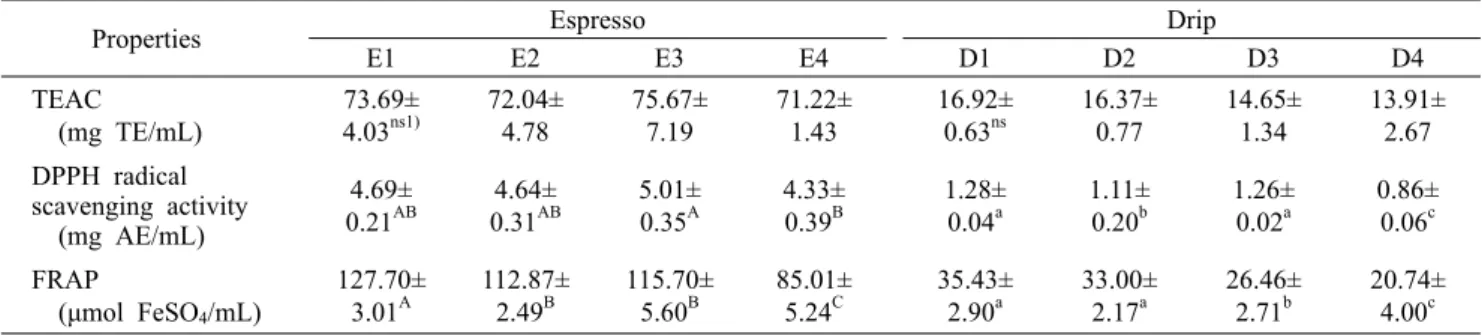
Table 3. TEAC, DPPH radical scavenging activity, and FRAP of Coffea arabica cv. Heirloom coffee extracts from Ethiopia with roasting degrees by two extraction methods
Properties Espresso Drip
E1 E2 E3 E4 D1 D2 D3 D4
TEAC (mg TE/mL)
73.69±
4.03ns1)
72.04±
4.78
75.67±
7.19
71.22±
1.43
16.92±
0.63ns
16.37±
0.77
14.65±
1.34
13.91±
2.67 DPPH radical
scavenging activity (mg AE/mL)
4.69±
0.21AB
4.64±
0.31AB
5.01±
0.35A
4.33±
0.39B
1.28±
0.04a
1.11±
0.20b
1.26±
0.02a
0.86±
0.06c FRAP
(μmol FeSO4/mL)
127.70±
3.01A
112.87±
2.49B
115.70±
5.60B
85.01±
5.24C
35.43±
2.90a
33.00±
2.17a
26.46±
2.71b
20.74±
4.00c E1: Light medium espresso, E2: Medium espresso, E3: Moderately dark espresso, E4: Very dark espresso, D1: Light medium drip, D2: Medium drip, D3: Moderately dark drip, D4: Very dark drip.
TE: Trolox equivalent, AE: ascorbic acid equivalent.
1)Means with the different letters in same row are significantly different (P<0.05).
A-CDuncan’s multiple range test in espresso samples.
a-cDuncan’s multiple range test in drip samples.
nsNot significant.
팅 원두에서 24.79 mg CE/g으로 가장 높은 총 플라보노이 드 함량을 보였으며, 생두 20.41 mg CE/g> medium 로스팅 원두 15.40 mg CE/g> dark 로스팅 원두 9.30 mg CE/g>
very dark 로스팅 원두 4.88 mg CE/g을 보여 본 연구 결과 와 유사하였다. 로스팅에 따른 총 플라보노이드 함량의 변화 는 light 로스팅 단계에서 약 20%까지 증가하며, 이후 열이 가해짐에 따라 파괴되어 dark 로스팅 단계에서는 전체 함량 의 약 23%만 남는다고 보고되었다(Cho 등, 2014). 커피의 로스팅은 Maillard 반응을 통해 항산화 물질의 화합물 형성 을 유도하며, 활성 화합물의 최종 손실에도 불구하고 커피 원두 전체의 항산화 물질의 합성 또는 형성 촉매 작용을 유 도한다(Tomaino 등, 2005).
Trolox equivalent antioxidant capacity (TEAC) 로스팅 정도에 따른 TEAC 항산화 활성 결과는 Table 3과 같다. 로스팅 정도에 따른 TEAC는 에스프레소 커피와 드립 커피에서 모두 유의적인 차이가 없었다. 드립 커피에서 는 D1(16.92 mg TE/mL)> D2(16.37 mg TE/mL)> D3 (14.65 mg TE/mL)> D4(13.91 mg TE/mL)의 순으로 Light medium 단계에서 가장 높았고, Very dark 단계에서 가장 낮았으며 로스팅이 강해질수록 감소하는 경향을 보였다.
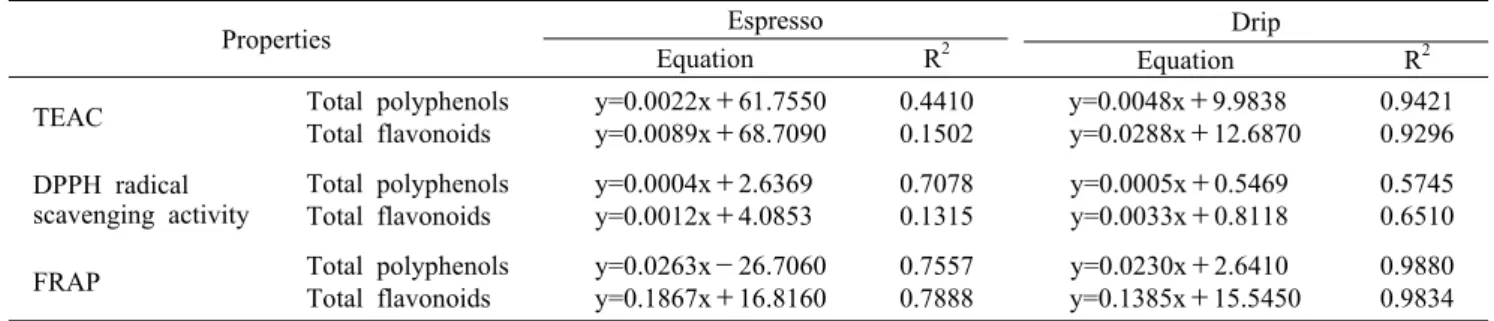
Gomez-Ruiz 등(2008)의 연구에서도 light 로스팅 단계에 서 TEAC가 가장 높았고, 그 이후에 점점 감소하는 결과를 보여주었다. Nam과 Kang(2015)의 연구에서 200°C 로스 팅에서 TEAC 활성이 52.75~60.21% 정도로 나타났으나, 250°C 로스팅에서는 47.31~56.70%로 감소하였다. 로스 팅에 따른 커피의 총 폴리페놀 함량과 TEAC의 상관관계는 Table 4와 같다. 에스프레소 커피(y=0.0022x+61.755;
R2=0.4410)와 비교하여 드립 커피(y=0.0048x+9.9838;
R2=0.9421)에서 높은 상관관계를 보였다. 로스팅에 따른 총 플라보노이드 함량과 TEAC의 상관관계는 드립 커피(y
=0.0288x+12.687; R2=0.9296)에서는 높았으나, 에스
프레소 커피(y=0.0089x+68.709; R2=0.1502)에서는 거 의 없었다.
DPPH 라디칼 소거 활성
로스팅 정도에 따른 DPPH 라디칼 소거 활성은 Table 3과 같다. 로스팅 정도에 따른 DPPH 소거 활성은 에스프레 소 커피에서 E3(5.01 mg AE/mL)> E1(4.69 mg AE/mL), E2(4.64 mg AE/mL)> E4(4.33 mg AE/mL)의 순으로 Moderately dark 단계에서 가장 높았고, Very dark 단계에 서 가장 낮았다. 드립 커피에서는 DPPH 라디칼 소거 활성이 D1(1.28 mg AE/mL)> D3(1.26 mg AE/mL)> D2(1.11 mg AE/mL)> D4(0.86 mg AE/mL)의 순으로, Light medium에 서 가장 높았고, 에스프레소 커피와 마찬가지로 Very dark 단계에서 가장 낮았다. Cho 등(2014)의 연구에서 DPPH 라 디칼 소거 활성은 light 로스팅 단계에서 35.54 mg AAE/g 으로 가장 높았으며, 이후 로스팅이 강해짐에 따라 medium 로스팅 단계에서 29.60 mg AAE/g> dark 로스팅 단계에서 25.66 mg AAE/g> very dark 로스팅 단계에서 20.16 mg AAE/g으로 감소하여 본 연구 결과와 유사하였다. 로스팅 정도가 높아짐에 따라 커피의 멜라노이딘 자유 라디칼 소거 활성은 감소하게 된다(Borrelli 등, 2002). Sunarharum 등 (2019)은 Arabica와 Robusta 원두에서 로스팅 온도가 증가 함에 따라 총 폴리페놀 함량이 감소하며, DPPH 라디칼 소거 활성이 유의적으로 감소한다고 보고하였다. 로스팅에 따른 총 폴리페놀 함량과 DPPH 라디칼 소거 활성의 상관관계는 에스 프레소 커피(y=0.0004x+2.6369; R2=0.7078)와 드립 커 피(y=0.0005x+0.5469; R2=0.5745)에서 모두 양의 상관 관계를 나타내었다(Table 4). 로스팅에 따른 총 플라보노이 드 함량과 DPPH 라디칼 소거 활성의 상관관계는 드립 커피 (y=0.0033x+0.8118; R2=0.6510)가 에스프레소 커피(y
=0.0012x+4.0853; R2=0.1315)보다 높았다.
Table 4. Correlation of TEAC, DPPH radical scavenging activity, and FRAP with total polyphenols and total flavonoids of Coffea arabica cv. Heirloom coffee extracts from Ethiopia with roasting degrees by two extraction methods
Properties Espresso Drip
Equation R2 Equation R2
TEAC Total polyphenols Total flavonoids
y=0.0022x+61.7550 y=0.0089x+68.7090
0.4410 0.1502
y=0.0048x+9.9838 y=0.0288x+12.6870
0.9421 0.9296 DPPH radical
scavenging activity Total polyphenols Total flavonoids
y=0.0004x+2.6369 y=0.0012x+4.0853
0.7078 0.1315
y=0.0005x+0.5469 y=0.0033x+0.8118
0.5745 0.6510 FRAP Total polyphenols
Total flavonoids
y=0.0263x-26.7060 y=0.1867x+16.8160
0.7557 0.7888
y=0.0230x+2.6410 y=0.1385x+15.5450
0.9880 0.9834
Ferric reducing antioxidant power (FRAP)
로스팅 정도에 따른 FRAP는 Table 3과 같다. 로스팅 정 도에 따른 FRAP는 에스프레소 커피에서 E1(127.70 μmol FeSO4/mL)> E2(112.87 μmol FeSO4/mL)> E3(115.70 μmol FeSO4/mL)> E4(85.01 μmol FeSO4/mL)의 순으로 Light medium 단계에서 가장 높았으며, Very dark 단계에 서 가장 낮았다. 드립 커피에서는 D1(35.43 μmol FeSO4/ mL)> D2(33.00 μmol FeSO4/mL)> D3(26.46 μmol FeSO4/ mL)> D4(20.74 μmol FeSO4/mL)의 순으로 Light medium 단계에서 가장 높았고 Very dark 단계에서 가장 낮아 에스프 레소 커피의 결과와 유사하였다. 로스팅에 따른 총 폴리페놀 함량과 FRAP의 상관관계는 에스프레소 커피(y=0.0263x
-26.706; R2=0.7557)와 드립 커피(y=0.023x+2.641;
R2=0.9880)에서 모두 높았다(Table 4). 로스팅에 따른 총 플라보노이드 함량과 FRAP 활성의 상관관계 또한 에스프 레소 커피(y=0.1867x+16.816; R2=0.7888)와 드립 커 피(y=0.1385x+15.545; R2=0.9834)에서 모두 높았다.
Pokorná 등(2015)의 연구에서 Arabica와 Robusta 원두에 서 로스팅 강도가 증가함에 따라 총 폴리페놀 함량과 FRAP 가 모두 감소하였다. 이는 에스프레소 커피와 드립 커피에서 로스팅에 따른 FRAP 감소는 총 폴리페놀 및 총 플라보노이 드 함량의 감소와 관련이 있을 것으로 생각된다.
요 약
본 연구에서는 에티오피아산 Coffea arabica cv. Heirloom 생두를 이용하여 로스팅 조건을 달리한 커피 원두를 제조하 고, 에스프레소 커피 및 드립 커피를 추출하여 총 폴리페놀 함량, 총 플라보노이드 함량, TEAC, DPPH 라디칼 소거 활 성, FRAP 등의 항산화 활성을 조사하였다. 총 폴리페놀 함 량은 에스프레소 커피에서는 Moderately dark 단계에서, 드립 커피에서는 Light medium 단계에서 가장 높았으며, Very dark 단계에서는 모두 가장 낮았다. 총 플라보노이드 함량은 에스프레소 커피와 드립 커피 모두 Light medium 단계에서 가장 높았으며, 로스팅이 강해질수록 감소하는 경 향을 보였다. 에스프레소 커피와 드립 커피에서 TEAC는 로스팅에 따른 시료 간에 유의적인 차이가 없었다. DPPH
라디칼 소거 활성은 에스프레소 커피와 드립 커피 모두에서 Very dark 단계에서 가장 낮았다. FRAP는 에스프레소 커 피와 드립 커피 모두 Light medium 단계에서 가장 높았으 며, 로스팅이 강해질수록 감소하여 Very dark 단계에서 가 장 낮았다. 드립 커피에서 TEAC와 로스팅에 따른 총 폴리 페놀, 총 플라보노이드 함량과의 상관관계는 높았다. FRAP 는 에스프레소와 드립 커피에서 모두 로스팅 정도에 따른 총 폴리페놀과 총 플라보노이드 함량과 양의 상관관계가 있 었다. 로스팅 강도는 커피의 총 폴리페놀과 총 플라보노이드 함량과 항산화 활성에 영향을 주는 것으로 여겨진다.
감사의 글
본 연구는 농림축산식품부 농림축산식품연구센터 지원사업 (과제번호 714001-07-5-SB110)에 의해 수행되었으며 이 에 감사드립니다.
REFERENCES
Belachew M. Coffee. In: Uhlig S, editor. Encyclopaedia Ae- thiopica. Harrassowitz Verlag, Wiesbaden, Germany. 2003.
Vol 1, p 763.
Benzie IF, Strain JJ. The ferric reducing ability of plasma (FRAP) as a measure of “antioxidant power”: the FRAP assay.
Anal Biochem. 1996. 239:70-76.
Blois MS. Antioxidant determinations by the use of a stable free radical. Nature. 1958. 181:1199-1200.
Borrelli RC, Visconti A, Mennella C, Anese M, Fogliano V.
Chemical characterization and antioxidant properties of cof- fee melanoidins. J Agric Food Chem. 2002. 50:6527-6533.
Bravo J, Arbillaga L, de Peña MP, Cid C. Antioxidant and geno- protective effects of spent coffee extracts in human cells. Food Chem Toxicol. 2013. 60:397-403.
Cano-Marquina A, Tarín JJ, Cano A. The impact of coffee on health. Maturitas. 2013. 75:7-21.
Chang CC, Yang MH, Wen HM, Chern JC. Estimation of total flavonoid content in propolis by two complementary colori- metric methods. J Food Drug Anal. 2002. 10:178-182.
Cho AR, Park KW, Kim KM, Kim SY, Han J. Influence of roasting conditions on the antioxidant characteristics of co- lombian coffee (Coffea arabica L.) beans. J Food Biochem.
2014. 38:271-280.
Choi YH, Kim SE, Huh J, Han YH, Lee MJ. Antibacterial and
antioxidative activity of roasted coffee and red ginseng mix- ture extracts. J Korean Soc Food Sci Nutr. 2012. 41:320-326.
Clarke RJ. Roasting and grinding. In: Clarke RJ, Macrae R, editors. Coffee Technology. Springer, London, UK. 1987. p 73-107.
Daglia M, Di Lorenzo A, Nabavi SF, Talas ZS, Nabavi SM.
Polyphenols: well beyond the antioxidant capacity: gallic acid and related compounds as neuroprotective agents: you are what you eat. Curr Pharm Biotechnol. 2014. 15:362-372.
del Castillo MD, Ames JM, Gordon MH. Effect of roasting on the antioxidant activity of coffee brews. J Agric Food Chem.
2002. 50:3698-3703.
Dybkowska E, Sadowska A, Rakowska R, Dębowska M, Świder- ski F, Świąder K. Assessing polyphenols content and anti- oxidant activity in coffee beans according to origin and the degree of roasting. Rocz Panstw Zakl Hig. 2017. 68:347-353.
Gomez-Ruiz JA, Ames JM, Leake DS. Antioxidant activity and protective effects of green and dark coffee components against human low density lipoprotein. Eur Food Res Technol. 2008.
227:1017-1024.
Halliwell B, Aeschbach R, Löliger J, Aruoma OI. The character- ization of antioxidants. Food Chem Toxicol. 1995. 33:601- 617.
Karakaya S, El SN, Taş AA. Antioxidant activity of some foods containing phenolic compounds. Int J Food Sci Nutr. 2001.
52:501-508.
Lim Y, Shin YK, Kim DW. Effect of germination and temper- ature on the antioxidant activity of coffee. Korean J Food Sci Technol. 2018. 50:198-202.
López-Galilea I, De Peña MP, Cid C. Correlation of selected constituents with the total antioxidant capacity of coffee bev- erages: influence of the brewing procedure. J Agric Food Chem. 2007. 55:6110-6117.
Martin MJ, Pablo F, Gonzalez AG, Valdnebro MS, Leon- Camacho M. Fatty acid profiles as discriminant parameters for coffee varieties differentiation. Talanta. 2001. 54:291-297.
Nam S, Kang S. Changes of biochemical components and phys- iological activities of coffee beans according to different
roasting conditions. Korean J Food Preserv. 2015. 22:182- 189.
Pellegrini N, Serafini M, Colombi B, Del Rio D, Salvatore S, Bianchi M, et al. Total antioxidant capacity of plant foods, beverages and oils consumed in Italy assessed by three differ- ent in vitro assays. J Nutr. 2003. 133:2812-2819.
Pérez-Martínez M, Caemmerer B, De Peña MP, Cid C, Kroh LW. Influence of brewing method and acidity regulators on the antioxidant capacity of coffee brews. J Agric Food Chem.
2010. 58:2958-2965.
Pokorná J, Venskutonis PR, Kraujalyte V, Kraujalis P, Dvořák P, Tremlová B, et al. Comparison of different methods of antioxidant activity evaluation of green and roast C. arabica and C. robusta coffee beans. Acta Alimentaria. 2015. 44: 454- 460.
Re R, Pellegrini N, Proteggente A, Pannala A, Yang M, Rice- Evans C. Antioxidant activity applying an improved ABTS radical cation decolorization assay. Free Radic Biol Med.
1999. 26:1231-1237.
Reineccius GA. The Maillard reaction and coffee flavor. Colloq Sci Int Cafe. 1995. 16:249-257.
Singleton VL, Rossi JA. Colorimetry of total phenolics with phosphomolybdic-phosphotungstic acid reagents. Am J Enol Vitic. 1965. 16:144-158.
Sunarharum WB, Yuwono SS, Aziza OF. Study on the effect of roasting temperature on antioxidant activity of early-roast- ed Java coffee powder (Arabica and Robusta). IOP Confer- ence Series Earth and Environmental Science. 2019. 230:
012045.
Svilaas A, Sakhi AK, Andersen LF, Svilaas T, Ström EC, Jacobs DR Jr, et al. Intakes of antioxidants in coffee, wine, and vege- tables are correlated with plasma carotenoids in humans. J Nutr. 2004. 134:562-567.
Tomaino A, Cimino F, Zimbalatti V, Venuti V, Sulfaro V, De Pasquale A, et al. Influence of heating on antioxidant activity and the chemical composition of some spice essential oils.
Food Chem. 2005. 89:549-554.