로스팅 조건에 따른 브라질산 Coffea arabica cv. Catuai 커피의 항산화 활성
김은경1*․송가영2*․김요섭2,3․김인용2․김성환4․김기영1․정윤화2,3
1경기대학교 관광전문대학원 외식산업경영학과, 2천연물식의약소재산업화연구센터
3단국대학교 식품영양학과, 4중부대학교 항공관광학부 식품영양학전공
Antioxidant Activities of Brazilian Coffea arabica cv. Catuai Coffee Extracts with Different Roasting Conditions
Eunkyung Kim1*, Ka-Young Song2*, Yosub Kim2,3, Inyong Kim2, Sung Hwan Kim4, Ki-Young Kim1, and Yoonhwa Jeong2,3
1Department of Food Service Industry Management, Graduate School of Tourism Business Management, Kyonggi University
2Research Center for Industrialization of Natural Neutralization and
3Department of Food Science and Nutrition, Dankook University
4Major of Food & Nutrition, Faculty of Aviations and Tourism, Joongbu University
ABSTRACT This study investigated the effect of using different roasting conditions (light medium, medium, moder- ately dark, and very dark) on the antioxidant activities of Brazilian Coffea arabica cv. Catuai extracts (both espresso and drip). The contents of the total polyphenols and flavonoids and the antioxidant activities [Trolox equivalence antioxidant capacity (TEAC), 1,1-diphenyl-2-picrylhydrazyl (DPPH), and ferric reducing antioxidant power (FRAP)]
were analyzed in the espresso and drip coffee extracts that were made with using different roasting conditions. The contents of total polyphenol and flavonoids were decreased with increasing the degree of roasting: both the espresso and drip coffee extracts had the lowest total polyphenol and flavonoids contents at very dark roasting. For the TEAC, the espresso extract was not significantly different as the degree of roasting increased (ranging from 36.83 to 38.78 mg Trolox/g), while those values of the drip extract were significantly decreased as the degree of roasting increased.
The DPPH radical scavenging capacity in both the espresso and drip extract was decreased as the degree of roasting increased. For the FRAP, the espresso extract did not show any significant differences as the degree of roasting increased, yet that of the drip extract was significantly decreased as the degree of roasting increased. Antioxidant compounds and activities were all affected by the roasting conditions as roasting time and temperature.
Key words: coffee, Coffea arabica cv. Catuai, roasting, antioxidant activities
Received 10 June 2019; Accepted 2 July 2019
Corresponding author: Yoonhwa Jeong, Department of Food Sci- ence and Nutrition, Dankook University, Cheonan, Chungnam 31116, Korea
E-mail: [email protected], Phone: +82-41-550-3477
*These authors contributed equally to this work.
Author information: Eunkyung Kim (Graduate student), Ka-Young Song (Professor), Yosub Kim (Graduate student), Inyong Kim (Pro- fessor), Sung Hwan Kim (Professor), Ki-Young Kim (Professor), Yoonhwa Jeong (Professor)
서 론
커피는 세계적으로 가장 많이 소비되는 음료 중 하나로, 특히 아시아 지역에서의 소비가 빠르게 증가하고 있다 (Kwak 등, 2017). 커피의 품종은 크게 Coffea arabica (Arabica종), Coffea canephora(Robusta종), Coffea lib- erica(Liberica종)의 3종으로 구분되며, Arabica종과 Rob-
usta종이 주로 생산되고 있다. Arabica종은 에티오피아의 고산지대에서 오랜 시간 동안 꾸준히 재배되어온 고품질의 품종으로 오늘날에도 널리 재배되고 있으며 전체 커피 생산 량의 약 70%를 차지한다(Kim 등, 2007). 주 생산국은 브라 질, 콜롬비아, 과테말라, 멕시코, 하와이, 코스타리카, 인도, 케냐, 에티오피아, 탄자니아 등이 있으며, 품종에는 Typica, Bourbon, National, Caturra, Catuai, Mundo Novo, Mara- gogype 등이 있다.
최근 소비자들은 커피의 카페인 및 생리활성 물질이 건강 과 웰빙 등 커피 섭취의 결과에 영향을 미치는지에 주 관심 을 두고 있으며, 커피와 건강의 연관성에 관한 연구도 증가 하는 추세이다(Derossi 등, 2017). 커피의 소비는 심혈관계 질환, 제2형 당뇨병, 알츠하이머, 파킨슨, 간경화, 대장암, 간암, 자궁암, 유방암 등의 여러 질병의 발병률을 감소시키 며(Hidgon과 Frei, 2006), 이러한 효과는 커피의 카페인 및 폴리페놀 화합물뿐만 아니라 로스팅 중의 Maillard 반응에
Table 1. Roasting conditions for the four roasting profiles
Sample Starting temperature (°C) Final temperature (°C) Total roasting time (min) Agtron number Light medium
Medium Moderately dark Very dark
170 170 170 170
195 200 210 228
5:27 6:19 6:39 8:01
67.20±0.60 56.50±0.80 46.00±0.60 27.40±0.40 의한 항산화 활성에 기인한다(Torres와 Farah, 2010). 대
부분의 천연 폴리페놀 화합물은 로스팅 중에 손실되지만, 커피의 항산화 활성은 Maillard 반응의 생성물로 인해 높아 지게 된다(Parliment, 2000; Nicoli 등, 1997; Bekedam 등, 2008; Perrone 등, 2012).
커피는 nicotinic acid, trigonelline, quinolinic acid, tannic acid, pyrogallic acid, caffeine 등 다양한 생리활성 물질을 많이 함유하고 있다(Minamisawa 등, 2004). 커피의 생리활성 물질은 각성 작용을 일으키는 카페인이 있으며, 카테킨(catechin), 안토시아닌(anthocyanin) 등의 플라보 노이드와 폴리페놀 화합물 등이 있다(Yukawa 등, 2004;
Lopez-Garcia 등, 2009). 특히 커피는 hydroxycinnamic acids 중 phenolic acids(caffeic, chlorogenic, coumaric, ferulic, sinapic acids 등) 함량이 풍부하여 폴리페놀 섭취 에 크게 기여하며 항산화제 역할을 한다(Manach 등, 2004;
Daglia 등, 2000).
로스팅(roasting) 과정에서 온도와 시간은 중요한 요소이 며 로스팅 시간이 길어질수록 쓴맛과 탄맛이 증가하게 된다.
특히 180~200°C 이상의 온도에서는 Maillard 반응 등에 의한 화합물의 변화, pyrolysis에 의한 유기화합물의 분해 등으로 생리활성 변화를 가져온다(Czerny 등, 1999; Daglia 등, 2000). 주요한 변화로는 chlorogenic acid, sucrose, trigonelline, amino acids 등의 감소이다(Trugo와 Macrae, 1984; Casal 등, 2000; Nehring과 Maier, 1992). 폴리페놀 화합물의 감소는 chlorogenic acid의 분해와 관련이 있으며 이는 항산화 능력에 영향을 끼친다고 알려져 있다(Nicoli 등, 1997; del Castillo 등, 2002).
커피의 로스팅 및 항산화 활성과 관련된 연구로는 로부스 타 원두의 로스팅 정도에 따른 생리활성 및 항산화 활성 (Herawati 등, 2019), 커피 로스팅에 따른 영양학적, 화학 적, 항산화 특성(Costa 등, 2018), 커피 로스팅에 따른 α- glucosidase 활성(Alongi와 Anese, 2018), 배전 강도와 추 출 시간에 따른 커피 추출물의 항산화 활성(Jo 등, 2016), 추출 시간 및 방법에 따른 커피 항산화 성분의 추출(Kwak 등, 2016; Ludwig 등, 2012), 배전 시간에 따른 커피 추출물 의 항균 및 항산화 효과(Kim과 Han, 2009), 고체 발효 커피 의 항산화 효과(Kwak 등, 2018) 등이 있다.
본 연구에서는 브라질산 Coffea arabica cv. Catuai 커피 의 로스팅 조건에 따른 항산화 활성에 대해 알아보고자 하였 다.
재료 및 방법
재료
생두는 Arabica종으로 2017년 6월에서 2018년 3월까지 수확된 Coffea arabica cv. Catuai(Brazil, Natural, NY2) 를 모이커피컴퍼니(Moi Coffee Company, Yongin, Korea) 에서 제공받아 사용하였다.
로스팅
생두는 Aillio Bullet R1 Roaster(Aillio, Taipei, Taiwan) 를 이용하여 스페셜티 커피 협회(The Specialty Coffee Association, SCA)의 8단계 분류법을 바탕으로 CM-100 (Lighttells, Zhubei City, Taiwan)을 이용한 4단계의 Ag- tron 값으로 로스팅하였다. 원두는 light medium(Agtron 70.17~60.36), medium(Agtron 60.07~50.00), moder- ately dark(Agtron 49.75~45.18), very dark(Agtron 30.07
~20.50)로 사용 시까지 -18°C에서 냉동 보관하였다(Table 1).
에스프레소 추출
에스프레소 커피는 반자동 그라인더 900N(Yang-Chia Machine Works Co., Ltd., Taipei, Taiwan)을 이용하여 분 쇄하였으며, 45 mesh 크기의 원두 분말 7 g을 반자동 에스 프레소 머신(E98 President A2, Faema, Milano, Italy)을 이용하여 30 mL 추출하였다. 에스프레소 커피는 light me- dium(E1), medium(E2), moderately dark(E3), very dark (E4)의 4가지 시료로 준비하였다.
드립 추출
드립 커피는 Fuji coffee mill R-440(Fujikouki Co., Ltd, Osaka, Japan)을 이용하여 분쇄하였으며, 25 mesh 크기의 원두 분말 15 g을 클레버 드리퍼(Mr. Clever, E.K, INT’L Co., Ltd., Taipei, Taiwan)를 이용하여 260 mL 추출하였 다. 드립 커피는 light medium(D1), medium(D2), moder- ately dark(D3), very dark(D4)의 4가지 시료로 준비하였 다.
시료 제조
커피 추출액은 Advantec No. 2 filter paper(Lot No.
60215106, Toyo Roshi Kaisha, Ltd., Tokyo, Japan)를 이용하여 여과 후 시료로 사용하였다.
총 폴리페놀 측정
총 폴리페놀 함량은 Alves 등(2010)의 방법을 응용하여 측정하였다. 에스프레소는 5배, 드립은 4배 희석한 후 96- well plate에 160 µL씩 넣고, Folin-Denis’s reagent(Sig- ma-Aldrich Co., St. Louis, MO, USA) 10 µL를 가하였다.
Folin-Denis’s reagent를 가한 뒤 8분 후 sodium carbo- nate(Cas.497-19-8, Showa Chemical Industry, Tokyo, Japan) 30 µL를 가하였다. 이후 암실에서 2시간 방치 후 Microplate reader(Spectramax M2E, Thermo Fisher Scientific, Waltham, MA, USA)를 이용하여 765 nm에서 흡광도를 측정하였으며, gallic acid(Cas.149-91-7, Sig- ma-Aldrich Co.) 표준곡선을 이용하여 함량을 계산하였다.
총 플라보노이드 측정
총 플라보노이드 함량은 Pourmorad 등(2006)과 Mari- nova 등(2005)의 방법을 응용하여 측정하였다. 에스프레소 는 20배, 드립은 5배 희석하였다. 시료 400 µL에 에탄올 (Cas.64-17-5, Junsei Chemical Co., Tokyo, Japan) 1,200 µL와 증류수 240 µL를 가한 후, 10% aluminum ni- trate(Cas.7784-27-2, Sigma-Aldrich Co.) 80 µL, 1.0 M potassium acetate(Cas.127-08-2, Sigma-Aldrich Co.) 80 µL를 차례로 가한 후 혼합하여 암실에서 40분간 방치하였 다. Microplate reader(Spectramax M2E, Thermo Fisher Scientific)를 이용하여 415 nm에서 흡광도를 측정하였으 며, 표준곡선 quercetin(Cas.6151-25-3, Sigma-Aldrich Co.)을 이용하여 함량을 계산하였다.
TEAC 측정
Trolox equivalence antioxidant capacity(TEAC)는 Oki 등(2006)과 Re 등(1999)의 방법을 응용하여 측정하였 으며, 에스프레소는 100배, 드립은 50배 희석한 후 시료 10 µL에 2,2’-azino-bis(3-ethylbenzothiazoline-6-sulfonic acid)(ABTS) reagent(Cas.30931-67-0, Sigma-Aldrich Co.) 200 µL를 첨가하여 암실에서 60분간 반응시켰다.
Microplate reader(Spectramax M2E, Thermo Fisher Scientific)를 이용하여 405 nm에서 측정하였다. 표준곡선 Trolox(Cas.53188-07-1, Sigma-Aldrich Co.)를 이용하 여 계산하였다.
DPPH 라디칼 소거능 측정
1,1-Diphenyl-2-picrylhydrazyl(DPPH)은 Serpen 등 (2012)과 Thaipong(2006)의 방법을 응용하여 측정하였으 며, 에스프레소는 100배, 드립은 50배 희석하였다. 시료 0.1 mL에 200 M DPPH reagent(Cas.84077-81-6, Sigma- Aldrich Co.) 0.1 mL를 첨가하였으며, 암실에서 30분간 반 응 후 Microplate reader(Spectramax M2E, Thermo Fisher Scientific)를 이용하여 520 nm에서 측정하였다. 표 준곡선 ascorbic acid(Cas.50-81-7, Sigma-Aldrich Co.)
를 이용하여 계산하였다.
FRAP 측정
Ferric reducing antioxidant power(FRAP)는 Benzie와 Strain(1999)의 방법을 응용하여 측정하였다. 에스프레소는 100배, 드립은 50배 희석하였으며 C2H3NaO2(Cas.127-09- 3, Sigma-Aldrich Co.)와 acetic acid(Cas.64-19-7, Sig- ma-Aldrich Co.)를 이용하여 acetic acid buffer(pH 3.6, 23 mM)를 제조하였다. 40 mM HCl(Cas.7647-01-0, Sig- ma-Aldrich Co.)과 TPTZ(2,4,6-tripyridyl-s-triazine) (Cas.3682-35-7, Sigma-Aldrich Co.)를 이용하여 10 mM TPTZ solution을 제조하였다. 시료 25 µL를 cocktail sol- ution(acetic acid : 10 mM TPTZ : 20 mM FeCl3・6H2O=
10:1:1)과 섞은 후 37°C를 유지하였으며 암실에서 15분간 반응 후 Microplate reader(Spectramax M2E, Thermo Fisher Scientific)를 이용하여 593 nm에서 측정하였다. 표 준곡선 FeSO4(Cas.7782-63-0, Sigma-Aldrich Co.)를 이 용하여 계산하였다.
통계처리
통계분석은 SPSS 통계프로그램(Statistical Package for the Social Science, Ver. 25.0, SPSS Inc., Chicago, IL, USA)을 이용하여 one-way ANOVA(analysis of varia- tion)로 분석하였다. Duncan’s multiple range test를 이용 하여 P<0.05 수준에서 유의성을 검증하였다.
결과 및 고찰
총 폴리페놀 및 총 플라보노이드 함량
로스팅 정도에 따른 총 폴리페놀 및 플라보노이드 함량은 Table 2와 같다. 총 폴리페놀 함량의 경우 에스프레소 커피 는 E1(0.85 mg gallic acid equivalent(GAE)/g)에서 E4 (0.52 mg GAE/g)로 로스팅이 강해질수록 총 폴리페놀 함량 이 감소하였다. 드립 커피도 D1(2.11 mg GAE/g)에서 D4 (1.92 mg GAE/g)로 로스팅이 강해짐에 따라 총 폴리페놀 함량이 감소하였다. Perrone 등(2012)의 연구에서 로스팅 시간이 길어짐에 따라 아라비카 원두의 폴리페놀 함량은 196.1 mg/100 g(6분)에서 175.2 mg/100 g(8분), 153.5 mg/100 g(9분), 94.0 mg/100 g(15분)으로 감소하였으며, 로스팅이 진행됨에 따라 카페인과 dihydrocaffeic acid의 함량이 감소하고 ferulic acid 함량이 증가하였다. 이는 페놀 화합물의 주요 물질인 phenolic acid가 분해되어 caffeic acid가 되고, caffeic acid가 분해되어 ferulic acid가 되고, ferulic acid가 quinic acid와 결합하여 chlorogenic acid가 되는 것과 연관이 있으며, chlorogenic acid 함량의 감소는 phenolic acids의 감소에 영향을 주어 페놀 화합물 함량이 감소하게 된다(Cano-Marquina 등, 2013). 로스팅 시 chlo- rogenic acid의 함량은 39.4%(6분)에서 25.6%(7분), 13.9%
Table 3. TEAC, DPPH, and FRAP of Coffea arabica cv. Catuai coffee extracts from Brazil with roasting degrees by two extraction methods
Properties Espresso Drip F-value
E1 E2 E3 E4 D1 D2 D3 D4
TEAC (mg Trolox/g)
37.37±
0.66a1)
38.62±
1.31a
38.78±
2.08a
36.83±
1.28a
15.93±
0.20b
14.31±
0.40bc
12.52±
0.51cd
11.40±
0.56d
463.104***
DPPH (mg ascorbic acid/g)
73.07±
1.25a
67.47±
0.98b
63.31±
1.44c
57.66±
0.83d
53.27±
0.68e
44.09±
0.73f
38.16±
0.95g
29.22±
1.88h
513.545***
FRAP
(mg FeSO4/g) 44.46±
1.88b 48.96±
0.95a 45.83±
0.30b 45.92±
1.33b 21.98±
1.23c 19.23±
0.57d 12.78±
0.12e 10.95±
0.60f 768.125***
E1: light medium espresso, E2: medium espresso, E3: moderately dark espresso, E4: very dark espresso, D1: light medium drip, D2: medium drip, D3: moderately dark drip, D4: very dark drip.
1)Means with the different letters (a-h) within a row are significantly different at P<0.05 by Duncan’s multiple range test in all samples.
***P<0.001.
Table 2. Total phenol and total flavonoid contents of Coffea arabica cv. Catuai coffee extracts from Brazil with roasting degrees by two extraction methods
Properties Espresso Drip F-value
E1 E2 E3 E4 D1 D2 D3 D4
Total phenols content (mg GAE/g)
0.85±
0.07c1)
0.70±
0.04cd
0.62±
0.04de
0.52±
0.05e
2.11±
0.18a
2.01±
0.12ab
1.98±
0.08ab
1.92±
0.09b
175.004***
Total flavonoids content (mg QE/g)
3.85±
0.05c
3.43±
0.05d
3.18±
0.03e
1.36±
0.05g
6.48±
0.25a
5.10±
0.21b
3.85±
0.12c
1.81±
0.04f
498.290***
E1: light medium espresso, E2: medium espresso, E3: moderately dark espresso, E4: very dark espresso, D1: light medium drip, D2: medium drip, D3: moderately dark drip, D4: very dark drip.
1)Means with the different letters (a-g) within a row are significantly different at P<0.05 by Duncan’s multiple range test in all samples.
***P<0.001.
(8분), 6.1%(9분), 2.1%(12분), 0.8%(15분)로 감소하였으 며 이는 폴리페놀 함량이 감소하는 결과와 일치하였다(Per- rone 등, 2012). 원두는 로스팅 진행 시 대부분의 페놀 화합 물이 파괴되며 Maillard 반응의 유리 라디칼과 반응하여 갈 변 물질을 생성한다(Nicoli 등, 1997).
총 플라보노이드 함량은 에스프레소 커피가 E1(3.85 mg quercetin equivalent(QE)/g)에서 E4(1.36 mg QE/g)로 로 스팅이 강해짐에 따라 감소하였으며, 드립 커피도 D1(6.48 mg QE/g)에서 D4(1.81 mg QE/g)로 로스팅이 강해짐에 따 라 감소하였다. Lee(2016)의 연구에서 로스팅 커피의 플라 보노이드 함량은 83.67 µg/mL(green bean), 111.33 µg/
mL(Agtron 95~85), 46.11 µg/mL(Agtron 75~65), 31.44 µg/mL(Agtron 55~45), 19.22 µg/mL(Agtron 35~25)로 Agtron 95~85 단계의 커피가 생두와 비교하여 많은 플라 보노이드 함량을 보였으며, 반면 로스팅 강도가 강해질수록 플라보노이드 함량은 감소하였다.
TEAC
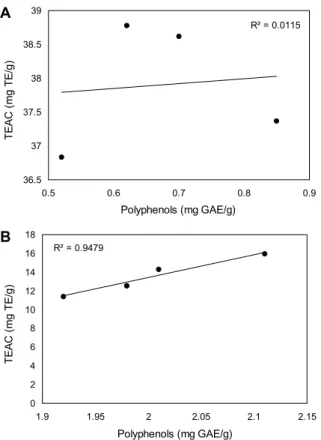
TEAC는 에스프레소 커피의 경우 36.83~38.78 mg Trolox/g으로 유의적인 차이가 없었다(Table 3). 반면 드립 커피는 로스팅 정도가 강해짐에 따라 D1(15.93 mg Trolox/
g)에서 D4(11.40 mg Trolox/g)로 감소하였다. Nam과 Kang (2015)의 연구에서는 210°C에서 로스팅한 원두의 항산화
활성이 59.86%(10분), 59.30%(15분), 58.99%(20분)로 유 의적인 차이가 없었으나(P>0.05), 210°C에서는 56.61%
(10분), 55.21%(15분), 53.99%(20분)로 로스팅 시간이 길 어짐에 따라 감소하였다. Gomez-Ruiz 등(2008)의 연구에 서는 6.15 µM Trolox/mL(green bean), 6.31 µM Trolox/
mL(light), 5.97 µM Trolox/mL(medium), 5.92 µM Tro- lox/mL(dark)로 생두와 비교하여 light 로스팅 단계에서 항 산화 활성이 증가하였으나, 로스팅 강도가 강해짐에 따라 항산화 활성이 감소하여 본 연구 결과와 유사하였다. 총 폴 리페놀 및 플라보노이드 함량에 따른 TEAC 값은 에스프레 소와 비교하여 드립 커피가 비례적으로 증가하였다(Fig. 1, 2). Eq. (1), (2):
y=24.455x-35.492; R2=0.9479 (1) y=0.9847x+9.2961; R2=0.9590 (2)
DPPH 라디칼 소거능
DPPH는 에스프레소 커피의 경우 E1(73.07 mg ascor- bic acid/g)에서 E4(57.66 mg ascorbic acid/g)로 로스팅 이 강해짐에 따라 감소하였으며, 드립 커피도 D1(53.27 mg ascorbic acid/g)에서 D4(29.22 mg ascorbic acid/g)로 로 스팅이 강해짐에 따라 감소하였다(Table 3). 에스프레소 커 피와 드립 커피 모두 very dark의 로스팅 단계에서 각각 57.66 mg ascorbic acid/g, 29.22 mg ascorbic acid/g으로
R² = 0.0115
36.5 37 37.5 38 38.5 39
0.5 0.6 0.7 0.8 0.9
Polyphenols (mg GAE/g)
TEAC (mg TE/g) .
A
R² = 0.9479
0 2 4 6 8 10 12 14 16 18
1.9 1.95 2 2.05 2.1 2.15
Polyphenols (mg GAE/g)
TEAC (mg TE/g) .
B
Fig. 1. Correlation of Trolox equivalent antioxidant capacity with polyphenols in espresso (A) and drip (B).
R² = 0.3191
36.5 37 37.5 38 38.5 39
1 1.5 2 2.5 3 3.5 4
Total flavonoids (mg QE/g)
TEAC (mg TE/g) .
A
R² = 0.959
0 2 4 6 8 10 12 14 16 18
1 2 3 4 5 6 7
Total flavonoids (mg QE/g)
TEAC (mg TE/g) .
B
Fig. 2. Correlation of Trolox equivalent antioxidant capacity with total flavonoids in espresso (A) and drip (B).
가장 낮은 항산화 활성을 보였다. Kim과 Han(2009)의 연구 에서 로스팅 시간이 길어짐에 따라 자유 라디칼 소거 활성이 증가하다가 감소하였으며, 0~10분에는 자유 라디칼 소거 활성에 유의적인 차이가 없었으나, 20분에는 크게 감소하여 25분에서 가장 낮은 항산화 활성을 보였다(P>0.05). Kim과 Park(2006)의 연구에서도 로스팅 시간에 따라 갈색도 및 항산화 활성이 비례하여 증가하다가 14분 이후부터 항산화 활성이 감소하여 본 연구 결과와 유사하였다. Herawati 등 (2019)의 연구에서도 early yellow 및 brown 단계에서 생 두와 비교하여 높은 활성을 보였으나 첫 번째 crack 이후 로스팅이 진행됨에 따라 항산화 활성이 감소하였다. 당류 및 아미노산 가열 시 생성되는 갈변 물질은 가열시간 및 갈 색도가 증가함에 따라 항산화 활성을 증가시키나 어느 이상 의 가열시간 이후부터는 갈색도의 증가와 관계없이 항산화 활성이 감소하게 된다(Vandewalle 등, 1980). 로스팅 과정 을 통해 생성되는 갈변 물질의 항산화 활성은 원두 내 자당 이 chlorogenic acid와 반응하여 생성된 glyceraldehyde 및 glycolaldehyde에서 기인된다(Rhi와 Shin, 1993). 총 폴 리페놀 함량에 따른 DPPH 값은 에스프레소와 드립 커피 모두 비례적으로 증가하였으며(Fig. 3), 총 플라보노이드 함 량에 따른 DPPH 값은 에스프레소보다 드립 커피가 비례적 으로 증가하였다(Fig. 4). Eq. (3), (4):
y=125.72x-210.88; R2=0.9737 (3) y=5.0721x+19.324; R2=0.9890 (4)
FRAP
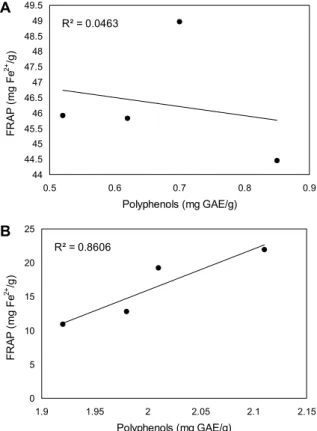
FRAP는 에스프레소 커피의 경우 E1이 44.46 mg FeSO4/ g으로 가장 낮았으며 E2에서 48.96 mg FeSO4/g으로 증가 하였다가 다시 낮아져 E3와 E4는 45.83~45.92 mg FeSO4/ g으로 유의적인 차이가 없었다(Table 3). 드립 커피는 D1 (21.98 mg FeSO4/g)에서 D4(10.95 mg FeSO4/g)로 로스 팅 정도가 강해짐에 따라 감소하였다. Perrone 등(2012)의 연구에서 드립 커피의 환원력은 로스팅 시간이 길어짐에 따 라 감소하였으며, 특히 220°C에서 15분간의 로스팅 단계 (dark, very dark)에서는 생두와 비교하여 FRAP 활성이 42% 감소하였다. Gornas 등(2016)의 연구에서도 FRAP 분 석 시 생두에서 가장 높은 값을 보였으며, dark 단계의 커피 에서 가장 낮은 값을 보였다. FRAP는 로스팅 강도가 강해짐 에 따라 감소하였으며, 로부스타 커피가 아라비카 커피와 비교하여 높은 환원력을 나타내었다. 반면 Herawati 등 (2019)의 연구에서는 25.13%(green bean), 24.74%(very light), 29.14%(light), 28.38%(medium), 27.21%(dark)로 생두와 비교하여 로스팅 시 FRAP 값이 높아지는 결과를 보였다. FRAP는 커피 로스팅 시 형성되는 갈변 물질인 멜라 닌 색소의 영향을 받는 것으로 여겨진다(Richelle 등, 2001;
Moreira 등, 2005). 총 폴리페놀 및 플라보노이드 함량에 따른 FRAP 값은 에스프레소와 비교하여 드립 커피가 비례 적으로 증가하였다(Fig. 5, 6). Eq. (5), (6):
R² = 0.9882
0 10 20 30 40 50 60 70 80
0.5 0.6 0.7 0.8 0.9
Polyphenols (mg GAE/g)
DPPH (mg AE/g) .
A
R² = 0.9737
0 10 20 30 40 50 60
1.9 1.95 2 2.05 2.1 2.15
Polyphenols (mg GAE/g)
DPPH (mg AE/g) .
B
Fig. 3. Correlation of DPPH radical scavenging activity with polyphenols in espresso (A) and drip (B).
R² = 0.8432
0 10 20 30 40 50 60 70 80
1 1.5 2 2.5 3 3.5 4
Total flavonoids (mg QE/g)
DPPH (mg AE/g) .
A
R² = 0.989
0 10 20 30 40 50 60
1 2 3 4 5 6 7
Total flavonoids (mg QE/g)
DPPH (mg AE/g) .
B
Fig. 4. Correlation of DPPH radical scavenging activity with total flavonoids in espresso (A) and drip (B).
R² = 0.0463
44 44.5 45 45.5 46 46.5 47 47.5 48 48.5 49 49.5
0.5 0.6 0.7 0.8 0.9
Polyphenols (mg GAE/g) FRAP (mg Fe2+/g) .
A
R² = 0.8606
0 5 10 15 20 25
1.9 1.95 2 2.05 2.1 2.15
Polyphenols (mg GAE/g) FRAP (mg Fe2+/g) .
B
Fig. 5. Correlation of ferric reducing antioxidant power with polyphenols in espresso (A) and drip (B).
R² = 0.0003
44 44.5 45 45.5 46 46.5 47 47.5 48 48.5 49 49.5
1 1.5 2 2.5 3 3.5 4
Total flavonoids (mg QE/g) FRAP (mg Fe2+/g) .
A
R² = 0.9098
0 5 10 15 20 25
1 2 3 4 5 6 7
Total flavonoids (mg QE/g) FRAP (mg Fe2+/g) .
B
Fig. 6. Correlation of ferric reducing antioxidant power with total flavonoids in espresso (A) and drip (B).
y=61.048x-106.17; R2=0.8606 (5) y=2.5125x+5.4059; R2=0.9098 (6)
요 약
본 연구에서는 브라질산 Coffea arabica cv. Catuai 생두를 이용하여 로스팅 조건을 달리한 에스프레소 및 드립 커피를 제조한 후 총 폴리페놀 함량과 총 플라보노이드 함량 및 항 산화 활성(TEAC, DPPH, FRAP)을 분석하였다. 총 폴리페 놀 함량과 총 플라보노이드 함량은 로스팅 강도가 강해질수 록 값이 감소하였으며, 에스프레소 및 드립 커피 모두 very dark 단계에서 가장 낮은 값을 나타내었다. 항산화 활성은 TEAC의 경우 에스프레소는 36.83~38.78 mg Trolox/g으 로 유의적인 차이가 없었으나, 드립 커피는 15.93~11.40 mg Trolox/g으로 로스팅 강도가 강해짐에 따라 감소하였 다. DPPH는 에스프레소와 드립 커피 모두 로스팅이 진행됨 에 따라 항산화 활성이 감소하여 very dark 단계에서 각각 57.66 mg ascorbic acid/g, 29.22 mg ascorbic acid/g으로 가장 낮은 항산화 활성을 보였다. FRAP의 경우 에스프레소 는 medium 단계에서 가장 높은 환원력을 보였으며, 이후 단계부터는 감소하였다. 드립 커피는 로스팅이 진행됨에 따 라 환원력이 감소하였다. 이상의 연구 결과 로스팅이 진행될 수록 항산화 물질의 함량 및 항산화 활성이 감소하였으며, 커피 추출방법에 따라서는 드립 커피가 총 폴리페놀 및 플라 보노이드 함량과 비례하여 항산화 활성이 증가하였다. 따라 서 소비자들의 커피 섭취를 통한 건강과 웰빙 등의 욕구를 충족시키기 위해서는 적절한 로스팅 단계의 선별 및 추출방 법 등이 고려되어야 할 것으로 여겨진다.
감사의 글
본 연구는 농림축산식품부 농림축산식품연구센터 지원사업 (과제번호 714001-07-5-SB110)에 의해 수행되었으며 이 에 감사드립니다.
REFERENCES
Alongi M, Anese M. Effect of coffee roasting on in vitro α- glucosidase activity: inhibition and mechanism of action.
Food Res Int. 2018. 111:480-487.
Alves RC, Costa AS, Jerez M, Casal S, Sineiro J, Núñez MJ, et al. Antiradical activity, phenolics profile, and hydroxymeth- ylfurfural in espresso coffee: influence of technological fac- tors. J Agric Food Chem. 2010. 58:12221-12229.
Bekedam EK, Schols HA, Van Boekel MA, Smit G. Incorpora- tion of chlorogenic acids in coffee brew melanoidins. J Agric Food Chem. 2008. 56:2055-2063.
Benzie IF, Strain JJ. Ferric reducing/antioxidant power assay:
direct measure of total antioxidant activity of biological fluids and modified version for simultaneous measurement of total antioxidant power and ascorbic acid concentration. Method Enzymol. 1999. 299:15-27.
Cano-Marquina A, Tarín JJ, Cano A. The impact of coffee on health. Maturitas. 2013. 75:7-21.
Casal S, Oliveira MB, Ferreira MA. HPLC/diode-array applied to the thermal degradation of trigonelline, nicotinic acid and caffeine in coffee. Food Chem. 2000. 68:481-485.
Costa ASG, Alves RC, Vinha AF, Costa E, Costa CSG, Nunes MA, et al. Nutritional, chemical and antioxidant/pro-oxidant profiles of silverskin, a coffee roasting by-product. Food Chem.
2018. 267:28-35.
Czerny M, Mayer F, Grosch W. Sensory study on the character impact odorants of roasted arabica coffee. J Agric Food Chem.
1999. 47:695-699.
Daglia M, Papetti A, Gregotti C, Bertè F, Gazzani G. In vitro antioxidant and ex vivo protective activities of green and roasted coffee. J Agric Food Chem. 2000. 48:1449-1454.
del Castillo MD, Ames JM, Gordon MH. Effect of roasting on the antioxidant activity of coffee brews. J Agric Food Chem.
2002. 50:3698-3703.
Derossi A, Ricci I, Caporizzi R, Fiore A, Severini C. How grind- ing level and brewing method (Espresso, American, Turkish) could affect the antioxidant activity and bioactive compounds in a coffee cup. J Sci Food Agric. 2017. 98:3198-3207.
Gomez-Ruiz JA, Ames JM, Leake DS. Antioxidant activity and protective effects of green and dark coffee components against human low density lipoprotein oxidation. Eur Food Res Tech- nol. 2008. 227:1017-1024.
Gornas P, Dwiecki K, Siger A, Tomaszewska-Gras J, Michalak M, Polewski K. Contribution of phenolic acids isolated from green and roasted boiled-type coffee brews to total coffee antioxidant capacity. Eur Food Res Technol. 2016. 2422:641- 653.
Herawati D, Giriwono PE, Dewi FNA, Kashiwagi T, Andarwu- lan N. Critical roasting level determines bioactive content and antioxidant activity of Robusta coffee beans. Food Sci Bio- technol. 2019. 28:7-14.
Higdon JV, Frei B. Coffee and health: a review of recent human research. Crit Rev Food Sci Nutr. 2006. 46:101-123.
Jo SJ, In MJ, Kim DC. Effect of the roasting intensity and ex- traction time of coffee bean on the antioxidant activity of cof- fee extract. Food Eng Prog. 2016. 20:165-169.
Kim HK, Hwang SY, Yoon SB, Chun DS, Kong SK, Kang KO.
A study of the characteristics of different coffee beans by roasting and extracting condition. Korean J Food Nutr. 2007.
20:14-19.
Kim JY, Han YS. Influence of roasting time on antibacterial and antioxidative effects of coffee extract. Korean J Food Cook Sci. 2009. 25:496-505.
Kim KJ, Park SK. Changes in major chemical constituents of green coffee beans during the roasting. Korean J Food Sci Technol. 2006. 38:153-158.
Kwak H, Ji S, Kim M, Lee Y, Jeong Y. Antioxidant activity and total polyphenol content of coffee extracted by three ex- traction methods. Agro Food Ind Hi Tec. 2016. 27:15-18.
Kwak HS, Jeong Y, Kim M. Effect of yeast fermentation of green coffee beans on antioxidant activity and consumer ac- ceptability. J Food Qual. 2018. Article ID: 5967130.
Kwak HS, Ji S, Jeong Y. The effect of air flow in coffee roasting for antioxidant activity and total polyphenol content. Food Control. 2017. 71:210-216.
Lee JC. A study of compound changes in coffee beans by differ- ent roasting condition. Culi Sci & Hos Res. 2016. 22:114-119.
Lopez-Garcia E, Rodriguez-Artalejo F, Rexrode KM, Logroscino G, Hu FB, van Dam RM. Coffee consumption and risk of stroke in women. Circulation. 2009. 119:1116-1123.
Ludwig IA, Sanchez L, Caemmerer B, Kroh LW, De Pena MP, Cid C. Extraction of coffee antioxidants: impact of brewing time and method. Food Res Int. 2012. 48:57-64.
Manach C, Scalbert A, Morand C, Rémésy C, Jiménez L. Poly- phenols: food sources and bioavailability. Am J Clin Nutr.
2004. 79:727-747.
Marinova D, Ribarova F, Atanassova M. Total phenolics and total flavonoids in Bulgarian fruits and vegetables. J Univ Chem Technol Metall. 2005. 40:255-260.
Minamisawa M, Minamisawa H, Yoshida S, Takai N. Adsorp- tion behaviours of copper and cadmium on roasted coffee beans. Chem Aust. 2004. 71:17-19.
Moreira DP, Monteiro MC, Ribeiro-Alves M, Donangelo CM, Trugo LC. Contribution of chlorogenic acids to the iron-re- ducing activity of coffee beverages. J Agric Food Chem. 2005.
53:1399-1402.
Nam SH, Kang S. Changes of biochemical components and physiological activities of coffee beans according to different roasting conditions. Korean J Food Preserv. 2015. 22:182-189.
Nehring UP, Maier HG. Indirect determination of the degree of roast in coffee. Eur Food Res Technol. 1992. 195:39-42.
Nicoli MC, Anese M, Manzocco L, Lerici CR. Antioxidant prop- erties of coffee brews in relation to the roasting degree. LWT
-Food Sci Technol. 1997. 30:292-297.
Oki T, Nagai S, Yoshinaga M, Nishiba Y, Suda I. Contribution of β-carotene to radical scavenging capacity varies among orange-fleshed sweet potato cultivars. Food Sci Technol Res.
2006. 12:156-160.
Parliment TH. An overview of coffee roasting. In: Parliment TH, Ho CT, Schieberle P, editors. Caffeinated Beverages:
Health Benefits, Physiological Effects, and Chemistry. ACS Symposium Series 754. American Chemical Society, Washing- ton, DC, USA. 2000. p 188-201.
Perrone D, Farah A, Donangelo CM. Influence of coffee roasting on the incorporation of phenolic compounds into melanoidins and their relationship with antioxidant activity of the brew.
J Agric Food Chem. 2012. 60:4265-4275.
Pourmorad F, Hosseinimehr SJ, Shahabimajd N. Antioxidant ac- tivity, phenol and flavonoid contents of some selected Iranian medicinal plants. African J Biotechnol. 2006. 5:1142-1145.
Re R, Pellegrini N, Proteggente A, Pannala A, Yang M, Rice- Evans C. Antioxidant activity applying an improved ABTS radical cation decolorization assay. Free Radic Biol Med.
1999. 26:1231-1237.
Rhi JW, Shin HS. Antioxidative effect of brown materials ex- tracted from roasted coffee beans. Korean J Food Sci Technol.
1993. 25:220-224.
Richelle M, Tavazzi I, Offord E. Comparison of the antioxidant activity of commonly consumed polyphenolic beverages (cof- fee, cocoa, and tea) prepared per cup serving. J Agric Food Chem. 2001. 49:3438-3442.
Serpen A, Gokmen V, Fogliano V. Total antioxidant capacities of raw and cooked meats. Meat Sci. 2012. 90:60-65.
Thaipong K, Boonprakob U, Crosby K, Cisneros-Zevallos L, Byrne DH. Comparison of ABTS, DPPH, FRAP, and ORAC assays for estimating antioxidant activity from guava fruit extracts. J Food Compos Anal. 2006. 19:669-675.
Torres T, Farah A. Coffee is the most important contributor to the antioxidant capacity in Brazilian’s diet. FASEB J. 2010.
24:919.
Trugo LC, Macrae R. A study of the effect of roasting on the chlorogenic acid composition of coffee using HPLC. Food Chem. 1984. 15:219-227.
Vandewalle L, Huyghebaert A. The antioxidant activity of the non-enzymatic browning reaction in sugar-protein systems.
Announcements from the Faculty of Agricultural Sciences, University of Ghent. 1980. 45:1277-1286.
Yukawa GS, Mune M, Otani H, Tone Y, Liang XM, Iwahashi H, et al. Effects of coffee consumption on oxidative suscepti- bility of low-density lipoproteins and serum lipid levels in humans. Biochemistry (Mosc). 2004. 69:70-74.