• 검색 결과가 없습니다.

Factors Affecting the Efficiency of Corporate Income Tax Management in Vietnam: Evidence from Mekong Delta Provinces

N/A
N/A
Protected

Academic year: 2021

Share "Factors Affecting the Efficiency of Corporate Income Tax Management in Vietnam: Evidence from Mekong Delta Provinces"

Copied!
8
0
0

로드 중.... (전체 텍스트 보기)

전체 글

(1)

Print ISSN: 2288-4637 / Online ISSN 2288-4645 doi:10.13106/jafeb.2021.vol8.no2.0175

Factors Affecting the Efficiency of Corporate Income Tax Management in Vietnam: Evidence from Mekong Delta Provinces*

Ha Hong NGUYEN

1

Received: November 05, 2020 Revised: December 30, 2020 Accepted: January 08, 2021

Abstract

The purpose of this study is to propose policy implications for improving the efficiency of corporate income tax management in Vietnam, by analyzing the study factors affecting the efficiency of corporate income tax management (evidence from Mekong Delta provinces, Vietnam).

This study used a primary data collection method and collected data of 329 enterprises, including 49 joint-stock companies and 280 limited liability companies in 3 provinces - Tra Vinh province, Soc Trang province, and Ben Tre province. By using the binary regression method, the author discovered eight factors affecting the efficiency of corporate income tax management in the Mekong Delta region such as the time of operation of the enterprises, type of business, gender, business results, tax amount temporarily paid, compliance with tax policies, business scale, and tax debt ratio. From the above research results, the author proposes policies to support Tax Departments to improve the efficiency of corporate income tax management in the Mekong Delta region in the future. These policies include - for further promoting the tax policy propaganda to enterprises, tax authorities need to promptly handle tax arrears, enhance the inspection of tax debt enterprises, and focus on the business models, gender, age of the business owners, etc.

Keywords: Tax Management, Corporate Incomes, Limited Liability Companies, Joint Stock Companies, Mekong Delta JEL Classification Code: K34, M14, P29, Q58, R50

ensures the balance of State-based budget revenues and expenditures, at the same time, contribute to promoting the effects of macro-economic regulation and social justice implementation (Do, 2015). Corporate income tax not only brings a huge source of revenue to the State-based budget, but it is also a governmental tool to implement social justice policies and regulate the business activities of enterprises in a market economy (Pham, 2018). Besides, it can be possible that the investors try to seek ways to maximize their profits including tax evasion and avoidance Nguyen (2011).

The statistics of 2019 corporate income tax finalization in the three provinces of the Mekong Delta: Ben Tre, Tra Vinh, and Soc Trang show that the number of enterprises that are covered under corporate income tax is 5358 enterprises, of which 3645 enterprises are earning profits (accounting for 69% of total enterprises settling taxes), 1713 enterprises reported losses (accounting for 31% of total enterprises settling taxes). ), and 936 businesses were exempt from tax.

The number of enterprises who paid corporate income tax in 2019 was 2964 when compared to 2880 enterprises that paid corporate income tax in 2018; this is an increase of approximately 5.5% (Department of Taxation of Soc Trang

*Acknowledgements:

The research is sponsored by Tra Vinh University and the author sincerely thank for the support and assistance of the survey team of Faculty of Economics, Tra Vinh University; Department of Taxation of Soc Trang province; Department of Taxation of Tra Vinh province and Department of Taxation of Ben Tre province, Viet Nam and 329 enterprises; including 49 joint-stock companies and 280 limited liability companies in 3 provinces: Tra Vinh, Soc Trang, and Ben Tre have enthusiastically helped, provided survey data and information.

The author sincerely thanks the enthusiastic support of these research groups.

1

First Author and Corresponding Author. Associate Professor, Vice Dean, School of Economics and Law, Tra Vinh University, Viet Nam [Postal Address: 126 Nguyen Thien Thanh Street, Ward 5, Tra Vinh City, Tra Vinh Province, 940000, Viet Nam]

Email: [email protected] ; [email protected] ; [email protected]

© Copyright: The Author(s)

This is an Open Access article distributed under the terms of the Creative Commons Attribution Non-Commercial License (https://creativecommons.org/licenses/by-nc/4.0/) which permits unrestricted non-commercial use, distribution, and reproduction in any medium, provided the original work is properly cited.
1. Introduction

The core of the study is to investigate the way the tax

policy achieves its goal of creating a solid revenue source,

(2)

Province; Department of Taxation of Tra Vinh Province;

Department of Taxation of Ben Tre Province (2019).

Besides, to minimize difficulties for enterprises, for reforming tax administrative procedures the Circular 151/2014 / TT-BTC dated October 10, 2014 (MP Law Firm, 2014), of the Ministry of Finance, guiding the implementation of Decree No. 91/2014 / ND-CP dated October 1, 2014 (MP Law Firm, 2014), of the Government must be followed (amending and supplementing a number of articles of decrees on taxes). According to the business result, the taxpayer makes the provisional payment of corporate income tax in the quarter within 30 days of the quarter succeeding the quarter in which tax is incurred. Every business that makes quarterly financial statements shall determine the provisional amount of corporate income tax in each quarter according to quarterly financial statements and regulations of law on taxation. Every business that is not required to make financial statements quarterly shall determine the provisional amount of corporate income tax in each quarter according to the amount of corporate income tax of the previous year and estimated business result in that year. If the total of four provisional tax payments is smaller than the amount payable according to the financial statement by 20% or more, the taxpayer shall incur interest on the amount that exceeds the 20% difference.

Taking advantage of the decree, business owners do not have to make temporary (provisional) payment quarterly in the year, but they must pay in the fourth quarter (the 30th day of the first month of the following year) and pay 80%

of the temporarily payable amount calculated according to the annual settlement of the year (Van, 2020). In the past, there was no interest payment for the difference in tax paid, which caused loss to the State-based budget revenue from corporate income tax, and at the same time, tax authorities could not impose any sanctions because there was no specific regulation. The centralized tax management system TMS used for the entire country did not have any specific regulation(s) concerning the delay in paying corporate income tax or failure to pay the corporate income tax.

2. Literature Review

Nguyen and Pham (2020) ascertained the key factors affecting tax compliance among Vietnamese firms in Vietnam. The results of the research showed that voluntary tax compliance is directly affected by the three factors of audit probability, corporate reputation, and business ownership. The probability of audit and severity of sanctions have the strongest impact on tax compliance. Therefore, the tax authorities need to strengthen the inspection of tax declarations, tax payments, and tax refunds of firms. The paper confirmed that enforced tax compliance is directly

affected by the three factors of audit probability, sanction severity, and social norms. Voluntary compliance and compulsory compliance affect tax compliance, though voluntary compliance has a more powerful impact.

Blaylock et al. (2015) used a panel of 139,536 firm-year observations across 34 countries over the period 1996–2007 to test whether high levels of book-tax conformity are associated with less earnings management. They found that higher book-tax conformity is associated with significantly more, not less, earnings management. They concluded that one of the claimed benefits of increasing book-tax conformity, more truthful financial reporting with less earnings management, is unlikely to be as large as previously thought.

Francis et al. (2014) investigated the effect of CFO gender on corporate tax aggressiveness. Focusing on firms that experience a male-to-female CFO transition, the paper compares those firms’ degree of tax aggressiveness during the pre-and post-transition periods. Using the probability of tax sheltering, the predicted unrecognized tax benefits, and the discretionary permanent book-tax differences to measure tax aggressiveness, they found that female CFOs are associated with less tax aggressiveness as compared to their male counterparts. The main findings are supported by additional tests based on propensity score matching, difference-in-differences tests, and tests with a female- to-male CFO transition sample. Overall, their study established CFO gender as an important determinant of tax aggressiveness.

Mulyadi et al. (2013) focused on Indonesian listed corporations and several events of corporate income tax rate changes in the last five years. Using discretionary accrual as an earnings management measurement, they found there is a significant impact of corporate income tax rate changes to corporate earnings management with the evidence of income minimization practice. While for earnings management determinant, they only found one variable out of four variables they tested in this research: earnings pressure which is significant in 10%.

Palil et al. (2013) attempted to reveal the determinants

of tax compliance in Malaysia in a self-assessment system

(SAS) with special emphasis on individual taxpayers. Four

tax compliance determinants were examined: the probability

of being audited; the perception of government spending; tax

rates; and the role of the tax authority. From a survey of 1073

respondents, the results showed that all four determinants

have a significant impact on tax compliance. Further,

their study contributed by providing evidence of other

key tax compliance determinants in a developing country,

particularly in Asia, that is generally under-researched. These

determinants are expected to affect tax compliance behavior

(3)

in other countries that have similar taxpayer backgrounds, cultures, economic environments, and policies.

Lanis et al. (2015) examined the impact of board of directors’ gender diversity on corporate tax aggressiveness.

Based on a sample of 418 U.S. firms covering the 2006–2009 period (1672 firm-year observations), the ordinary least squares regression results showed a negative and statistically significant association between female representation on the board and tax aggressiveness after controlling for endogeneity. Their results are consistent across several measures of tax aggressiveness and additional robustness checks.

Nguyen (2014) used the method of time series analysis and the comparison method which are usually applied by the experts to analyze changes in tax collection, compare tax administration of small and medium enterprises. Nguyen and Nguyen (2012) collected the data of 170 private enterprises operating in Ho Chi Minh City to identify factors affecting tax compliance behaviors of enterprises. The research suggested that tax compliance by private enterprises, to pay taxes on time, can be affected by the factors related to the business performance, namely the profitability of the enterprises, total tax payable, business sector, and genders of the business owners.

Mai and Le (2018) surveyed 120 subjects including 80 enterprises and 40 family businesses currently under the management of Ung Hoa District Sub-Department.

elements: (1) Punishment, enforcement, (2) Tax officers’

skills, (3) Inspection activities, (4) Propaganda and supporting activities, (5) Tools and facilities significantly affecting the quality of tax administration at Ung Hoa District Tax Department. Nguyen (2014) used descriptive statistical methods and comparative analysis methods to analyze and evaluate the role of the authoritative department in tax administration as well as the difficulties and limitations for the role of the authoritative departments in tax administration concerning assessing the changes in the number of enterprises, the structure of the enterprises, assessing changes in tax policies, compliance of tax policies of enterprises, the implementation of tax administration procedures, and solutions to enhance tax management of the enterprises

Ha and Trinh (2019) investigated factors influencing business households’ decisions for borrowing credit. The study was conducted by collecting data from 300 business households traded at four commercial banks in Tra Vinh province. By the use of the binary logistic regression method, the research found out that the factors influencing the ‘borrow-credit’ decision of business households at commercials banks in Tra Vinh province. They were the bank’s brand name, loan interest rates, service attitude, and loan procedures. Of those, the bank’s brand name and lending

interest rates have the strongest impacts on the borrow-credit decision of business households at commercials banks in Tra Vinh province. Since then, the study has proposed solutions to improve access to credit of business households in commercial banks in Tra Vinh province in the coming time, such as. developing a bank brand, developing flexible lending interest rate policies, improve the service style of bank staff, at the same time, and simplifying lending procedures

Nguyen (2011) systematically used statistical methods to collect, synthesize, and analyze data. There can be different types of data: collected data, combined survey questionnaires conducted based on statistical classification methods according to different criteria. Depending on the content of the research and construction criteria, the researcher sets up a system of tables to analyze and assess the situation of tax administration.

Tran (2013) aimed to explore the application with Balanced Scorecard in enterprises according to 4 perspectives of Balanced Scorecard in Vietnamese commercial banks.

Basing on the results of 109 questionnaires of managers and head of the department from Vietnamese commercial banks, the research showed the impact of the Balanced Scorecard on the performance of Vietnamese commercial banks. This is the scientific basis for enterprises of Vietnam in general and Vietnamese commercial banks firms, in particular, have a successful application of balanced scorecard to improve the business performance.

Nguyen (2009) assessed the correlation among the variables and compared the groups of enterprises with different levels of tax compliance, and assessed the advantages, disadvantages, and causes of tax collection management for enterprises in Hanoi. Bui (2017) identified the factors affecting the income tax compliance behaviors of the enterprises in Ho Chi Minh City. He suggested that it was necessary to consider the explanations of taxpayers and tax officials on the situation of tax non-compliance. The author collected data by surveying 198 enterprises. The results show 7 influencing factors including (1) characteristics of tax authorities; (2) legal factors and tax policies; (3) factors of psychological characteristics of the enterprises; (4) operational characteristics of the enterprises; (5) sectoral characteristics; (6), economic factors; and (7) social factors (Tran, 2020).

Van (2012), Nguyen (2013), Hoang (2018), Pham

(2018), and Le (2015) had suggested that the factors

affecting tax compliance behaviors of enterprises include

economic factors, tax policy, and tax administration factors,

corporates’ characteristics, business model factors, legal and

social factors, psychological factors, among others. Previous

studies mainly focused on managerial aspects, improving

management solutions, enhancing corporate income tax

control, and compliance with corporate income tax. Nguyen

(4)

and Nguyen (2012), Mai and Le (2018), Nguyen (2018), Blaylock et al. (2015), Nguyen (2009); Bui (2017), and Van (2012) did not find any research on the effectiveness of corporate income tax management. These authors’ previous research results used different models and different analytical methods to identify the factors affecting tax administration.

The discovered factors are business models, operating time of the enterprises, size of the enterprises, age of the owners, the gender of the owners, qualifications, results of production and business activities complying with corporate income tax, business lines, inspections, and debt management.

This study was conducted in 3 provinces, namely Soc Trang, Tra Vinh, and Ben Tre. At the same time, this study would also inherit the same analytical methods of previous authors, and accordingly, the Binary Logistic regression model is used to analyze and identify the factors affecting the efficiency of corporate income tax management of the

enterprises in Mekong Delta. The inclusion of additional variables in the research model is due to the tax authorities having a direct influence on the temporary payment of taxes as well as acts of tax compliance of enterprises, namely the act of temporarily paying corporate income tax.

3. Research Methodology

The survey of 329 enterprises (Hoang & Chu, 2008) is conducted with Binary Logistic, binary regression method to conduct analysis and evaluation according to the inheritance model from the following profiles:

The Binary Logistic regression model has the following form:

Y = Ln(p/1-p)= β

0

+ β

1

X1+ β

2

X2+…..+ β

12

X12 + ɛi Table 1: Describing Variables

Variable

code Variable names Variable

expectations Sources

1 X1 Type of Business +/- Blaylock et al. (2015); Nguyen (2009); OECD (2004); Van (2012)

2 X2 The time of operation of

the enterprises +/- Francis et al. (2014); Mulyadi et al. (2013); Nguyen (2009);

OECD (2004); Van (2012).

3 X3 Business scale +/- Palil et al. (2013); Lanis et al. (2015); Mai and Le (2018);

Nguyen (2018).

4 X4 Business owners’ age +/- Mulyadi et al. (2013); Palil et al. (2013); Lanis et al. (2015);

Nguyen (2009); Van (2012)

5 X5 Gender +/- Blaylock et al. (2015); Francis et al. (2014); Mulyadi et al.

(2013); Nguyen and Nguyen (2012); Nguyen (2009).

6 X6 Qualification + Palil et al. (2013); Lanis et al. (2015); Bui (2017); Nguyen (2018).

7 X7 Business results + Blaylock et al. (2015); Francis et al. (2014); Nguyen (2009);

Do (2015); Bui (2017); Tran (2020) 8 X8 Tax amount temporarily

paid + Ha and Trinh (2019) and Experts’ surveys.

9 X9 Tax compliance + Palil et al. (2013); Lanis et al. (2015); Bui (2017); Nguyen (2009); Nguyen (2018); Mai and Le (2018); OECD (2004);

Nguyen and Pham (2020)

10 X10 Business Classification + Blaylock et al. (2015); Francis et al. (2014); Nguyen (2018);

Do (2015), Pham (2018); Mai and Le (2018).

11 X11 Inspections + OECD (2004); Nguyen (2014); Nguyen (2013); Pham (2018);

Nguyen (2018); Mai and Le (2018).

12 X12 Tax debt ratio - Francis et al. (2014); Mulyadi et al. (2013); Palil et al. (2013);

Nguyen (2014); Nguyen (2013); Pham (2018); Nguyen (2018); Van (2012).

Y The effective management of

Corporate Income Tax +/- Synthesis from literature reviews and experts’ surveys

(5)

- The dependent variable Y: the effectiveness of Corporate Income Tax management is measured by two values, 0 and 1 (The value 0 is “ineffective” and value 1 is

“effective”).

Depending on the Binary Logistic regression model used with binary variables with values 1 and 0, the author applied the model to analyze the factors affecting the efficiency of Corporate Income Tax Management in Table 1:

Receiving the value 1 if the percentage (%) between the amount of provisional tax paid in the year / the total amount of payable enterprise income tax in this year is ≥ 80%.

Receiving the value of 0 if the percentage (%) between the amount of provisional tax paid in the year / the total amount payable enterprise income tax in this year is <80%.

- The independent variables Xi are the factors affecting the efficiency of corporate income tax management and are described and explained as follows:

4. Research Results

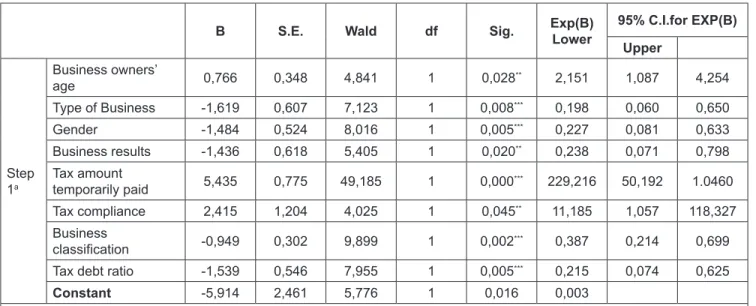
The results of testing the statistical significance of the regression coefficients (Table 2) show that: The time of operation of the enterprises, Business scale, Qualifications, and Inspections are valid Sig. respectively: 0.499, 0.527, 0.773, 0.788 (greater than 0.05). Therefore, the relationship between the dependent variable (effective management of corporate income tax) and the variables are not statistically significant.

- The remaining variables in the model: Business owners’

age, Type of business, Gender, Business results, Tax amount temporarily paid, Tax compliance, Business classification, and Tax debt ratio are statistically significant with a confidence level above 95 % and effecting the management efficiency of Corporate Income Tax).

Ln P Y P Y

( )

( )

=

= é

ë ê ù

û ú 1 0

= -5.914 + 0.766* Business owners’age – 1.619* Type of Business – 1.484*Gender – 1.436*Business results + 5.435*Tax amount temporarily paid + 2.415*Tax compliance – 0.949*Business classification – 1.539*Tax debt ratio.

Tax Amount Temporarily Paid: The amount of Corporate Income Tax that each enterprise must fulfill (the provisional obligation) to pay in the year before the finalization with the tax authorities. The Sig value = 0.000

<0.01 (99% confidence level) shows that the provisional variable has the strongest influence on variable Y (The efficiency of Corporate Income Tax Management). The positive beta coefficient of this variable with the dependent variable shows that when one more enterprise makes a temporary (provisional) payment of corporate income tax in the year, the effectiveness of corporate income tax management will increase 5,435 times.

Table 2: Test Results of Statistical Significance of Variables in The Model

B S.E. Wald df Sig. Exp(B)

Lower 95% C.I.for EXP(B) Upper

Step 1

a

Business owners’

age 0,766 0,348 4,841 1 0,028

**

2,151 1,087 4,254

Type of Business -1,619 0,607 7,123 1 0,008

***

0,198 0,060 0,650

Gender -1,484 0,524 8,016 1 0,005

***

0,227 0,081 0,633

Business results -1,436 0,618 5,405 1 0,020

**

0,238 0,071 0,798

Tax amount

temporarily paid 5,435 0,775 49,185 1 0,000

***

229,216 50,192 1.0460

Tax compliance 2,415 1,204 4,025 1 0,045

**

11,185 1,057 118,327

Business

classification -0,949 0,302 9,899 1 0,002

***

0,387 0,214 0,699

Tax debt ratio -1,539 0,546 7,955 1 0,005

***

0,215 0,074 0,625

Constant -5,914 2,461 5,776 1 0,016 0,003

a. Variable(s) entered on step 1: Business owners are, Type of Business, The time of operation of the enterprises, Business scale, Gender, Qualification, Business results Tax amount temporarily paid, Tax compliance, Business classification, Inspections, Tax debt ratio.

(Notes: *** the meanings α 1%, reliability 99%; ** α 5%, reliability 95%; * α 10%, reliability 90%;)

(6)

- Business Classification: Sig value. = 0.002 <0.01 (99% confidence level), show that the industry variable has the next strong influence on the Y variable (The efficiency of Corporate Income Tax Management). The negative beta ratio of this variable with the dependent variable shows that when construction and trading services do not proviisonally pay corporate income tax in the year, the efficiency of Corporate Income Tax Management will be reduced by 0.949 times.

- Tax Debt Ratio: The debt to total corporate income tax debt, Sig value. = 0.005 <0.01 (99% confidence level), shows that the debt ratio variable has the next strong influence on the Y variable (The efficiency of Corporate Income Tax Management). The negative beta ratio of this variable with the dependent variable shows when reducing a unit of corporate income tax debt, the effective management of Corporate Income Tax increased by 1,539 times.

- Gender: The gender of business owners, Sig value = 0.005 <0.01 (99% confidence level), shows that the gender of business owners has the fourth strongest influence on the Y variable (The efficiency of Corporate Income Tax Management). The negative beta ratio of this variable with the dependent variable shows that when the business owner is female, she will fulfill the obligation to provisionally pay the Corporate Income Tax in the year, so the effectiveness of the Corporate Income Tax management will increase by 1,484 times.

- Type of Business: The type of ownership of the enterprises, Sig value. = 0.008 <0.01 (99% confidence level), show that the type of enterprise has a strong influence on the Y variable (The efficiency of Corporate Income Tax Management). The negative beta ratio of this variable with the dependent variable shows that when reducing an enterprise (say, Limited Liability Company) or a Shareholding Company fails to temporarily pay corporate income tax in the year, the effective management of Corporate Income Tax decreased by 1,619 times.

- Business Result: The business results of enterprises are measured by pre-tax profit on form 03 / Enterprise Income Tax when making Corporate Income Tax finalization. Sig value. = 0.020 <0.05 (95% confidence level) shows that the business model variable has a sixth strong influence on the Y variable (The efficiency of Corporate Income Tax Management). The negative beta ratio of this variable with the dependent variable shows that when an enterprise increases its profit before tax, the efficiency of corporate income tax management will decrease by 1,436 times. Because there is no profit, the enterprises may not temporarily pay corporate income tax.

- Business owners’ age: The age of the business owners, Sig value. = 0.028 <0.05 (95% confidence level), shows that the age variable has a strong influence on the Y variable (The efficiency of corporate income tax management). The

positive beta coefficient of this variable with the dependent variable shows that when the business owners’ age increase by 1 year, the efficiency of corporate income tax management will increase by 0.766 times.

- Tax compliance: Paying income tax on time, Sig value.

= 0.045 <0.05 (95% confidence level), show that the tax compliance variable has the weakest influence among the 8 variables on the Y variable (The efficiency of Corporate Income Tax Management). The positive beta coefficient of this variable with the dependent variable shows that when an enterprise pays its corporate income tax return on time, the efficiency of corporate income tax management will increase by 2,415 times.

5. Policy Recommendations

Based on the research results and practical experience, for a better and more effective Corporate Income Tax management in Mekong Delta in particular and the tax industry in general in the future, the author would like to propose several policy implications as follows:

5.1. Further promoting the tax policy propaganda to enterprises

State and local governments tend to obtain the largest portion of tax revenues from corporates. It is necessary to promote the propaganda of the enterprise income tax policies to taxpayers through training courses and communicating on new tax policies. Tax authorities must identify enterprises from whom provisional tax is due in the year and urge them to pay the taxes. They must issue a notice to urge taxpayers to pay taxes provisionally in accordance with regulations and according to the tax amount stated in the notice.

5.2. Tax authorities need to promptly handle tax arrears

The goal of tax administration is to foster voluntary tax compliance. Penalizing tax evaders or going after delinquent taxpayers are not in themselves the object of tax administration. Voluntary compliance may be encouraged, however, if the administration is successful in establishing a strong prospect that noncompliance will be detected and effectively punished.

A return is filed for the current tax year using the

provisional tax return form and for the previous year using

the final tax return form. A tax return is the completion of

documentation that calculates an entity’s income earned with

the amount of tax payable to the government, government

organizations, or to potential taxpayers Tax authorities must

make a list of enterprises that regularly submit tax returns

(7)

and issue a notice to urge taxpayers to submit tax returns on time, in case they do not file returns on time (within the due date). If even after the issue of notice if the enterprises fail to file returns, tax authorties must impose a penalty for violation and according to regulations.

Tax officials must fully comply with the procedures on urging and notifying enterprises of the tax payment due and strict measures must be taken when taxpayers intentionally fail to comply with their tax obligation to the State. At the same time, tax officials must apply tax coercive measures along with the revocation of business license/registration to those who owe tax for more than 90 days.

5.3. Enhancing the inspection of tax debt enterprises

Tax authorities need to intensify checking for tax debt enterprises to verify whether their business activities are genuine or not. If the enterprises try to make a false declaration of expenses, increase deductions, omit sales/

revenue invoices, do not accurately record income, and so on, tax authorities can check such declaration and ensure the sources of tax revenue from these activities.

5.4. Tax authorities should focus on the business models, genders, and ages of the business owners

A provisional taxpayer is required to pay installments of income tax (called provisional tax) during the income year, rather than at the end of the year when a tax return is filed. Tax authorities should review the list of enterprises that declare tax provisionally, and through their legal representatives (especially if they are males, since women are more responsible tax payers), urge them to provisionally pay corporate income tax in the year before finalization. In terms of age, if the legal representatives of the enterprises are too young (under 30 years old), the tax authorities must verify that the enterprises are operating, the address is true, and business lines are registered. If the enterprises exist at the registered location, it is necessary to communicate to the enterprises about tax policy so that the enterprises can understand and fulfill the obligation to provisionally pay corporate income tax.

References

Blaylock, B., Gaertner, F., & Shevlin, T. (2015). The association between book-tax conformity and earnings management.

Review of Accounting Studies, 20(1), 141-172. https://doi.

org/10.1007/s11142-014-9291-x

Bui, N. T., (2017). Factors influencing corporate income tax compliance: An empirical study in Ho Chi Minh City. Journal of Science (Hue University), 126(5A), 77–88.

MP Law Firm. (2014) Circular 151/2014/TT-BTC dated 10 October 2014 guiding the implementation of Decree 91/2014/

ND-CP amending and supplementing a number of articles of the Decree on taxation by the Minister of Finance, Vietnam.

https://mplaw.vn/en/decree-no-912014nd-cp-dated-october-1- 2014-on-amendments-to-decrees-on-taxes/

MP Law Firm. (2014). Decree 91/2014/ND-CP 2014 of the Prime Minister amending and supplementing a number of articles of decrees on tax regulations. https://mplaw.vn/en/decree- no-912014nd-cp-dated-october-1-2014-on-amendments-to- decrees-on-taxes/

Department of Taxation of Soc Trang Province. (2019). Review report on tax work of the Tax Department of Soc Trang province.

Soc Trang, Vietnam: DoT

Department of Taxation of Tra Vinh Province. (2019). Report on the summary of the tax work of Tra Vinh Department of Taxation.

Tra Vinh, Vietnam: DoT

Department of Taxation of Ben Tre Province. (2019). Review report on tax work of Ben Tre Tax Department. Ben Tre, Vietnam: DoT Do, T. H. (2015). Strengthening corporate income tax

administration for non-state enterprises at the ax Department of Bac Ninh province [Master’s thesis in Economics]. Thai Nguyen University, Vietnam.

Francis, B. B., Hasan, I., Wu, Q., & Yan, M. (2014). Is female CFOs less tax aggressive? Evidence from tax aggressiveness. The Journal of the American Taxation Association, 36(2), 171-202.

https://doi.org/10.2308/atax-50819

Ha, H. N., & Trinh. T. L. (2019). Factors influencing the family business decision for borrowing credit from commercial banks:

Evidence in Tra Vinh Province, Vietnam. Journal of Asian Finance, Economics, and Business, 6(2), 119-122. https://doi.

org/10.13106/jafeb.2019.vol6.no2.119.

Hoang, T. N. (2018). Completing the corporate income tax inspection at the Tax Department of Quang Tri province [Master thesis of Economics] Hue University, Vietnam.

Hoang, T., & Chu, N. M. N. (2008). Analysis of research data with SPSS. Vietnam: Hong Duc Publishing House.

Lanis, R., Richardson, G., & Taylor, G. (2015). Board of director gender and corporate tax aggressiveness: An empirical analysis. Journal of Business Ethics, 144(3), 577–596. https://

doi.org/10.1007/s10551-015-2815-x

Le, T. T. T. (2015). Completing tax administration for non-state enterprises at HaiDuong Tax Department [Master Thesis in Economics]. Thai Nguyen University, Vietnam.

Mulyadi, M. S., Anwar, Y., & Yanny, L. (2013). Analysis of

corporate income tax rate changes and earnings management.

(8)

Asian Finance, Economics, and Business, 7(2), 65-73. https://

doi.org/10.13106/jafeb.2020.vol7.no2.65

OECD. (2004). Compliance risk management: Managing and improving tax compliance, the forum on tax administration.

Centre for Tax Policy, and Administration. https://www.oecd.

org/tax/administration/33818656.pdf

Palil, M. R., Hamid, M. A., & Hanafiah, M. H. (2013). Taxpayers compliance behavior: Economic factors approach. Jurnal Pengurusan (UKM Journal of Management), 38, 75-85.

Pham, T. L. P (2018). Strengthening corporate income tax control at the tax department of Quang Binh province [Master’s thesis in Economics]. The Hue University of Economics, Vietnam.

Tran, T. T. (2020). The impact of balanced scorecard on performance:

The case of Vietnamese commercial banks. Journal of Asian Finance, Economics, and Business, 7(1), 71-79. https://doi.

org/10.13106/jafeb.2020.vol7.no1.71.

Tran, H. L. (2013). Study on the effects of tax stretching and corporate income tax reduction on business results and efficiency of small and medium enterprises in Tu Son town, Bac province. Ninh [Master’s thesis in Economics]. Hanoi University of Agriculture.

Van, C. T (2012). Factors affecting tax compliance of businesses:

Case studies at Tax Department District 1, Ho Chi Minh City [Master’s thesis]. National Economics University, Hanoi, Vietnam.

Van, D. H. (2020). The impacts of empowerment on the teamwork performance: Evidence from commercial banks in Vietnam.

The Journal of Asian Finance, Economics, and Business, 7(4), 267-273. https://doi.org/10.13106/jafeb.2020.vol7.no4.267.

Beykent University Journal of Social Sciences, 6(2), 136-141.

https://core.ac.uk/download/pdf/132095241.pdf

Mai, T. L. H., & Le, D. H (2018). Factors affecting the quality of tax administration at the Tax Department of Ung Hoa district - City. Hanoi. Journal of Forestry Science and Technology, 01, 178-188.

Nguyen, M. H. (2014). Completing tax administration for non- state enterprises at the Tax Department of Vinh Phuc province [Master Thesis in Economics]. Thai Nguyen University, Vietnam.

Nguyen, M. H., & Nguyen, H. Q. (2012). Factors influencing tax compliance behavior of private enterprises, Considering tax payment on time. Journal of Banking Technology, 80, 23 -34.

Nguyen, T. H. (2014). A solution of corporate income tax management in Bac Ninh city, Bac Ninh province [Master’s thesis in Economics]. Vietnam Academy of Agriculture.

Nguyen, T. L. (2011). Completing the tax administration of non- state enterprises at the tax department of Hue City [Master thesis in Business Administration]. Hue University, Viet Nam.

Nguyen, Q. T. (2013). Completing tax administration for small and medium-sized enterprises at Tax Department of Thanh Ba district, Phu Tho province [Master’s thesis in Economics]. Thai Nguyen University, Vietnam.

Nguyen, T. L. T., (2009). Improving tax collection management of the State to enhance tax compliance of enterprises: Hanoi case study [Doctoral thesis in economics]. National Economics University, Hanoi, Vietnam.

Nguyen, T. T. D., & Pham, T. M. L (2020). Determinants

influencing tax compliance: The case of Vietnam. Journal of

수치

Table 2: Test Results of Statistical Significance of Variables in The Model

참조

관련 문서

• 이명의 치료에 대한 매커니즘과 디지털 음향 기술에 대한 상업적으로의 급속한 발전으로 인해 치료 옵션은 증가했 지만, 선택 가이드 라인은 거의 없음.. •

 The Dutch physicist Pieter Zeeman showed the spectral lines emitted by atoms in a magnetic field split into multiple energy levels...  With no magnetic field to align them,

Modern Physics for Scientists and Engineers International Edition,

At the beginning of the Moon's presidency, the tax burdens of income taxes(both personal income and corporate income) and comprehensive real estate holding

R., 2007, December, “Labor and capital shares of the corporate tax burden: International evidence”, In Conference on Who Pays the Corporate Tax in an Open Economy..

14 For individuals with a triglyceride concentration of 200–499 mg/dL, pharmacological therapy should be considered to lower triglyceride concentration after

웹 표준을 지원하는 플랫폼에서 큰 수정없이 실행 가능함 패키징을 통해 다양한 기기를 위한 앱을 작성할 수 있음 네이티브 앱과

_____ culture appears to be attractive (도시의) to the