Corresponding author: Chang-Ju Kim, Department of Physiology, College of Medicine, Kyung Hee University, 1, Hoigi-dong, Dong- daemoon-gu, Seoul 130-701, Korea
Tel: +82-2-961-0407, E-mail: [email protected] Received February 15, 2011, Revised March 10, 2011 Accepted March 12, 2011
Protective Effect of (-)-Epigallocatechin Gallate on Nitric Oxide-Induced Apoptosis in Alveolar Epithelial Cells
*Respiratory Disease Center, Gangdong Kyung Hee University Hospital,
†Department of Physiology, College of Medicine, Kyung Hee University, Seoul,
‡Department of Ophthalmology, Chungju Hospital, Konkuk University,
College of Medicine, Chungju, Korea
Cheon-Woong Choi*, Jee-Hong Yoo*, Sung-Eun Kim
†, Yun-Hee Sung
†, Jin-Hee Seo
†, Mal-Soon Shin
†, Dong-Hee Kim
‡, Chang-Ju Kim
†The lung is exposed to various stimulants, such as reactive nitrogen species. Alveolar epithelial cells are sensitive to nitric oxide (NO), which is a free radical inorganic gas synthesized from L-arginine by nitric oxide synthase (NOS). NO mediates many biological processes, but excessive NO exposure induces apoptosis in various cell types. (-)-Epigallocatechin-3-gallate (EGCG) has recently been shown to modulate apoptotic pathways. EGCG is the most abundant and most active ingredient of green tea. EGCG has been shown to have anti-carcinogenic, anti-oxidant, anti-inflammatory, neuroprotective, and anti-apoptotic effects. In the present study, we investigated whether EGCG exhibits a protective effect against apoptosis induced by the NO donor sodium nitroprusside (SNP) in human lung epithelial cells. To confirm the anti-apoptotic properties of EGCG, a 3-(4,5-dimethylthiazol- 2-yl)-2,5-diphenyltetrazolium bromide (MTT) assay, 4,6-diamidino-2-phenylindole (DAPI) staining, terminal deoxynucleotidyl transferase-mediated dUTP nick end-labeling (TUNEL) assay, DNA fragmentation assay, and Western blotting were performed using human alveolar type II L-132 cells. The present results show that SNP induced apoptotic morphological changes, increased the expression levels of the pro-apoptotic protein Bax and enhanced the enzymatic activity of caspase-3 in L-132 human lung epithelial cells. However, EGCG treatment remarkably increased the expression of the anti-apoptotic protein Bcl-2, decreased the expression of Bax, and suppressed the enzymatic activity of caspase-3. The results of the present study revealed that EGCG exerts a protective effect against SNP-induced apoptosis in L-132 human lung epithelial cells. (Korean J Str Res 2011;19:69∼77)
Key Words: (-)-Epigallocatechin-3-gallate, Sodium nitroprusside, Nitric oxide, Human lung epithelial cells, Apoptosis
INTRODUCTION
The lung is composed of many different types of cells, include-
ing endothelial cells, epithelial cells, fibroblasts, and inflammatory cells. Alveolar epithelium lines the alveolar air sacs, which are involved in gaseous exchange. The alveolar epithelium is predo- minantly comprised of two specialized epithelial cell types:
squamous alveolar epithelial type I cells, which constitute appro- ximately 93% of the alveolar epithelial surface area, and cuboidal alveolar epithelial type II cells, which comprise the remaining 7%
of the alveolar epithelial surface area and 67% of epithelial cells.
The alveolar type II cells are regarded as the “defender of the
alveolus” (Fehrenbach, 2001). Alveolar type II cells contribute to the following four major functions: (i) synthesis and secretion ofsurfactant, (ii) xenobiotic metabolism, (iii) transepithelial move- ment of water, and (iv) regeneration of the alveolar epithelium following lung injury. Therefore, alveolar type II cells play impor- tant roles in normal pulmonary activity and in responses of the lungs to toxic compounds, which may cause lung damage (Castranova et al., 1988). Alveolar epithelium is sensitive to oxidative stresses derived from reactive oxygen species and nitrogen species, such as nitric oxide (NO) and peroxynitrite (ONOO
-) (Freeman et al., 1993).
NO is a free radical inorganic gas synthesized from L-arginine by three isoforms of nitric oxide synthase (NOS). NO mediates many biological functions, including vasodilation, inhibition of platelet aggregation, neurotransmission, and immune reactions.
However, excessive NO exposure induces apoptosis in various types of cells, such as macrophages and megakaryocytes (Battinelli et al., 2000).
Apoptosis (programmed cell death) is a form of cell death that occurs during several pathological situations in multi-cellular organisms and contributes to cell replacement, tissue remodeling, and removal of damaged cells under normal conditions (DeLong, 1998). Numerous factors are involved in the regulation of apoptosis. In particular, the members of the Bcl-2 family of proteins play pivotal roles in the regulation of apoptosis, and they activate caspases that mediate the cleavage of apoptosis regulators.
Caspases, a family of cysteine proteases, are integral parts of the apoptotic pathway. The Bcl-2 family proteins are classified as either anti-apoptotic proteins or pro-apoptotic proteins based on their function. The balance between pro-apoptotic and anti- apoptotic Bcl-2 family members determines the mitochondrial response to apoptotic stimuli (Upadhyay et al., 2003).
Green tea belongs to the Theaceae family and is derived from two main varieties: Camellia sinensis var. sinensis and Camellia sinensis var. assamica (Graham, 1992; Sang S et al., 2003). (-) Epigallocatechin gallate (EGCG) is a constituent of green tea that has been reported to have anti-inflammatory, neuroprotective, anti-tumor, and anti-oxidant effects as a free radical scavenger. It was recently reported that EGCG modulates apoptotic pathways (Kelly et al., 2001; Bastianetto et al., 2006; Sutherland et al., 2006; Yang et al., 2006; Syed et al., 2007).
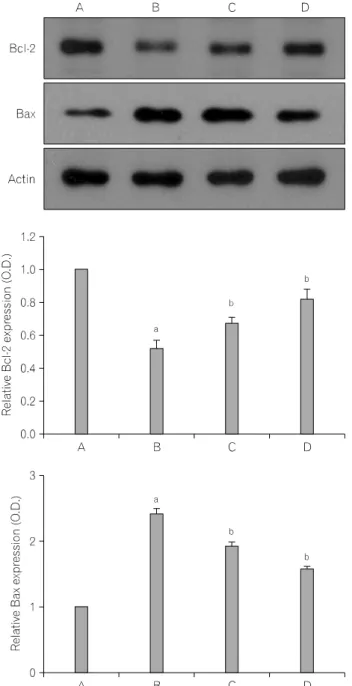
In the present study, we investigated the protective effect of EGCG against NO-induced apoptosis in L-132 human alveolar epithelial cells by using sodium nitroprusside (SNP), an NO donor. In this study, a 3-(4,5-dimethylthiazol-2-yl)-2,5-diphenyl- tetrazolium bromide (MTT) assay, 4,6-diamidino-2-phenylindole (DAPI) staining, terminal deoxynucleotidyl transferase-mediated dUTP nick end-labeling (TUNEL) assay, DNA fragmentation assay, Western blot analysis, and caspase-3 enzyme activity assay were performed.
MATERIALS AND METHODS
1. Drugs and reagents
EGCG and SNP were purchased from Sigma Chemical Co. (St.
Louis, MO, USA). The MTT assay kit was purchased from Boehringer Mannheim GmbH (Mannheim Germany). The DNA fragmentation assay kit was obtained from TaKaRa (Shiga, Japan), and the caspase-3 assay kit was purchased from CLONTECH (Palo Alto, CA, USA).
2. Cell culture
Cells derived from human alveolar type II cells, L-132 cells, were purchased from the Korean Cell Line Bank (KCLB; Seoul, Korea). The cells were cultured in Dulbecco’s Modified Eagle Medium (DMEM; Gibco BRL, Grand Island, NY, USA) sup- plemented with 10% heat-inactivated fetal bovine serum (FBS;
Gibco BRL) at 37
oC in 5% CO
2, 95% O
2in a humidified cell incubator. The medium was changed every 2 days. The cells were plated onto culture dishes at a density of 2×10
4cells/cm
212 h prior to treatment with EGCG. Cells from passages 8 to 25 were used in the experiments.
3. MTT cytotoxicity assay
Cell viability was determined using the MTT assay kit according to the manufacturer’s protocol. To determine the cyto- toxicity of SNP, the cells were treated with SNP at concentrations of 100μM, 500μM, 1 mM, 2 mM, and 4 mM for 12 h. To analyze the protective effect of EGCG against SNP-induced cell death, cells were pre-treated with EGCG at concentrations of 12.5μM/ml, 25μM/ml, 50μM/ml, 100μM/ml, and 200μM/
ml for 1 h prior to SNP treatment. The cells in the control group
were left untreated. Ten microliters of MTT labeling reagent containing 5 mg/ml MTT in phosphate-buffered saline (PBS) was added to each well, and the plates were incubated for 4 h. Each well was added with 100μl of a solubilization solution con- taining 10% sodium dodecyl sulfate (SDS) in 0.01 M hydrochloric acid (HCl), and the cells were incubated for another 12 h. The absorbance was then measured with a microtiter plate reader (Bio-Tek, Winooski, VT, USA) at a test wavelength of 595 nm with a reference wavelength of 690 nm. The optical density (O.D.) was calculated as the difference between the absorbance at the reference wavelength and that observed at the test wave- length. Percent viability was calculated as follows: (O.D. of drug- treated sample/control O.D.) ×100.
4. TUNEL assay
For in situ detection of apoptotic cells, TUNEL assay was per- formed using the ApoTag
Ⓡperoxidase in situ apoptosis detection kit. Cells were cultured on 4-chamber slides (Nalge Nunc Inter- national, Naperville, IL, USA) at a density of 2×10
4cells/
chamber. The cells were pre-treated with 100μM/ml EGCG for 1 h prior to 2 mM SNP treatment and incubated for another 12 h. After treatment with EGCG and SNP, the cells were washed with phosphate buffered saline (PBS) and fixed by incubation in 4% paraformaldehyde (PFA) for 10 min at 4
oC. The fixed cells were then incubated with digoxigenin-conjugated dUTP in a terminal deoxynucleotidyl transferase (TdT)-catalyzed reaction for 60 min at 37
oC in a humidified atmosphere and immersed in stop/wash buffer for 10 min at room temperature. The cells were then incubated with anti-digoxigenin antibody conjugated with peroxidase for 30 min. DNA fragments were stained using 3,3-diaminobenzidine (DAB; Sigma Chemical Co.) as the substrate for peroxidase.
5. DAPI staining
For DAPI staining, the cells were cultured on 4-chamber slides (Nalge Nunc International). The cells were pre-treated with 100 μM/ml EGCG for 1 h prior to 2 mM SNP treatment and incubated for another 12 h. After treatment with EGCG and SNP, the cells were fixed by incubation in 4% PFA for 30 min.
The cells were washed in PBS and then incubated in 1μg/ml DAPI solution (Sigma Chemical Co.) for 30 min in the dark. The
cells were then observed under a fluorescence microscope (Zeiss, Oberköchen, Germany).
6. DNA fragmentation
For detection of apoptotic DNA cleavage, a DNA fragmenta- tion assay was performed using the ApopLadder EX
TMDNA fragmentation assay kit. The cells were treated with EGCG and SNP and then lysed with 100μl of lysis buffer. The lysate was incubated with 10μl of 10% sodium dodecyl sulfate (SDS) solution containing 10μl of Enzyme A at 56
oC for 1 h followed by treatment with 10μl of Enzyme B at 37
oC for 1 h. After adding 70μl of precipitant and resuspending the resultant pellet in Tris-EDTA (TE) buffer, genomic DNA was visualized by electrophoresis in a 2% agarose gel containing ethidium bromide.
7. Western blot analysis
The cells were treated with EGCG and SNP and incubated for 12 h. After treatment with EGCG and SNP, the cells were collected by trypsinization and centrifugation. The supernatant was removed, and the cell pellets were lysed in a lysis buffer containing 50 mM Tris-HCl (pH 7.5), 150 mM NaCl, 0.5%
deoxycholic acid, 1% Nonidet P40, 0.1% SDS, 1 mM PMSF, and 100 mg/ml leupeptin. Protein content was measured using a Bio- Rad colorimetric protein assay kit (Bio-Rad). Thirty micrograms of protein was separated on SDS-polyacrylamide gels and trans- ferred onto a nitrocellulose membrane. Mouse Bax antibody (1:
1,000; Santa Cruz Biotech, Santa Cruz, CA, USA) and mouse Bcl-2 antibody (1:1,000; Santa Cruz Biotech) were used as primary antibodies. Horseradish peroxidase-conjugated anti-mouse antibody for Bax and Bcl-2 (1:2,000; Amersham Pharmacia Biothech GmbH, Freiburg, Germany) were used as secondary antibodies. Band detection was performed using the enhanced chemiluminescence (ECL) detection system (Amersham Pharmacia Biothech GmbH).
8. Caspase-3 enzyme activity assay
The enzymatic activity of caspase-3 was measured using the
ApoAlert
Ⓡcaspase-3 assay kit according to the manufacturer’s
protocol. The colorimetric assay is based on spectrophotometric
detection of the chromophore p-nitroaniline (pNA) after cleavage
from the labeled caspase-specific substrates by caspases. The
Fig. 1. Sodium nitroprusside (SNP)-induced cytotoxicity. Human lung alveolar epithelial cell line L-132 was incubated with SNP at various concentrations for 12 h prior to the determination of cellular viability using the MTT assay. (A) Control group, (B) 100μM SNP-treated group, (C) 500μM SNP-treated group, (D) 1 mM SNP-treated group, (E) 2 mM SNP-treated group, (F) 4 mM SNP-treated group.
aRepresents p<0.05 compared to the control group.
Fig. 2. Protective effect of (-) epigallocatechin gallate (EGCG) against sodium nitroprusside (SNP)-induced cytotoxicity. (A) Control group, (B) 2 mM SNP-treated group, (C) 12.5μM EGCG-pre-treated and 2 mM SNP-treated group, (D) 25μM EGCG-pre-treated and 2 mM SNP- treated group, (E) 50μM EGCG-pre-treated and 2 mM SNP-treated group, (F) 100μM EGCG-pre-treated and 2 mM SNP-treated group, (G) 200μM EGCG-pre-treated and 2 mM SNP-treated group.
aRep- resents p<0.05 compared to the control group.
bRepresents p<0.05 compared to the SNP-treated group.
caspase-3-specific substrate used in the present study was DEVD- pNA, and the rate of DEVD-pNA cleavage was measured in order to assay the caspase-3 enzyme activity. In brief, after treatment with EGCG and SNP, the cells were lysed with 50μl of chilled cell lysis buffer. Fifty microliters of 2× reaction buffer (containing DTT) and 5μl of the appropriate conjugated sub- strate (DEVD-pNA) at a concentration of 1 mM were added to each lysate. The mixture was incubated in a water bath at 37°C for 1 h, and the absorbance was measured with a microtiter plate reader at a test wavelength of 405 nm. The caspase-3 inhibitor (DEVD-fmk) was used as negative control.
9. Statistical analysis
The results were expressed as the mean±standard error of the mean (SEM). The data were analyzed by one-way analysis of variance (ANOVA) followed by Duncan’s post-hoc test using WIN SPSS 12.0. Differences were considered statistically significant at p<0.05.
RESULTS
1. Effect of EGCG on viability of SNP-treated L-132 cells
As shown in Fig. 1, the viabilities of cells incubated with SNP
at concentrations of 100μM, 500μM, 1 mM, 2 mM, and 4 mM for 12 h were 98.83±3.93%, 90.53±2.44%, 83.88±3.82%, 59.18±3.13%, and 25.43±0.61% of the control value, respec- tively. It was observed that the viability of cells decreased as the concentration of SNP increased. The concentration of SNP was set at 2 mM for the next experiments.
As shown in Fig. 2, the viability of cells exposed to 2 mM SNP for 12 h was 63.84±2.21% of the control value, while the viabilities of the cells pre-treated with EGCG at concentrations of 12.5μM, 25μM, 50μM, 100μM, and 200μM for 1 h before exposure to 2 mM SNP increased significantly to 67.18±5.33%, 72.88±7.05%, 80.42±6.51%, 89.32±7.29% and 85.45±9.80%, respectively. MTT assay showed that SNP treatment significantly decreased the viability of cells, while pre-treatment with EGCG exerted a protective effect against SNP-induced cytotoxicity. The concentrations of the EGCG were set at 50μM and/or 100μM for the next experiments.
2. Morphological changes induced by SNP and EGCG
The cells were treated with SNP to further confirm the induc-
tion of apoptosis by SNP and the protective effect of EGCG in
L-132 cells, and the protective effect of EGCG was analyzed
Fig. 3. Morphological observations of cells treated with sodium nitroprusside (SNP) and (-) epigallocatechin gallate (EGCG). (A) Control group, (B) 2 mM SNP-treated group, (C) 100μM EGCG- pre-treated and 2 mM SNP-treated group.
Fig. 4. Electrophoretic examination of the genomic DNA of L-132 human lung epithelial cells. (M) Marker, (A) control group, (B) 2 mM SNP-treated group, (C) 50μM EGCG-pre-treated and 2 mM SNP- treated group, (D) 100μM EGCG-pre-treated and 2 mM SNP-treated group.
using a TUNEL assay, DAPI staining and PI staining. DNA strand breaks occur during apoptosis, and it is known that nicks in DNA molecules can be detected via TUNEL assay. As shown in Fig. 3, TUNEL-positive cells were stained dark brown under the light microscope, and nuclear condensations were observed in the cells treated with 2 mM SNP, while the appearance of cells pre-treated with 100μM EGCG prior to SNP exposure was similar to that of the control cells.
DAPI staining revealed nuclear condensation, DNA fragmenta- tion, and perinuclear apoptotic bodies. Apoptotic bodies, one of the stringent morphological criteria for apoptosis, were remarkably presented in the 2 mM SNP-treated cells, whereas attenuated morphological changes were shown in the cells pre-treated with 100μM EGCG prior to SNP exposure.
3. Characterization of apoptosis via examination of DNA fragmentation
DNA fragmentation, which reflects the endonuclease activity
characteristic of apoptosis, was assessed in order to investigate the
Fig. 6. Inhibitory effect of EGCG on sodium nitroprusside (SNP)-induced caspase-3 enzyme activity. A, Control group; B, 2 mM sodium nitro- prusside (SNP)-treated group; C, 50μM (-) epigallocatechin gallate (EGCG)-pre-treated and 2 mM SNP-treated group, (D) 100μM EGCG- pre-treated and 2 mM SNP-treated group, (E) DEVD-fmk added SNP- treated group.
aRepresents p<0.05 compared to the control group.
b