• 검색 결과가 없습니다.

Iatrogenic Bidirectional Dissection of the Right Coronary Artery and the Ascending Aorta: The Worst Nightmare for an Interventional Cardiologist

N/A
N/A
Protected

Academic year: 2022

Share "Iatrogenic Bidirectional Dissection of the Right Coronary Artery and the Ascending Aorta: The Worst Nightmare for an Interventional Cardiologist"

Copied!
3
0
0

로드 중.... (전체 텍스트 보기)

전체 글

(1)

504 Copyright © 2012 The Korean Society of Cardiology Korean Circulation Journal

Introduction

Iatrogenic coronary artery dissections are well known complica- tions in the era of interventional cardiology and especially with the advances in technology, devices, and operator experience that have led to the performance of more complex percutaneous interven- tions. Management of the dissection propagating to the ascending aorta is challenging.

1)2)

We present a case of iatrogenic bidirectional dissection of the right coronary artery (RCA) and the ascending aor- ta that was managed rapidly by stenting the entry point of the dis- section, however, the aortic valve was involved which necessitated

Case Report

http://dx.doi.org/10.4070/kcj.2012.42.7.504 Print ISSN 1738-5520 • On-line ISSN 1738-5555

Iatrogenic Bidirectional Dissection of the Right Coronary Artery and the Ascending Aorta: The Worst Nightmare

for an Interventional Cardiologist

Ziad Dahdouh, MD 1 , Vincent Roule, MD 1 , Thérèse Lognoné, MD 1 , Rémi Sabatier, MD 1 , Mathieu Bignon, MD 1 , Guillaume Malcor, MD 1 , Adrien Lemaitre, MD 1 , Katrien Blanchart, MD 1 , Julien Wain-Hobson, MD 1 ,

Vladimir Saplacan, MD 2 , Fabio Cutone, MD 2 , Dimitrios Buklas, MD 2 , Calin Ivascau, MD 2 , Massimo Massetti, MD 2 , and Gilles Grollier, MD 1

1
Departments of Cardiology and

2

Thoracic and Cardiovascular Surgery, CHU de Caen, Caen, France

Although rare, iatrogenic aortocoronary dissection is one of the complications most dreaded by the interventional cardiologist. If not managed promptly, it can have redoubted and serious consequences. Herein, we present the case of a 70 year-old woman who was treat- ed by stenting of the second segment of the right coronary artery (RCA) for recurrent angina but, unfortunately, the procedure was com- plicated by anterograde dissection of the RCA with a simultaneous retrograde propagation to the proximal part of the ascending aorta.

Successful stenting of the entry point was able to recuperate the RCA and to limit the retrograde propagation to the ascending aorta, but there was an extension of the dissection to the aortic valve leaflets resulting in a massive aortic insufficiency. Therefore, an isolated surgi- cal aortic valve replacement was performed. (Korean Circ J 2012;42:504-506)

KEY WORDS: Coronary angioplasty; Coronary dissection; Ascending aorta.

Received: November 16, 2011 Revision Received: January 11, 2012 Accepted: January 11, 2012

Correspondence: Ziad Dahdouh, MD, University Hospital of Caen, Avenue Cote de Nacre 14033 Caen, France

Tel: 00 33 6 29 36 22 32, Fax: 00 33 9 57 20 80 76 E-mail: [email protected]

• The authors have no financial conflicts of interest.

This is an Open Access article distributed under the terms of the Creative Commons Attribution Non-Commercial License (http://creativecommons.

org/licenses/by-nc/3.0) which permits unrestricted non-commercial use, distribution, and reproduction in any medium, provided the original work is properly cited.

valve replacement surgery.

Case

A 70 year-old woman was admitted to our hospital for evaluation of recurrent angina. She had presented with hypertension and ch- ronic atrial fibrillation. Diagnostic catheterization through the right radial artery was performed using a 6 French (6 Fr) arterial sheath and revealed a heavily calcified tight stenosis in the second segment of the RCA. We decided to perform an angioplasty on this lesion. We used a (6 Fr) Amplatz left 0.75 (AL 0.75) Launcher guiding catheter (Medtronic Inc., Minneapolis, MN, USA). After pre-dilation with the Maverick 2 2.5×20 mm balloon (Boston Scientific Company, Natick, MA, USA), we deployed the Bare Metal Stent TSUNAMI 3.5×20 mm (Terumo, Tokyo, Japan). We postdilated with a Quantum 3.5×20 mm balloon (Boston Scientific Company, Natick, MA, USA). The first angi- ographic control with the guide wire 0.014 with ICE hydrophilic co- ating (ChoICE

TM

, Floppy LS, Boston Scientific, Natick, MA, USA) was good with no residual stenosis in the second segment of the RCA.

Next, we pulled back the guide wire and the selective injection of the

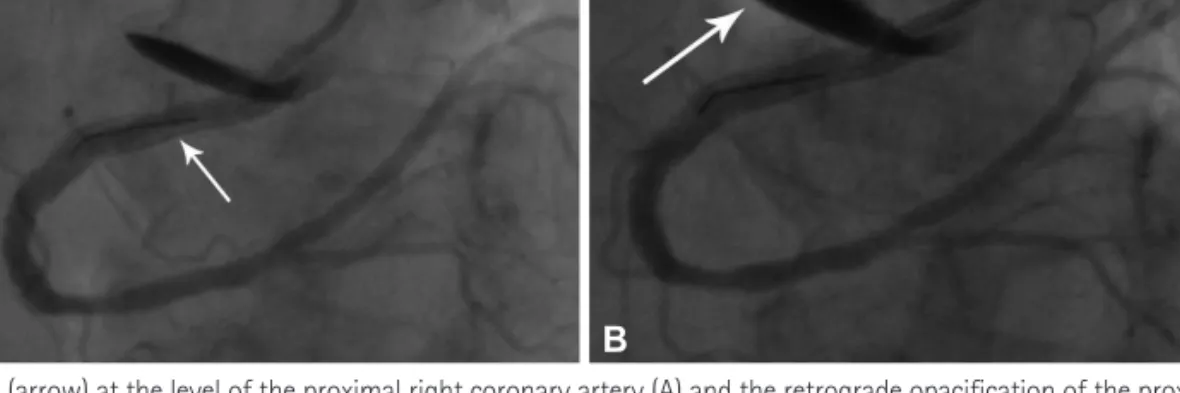
RCA showed a permeable RCA with a proximal dissection line (Fig. 1A)

and a retrograde opacification of the proximal segment of the as-

(2)

505 Ziad Dahdouh, et al.

http://dx.doi.org/10.4070/kcj.2012.42.7.504 www.e-kcj.org

cending aortic wall (Fig. 1B). In addition, we found a stagnation of contrast material within several centimeters of the aortic wall and the proximal segment of the RCA (Fig. 2A), a finding suggestive of bi- directional dissection. We immediately advanced the guide wire 0.014 and successfully stented the RCA ostia’s with another Bare Metal Stent TSUNAMI 3.5×15 mm (Terumo), into the entry point of the dissection (Fig. 2B). The patient’s condition following the surgi-

cal procedure remained stable. Computed tomography scans per- formed the same day exhibited the type A (Stanford classification) aortic dissection (Fig. 3). The cardiac ultrasound taken on the same day after the procedure showed an extension of the dissection into the aortic valve leaflets with consequent massive aortic insuffici- ency. An isolated aortic valve replacement was performed but the post- surgical period was complicated by the incidence of uncontrollable septic shock and death occurred at day seven following the procedure.

Discussion

Iatrogenic coronary artery dissections may be caused by direct trauma from the catheter tip or through entrapment in an athero- ma plaque. Other possible causes of dissection include over infla- tion and dilation of the balloon or stent during percutaneous cor- onary interventions, the dilation of a calcified plaque, the fracture of the stent strut or from aggressive handling of guide wires, spe- cifically those that are rigid and hydrophilic. The extension of the dissection seemed to be accelerated by vigorous contrast media injections. Once coronary dissection occurs, it can rapidly propagate in the anterograde direction into the distal part of the coronary ar-

A   B  

Fig. 1. The dissection line (arrow) at the level of the proximal right coronary artery (A) and the retrograde opacification of the proximal segment of the as- cending aortic wall (false lumen) (arrow) highlighting the aortic dissection (B).

A   B  

Fig. 2. The stagnation of contrast media within several centimeters of the aortic wall and the proximal segment of the right coronary artery (RCA) prior to stenting and the observed bidirectional dissection (A) and the angiographic results following the stenting procedure of the ostium of the RCA (B).

Fig. 3. Computed tomography scans showing the intimal flap with the false

lumen (FL) (thick arrow) of the type A aortic dissection (Stanford classifica-

tion) at the level of the right coronary artery’s (RCA) (thin arrow) ostium.

(3)

506 Iatrogenic Bidirectional Dissection of the Coronary and the Aorta

http://dx.doi.org/10.4070/kcj.2012.42.7.504 www.e-kcj.org

tery and, sometimes, in the opposite direction into the aorta.

3)

In these latter cases, if the dissection was limited to a few centime- ters beyond the aortic valve, it can be treated by sealing the entry point with a coronary stent.

4)

Follow up after the procedure could then be performed using a CT scan or by transesophageal echocar- diography

5)

as most of these aortic dissections heal spontaneously.

Furthermore, life threatening situations may occur if the dissection is extensive and involves the ascending aorta which would neces- sitate urgent surgical intervention.

3)6)

The integrity of aortic valve should be assessed by echocardiography in all cases.

In our specifc patient, the bidirectional dissection is thought to have been related to direct trauma casued by the catheter tip with a non-coaxial alignment provoked by the removal of the guide wire 0.014 after the stent implantation. The patient was hemody- namically stable and the dissection extended only 2 to 3 cm into the ascending aorta which explains the reasoning for stenting the entry point to allow the aortic dissection to heal spontaneously.

The present case report suggests that if the patient’s hemody- namic conditions were stable, and the propagation of the dissec- tion was limited to the early proximal region of the ascending aorta, sealing the coronary entry door with a coronary stent is a reason- able strategy. Imaging surveillance should be considered for early detection of other complications and during the follow up exami-

nation. The surgical approach should be reserved for cases involv- ing impairment of hemodynamic conditions or extensive involve- ment of the aorta.

References

1. Akgul F, Batyraliev T, Besnili F, Karben Z. Emergency stenting of unpro- tected left main coronary artery after acute catheter-induced occlu- sive dissection. Tex Heart Inst J 2006;33:515-8.

2. Wykrzykowska JJ, Carrozza J, Laham RJ. Aortocoronary dissection with acute left main artery occlusion: successful treatment with emergent stenting. J Invasive Cardiol 2006;18:E217-20.

3. Dunning DW, Kahn JK, Hawkins ET, O’Neill WW. Iatrogenic coronary ar- tery dissections extending into and involving the aortic root. Catheter Cardiovasc Interv 2000;51:387-93.

4. Al-Saif SM, Liu MW, Al-Mubarak N, Agrawal S, Dean LS. Percutaneous treatment of catheter-induced dissection of the left main coronary ar- tery and adjacent aortic wall: a case report. Catheter Cardiovasc Interv 2000;49:86-9.

5. Maiello L, La Marchesina U, Presbitero P, Faletra F. Iatrogenic aortic dis- section during coronary intervention. Ital Heart J 2003;4:419-22.

6. Yip HK, Wu CJ, Yeh KH, et al. Unusual complication of retrograde dis- section to the coronary sinus of valsalva during percutaneous revascu- larization: a single-center experience and literature review. Chest 2001;

119:493-501.

수치

Fig. 1. The dissection line (arrow) at the level of the proximal right coronary artery (A) and the retrograde opacification of the proximal segment of the as- as-cending aortic wall (false lumen) (arrow) highlighting the aortic dissection (B).

참조

관련 문서

 The Dutch physicist Pieter Zeeman showed the spectral lines emitted by atoms in a magnetic field split into multiple energy levels...  With no magnetic field to align them,

Modern Physics for Scientists and Engineers International Edition,

However, all greetings are usually used to welcome people and wish them

If both these adjustments are considered, the resulting approach is called a bootstrap-BC a -method (bias- corrected-accelerated). A description of this approach

③ A student who attended Korean course at KNU Korean Language Program and holds TOPIK Level 3 or a student who completed Korean course Level 4 at the KNU Korean Language

Five days later, on 15 January 1975, the Portuguese government signed an agreement with the MPLA, FNLA and UNITA providing for Angola to receive its independence on 11

· 50% exemption from tuition fee Ⅱ for the student with a TOPIK score of level 3 or higher or completion of level 4 or higher class of the Korean language program at the

Usefulness of co-treatment with immunomodulators in patients with inflammatory bowel disease treated with scheduled infliximab maintenance therapy.. Oussalah A, Chevaux JB, Fay