INTRODUCTION
Lung cancer is a common tumor malignancy with high mor- tality worldwide.1 And lung adenocarcinoma (LA) is a major subtype that accounts for 40% of lung cancer with poor prog- nosis.2 With the development of chemo-therapy and immu-
MiR-218-5p Suppresses the Killing Effect of Natural
Killer Cell to Lung Adenocarcinoma by Targeting SHMT1
Quanjun Yang
1*, Jingjing Li
2*, Yili Hu
1, Xiaofei Tang
3, Lili Yu
1, Lihua Dong
1, and Diandian Chen
11Department of Oncology, The Affiliated Renhe Hospital of China Three Gorges University, Yichang;
2Department One of Medical Oncology, Jing Men No.2 People’s Hospital, Jing Men;
3Internal Medicine, Changyang Tujia Autonomous District People’s Hospital, Yichang, China.
Purpose: Lung adenocarcinoma (LA) is one of the major types of lung cancer. MicroRNAs (miRNAs) play an essential role in reg- ulating responses of natural killer (NK) cells to cancer malignancy. However, the mechanism of miR-218-5p involved in the killing effect of NK cells to LA cells remains poorly understood.
Materials and Methods: The expression of miR-218-5p was examined by quantitative real-time polymerase chain reaction (qRT- PCR). Serine hydroxymethyl transferase 1 (SHMT1) level was detected by qRT-PCR or western blots. Cytokines production of interferon-γ (IFN-γ) and tumor necrosis factor-α (TNF-α) were detected by ELISA. The killing effect of NK cells to LA cells was in- vestigated using lactate dehydrogenase cytotoxicity assay kit. The interaction of miR-218-5p and SHMT1 was probed by luciferase activity assay. Xenograft model was established to investigate the killing effect of NK cells in vivo.
Results: miR-218-5p was enhanced and SHMT1 was inhibited in NK cells of LA patients, whereas stimulation of interleukin-2 (IL-2) reversed their abundances. Addition of miR-218-5p reduced IL-2-induced cytokines expression and cytotoxicity in NK-92 against LA cells. Moreover, SHMT1 was negatively regulated by miR-218-5p and attenuated miR-218-5p-mediated effect on cyto- toxicity, IFN-γ and TNF-α secretion in IL-2-activated NK cells. In addition, miR-218-5p exhaustion inhibited tumor growth by promoting killing effect of NK cells.
Conclusion: miR-218-5p suppresses the killing effect of NK cells to LA cells by targeting SHMT1, providing a potential target for LA treatment by ameliorating NK cells function.
Key Words: Lung adenocarcinoma, natural killer cells, miR-218-5p, SHMT1
pISSN: 0513-5796 · eISSN: 1976-2437
Received: September 4, 2018 Revised: November 12, 2018 Accepted: November 20, 2018
Corresponding author: Jingjing Li, MD, Department One of Medical Oncology, Jing Men No.2 People’s Hospital, No.39, Xiangshan Avenue, Dongbao District, Jing Men, 448000, China.
Tel: 86-724-6903012, Fax: 86-724-6903012, E-mail: [email protected]
*Quanjun Yang and Jingjing Li contributed equally to this work.
•The authors have no potential conflicts of interest to disclose.
© Copyright: Yonsei University College of Medicine 2019
This is an Open Access article distributed under the terms of the Creative Com- mons Attribution Non-Commercial License (https://creativecommons.org/licenses/
by-nc/4.0) which permits unrestricted non-commercial use, distribution, and repro- duction in any medium, provided the original work is properly cited.
Yonsei Med J 2019 Jun;60(6):500-508 https://doi.org/10.3349/ymj.2019.60.6.500
nological therapy, more strategies have been implicated in treatment of LA, whereas the survival rate is still low.3 Emerg- ing research have reported that immune system is responsible for immunotherapy of lung cancer.4 Natural killer (NK) cell is one of the key immune cells and its cytolytic potential is limit- ed in lung cancer, whereas increasing NK cells function can result in tumor regression.5 Potentiation of cytotoxicity, medi- ated by NK cells to LA, plays a vital role in overcoming tumor cell escape from immune system.6 NK cells control tumor by regulating pro-inflammatory cytokines production, such as interferon-γ (IFN-γ) and tumor necrosis factor-α (TNF-α), which can induce cytolysis of tumor cells.7 Therefore, it is prom- ising to explore a novel driver that modulates the killing effect of NK cells to LA cells.
MicroRNAs (miRNAs) hold great promise in development of LA, and are associated with prognosis of LA.8 Previous re- search have reported that miRNAs may regulate the function
of NK cells by enhancing or inhibiting the cytotoxic potential of NK cells.9 Moreover, miRNAs have been suggested to par- ticipate in NK cells activity impairment.10 For example, miR- 183 is associated with NK cells function in lung cancer.11 The available evidence indicates that miR-218-5p plays an essen- tial role in LA progression by regulating target gene expres- sion.12 Notably, miR-218-5p is expressed in human NK cells, and may be involved in the development and function of NK cells.13 Therefore, we speculate miR-218-5p may be implicated in regulating NK cells function in LA.
A number of researchers have reported that serine hydroxy- methyl transferase 1 (SHMT1) is required for tumor growth and disease progression.14,15 Previous work investigated the regula- tion of SHMT1 on lung cancer risk, and suggested SHMT1 may affect etiology of lung cancer.16 In LA, SHMT1 has an important impact on cell proliferation and apoptosis.17 However, there is no direct evidence in support of SHMT1 required for NK cells function. Intriguingly, bioinformatics analysis predicates the putative binding sites of miR-218-5p and SHMT1. Therefore, we assumed that SHMT1 is required for miR-218-5p-mediat- ed function on the killing effect of NK cells to LA cells. In the present study, we detected the expressions of miR-218-5p and SHMT1 in NK cells of LA patients, and explored the potential mechanism that underlies miR-218-5p regulating the killing effect of NK cells to LA cells.
MATERIALS AND METHODS
Isolation of primary NK cells
Peripheral blood mononuclear cells were collected from 20 patients with LA and healthy volunteers, and were used to isolate human NK cells using NK cell enrichment kit (Thermo Fisher, Wilmington, DE, USA) according to the manufacturer’s instructions. Highly pure NK cells were obtained by negative selection with magnetic labeling. Informed consent was signed by all patients, and the study was accepted by the Institutional Research Ethics Committee of The Affiliated Renhe Hospital of China Three Gorges University.
Cell culture and treatment
Human NK cell line NK-92, mouse NK cell line LNK, human LA cell line A549, and 293T cells were obtained from American Tis- sue Culture Collection (ATCC, Manassas, VA, USA). In this study, all cells were grown in RPMI-1640 (Gibco, Carlsbad, CA, USA) containing 10% fetal bovine serum (Gibco), 1% penicil- lin, and streptomycin (Invitrogen, Carlsbad, CA, USA) at 37°C in an incubator with 5% CO2.
To activate NK-92 or LNK cells, 20 ng/mL interleukin-2 (IL-2, Gibco) was introduced into cells for 24 h. SHMT1 overexpres- sion vectors (SHMT1) cloned into pcDNA, miR-218-5p mim- ics (miR-218-5p), miR-218-5p inhibitor (anti-miR-218-5p), and negative control (miR-NC or anti-NC) were obtained from Ge-
nePharma (Shanghai, China). Transfection was performed in NK-92 or LNK cells using Lipofectamine 2000 (Invitrogen) ac- cording to the manufacturer’s protocol.
Quantitative real-time polymerase chain reaction
Total RNA was isolated using Trizol reagent (Invitrogen) ac- cording to the manufacturer’s instructions. Then cDNA was synthesized using TaqMan miRNA reverse transcription kit (Applied Biosystems, Foster City, CA, USA), followed by quan- titative real-time polymerase chain reaction (qRT-PCR) with SYBR Green Master Mix (Applied Biosystems). All primers were listed as follows: miR-218-5p (Forward, 5’-TTGCGGATG GTTCCGTCAAGCA-3’; Reverse, 5’-ATCCAGTGCAGGGTCC GAGG-3’), U6 (Forward, 5’-CTCGCTTCG GCAGCACA-3’; Re- verse, 5’-AACGCTTCACGAATTTGCGT-3’), SHMT1 (Forward, 5’-TTGCCTCGGAGAATTTCGCC-3’; Reverse, 5’-GTCCCGC CATAGT ATCTCTGG-3’), and β-actin (Forward, 5’-CAGCCTT CCTTCTTGGGTAT-3’; Reverse, 5’-TGGCATAGAGGTCTT TACGG-3’). The expression of miR-218-5p or SHMT1 was an- alyzed using 2-ΔΔCt method, and normalized to U6 or β-actin, re- spectively.Western blots
Total protein was prepared in cell lysis buffer containing 1%
protease inhibitor (Thermo Fisher). After quantification by BCA assay kit (Sigma, St. Louis, MO, USA), denatured proteins were separated by SDS-PAGE gel, transferred to polyvinyli- dene difluoride membranes (Millipore, Billerica, MA, USA), and then blocked with blocking reagent (Thermo Fisher) for 1 h at room temperature. Subsequently, the membranes were in- cubated with primary antibodies against SHMT1 or β-actin (Cell Signaling Technology, Danvers, MA, USA) overnight at 4°C. After being rinsed with TBST, membranes were hatched with secondary antibodies (Cell Signaling Technology) for 2 h at room temperature. The protein blots were visualized using enhanced chemiluminescence chromogenic substrate (Ther- mo Fisher), and investigated by Image Lab software (Bio-Rad, Hercules, CA, USA). β-actin was used as a standard for band intensities.
Enzyme linked immunosorbent assay
After treatment, cell supernatants were collected to detect lev- els of IFN-γ and TNF-α using commercial human ELISA Kit (In- vitrogen) according to the manufacturer’s instructions. Inten- sity of color was assayed at 450 nm with reference wave length at 620 nm using a microplate reader (Bio-Rad).
Cytotoxicity assay
The cytotoxicity of NK-92 to A549 cells was investigated by a lactate dehydrogenase (LDH) assay according to the manufac- turer’s instructions. Briefly, A549 cells were seeded into 96-well plates at a density of 1×10⁴ cells per well, and then IL-2-treated NK-92 cells transfected with miR-218-5p, miR-NC, anti-miR-
218-5p, anti-NC, pcDNA, or SHMT1 were introduced into each well, and co-cultured with A549 cells at effector/target cell ra- tio of 5:1 for 4 h. Following incubation, supernatants were col- lected, and the cytotoxicity of NK-92 cells was detected by LDH cytotoxicity assay kit (Thermo Fisher).
Luciferase activity assay
TargetScan analysis predicted putative binding sites of miR- 218-5p and 3’ untranslated regions (3’-UTR) sequences of SHMT1.
Luciferase report vectors with wild-type plasmid (SHMT1-wt) or mutant-type plasmid (SHMT1-mut) were generated using pGL3 vector (Promega, Madison, WI, USA), respectively. Lu- ciferase reporter vectors, miR-218-5p, anti-miR-218-5p, or their negative control were co-transfected in 293T cells for 48 h using Lipofectamine 2000 according to the manufacturer’s protocols. Luciferase activity was evaluated by luciferase assay kit (GeneCopoeia, Rockville, MD, USA).
Animals and xenograft model of LA
Every protocol was approved by the Animal Research com- mittee of The Affiliated Renhe Hospital of China Three Gorges University. SPF BALB/c nude mice (male, 6-week-old) were pur- chased from Vital River Laboratory Animal Technology (Bei- jing, China). A549 cells (6×10⁶ cells) were introduced into nude mice by subcutaneous injection (n=8 per group). At 2 h after LA model construction, IL-2-treated LNK cells (3×10⁶ cells),
with stable transfection of anti-miR-218-5p or anti-NC, were subcutaneously injected into the same sites. Tumors were ex- amined every three days, and tumor volume was calculated with slide calipers by (0.5×length×width×height). Mice were sacrificed at 15 days after cell implantation, and tumor speci- mens were collected for molecular analyses.
Statistical analysis
Data were presented as the mean±SEM. Student’s t test or one way ANOVA was used to evaluate the differences using SPSS 18.0 software (SPSS, Inc., Chicago, IL, USA). Statistically sig- nificant was considered as p values less than 0.05.
RESULTS
MiR-218-5p was enhanced while SHMT1 expression was impaired in NK cells of LA patients
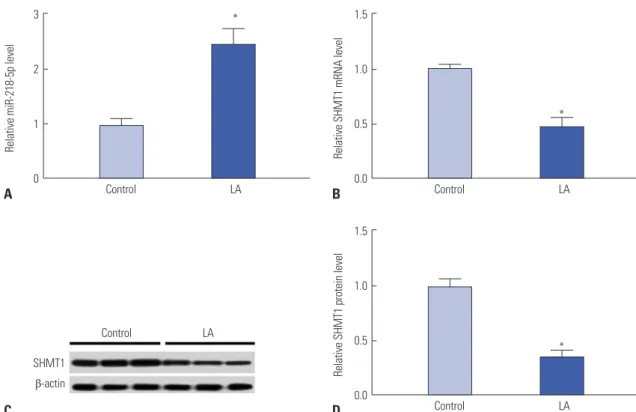
To test whether miR-218-5p and SHMT1 participate in func- tioning of NK cells, their expressions were detected by qRT- PCR and western blots in NK cells from healthy control and LA patients (n=20). As a result, miR-218-5p expression was signif- icantly increased in NK cells of LA patients compared to con- trol group (Fig. 1A). However, a strong reduction of SHMT1 mRNA level was observed in NK cells in LA group compared to control group (Fig. 1B). Moreover, SHMT1 protein abun-
Fig. 1. MiR-218-5p and SHMT1 expressions were ectopic in NK cells of LA patients (n=20). (A) Expression of miR-218-5p was detected by qRT-PCR in NK cells of control or LA patients. (B) SHMT1 mRNA level was examined in NK cells in control and LA groups. (C and D) Abundance of SHMT1 protein was investigated by western blots. *p<0.05, LA vs. control group. LA, lung adenocarcinoma; SHMT1, serine hydroxymethyl transferase 1; qRT-PCR, quantita- tive real-time polymerase chain reaction; NK, natural killer.
3
2
1
0
1.5
1.0
0.5
0.0
1.5
1.0
0.5
0.0 LA
LA
LA
LA
*
*
* Control
Control SHMT1
β-actin
Control
Control
Relative miR-218-5p level Relative SHMT1 mRNA levelRelative SHMT1 protein level
A
C
B
D
dance showed similar trend in NK cells (Fig. 1C and D). These finding indicated that miR-218-5p and SHMT1 might play es- sential roles in NK cells in LA.
Activated NK-92 cells promoted cytokines production, inhibited miR-218-5p, and induced SHMT1 protein expression
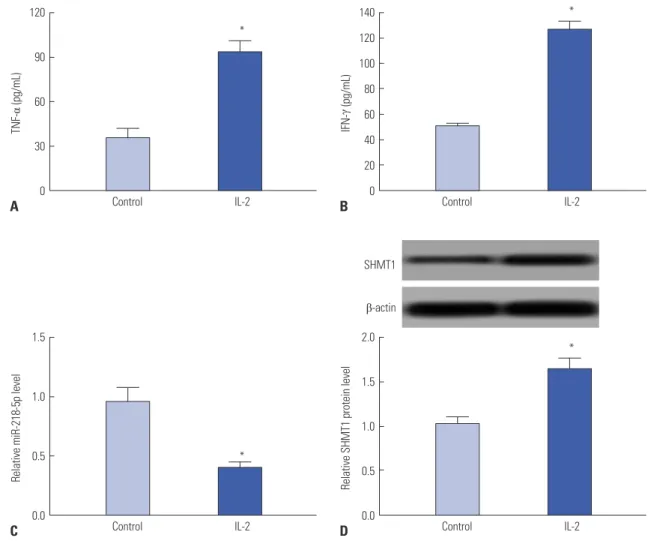
IL-2 was used to induce activation of NK cells in vitro. NK-92 cells showed enhanced TNF-α production after IL-2 stimula- tion (Fig. 2A). Meanwhile, IFN-γ expression was also elevated in NK-92 cells in response to IL-2 (Fig. 2B). These suggested that NK cells were activated by IL-2 treatment, indicating trig- gering of killing effect of NK cells. Subsequently, the expres- sions of miR-218-5p and SHMT1 were detected in activated NK-92 cells. The expression of miR-218-5p was impaired in activated NK cells compared to those without IL-2 treatment (Fig. 2C). Besides, IL-2 insult resulted in a great increase of SHMT1 protein level in NK cells compared to that before IL-2 stimulation (Fig. 2D). These results further showed that miR-
218-5p and SHMT1 might be required for the functioning of NK cells.
Addition of miR-218-5p blocked the killing effect of NK cells to LA cells
To evaluate the effect of miR-218-5p on killing effect of NK cells to LA cells, miR-218-5p mimics were introduced into NK- 92 cells and co-cultured with A549 cells after IL-2 stimulation.
MiR-218-5p expression was downregulated in NK-92 cells af- ter IL-2 treatment, whereas addition of miR-218-5p reversed the level of miR-218-5p (Fig. 3A). Moreover, abundant pres- ence of miR-218-5p inhibited IFN-γ and TNF-α secretion in NK-92 cells with treatment of IL-2, which activated cells and promoted cytokines production (Fig. 3B and C). In addition, the cytotoxicity of activated NK cells to A549 cells was investi- gated by co-culturing of NK-92 and A549 cells. Results showed that IL-2 stimulation improved the killing effect of NK-92 cells, while introduction of miR-218-5p displayed opposite effect (Fig.
3D). These results suggested that miR-218-5p overexpression
Fig. 2. IL-2 induced activation of NK cells and dysregulation of miR-218-5p and SHMT1 expression. NK-92 cells were treated by IL-2 (20 ng/mL) for 24 h. (A and B) TNF-α and IFN-γ production levels were determined by ELISA in NK-92 cells with or without IL-2 stimulation. (C) Effect of IL-2 on miR-218-5p ex- pression was investigated in NK-92 cells. (D) SHMT1 protein expression was detected in NK-92 cells after or before IL-2 treatment. *p<0.05, IL-2-treated group vs. control group. IL-2, interleukin-2; NK, natural killer; SHMT1, serine hydroxymethyl transferase 1; TNF-α, tumor necrosis factor-α; IFN-γ, interferon-γ.
120
90
60
30
0
1.5
1.0
0.5
0.0
140 120 100 80 60 40 20 0
2.0
1.5
1.0
0.5
0.0 IL-2
IL-2
IL-2
IL-2
*
*
*
* Control
Control
Control
Control SHMT1
β-actin
TNF-α (pg/mL)Relative miR-218-5p level IFN-
γ (pg/mL)Relative SHMT1 protein level
A
C
B
D
can protect against the killing effect of NK cells to LA cells.
SHMT1 was a target of miR-218-5p
Since miR-218-5p and SHMT1 were involved in dysfunction of NK cells, we next probed the potential link of miR-218-5p and SHMT1 in NK-92 cells. Bioinformatics assay described the putative binding sites of miR-218-5p and SHMT1 by Tar- getScan, indicating SHMT1 might be a direct target of miR- 218-5p (Fig. 4A). Next, we investigated the interaction in 293T cells by luciferase activity assay. SHMT1-wt and miR-218-5p were co-transfected into 293T cells, and luciferase activity was obviously inhibited in miR-218-5p group compared to NC group, whereas there was not significant difference of the ac- tivity in response to SHMT1-mut (Fig. 4B). Conversely, lucif- erase activity of cells with SHMT1-wt showed a higher level in anti-miR-218-5p group compared to that in anti-NC group.
However, miR-218-5p deletion failed to show efficacy in affect- ing the activity of cells transfected with SHMT1-mut (Fig. 4C).
These uncovered the interaction between miR-218-5p and SHMT1. Accordingly, the effect of miR-218-5p on SHMT1 ex- pression was investigated in NK-92 cells. Addition of miR-218- 5p led to a great loss of SHMT1 mRNA and protein level com- pared to NC group (Fig. 4D and E). Nevertheless, the absence
of miR-218-5p showed an opposite effect, revealed by elevat- ed SHMT1 abundance at mRNA and protein level (Fig. 4F and G), indicating miR-218-5p was negatively correlated with SHMT1 in NK cells.
SHMT1 was required for miR-218-5p-mediated killing effect of NK cells to LA cells
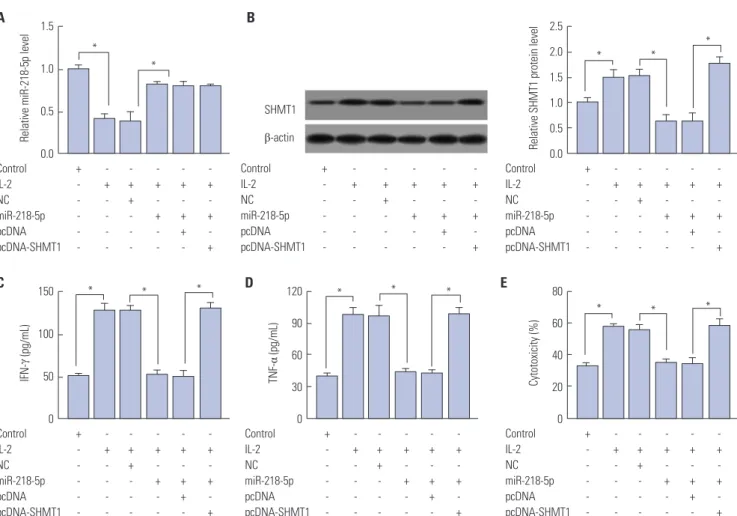
To probe whether SHMT1 was associated with miR-218-5p- mediated limited capacity for killing effect of NK cells, miR- 218-5p or (and) SHMT1 were transfected into IL-2-treated NK-92 cells. MiR-218-5p abundance was markedly impaired after IL-2 insult and miR-218-5p mimics protected the expres- sion, while SHMT1 overexpression could not afford miRNA expression (Fig. 5A). Besides, SHMT1 expression was promot- ed in NK-92 cells by IL-2 stimulation and miR-218-5p addition inhibited SHMT1 abundance, whereas SHMT1 overexpres- sion effectively increased protein levels (Fig. 5B). IL-2 facilitat- ed IFN-γ production and miR-218-5p blocked cytokine secre- tion, while SHMT1 reversed the expression of IFN-γ in NK-92 cells (Fig. 5C). Moreover, similar trend was uncovered in terms of TNF-α level in NK cells (Fig. 5D). Likewise, SHMT1 ablated the effect of miR-218-5p on cytotoxicity of NK cells to A549 cells, which enhanced the killing effect (Fig. 5E). These data
Fig. 3. Enrichment of miR-218-5p blocked the killing effect of NK cells to LA cells. (A) Altered abundance of miR-218-5p was detected in IL-2-avtivated NK- 92 cells with miR-218-5p or NC transfection. (B and C) IFN-γ and TNF-α secretion were examined in NK-92 cells after IL-2 and miR-218-5p treatment. (D) Killing effect of NK-92 to LA cells was evaluated by LDH cytotoxicity assay kit, and the effect of miR-218-5p on killing effect was detected in NK-92 cells transfected with miR-218-5p mimics. *p<0.05, IL-2-treated group vs. control group, and IL-2+miR-218-5p group vs. IL-2+NC group. NK, natural killer; LA, lung adenocarcinoma; IL-2, interleukin-2; NC, negative control; IFN- γ, interferon-γ; TNF-α, tumor necrosis factor-α; LDH, lactate dehydrogenase.
2.5
2.0
1.5
1.0
0.5
0.0
120
90
60
30
0
150
100
50
0
80
60
40
20
0 IL-2
IL-2
IL-2
IL-2 IL-2+NC
IL-2+NC
IL-2+NC
IL-2+NC IL-2+miR-218-5p
IL-2+miR-218-5p
IL-2+miR-218-5p
IL-2+miR-218-5p Control
Control
Control
Control
*
*
*
*
*
*
*
*
Relative miR-218-5p expressionTNF-α (pg/mL) IFN-
γ (pg/mL)
Cytotoxicity (%)
A
C
B
D
indicated that miR-218-5p overexpression repressed the killing effect of NK cells to LA cells by regulating SHMT1 expression.
MiR-218-5p depletion limited LA tumor growth
in vivoTo further explore the effect of miR-218-5p on cytotoxicity of NK cells to LA cells in vivo, activated LNK cells were transfect- ed with anti-miR-218-5p or anti-NC, and then introduced into mice model of LA (n=8 per group). Tumor volume was pro- gressively increased, and absence of miR-218-5p decreased tumor growth compared to anti-NC treatment group (Fig. 6A).
Moreover, the expression of SHMT1 was examined in tumor tissues. An evident increase in protein level was observed in miR-218-5p deficiency group compared to NC group (Fig. 6B and C). These findings suggested that miR-218-5p exhaustion weakened tumor growth in vivo by enhancing the killing ef- fect of NK cells to LA cells.
DISCUSSION
LA is a major subtype of lung cancer which threatens people’s health all over the world.2 Over the past few years, immune- based therapy has gained more attention, and increasing number of investigators showed great promise in cytotoxicity of NK cells to tumor cells. NK cells played important roles in various types of cancer, including hepatocellular carcinoma and colorectal cancer.18,19 Likewise, immune T cell and NK cell were involved in LA progression by varying pathways.20 Be- sides, miRNAs have been suggested to be associated with control of immune response in diverse cancers by regulating functions of T or NK cells.21 For instance, miR-146a sup- pressed NK cells function via mediating signal transducer and activator of transcription 1 (STAT1).22 However, miR-30c could confer NK cells cytotoxicity by regulating natural-killer group 2 member D (NKG2D).23 A novel miRNA, miR-218-5p, has been reported as a potential biomarker in many cancers, such as colorectal cancer, osteoarthritis, and LA.24-26 However, the study on involvement of miR-218-5p in NK cells function re- Fig. 4. SHMT1 was a target of miR-218-5p. (A) Bioinformatics assay indicated putative binding sites of miR-218-5p and 3’-UTR of SHMT1 by TargetScan. (B and C) Wt or mut of SHMT1-transfected 293T cells were used to investigate luciferase activity by co-transfection of miR-218-5p or anti-miR-218-5p, re- spectively. (D and E) Effect of miR-218-5p on SHMT1 expression was detected in NK-92 cells at mRNA and protein level. (F and G) Abundances of SHMT1 mRNA and protein were altered in NK-92 cells after anti-miR-218-5p transfection. *p<0.05, miR-218-5p group vs. NC group, and anti-miR-218-5p group vs.
anti-NC group. SHMT1, serine hydroxymethyl transferase 1; NK, natural killer.
1.5
1.0
0.5
0.0
4 3 2 1 0
1.5
1.0
0.5
0.0
1.5
1.0
0.5
0.0
2.5 2.0 1.5 1.0 0.5 0.0 3
2
1
0
SHMT1-mut SHMT1-mut miR-218-5p
miR-218-5p Anti-miR-218-5p Anti-miR-218-5p
SHMT1-wt SHMT1-wt NC
NC Anti-NC Anti-NC
NC miR-218-5p
Anti-NC Anti-miR-218-5p
*
*
*
*
* *
Relative luciferase activity Relative luciferase activity Relative SHMT1 mRNA level
Relative SHMT1 protein level Relative SHMT1 protein levelRelative SHMT1 mRNA level
B A
C D
E F G
SHMT1 β-actin
SHMT1 β-actin
mains poorly understood. In the present study, we obtained NK cells from LA patients or healthy controls, and detected the expressions of miR-218-5p and SHMT1 in NK cells, and showed that both miR-218-5p and SHMT1 were expressed in NK cells.
Tumor cells have been reported to be killed by immune
cells, while tumor immune escape supported tumor develop- ment by triggering the resistance to cytotoxicity of immune cells, such as NK cells.5 Previous research revealed that trans- forming growth factor-β (TGF-β) and IL in the microenviron- ment might disturb the balance of limitation of NK cell func- tion in cancers.27 Furthermore, IL-2 was widely used to induce 1.5
1.0
0.5
0.0
150
100
50
0
120 90 60 30 0
2.5 2.0 1.5 1.0 0.5 0.0
80 60 40 20 0
Control + - - - - -
IL-2 - + + + + +
NC - - + - - -
miR-218-5p - - - + + +
pcDNA - - - - + -
pcDNA-SHMT1 - - - +
Control + - - - - -
IL-2 - + + + + +
NC - - + - - -
miR-218-5p - - - + + +
pcDNA - - - - + -
pcDNA-SHMT1 - - - +
Control + - - - - -
IL-2 - + + + + +
NC - - + - - -
miR-218-5p - - - + + +
pcDNA - - - - + -
pcDNA-SHMT1 - - - +
Control + - - - - -
IL-2 - + + + + +
NC - - + - - -
miR-218-5p - - - + + +
pcDNA - - - - + -
pcDNA-SHMT1 - - - +
Control + - - - - -
IL-2 - + + + + +
NC - - + - - -
miR-218-5p - - - + + +
pcDNA - - - - + -
pcDNA-SHMT1 - - - +
Control + - - - - -
IL-2 - + + + + +
NC - - + - - -
miR-218-5p - - - + + +
pcDNA - - - - + -
pcDNA-SHMT1 - - - +
SHMT1 β-actin
*
* *
*
*
*
*
*
* * * *
*
*
Relative miR-218-5p levelIFN-
γ (pg/mL)
TNF-α (pg/mL) Relative SHMT1 protein levelCytotoxicity (%)
A
C D
B
E
Fig. 5. Introduction of SHMT1 reversed miR-218-5p-mediated inhibitory role in the killing effect of NK-92 to LA cells. (A) Expression of miR-218-5p was ex- amined in NK-92 cells after treatment. (B) Ectopic SHMT1 protein level was detected in miR-218-5p or SHMT1-transfected NK-92 cells after IL-2 insult. (C and D) Effect of SHMT1 on IFN-γ and TNF-α expression in IL-2-activated NK-92 cells was investigated. (E) Cytotoxicity of NK-92 with SHMT1 transfection to A549 cells was evaluated. *p<0.05, IL-2-treated group vs. control group, IL-2+miR-218-5p group vs. IL-2+NC group, and IL-2+miR-218-5p+SHMT1 group vs. IL-2+miR-218-5p+pcDNA group. SHMT1, serine hydroxymethyl transferase 1; NK, natural killer; IFN- γ, interferon-γ; TNF-α, tumor necrosis factor-α; IL- 2, interleukin-2.
SHMT1 β-actin
Fig. 6. Abrogation of miR-218-5p enhanced the killing effect of NK to LA cells in vivo. IL-2-treated LNK cells were transfected with anti-miR-218-5p and in- troduced into LA tumor in nude mice (n=8 per group). (A) Tumor volume was examined every three days. (B and C) Expression of SHMT1 protein was de- tected in the tumor tissues. *p<0.05, anti-miR-218-5p group vs. anti-NC group. NK, natural killer; LA, lung adenocarcinoma; IL-2, interleukin-2; LNK, mouse NK cell line; SHMT1, serine hydroxymethyl transferase 1.
100 80 60 40 20 0
*
* 3 6 9 12 15
Time (day) Anti-NC Anti-miR-218-5p
Tumor volume (mm3)
A B
4 3 2 1
0 Anti-miR-218-5p
Anti-miR-218-5p
Anti-NC Anti-NC
*
Relative SHMT1 protein level
C
activation of NK cells to inhibit tumor processes.28,29 Therefore, we also introduced IL-2 into NK cells and found that IL-2 stimulated IFN-γ and TNF-α secretion, and altered the abun- dances of miR-218-5p and SHMT1. This was consistent with another finding that suggested miR-218-5p had low expres- sions in activated NK cells.13 We hypothesized that miR-218- 5p and SHMT1 might be required for activation of NK cells, which could provide a novel biomarker of regulating NK cells function. To test the hypothesis, we probed whether miR-218- 5p might affect the killing effect of NC cells to LA cells. Our re- sults showed that miR-218-5p overexpression inhibited in- flammatory cytokines production and cytotoxicity against LA cells, indicating that miR-218-5p was negatively correlated with the killing effect of NK cells. Similarly, miR-889 compro- mised the killing effect of NK cells by increasing resistance to cytotoxicity of NK cells.18 Apart from miR-889, miR-615-5p also blocked NK cells cytotoxicity to tumor cells by regulating insulin-like growth factor-1R (IGF-1R) expression.30 These find- ings uncovered that miRNAs might play an essential role in regulating NK cells cytotoxicity.
miRNAs interacted with the development and function of NK cells by transcriptional and post-transcriptional regula- tion.31 MiR-218-5p was negatively correlated with poor prog- nosis of lung cancer by targeting IL-6 and STAT3.32 Besides, slug and zinc finger E-box binding homeobox 2 (ZEB2) were also targeted by miR-218-5p, and played essential roles in epi- thelial-mesenchymal transition and metastasis in lung can- cer.33 SHMT1 was reported to be crucial for tumor progression in various cancer types, including lung cancer.14,16,34 In addi- tion, SHMT1 might participate in cell proliferation and apop- tosis by miR-198 targeting in LA.17 Previous study revealed that vitamin B6 might regulate inflammatory response by me- diating SHMT-related pathway.35 Moreover, SHMT1 was sug- gested to stimulate the production of inflammatory cytokines in ovarian cancer.36 Besides, currently available evidence have indicated SHMT1 was required for B-lymphoma cell growth.34 These findings uncovered that SHMT1 might be regarded as a target for immunotherapy of tumors. However, the mecha- nism that SHMT1 requires for functioning of NK cells still re- mains unclear. Hence, we probed a link of miR-218-5p with SHMT1, and investigated the effect of SHMT1 on functioning of NK cells. Our results showed that addition of SHMT1 ame- liorated NK cell function. Murine xenograft model in vivo was responsible for preclinical drug trials, and it has been widely used for NK cells function or LA progression investigation.29,37 In this study, we found that miR-218-5p also regulated the killing effect of NK cells in vivo, revealed by reduced tumor volume. MiR-218-5p and SHMT1 were involved in not only cytotoxicity of NK cells but also in LA progression, whereupon the mechanism by which miR-218-5p and SHMT1 affected LA processes should be investigated further in future studies.
In summary, miR-218-5p was enhanced in NK cells but in- hibited by IL-2 treatment. Moreover, miR-218-5p overturned
the killing effect of NK cells to LA cells by regulating SHMT1 expression in vitro and in vivo. This might indicate that miR- 218-5p has a potential to regulate NK cell functions to address anti-tumor role in cancers, such as LA.
AUTHOR CONTRIBUTIONS
Conceptualization: Quanjun Yang. Data curation: Jingjing Li. Formal analysis: Yili Hu. Funding acquisition: Xiaofei Tang. Investigation: Lili Yu. Methodology: Lihua Dong. Project administration: Diandian Chen. Resources: Quanjun Yang, Lihua Dong. Software: Diandian Chen. Supervision: Jingjing Li. Validation: Xiaofei Tang, Yili Hu. Visu- alization: Quanjun Yang, Jingjing Li. Writing—original draft: Quanjun Yang, Jingjing Li. Writing—review & editing: Jingjing Li, Quanjun Yang, Yili Hu.
ORCID iDs
Quanjun Yang https://orcid.org/0000-0002-6914-1923 Jingjing Li https://orcid.org/0000-0002-0990-1556 Yili Hu https://orcid.org/0000-0002-2646-4677 Xiaofei Tang https://orcid.org/0000-0003-1764-0971 Lili Yu https://orcid.org/0000-0001-6246-4239 Lihua Dong https://orcid.org/0000-0003-3257-0131 Diandian Chen https://orcid.org/0000-0003-4578-1720
REFERENCES
1. Global Burden of Disease Cancer Collaboration, Fitzmaurice C, Allen C, Barber RM, Barregard L, Bhutta ZA, Brenner H, et al.
Global, regional, and national cancer incidence, mortality, years of life lost, years lived with disability, and disability-adjusted life- years for 32 cancer groups, 1990 to 2015: a systematic analysis for the global burden of disease study. JAMA Oncol 2017;3:524-48.
2. Inamura K. Clinicopathological characteristics and mutations driving development of early lung adenocarcinoma: tumor initia- tion and progression. Int J Mol Sci 2018;19:1259.
3. Donington JS, Kim YT, Tong B, Moreira AL, Bessich J, Weiss KD, et al. Progress in the management of early-stage non-small cell lung cancer in 2017. J Thorac Oncol 2018;13:767-78.
4. Shroff GS, de Groot PM, Papadimitrakopoulou VA, Truong MT, Carter BW. Targeted therapy and immunotherapy in the treatment of non-small cell lung cancer. Radiol Clin orth Am 2018;56:485-95.
5. Aktas¸ ON, Öztürk AB, Erman B, Erus S, Tanju S, Dilege S¸. Role of natural killer cells in lung cancer. J Cancer Res Clin Oncol 2018;144:
997-1003.
6. Le Maux Chansac B, Missé D, Richon C, Vergnon I, Kubin M, So- ria JC, et al. Potentiation of NK cell-mediated cytotoxicity in hu- man lung adenocarcinoma: role of NKG2D-dependent pathway.
Int Immunol 2008;20:801-10.
7. Wang R, Jaw JJ, Stutzman NC, Zou Z, Sun PD. Natural killer cell- produced IFN-γ and TNF-α induce target cell cytolysis through up-regulation of ICAM-1. J Leukoc Biol 2012;91:299-309.
8. Maemura K, Watanabe K, Ando T, Hiyama N, Sakatani T, Amano Y, et al. Altered editing level of microRNAs is a potential biomark- er in lung adenocarcinoma. Cancer Sci 2018;109:3326-35.
9. Shirshev SV, Nekrasova IV, Gorbunova OL, Orlova EG, Maslen- nikova IL. MicroRNA in hormonal mechanisms of regulation of NK cell function. Dokl Biochem Biophys 2017;474:168-72.
10. Rizzo R, Soffritti I, D’Accolti M, Bortolotti D, Di Luca D, Caselli E.
HHV-6A/6B infection of NK cells modulates the expression of miRNAs and transcription factors potentially associated to im- paired NK activity. Front Microbiol 2017;8:2143.
11. Donatelli SS, Zhou JM, Gilvary DL, Eksioglu EA, Chen X, Cress WD, et al. TGF-β-inducible microRNA-183 silences tumor-associ- ated natural killer cells. Proc Natl Acad Sci U S A 2014;111:4203-8.
12. Li YJ, Zhang W, Xia H, Zhang BS, Chen P, Zhao YL, et al. miR-218 suppresses epithelial-to-mesenchymal transition by targeting Robo1 and Ecop in lung adenocarcinoma cells. Future Oncol 2017;
13:2571-82.
13. Victor AR, Weigel C, Scoville SD, Chan WK, Chatman K, Nemer MM, et al . Epigenetic and posttranscriptional regulation of CD16 expression during human NK cell development. J Immunol 2018;
200:565-72.
14. Gupta R, Yang Q, Dogra SK, Wajapeyee N. Serine hydroxymethyl transferase 1 stimulates pro-oncogenic cytokine expression through sialic acid to promote ovarian cancer tumor growth and progres- sion. Oncogene 2017;36:4014-24.
15. Bahari G, Hashemi M, Naderi M, Sadeghi-Bojd S, Taheri M. Asso- ciation of SHMT1 gene polymorphisms with the risk of childhood acute lymphoblastic leukemia in a sample of Iranian population.
Cell Mol Biol (Noisy-le-grand) 2016;62:45-51.
16. Wang L, Lu J, An J, Shi Q, Spitz MR, Wei Q. Polymorphisms of cy- tosolic serine hydroxymethyltransferase and risk of lung cancer: a case-control analysis. Lung Cancer 2007;57:143-51.
17. Wu S, Zhang G, Li P, Chen S, Zhang F, Li J, et al. miR-198 targets SHMT1 to inhibit cell proliferation and enhance cell apoptosis in lung adenocarcinoma. Tumour Biol 2016;37:5193-202.
18. Xie H, Zhang Q, Zhou H, Zhou J, Zhang J, Jiang Y, et al. microR- NA-889 is downregulated by histone deacetylase inhibitors and confers resistance to natural killer cytotoxicity in hepatocellular carcinoma cells. Cytotechnology 2018;70:513-21.
19. Zhao H, Su W, Kang Q, Xing Z, Lin X, Wu Z. Natural killer cells in- hibit oxaliplatin-resistant colorectal cancer by repressing WBSCR22 via upregulating microRNA-146b-5p. Am J Cancer Res 2018;8:824-34.
20. Lavin Y, Kobayashi S, Leader A, Amir ED, Elefant N, Bigenwald C, et al. Innate immune landscape in early lung adenocarcinoma by paired single-cell analyses. Cell 2017;169:750-65.
21. Jasinski-Bergner S, Mandelboim O, Seliger B. The role of microR- NAs in the control of innate immune response in cancer. J Natl Cancer Inst 2014;106:dju257.
22. Xu D, Han Q, Hou Z, Zhang C, Zhang J. miR-146a negatively regu- lates NK cell functions via STAT1 signaling. Cell Mol Immunol 2017;14:712-20.
23. Ma Y, Gong J, Liu Y, Guo W, Jin B, Wang X, et al. MicroRNA-30c pro- motes natural killer cell cytotoxicity via up-regulating the expres- sion level of NKG2D. Life Sci 2016;151:174-81.
24. Liu M, Yin K, Guo X, Feng H, Yuan M, Liu Y, et al. Diphthamide biosynthesis 1 is a novel oncogene in colorectal cancer cells and is regulated by MiR-218-5p. Cell Physiol Biochem 2017;44:505-14.
25. Lu J, Ji ML, Zhang XJ, Shi PL, Wu H, Wang C, et al. MicroRNA- 218-5p as a potential target for the treatment of human osteoar- thritis. Mol Ther 2017;25:2676-88.
26. Tian F, Li R, Chen Z, Shen Y, Lu J, Xie X, et al. Differentially ex- pressed miRNAs in tumor, adjacent, and normal tissues of lung adenocarcinoma. Biomed Res Int 2016;2016:1428271.
27. Marcais A, Viel S, Grau M, Henry T, Marvel J, Walzer T. Regulation of mouse NK cell development and function by cytokines. Front Immunol 2013;4:450.
28. Pan C, Xiang L, Pan Z, Wang X, Li J, Zhuge L, et al. MiR-544 pro- motes immune escape through downregulation of NCR1/NKp46 via targeting RUNX3 in liver cancer. Cancer Cell Int 2018;18:52.
29. Zhang LL, Zhang LF, Shi YB. miR-24 inhibited the killing effect of natural killer cells to colorectal cancer cells by downregulating Paxillin. Biomed Pharmacother 2018;101:257-63.
30. Rahmoon MA, Youness RA, Gomaa AI, Hamza MT, Waked I, El Tayebi HM, et al. MiR-615-5p depresses natural killer cells cyto- toxicity through repressing IGF-1R in hepatocellular carcinoma patients. Growth Factors 2017;35:76-87.
31. Leong JW, Wagner JA, Ireland AR, Fehniger TA. Transcriptional and post-transcriptional regulation of NK cell development and function. Clin Immunol 2017;177:60-9.
32. Yang Y, Ding L, Hu Q, Xia J, Sun J, Wang X, et al. MicroRNA-218 functions as a tumor suppressor in lung cancer by targeting IL-6/
STAT3 and negatively correlates with poor prognosis. Mol Cancer 2017;16:141.
33. Shi ZM, Wang L, Shen H, Jiang CF, Ge X, Li DM, et al. Downregu- lation of miR-218 contributes to epithelial-mesenchymal transi- tion and tumor metastasis in lung cancer by targeting Slug/ZEB2 signaling. Oncogene 2017;36:2577-88.
34. Ducker GS, Ghergurovich JM, Mainolfi N, Suri V, Jeong SK, Hsin- Jung Li S, et al. Human SHMT inhibitors reveal defective glycine import as a targetable metabolic vulnerability of diffuse large B- cell lymphoma. Proc Natl Acad Sci U S A 2017;114:11404-9.
35. Ueland PM, McCann A, Midttun Ø, Ulvik A. Inflammation, vita- min B6 and related pathways. Mol Aspects Med 2017;53:10-27.
36. Gupta R, Yang Q, Dogra SK, Wajapeyee N. Serine hydroxymethyl transferase 1 stimulates pro-oncogenic cytokine expression through sialic acid to promote ovarian cancer tumor growth and progression. Oncogene 2017;36:4014-24.
37. Lv Q, Hu JX, Li YJ, Xie N, Song DD, Zhao W, et al. MiR-320a effec- tively suppresses lung adenocarcinoma cell proliferation and me- tastasis by regulating STAT3 signals. Cancer Biol Ther 2017;18:
142-51.