• 검색 결과가 없습니다.

Recent Development in Metal Oxides for Carbon Dioxide Capture and Storage

N/A
N/A
Protected

Academic year: 2021

Share "Recent Development in Metal Oxides for Carbon Dioxide Capture and Storage"

Copied!
14
0
0

로드 중.... (전체 텍스트 보기)

전체 글

(1)

1. Introduction

1)

Ever-growing increase of anthropogenic carbon diox- ide emission and resultant climate change are the ur- gent that humankind has faced. CO

2

capture and stor-

age (CCS) technologies have been arose as the near to midterm solution to the climate change[1-8]. It can be divided into three main types: (i) precombustion meth- od, (ii) post-combustion method and (iii) oxy-fuel com- bustion method. Among them, post-combustion method

Corresponding author(e-mail: [email protected], https://orcid.org/0000-0002-3820-141X)

연세대학교 언더우드국제대학 융합과학공학부 에너지환경과학공학 (2020년 4월 13일 접수, 2020년 4월 23일 수정, 2020년 4월 26일 채택)

Recent Development in Metal Oxides for Carbon Dioxide Capture and Storage

Hyunyoung Oh and Rajkumar Patel

Energy and Environmental Science and Engineering (EESE), Integrated Science and Engineering Division (ISED), Underwood International College, Yonsei University, 85 Songdogwahak-ro, Yeonsu-gu, Incheon 03722, South Korea

(Received April 13, 2020, Revised April 23, 2020, Accepted April 26, 2020)

요 약: 이산화탄소 포집 및 저장기술(CCS)은 인류발생적 요인에 의한 이산화탄소 배출 증가와 그로 인한 기후변화를 완 화시킬 수 있는 기술 중 하나이다. 그 중, 매체 순환식 연소(chemical looping combustion, CLC)와 칼슘루핑(calcium looping) 기 술은 현재 아민 스크러빙(amine scrubbing)을 대체할 수 있는 유망한 기술로 주목받고 있다. 두 방법 모두 금속 산화물을 이 용한 연속적인 순환 사이클 반응에 의한 것이다. 전체적인 이산화탄소 포집 및 저장 성능의 향상을 위해서는 사이클을 거듭 하며 발생하는 소결(sintering)로 인한 안정성 저하 문제를 해결하고 금속 산화물의 구조 또한 최적화해야 한다. 금속 산화물 표면에 얇은 박막을 형성하는 것은 소결로 인한 손상을 막을 수 있는 방법이다. 이러한 박막 제조 기술로 잘 알려진 기술에 는 화학기상증착법(chemical vapor deposition)과 원자층증착기술(atomic layer deposition)이 있다. 본 총설에서는 CVD, ALD 기술을 비롯하여 효과적인 반응 안정성 향상을 위한 안정제 첨가 방법, 금속 산화물 구조 개선에 대한 다양한 최근 기술들을 다루었다.

Abstract: CO

2

capture and storage (CCS) is one of the promising technologies that can mitigate ever-growing emission of anthropogenic carbon dioxide and resultant climate change. Among them, chemical looping combustion (CLC) and calcium looping (CaL) are getting increasing attention recently as the prospective alternatives to the existing amine scrubbing. Both methods use metal oxides in the process and consist of cyclic reactions. Yet, due to their cyclic nature, they both need to resolve sintering-induced cyclic stability deterioration. Moreover, the structure of the metal oxides needs to be optimized to enhance the overall performance of CO

2

capture and storage. Deposition of thin film coating on the metal oxide is another way to get rid of wear and tear during the sintering process. Chemical vapor deposition or atomic layer deposition are the well-known, established methods to form thin film membranes, which will be discussed in this review. Various effective recent developments on structural modification of metal oxide and incorporation of stabilizers for cyclic stability are also discussed.

Keywords:

carbon capture and storage, atomic layer deposition, CO2, thin film membranes

(2)

Fig. 1. Schematic diagram of calcium oxide synthesis form calcium nitrate (a) without precipitation (b) with precip- itation and (c) in the presence of urea.

is the most suitable one to the condition of existing power plants due to its simplicity and high efficiency, and the most mature of it in industrial scale is amine scrubbing. However, due to the high cost, involvement of corrosive chemicals and hazardous byproducts, alter- natives to amine scrubbing are being vigorously sought.

Widely developed alternatives are chemical looping combustion (CLC) and calcium looping (CaL: CaO

(s)

+ CO

2(g)

↔ CaCO

3(s)

)[9-11] (Fig. 1). Both processes are dependent on the cyclic reactions and the use of metal oxides. Yet, due to the cyclic nature of the process, cyclic stability decreases over multiple cycles largely due to sintering, which cause blockage, irreversible collapse of the structure, or increase the size of the constituent particles. The main cause of the sintering is the lower Tammann temperature (T

T

).

In order to reduce the sintering-induced capacity de- cay, the incorporation of high Tammann temperature TT stabilizers have been proposed. Stabilizers work in two different ways upon incorporation especially in CaL: (i) forming solid solution with CaO and (ii) no solid solution formed with CaO. The effective in-

corporation of stabilizer depends on the two main as- pects: (i) homogeneous distribution on the support, and (ii) minimized quantity. In that sense, atomic layer deposition (ALD) has rose as the attractive way of sta- bilizer incorporation since it can deposit thin films in atomic-level thickness with high conformity[12].

Moreover, the structure of the sorbent must contain certain features in order to enhance the performance capacity. Nano-structured morphology, certain level of porosity and multi-shelled nature of the structure are found to be desirable. Various new synthesis method such as hydrothermal approach, evaporation induced self-assembly (EISA) approach, utilizing hierarchical carbon nanosheet (CNS) and porous gas-separation membrane have been proposed[13]. Among them, tem- plating synthesis is the most widely-employed method for developing structure with hollow interior and meso- porous outer shell. Templating method can be divided into soft and hard templating and the latter one is po- tentially more attractive due to its greater stability, pre- dictability and controllability. In this review, various recent developments on the synthesis and enhancement methods of CO

2

capture and storage techniques, is dis- cussed, concentrating on the use of metal oxide in the process.

2. Carbon Dioxide Capture and Storage

At higher pressure of the adsorption isotherms of gases at temperature near their condensation points, the isotherm convex towards the pressure axis, which may be the indication of the formation of multimolecular adsorbed layers[14]. DeBoer and Zwicker explained this multimolecular adsorption by the polarization theo- ry[15]. However, this paper points out the limitation of the polarization theory then derives the isotherm equa- tion of multimolecular adsorption by generalizing Langmuir’s treatment of the unimolecular layer and ap- plies the equation to various experimental isotherms.

Porous structure and large pore volume are the key of

the performance of an amine-impregnated adsorbent

(3)

[16] (Fig. 2). Since most porous materials can only in- teract weakly with CO

2

, amine functionalization either by chemical grafting or physical impregnation is essen- tial to overcome that shortcoming. Facile generation of hierarchical nitrogen-rich carbon nanosheet (CNS) with large pore width and pore volume is proposed in this study. CNS is synthesized by one-step carbonization of glucose and dicyandiamide. CNS is physically impreg- nated with pentaethylenehexamine (PEHA) for the en- hancement of CO

2

adsorption. SEM and TEM images reveal the architecture of the synthesized CNS. 3-D Channels made up of micro-sized flakes, interconnect- ing uniform graphene-like layers of CNS, constitute the meso-macroporous structure of CNS. N

2

adsorption iso- therm further suggests the presence of abundant macro- pores in CNS. BET (Brunauer-Emmett-Teller) method calculates specific surface area of CNS as 1,410 m

2

/g.

Total pore volume of CNS is calculated as 8.41 cm

3

/g with meso-macropore volume of 8.29 cm

3

/g and micro- pore volume 0.12 cm

3

/g. Raman spectrum reveals the presence of sp

3

and sp

2

carbon in CNS structure and abundant defects and disorders at carbon layer edges

by strong D band. XRD reveals low crystalline and few-layered CNS structure. PEHA-CNS showed much higher CO

2

capture capacity than CNS due to the strong chemical interaction of PEHA with CO

2

. The optimized temperature for CO

2

adsorption of PEHA-CNS compo- sites is 75°C and optimal PEHA loading is 4 g/g. CO

2

uptake capacity at 75°C with 4 g/g PEHA is 5.45 mmol/g, which is the highest among known amine-im- pregnated absorbents. Due to the large pore width and volume of CNS, amine utilization of PEHA-CNS com- posites also shows competitive efficiency. Residual cal- cium chemicals (RCC) is an alternative sorbent to ach- ieve cost-effective improvement of CaL process[17].

RCC are the hazardous wastes derived from dry proc-

esses for acid gas removal from flue gas in waste-to-en-

ergy (WtE) facilities. RCC is the feasible alternative

sorbent for CaL process because they possess high

content of available calcium since it is the product of

the reaction between acid pollutants and Ca(OH)

2

. Also,

recycling RCC as the CaL sorbent is environmentally

beneficial in a sense that it improves the sustainability

of WtE flue-gas cleaning system since the gas-solid

Fig. 2. Illustration for the synthesis of CNS (A). SEM (B-D) and TEM (E-G) images of synthesized CNS (Reproduced from

Huang et al., 16 with permission of American Chemical Society).

(4)

carbonation has been already suggested as a safe dis- posal method of RCC. Calcium is the most abundant element in RCC samples due to the injection of Ca(OH)

2

to the flue gas as a typical process of dry processes for acid gas removal. XRD, TGA and DTG data reveals the main component of the samples as Ca(OH)

2

, CaOHCl as a product of reaction with HCl, CaSO

4

as a production of reaction with SO

2

, and CaCO

3

. The morphology of samples are shown by SEM. RCC samples show typical Ca(OH)

2

morphology of hexagonal plate-shaped nanograins and uniform coating of CaCO

3

product layer around Ca(OH)

2

nanograins. TG-FTIR then shows the point of gen- eration of evolved gas including H

2

O, CO

2

, HCl and SO

2

gas during the thermal decomposition of residues.

RCC samples were pre-calcined at 800°C in N

2

atmos- phere then carbonated under 60 vol% CO

2

at three dif- ferent temperatures: 500, 600, 700°C. Three RCC sam- ples with different elemental composition were tested.

When only amount of calcium is concerned, RCC-FC has the most abundant calcium, then RCC-FE and then RCC-RN. All RCC samples show a fast decay during the first 3 cycles, then recovery peaking, then gradual decline after multiple cycles. Electrochemical method is the new approach in carbon capture and storage (CCS) technique[18]. It usually involves applying electrical field across and electrochemical cell comprised of elec- trolyte and electrodes, however, new electrodeless high-temperature electrochemical cells have been devel- oped in this work. Instead of the electrical potential, the chemical potential gradient of CO

2

and O

2

across the mixed conducting membrane is used as the driving force of the CO

2

transport. High temperature nature of the cell could fasten the surface reaction kinetics with- out the metal catalyst. Two mixed conducting mem- branes used are oxide-carbonate and metal-carbonate.

The surface reactions enabling CO

2

separation in each membrane are respectively, CO

2(g)

+ O

2-(oxide)

↔ CO

32-

(carbonate)

for mixed oxide-ion and carbonate-ion membrane (MOCC), and CO

2(g)

+ 1/2O

2(g)

+ 2e

-(metal)

↔ CO

32-

(carbonate)

for mixed electron and carbonate-ion con- ductor (MECC). In MECC, since CO

2

and O

2

permeate

through the membrane, further separation of those gas- es is necessary. If H

2

or syngas is used as a sweep gas, CO

2

and O

2

can be converted to pure H

2

O and CO

2

stream which can be easily condensed as pure CO

2

. Ag-molten carbonate (MC) MECC membrane with ALD-coated Al

2

O

3

thin film was synthesized in this study to understand its high oxygen permeation rate.

When the permeation flux of CO

2

and O

2

through the ALD-Al

2

O

3

-overcoated Ag-MC MECC membrane was calculated, remarkably high O

2

flux was recorded. For the gas separation membrane to be effective, it is re- quired to have high flux and high selectivity[19]. High flux can be obtained by thin membrane and high se- lectivity can be obtained by small pores on the mem- brane with diameter less than 0.5 nm. As the pore size becomes smaller and smaller, it becomes extremely harder to manufacture, obtain size uniformity and reproducibility. Recently, “cross-linking” amphiphilic monomers in type 1 bicontinuous cubic (Q

1

) lyotropic liquid crystal (LLC) phase with retention of phase mi- crostructure has been suggested as the method for pol- ymer membrane manufacture which has uniform sub-1-nm pores. The effective pore size of this micro- structure has found to be 0.75 nm, which is still large for the light gas separation through size discrimination, noting average kinetic diameters of light gases are less than 0.4 nm with size differences within 0.1 nm.

Post-treatments after first-generation Q

1

phase LLC

polymer membranes generation by surface film deposi-

tion are suggested to decrease the effective pore size

of membranes. Among thin film deposition techniques,

atomic layer deposition (ALD) is almost the only meth-

od which can control the thickness of the coating at

sub-nanometer scale. The experiment was done to mod-

ify nanoporous, supported Q

1

-phase LLC polymer mem-

branes by depositing ultra-thin ceramic films or clusters

inside the pores via ALD. This work showed potential

modification method of LLC nanoporous polymer

membranes using ALD to successfully decrease effec-

tive pore size without creating any defect so that it can

be applied in light gas separations via molecular size

discrimination.

(5)

2.1. Calcium oxide

The structure of the CaO-based sorbent is critical in enhancement of CO

2

uptake capacity in calcium loop- ing reaction[20] (Fig. 3). It has been reported that CaO-based sorbents with nanostructure and a certain level of porosity possess high and stable CO

2

uptake capacity. In this work, cage-like CaO hollow micro- spheres are successfully synthesized via template-as- sisted synthesis approach, where carbonaceous spheres (CSs) derived from hydrothermal reaction of starch are used as templates. SEM images show that hydrothermal treatment at 180°C with duration of 3 hours result in the desirable morphology of CSs with smooth surfaces and narrow particle size distributions. CaO-based sorb- ents are prepared from 0.5M Ca(NO

3

)

2

solution, CSs template and precipitants. Types of precipitant de- termines the morphologies of the sorbents; among 3 different precipitants, sodium carbonate (SC), oxalic acid (OA) and urea(U), only urea results in the cage-like hollow microsphere structure. SEM and TEM images clearly show the cage-like hollow microsphere structure of CaO-U with highly porous shells consist of CaO

nanoparticles. Polycrystallinity of obtained structure is shown by diffraction pattern (SAED). This completely different morphologies of synthetic CaO sorbents is due to (i) formation route and (ii) amount of the pre- cipitated CaCO

3

. Finally, via calcination, cage-like CaO hollow microspheres are obtained. Urea assists the dep- osition of Ca ions on the hydrophilic template surface in short period of time which provides the thick shell walls that does not collapse easily during calcination.

Successful Ca ions deposition on the surface layer of

the template is shown by increase of zeta-potential

value. Synthetic CaO-based sorbents and reference

limestone were tested for 15 cycles under both mild

and harsh conditions. All synthetic sorbents show sig-

nificantly higher initial CO

2

uptake capacity than that

of limestone, especially at the initial rapid chemical

controlled stage of carbonation. Cage-like CaO hollow

microspheres possess the highest capacity of 98.2% un-

der mild condition and 82.5% under harsh condition

due to the highest specific surface area. During 15 re-

peated cycles, all of the sorbents experienced the decay

in CO

2

uptake but cage-like CaO hollow microspheres

Fig. 3. Schematic illustrations of the formation mechanism of CaO-based sorbents synthesized (A) without any precipitants,

with the addition of (B) sodium carbonate or oxalic acid and (C) urea (Reproduced from Chen et al., 20 with permission of

American Chemical Society).

(6)

show the lowest decay, maintaining 39.7% of CO

2

up- take under harsh condition. When it was put under 30 cycles, hard condition, it maintained 37.7% of CO

2

uptake. In order to understand the kinetic of carbo- nation reaction, two models have been used: (i) grain model for initial rapid chemical-controlled stage and (ii) three-dimensional diffusion model for diffusion-con- trolled stage. Reaction rate constant of each stage is calculated by the equation of respective model. It is found that the rate constant of chemical-controlled stage is always larger than the diffusion controlled stage and the rate constants for 15

th

cycle are lower than those in the first cycle, showing the decrease in CO

2

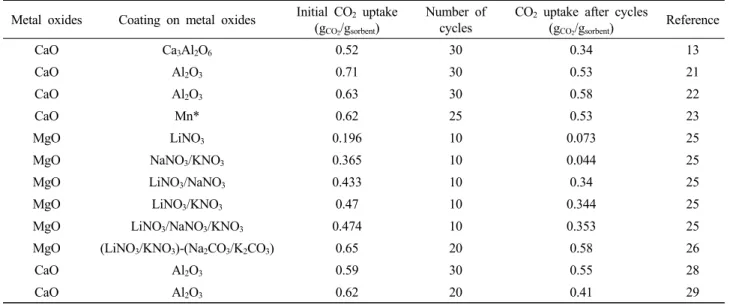
capture capacity over the cycles. The rate constants and activa- tion energy of cage-like CaO hollow microspheres are much larger than those of limestone. Performance of metal oxides are summarized in Table 1.

2.2. Modified calcium oxide

Deactivation of CaO-based sorbents has been gen- erally attributed to the sintering-induced pore volume and surface area reduction, but it is unclear if these are the sole reason for deactivation[13]. This work identi- fies the deactivation mechanism of Ca

3

Al

2

O

6

-stabilized CaO by studying structural and chemical properties of

Ca

3

Al

2

O

6

-stabilized CaO and their changes after repeat- ing cycles with Al magic-angle spinning (MAS) sol- id-state NMR, dynamic nuclear polarization surface en- hanced NMR spectroscopy (DNP-SENS), in situ XRD, Raman spectroscopy, electron microscopy coupled EDX spectroscopy and N

2

physisorption. Ca

3

Al

2

O

6

-stabilized CaO is prepared via an evaporation induced self-as- sembly (EISA) method using pluronic P-123 and metal oxide precursors, aluminum isopropoxide and calcium acetylacetonate (Ca : Al = 90 : 10). EISA method en- sures the sorbent structure to obtain high pore volume in desired meso-porous range and homogeneous dis- tribution between active CaO and the stabilizer, Ca

3

Al

2

O

6

. It was calcined at 400°C and further temper- ature was raised to 700°C for CaO formation. XRD confirms the formation of metal oxides, Ca

12

Al

14

O

33

at 700~800°C and Ca

3

Al

2

O

6

at 800~900°C in the calcined sorbent. Homogeneous distribution of Al in as-synthe- sized sorbent and 400°C-calcined sorbent is shown by STEM with EDX. N

2

physisorption reveals com- paratively high pore volume (0.19 cm

3

/g

sorent

) and sur- face area (29 m

2

/g

sorbent

) of 900°C-calcined sorbent and hierarchical pore size distribution with rich amount of small mesopores (d < 10 nm). The cyclic CO

2

capture capacity of Ca

3

Al

2

O

6

-stabilized CaO is assessed by TGA

Metal oxides Coating on metal oxides Initial CO2 uptake

(gCO2/gsorbent)

Number of cycles

CO2 uptake after cycles

(gCO2/gsorbent) Reference

CaO Ca3Al2O6 0.52 30 0.34 13

CaO Al2O3 0.71 30 0.53 21

CaO Al2O3 0.63 30 0.58 22

CaO Mn* 0.62 25 0.53 23

MgO LiNO3 0.196 10 0.073 25

MgO NaNO3/KNO3 0.365 10 0.044 25

MgO LiNO3/NaNO3 0.433 10 0.34 25

MgO LiNO3/KNO3 0.47 10 0.344 25

MgO LiNO3/NaNO3/KNO3 0.474 10 0.353 25

MgO (LiNO3/KNO3)-(Na2CO3/K2CO3) 0.65 20 0.58 26

CaO Al2O3 0.59 30 0.55 28

CaO Al2O3 0.62 20 0.41 29

*Mn is doped with CaO.

Table 1. Summary of Metal Oxides and CO

2

uptake Performance

(7)

rials consist of self-assembled network structure of transition metal ions and organic ligands[21]. The struc- ture, crystal size and morphology of the MOF pre- cursor and synthesis method, calcination condition and surfactant types all significantly affect the morphology of the MOF-derived material. In this article, Al

2

O

3

-stabilized, MOF-derived, Ca-based CO

2

sorbents have been synthesized via a combined solvothermal and wet mixing method. 2-aminoterephthalic acid (H

2

-ABDC), terephthalic acid (PTA) and isophthalic acid (IPA) are the three chosen organic ligands for MOF. FT-IR re- sults showed the successful synthesis of MOFs driven by each organic ligand. XRD patterns then showed the chemical composition of Al-stabilized, MOF-driven sorbents as CaO, Ca(OH)

2

, and calcium aluminum sol- id solution (Ca

x

Al

y

O

z

), which were further identified as Ca

12

Al

14

O

33

, Ca

5

Al

6

O

14

, and Ca

3

Al

10

O

8

. These calcium aluminum solids were formed by the reaction of CaO + Al

2

O

3

→ Ca

x

Al

y

O

z

and they are the main cause of cyclic stability enhancement of the sorbents. The effect of the CaO/Al

2

O

3

mass ratios on CO

2

sorption per- formance was analyzed. Increased stability of the stabi- lized sorbents is due to the prevention of agglomer- ation or sintering by the stabilizer, Al

2

O

3

or Ca

x

Al

y

O

z

, with high Tammann temperature. SEM images showed surface agglomeration and non-uniform pores on the unstabilized sorbents. It also showed the optimized mi- cro-morphologies of MOF precursors with a blocky shape and MOF-derived sorbents with uniform pores and smoother surface. Even after 10 cycles, MOF-de- rived sorbents retained block-shape crystals. The high- est sorption performance of 0.71 g

CO2

/g

sorbent-1

with 85.07% retention after 10 cycles was obtained with CaO/Al

2

O

3

mass ratio of 30 : 1. Presence of calcium aluminum solids act as physical barriers, not participat- ing in the cyclic reaction, successfully prevent agglom-

limestone as a CaO precursor and Al(NO

3

)

3

as an Al

2

O

3

precursor, to be utilized in the calcium looping process (CLP)[22]. The XRD patterns show that the main components of the synthesized sorbent are CaO and Ca

12

Al

14

O

33

, which is formed by the reaction be- tween CaO and Al

2

O

3

. Ca

12

Al

14

O

33

hinders the sorb- ent’s deformation due to the sintering and therefore improve the cyclic stability. When comparing SEM im- ages of Ca-Al-T and Ca-Al (sorbent without the ab- sorbent cotton template), the effect of the addition of adsorbent cotton is evident. Ca-Al-T replicates the hol- low microtubular morphology of the absorbent cotton, with diameters ranging from 0.5 to 5 µm, while Ca-Al do not contain hollow microtubes. Many mesopores are also present on the present of the Ca-Al-T. This struc- ture of Ca-Al-T increases the contact area between CaO and CO

2

which enhance the CO

2

capture capacity.

Electron diffraction (SAED) pattern indicates well-poly-crystallized structure and good stability of the sorbent structure. Different mass ratios of CaO to Al

2

O

3

determines the mass ratios of CaO to Ca

12

Al

14

O

33

in

the synthesized sorbent. The mass ratio of 90 : 10 re-

sults the highest CO

2

capture capacity of the sorbent,

Ca-Al-T, over the cycles, retaining 0.38 g/g during 50

cycles. When the CO

2

capacity of Ca-Al-T was tested

under mild (850°C, 100% N

2

) and severe condition

(920°C, 70% CO

2

/30% N

2

), it showed 7.91- and 8.93-

times higher capacity respectively for each condition

than that of the limestone over 50 cycles. Ca-Al-T

showed the highest and most stable CO

2

capacity

among Ca-Al-T, Ca-T, Ca-Al and limestone over 30

cycles. It showed 1.32 and 5.03 times greater capacity

respectively for Ca-Al and limestone under mild con-

dition and 1.30 and 8.24 times greater capacity re-

spectively under sever condition. During 50 cycles,

Ca-Al-T showed 7.91 and 8.93 times greater capacity

(8)

respectively for limestone under mild and sever condition.

This excellent CO

2

capture capacity of Ca-Al-T is at- tributed to (i) hollow microtubular structure and (ii) presence of Ca

12

Al

14

O

33

as a supporter. Even when the CO

2

capacity of Ca-Al-T, prepared by hard templating, is compared with the Ca/Al absorbents prepared by various methods, hard templating synthesized Ca-Al-T showed higher capacity than any other.

Double-shell, hollow microspheres structure of CaCO

3

was synthesized via hydrothermal reaction of sucrose, using carbonaceous microspheres (CMSs) as hard tem- plates[23]. Different shrinking rates between CMSs and metal functional shell results in double-shelled structure.

The spacing between shells is short since metal cations are mainly located in the surface of CMSs, which makes the structure more attractive since this close shell spacings further can shorten the transportation path of CO

2

and heat upon carbonation reaction. Four different sorbents were synthesized with different Ca/Mn molar ratios: pure CaCO

3

, Ca

75

Mn

1

, Ca

25

Mn

1

and Ca

10

Mn

1

. As determined by SEM and TEM images, all four sorb- ents obtained spherical structures, but as Ca/Mn molar ratio decreased, there was a slight increase in the di- ameter of the microspheres, as there are more metal cations available with increasing Mn dosage, which fastens the process of reaching critical concentration of forming a metal functional shell. Furthermore, Upon 25 adsorption-desorption cyclic tests, the importance of adequate amount of Mn doping was demonstrated more profoundly; with increasing amount of Mn doping, the adsorption stability and initial uptake capacity were no- tably promoted. Presence of agglomeration and coa- lescence among adjacent microspheres of the sorbents with insufficient Mn doping and decreased crystalline size further supports the fact of improved stability by Mn doping due to the microscopical separation of CaO nanocrystal and segregations of adjacent microspheres, forming effective physical barriers. In terms of reaction mechanism of CaO/CO

2

, Mn doping promotes the ad- sorption performance by enhancing electron donating ability of CaO by increasing electron cloud density of Ca and O atom. In carbonation reaction, electrons in O

atom of CaO are transferred to C atom in CO

2

, so with enhanced electron cloud density, more electrons in O can be transferred to C. By XRD result, the presence of Mn multiple valence states is demonstrated, which can facilitate the occurrence of the oxygen vacancies.

The Ca/Mn ratio of 12 : 1 resulted highest capacity.

The facile synthesis method of highly porous, hollow, multi-shelled MgO-stabilized CaO microsphere sorbent for calcium looping is offered in this study[24]. MgO is the attractive stabilizer with high Tammann temper- ature in a sense that it does not form a solid solution under operating condition. The sorbent is synthesized via template-assisted method and the template used is carbonaceous spheres which are formed via hydro- thermal treatment of an aqueous solution of xylose, urea and glycine with Ca and Mg precursor, which are Ca(NO

3

)

2

and Mg(NO

3

)

2

respectively. The template-as- sisted synthesis approach is found to be highly effec- tive for two reasons: (i) yielding hollow microspheres with highly porous shells and (ii) simultaneously form- ing template and precipitation of compounds of inter- est, which are CaCO

3

and MgCO

3

. When the template is calcined and removed completely, highly porous, multishelled microspheres which shells are composed of CaO and MgO nanoparticles are realized. SEM and TEM images show a formation of desired structure af- ter thermal removal of carbonaceous template. The aver- age size of shell-comprising CaO nanoparticles are ~85

± 20 nm, fulfilling an requirement < 100 nm to avoid diffusion limitations, and the average size of MgO nanoparticles are 25 ± 5 nm. TGA study showed that when compared to CaO without a stabilizer, MgO sta- bilized-CaO exhibit more stable CO

2

uptake with less decay with increasing cycle numbers. Moreover, effec- tiveness of structure composed of primary particles with

< 100 nm in diameter and void space is confirmed by

the fact that CO

2

uptake performance of CaO without

a stabilizer outperforms that of the limestone-derived

pure CaO. The influence of MgO on the sorbent per-

formance is also compared. Indeed, MgO-stabilized

sorbents captures larger fraction of CO

2

particularly in

the kinetically controlled regime of the carbonation,

(9)

take and hinders an early transition to diffusion-con- trolled reaction stage.

2.3. Magnesium oxide

Alkaline earth metal oxides are receiving increasing attention as the attractive solid sorbents for CCS tech- nologies[25]. Magnesium oxide (MgO) is used in this work as the sorbent and promoted it with alkali metal nitrates (e.g., LiNO

3

, NaNO

3

, KNO

3

) to further increase CO

2

uptake. The CO

2

capture reaction of MgO is car- bonation and it is regenerated via calcination reaction:

MgO(s) + CO

2

(g) MgCO

3

(s). Mg

5

(CO

3

)

4

(OH)

2

⋅ 4H

2

O, hydromagnesite (HM), is chosen as the MgO precursor.

Salt mixtures of promoted MgO samples are follow- ings: Li NO

3

, NaNO

3

, KNO

3

, (Li,K)NO

3

, (Na,K)NO

3

, (Li,Na)NO

3

and (Li,Na,K)NO

3

. MgO precursor and salt mixtures were mixed with deionized water, dried and calcinated. SEM showed the grain-like morphology and the morphology is maintained after carbonization in first cycle. XRD patterns showed conversion of MgO to MgCO

3

after carbonation. The peaks of MgCO

3

de- creased after 10 cycles due to the decreased CO

2

uptake. Also, XRD patters of alkali metal nitrate pro- moted MgO showed sharper MgO peaks, indicating the acceleration of MgO crystal growth due to alkali metal nitrates. When the size is compared, MgO crystallite size of pure HM is 7~8 nm, while NaNO

3

- or (Li,Na,K)NO

3

-promoted MgO is ~20 nm. CO

2

uptake of unpromoted and promoted MgO can be compared with the TGA plot. Unpromoted MgO showed immedi- ate CO

2

uptake at the very beginning while promoted MgOs showed abrupt acceleration of CO

2

uptake after a threshold temperature which is slightly lower than the melting point of the alkali metal nitrate. The pro- motion with eutectic mixtures of alkali metal nitrates further reduced the onset temperature of MgO carbona-

fect of different promoters on carbonation kinetics. The addition of alkali metal nitrates increased the amount of CO

2

uptake and ternary mixture, (Li,Na,K)NO

3

ex- hibited the fastest kinetics with highest CO

2

uptake of 474 mg CO

2

/g sorbent. Integrated gasification combined cycle is the typical example of the precombustion cap- ture of CCS[26] (Fig. 4). Layered double hydroxides and MgO are mainly included in this process but CO

2

capture capacity of the pure MgO is very small. Alkali

metal salt-promoted MgO (AMS-MgO) is suggested as

the modification of the pure MgO to enhance CO

2

cap-

ture capacity by decreasing activation energy of MgO

ionic bond and increasing ion diffusivity which derives

from the ability of molten nitrates. The operation tem-

perature of the integrated gasification combined cycle

which is between 200 to 400°C is enough for the in-

corporated nitrates to be dissolved. Indeed, AMS-MgO

has much higher CO

2

capacity than pure MgO. Yet,

slow sorption rate and poor stability of AMS-MgO

must be improved. In this article, incorporation of

CaCO

3

to MgO is suggested to develop AMS-MgO

with high capacity, rapid sorption rated and good cy-

clic stability. Prepared MgO-CaCO

3

structure is denoted

as Mg

98

Ca

2

, Mg

95

Ca

5

, Mg

90

Ca

10

, etc. according to the

molar ration between MgO and CaCO

3

. Following dep-

osition of nitrates and carbonates on MgO-CaCO

3

sup-

port for the ultimate AMS supported structure was done

using a solvent evaporation method. The structure was

denoted as AMS-Mg

100-x

Ca

x

. First, CaCO

3

incorporation

was applied to the flower-like MgO structure. By the

result of the field emission scanning electron micro-

scopy (FESEM) and high-resolution transmission elec-

tron microscopy (HRTEM), the effect of CaCO

3

in-

corporation on MgO was studied. Even though the

structure loses the its spherical morphology, flower-like

structure constructed with nanoflakes was remained.

(10)

Also, the specific surface area and the pore volume of the structure decreased, resulting in larger particles and pores size. The flower-like structure was well remained in the AMS-promoted MgO-based sorbents as well, al- so with the decrease in the specific surface area and the pore volume. The result of the XRD analysis con- firmed the presence of AMS and that of the EDS map- ping confirmed the homogeneous distribution of AMS on the support. Then, CO

2

capture performance on the structure was tested under two conditions: the mild condition and the severe condition. Under the mild condition, all sorbents, AMS-Mg

100

, AMS-Mg

98

Ca

2

, AMS-Mg

95

Ca

5

and AMS-Mg

90

Ca

10

showed high cap- ture capacity and excellent stability due to the in- corporation of CaCO

3

on MgO with initial capacity of 0.72, 0.70, 0.65 and 0.57 to 0.66, 0.65, 0.61 and 0.57 g

co2

g

MgO-1

after 50 cycles respectively.

2.4. Calcium looping

Along with the carbon capture and storage technol- ogy, the capture and subsequent utilization of captured CO

2

, called CO

2

capture and utilization (CCU) technol- ogy is getting attention[27] (Fig. 5). In order the CCU to be effective, (i) sorbent regeneration and CO

2

con- version must be performed in an integrated fashion, (ii) yield high CO

2

conversion and (iii) avoid using ex- pensive chemical resources. In this study, two-step cal- cium looping-based CCU process has been proposed.

CaO derived from the limestone is used as the sorbent for CO

2

capture in the first step. Then, in the second step, sorbent regeneration and CO

2

conversion are per- formed simultaneously in a single step through: CaCO

3(s)

+ CH

4

→ CaO

(s)

+ 2CO + 2H

2

. The process is oper- ated in a fluidized bed containing a mixture of an in- expensive limestone-derived CO

2

sorbent (CaO) and dry reforming catalyst, Ni/MgO-Al

2

O

3

, where dry reforming of methane (DRM) is demonstrated by the equation:

Fig. 4. (a, b, e, f, i-l) FESEM and (c, d, g, h) HRTEM images of supports: (a-d) Mg

100

, (e-h) Mg

95

Ca

5

, (i, j) Mg

98

Ca

2

, and

(k, l) Mg

90

Ca

10

(Reproduced from Cui et al., 26 with permission of American Chemical Society).

(11)

CH

4

+ CO

2

→ 2H

2

+ 2CO. The morphological char- acteristics of limestone-derived CaO and DRM catalyst are shown by HR-SEM. It is found that active sites of DRM catalysts are metallic Ni nanoparticles on a peri- clase-type solid solution. Rates of CO

2

release and CO

2

conversion during sorbent regeneration must be very similar for the CCU to be effective. Regeneration temperature of 720°C shows stable CO

2

release which rate matches the activity of Ni-based DRM catalyst during sorbent regeneration, making the rate of CO

2

concentration trade-off between its release and con- version very alike. CO

2

with stable volume fraction of 2.4 vol% was sufficiently obtained under this condition.

The CO

2

capture capacity of limestone-derived CaO is determined as 0.62 g

CO2

/g

sorbent

in the first cycle. In the second step of the process CH

4

: CO

2

in 1 : 1 ratio is introduced in the fluidized bed for CO

2

conversion via the DRM. Three reaction stages, prebreakthrough, break- through and postpreakthrough, are observed in this stage and prebreakthorugh is the stage in which almost full conversion of CO

2

into a synthesis gas is observed, with the ratio of H

2

to CO as ~1.06 : 1. In the last stage, almost no DRM or methane decomposition pro- ceeds but only the Ni surface is significantly reduced due to coking.

2.4. Stabilized metal oxide by atomic layer deposition One major drawback of limestone-derived CaO is its poor cyclic stability[28]. Significantly lower tamman temperature of CaCO

3

than operating condition results severe sintering, deforming surface irreversibly which decreases more than half of CO

2

uptake capacity of CaO within only 5 cycles. Therefore, high tammann temperature material such as Al

2

O

3

and MgO is needed to stabilize CaO. In this study, Al

2

O

3

was deposited by ALD. ALD process allows conformal film formation with atomic thickness of < 3 nm, which minimizes the quantity of the stabilizer as required to retain high CO

2

uptake capacity. Glucose and calcium were dissolved in water and then mixed with glucose. The solution was kept in an autoclave for 24 h at 170°C for hydro- thermal treatment and then the precipitate was calcined at 800°C for 1 h to prepare spherical multiwall meso- porous CaO. Smaller CaO spheres (3~4 µm) resulted from the slow template removal comparing to those re- sulted from fast template removal by oxygen plasma treatment (> 5 µm). CO

2

uptake capacity of CaO-based CO

2

sorbent was analyzed with TGA and compared with the limestone-derived CaO. Even from the first cycle of calcination and carbonation, all synthesized CO

2

sorbents exceeded the performance of limestone-derived

Fig. 5. Stability test: (a) molar flow rate and H

2

/CO ratio of the effluent gas as a function of cycle number: (-) 1

st

, (- - -)

5

st

, and (-ㆍ-) 10

st

cycle. The arrows highlight the trends with cycle number; (b) cyclic CO

2

uptake of limestone-derived CaO,

determined in both a TGA and a fluidized bed (Reproduced from Kim et al., 27 with permission of American Chemical

Society).

(12)

CaO by more than 30% and in the second cycle, syn- thesized sorbents almost reached their full theoretical capacity. But beyond 10 cycles CO

2

sorption capacity reduce drastically. In order to improve cyclic CO

2

up- take performance, the synthesized sorbents were stabi- lized by ALD-grown, nanometer-thick, conformal Al

2

O

3

layers. CO

2

uptake in sorbents stabilized with ALD grown Al

2

O

3

layer are lower than that of unstabilized material, and as thickness of the layer increases, uptake capacity decreases more. However, high capacity re- tention percentage of stabilized materials is noticed.

The novel structure of the CaO-Al

2

O

3

nanocomposite sorbents is successfully synthesized by a limited-space metal organic chemical vapor deposition (MOCVD) method in this work[29]. CaCO

3

substrate is mixed with the aluminum precursor, aluminum acetylacetonate and sealed in an ampoule. Temperature was raised to 280°C and then to 400°C and finally calcinated at 850°C in air to generate CaO-Al

2

O

3

nanocomposite.

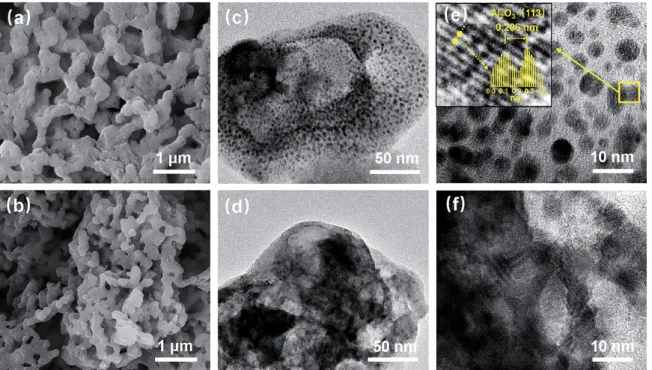
TEM measurement showed that the CaO are coated by Al

2

O

3

nanoparticles of around 4~8 nm (Fig. 6). It was observed that after 20 cylces the CaO in the presence

of 10 % Al

2

O

3

has 300% higher CO

2

adsorption than pristine CaO. Yuzbasi et al. reported a synthesis of a porous copper foam by electrochemical deposition meth- od[30]. Al

2

O

3

was deposited on the coppery foam by ALD and finally it was calcined at 800°C for 1 h to get rid of the PET substrate onto which the foam was developed. Copper oxide with 20 nm thick Al

2

O

3

shows the 96% capacity retention upto 10 redox cycles.

3. Conclusions

Carbon capture and storage (CCS) technologies are crucial in mitigating constantly increasing anthropogenic carbon dioxide emission. Metal oxides used in recently developed CCS technologies, CLC and calcium loop- ing, must undergo certain modifications to enhance performance capacity largely due to the sintering-induced capacity deterioration over the multiple cyclic reactions.

Different types of stabilizers with high Tammann tem- perature, such as Al

2

O

3

, MgO, TiO

2

, Mn, alkali metal nitrates, etc are incorporated into metal oxides via vari- ous methods including atomic layer deposition (ALD).

Fig. 6. SEM and TEM images of synthetic samples after calcination at 1123 K. (a, c, e) CCi-A-CA

90

, (b, d, f) CCi-N-CA

90

(Reproduced from Han et al., 29 with permission of The Royal Society of Chemistry).

(13)

tain a certain level of porosity, nanometer particle size and hollow interior. This review is classified into two parts: In part one CCS based on metal oxide and in part two thin film deposited metal oxide are discussed.

Reference

1. M. E. Boot-Handford, J. C. Abanades, E. J.

Anthony, M. J. Blunt, S. Brandani, N. Mac Dowell, J. R. Fernández, M.-C. Ferrari, R. Gross, J. P. Hallett, R. S. Haszeldine, P. Heptonstall, A.

Lyngfelt, Z. Makuch, E. Mangano, R. T. J. Porter, M. Pourkashanian, G. T. Rochelle, N. Shah, J. G.

Yao, and P. S. Fennell, “Carbon capture and stor- age update”, Energy Environ. Sci., 7, 130 (2014).

2. J. Wang, L. Huang, R. Yang, Z. Zhang, J. Wu, Y.

Gao, Q. Wang, D. O’Hare, and Z. Zhong, “Recent advances in solid sorbents for CO

2

capture and new development trends”, Energy Environ. Sci., 7, 3478 (2014).

3. A. B. Rao and E. S. Rubin, “A technical, economic, and environmental assessment of amine-based CO

2

capture technology for power plant greenhouse gas control”, Environ. Sci. Technol., 36, 4467 (2002).

4. B. P. Spigarelli and S. K. Kawatra, “Opportunities and challenges in carbon dioxide capture”, J. CO

2

Util., 1, 69 (2013).

5. S. J. Moon, H. J. Min, N. U. Kim, and J. H. Kim,

“Fabrication of polymeric blend membranes using PBEM-POEM comb copolymer and poly(ethylene glycol) for CO

2

capture”, Membr. J., 29, 223 (2019).

6. C. W. S. Chi, J. H. Lee, M. S. Park, and J. H. Kim,

“Recent research trends of mixed matrix mem- branes for CO

2

separation Won Seok”, Membr. J., 25, 373 (2015).

7. M. Jung and H. Oh, “CO

2

/CH

4

separation in met-

J. Huang, “Progress in the development and appli- cation of CaO-based adsorbents for CO

2

capture - a review”, Materials Today Sustainability, 1-2, 1 (2018).

10. S. A. Salaudeen, B. Acharya, and A. Dutta,

“CaO-based CO

2

sorbents: A review on screening, enhancement, cyclic stability, regeneration and ki- netics modelling”, J. CO

2

Util., 23, 179 (2018).

11. C. Ortiz, J. M. Valverde, R. Chacartegui, L. A.

Perez-Maqueda, and P. Giménez, “The calcium-loop- ing (CaCO

3

/CaO) process for thermochemical en- ergy storage in concentrating solar power plants”, Renew. Sust. Energ. Rev., 113, 109252 (2019).

12. B. J. O’Neill, D. H. K. Jackson, J. Lee, C. Canlas, P. C. Stair, C. L. Marshall, J. W. Elam, T. F.

Kuech, J. A. Dumesic, and G. W. Huber, “Catalyst design with atomic layer deposition”, ACS Catal., 5, 1804 (2015).

13. S. M. Kim, W. C. Liao, A. M. Kierzkowska, T.

Margossian, D. Hosseini, S. Yoon, M. Broda, C.

Copéret, and C. R. Müller, “In situ XRD and dy- namic nuclear polarization surface enhanced NMR spectroscopy unravel the deactivation mechanism of CaO-based, Ca

3

Al

2

O

6

-stabilized CO

2

sorbents”, Chem. Mater., 30, 1344 (2018).

14. S. Brunauer, P. H. Emmett, and E. Teller,

“Adsorption of gases in multimolecular layers”, J.

Am. Chem. Soc., 60, 309 (1938).

15. J. DeBoer and C. Zwicker, “The polarization due to adsorption isotherms”, Z. Phys. Chem., 3, 407 (1929).

16. K. Huang, F. Liu, J. P. Fan, and S. Dai, “Open and hierarchical carbon framework with ultralarge pore volume for efficient capture of carbon dioxide”, ACS Appl. Mater. Interfaces, 10, 36961 (2018).

17. A. Dal Pozzo, A. Armutlulu, M. Rekhtina, C. R.

(14)

Müller, and V. Cozzani, “CO

2

uptake potential of Ca-based air pollution control residues over repeated carbonation-calcination cycles”, Energy & Fuels, 32, 5386 (2018).

18. J. Tong, X. Lei, J. Fang, M. Han, and K. Huang,

“Remarkable O

2

permeation through a mixed con- ducting carbon capture membrane functionalized by atomic layer deposition”, J. Mater. Chem. A, 4, 1828 (2016).

19. X. Liang, X. Lu, M. Yu, A. S. Cavanagh, D. L.

Gin, and A. W. Weimer, “Modification of nano- porous supported lyotropic liquid crystal polymer membranes by atomic layer deposition”, J. Membr.

Sci., 349, 1 (2010).

20. J. Chen, L. Duan, and Z. Sun, “Accurate control of cage-like CaO hollow microspheres for en- hanced CO

2

capture in calcium looping via a tem- plate-assisted synthesis approach”, Environ. Sci.

Technol., 53, 2249 (2019).

21. J. Liao, B. Jin, Y. Zhao, and Z. Liang, “Highly ef- ficient and durable metal-organic framework mate- rial derived Ca-based solid sorbents for CO

2

cap- ture”, Chem. Eng. J., 1028 (2019).

22. C. Chi, Y. Li, W. Zhang, and Z. Wang, “Synthesis of a hollow microtubular Ca/Al sorbent with high CO

2

uptake by hard templating”, Appl. Energy, 113382 (2019).

23. S. Li, T. Jiang, Z. Xu, Y. Zhao, X. Ma, and S.

Wang, “The Mn-promoted double-shelled CaCO

3

hollow microspheres as high efficient CO

2

adsorb- ents”, Chem. Eng. J., 53 (2019).

24. M. A. Naeem, A. Armutlulu, Q. Imtiaz, F. Donat, R. Schäublin, A. Kierzkowska, and C. R. Müller,

“Optimization of the structural characteristics of CaO and its effective stabilization yield high-ca- pacity CO

2

sorbents”, Nat. Commun., 9, 1 (2018).

25. A. Dal Pozzo, A. Armutlulu, M. Rekhtina, P. M.

Abdala, and C. R. Müller, “CO

2

uptake and cyclic stability of MgO-based CO

2

sorbents promoted with alkali metal nitrates and their eutectic mixtures”, ACS Appl. Ener. Mat., 2, 1295 (2019).

26. H. Cui, Q. Zhang, Y. Hu, C. Peng, X. Fang, Z.

Cheng, V. V. Galvita, and Z. Zhou, “Ultrafast and stable CO

2

capture using alkali metal salt-promoted MgO-CaCO

3

sorbents”, ACS Appl. Mater. Interfaces, 10, 20611 (2018).

27. S. M. Kim, P. M. Abdala, M. Broda, D. Hosseini, C. Copéret, and C. Müller, “Integrated CO

2

capture and conversion as an efficient process for fuels from greenhouse gases”, ACS Catal., 8, 2815 (2018).

28. A. Armutlulu, M. A. Naeem, H. J. Liu, S. M. Kim, A. Kierzkowska, A. Fedorov, and C. R. Müller,

“Multishelled CaO microspheres stabilized by atomic layer deposition of Al

2

O

3

for enhanced CO

2

capture performance”, Adv. Mater., 29, 1702896 (2017).

29. R. Han, J. Gao, S. Wei, Y. Su, and Y. Qin, “De- velopment of highly effective CaO@Al

2

O

3

with hi- erarchical architecture CO

2

sorbents: Via a scalable limited-space chemical vapor deposition technique”, J. Mater. Chem. A, 6, 3462 (2018).

30. N. S. Yüzbasi, A. Armutlulu, P. M. Abdala, and C. R. Müller, “Atomic layer deposition of a film of Al

2

O

3

on electrodeposited copper foams to yield highly effective oxygen carriers for chemical looping combustion-based CO

2

capture”, ACS Appl. Mater.

Interfaces, 10, 37994 (2018).

수치

Fig.  1.  Schematic  diagram  of  calcium  oxide  synthesis  form calcium  nitrate  (a)  without  precipitation  (b)  with   precip-itation  and  (c)  in  the  presence  of  urea.
Table  1.  Summary  of  Metal  Oxides  and  CO 2   uptake  Performance
Fig.  6.  SEM  and  TEM  images  of  synthetic  samples  after  calcination  at  1123  K

참조

관련 문서

FPSO (Floating Production Storage &amp; Offloading) FSO(floating storage and offloading).. FSRU (Floating Storage Regasification

Effect of pain control and improve function of knee joint applied to osteoarthritis by carbon surface-heating... Diagram of

ƒ Reduction (환원) : reduction of metal oxides using gases such as.. ƒ Reduction (환원) : reduction of metal oxides using gases such as hydrogen

Improvement of the Performance and Stability of Oxide Semiconductor Thin-Film Transistors Using Double-Stacked Active Layers.. Metal oxide semiconductor

Calcium metaphosphate(CMP) Bioactive glasses.. 1 Bioactive spectra for various bioceramic implants.. Solubility of calcium phosphate

In this study, we demonstrated a transparent oxide-metal-oxide (OMO) structure using aluminum-doped zinc oxide and oxidized silver (AgO x ) and applied it as

Metal foam is a good candidate for hydrogen storage materials by forming hydride..

ƒ Flux lime silica manganese oxide calcium fluoride.. ƒ Flux - lime, silica, manganese