409 서 론
해조류는 예로부터 아시아 지역에서 널리 섭취해 왔으며, 영 양학적으로 열량은 매우 낮으면서 비타민과 무기질, 식이섬유 가 풍부하고, 비소화성의 점질성 다당류를 다량 함유하고 있 으며, 채소류와 비교해서 필수 아미노산과 불포화지방산이 많 이 함유되어 있다(Hwang and Wang, 2004; Jimenez-Escrig and Goni, 1999). 김은 미역 및 다시마 등의 해조류와 함께 각 종 미네랄, 식이섬유와 같은 영양 공급원으로 이용되어 온 기 호식품으로 최근에는 해조성분이 가지는 생체유지기능에 관해 서도 관심이 집중되고 있다(Kim and Kim, 1982). 우리 나라 에서의 김 양식은 1600년대부터 시작되었고(Mumoford and Miura, 1988), 우리나라와 일본에 양식되고 있는 김의 대부분 은 방사무늬김(Porphyra yezoensis) 으로 alanine, glutamic acid, taurine 등 유리아미노산 함량이 풍부한 것으로 알려져 있다(Yoshie et al., 1993).
우리나라에서도 각 지역에 따라 다양한 김들이 양식되고 있 지만, 아직까지 국내 산지별 김에 대한 성분 조성이나 생리활 성 연구는 일부만이 보고되고 있는 실정이다(Jung et al., 2003;
Lee et al., 2001; Lee et al., 1987). 이에 본 연구에서는 국내 산지별 마른김류의 아미노산 조성을 비교 분석하였고, 에탄올 추출물의 항산화효과와 폴리페놀 함량 및 면역세포 활성을 비 교하였다.
재료 및 방법 지역별 마른김 추출물의 제조
해남산 마른김은 전남도수산기술사업소 해남지소에서 지원 받았고 장흥 및 서천산 마른김은 양식지역 인근 시장에서 원 산지가 확인된 제품으로 구입하였다. 구입한 김은 일정한 중 량을 가질 때까지 60℃에서 건조시켰다. 지역별 김 1 g씩 곱
Article history;
Received 13 February 2012; Revised 17 September 2012; Accepted 8 October 2012
*Corresponding author: Tel: +82. 63. 570. 3210 Fax: +82. 63. 570. 3039 E-mail address: [email protected]
Kor J Fish Aquat Sci 45(5) 409-413, October 2012 http://dx.doi.org/10.5657/KFAS.2012.0409 pISSN:0374-8111
ⓒ The Korean Society of Fishereis and Aquatic Science. All rights reserved
국내산 마른 김(Porphyra)의 생리활성 및 아미노산 조성 비교
이학증 . 최종일* . 최성재1
Physiological Activities and Amino Acid Compositions of Korean Dried Laver Porphyra Products
Advanced Radiation Technology Institute, Korea Atomic Energy Research Institute, Jeongeup 580-185, Korea
1Jellanam-do Provincial Government Ocean & Fisheries Science Institute, Haenam Branch, Haenam 536-812, Korea
The physiological activities and amino acid compositions of dried lavers of Porphyra from the Jangheung, Seochen and Haenam coasts were determined. The ethanol extract of the Haenam dried laver exhibited the greatest 1,1-diphenyl- 2-picrylhydrazyl (DPPH) radical scavenging activity (56.1%), ferric-reducing antioxidant potential (FRAP) value(86.5 mM) and total polyphenol content (3.51 ppm) of these dried laver products. In addition, there was a strong positive correlation between the antioxidative activity and total polyphenol content of the laver products, suggesting that poly- phenol compounds contribute to the antioxidant capacity in the ethanol extract of dried laver. However, there was no difference among the extracts in terms of cell proliferation activity. Fourteen combined amino acids were identified in oligopeptides from the dried laver products. Of the three extracts, that of the Haenam dried laver contained the highest levels of both free and total amino acids including alanine, glutamic acid, taurine, phosphoserine, and aspartic acid.
Key words: Dried laver, Antioxidative activity, Polyphenol, Amino acid composition
Hak-Jyung Lee, Jong-il Choi* and Sung-Je Choi1
한국원자력연구원 첨단방사선연구소, 해양수산과학원 해남지소
게 분쇄한 후 시료의 에탄올 추출물을 얻기 위하여 건조시료 1 g 에 95% 에탄올을 10 mL을 가하여 실온에서 24시간 교반 추출을 총 3회 반복하여 얻어진 상층액 모두를 합하여 농축원 심분리기로 원심 분리하였다. 분리된 추출물을 10 mg/mL 농 도의 에탄올로 녹인 후 실험에 사용하였다. 세포분화활성 평 가 측정을 위한 추출방법으로 마른김 1.5 g에 50 mL의 증류 수를 가하여 120℃ heating block에 3시간 동안 가열하였다.
가열 후, Whatman filter paper (Whatman International Ltd., Springfield Mill, Kent, UK)로 여과하여 얻은 상등액을 동결 건조하여 본 실험에 사용하였다.
DPPH (1,1-diphenyl-2-picryl-hydrazyl) radical 소거능 지역별 마른김 추출물의 항산화 활성을 비교하기 위해 다음 과 같은 방법으로 측정하였다. DPPH radical 소거능은 Kim and Lee (2007)의 방법에 따라 측정하였다. 시료 1 mL에 0.2 mM DPPH (Sigma Chemical Co., St. Louis, MO, USA) 1 mL을 넣고 교반한 후 30분 동안 실온에서 정치한 다음 반응용 액을 분광광도계(UV 1600 PC, Shimadzu, Tokyo, Japan)를 이용하여 517 nm에서 흡광도를 측정하였다. 전자공여능은 다 음과 같은 계산식에 의해 환산되었다.
DPPH radical scavenging activity(%)=(1-(공시료군-반응 군)/공시료군 )×100
FRAP (ferric-reducing antioxidant potential) assay 마른김 에탄올 추출물의 FRAP 측정 방법은 Benzie and Strain의 방법(1996)을 참고하여 측정하였다. FRAP reagent 는 25 mL acetate buffer (300 mM, pH 3.6)를 37℃에서 가온 한 후, 40 mM HCl에 용해한 10 mM 2, 4, 6-tris(2-pyridyl)- s-triazine (TPTZ, Sigma) 5 mL과 20 mM ferric sulfate (FeSO4) 2.5 mL을 가하여 제조하였다. 제조된 0.9 mL FRAP reagent에 추출물 0.03 mL와 증류수 0.09 mL를 넣은 후 37℃ 에서 10분간 반응시킨 후 593 nm에서 분광광도계를 이용하여 흡광도를 측정하였다. 공시료는 시료 대신 70% 에탄올을 넣어 측정하였다. 계산은 0.125, 0.25, 0.5, 1, 2.5 및 5 mM의 농도 로 반복하여 작성한 FeSO4의 검량식에 대입하여 환산하였다.
폴리페놀 함량 측정
지역별 3종의 마른김 에탄올 추출물에 대한 총페놀 함량은 De-Wanto 방법(Dewanto, 2002)에 준하여, 추출된 시료 0.1 mL에 Folin-Ciocalteu’s reagent (Sigma) 0.2 mL를 첨가하고 23℃에서 1분간 유지시켰다. 그 후 5% sodium carbonate 3 mL을 가하여 23℃에서 2시간 반응시킨 후 765 nm에서 흡광 도를 측정하였다. 표준곡선은 gallic acid (Sigma)를 이용하여 검량곡선을 작성한 후 함량 계산에 활용하였다.
세포분화활성 평가
세포분화활성 평가는 세포주(RAW 264.7)를 1×10⁴ cells well-1씩 96 well plate에 90 μL씩 분주하고 지역별 건조된 김 추출물을 200 μg mL-1의 농도로 10 μL씩 처리하여 37℃, 5% CO2 조건하에서 24시간 동안 배양하여 MTT 분석을 통 해 김 추출물의 세포분화활성을 산출하였다. MTT assay는 3-(4,5-dimethylthiazol-2yl)-2,5-diphenyl-2H-tetrazolium bromide용액(5 mg mL-1)를 각각의 well에 30 μL씩 첨가하고 2시간 동안 배양한 후 배양 상층액을 제거하고 세포 내 생성된 formazan crystal을 dimethyl sulfoxide (DMSO)에 녹여 540 nm에서 흡광도를 측정하였다.
총 아미노산 함량 측정
마른김 1 g을 시험관에 넣고 6 N HCl 3 mL을 가한 다음 시험 관을 밀봉한 후 120℃ heating block에 24시간 동안 가수분해 하였다. 24시간 후 50℃에서 40 psi의 감압농축기(WB2000, Heidolph, Schwabach, Germany)로 산을 제거, 0.2M sodium citrate buffer (pH 2.2) 10 mL 로 정용하고, 이 중 1 mL를 취 하여 Whatman membrane filter (0.2 µm)로 여과하여 아미노 산분석기(S433-H, SYKAM, Eresing, Germany)로 100 µL 의 시료를 처리하여 정량 분석하였다.
유리 아미노산 함량 측정
마른김 김 1 g을 증류수 40 mL을 가하여 121℃에서 15분간 끓인 후 남은 용액을 증류수를 이용하여 총 50 mL로 맞춘 다 음, 감압증류로 건조시킨 후 5% trichloroacetic acid (Sigma) 1 mL에 용해하고 10,000 rpm에서 10분간 원심분리를 한 후 0.2 µm membrane filter (Sigma)로 여과하여 아미노산 분석 기(S433-H, SYKAM, Eresing, Germany)로 분석하였다.
결과 및 고찰 지역별 마른김 추출물의 항산화 활성
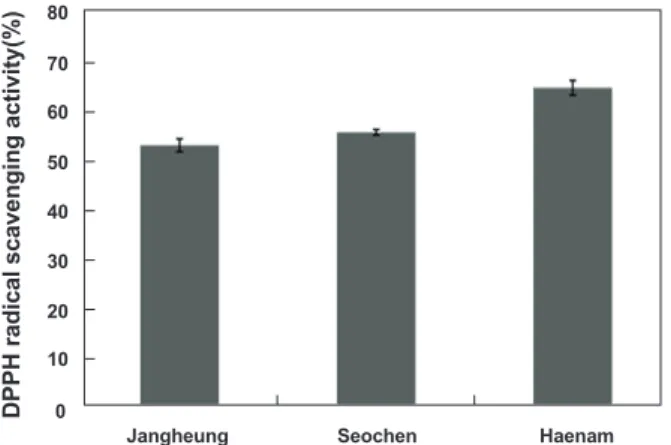
최근 우리나라에 자생하고 있는 일부 해조류에 대한 활성 성 분이 보고되고 있다. 우리나라에서 생육하는 12종의 해조류 를 순차적으로 분획 추출하여 항산화효과를 측정한 결과 메탄 올 추출분획이 DPPH 라디칼 소거능이 매우 높았으며, 김, 미 역, 다시마, 파래의 순으로 효과가 좋았다고 하였다. 본 연구 에서는 DPPH 라디칼 소거를 포함하여 2가지 방법을 통한 항 산화 효과를 나타내었다. 지역별 마른김 추출물을 대상으로 하 여 DPPH radical 소거능을 통한 항산화 활성의 결과는 Fig. 1 과 같다. 각 시료를 1 mg/mL의 농도로 희석한 후 비교한 결과 지역별 장흥, 서천 및 해남김의 에탄올 추출물 활성은 53.5%, 56.1% 그리고 65.1%를 나타내었다. 장흥과 서천에서 양식되 는 김의 DPPH radical 소거능은 유사하며, 해남에서 양식된
김 추출물에서 가장 높은 radical 소거능을 보였다.
FRAP 측정법은 항산화력을 측정하는 방법 중 하나로 DPPH 를 이용한 라디칼 소거능을 측정하는 방법과 달리 환원력에 의 한 항산화능을 측정할 수 있는 방법이다. 지역별 마른김 추출 물의 환원력을 비교한 결과 해남김에서 86.5 mM, 서천김에서 는 51.4 mM 그리고 장흥김에서는 44.3 mM의 환원력이 확인 할 수 있었다(Fig 2). 이러한 해남김에서의 높은 환원력 결과는 DPPH radical 소거능과 일치된 결과를 보이고 있다.
폴리페놀 함량 측정
지역별 마른김의 항산화 활성차이의 원인을 규명하기 위하여 폴리페놀 함량을 측정하였다. 마른김의 추출물을 1 mg/mL의 농도에서 비교하였을 때 장흥김 추출물에서는 2.45 ppm, 서천 김 추출물에서 2.93 ppm, 그리고 해남김 추출물에서는 3.51 ppm으로 장흥과 서천김에 함유된 폴리페놀은 유사한 함량을 나타내었으며 해남김에서는 그 함량이 높았다(Fig 3). Lim et al. (2002)은 중국연안에서 생육하는 해조류에서의 추출물을 통해 항산화효과를 측정한 결과 폴리페놀이 많이 함유되어 있
는 추출물에서 항산화능이 높다는 것을 보고하였고, 본 연구에 서도 지역별 3종의 마른김 에탄올 추출물의 총 폴리페놀 함량 을 비교하였을 때 항산화활성이 높은 추출물에서 폴리페놀함 량이 높다는 유의한 결과를 나타내었다. 이는 free radical 소거 능이 페놀함량과 밀접한 관련이 있음을 나타낸다. 또한, 자연 건조된 푸른 잎 채소들을 대상으로 총 폴리페놀 및 비타민 C 함 량, 항산화활성을 조사한 결과, 자연건조에 의한 비타민 C의 유의적인 감소에도 불구하고 reducing property와 free radical 소거활성이 증가하였는데, 이는 총페놀함량이 증가한 것과 관 련이 있다고 보고되었다(Oboh and Akindahunsi, 2004). 이 러한 선행결과에서 건조된 김의 항산화활성이 폴리페놀함량과 상관성이 있음을 추측할 수 있다.
지역별 김 추출물의 세포분화활성 평가
지역별 김 추출물의 세포분화활성 평가에 관하여 알아보기 위해 대식세포 유래의 면역세포인 RAW 264.7 세포주에 처리 Fig. 1. Comparison of DPPH radical scavenging activity of the
ethanol extract of three dried lavers Porphyra. Fig. 3. Comparison of total phenolic content of the ethanol ex- tract of dried lavers Porphyra.
Fig. 4. Proliferation of raw 264.7 cells with dried lavers Porphyra extracts at different concentrations.
DPPH radical scavenging activity(%) Total phenolic content (ppm)Cell viability (% of control)
μg/ml
80 4
3.5 3 2.5 2 1.5 1 0.5 0
180 160 140 120 100 80 60 40 20
0 0 62.5 125 250 500 1000
70 60 50 40 30 20 10
0 Jangheung Seochen Haenam Jangheung Seochen Haenam
Fig. 2. Comparison of FRAP assay of the ethanol extract of three dried lavers Porphyra.
Fe2+ (mM)
100 90 80 70 60 50 40 30 20 10
0 Jangheung Seochen Haenam
Nomal Jangheung Seochen Haenam
하여 세포 분화능을 관찰하였다(Fig 4). 지역별 김 추출물의 면 역세포 분화활성을 확인 한 결과, 샘플 무처리군(PBS buffer 처리군)과 김 추출물의 면역 세포 활성은 추출물의 농도가 증가 할수록 비처리군에 비해 증가되는 것을 확인 할 수 있었으며, 산지에 따른 유의적 차이는 확인되지 않았다.
아미노산 함량
지역별 마른김의 총아미노산 함량을 비교 분석하였다(Table 1). 14개의 각기 다른 필요 아미노산이 검출되었으며, 마른김 의 1 g당 구성아미노산 총량은 장흥김에서는 156 mg, 서천 김에서는 196.1 mg, 해남김에서는 310.9 mg으로 해남김의 총아미노산 함량이 가장 많았다. 아미노산중에서는 alanine, glutamic acid, aspartic acid, leucine, glycine, threonine, va- line, serine, phenylalanine, proline, isoleucine등의 함량이 많았으며, 이러한 아미노산들의 함량은 장흥김이 156 mg/g, 서천김이 196 mg/g, 해남김이 310.9 mg/g으로 해남김에서 2 배정도 더 높은 함량이 검출되었다. 함황 아미노산인 cysteine 의 함량은 큰 차이가 없었고 histidine, proline, glutamic acid, phenylalanine, alanine의 경우에는 해남김에서 높은 함량을 보였다. 이러한 지역별 마른김의 아미노산 함량의 차이는 계 절, 생육장소, 해황 등에 따라 변동이 심한 것으로 알려져 있다 (Noda, 1993). 또한 가공방법에 따라서 어느 정도 차이가 있을 것이라 사료된다. 함질소 엑스성분에 관한 연구에서 유리아미 노산 (Noda et al., 1975, Isihara et al., 1998, Sakai and Kasai, 2000), ATP 관련화합물(Fujita and Hashimoto, 1960, Araki
et al., 1996) 등이 김의 맛에 중요한 인자로 보고되어있다. 유 리아미노산의 함량은 기호성에 영향을 미치는 중요한 요소이 고, 식품의 풍미를 예측하는 하나의 중요한 요소가 될 수 있다 고 보고되어 있다(Watanabe and Sato, 1974). 또한 glutamic acid, aspartic acid, alanine 및 glycine 등은 식품의 향기와 맛 을 부여한다고 알려져 있다(Ruiz and Moral, 2001). 지역별 마른김에서는 glutamic acid, aspartic acid, alanine, glycine, phosphoserine, taurine, valine 등 15종의 유리아미노산이 확 인되었고, 더 많은 유리아미노산을 함유한다는 것은 더 다양한 풍미를 가질 것이라고 사료된다. 김에 높은 함량으로 포함되어 있는 taurine의 경우 장흥김이 58.4 mg, 서천김 50 mg 그리 고 해남김이 45 mg으로 나타났으며, aspartic acid, glutamic acid 그리고 alanine함량은 해남김이 약 1.5배정도 높은 값을 나타내었다. Proline는 높은 함량은 아니지만 장흥김에서 더 높았고 그 유도체인 hydroxyproline 함량은 마른김에서는 나 타나지 않았다.
사 사
본 연구는 한국원자력연구원 연구지원사업의 지원을 받아 수 행하였으며 이에 감사드립니다.
참고문헌
Benzie IFF and Strain JJ. 1996. The ferric reducing ability of palsma (FRAP) as a measure of “Antioxidant power”: The Table 1. The amounts of total amino acids in the dried laver
Porphyra
Amino acid Concentration (mg/g)
Jangheung Seochen Haenam
Pro 0.9 11 16.3
Asp 19.3 22.4 36.7
Thr 12.1 13.5 21.5
Ser 10.3 11.7 18.3
Glu 20.8 26.4 44.6
Gly 12.7 15 24.8
Ala 25.4 30.6 55.8
Val 12.1 14 18.6
Cys 2.5 3.1 2.8
Ile 6.9 8.9 12
Leu 15.2 18.2 28.4
Tyr 6 7.6 8.8
Phe 8.7 10.2 16.3
His 3.1 3.5 6
Total 156.0 196.1 310.9
Table 2. The amounts of free amino acids in the dried laver Porphyra
Amino acid Concentration (mg/g)
Jangheung Seochen Haenam
Pro 2.1 0.9 1.4
Asp 11.6 6.2 16.2
Thr 1.7 1.2 2.0
Ser 1.2 0 1.7
Glu 36.4 45 62.6
Gly 0.6 1.4 1.5
Ala 61.4 68.3 94.2
Val 1.8 1.7 2.0
Cys 0 0 0.7
Ile 0 0.8 1.6
Leu 0.7 1.3 1.7
Tyr 0.6 0.7 0.7
Phe 0 0 0.8
Tau 58.4 50.0 45.0
His 0 0 0
Total 176.5 177.5 232.1
FRAP assay. Anal Biochem 230, 70-79.
Dewanto V, Xianzhong W and Liu RH. 2002. Processed sweet corn has higher antioxidant activity. J Agric Food Chem 50, 4959-4964.
Haung HL and Wang BG. 2004. Antioxidant capacity and li- opphilic content of seaweeds collected from the Qungdao coastline. J Agric Food Chem 52, 4993-4997.
Jimenez-Escrig A and Goni Cambrodon I. 1999. Nutritional evaluation and physiological effects of edinle seaweeds.
Arch Latinoam Nutr 49, 114-120.
Jung BM, Shin TS, Kim HR, Jung KJ and Kim SB. 2003. Ef- fect of Porphyran isolated from laver, Porphyra yezoensis on calcium, magnesium and potassium contents in hyper- lipidemic rats. J Kor Fish Soc 36, 220-224.
Kim H and Lee SW. 2007. The effects of quercetin on paraquat- induced cell damage. J Korean Soc Emerg Med 18, 41-47 Kim KH and Kim CS. 1982. Studies on the manufacture of Un-
deria pinnatifida laver and it’s physicochemical properties I. Histochemical properties. Korean J Food Sci Technol 14, 336-341.
Lee HO, Kim DS, Do JR and Kwan DY. 2001. Separation and purification of angiotension-I converting enzyme inhibitory peptides from laver hydrolysate. J Kor Fish Soc 34, 164- Lee KH, Song SH and Jeong IH. 1987. Quality changes of dried 172.
lavers during processing and storage. 1. Quality evaluation
of different grades of dried lavers and its changes during storage. J Kor Fish Soc 20, 408-418.
Lim SN, Cheung PCK, Ooi VEC and Ang PO. 2002. Evalu- ation of antioxidative activity of extrects from a brown seaweed, Sargassum siliquastrum. J Agric Food Chem 50, 3862-3866.
Mumford TF and Miura A. 1989. Porphyra as food: cultiva- tion and economics. In Algae and human Affairs, Lembi CA and Waaland JR, eds. Cambridge University Press, London, U.K., 87-117.
Noda H. 1993. Chemistry of marine algae. In Science of marine Algae. Oishi K, ed. Asakura-Shoten, Tokyo, Japan, 14-29.
Oboh G and Akindahunsi AA. 2004. Change in the ascorbic acid, total phenol and antioxidant activity of sun-dried com- monly consumed green leafy vegetables in Nigeria. Nutr Health 18, 29-36.
Ruiz-Capillas C and Moral A. 2001. Changes in free amino ac- ids during chilled storage of hake (Merluccius merluccius, L.) in controlled atmospheres and their use as a quality con- trol index. Eur Food Res Technol 212, 302-307.
Watanabe K and Sato Y. 1974. Meat flavor. Japan J Zootech Sci 45, 113-128.
Yoshie Y, Suzuki T, Shirai T, Hirano T and Lee EH. 1993. Di- etary fiber, Minerals, free amino acids and fatty acid com- positions in dried Nori of several culture places in Korea. J Tokyo Univ of Fish 80, 197-203.