- 894 - 연구노트
Physicochemical characteristics of onion with cold tolerance cultivated in Kangwon
Gi-Hae Shin, Ah-Young Ko, Dan-Bi Kim, Young-Jun Lee, Ok-Hwan Lee*
Department of Food Science and Biotechnology, Kangwon National University, Chuncheon 200-701, Korea
강내한성 강원양파의 이화학적 특성
신기해․고아영․김단비․이영준․이옥환*
강원대학교 식품생명공학과
Abstract
This study was performed to provide the basic data for the prediction of the usefulness of onion with cold tolerance cultivated in Kangwon. The physicochemical properties and antioxidant activity of freeze-dried and hot-air-dried (40 and 60 ℃) onions were investigated. The moisture content of the raw onion was 90.55%. The crude protein and crude fat contents of the freeze-dried onions were slightly higher than those of the hot-air-dried onions (40 ℃ and 60 ℃). As for the color values, the freeze-dried onion powder was highest in lightness (77.19), and the 60℃
hot air-dried onion was highest in redness (6.09) and yellowness (24.60). Moreover, the color difference (ΔE) between the freeze-dried and hot-air-dried (40 ℃ and 60℃) onion powders was significant. The brown index was lower in the freeze-dried onion than in both hot-air-dried onions. The total phenol content and the 2,2-diphenyl-1-picrylhydrazyl radical (DPPH) scavenging activity of both hot-air-dried onions were higher than those of the freeze-dried onion. These results indicate that the freeze-drying methods protected the physicochemical properties of the onion powder, whereas the hot-air-drying method enhanced the antioxidant activity and the total phenol content of the onion powder.
Key words :cold tolerance, drying methods, freeze drying, hot air drying, onion powder
서 론
1)
양파( Allium cepa L.)는 백합목 백합과의 외떡잎식물로 두해살이풀이며, 인류가 재배해 온 가장 오래된 채소 중 하나로 현재 세계 각지에서 재배되고 있고, 매운 맛과 특이 한 향기가 있어 향신 조미료로서 널리 이용되고 있다(1).
최근에는 양파에 들어 있는 각종 성분들의 생리활성 효과가 입증 되면서 양파에 대한 관심이 높아지고 있는 추세이다.
특히 양파에는 quercitin, quercetin 및 rutin 등의 flavonoid계 물질과 diallyl disulfide, allyl propyl disulfide 등의 함황화합 물이 함유(2)되어 있어, 항산화작용(3), 콜레스테롤 저하(4), 항당뇨(5), 심혈관계 질환 예방(6), 항혈전(7), 혈당 저하(8) 등의 여러 대사조절 기능을 갖는 것으로 보고되고 있다.
*Corresponding author. E-mail :[email protected] Phone:82-33-250-6454, Fax:82-33-259-5565
양파는 비교적 서늘한 기후에서 서식하며 내한성이 비교 적 강한 작물로 우리나라 남부에서는 보통 가을에 파종하여 여름에 수확한다. 반면 해발 400~600 m 내외의 고랭지 지대 에서는 여름에도 온도가 비교적 서늘한 기후를 이용하여 재배가 가능하다. 통계청에 따르면 2012년 양파 재배면적 은 20,957 ha, 생산량은 1,195천 톤에 이른다. 이는 과거 1999년도 16,000 ha의 재배면적에 936,000톤의 생산량에 비해 큰 폭으로 상승한 것이다.
기후변화에 따라 양파의 재배지역이 과거 남부지방에서
점차 강원도 지역까지 확대됨에 따라 겨울철 추위에도 양파
의 재배가 가능한 강내한성 양파의 품종계량이 연구되고
있다. 강내한성 강원 양파는 낮은 온도에서도 잘 자랄 수
있게 품종 개량 된 종으로써, 환경에 따라 차이가 있지만
위도 36.65도(경상북도 영주, 충청북도 진천, 충청남도 당
진)부터 북쪽으로 경기도 강원도 전 지역에 재배가 가능하
며, 위도 36.65도로부터 그 남쪽 지역은 재배가 어렵다고
알려져 있다. 낮은 온도에서 재배된 양파는 추위에 내성을 가지며 남쪽 지방에서 재배된 양파에 비해 맛이 달고 매운 맛이 강하고 단단하여 저장성이 뛰어나다. 또한 식물체의 경우 본래 생육 온도보다 낮은 온도에서 자랄 때, 저온의 스트레스에 노출되어 다른 지역의 생물보다 기능성을 가진 이차 대사산물의 함량이 높은 것으로 보고되어(9,10) 강내 한성 강원양파의 기능성도 기대되는 바이다.
그러나 생산량 증가에 따른 저장의 손실도 매우 커서 그 활용도에 대한 다양한 연구가 필요한 실정이다. 특히 양파의 경우, 높은 수분함량으로 저장기간 중 중량의 감소 및 부패가 많이 일어나며, 맹아, 발근 및 위조에 의해 저장 중 상품가치를 상실하는 경우가 많이 발생한다(11). 이에 따라 수확된 양파의 저장성을 향상시키기 위하여 수분을 제거하는 가공법인 건조를 이용하고 있는 추세이다. 식품 의 건조에는 방법, 온도, 시간 및 태양 광선의 존재 여부 등의 다양한 조건이 관여하고 있으며 이들 조건은 식품에 함유된 유효 생리활성 성분에도 영향을 미칠 것으로 추정된 다. 따라서 본 연구에서는 강내한성 강원양파를 동결건조 (FD) 및 40℃ 열풍건조(HD 40), 60℃ 열풍건조(HD 60) 방법 으로 각각 건조하여 일반성분, 색도, 갈색도, 총 페놀 함량 및 항산화활성을 비교하여 기능성 식품으로의 활용가능성 을 검토하였다.
재료 및 방법
실험재료
(주) 아그로진(Daegu, Korea)에서 제공받은 양파를 0.5 cm 너비로 자른 후 각각의 건조 방법에 따라 처리하였다.
동결건조는 동결건조기(FD5510, Ilshin Lab. Co., Seoul, Korea)를 이용하여 60시간을 건조하였고, 열풍건조는 열풍 건조기 (HY- 8000S, Hanyoung, Bucheon, Korea)를 이용하 여 40℃와 60℃에서 각각 48시간씩 처리하였다. 각각의 건 조된 분말을 15초 동안 파쇄한 후 20 mesh의 체를 통과시켜 입자를 선별하였다. 완성된 분말은 밀폐용기에 담아 냉장 보관하며 실험직전에 꺼내어 사용하였다. 본 연구에 사용 된 시약인 trichloroacetic acid, 2,2-diphenyl-1-picrylhydrazyl (DPPH), gallic acid, Folin & Ciocalteu's phenol reagent, sodium carbonate 등은 Sigma (St. Louis, MO, USA)로부터 구입하여 사용하였다.
일반성분 분석
양파분말의 일반성분 분석은 AOAC 시험방법(12)에 준 하여 실시하였다. 수분함량은 105℃ 상압가열건조법으로 측정하였고, 조단백은 Kjeldahl법에 의해, 조지방은 Soxhlet 법을 사용하여, 조회분은 550℃ 회화건조법에 의해 측정하 였다. 탄수화물의 함량은 100에서 수분, 조단백질, 조지방
및 조회분을 뺀 함량으로 표시하였다.
색도 및 갈색도 측정
분말의 색도는 색차계(CR-400 Minolta, Co., LTD., Osaka, Japan)로 Hunter's value인 L값(명도), a값(적색도), b값(황색도)으로 나타내었다. 이때 사용한 표준 백색판은 명도, 적색도, 황색도는 각각 97.75, 0.49, 1.96이었다.
양파분말의 갈색도는 Yilmaz와 Toledo의 방법(13)을 변 형하여 시료 1 g을 증류수 40 mL와 진탕하고 10% trichloroacetic acid 40 mL을 첨가한 후 2시간동안 반응 시킨다. 그 후 원심분리기(MEGA2100, Hanil, Seoul, Korea)를 이용하여 4,000 rpm에서 20분간 원심분리 후 상등액만 취해 microplate reader(Molecular Devices, Sunnyvale, CA, USA)를 이용하 여 420 nm에서 흡광도를 측정하였다.
총 페놀 함량 측정
총 폴리페놀 함량은 Folin-Ciocaluteau의 방법(14)을 변형 하여 측정하였다. 시료를 1 mg/mL의 농도로 제조 한 뒤 10% Folin-Ciocaltueu's reagent 1 mL와 2% sodium carbonate 용액 1 mL을 혼합하여 1시간 반응 시킨 후 microplate reader 를 이용하여 750 nm에서 흡광도를 측정하였다. Gallic acid 를 이용하여 표준검량선을 작성하였고, 이로부터 시료의 총 페놀 함량을 산출하였다.
DPPH radical 소거능 분석
Abdille 등(15)의 방법을 변형하여 DPPH free radical 소거 능을 측정하여 시료의 항산화 활성을 비교하였다. 시료 0.2 mL와 ethanol에 녹인 0.0004 M DPPH 시약 0.8 mL를 혼합 후 25℃ 암소에서 10분간 반응시킨 후 517 nm에서 흡광도 를 측정하였으며, 다음 식에 의하여 DPPH free radical 소거 능을 나타내었다.
DPPH radical scavenging activity (%)=
{ 1-[
AControl
AExperiment ABlank
]}×100
통계분석
모든 실험은 3회 이상 반복하여 실시하였으며, 평균값
± 표준편차로 나타내었다. 실험 결과 값은 SAS package (release 9.3 SAS Institute Inc., Cary, NC, USA)를 이용하여 one-way ANOVA 분석을 수행하였으며, Duncan's multiple range test에 의해 평균값의 통계적 유의성을 p<0.05 수준에 서 검정하였다.
결과 및 고찰
양파 분말의 일반성분 변화
건조방법에 따른 강내한성 강원양파의 일반성분에 대한
분석결과는 Table 1과 같다. 수분 및 조회분 함량은 건조방 법에 따라 유의성 차이를 나타내지 않았다. 이는 Kim 등(16) 의 연구에서와 같이 양파의 건조조건에 따른 품질특성 차이 중 동결건조, 진공건조, 열풍건조한 양파의 일반성분의 함 량이 크게 차이를 보이지 않은 것과 유사하게 나타났다.
반면 조단백질 및 조지방 함량은 FD에서 10.99±0.04와 0.84±0.05로 나타나 HD 40과 HD 60 보다 유의적으로 높게 나타났다(Table 1). 이와 유사하게 Chan 등(17)의 연구에 따르면 건조방법에 따른 미역의 연구결과 동결건조물이 oven 건조에 비해 조단백질 함량과 조지방 함량이 비교적 높은 것으로 나타났다. 또한 tray dryer를 이용하여 데침 처리 되지 않은 당근껍질과 데침 처리된 당근 껍질을 각각 60℃, 70℃ 및 80℃에서 건조한 뒤 일반성분의 변화를 관찰 한 연구에서는 조지방 함량이 두 가지 시료군에서 건조 온도가 높아질수록 그 함량이 감소하는 경향을 나타내었다 (18). 이는 Hsu 등(19)의 연구에서 보면 동결건조한 yam ( Dioscorea spp.) 꽃과 열풍건조한 yam 꽃의 결과에서 조단 백질 및 조지방의 경우 유의적 차이를 내지 않은 것과는 상이한 결과이다.
Table 1. Proximate composition of dried onion powder Unit : (%) Sample Moisture Crude protein Crude ash Crude fat Carbohydrate FD1) 13.27±0.40a 10.99±0.04a 4.59±0.05a 0.84±0.05a 70.31±0.54b HD 402) 12.95±0.97a 8.61±0.13b 4.81±0.17a 0.42±0.03b 73.10±0.93a HD 603) 12.44±0.31a 8.36±0.20b 4.73±0.04a 0.42±0.03b 74.05±0.47a Each value is expressed as the mean±SD of triplicate determinations. Statistical analysis was performed using a one-way ANOVA (p<0.05).
1)Freeze drying
2)Hot air drying at 40℃
3)Hot air drying at 60℃
색도 및 갈변도 변화
각 조건별로 건조 된 분말의 색도 측정 결과를 Table 2에 나타내었다. 밝기의 정도를 나타내는 L 값은 FD가 77.19로 가장 높게 나타났으며, HD 40 및 HD 60이 각각 60.36, 59.45로 나타났다. 적색도를 나타내는 a값은 FD가 -1.76으로 가장 낮게 나타났고 HD 40과 HD 60 순으로 유의 적으로 낮게 나타났다. 황색도를 나타내는 b값도 FD가 20.92로 가장 낮게 나타났고, HD 40과 HD 60 순으로 a와 비슷한 경향을 나타내었다.
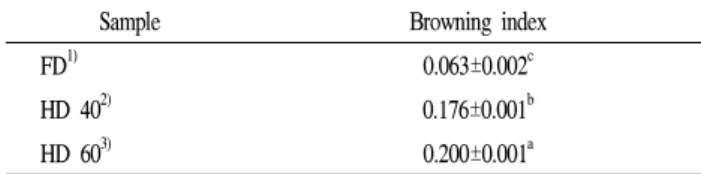
양파분말의 갈변도 또한 HD 60이 0.200으로 제일 높고 그 다음 HD 40과 FD 순이었다(Table 3). 양파는 건조하는 온도가 증가함에 따라 갈변정도가 상승하는 것을 알 수 있다. 이는 Ha 등(20)의 연구에서 건조한 파쇄수삼분말과 주근수삼분말을 440 nm와 520 nm에서 흡광도를 측정하여 갈색도와 홍색도를 나타내었을 때 추출액의 건조온도 증가
와 함께 증가하는 경향을 나타내는 것과 일치한다. 또한 이 연구에서는 건조 온도에 따라 색도를 측정한 결과, 온도 가 높을수록 L값은 낮고 a, b 및 ΔE값은 높아지는 것으로 보고하였다.
Table 2. Hunter's L, a and b value of dried onion powder Sample Hunter's color value
ΔE7)
L4) a5) b6)
FD1) 77.19±0.01a -1.76±0.01c 20.92±0.01c - HD 402) 60.36±0.02b 5.14±0.02b 22.54±0.02b 18.26 HD 603) 59.45±0.03c 6.09±0.01a 24.60±0.03a 19.75 Each value is expressed as the mean±SD of triplicate determinations. Statistical analysis was performed using a one-way ANOVA (p<0.05).
1)Freeze drying
2)Hot air drying at 40℃
3)Hot air drying at 60℃
4)Lightness 0 (black) to 100 (white).
5)Redness -80 (green) to +100 (red).
6)Yellowness -70 (blue) to +70 (yellow).
7)Overall color difference. ΔE=[(L-L*)+(a-a*)+(b-b*)]1/2.
Table 3. Brown index of dried onion powder
Sample Browning index
FD1) 0.063±0.002c
HD 402) 0.176±0.001b
HD 603) 0.200±0.001a
Each value is expressed as the mean±SD of triplicate determinations. Statistical analysis was performed using a one-way ANOVA (p<0.05).
1)Freeze drying
2)Hot air drying at 40℃
3)Hot air drying at 60℃
총 페놀 함량 변화
강내한성 강원양파의 유용성분 함량을 측정하기 위해 양파분말 내 총 페놀 함량을 분석하였다. 건조 조건에 따른 양파분말의 총페놀 함량은 Fig. 1과 같다. 총페놀 함량 분석 결과 HD 40 및 HD 60이 각각 38.62 및 38.00 mg GAE/g으로 나타내었으며, FD는 20.11 mg GAE/g으로 나타나 HD 40 및 HD 60이 FD 보다 유의적으로 높게 나타났다. 이는 건조 온도 상승에 따른 갈변물질의 생성량 증가와 밀접한 관련을 가지는 것으로 사료된다(21). 또한 동결건조와 열풍건조로 분말화 한 호박의 이화학적 특성과 항산화활성을 비교한 연구(22)에서 열풍건조 분말이 동결건조 분말보다 약 4.6배 이상 높은 총 페놀 함량을 나타낸 것과 유사하게 나타났다.
DPPH radical 소거능 변화
DPPH assay는 페놀성 화합물, 방향족 아민류 및 아스코
르빈산 등에 의해 수소나 전자를 받아 환원되어 보라색이
탈색되는 원리를 이용하여 항산화 활성을 측정하는 방법으
로 비교적 간단하고 짧은 시간 내에 항산화 활성을 측정할
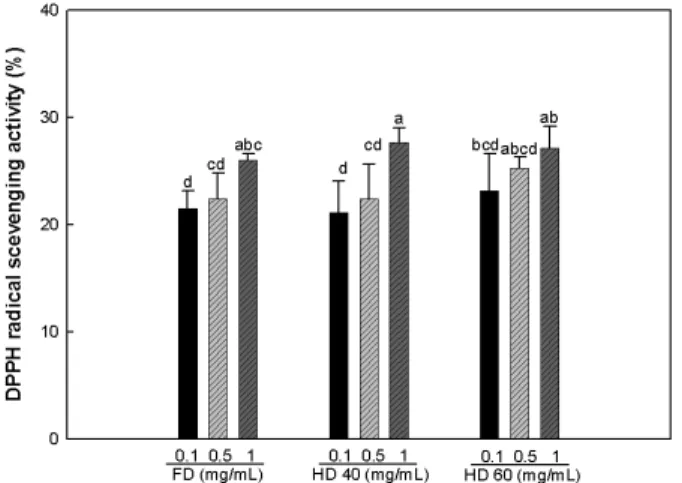
수 있으며, 식물체의 항산화 활성과도 높은 연관성을 가지 기 때문에 널리 사용되는 방법이다(23). 강내한성 강원양파 분말의 건조조건에 따른 DPPH free radical 소거능은 Fig.
2와 같다. 세 가지 건조조건 모두 농도가 상승함에 따라 항산화 활성이 증가하는 경향이 나타났다. DPPH assay를 통하여 건조방법에 따른 항산화 활성을 분석한 결과 HD 40의 0.1 μg/mL 농도를 제외하고 FD보다 HD 40과 HD 60에서 높은 활성을 나타내었다. 이러한 결과는 HD 내 페놀 및 항산화 활성을 나타내는 갈변물질의 함량이 동결건조 양파분말 보다 많기 때문으로 사료된다. 또한 Lee 등(24)의 연구에서 와송의 건조 방법에 따른 항산화 효과 측정 중 DPPH free radical 소거능의 경우 열풍건조에서 가장 활성 이 높고 그 다음으로 동결건조와 천일건조 순으로 나온 결과와 유사하다.
Fig. 1. Total phenolic contents of dried onion powder.
For drying methods, freeze drying (FD), Hot air drying at 40℃ (HD 40) and 60℃
(HD 60) respectively. Each value is expressed as the mean±SD of triplicate determinations.
Statistical analysis was performed using a one-way ANOVA (p<0.05).
Fig. 2. DPPH radical scavenging activity of dried onion powder.
Freeze drying (FD), Hot air drying at 40℃ (HD 40) and Hot air drying at 60℃
(HD 60). Each value is expressed as the mean±SD of triplicate determinations. Statistical analysis was performed using a one-way ANOVA (p<0.05).
요 약
본 연구에서는 강내한성 강원양파의 건조방법을 달리하 여 건조방법에 따른 이화학적 특성을 비교하였다. FD, HD 40 및 HD 60의 세 가지 분말에 대해 일반성분 분석, 색도, 갈색도, 총 페놀 함량 및 DPPH free radical 소거능을 측정 하였다. 일반성분 분석의 결과 FD의 조단백질 및 조지방의 함량이 각각 10.99%, 0.84%로 HD 40 및 HD 60 보다 유의적 으로 높게 나타났다. 색도의 경우, Hunter's value로 L값 (lightness), a값(redness), b값(yellowness)으로 나타내었다.
FD의 L값이 77.19±0.01로 가장 높게 나왔으며, 나머지 a값 및 b값은 각각 6.09±0.01과 24.60±0.03으로 HD 60이 높게 나왔다. 갈변도의 경우에도 HD 60이 0.200으로 제일 높은 값으로 나타나 건조 온도가 높아질수록 양파의 갈변정도가 커진 다는 것으로 사료된다. 총 페놀 함량의 경우에 HD 40과 HD 60이 FD 보다 더 높은 함량을 나타내었다. DPPH radical 소거능은 시료의 농도를 0.1, 0.5, 1 mg/mL로 처리하 여 측정한 결과 농도에 따라 유의적으로 항산화 활성이 증가되었으며, FD 보다 HD 40 및 HD 60에서 유의적으로 더 높은 항산화 활성을 나타내었다.
References
1. Kim MY, Chun SS (2001) Effects of onions on the quality characteristics of strawberry jam. Korean J Soc Food Cookery Sci, 17, 316-322
2. Augusti KT (1990) Therapeutic and medicinal values of onions and garlic. Onions and allied crops, 3, Rabinowitch HD and Brewster JL (Editors), CRC Press, FL, USA, p 93-108
3. Kwak HJ, Kwon YJ, Jeong PH, Kwon JH, Kim HK (2000) Physiological activity and antioxidative effect of methanol extract from onion ( Allium cepa L). J Korean Soc Food Sci Nutr, 29, 349-355
4. Kim SO, Lee MY (2001) Effects of ethylacetate fraction of onion on lipid metabolism in high cholesterol-fed rats.
J Korean Soc Food Sci Nutr, 30, 673-678
5. Lee SK, Hwang JY, Kang MJ, Kim Y, Jung SH, Lee JH, Kim JI (2008) Hypoglycemic effect of onion skin extract in animal models of diabetes mellitus. Korean J Food Sci Technol, 17, 130-134
6. Hwang HJ (2008) Effect of onion powder supplementation on lipid metabolism in high fat-cholesterol fed SD Rats.
J Korea Soc Food Sci Nutr, 13, 71-76
7. Kim SK, Kim MK (2004) Effect of dried powders or
ethanol extracts of onion flesh and peel on lipid
metabolism, antioxidative and antithrombogenic capacities in 16-month-old rats. Nutr Res Pract, 37, 623-632 8. Jung YS, Kim MH, Lee SH, Baik EJ, Park SW, Moon
CH (2002) Antithrombotic effect of onion in streptozotocin-induced diabetic rat. Prostaglandins Leukot Essent Fatty Acids, 66, 453-458
9. Oh SJ, Hong SS, Kim YH, Koh SC (2008) Screening of biological activities in fern plants native to Jeju island.
Korean J Plant Res, 21, 12-18
10. Ramakrishna A, Ravishankar GA (2011) Influence of abiotic stress signals on secondary metabolites in plants.
Plant Signal Behav, 6, 1720-1731
11. Chung HD (1982) Control of onion bulb rot during storage at low temperature by postharvest treatment of fungicides. Korean J Hort Environ Biotechnol, 23, 17-22 12. AOAC. (1990) Official Methods of Analysis. 15th ed, Association of Official Analytical Chemists, Washington DC, USA
13. Yilmaz Y, Toledo R (2005) Antioxidant activity of water-soluble Maillard reaction products. Food Chem, 93, 273-278
14. Sato M, Ramarathnam N, Suzuki Y, Ohkubo T, Takeuchi M, Ochi H (1996) Varietal differences in the phenolic content and superoxide radical scavenging potential of wines from different sources. J Agric Food Chem, 44, 37-41
15. Abdille MH, Singh P, Jayaprakasha GK, Jena BS (2005) Antioxidant activity of the extracts from Dillenia indica fruits. Food Chem, 90, 891-896
16. Kim HR, Seog EJ, Lee JH, Rhim JW (2007) Physicochemical properties of onion powder as influenced by drying methods. J Korean Soc Food Sci Nutr, 36, 342-347
17. Chan JCC, Cheung PCK, Ang PO (1997) Comparative studies on the effect of three drying methods on the nutritional composition of seaweed Sargassum hemiphyllum (Turn.) C. Ag. J Agric Food Chem, 45, 3056-3059 18. Chantaro P, Devahastin S, Chiewchan N (2008)
Production of antioxidant high dietary fiber powder from carrot peels. LWT-Food Sci Technol, 41, 1987-1994 19. Hsu CL, Chen W, Weng YM, Tseng CY (2003) Chemical
composition, physical properties, and antioxidant activities of yam flours as affected by different drying methods. Food Chem, 83, 85-92
20. Ha, DC, Ryu GH, Lee JW, Do JH, Park CK (2004) Drying rate and physicochemical characteristics of dried ginseng root at different temperature. J Korean Soc Food Sci Nutr, 33, 741-746
21. Hong MJ, Lee GD, Kim HK, Kwon JH (1998) Change in functional and sensory properties of chicory roots induced by roasting processes. Korean J Food Sci Technol, 30, 413-418
22. Que F, Mao L, Fang X, Wu T (2008) Comparison of hot air‐drying and freeze‐drying on the physicochemical properties and antioxidant activities of pumpkin ( Cucurbita moschata Duch.) flours. Korean J Hort Sci Technol, 43, 1195-1201
23. Que F, Mao L, Zhu C, Xie G (2006) Antioxidant properties of Chinese yellow wine, its concentrate and volatiles. LWT-Food Sci Technol, 39, 111-117 24. Lee SJ, Seo JK, Shin JH, Lee HJ, Sung NJ (2008)
Antioxidant activity of wa-song ( Orostachys japonicus A. Berger) according to drying methods. J Korean Soc Food Sci Nutr, 37, 605-611
(접수 2013년 7월 8일 수정 2013년 10월 19일 채택 2013년 10월 24일)