• 검색 결과가 없습니다.

Anti-inflammatory Effect of MeOH Extract of Cibotium barometz in IFN-$\gamma$ and LPS-stimulated Mouse Peritoneal Macrophage

N/A
N/A
Protected

Academic year: 2021

Share "Anti-inflammatory Effect of MeOH Extract of Cibotium barometz in IFN-$\gamma$ and LPS-stimulated Mouse Peritoneal Macrophage"

Copied!
7
0
0

로드 중.... (전체 텍스트 보기)

전체 글

(1)

41(2) : 108 114 (2010)

108

IFN -γ와 LPS로 자극된 쥐의 복강 대식세포에서 구척 메탄올 추출물의 항염증 효과

이지영·고성훈·이용재·이세연·박호준·신태용

1

·전 훈

1

*

우석대학교 약학대학 ,

1

헬스케어기술개발사업단

Anti-inflammatory Effect of MeOH Extract of Cibotium barometz in IFN-γ and LPS-stimulated Mouse Peritoneal Macrophage

Ji Young Lee, Sung Hoon Ko, Yong Jae Lee, Se Yeoun Lee, Ho Jun Park, Tae Yong Shin

1

and Hoon Jeon

1

*

College of Pharmacy, Woosuk University, Samrye 565-701, South Korea

1

Center for Healthcare Technolohy Development, Chonbuk, South Korea

Abstract − The rhizome of Cibotium barometz has been used for variety of bone disease as a traditional medicine. In the present study, we examined the antioxidant and anti-inflammatory activities of 85% methanol extract of C. barometz . C.

barometz exhibited potent scavenging effect on 1,1-diphenyl-2-picrylhydrazyl (DPPH) radical, superoxide radical and nitric oxide radical. In IFN- γ /LPS-stimulated mouse peritoneal macrophage model, C. barometz suppressed nitric oxide production and IL-6 secretion dose-dependently. Moreover, C. barometz showed decreased iNOS and COX-2 expression without notable cytotoxicity. These results suggest that C. barometz may be an useful agent as an antioxidant and anti-inflammatory agent.

Key words − Cibotium barometz, antioxidant, anti-inflammatory, nitric oxide

염증 (inflammation) 외래의 자극원이나 다른 질병에

한 생체의 방어 반응으로 , 다양한 세포와 cytokine 들이 관여

하는 일련의 과정이다 . 이러한 과정은 lipopolysaccharide (LPS) 같은 외부 자극이나 arachidonic acid 대사물과

은 내부 자극을 매개로 하여 대식세포 (macrophage)

립구 (granulocyte) 등의 염증 관련 세포들의 염증 부위로의

유입과 축적을 주요 특징으로 한다 .

1,2)

특히 활성화된 대식

세포는 cytokine 뿐만 아니라 nitric oxide (NO) prostaglandin E

2

(PGE

2

) 과도하게 생성하여 염증 과정에 역할을

당한다는 사실이 보고되고 있다 .

3,4)

대식세포는 숙주의 방어 및 항상성 유지에 중요한 역할을 하는 면역세포로서 염증반응 시에는 활성산소종 및 IL-6

의 cytokine 생산하여 감염초기에 관여한다고 보고되고

있다 . 특히 대식세포가 탐식된 이물질을 분해시킬 생성

되는 NO 숙주에 치명적인 결과를 초래할 있는 것으

로 알려져 있다 .

5-9)

NO NO synthase (NOS) 의해 L-arginine 으로부터

합성되며 , 신경전달 , 혈액응고 혈압조절 등의 다양한

리적 역할을 한다 . 그러나 세포외 자극으로 활성화되어 inducible NOS (iNOS) 의해 대량으로 합성된 NO 대식

세포의 cytotoxicity 중추적인 역할을 할뿐만 아니라 염증

반응에 관여하여 조직의 손상 , 유전자 변이 신경 손상 , septic shock, 순환부전 등을 포함한 systemic damage

유발하는 것으로 알려져 있다 .

10-12)

Cyclooxygenase-2 (COX-2) 역시 대식세포에서 발현되는

단백질로서 arachidonic acid 로부터 PGE

2

를 생합성하는데 관여하여 염증과 암 등의 각종 퇴행성 질환에 중요한 역할 을 한다 . 대표적인 염증성 cytokine interleukin-6 (IL-6)

염증반응을 매개하는 cytokine 으로 , B cell 항체 생성을

촉진시키고 T cell 분화를 유도하며 ,

13-15)

염증부위에서

상 증가하는 것으로 보고되고 있다 .

16)

세포내 대사 과정 중에 생성되는 free radical ·O

2-

, H

2

O

2

,

·OH 등의 활성산소종 (reactive oxygen species; ROS) 이나 NO, HNO

2

, NO

2

, ONOO

-

등의 활성질소종 (reactive nitrogen species; RNS) 강력한 산화력을 가지고 있어서

*교신저자(E-mail):[email protected] (Tel): +82-63-290-1577

(2)

생체에 유해한 영향을 미치며 특히 만성 염증반응시 다량 생성되어 단백질이나 DNA 등의 손상을 일으킨다 . 따라서 ROS RNS 제거할 있는 항산화제나 염증매개인자

해물질은 염증반응의 억제에 효과적으로 사용될 수 있다 .

구척은 구척과 (Dicksoniaceae) 속하는 다년생 초본인

금모구척 ( Cibotium barometz ) 근경으로 , 補益藥에 속하

며 補肝腎 , 强腰膝 , 祛風濕의 효능이 있어 腎虛의 腰痛脊强 ,

腎氣不固의 小便不禁 , 白帶過多의 치료에 쓰이며 , 주로

와 관절 질환의 치료에 효능이 있는 것으로 알려져 왔다 .

17)

구척에는 onitin, onitin 4-O- β -D-glucopyranoside, pterosin R, woodwardinic acid, tannin 등의 성분이 함유되어 있으

며 ,

18,19)

약리작용에 대한 연구로는 평활근 이완작용 ,

20)

신경

세포의 재생 및 회복 ,

21)

흰쥐의 장골 길이의 성장

22)

등이

고되고 있다 . 그러나 구척의 항산화 항염증에 대한 연구

는 많이 미흡한 실정이다 .

이에 본 연구에서는 구척의 항산화 활성을 확인하기 위 해 DPPH radical, superoxide radical Nitric oxide 소거

능 등을 실험하였으며 , 항염증 기전을 알아보기 위해서

척이 rIFN- γ와 LPS 자극된 대식세포에서의 NO 생성

iNOS, COX-2, IL-6 발현에 어떠한 영향을 미치는지

사하였다 .

재료 및 방법

실험재료 − 본 실험에 사용된 구척 ( Cibotium barometz )

은 2005 9 옴니허브에서 구입하여 사용하였으며 voucher

specimen (WME019) 우석대학교 약학대학에 보관되어

다 .

기기 및 시약 − 실험에 사용한 시약은 Dulbecco's modified Eagle's medium (DMEM), penicillin-streptomycin, Dulbecco's phosphate buffered saline, sodium dodecyl sulfate (SDS), fetal bovine serum (FBS), trypsin Gibco Co. 에서 anti-mouse iNOS Santa Cruz 에서 구입한 것을

용하였다 . L-ascorbic acid, 1,1-diphenyl-2-picrylhydrazyl (DPPH), xanthine, xanthine oxidase, nitroblue tetrazolium (NBT), sodium nitroprusside (SNP), lipopolysaccharide (LPS), anti-rabbit actin, 3-(4,5-dimethylthiazol-2-yl) -2,5- diphenyltetrazolium (MTT) Sigma Co. 에서 기타 시약은 cell culture 1 시약을 사용하였다 . 사용기구는 culture flask (Nunc), 24 well plate (Costar), CO

2

incubator (Vision scientific Co.), inverted fluoromicroscope (Zeiss Co.), electrophoresis system (Bio-Rad), XAR-5 X-ray film (Kodak), microplate reader (Tecan) 등을 사용하였다 .

시료의 추출 − 구척 300 g 85% 메탄올 5000 ml 2

간 씩 , 2 초음파 추출하였으며 , 여과한 여액을 rotary evaporator 감압 농축하였다 . 농축액은 freeze dryer

용하여 동결건조 하였으며 , 사용 시까지 -20

o

C 에서 보관하

였다 . 구척 추출물의 수율은 11.9% 였으며 실험에서는

5% dimethylsulfoxide (DMSO) 녹인 다음 filtering

을 사용하였다 .

DPPH radical 소거활성 측정 − DPPH radical 대한

척의 영향을 관찰하기 위해 Gyamfi 등의 방법

23)

응용하

여 실험하였다 . 0.25 mM DPPH (dissolved absolute ethanol) 495 µ l 여러 농도의 구척 추출물 5 µ l 암실에서 20 분동안 교반한 microplate reader (GENios, Tecan, Austria) 이용하여 520 nm 에서 흡광도를 측정하였다 .

성 대조군으로는 L-ascorbic acid 사용하였으며 , DPPH radical 소거능은 % inhibition 으로 환산하여 표기하였다 .

Superoxide anion 소거활성 측정 − Superoxide anion (·O

2-

) 대한 소거능 (SOD mimic activity) Hisham 등의

방법

24)

을 일부 수정하여 사용하였다 . 먼저 Reaction mixture (1.6 mM xanthine in PBS, pH 8.0) 여러 농도의 구척

출물 5 µ l 섞은 다음 37

o

C 에서 5 분간 정치하였다 . 1 ml

의 xanthine oxidase (0.05 U/ml) 첨가하여 반응을 시작하

였으며 , 37

o

C 에서 20 분간 반응시킨 2 ml SDS (69 mM) 첨가하여 반응을 종료시켰다 . 대조군은 시료 대신 D.W 넣어 실험하였고 570 nm 에서 흡광도를 측정하여 NBT 감소량을 확인하였다 .

Nitric oxide 소거활성 측정 − SNP (5 mM) 495 µ l 여러

농도의 구척 추출물 5 µ l 섞은 다음 실온에서 2 시간 30 동안 반응시켰다 . SNP 의해 생성된 NO 대한

척의 효과는 Griess reagent (1% sulphanilamide and 0.1%

naphthyletylenediamine dihydrochloride in 2.5% H

3

PO

4

)

반응시켜 540 nm 에서 흡광도를 측정하여 비교하였으며 ,

과는 % inhibition 으로 환산하여 표기하였다 .

복강 대식세포의 분리 및 세포배양 − 쥐의 복강 대식세 포는 , C57BL/6 6 주령 male TG 2.5 ml 주사하여 3

후 cell 분리하였다 . 분리한 대식세포는 10% FBS 100 unit/ml penicillin/streptomycin 1% 첨가한 DMEM 배지

에 배양 하였으며 , 37

o

C 포화 습도가 유지되는 5% CO

2

incubator 에서 배양하였다 .

세포생존도 측정 − 쥐의 복강 대식세포를 24 well plate 3×10

5

cells/well 되도록 분주한 다음 , 구척을 농도별로

치하여 세포의 생존도를 측정하였다 . 세포에 0.01, 0.1, 1 mg/ml 농도로 구척을 처리하고 37

o

C, 5% CO

2

에서 24

간 동안 배양하였다 . 24 시간 세포에 0.5 mg/ml MTT

용액을 50 µ l 처리하고 3 시간 동안 배양한 , 배지를

거하고 생성된 formazan crystal DMSO 녹여

microplate reader 이용하여 570 nm 에서 흡광도를 측정하

였다 .

Nitric Oxide 생성량 분석 − rIFN- LPS 의해 생성되

는 NO 양은 세포배양액에 존재하는 NO

2-

의 형태로서

(3)

Griess 시약을 이용하여 측정하였다 . 복강 대식세포를 3×10

5

cells/well 되도록 24 well plate 분주한 다음

척을 처리 하고 , rIFN- γ 10

5

U/ml LPS 0.1 mg/ml 5 µ l

씩 처리하여 48 시간동안 배양하였다 . 배양후 세포배양액과 Griess 시약을 각각 100 µ l 혼합하여 37

o

C 에서 10 동안

배양한 다음 micro plate reader 이용하여 540 nm 에서

광도를 측정하였으며 , NO

2-

의 농도는 NaNO

2

의 검량선에 의 해 환산하였다 .

Immunoblot analysis − 포집된 세포는 40 mM Tris- HCl, 10 mM EDTA, 1 mM dithiothreitol, 120 mM NaCl,, 1 mM PMSF, 1 mM NaF, 0.1% noniodet P-40, 1 mM Na

3

VO

4

, P1 cocktail 포함된 lysis buffer 4 에서 1 시간

동안 반응시킨 다음 sample buffer 혼합하여 100

o

C 에서 3

분 동안 가열하여 단백질 변성을 유도하였다 . 완성된 cell lysate 10% SDS-polyacrylamide gel 이용하여 전기영동

한 다음 분리된 gel 단백질을 nitrocellulose membrane

로 electroblotting 의해 transfer 하였고 , membrane 5%

skim milk 반응시켜 비특이적 단백질을 blocking 하였다 .

일차 항체인 iNOS COX-2 skim milk 각각 1:500, 1:5000 으로 희석하고 , 2 시간 동안 각각 항원 항체 반응을

킨 다음 5 분간 3 PBS-T 씻어내고 이차 항체인 anti- mouse IgG, anti-Rabbit IgG conjugated HRP 1 시간 30

동안 반응시킨 후 ECL kit 사용하여 X-ray film 감광시

켜 발현된 단백질의 양을 분석하였다 .

IL-6 분비량 분석 − IL-6 측정하기 위하여 24 well plate

에 쥐의 복강 대식세포를 well 3×10

5

개씩 분주하고 , 구척

추출물을 0.01, 0.1, 1 mg/ml 농도로 처리하였다 . 30 rIFN- γ 10

3

U/ml 처리하고 , 6 시간 LPS 0.1 mg/ml

리한 다음 , 24 시간 동안 incubator 에서 배양하였고 , 배양액

을 수거하여 -20

o

C 에서 보관하였다 . IL-6 ELISA Kit (Pharmigen, CA, USA) 사용하여 측정하였으며 , 실험

법은 manufacturer's instruction 따랐다 .

통계처리 − 본 실험에서 얻은 실험군 간의 데이터는

student's t -test 분석하였으며 대조군과 비교하여 p < 0.001

일 때 유의성이 있는 것으로 간주하였다

결과 및 고찰

Superoxide radical (·O

2-

), hydrogen peroxide (H

2

O

2

), hydroxyl radical (·OH) 등의 활성산소종 (reactive oxygen

species; ROS) 높은 반응성으로 인해 생체에 산화적 스트

레스를 유발하는 것으로 알려져 있으며 , 지질 , 단백질

DNA 같은 분자들을 산화시켜 염증을 유발하고 세포

여러 조직을 손상시킨다 . 또한 ROS , 노화 , 동맥경화 ,

류마티스 관절염 , 과민반응 등의 여러 퇴행성 만성 질환

과 관련되어 있다고 보고되고 있으며 이들 질환은 모두 염

증반응과 깊은 관련이 있다고 알려져 있다 .

25-28)

따라서

증반응 억제와 관련하여 , ROS 소거하는 항산화 물질을

찾기 위한 노력이 요구되고 있는 실정이며 이에 본 실험에

서는 구척의 85% 메탄올 추출물을 이용하여 항산화 활성

을 검토하였다 .

먼저 구척의 항산화 효과를 확인하기 위해 구척의 DPPH

에 대한 전자공여능을 측정하였다 . 구척의 항산화능은 항산

화제로 잘 알려진 ascorbic acid 대조군으로 하여 비교하

였으며 , 실험결과 구척의 농도의존적인 DPPH radical 소거

활성을 관찰할 수 있었다 (Table I). 다음으로 nitroblue tetrazolium (NBT) 환원능을 통해 xanthine/xanthine oxidase 의한 superoxide anion 생성에 미치는 구척의

영향을 확인하였다 . 대표적인 ROS 일종인 superoxide anion (·O

2-

) 정상적으로는 superoxide dismutase (SOD)

의해 hydrogen peroxide 전환되고 catalase peroxidase

등에 의해서 생체에 무해한 물과 산소로 분해되면서 반응 이 종결된다 . 그러나 이러한 과정 중에 superoxide anion hydroxyl radical 같은 다른 ROS 전환되어 세포 손상

을 일으키며 , 이로 인해서 세포에 직접 또는 간접적인 손상

을 일으키는 것으로 알려져 있다 . 구척은 농도의존적으로

강한 superoxide 소거 활성을 보였으며 , 1 mg/ml 농도에

서는 ascorbic acid 효력이 유사하게 나타나는 강한 소거

능이 관찰되었다 (Table I).

일산화질소 (NO) reactive nitrogen species (RNS)

종으로 NOS 의하여 l-arginine citrulline 으로 산화될

Table I. Scavenging capacity of CB in different free radical scavenging tests

Treatment Concentration Radical scavenging capacity

a

(%Inhibition)

DPPH X/XO/NBT Nitric oxide

Ascorbic acid

b

(mM) 1 85.94±0.75 94.59±4.54 97.97±0.11

CB (mg/ml) 0.01 5.48±3.78 7.23±3.78 26.22±1.11

0.1 12.99±4.53 24.62±1.93 31.67±0.31

1 52.95±1.85 92.38±1.88 64.76±0.48

a)

Each value in the table represents the mean ± S.D. of three parallel measurements

b)

Ascorbic acid used as positive control

(4)

생산되는 반응성이 높은 radical 이다 . NO EDRF (endothelium-derived relaxing factor) 로서 세포 cGMP

생산을 유도하여 혈관내피 평활근의 이완을 일으킨다고 알 려져 있으며 ,

29)

세균을 비롯한 감염성 병원체나 종양을

제한다고 보고되어

30)

NO 내재면역계에서 중요한 기능을

수행한다는 것이 밝혀졌다 . 하지만 과도하게 생성된 NO toxic radical 작용하여 세포나 조직의 손상을 일으키고 ,

31)

천식과 같은 염증 질환에 있어서 NO 과다발현은 NO

염증을 유발하는 인자로 생각되기도 한다 . 이처럼 NO

체내에서 중요한 역할을 하지만 양날의 검을 가진 물질로 파악되며 NO 가진 기능의 다양성은 NO 농도나 표적

세포의 활성화 여부 등에 의해 결정된다고 알려져 있다 .

32)

본 실험에서는 NO 대한 구척의 영향을 in vitro assay

와 macrophage model system 이용하여 알아보았다 . 먼저

NO radical 대한 구척의 직접적인 소거능을 알아보기

해서 sodium nitroprusside (SNP) 의해서 인공적으로

성된 NO Griess reaction 통해 정량하였다 . 실험결과 ,

구척은 SNP 의해 생성된 NO radical 유의성있게 소거

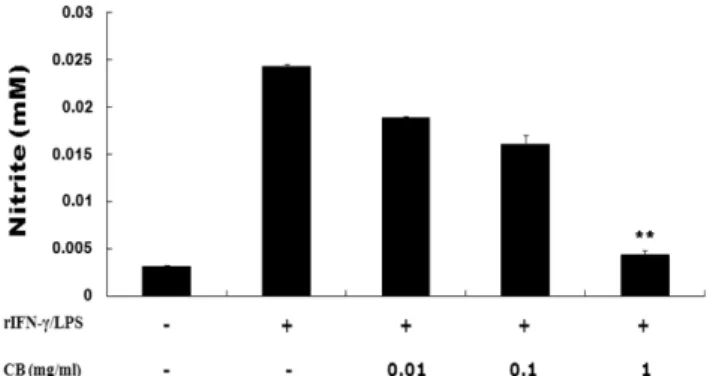
하는 것을 확인할 수 있었다 (Fig. 3). 다음으로 쥐의 복강

대식세포에서 구척의 NO 생성 억제 효과를 확인한 결과 ,

rIFN- γ와 LPS 처리한 군은 아무것도 처리하지 않은 군에

비해 NO 생성이 유의성 있게 증가하였으며 , 구척 투여군에

서는 rIFN- γ와 LPS 의해 생성된 NO 유의성 있게 감소

됨이 관찰되었다 (Fig. 1). 구척이 rIFN- γ와 LPS 유도된 NO 생성을 억제시킨 것이 구척의 세포독성에서 기인하

였는지 알아보기 위하여 , 대식세포에 구척을 농도별로 처리

한 다음 MTT assay 통하여 세포 생존도를 측정하였다 .

실험결과 구척 투여에 의해 유의성 있는 세포독성은 확인 되지 않았으며 (Fig. 2), 이러한 결과는 구척의 NO 억제

과가 대식세포의 수적 감소에 기인하는 것이 아니라 구척 자체에 NO 생성 억제능이 있음을 의미한다 .

NO NO synthase (NOS) 의해 생성되며 , NOS neuronal NOS (nNOS, NOS1), inducible NOS (iNOS, NOS2), endothelial NOS (eNOS, NOS3) 3 가지 종류가

존재한다 . 가운데 nNOS eNOS constituent NOS

(cNOS) 불리며 Ca

2+

의존적으로 짧은 시간 동안 소량의

NO 생성하여 세포의 정상적인 생리활동에 관여한다

33)

.

면에 iNOS Ca

2+

비의존적으로 대식세포 , 혈관 평활근세

포 , 심근세포 , 간세포 등의 세포에서 lipopolysaccharide (LPS), interferon- γ (IFN- γ ), IL-1, TNF- α 등의 자극에 의해

활성화되어 장시간 동안 대량의 NO 생성과 관련이 있다 .

Fig. 1. Dose-dependent inhibition effects of CB on NO production in rIFN- γ /LPS treated peritoneal macrophages.

Peritoneal macrophages (3×10

5

cells/well) were cultured with various concentration CB. The peritoneal macrophages were then stimulated with rIFN- γ (20 U/ml) and LPS (1 µ g/ml).

After 48h culture, NO release was measured by the Griess method (nitrite). NO released into the medium is presented as the mean±S.D. of three independent experiments duplicate in each run; ** P < 0.001 compared to rIFN- γ + LPS.

Fig. 2. Effect of CB on the viability in rIFN- γ /LPS treated peritoneal macrophages. Various concentrations of CB-treated peritoneal macrophages (3×10

5

cells/well) were primed for 6h with rIFN- γ (20 U/ml). The peritoneal macrophages were then stimulated with LPS (1 µ g/ml) for 24 h. Cell viability was evaluated by MTT colorimetric assay as described in the method. The results are expressed as means±S.D. of three independent experiments duplicate in each run.

Fig. 3. Effects of CB on the expression of iNOS and COX-2 by rIFN- γ /LPS treated peritoneal macrophages. Peritoneal macrophages (5×10

6

cells/well) were pretreated with CB (0.01, 0.1, 1 mg/ml) and then stimulated for 6 h with rIFN- γ (20 U/

ml). The peritoneal macrophages were then stimulated with

LPS (1 µ g/ml) for 24 h. The protein extracts were prepared

and samples were analyzed for iNOS and COX-2 expression

by western blotting as described in the method.

(5)

iNOS 의해 생성된 과량의 NO 패혈성 쇼크 (septic shock), 조직 손상 , 류마티스 관절염 (rheumatoid arthritis)

의 염증 관련 질병을 유발하는 원인물질이라고 알려져 있 다 .

34-36)

쥐의 복강 대식세포에서 구척의 NO 생성 억제가 iNOS

의 발현 감소에서 기인한 것인지 확인하기 위하여 Western

blotting 통하여 세포질내 iNOS 단백질 발현량을 조사

하였다 . 아무것도 처리하지 않은 blank 군에 비하여 rIFN- γ

와 LPS 처리한 control 군은 iNOS 발현량이 현저히

가하였으며 , rIFN- γ /LPS 구척을 동시처리한 군에서는 iNOS 발현량이 감소함을 확인할 있었다 . 특히 1 mg/

ml 농도에서는 iNOS 발현이 거의 관찰되지 않았다 (Fig.

3). 이러한 결과를 통해서 구척의 대식세포에서의 NO 생성

저해가 NO radical 대한 구척의 직접적인 소거능과 NO

생성에 관여하는 효소 활성을 억제하는 두가지 기전에 의 한 것임을 확인할 수 있었다 .

한편 , cyclooxygenase (COX) arachidonic acid 로부터 prostaglandins (PGs) 생합성 하는 효소로 constitutive cyclooxygenase (COX-1) inducible cyclooxygenase (COX-

2) 분류된다 .

37,38)

cNOS 경우와 마찬가지로 COX-1

내에서 혈소판의 형성 , 위벽보호 , 신장기능의 유지 체내

의 항상성 유지에 작용하며

39)

, COX-2 prooxidant proinflammatory stimuli (TPA, LPS, TNF- α , ROI )

해 MEKK-1, NFB 활성화를 경유하여 생성되고 , 염증

개물질인 PGE2 대량으로 생산하여 염증반응에 중추적인

역할을 하며 .

40,41)

혈관신생 (angiogenesis) 촉진하는

발생에도 깊은 관련이 있는 것으로 보고되고 있다 .

42)

또한

단구 (monocyte) 에서 COX-2 발현은 IL-1 β , TNF- α , LPS, fibroblast growth factor 등에 의해서 현저히 증가한다 . 따라

서 선택적인 COX-2 억제제의 개발은 염증 치료의 주요

적이 되고 있다 .

43)

실험에서 rIFN- γ와 LPS 처치시에는 blank 군에 비하여 COX-2 강하게 발현됨을 확인하였고 , rIFN- γ /LPS 구척을 병용투여 하였을 경우 COX-2 발현

량이 농도의존적으로 감소함을 확인할 수 있었다 (Fig. 3).

이러한 결과로 미루어보아 구척은 COX-2 의해 형성되는

주요 염증성 매개물질인 PGE2 생성 억제에도 영향을

것으로 추측된다 .

IL-6 T cell, B cell, 내피세포 , monocyte macrophage

를 포함하는 다양한 세포에서 분비되는 cytokine 이며 ,

44,45)

는 IL-1 β , TNF- α , IFN- 같은 cytokine 이나 LPS 같은

여러 가지 자극에 의해서 발현된다 .

46-49)

IL-6 B cell

체 생성을 촉진시키고 , T cell 분화를 유도하며 염증반응

을 심화시키는 것으로 알려져 있다 .

13-15)

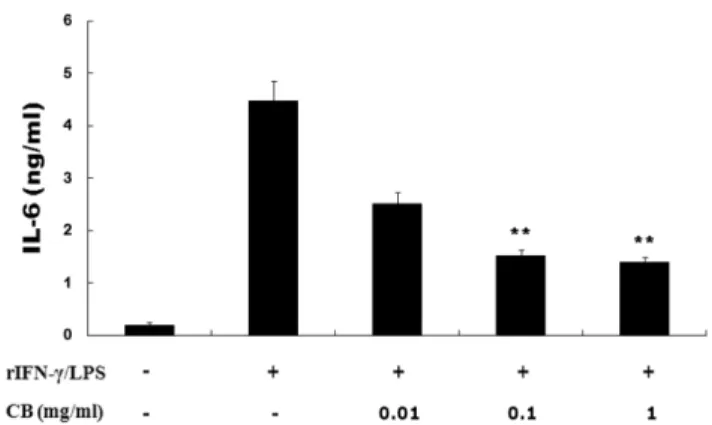
실험에서 구척

은 rIFN- γ /LPS 자극된 쥐의 복강 대식세포에서의 IL-6

분비를 효과적으로 감소시켰으며 , 구척은 이러한 염증성

cytokine 분비 억제를 통해 염증성 신호 전달을 차단하여

결과적으로 염증반응을 억제할 것으로 생각된다 .

이상의 연구결과를 종합해보면 구척은 DPPH radical, superoxide anion, NO radical 등에 대한 소거능을 보여주었

다 . 또한 항염증 효과를 알아보기 위해 사용된 쥐의 복강

식세포 모델에서 구척은 IFN- γ와 LPS 의해 생성된 NO

를 유의성 있게 억제하였으며 , 이는 iNOS 발현의 감소에서

기인함을 확인하였다 . 구척은 COX-2 발현 역시 농도의

존적으로 감소시켰으며 그로 인해 PGE

2

의 합성이 억제되었 을 것으로 추측된다 . 이러한 연구결과를 통해 구척이 뛰어

난 항산화 및 항염증 활성을 가지고 있는 것을 확인할 수 있었으며 , 구척이 류마티스 관절염이나 동맥경화 등의 만성

염증성 질환의 예방과 치료에 도움을 줄 수 있을것으로 사 료된다 .

결 론

구척 85% 메탄올 추출물의 항산화능을 측정하기 위해 in

vitro 상에서 DPPH radical, superoxide anion nitric

oxide 소거 활성을 알아본 결과 세가지 종류 라디칼 모두에

서 뚜렷한 소거활성이 관찰되었다 . 또한 구척의 항염증

성을 알아보기 위해 쥐의 복강 대식세포를 rIFN- γ /LPS

성화시킨 후 NO 생성량 iNOS COX-2 발현량 , IL- 6 분비량에 구척 추출물이 미치는 영향을 살펴보았다 .

척은 rIFN- γ /LPS 의해 생성된 NO 농도 의존적으로

소시켰으며 이는 구척의 세포독성에서 기인한 것이 아님을 확인하였다 . 또한 구척에 의해 iNOS COX-2 발현량

시 억제되는 것을 확인 하였고 , 염증성 cytokine IL-6

Fig. 4. Effects of CB on the secretion of IL-6 by rIFN- γ /LPS

treated peritoneal macrophages. Peritoneal macrophages (3×10

5

cells/well) were pretreated with CB (0.01, 0.1, 1 mg/ml) and

then stimulated for 6 h with rIFN- γ (20 U/ml). The peritoneal

macrophages were then stimulated with LPS (1 µ g/ml) for

24 h. The amount of IL-6 secretion in mouse peritoneal

macrophages was measured by ELISA method. Data represent

mean±S.D. ** represent statistically differences from rIFN- γ /

LPS treated group (** P < 0.01).

(6)

효과적으로 억제하였다 . 이러한 결과로 보아 , 구척의 메탄

올 추출물은 현저한 항산화 및 항염증 활성을 가진 것이 확 인되었으며 활성산소 등과 관련된 만성 염증성 질환의 예 방 또는 치료에 유용하게 사용될 수 있을 것으로 사료된다 .

사 사

이 논문은 2010 우석대학교 교내 연구비로부터 지원받

아 수행된 연구임 .

인용문헌

1. Zamora, R., Vodovotz, Y. and Billiar, T. R. (2000) Inducible nitric oxide synthase and inflammatory diseases. Mol. Med .

6 : 347-373.

2. Trowbridge, H. O. and Emling, R. C. Inflammation: a review of the process, 5th Ed. Quintessence Pub. Co., Chicago . 3. Salvemini, D., Korbut, R., Anggård, E. and Vane, J. (1990)

Immediate release of a nitric oxide-like factor from bovine aortic endothelial cells by Escherichia coli lipopolysaccha- ride. Proc. Natl. Acad. Sci. USA. 87 : 2593-2597.

4. Fu, J. Y., Masferrer, J. L., Seibert, K., Raz, A. and Needle- man, P. (1990) The induction and suppression of prostag- landin H2 synthase (cyclooxygenase) in human monocytes. J.

Biol. Chem . 265 : 16737-16740.

5. Lee, Y. S., Kim, H. S., Kim, H. S. and Kim, S. D. (2000) IL- 6 mRNA expression in mouse peritoneal macrophages and NIH3T3 fibroblast in response to candida albicans. J. Micro- biol. Biotechonol. 10 : 8-15.

6. Higuchi, M., Higashi, N., Taki, H. and Osawa, (1990) T.

Cytolytic mechanisms of activated macrophages. Tumor necrosis factor and L-arginine-dependent mechanisms act synergistically as the major cytolytic mechanisms of activated macrophages. J. Immunol. 144 : 1425-1431.

7. McDaniel, M. L., Kwon, G., Hill, J. R., Marshall, C. A. and Corbett, J. A. (1996) Cytokines and nitric oxide inislet inflammation and diabetes. Proc. Soc. Exp. Biol. Med . 211 : 24-32.

8. Corbett, J. A. and MacDaniel, M. L. (1995) Intraislet release of interleukin-1 inhibits beta cell function by inducing beta cell expression of inducible nitric oxide syntheses. J. Exp.

Med . 181 : 559-568.

9. Cetkovic-Cvrlje, M. and Eizirik, D. L. (1994) TNF and IFN γ

potentiate the deleterious effects of IL-1 β in moise pancreatic islets mainly via generation of nitric oxide. Cytokine 6 : 399- 10. Stuehr, D. J., Cho, H. J., Kwon, N. S., Weise, M. F. and 406.

Nathan, C. F. (1991) Purification and characterization of the cytokine-induced macrophage nitric oxide synthase: an FAD- and FMN-containing flavoprotein. Proc. Natl. Acad. Sci.

USA . 88 : 7773-7777.

11. McCartney-Francis, N., Allen, J. B., Mizel, D. E., Albina, J.

E., Xie, Q. W., Nathan, C. F. and Wahl, S. M. (1993) Sup- pression of arthritis by an inhibitor of nitric oxide synthase. J.

Exp. Med . 178 : 749-754.

12. Weisz, A., Cicatiello, L. and Esumi, H. (1996) Regulation of the mouse inducible-type nitric oxide synthase gene promoter by interferon-gamma, bacterial lipopolysaccharide and NG- monomethyl-L-arginine. Biochem. J . 316 : 209-215.

13. Muraguchi, A., Hirano, T., Tang, B., Matsuda, T., Horii, Y., Nakajima, K. and Kishimoto, T. (1988) The essential role of B cell stimulatory factor 2 (BSF-2/IL-6) for the terminal dif- ferentiation of B cells. J. Exp. Med . 167 : 332-344.

14. Garman, R. D., Jacobs, K. A., Clark, S. C. and Raulet, D. H.

(1987) B-cell-stimulatory factor 2 (beta 2 interferon) func- tions as a second signal for interleukin 2 production by mature murine T cells. Proc. Natl. Acad. Sci. USA . 84 : 7629- 7633.

15. Park, J. Y. and Pillinger, M. H. (2007) Interleukin-6 in the pathogenesis of rheumatoid arthritis. Bull. NYU. Hosp. Jt.

Dis . 65 : 4-10.

16. Delgado, A. V., McManus, A. T. and Chambers, J. P. (2003) Production of tumor necrosis factor-alpha, interleukin 1-beta, interleukin 2, and interleukin 6 by rat leukocyte subpopu- lations after exposure to substance P. Neuropeptides 37 : 355- 17. 전국한의과대학 361. 본초학교실 (2006) 본초학 , p822-823, 영

림사 , 서울 .

18. Namba, T. (1993) The encycloopedia of Wankan-Yaku with color pictures(I). p86, Hoikusha Pub. Co, Osaka.

19. Murakami, T., Satake, T., Ninomiya, K., Iida, H., Yamauchi, K., Tanaka, N., Saiki, Y. and Chen, C. M. (1980) Pterosin- derivate aus der famile pteridaceae. Phytochemistry 19 : 1743- 1746.

20. Yang, M. S. (1986) Studies on the taiwan fork medicine VI.

Studies on onitin. Planta Medica (1) : 25-27.

21. Kim, S. T., Han, Y. N., Son, Y. K., Jang, H. S., Kim, S. J. and Shin, J. S. (2002) Isolation of the efficacy constituent for neu- ronal regeneration from Cibotium barometz. Yakhak. Hoeji .

46 : 398-404.

22. Leem, K. H. and Kim, H. C. (2001) Effect of Cibotium barometz on the growth of longitudinal bone in adolescent male rats. Kor. J. Herbology 16 : 49-55.

23. Gyamfi, M. A., Yonamine, M. and Aniya, Y. (1999) Free-rad- ical scavenging action of medicinal herbs from Ghana:

Thonningia sanguinea on experimentally-induced liver inju- ries. Gen. Pharmacol . 32 : 661-667.

24. Ibrahim, H. R., Hoq, M. I. and Aoki, T. (2007) Ovotransferrin possesses SOD-like superoxide anion scavenging activity that is promoted by copper and manganese binding. Int. J. Biol.

Macromo . 41 : 631-640.

25. Karin, M. and Greten, F. R. (2005) NF-kappaB: linking

(7)

inflammation and immunity to cancer development and pro- gression. Nat. Rev. Immunol . 5 : 749-759.

26. Squadrito, G. L. and Pryor, W. A. (1998) Oxidative chemistry of nitric oxide: the roles of superoxide, peroxynitrite, and car- bon dioxide. Free Radic. Biol. Med . 25 : 392-403.

27. Phan, H. M., Alpert, J. S. and Fain, M. F. (2008) inflam- mation, and cardiovascular disease: evidence of a connection.

Am. J. Geriatr. Cardio . 17 : 101-107.

28. Thornfeldt, C. R. (2008) Chronic inflammation is etiology of extrinsic aging. J. Cosmet. Dermatol . 7 : 78-82.

29. Furchgott, R. F. and Zawadzki, J. V. (1980) The obligatory role of endothelial cells in the relaxation of arterial smooth muscle by acetylcholine. Nature 288 : 373-376.

30. Ross, R. and Reske-Kunz A. B. (2001) The role of nitric oxide in contact hypersensitivity. intimmunopharmacol . 1 : 1469-1478.

31. Nakagawa, T. and Yokozawa, T. (2002) Direct scavenging of nitric oxide and superoxide by green tea. Food. Chem. Tox- icol . 40 : 1745-1750.

32. Gantt, K. R., Goldman, T. L., McCormick, M. L., Miller, M.

A., Jeronimo, S. M., Nascimento, E. T., Britigan, B. E. and Wilson, M. E. (2001) Oxidative responses of human and murine macrophages during phagocytosis of Leishmania cha- gasi. J. Immunol . 167 : 893-901.

33. Nathan, C. and Xie, Q. W. (1994) Nitric oxide synthases:

roles, tolls, and controls. Cell 78 : 915-918.

34. Bogdan, C. (2001) Nitric oxide and the immune response.

Nat. Immunol . 2 : 907-916.

35. Laskin, D. L. and Pendino, K. J. (1995) Macrophages and inflammatory mediators in tissue injury. Annu. Rev. Phar- macol. Toxicol . 35 : 655-677.

36. Wu, G. and Morris, S. M. (1998) Arginine metabolism: nitric oxide and beyond. Biochem. J . 336 : 1-17.

37. Masferrer, J. L., Zweifel, B. S., Manning, P. T., Hauser, S. D., Leahy, K. M., Smith, W. G., Isakson, P. C. and Seibert, K.

(1994) Selective inhibition of inducible cyclooxygenase 2 in vivo is antiinflammatory and nonulcerogenic. Proc. Natl.

Acad. Sci. USA . 91 : 3228-3232.

38. Santos-Gomes, P. C., Seabra, R. M., Andrade, P. B. and Fernandes-Ferreira, M. (2003) Determination of phenolic antioxidant compounds produced by calli and cell suspen- sions of sage (Salvia officinalis L.). J. Plant Physiol . 160 : 1025-1032.

39. Seibert, K., Zhang, Y., Leahy, K., Hauser, S., Masferrer, J.,

Perkins, W., Lee, L. and Isakson, P. (1994) Pharmacological and biochemical demonstration of the role of cyclooxygenase 2 in inflammation and pain. Proc. Natl. Acad. Sci. USA . 91 : 12013-12017.

40. Surh, Y. J., Chun, K. S., Cha, H. H., Han, S. S., Keum, Y. S., Park, K. K. and Lee, S. S. (2001) Molecular mechanisms underlying chemopreventive activities of anti-inflammatory phytochemicals: down-regulation of COX-2 and iNOS through suppression of NF-kappa B activation. Mutat. Res .

480-481 : 243-268.

41. Lee, A. K., Sung, S. H., Kim, Y. C. and Kim, S. G. (2003) Inhibition of lipopolysaccharide-inducible nitric oxide syn- thase, TNF-alpha and COX-2 expression by sauchinone effects on I-kappaBalpha phosphorylation, C/EBP and AP-1 activation. Br. J. Pharmacol . 139 : 11-20.

42. Kim, Y. H. and Ko, W. S. (2004) Inhibitory effect of spirodela polyrhiza on the mast cell-mediated immediate hypersensi- tivity. J. Oriental Physiology & Pathology 18 : 919-923.

43. Reddy, B. S., Rao, C. V. and Seibert, K. (1996) Evaluation of cyclooxygenase-2 inhibitor for potential chemopreventive properties in colon carcinogenesis. Cancer Res . 56 : 4566- 4569.

44. Nishimoto, N. and Kishimoto, T. (2006) Interleukin 6: From bench to bedside. Nat. Clin. Pract. Rheumatol . 2 : 619-626.

45. Kishimoto, T. (1989) The biology of interleukin-6. Blood , 74 : 1-10.

46. Sehgal, P. B., Helfgott, D. C., Santhanam, U., Tatter, S. B., Clarick, R. H., Ghrayeb, J. and May, L. T. (1988) Regulation of the acute phase and immune responses in viral disease.

Enhanced expression of the beta 2-interferon/hepatocyte- stimulating factor/interleukin 6 gene in virus-infected human fibroblasts. J. Exp. Med . 167 : 1951-1956.

47. Shalaby, M. R., Waage, A. and Espevik, T. (1989) Cytokine regulation of interleukin 6 production by human endothelial cells. Cell Immunol . 121 : 372-382.

48. Frei, K., Malipiero, U. V., Leist, T. P., Zinkernagel, R. M., Schwab, M. E. and Fontana, A. (1989) On the cellular source and function of interleukin 6 produced in the central nervous system in viral diseases. Eur. J. Immunol . 19 : 689-694.

49. Sanceau, J., Beranger, F., Gaudelet, C. and Wietzerbin, J.

(1989) IFN-gamma is an essential cosignal for triggering IFN-beta 2/BSF-2/IL-6 gene expression in human monocytic cell lines. Ann. NY. Acad. Sci . 557 : 130-143.

(2010. 3. 12 접수; 2010. 4. 29 심사; 2010. 6. 7 게재확정)

수치

Table I.  Scavenging capacity of CB in different free radical scavenging tests
Fig. 1.  Dose-dependent inhibition effects of CB on NO production in rIFN- γ /LPS treated peritoneal macrophages.
Fig. 4.  Effects of CB on the secretion of IL-6 by rIFN- γ /LPS treated peritoneal macrophages

참조

관련 문서

Methods : To investigate the anti-oxidative effect and scavenging activities of DPPH radical, superoxide anions, nitric oxide and peroxynitrite were measured.. Cytotoxic

DPPH radical scavenging assay − The DPPH (2,2- diphenyl-1-picrylhydrazyl) radical scavenging activity of halophyte extracts was measured using the method described by Blois with

The free radical (1,1-diphenyl-2-picrylhydrazyl, DPPH) scavenging activities were determined with kaempferol (62.5 µM) and α-rhamnoisorobin (50.0 µM) but af- zelin and

In this study, we investigated the antioxidative activity (scavenging activity of 1,1-diphenyl-2-picrylhydrazyl (DPPH) free radical and superoxide anion radical) and

The aronia extract was tested for various antioxidative potentials (scavenging activity of 1,1-diphenyl-2- picrylhydrazyl (DPPH) radical and superoxide anion

Upon the biological activities screening, the ethanol extract exhibited potent free radical scavenging activities and inhibited the production of nitric oxide on

The aim of this study was to determine whether fractionated extracts of CS inhibit free radical generation such as DPPH radical, superoxide radical, nitric

Evaluation of the total phenolic and total flavonoid content, 2,2'-azino-bis(3-ethylbenzothiazoline-6-sulfonic acid) (ABTS) and 1,1- diphenyl-2-picrylhydrazyl (DPPH) radical