171
경북약용작물(홍화자, 향부자, 형개, 위유, 작약)의 항산화 및 Nitric Oxide 저해활성
황은영1,2·김동희1·김희정1·황주영1·박태순1·이인선2·손준호1*
1대구경북한방산업진흥원, 2계명대학교 식품가공학과
Antioxidant Activities and Nitric Oxide Production of Medicine Plants in Gyeongsangbukdo (Carthamus tinctorius seed, Cyperus rotundus,
Schizonepeta tenuifolia, Polygonatum odoratum var. pluriflorum, Paeonia lactiflora)
Eun-Young Hwang1,2, Dong-Hee Kim1, Hui-Jeong Kim1, Jo-Young Hwang1, Tae-Soon Park1, In-Sun Lee2,and Jun-Ho Son1*
1Daegu Gyeongbuk Institute for Oriental medicine Industry, 712-260, Republic of Korea
2Department of Food and Technology, Keimyung University, 1000 Sindang-Dong, Dalseo-Gu, Daegu 704-701, Republic of Korea
Reveived June 7, 2011; Accepted August 25, 2011
This study was carried out to search for natural anti-oxidants and anti-inflammatory compounds from 5 medicinal plants (Carthamus tinctorius seed, Cyperus rotundus, Schizonepeta tenuifolia, Polygonatum odoratum var. pluriflorum, and Paeonia lactiflora). These plants were extracted with 70% ethanol. In order to measure total antioxidant activity of flavonoids, polyphenol content was measured. Radical scavenging activities of extracts were examined using a-a-Diphenyl-β- picrylhydrazyl (DPPH·), 2,2-azino-bis 3-ethylbenzthiazoline-6-sulfonic acid (ABTS·), ferric reducing antioxidant power (FRAP) and superoxide anion radical assays. C. tinctorius seed extracts showed the highest polyphenol and flavonoid contents as well as strong DPPH·, ABTS·, FRAP, and superoxide anion radical scavenging activity. Also, C. tinctorius seed extracts showed the highest nitric oxide (NO) production inhibitory effect. Theses results indicate that the C. tinctorius seed extracts can be used as a functional material due to their effective anti-oxidative and anti- inflammatory activities.
Key words: anti-inflammatory, anti-oxidant, Carthamus tinctorius seed
서 론
최근 세계적으로 삶의 질적 향상과 함께 건강과 장수에 대 해 관심이 높아지고 있으며 이러한 추세에 따라 기존에 건강을 주로 담당하던 의약품을 비롯한 의료제품에 추가하여 건강 기 능성과 관련된 생활필수품, 식품, 화장품 등이 다양하게 개발되 거나 개발 중에 있다[Lee 등, 2003].
한약을 소재로 하여 천연물을 개발하려는 시도는 많은 생필 품에 적용되고 있는데 특히, 천연물의 항산화활성을 이용한 제
품개발은 우리 생활주변에서 쉽게 볼 수 있다.
일반적으로 활성산소와 free radical 생성을 방지하기 위해 butylated hydroxytoluene (BHT), butylated hydroxyanisole (BHA), propyl gallate (PG), tertiary-butylhydroquinone (TBHQ) 등 수많은 합성항산화 물질들이 개발, 이용되어 왔는데[Davies, 1995], 그 중 항산화 효과가 뛰어난 BHT와 BHA는 간 비대, 간장 중 microsomal enzyme 활성 증가, 체내흡수물질의 독성 화 혹은 발암 가능성[Chance 등, 1979] 등의 문제점이 초래되 어 그 사용이 크게 제한을 받고 있어, 안전성과 기호성이 문제 가 되지 않는 천연 항산화제 개발 연구가 중요하다. 우리나라 에서는 한방 약용식물을 일상생활에서 다양한 방법으로 이용하 는 민간요법이 있어 약용자원을 이용한 식품첨가제나 기능성 제품의 개발 및 상품화가 용이하다[Lee 등, 2009].
우리나라의 산야에는 이용 가능한 약용식물이 약 900여종이
*Corresponding author
Phone: +82-53-810-0320; Fax: +82-53-801-9896 E-mail: [email protected]
http://dx.doi.org/10.3839/jabc.2011.029
분포하는 것으로 알려져 있으며, 이중 약 50여 종이 농가에서 재배 생산되고 있다. 그 중 경북지역 약용식물인 홍화자, 향부 자, 형개, 위유, 작약의 5가지 한방자원이 있으며, 이들 약용식 물에서 연구의 관심이 되고 있는 기능성 성분으로는 건물기준 함량의 15-45%를 점유하는 것으로 알려진 식이섬유[Lee, 1997]
와 당과 결합한 배당체의 형태로 여러 약용식물에 존재하는 flavonoid를 비롯한 polyphenol[Singleton, 1981]류 들이 있으며, 항산화의 다양한 기능성을 발견할 수 있을 것으로 기대된다.
따라서 본 연구에서는 경북지역 약용식물을 대한 항산화제나 기능성 소재로 이용하기 위하여 약용식물 추출물에 함유된 플 라보노이드와 폴리페놀 화합물의 함량을 측정하였으며, 각 추 출물의 a-a-Diphenyl-β-picrylhydrazyl (DPPH), ferric reducing antioxidant power (FRAP), superoxide anion radical 저해 등 항산화 활성효과를 측정하였다. 또한 더 나아가 항염증 효과의 가능성을 지닌 소재를 발굴 하고자 nitric oxide radical (NO) 저해활성 측정하였다.
재료 및 방법
시료제조. 본 실험에서 사용한 경북 지역에서 재배된 약용작 물 5종 홍화자(Carthamus tinctorius seed, seed), 향부자 (Cyperus rotundus, rhizome), 형개(Schizonepeta tenuifolia, leaf), 위유(Polygonatum odoratum var. pluriflorum, rhizome), 작약(Paeonia lactiflora, leaf)로 홍화자는 경북영천, 향부자는 경 북고령, 형개는 경북청송, 위유와 작약은 경북의성에서 재배된 것을 사용하였다(Table 1). 이들 경북약용작물은 실온에서 70%
에탄올로 3회 반복 추출하였다. 추출액은 여과하여 rotary vacuum evaporator로 감압농축한 후 동결 건조하여 항산화 활 성 검정에 사용하였다.
시약 및 기기. 항산화능과 항염증 측정 실험에 사용된 시약 인 folin reagent, aluminum nitrate, postassium acetate, DPPH, 6-tri(2-pyridyl)-1,3,5-triazine (TPTZ), FeCl3· 6H2O, 2,2- azino-bis(3-ethylbenzthiazoline-6-sulfonic acid) (ABTS), potassium persulfate, xanthine oxidase, sodium nitrite 및 griess reagent, tannic acid 등은 Sigma Chemical Co. (St. Louis, MO)에서 구입하여 사용하였으며, 세포 생존율 측정에 사용된 macrophage 세포인 Raw 264.7을 Korean Cell Line Bank (KCLB)에서 구 입하여 사용하였다. 세포 생존율 측정 시약은 DMEM (Dulbecco’s Modified Eagle Medium), fetal bovine serum (FBS), penicillin/streptomycin, trypsin 250, 0.4% trypan blue stain은 Gibco BRL Co. (Grand Island, NY)에서, haemacytometer는 Superior (Marienfeld, Germany)에서 구입하
여 사용하였으며, 3-[4,5-dimethylthiazol-2-yl]-2,5-diphenyl- tetrazolium-bromide (MTT)는 Sigma Chemical Co.에서 구입하 여 사용하였다. 또한 기기는 rotary vacuum evaporator (EYELA NVC-2100, Tokyo, Japan), UV/Visible spectro- photometer (Kontron UVIKON 922, Milan, Italy)를 사용하 였다.
총 폴리페놀 함량. 총 폴리페놀 함량은 Folin-Denis법[Folin 과 Denis, 1912]을 응용하여 측정하였다. 즉, 각 추출물 1 mg을 증류수 1 mL에 녹이고 10배 희석한 희석액 2 mL에 2배 희석 한 Folin 시약 2 mL을 첨가하고 잘 혼합한 후 3분간 방치한 후 10% Na2CO3 2 mL을 넣고 1시간 반응 시킨 후 UV/
Visible spectrophotometer를 사용하여 700 nm에서 흡광도를 측 정하여 작성한 표준곡선으로부터 함량을 구하였다. 이 때 tannic acid를 이용한 표준곡선으로부터 총 폴리페놀 함량을 구하였다.
총 플라보노이드 함량. 총 플라보노이드 함량은 Nieva Moreno 등[Nivea 등, 2000]의 방법에 의해 측정하였다. 각 시 료 100 µL를 80% ethanol 900 µL에 희석한 후 100 µL를 취하 여 10% aluminum nitrate와 1 µM postassium acetate를 함유 하는 80% ethanol 4.3 mL에 혼합하여 실온에서 40분 방치한 뒤 415 nm에서 흡광도를 측정하였다. 이때 총 flavonoid 함량 은 quercetin을 이용하여 작성한 표준곡선으로부터 함량을 구하 였다.
DPPH radical 소거활성. 시료의 free radical 소거활성은 stable radical인 DPPH에 대한 환원력을 측정한 것으로 99% 메 탄올에 각 시료를 녹여 농도별로 희석한 희석액 800 µL와 메 탄올에 녹인 0.15 mM DPPH 용액 200 µL를 가하여 실온에 30분 방치한 후 517 nm에서 흡광도를 측정하였다. 각 시료 추 출물의 유리라디칼 소거활성은 시료를 첨가하지 않은 대조구의 흡광도를 1/2로 환원시키는데 필요한 시료의 농도인 RC50값으 로 나타내었다. 이때 활성비교를 위하여 BHA와 ascorbic acid 를 사용하였다.
FRAP 측정. FRAP assay는 Benzie와 Strain법[Benzie과 Strain, 1996]을 96well plate에 맞게 수정하여 실시하였다. 반응 액은 acetate buffer (pH 3.6와 300 mM): 10 mM의 TPTZ:20 mM의 FeCl3· 6H2O를 10 : 1 : 1의 비율로 실험 직전에 만들어 사용하였다. 반응액과 시료를 혼합하여 4분간 반응시킨 후 593 nm에서 흡광도를 측정하였다. 시료의 환원력은 0.1~1 mM trolox로 표준곡선을 작성하여 추출물 1 g 당 Fe2+ mM로 표시 하였다.
ABTS radical 소거활성. ABTS radical을 이용한 항산화력 측정은 ABTS+· cation decol orization assay방법[Re 등, 1999]
에 의해 시행하였다. 7 mM ABTS와 2.45 mM potassium perulfate를 최종농도로 혼합하여 실온인 암소에서 24시간 동안 방치하여 ABTS+· 형성 시킨 후 732 nm에서 흡광도 값이 0.70 (±0.02)이 되게 phosphate buffer saline (PBS, pH 7.4)로 희석 하였다. 희석된 용액 990 µL에 sample 10 µL를 가하여 정확히 1분 동안 방치한 후 흡광도를 측정하였다.
Xanthine oxidase (XOase)에 의해 생성된 superoxide radical 저해활성. XOase에 의해 생성된 superoxide radical 저 해활성은 NBT (nitro-blue tetrazolium)환원법[Parejo 등, 2002]
Table 1. List of medicine plants
Scientific name Part used Native habitat Carthamus tinctorius seed seed Gyeongbuk Yeongcheon Cyperus rotundus rhizome Gyeongbuk Goryeong Schizonepeta tenuifolia leaf Gyeongbuk Cheongsong Polygonatum odoratum var.
pluriflorum rhizome Gyeongbuk Uiseong Paeonia lactiflora leaf Gyeongbuk Uiseong
을 사용하여 검정하였다. 즉, 0.8 mM xanthine을 포함하는 0.1 mM phosphate buffer (pH 8.0) 0.5 mL와 0.48 mM NBT를 포함하는 0.1 mM phosphate buffer (pH 8.0)에 시료를 농도별 로 각각 처리하여 혼합한 후, 37oC에서 5분간 incubation하였 다. 반응물에 XOase (0.049 U/mL)를 1.0 mL을 가하여 37oC에 서 20분간 incubation시켰다. 그 후, 69 mM SDS를 2.0 mL을 첨가하여 반응을 정지 시킨 후 560 nm 흡광도에서 측정하였다.
Nitric oxide radical (NO) 저해활성. NO 측정은 세포의 상 층액에서의 NO의 량을 nitrite와 nitrate로서 측정을 하였다[Ding 등, 1988]. Nitrite에 대한 nitrate로 환원된 후의 안전한 형태인 griess reagent를 사용하였으며, 6 well plate에 2×10⁶개의 cell을 confluence가 80%일 때, PBS로 2번 washing한 후에 무혈청 배지를 사용하여 12시간 이상 배양시킨 후에 lipopolysaccharide (LPS) 1µg/mL을 대조군을 뺀 모든 well에 다 넣어서 자극시 켰다. 2시간 후에 시료를 농도별로 처리하여 실험하였다. NO 생성량은 24시간 후에 상층액를 모아 griess 시약으로 10분간 반응시킨 후 540 nm에서 흡광도로 측정하였다. LPS만 첨가한 군에서 생성된 NO의 양을 100%로 하여 시료가 첨가된 경우 에 측정된 흡광도를 환산하여 표기하였다.
결과 및 고찰
총 폴리페놀 및 플라보노이드 함량 측정. 폴리페놀계 물질들 은 식물체에 특수한 색깔을 부여하고 산화-환원반응에서 기질 로 작용하고, 한 분자 내에 2개 이상의 phenolic hydroxyl (OH)기를 가진 방향족 화합물들을 가리키며 플라보노이드와 탄 닌이 주성분으로 충치예방, 고혈압 억제, 항에이즈, 항산화, 항 암 등의 다양한 생리활성을 가진다[Yoshizawa 등, 1987]. 본 실 험에서는 경북약용작물들의 에탄올 추출물에 존재하는 총 폴리 페놀의 함량은 tannic acid를 기준물질로, 총 플라보노이드 함 량은 quercetin을 기준물질로 하여 측정하였다(Table 2). 그 결 과, 5가지 경북약용작물의 총 폴리페놀 함량은 홍화자 43.92±
4.81µg/mg, 형개 45.97±2.29 µg/mg, 작약 47.51±1.38 µg/mg 으로 홍화자, 형개, 작약 추출물에서 높은 폴리페놀 함량을 보 였다. 총 플라보노이드 함량을 홍화자 16.49±2.55 µg/mg, 형개 17.33±2.02µg/mg으로 홍화자, 형개 추출물에서 높은 플라보노 이드 함량을 나타냈다. 5가지 경북약용작물 중 홍화자, 형개 추 출물에서 높은 폴리페놀과 플라보노이드를 함유하는 것으로 나 타났다. 국내산 다른 지역의 홍화자 폴리페놀 함량을 보면
12.34 %로[Kim 등, 2000] 경북지역 홍화자 추출물과 비교했을 때 35.70%로 뛰어난 폴리페놀 함량을 보이는 것을 알 수 있었 다. 또한 선인장 씨에서 1.47%[Lee 등, 1997], 부추씨 열침에 따른 폴리페놀 화합물은 20, 40 및 60oC에서 각각 3.64, 4.62, 5.51%[Cha 등, 2000]로 다른 씨 추출물과 비교하였을 때 홍화 자 추출물이 많은 양의 폴리페놀을 함유하는 것을 확인하였다.
그리고 울릉도산 산채류 추출물의 항산화 활성 보고[Lee 등, 2005]에서 6가지 잎 추출물과 비교했을 때 섬고사리 16.75±0.43 µg/mg, 눈개승마 16.47±0.18 µg/mg, 쇠무릅 4.57±0.27 µg/mg, 엉겅퀴 13.30±0.07 µg/mg, 서덜취 0.36±0.04 µg/mg, 미역취 5.75±0.02µg/mg로 형개 추출물의 높은 플라보노이드 함량을 가지는 것으로 확인했다. 한방 아로마 식물인 체리세이지, 캐모 마일, 물싸리의 폴리페놀 함량은 각각 22.6, 7.5, 37.9 µg/mg이 며, 플라보노이드 함량은 각각 3.5, 7.1, 6.1 µg/mg으로 보고되 었다[Miliauskas 등, 2004]. 이들 결과들과 비교해 볼 때 경북 약용작물 특히 홍화자, 형개 등은 상당히 높은 폴리페놀과 플 라보노이드를 함유하고 있는 것으로 나타났다.
FRAP 측정. FRAP 방법은 DPPH radical 소거 활성의 측정 법과는 메카니즘이 다른 항산화 활성검정법이다. DPPH 방법은 free radical을 직접적으로 소거하는 것에 의하여 항산화 활성을 평가하는 방법이며[Benzie과 Strain, 1996], FRAP 방법은 colored ferrous tropyridyl triazine complex에 의해 ferric ion이 ferrous로 전환되어지는 과정을 분석함으로서 시료 내의 총 항 산화력을 측정하는 방법으로 낮은 pH에서 환원제에 의해 3가 철이 2가 철로 환원되는 원리를 기초로 고안되어진 방법이다 [Kim 등, 2009]. 경북약용작물들의 에탄올 추출물에 존재하는 FRAP값은 trolox기준물질로 하여 측정하였다(Table 2). 5가지 약용작물 중 FRAP값은 홍화자 1914.95±2.11 µM Fe2/mg로 가 장 높은 FRAP활성을 나타냈으며, 총 폴리페놀과 플라보노이드 함량과 비교했을 때 5가지 약용식물 중 홍화자 추출물에서 모 두 높은 함량으로 동일한 결과를 확인할 수 있었다. 또한 포도 씨의 항산화 활성[Hwang 등, 2008]에서 보고된 포도씨와 머루 씨 추출물의 FRAP값은 자옥 308±16.64 µM Fe2/mg, 흑구슬 209±31.61µM Fe2/mg, 탐나라 176±3.68 µM Fe2/mg, 캠벨 150±11.92µM Fe2/mg, 산머루 121±9.22 µM Fe2/mg로 홍화자 추출물의 우수한 FRAP활성을 확인하였다.
DPPH free radical 소거활성. DPPH radical 소거 활성법은 항산화 활성 물질이 DPPH의 radical을 소거시켜 탈색되는 점 을 이용하여 항산화 활성을 쉽게 측정 하는 방법이다. 전자공 Table 2. Total polyphenol and flavonoid contents and FRAP (ferric reducing/antioxidant powers) activity of ethanol extracts from medicine plants
Samples Total 1) polyphenols (µg/mg) Total 2) flavonoids (µg/mg) FRAP value 3) (µmol Fe2/mg)
Carthamus tinctorius seed 43.52±4.81 16.49±2.55 1914.95±2.11
Cyperus rotundus 17.89±1.32 05.46±2.76 0443.19±5.06
Schizonepeta tenuifolia 45.97±2.29 17.33±2.02 1415.28±1.60
Polygonatum odoratum var. pluriflorum 06.22±2.26 04.86±2.96 0044.01±9.09
Paeonia lactiflora 47.51±1.38 05.90±3.06 1721.71±1.44
1)Micrograms of total polyphenol content/µg of plants based on tannic acid as standard.
2)Micrograms of total flavonoid content/µg of plants based on quercetin as standard.
3)Micrommole of total Fe2/mg of plants based on trolox as standard.
4)Each value is mean ± SD (n=3).
여 작용은 활성 라디칼에 전자를 공여하여 지방질 산화를 억제 시키는 척도로 사용되고 있을 뿐만 아니라 인체 내에서 활성 라디칼에 의한 노화를 억제하는 작용의 척도로도 이용되고 있 다[Choi와 Oh, 1985]. 각 경북약용 식물 에탄올 추출물과 합성 항산화제인 ascorbic acid의 항산화 활성을 DPPH·의 소거활성 을 측정하여 비교하였다(Table 3). 5가지 약용식물의 RC50
(concentration required for 50% reduction) 값은 작약 28.42±
1.24µg/mL으로 가장 높은 소거활성을 나타냈다. 또한, 항산화 성분 함량과 free radical 소거활성과의 관계를 살펴보면 폴리페 놀과 플라보노이드 함량에 따라 활성이 증가하는 것을 볼 수 있는데[Yu 등, 2006; Kim 등, 2010] 5가지 경북약용작물 중 폴리페놀과 플라보노이드 함량이 높은 작약 추출물 역시 DPPH·
소거능이 높아 항산화 활성이 뛰어난 것으로 생각된다. 그러나 국내산 약용식물에서 작약의 DPPH· RC50값은 18.8 µg/mL로 본 연구에 사용된 작약 추출물이 낮은 소거활성효과를 가지는 것 으로 확인되었다. 앞선 FRAP측정에서 홍화자, 작약 추출물 모 두에서 높은 FRAP활성을 나타낸 것에 반에 DPPH· 소거측정
에서는 작약이 가장 높게 나타난 것은 실험 방법에 의한 차이 라고 사료된다. 그리고 국내산 약용식물의 항산화물질 연구[Song 등, 2000] 에서 EtOAc로 추출한 분획물에서 홍화자의 DPPH·
RC50값은 200 µg/mL 이하로 나타난 것과 비교했을 때 경북약 용작물인 홍화자 추출물은 45.57±0.32 µg/mL로 높은 소거활성 을 나타내었다. 또한 울릉도산 산채류 추출물[Lee 등, 2005] 중 씨에서 추출된 DPPH· RC50값 물엉겅퀴씨 80.62 µg/mL, 미역취 씨 57.14 µg/mL로 홍화자 추출물이 높은 활성을 나타냈다. 따 라서 경북지역에서 재배된 홍화자가 높은 DPPH· 소거활성을 가지므로 항산화 활성이 뛰어난 것으로 나타났다.
ABTS free radical 소거활성. 혈장에서 ABTS의 양이온 라 디칼의 흡광도가 항산화제에 의해 억제되는 것에 기초하여 개 발된 ABTS 라디칼 소거활성법은 표준물질인 trolox의 값과 비 교하여 나타낼 수 있으며, in vivo에서 의 항산화응 측정뿐만 아니라 in vitro에서도 항산화능을 측정하기 위한 방법으로 널 리 이용되고 있다[Miller 등, 1993; Rice-Evans과 Miller, 1994;
Rice-Evans 등, 1996].
Table 3. Scavenging effects of ethanol extracts from medicine plants on DPPH·
Samples Concentration (µg/mL) Scavenging effect (%) RC50 (µg/mL) 1)
Carthamus tinctorius seed 100 86.23±1.26
45.57±0.32
1000 94.62±0.91
Cyperus rotundus 100 43.22±2.01
148.15±13.77
1000 94.51±1.42
Schizonepeta tenuifolia 100 78.87±1.39
57.68±1.25
1000 93.21±0.66
Polygonatum odoratum var. pluriflorum 100 08.70±1.45
2422.82±4.6500
1000 26.62±1.06
Paeonia lactiflora 100 94.32±1.37
28.42±1.24
1000 96.33±3.02
Ascorbic acid 1 16.42±1.26
8.14±0.97
10 96.46±1.04
1)Concentration required for 50% reduction of DPPH· at 30 min reaction.
2)Each value is mean ± SD (n≥3).
Table 4. Scavenging effects of trolox and ethanol extracts from medicine plants on ABTS·
Samples Concentration (µg/mL) Scavenging effect (%) RC50 (µg/mL) 1)
Carthamus tinctorius seed 100 11.27±0.29
626.63±1.57
1000 77.32±3.21
Cyperus rotundus 100 05.83±1.06
2211.33±1.620
1000 25.00±1.72
Schizonepeta tenuifolia 100 09.72±0.49
1609.71±2.030
1000 31.67±1.48
Polygonatum odoratum var. pluriflorum 100 01.20±0.09
16436.30±0.3100
1000 04.26±0.42
Paeonia lactiflora 100 25.07±1.29
631.22 ±1.170
1000 63.00±1.08
Ascorbic acid 1 23.94±1.77
02.06±0.57
10 42.39±4.58
1)Concentration required for 50% reduction of ABTS+· at 1 min reaction.
2)Each value is mean ± SD (n≥3).
ABTS와 potassium persulfate를 암소에 방치하면 ABTS+·이 생성되는데 추출물의 항산화력에 의해 ABTS+·이 소거되어 radical 특유의 색인 청록색이 탈색된다. 이와 같이 ABTS+· 탈 색 반응은 이미 생성된 free radical의 제거 정도를 흡광도 값 으로 나타내어 ABTS+· 소거활성능을 측정하는 방법으로 소수 성과 친수성 모두에 적용가능하다[Lee 등, 2005]. 본 실험에서 는 경북 약용식물들과 trolox의 ABTS+· 소거활성을 비교 측정 하여 나타내었다(Table 4.). 5가지 약용식물의 RC50값은 홍화자 626.63±1.57 µg/mL, 작약 631.22±1.17 µg/mL으로 홍화자, 작약 추출물에서 높은 소거활성을 나타냈다. 이는 DPPH· 소거활성 과 유사한 경향이다. 국내 시판되는 다류의 항산화를 검색한 결
과 DPPH· 소거활성과 ABTS+· 소거활성간의 높은 상관관계가 존재하다고 보고하였다[Choi 등, 2003]. 이에 따라 5가지 경북 약용식물 중 홍화자, 작약 추출물이 DPPH·와 ABTS+· 소거활 성이 높게 나타나 그 경향은 매우 유사함을 알 수 있었다. 또 한 아보카도 추출물의 항산화 활성[Lee 등, 2008]에서 보고된 아보카도 씨 추출물의 ABTS+· RC50값은 3543 µg/mL로 홍화자 추출물 5배 높은 소거활성을 나타냈다.
XOase에 의해 생성된 superoxide radical 저해활성 측정.
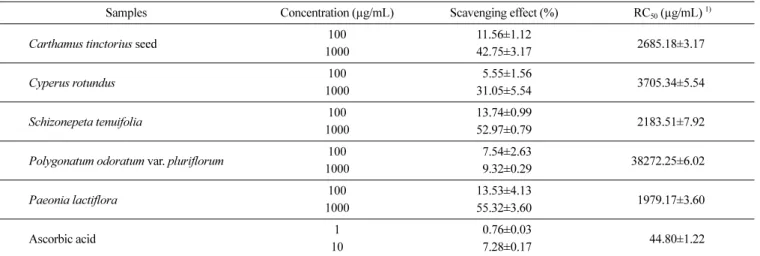
Xanthine/XOase의 효소에 의한 superoxide 음이온 저해작용은 superoxide 음이온 소거작용과 XOase 효소저해에 의해 나타난 다. XOase는 체내에서 urea를 생성하여 염증 및 통증을 동반 Table 5. Inhibition rate of ethanol extracts from medicine plants on superoxide anion radical
Samples Concentration (µg/mL) Scavenging effect (%) RC50 (µg/mL) 1)
Carthamus tinctorius seed 100 11.56±1.12
2685.18±3.17
1000 42.75±3.17
Cyperus rotundus 100 05.55±1.56
3705.34±5.54
1000 31.05±5.54
Schizonepeta tenuifolia 100 13.74±0.99
2183.51±7.92
1000 52.97±0.79
Polygonatum odoratum var. pluriflorum 100 07.54±2.63
38272.25±6.020
1000 09.32±0.29
Paeonia lactiflora 100 13.53±4.13
1979.17±3.60
1000 55.32±3.60
Ascorbic acid 1 00.76±0.03
0044.80±1.22
10 07.28±0.17
1)Concentration required for 50% inhibition of superoxide anion radical at 20 min reaction.
2)Each value is mean ± SD (n≥3).
Fig. 1. Effects of ethanol extracts from medicine plants on the production of nitric oxide in Raw 264.7 cell. 1)Each value is mean ± SD (n≥3).
한 통풍과 신장질환을 일으키는 것으로 알려져 있다[Storch와 Ferbe, 1988; Hatano 등, 1991]. 또한 XOase는 분자상의 산소 를 수소 수용체로 이용하여 xanthine을 요산형으로 산화하는 반 응을 촉매한다. 따라서 XOase의 저해 효과는 free radical의 생 성을 억제하므로 항산화, 노화 및 항암 등과 연관되므로 생물 학적으로 중요한 의의를 가진다[Lee, 2007]. 경북약용작물들과 ascorbic acid의 superoxide anion radical 저해 활성을 IC50값으 로 나타내었다(Table 5). 5가지 경북약용작물의 IC50값은 작약 1979.17±3.60 µg/mL으로 작약 추출물에서 가장 높은 소거활성 을 나타냈다. 식물계에 널리 존재하는 flavonoid에 의해 XOase 가 저해 된다는 많은 보고[Lee 등, 2006], 다양한 탄닌류 및 관 련 페놀성 물질들이 보고되고 있는 바[Yeo 등, 1995] 5가지 경 북약용작물 중 형개, 홍화자 추출물에서 높은 폴리페놀과 플라 보노이드를 함유하는 결과와 일치하지 않지만 작약 추출물에 다양한 탄닌류를 함유한 성분이 많은 것으로 사료된다. 또한 XOase IC50값으로 홍화자 2685.18±3.17 µg/mL, 형개 2183.51
±7.92 µg/mL로 우수하지 않지만 저해활성을 확인하였다.
Nitric oxide (NO) radical 저해활성 측정. 체내 염증과정에 서는 과량의 NO 및 prostaglandin E2 (PGE2) 등의 염증인자 가 유도형 NO synthase (iNOS) 및 cycloxygenase (COX)-2에 의해 형성된다. 이 중 NO는 체내 방어기능, 신호전달기능, 신 경독성, 혈관 확장 등의 다양한 생리기능을 가지고 있다. NO 자체는 반감기자 6~10초 정도로 매우 짧으며, 이러한 NO를 형 성하는 NO syntase (NOS)는 물리 화학적 성상에 따라 type I, II 및 III 등 3종류의 동종 효소로 나누어 진다. Type I (neuronal NOS, nNOS)과 type III (endothelial, eNOS)는 세포 속에 계속적으로 존재하기 때문에 구성 NOS (constitutive NOS)로 분류하였으며, 상대적으로 일부 세포에서 LPS, cytokides 및 박테리아 독소 같은 특수한 자극제들에 노출되는 경우에만 발현되는 type III인 iNOS로 나누어 진다[Lee 등, 2004]. 이러한 NOS들은 L-argine을 L-citrulline으로 전환시키면 서 NO를 형성하였다. 이들 NOS는 iNOS에 의한 발현성이 절 대적으로 많으며, 이는 병리적으로 중요한 작용을 하였다. 일반 적으로 NO의 형성은 박테리아를 죽이거나 종양을 제거시키는 중요한 역할을 하지만 병리학적인 원인에 의한 과도한 NO의 형성은 염증을 유발시키게 되며, 조직의 손상, 유전자 변이 및 신경 손상 등을 유발한다. 최근 염증 유발에 중요한 역할을 하 는 것으로 알려진 NO 생성에 대한 5가지 경북 약용 작물을 100µg/mL농도로 세포에 처리하여 생성되는 NO량을 측정한 결 과 홍화자, 향부자, 형개, 위유, 작약 추출물 중 홍화자 추출물 이 6.13±0.72 µM로 가장 낮은 NO 생성능을 나타냈다(Fig. 1).
붉은 피망씨의 항산화 효과와 항돌연변이 효과[Sim 등, 2007]
에서 1000 µg/mL 농도 처리시 22%의 NO 생성량을 나타낸 것 에 비해 홍화자 추출물은 100 µg/mL에서 20%로 우수한 효과 를 나타냈다. 이는 홍화자 추출물을 이용한 항염증 효과[Jun 등, 2011]의 연구가 뒷받침 되고 있다. 그러나 홍화자 원산지가 중국지역이므로 추후 더 나아가 높은 항산화활성을 가진 경북 약용작물인 홍화자를 이용하여 심도 깊은 항염증 효과 연구가 더 실행되어야 한다고 사료된다.
초 록
본 연구는 5가지 경북약용작물(홍화자, 향부자, 형개, 위유, 작약)의 항산화와 항염증 효과에 대해서 검증하였다. 추출은 70% 에탄올에서 추출하였다. 항산화 활성을 측정하기 위해 총 플라보노이드, 폴리페놀 함량을 측정하였고, 추출물의 소거활성 은 a-a-Diphenyl-β-picrylhydrazyl (DPPH·), 2,2-azino-bis 3- ethylbenzthiazoline-6-sulfonic acid (ABTS·), ferric reducing antioxidant power (FRAP), superoxide anion 저해활성으로 측 정하였다. 홍화자 추출물에서 높은 총 폴리페놀과 플라보노이 드 함량과 뛰어난 DPPH·, ABTS·, FRAP, superoxide anion 소거활성을 나타내었다. 또한, 홍화자 추출물에서 가장 높은 NO 생성 저해 활성을 나타냈다. 그 결과 홍화자 추출물은 항산화 와 항염증 활성에 효과를 가진 기능성 소재로 사용될 수 있을 것이다.
Key words: anti-inflammatory, anti-oxidant, Carthamus tinctorius seed
참고문헌
Benzie IFF and Strain JJ (1996) The ferric reducing ability of plasma (FRAP) asa measure of “antioxidant power” The FRAP assay.
Anal Biochem 239, 70-76.
Cha JY, Kim SK, Kim HJ, Somg JY, and Cho YS (2000) Chemical Compositions and Antioxidative Activity of Leek (Allium tuberusum) Seeds. Korean J Life Sci 10, 273-278.
Chance B, Sies H, and Boveris A (1979) Hydroperoxide metabolism in mammalian organs. Physiol Rev 59, 527-605.
Choi JH and Oh SK (1985) Studies on the anti-aging of Korean Ginseng. Korean J Food Sci Technol 17, 506-515.
Choi YM, Kim MH, Shin JJ, Park JM, and Lee JS (2003) The antioxidant activities of the some commercial teas. J Korean Soc Food Sci Nutr 32, 723-727.
Davies KJA (1995) Oxidative stress: The paradox of aerobic life. In Free Radicals and Oxidative Stress: Environment, Drugs and Food Additives, Rice-Evans C, Halliwell B, Lunt G (eds.).
Biochemical Society Symposium no. 61, pp. 1-31. Portland Press, London, UK.
Ding AH, Nathan CF, and Stuehr DJ (1988) Release of reactive nitrogen intermediates and reactive oxygen intermediates from mouse peritoneal macrophages. Comparisonof activating cytokines and evidence for independent production. J Immunol 141, 2407-2412.
Folin O and Denis W (1912) On phosphotungastic-phosopho- mdybdic compounds as color reagents. J Biol Chem 12, 239-249.
Hatano T, Yasuhara T, Yoshihara R, and Okuda T (1991) Inhibitory effects of galloylated flavonoids on xanthine oxidase. Planta Medica 57, 83-86.
Hwang IW, Lee HR, Kim SK, Zheng HZ, Choi JU, Lee SH, Lee SH, and Chung SK (2008) Proanthocyanidin Content and Antioxidant Characteristics of Grape Seeds. Korean J Food Preserv 15, 859- 863.
Jun MS, Ha YM, Kim, HS, Jang HJ, Kim YM, and Lee YS (2011) Anti-inflammatory action of methanol extract of Carthamus tinstorius involves in heme oxygenase-1 induction. J Ethnophamacol 133, 524-530.
Kim HJ, Hwang EY, IM NK, Park SK, and Lee IS (2010) Antioxidant activities of Rumex crispus extracts and effects on quality characteristics of seasoned pork. Korean J Food Sci Technol 42, 445-451.
Kim HJ, Jun BS, Kim SK, Cha JY, and Cho YS (2000) Polyphenolic compound content and antioxidative activities by extracts from seed, sprout and floser of safflower (Carthamus tinctorius L.). J Korean Soc Food Sci Nutr 29, 1127-1132.
Kim JH, Sung NY, Kwon SK, Srinivasan P, Song BS, Choi JI, Yoon Y, Kim JK, Byun MW, Kim MR, and Lee JW (2009) Gamma- irradiation improves the color and antioxidant properties of Chaga mushroom (Inonotus obliquus) extract. J Med Food 12, 1343- 1347.
Lee ES, Ju HK, Moon TC, Lee E, Jang Y, Lee SH, Son JK, Baek SH, and Chang HW (2004) Inhibition of nitric oxide and tumor necrosis factor-a (TNF-a) production by propenone compound through blockade of nuclear factor (NF)-B activation in cultured murine macrophage. Biol Pharm BµLl 27, 617-620.
Lee KH, Kwon HJ, Chun SS, Kim JH, Cho YJ, and Cha WS (2006) Biological Activities of Extracts from Phellinus linteus. J Korean Soc Appl Biol Chem 49, 298-303.
Lee KS (1997) Content analysis, intake estimation and physiological function of dietary fibers in Korean food. MS thesis, Ewha Womans University, Seoul, Korea.
Lee SE, Seong NS, and Bang JK (2003) Antioxidative activities of korean medicineal plants. Korean J Medicinemal Crop Sci 11, 127-134.
Lee SG, YU MH, Lee SP, and Lee IS (2008) Antiosidant Activities and Induction of Apoptosis by Methanol Extracts from Avocado. J Korean Soc Food Sci Nutr 37, 269-275.
Lee SO, Lee HJ, Yu MH, Im HG, and Lee IS (2005) Total polyphenol contents and antioxidant activities of methanol extracts from vegetables produced in Ullung Island. Korean J Food Sci Technol 37, 233-240.
Lee YS (2007) Antioxidative and physiological activity of extracts of Angelica dahurica leaves. Korean J Food Preserv 14, 78-86.
Lee YS, Choi BD, and Joo EY (2009) Antioxidative activities and tyrosinase inhibition ability in various extracts of the Vitex rotundifolia seeds. Korean J Food Preserv 16, 101-108.
Miliauskas G, Venskutonis PR, and Been TAV (2004) Screening of radical scavenging activity of some medicinal and aromatic plant extracts. Food Chem 85, 231-237.
Miller NJ, Rice-Eans C, Davies MJ, Gopinathan V, and Milner A (1993) A novel method for measuring antioxidant capacty and its application to monitoring the antioxidant suatus in premature neonates. Clin Sci 84, 407-412.
Nivea MMI, Sampietro AR, and Vattuone MA (2000) Comparison of the free radical-scavenging activity of propolis from several regions of Argentina. J Ethnopharmacol 71, 109-114.
Parejo I, Viladomat F, Bastida J, Rosas-Romero A, Flerlage N, Burillo J, and Conida C (2002) Comparision between the radical scavenging activity and antioxidant activity of six distilled and nondistilled Mediterranean herbs and aromatic plants. J Agric Food Chem 50, 6882-6890.
Re R, Pellegrini N, Proteggente A, Pannala A, Yang M, and Rice- evans C (1999) Antioxidant activity applying an improved ABTS radical cation decolorization assay. Free Radical Biol Med 26, 1231-1237.
Rice-Evans CA and Miller NJ (1994) Total antioxidant status in plasma and body fluids. In Methods Enzymol 234, pp. 279-293, Academic Press, California.
Rice-Evans CA, Miller NJ, and Paganga G (1996) Structure- antioxidant activity relationships of flavonoids and phenolic acids.
Free Rad Biol Med 20, 933-956.
Sim KH and Han YS (2007) The Antimutagenic and Antioxidant Effects of Red Pepper Seed and Red Pepper Pericarp (Capsicum annuum L.). J Food Sci Nutr 12, 273-278.
Singleton VL (1981) Naturally ocurring food toxicants: Phenolic substances of plant origin common in foods. Adv Fd Res 27, 149- 242.
Song JC, Park NK, Hur HS, Bang MH, and Baek NI (2000) Examination and Isolation of Natural Antioxidants from Korean Medicinal Plants. Korean J Medicinal Crop Sci 8, 94-101.
Storch I and Ferber E (1988) Detergent amplified chemiluminescence of lucigenin for determination of superoxide amini production by NADPH oxidase and xanthine oxidase. Anal Biochem 169, 262- 267.
Yeo SG, Park YB, Kim IS, Kim SB, and Park YH (1995) Inhibition of xanthine oxidase by tea extracts from green tea, oolong tea and black tea. J Korean Soc Food Nutr 24, 154-159.
Yoshizawa S, Horiuchi T, Yoshida T, and Okuda T (1987) AntitµMor promoting activity of (-)-epigallocatechin gallate, the main constitutent of tannin in green tea. Phytother Res 1, 44-47.
Yu MH, Im HG, Lee HJ, Ji YJ, and Lee IS (2006) Components and their antioxidative activities of methanol extracts from sarcocarp and seed of Zizyphus jujuba var. inermis rehder. Korean J Food Sci Technol 38, 128-134.